The development of children's emotional and social competence during the transition to kindergarten provides a foundation for children's later functioning across peer and school contexts (Keane & Calkins, Reference Keane and Calkins2004; Rubin, Coplan, Fox, & Calkins, Reference Rubin, Coplan, Fox and Calkins1995), and can potentially constrain the development of a range of emotional, cognitive, and social skills as children grow (Calkins & Fox, Reference Calkins and Fox2002; Nigg & Huang-Pollock, Reference Nigg, Huang-Pollock, Lahey, Moffit and Caspi2003). Multiple factors, including parenting behaviors and child characteristics, are notable predictors of children's emotional and social competence (Denham, McKinley, Couchoud, & Holt, Reference Denham, McKinley, Couchoud and Holt1990; McCollum & Ostrosky, Reference McCollum, Ostrosky, Brown, Odom and McConnell2008). However, these factors do not always account for the individual differences observed in children's emotional and social competence during the transition to kindergarten. Recent research suggests that the effect of parenting behaviors such as maternal control and responsiveness on children's outcomes is complex, and differs depending on characteristics of the child and broader aspects of the caregiving environment (Belsky, Hsieh, & Crnic, Reference Belsky, Hsieh and Crnic1998). This is consistent with a developmental psychopathology perspective, which posits that multiple factors interact to either enhance or impede children's developmental outcomes, and that understanding these complex interactions is critical for understanding individual differences (Cicchetti, Reference Cicchetti1993). The current study explores how maternal parenting behavior and toddler risk, characterized by externalizing behavior problems and poor emotion regulation strategies, interact to predict children's social and emotional competence during the transition to kindergarten.
Emotional and Social Competence During the Transition to Kindergarten
Children's emotional competence encompasses a range of abilities that are vital for their development of self-efficacy during their social interactions and when building relationships (Saarni, Reference Saarni1999). During childhood, some indicators of emotional competence include children's emotional expressiveness, their emotion knowledge and their ability to identify others' emotions based on situational and affective cues, the ability to manage and control emotions, the emerging capacity to empathize with others' emotional experiences, and learning the cultural and social expectations for expressing emotions across different situations and relationships (Denham et al., Reference Denham, Blair, DeMulder, Levitas, Sawyer, Auerbach-Major and Queenan2003; Miller et al., Reference Miller, Fine, Gouley, Seifer, Dickstein and Shields2006; Saarni, Reference Saarni1999).
We focus on two indictors of emotional competence, children's negative emotional expressiveness and their ability to regulate their emotions, that have been linked to a number of outcomes. For example, research suggests that deficits in emotion regulation and higher levels of negativity in emotional expression are linked to greater levels of behavior problems, difficulties with peers, and later psychopathology (Calkins, Gill, Johnson, & Smith, Reference Calkins, Gill, Johnson and Smith1999; Eisenberg et al., Reference Eisenberg, Cumberland, Spinrad, Fabes, Shepard and Reiser2001; Shipman, Schneider, & Brown, Reference Shipman, Schneider, Brown and Beauregard2004). Conversely, a greater capacity for controlling one's emotional responses and more positive emotional expressiveness has been directly linked to better social skills, which in turn, are associated with higher peer reported likeability (Denham et al., Reference Denham, McKinley, Couchoud and Holt1990; Keane & Calkins, Reference Keane and Calkins2004). These findings reflect the fact that children who are able to regulate their responses to emotional situations are more likely to respond in a socially appropriate manner during social interactions with their peers.
The research indicates that emotional competence is clearly important for children's ability to gain social competence (Denham et al., Reference Denham, Blair, DeMulder, Levitas, Sawyer, Auerbach-Major and Queenan2003; Saarni, Reference Saarni1999). Social competence, broadly defined, reflects children's ability to be effective in their social interactions with respect to achieving their goals (Rose-Krasnor, Reference Rose-Krasnor1997). This includes the ability to utilize appropriate emotional and behavioral strategies, to successfully engage in social interactions and maintain relationships over time (Odom, McConnell, & Brown, Reference Odom, McConnell, Brown, Brown, Odom and McConnell2008). During the transition to kindergarten, children's peer acceptance and the ability to maintain reciprocated friendships are important indicators of social competence (Denham et al., Reference Denham, Blair, DeMulder, Levitas, Sawyer, Auerbach-Major and Queenan2003; Odom et al., Reference Odom, McConnell, Brown, Brown, Odom and McConnell2008). We focus on several indicators of children's social competence during the transition to kindergarten, including their social skills, problem behavior, and their ability to get along with and be liked by their peers. Understanding these aspects of social competence during kindergarten is important because the research suggests that children's peer acceptance is fairly stable across childhood (Coie, Reference Coie, Asher and Coie1990). Therefore, if children are able to develop good peer relationships in kindergarten, it is likely they will also be successful in social interactions with their peers as they progress through school (Pettitt, Clawson, Dodge, & Bates, Reference Pettitt, Clawson, Dodge and Bates1996).
Maternal Parenting Behavior
Children's early social interactions with caregivers are particularly important for learning socially appropriate behavior that they then are able to use when engaging with their peers (Thompson & Meyer, Reference Thompson, Meyer and Gross2007). It is during these interactions when children are able to learn skills and strategies for dealing constructively with their emotional states to meet different situational demands (Calkins & Hill, Reference Calkins, Hill and Gross2007). Mothers who are sensitive and responsive may help children who have difficulties with self-control develop regulation strategies that foster socially appropriate behavior. For instance, sensitive mothers may monitor their child's environment so that the situational demands are developmentally appropriate and provide support and assistance such as distraction or soothing when their child is distressed (Thompson & Meyer, Reference Thompson, Meyer and Gross2007). In contrast, mothers who are intrusive or controlling may exacerbate their child's poor regulatory skills by increasing the demands of the situation, therefore making it more difficult for their children to manage their behavior and emotional reactions, such as increased negativity (Gilliom, Shaw, Beck, Schonberg, & Lukon, Reference Gilliom, Shaw, Beck, Schonberg and Lukon2002). The parenting strategies that mothers use also have important implications for children's behavior during social interactions with peers. For instance, restrictive parenting has been linked to lower peer acceptance during the early school years (Pettitt, Clawson, Dodge, & Bates, 1996). In contrast, when mothers are warm and responsive children are more likely to engage in prosocial behavior in school, are less aggressive, exhibit appropriate emotional expressiveness, and utilize better emotion regulation skills (Davidov & Grusec, Reference Davidov and Grusec2006; Isley, O'Neil, Clatfelter, & Parke, Reference Isley, O'Neil, Clatfelter and Parke1999; Spinrad et al., Reference Spinrad, Eisenberg, Gaertner, Popp, Smith and Kupfer2007).
Mothers' use of controlling parenting strategies is one dimension of parenting that has often been considered detrimental to multiple aspects of children's socioemotional development. Specifically, parenting behavior that is controlling, harsh, or rejecting has been linked to children's behavior problems, aggression, negative emotionality, and noncompliance (Campbell, Pierce, Moore, Marakovitz, & Newby, Reference Campbell, Pierce, Moore, Marakovitz and Newby1996; Paulussen-Hoogeboom, Geert, Stams, & Peetsma, Reference Paulussen-Hoogeboom, Geert, Stams and Peetsma2007; Rubin, Hastings, Chen, Stweart, & McNichol, Reference Rubin, Hastings, Chen, Stewart and McNichol1998; Shaw et al., Reference Shaw, Winslow, Owens, Vondra, Cohn and Bell1998). However, maternal control does not consistently predict poor emotional and social adjustment. Denham and colleagues (Reference Denham, Workman, Cole, Weissbrod, Kendziora and Zahn-Waxler2000) have found that parental limit setting and control within an emotional environment that is not characterized by parental anger and hostility is associated with decreasing levels of problem behavior across early childhood. This suggests that when maternal controlling behavior occurs within the context of an emotionally negative parent–child relationship, that it is detrimental to children who have difficulties with emotion regulation. In fact, maternal negative emotional expressiveness, even when it is not caused by the child, has been linked with poor peer relationships, less cooperative behavior, and lower levels of empathy (Denham, Reference Denham1997). This suggests that maternal control, within the context of a warm and sensitive relationship or at least the absence of harsh and rejecting behavior, is necessary for the development of more adaptive social functioning (Patterson & Bank, Reference Patterson, Bank, Gunnar and Thelen1989). This is consistent with early research on parenting styles that have linked authoritative parenting, characterized by high control and high maternal warmth and responsiveness, to better child outcomes (Baumrind, Reference Baumrind1996).
This research suggests that maternal control may function differently with respect to the broader emotional context in which the controlling behavior occurs and as a result of child characteristics that may make the child less resilient. In some instances, maternal control may help to dampen children's frustration reactivity and limit the display of disruptive and problem behaviors. In other situations, however, maternal control may exacerbate problems for children who have difficulties with self-regulation and, as a result, more problem behavior.
Toddler Risk
Children's early risk for developing persistent behavior problems and the strategies that children use to manage their negative emotions are two factors that may moderate the impact of maternal parenting on children's emotional and social competence. Previous research indicates that externalizing behavior normatively reaches its highest levels around 2 years of age and then generally declines over time (Tremblay, Reference Tremblay2000). This decrease occurs during the same developmental period in which children are gaining a greater capacity for self-regulation (Kopp, Reference Kopp1989). For some children, however, externalizing behavior problems do not decline, and when they persist across the preschool period they are a risk factor for the development of serious adjustment problems later in childhood (Campbell, Reference Campbell2002). Children's use of different self-regulatory strategies may play an important role in children's risk for later problem behavior for those children who exhibit high levels of early behavior problems.
Emotion regulation is a dynamic process that includes both reactive and control dimensions, both of which have been found to contribute uniquely to the prediction of children's psychosocial functioning (Calkins & Hill, Reference Calkins, Hill and Gross2007; Eisenberg et al., Reference Eisenberg, Guthrie, Fabes, Reiser, Murphy and Holgren1997; Gross & Thompson, Reference Gross, Thompson and Gross2007). The control dimension of this process reflects the child's behaviors and strategies, which modulate, inhibit, or enhance emotional experiences and expressions to meet situational demands and achieve personal goals (Calkins & Hill, Reference Calkins, Hill and Gross2007; Cole, Martin, & Dennis, Reference Cole, Martin and Dennis2004; Gross & Thompson, Reference Gross, Thompson and Gross2007). Young children who consistently have problems managing emotions such as anger and distress tend to be at greater risk for poor social functioning, such as persistent externalizing behavior problems, difficulties with peers, and later, psychopathology (Calkins et al., Reference Calkins, Gill, Johnson and Smith1999; Eisenberg et al., Reference Eisenberg, Cumberland, Spinrad, Fabes, Shepard and Reiser2001; Shipman et al., Reference Shipman, Schneider, Brown and Beauregard2004).
During toddlerhood, children's regulatory abilities improve and as a result they are better able to cope during challenging situations (Campbell, Reference Campbell2002; Kopp, Reference Kopp1989). This is largely due to their increasing ability to use more constructive emotion regulation strategies such as distracting themselves from frustrating events rather than just acting out or relying completely on their caretaker for assistance. Although children's abilities to use more beneficial strategies are increasing, research indicates that children continue to use a variety of strategies during challenging situations, only some of which are adaptive in terms of their later social functioning (Calkins & Johnson, Reference Calkins and Johnson1998; Diener & Mangelsdorf, Reference Diener and Mangelsdorf1999). It has been proposed that during this period when most children are developing strategies to manage their emotions and behavior during challenging situations, children, who have demonstrated an early onset of high levels of externalizing behavior, may not be learning more effective regulatory strategies. Therefore, children at the highest risk for later social and emotional difficulties may be those who exhibit early levels of high externalizing behavior and relatively more maladaptive regulation strategies rather than adaptive strategies during emotionally difficult situations.
The Current Study
The current study, framed within the developmental psychopathology perspective, explored the interactions between maternal parenting behavior and toddler risk, characterized by early externalizing behavior problems and poor emotion regulation, as predictors of individual differences in children's emotional and social competence during the transition to kindergarten. There were three aims: (a) to examine whether children who exhibited high levels of toddler risk were more likely to exhibit greater problem behavior, poorer regulation, and more problems interacting with peers in kindergarten; (b) to examine whether maternal parenting behavior during toddlerhood was associated with children's emotional and social competence during the transition to kindergarten (the literature on maternal warmth and control and children's developmental outcomes has been inconsistent, so we did not have a specific directional hypothesis); (c) to examine the interaction effects between toddler risk and maternal parenting behavior on children's social and emotional competence. We hypothesized that maternal controlling behavior may exacerbate behavior and regulation problems when toddlers exhibited higher levels of risk. Under conditions of greater positive maternal parenting behavior (characterized by high levels of warmth and responsiveness) maternal controlling behavior was expected to be associated with more competent functioning.
Method
Recruitment and attrition
The current sample utilized data from an ongoing longitudinal study that includes three cohorts of children. The goal for recruitment was to obtain a sample of children who were at risk for developing future externalizing behavior problems that was representative of the surrounding community in terms of race and socioeconomic status (SES). All cohorts were recruited through child day care centers, the County Health Department, and the local Women, Infants, and Children (WIC) program. Potential participants for Cohorts 1 and 2 were recruited at 2 years of age (Cohort 1: 1994–1996, Cohort 2: 2000–2001) and screened using the Child Behavior Checklist (CBCL 2–3; Achenbach, Reference Achenbach1992) completed by the mother to oversample for externalizing behavior problems. Children were identified as being at risk for future externalizing behaviors if they received an externalizing T score of 60 or above. Efforts were made to obtain approximately equal numbers of males and females. A total of 307 children were selected. Cohort 3 was initially recruited when infants were 6 months of age (in 1998) for their level of frustration based on laboratory observation and parent report and followed through the toddler period (see Calkins, Dedmon, Gill, Lomax, & Johnson, Reference Calkins, Dedmon, Gill, Lomax and Johnson2002, for more information). Children whose mothers' completed the CBCL at 2 years of age were included in the current study (n = 140). Of the entire sample (N = 447), 37% of the children were identified as being at risk for future externalizing problems. There were no significant demographic differences between cohorts with regard to gender, χ2 (2, N = 447) = 0.63, p = 0.73, race, χ2 (2, N = 447) = 1.13, p = .57, or 2-year SES, F (2, 444) = 0.53, p = .59. Cohort 3 had a significantly lower average 2-year externalizing T score (M = 50.36) compared to cohorts 1 and 2 (M = 54.49), t (445) = −4.32, p = .00. Of the 447 original screened participants, 6 were dropped because they did not participate in any 2-year data collection.
At 5 years of age 365 families participated. Families lost to attrition included those who could not be located, who moved out of the area, who declined participation, and who did not respond to phone and letter requests to participate. There were no significant differences between families who did and did not participate in terms of gender, χ2 (1, N = 447) = 0.76, p = .38, race, χ2 (1, N = 447) = 0.17, p = .68, 2-year socioeconomic status, t (424) = 1.93, p = .06, and 2-year externalizing T score, t (445) = −1.73, p = .09.
Participants
The current data were drawn from the larger study and included the 253 children (116 male, 137 female) who had complete mother-reported 5-year outcome data and kindergarten teacher-reported measures. For the current analyses, missing data were because of missing mother-reported questionnaires (n = 14), problems with observational data collection at the 2-year assessment (n = 9), and missing kindergarten teacher-reported questionnaires (n = 89). There were no significant differences between those children who were missing or not missing kindergarten teacher data based on gender, χ2 (1, N = 346) = 1.41, ns, minority status, χ2 (1, N = 346) = 0.65, ns, 2-year Hollingshead score, t (334) = −0.83, ns, toddler risk, t (334) = −1.71, p = .09, maternal control, t (337) = −0.91, ns, and maternal positive behavior, t (337) = 0.17, ns.
Children were on average 31 months (SD = 3.80) and 68 months (SD = 3.21) at the 2- and 5-year assessments, respectively, and 70 months (SD = 4.69) at the kindergarten assessment. For the current sample, 66% were European American, 28% were African American, 4% were biracial, and 2% were Hispanic. The children were primarily from intact families at age 2 (77%; single = 15%, divorced/separated = 7%) and families were economically diverse based on Hollingshead (Reference Hollingshead1975) scores at the 2- and 5-year assessments (M = 40.49, SD = 11.24 and M = 43.81, SD = 10.53, respectively).
Procedures
2-Year laboratory assessment
At 2 years of age the mother–child dyads participated in a series of laboratory tasks designed to measure aspects of children's emotion regulation and mother–child interaction. The mother–child tasks included a teaching task, in which mothers were asked to teach their children how to complete a shape puzzle (3 min); a free-play session, in which the mother–child dyads were asked to play with a Sesame Street toy farm set as they normally would at home (4 min); and a compliance task, in which mothers were asked to have their children clean up toys from the free-play session (2 min). Children also participated in two frustration tasks designed to elicit anger or frustration (LAB-TAB; Goldsmith & Rothbart, Reference Goldsmith and Rothbart1993). The first task was a prize in the box task in which cookies or a desirable toy was placed in a clear box that the children were unable to open for 2 min. During this task, mothers were directed to limit their interactions with the child. The second task was a high chair task where the children were placed in a high chair where they needed to remain without toys or snacks for 5 min. Mothers were instructed to respond as they thought was necessary to their child. Tasks were ended early if the child was highly distressed or cried hard for more than 30 s. Mothers also completed a series of questionnaires.
5-Year laboratory assessment
At 5 years of age the mother–child dyads also participated in a series of laboratory tasks, but this data were not used in the current analysis. As part of this assessment, children completed the peer acceptance interview with the experimenter and mothers completed questionnaires.
Kindergarten assessment
Consent from the families was obtained to complete an assessment in the child's kindergarten classroom. This assessment did not take place until the children had at least 8 weeks in the classroom to become acclimated to their peers. Trained graduate and undergraduate students individually interviewed each child. The sociometric procedures used were a modified version of the Coie, Dodge, and Coppotelli (Reference Coie, Dodge and Coppotelli1982) procedure. Instead of asking children to nominate three peers they “liked most” and “liked least,” children were asked to give unlimited nominations for each category. This method allows for more reliable results and a reduction in measurement error (Terry, Reference Terry, Cillessen and Bukowski2000). Furthermore, this increased precision can be achieved with fewer classmates than are needed for the limited-choice nominations (Terry, Reference Terry, Cillessen and Bukowski2000). The mean rate of participation across classrooms was 84% (range = 68–94%; number of reporters = 8–22), which is well within the acceptable range (Keane & Calkins, Reference Keane and Calkins2004). Sociometric data were collected in 158 classrooms for the current sample. The average number of students in a class was 20 (range = 10–27). Cross-gender nominations were permitted to increase the stability of measurement for the nominations to determine peer status. To ensure that the children had a good understanding of the questions, they were asked to go through several sample questions until they understood the task, and pictures of all of the participating children were provided as visual prompts. Interviewers were trained to provide further information and more examples if the child did not seem to grasp the questions. Teachers also completed questionnaires to assess the target child's social, emotional, and behavioral functioning in the school setting.
Measures
Maternal parenting behavior
Maternal behavior was coded during several interaction tasks (i.e., teaching, freeplay, and cleanup) using two coding systems when the children were 2 years of age. The goals of each maternal statement were coded while watching the videotaped observations, according to Rubin et al. (Reference Rubin, Booth, Rose-Krasnor, Mills and Shulman1995). Adult-oriented goals included statements initiating a new activity (a beginning) that changed the direction or content of the child's ongoing activity or statements that stopped the child's ongoing activity (a stop); child-oriented goals included statements in which the mother attempted to maintain or encourage the child's ongoing behavior and activities. The frequencies of these types of statements were coded. The duration of the tasks varied across dyad, so the sum of the frequencies of the adult-oriented statements and child-oriented goals were standardized for each participant by dividing the total number by the total time of the task and multiplying this value by the expected time of the task (teaching: 3 min, free play: 4 min, cleanup: 2 min). Four coders trained on 10% of the videotaped sessions and independently coded another 10% for reliability. The intercoder reliability for the maternal goal measures ranged from r = .81 to r = .88 (ps < .001). Global codes of maternal behavior were adapted from the Early Parenting Coding System (Winslow, Shaw, Bruns, & Kiebler, Reference Winslow, Shaw, Bruns and Kiebler1995). Behaviors coded included warmth/positive affect (displaying positive affect and warmth toward the child), sensitivity/responsiveness (promptly and appropriately responding to the child's bids to her), and strictness/punitiveness (being too strict, demanding, or harsh relative to the child's behavior; exerting influence toward completion of the child's activity; displaying a no-nonsense attitude; constantly guiding the child and creating a very structured environment). Each behavior was coded once for each episode on a 4-point scale (1 = low to 4 = high). Four coders trained on 10% of the videotaped sessions and independently coded another 10% for reliability. Adjusted kappa values were all above 0.70 for all of the global maternal parenting behaviors coded.
The adult-oriented goals (r = .12, p < .10 to r = .22, p < .01) and the global code for strictness/punitiveness (r range = .32–.44, p < .001) were averaged across the three different tasks. Average adult-oriented goals and average strictness/punitiveness scores were then standardized and summed to create a maternal controlling behavior composite (higher scores indicate more maternal control). The average adult-oriented goals and global strictness/punitiveness score were significantly correlated (r = .60, p < .001). To create a maternal positive behavior composite the maternal child-oriented goals (r = .18–.32, ps < .01) and the maternal warmth/positive affect and responsiveness scores were averaged across the three different tasks (r = .47–.79, ps < .001). Average scores were then standardized and summed (Degnan, Calkins, Keane, & Hill-Soderlund, Reference Degnan, Calkins, Keane and Hill-Soderlund2008; Smith, Calkins, Keane, Anastopoulos, & Shelton, Reference Smith, Calkins, Keane, Anastopoulos and Shelton2004). Higher scores indicate more maternal positive behavior.
Emotion regulation strategies
The specific strategies that children used to regulate emotion were coded from videotapes of the two frustration tasks conducted at the 2-year laboratory assessment (Calkins et al., Reference Calkins, Gill, Johnson and Smith1999; Stifter & Braungart, Reference Stifter and Braungart1995). The frequency of different emotion regulation strategies were coded as follows: engaging with goal object, focused on goal object, distraction (attending to or manipulating an object different than the task object), scanning, help-seeking (reaching to or vocalizing to get mom's help), self-soothing, self-stimulating (e.g., clapping, singing, self-talk), physical venting (negative affect and physical expression such as stomping/back arching), and escape (physically trying to remove oneself from the stimulus event; Calkins et al., Reference Calkins, Dedmon, Gill, Lomax and Johnson2002). The frequency of behaviors during each task were coded on a 4-point scale (0 = never to 3 = most of the time). Four coders were trained on 10% of the videotaped sessions (these were recoded independently after reaching reliability) and independently coded another 10% for reliability where any disagreements were resolved through consensus agreement (Calkins et al., Reference Calkins, Dedmon, Gill, Lomax and Johnson2002). The reliability κ values between each pair of coders ranged between 0.72 and 1.0.
Two emotion regulation strategy composites were created. Instrumental strategies, those behaviors considered adaptive, included children's use of distraction and self-stimulation. These two strategies were averaged across the across the two different frustration tasks. The average distraction and self-stimulation strategy scores were significantly correlated (r = .32, p < .001). Scores were then averaged to create an instrumental emotion regulation composite. Behaviors generally considered maladaptive included children's use of escape behavior, help-seeking, and physical venting, were averaged across the two different frustration tasks. The average maladaptive strategy scores were significantly correlated (r = .29–.35, p < .01). The average individual strategy scores were then averaged to create a maladaptive emotion regulation composite. The instrumental and maladaptive strategy composites were significantly negatively correlated (r = −.32, p < .001).
Externalizing behavior problems
The CBCL was used to assess externalizing behaviors at the 2-year laboratory assessment (Achenbach & Edelbrock, Reference Achenbach and Edelbrock1983). Mothers completed the CBCL for 2- to 3-year-olds when the children were 2 years of age (Achenbach, Reference Achenbach1992). These scales have been found to be a reliable index of externalizing behavior problems across childhood (Achenbach, Reference Achenbach1992; Achenbach, Edelbrock, & Howell, Reference Achenbach, Edelbrock and Howell1987). At 2 years of age, the externalizing subscale consisted of 26 items that included the minor subscales of aggression and destructive behavior. Mothers rated their child on a 3-point scale (0 = not true, 1 = sometimes true, 2 = often true). The externalizing subscale has adequate psychometric properties, including internal consistency (α = 0.93), test–retest reliability, and discriminates between clinically referred and nonreferred children (Achenbach, Reference Achenbach1992).
Emotion regulation and negativity
Mothers completed the Emotion Regulation Checklist at the 5-year laboratory assessment (ERC; Shields & Cicchetti, Reference Shields and Cicchetti1997). This measure assessed the mothers' perceptions of their child's emotionality and regulation. This measure includes 24 items that are rated on a 4-point Likert scale indicating how frequently the behaviors occur (1 = almost always to 4 = never). The emotion regulation subscale (α = 0.61) includes 8 items that assessed aspects of emotion understanding and empathy and includes items such as “displays appropriate negative affect in response to hostile, aggressive or intrusive play.” Items were recoded so that higher scores indicate better emotion regulation. The negativity subscale (α = 0.86) included 15 items that assessed aspects such as angry reactivity, emotional intensity, and dysregulated positive emotions and includes items such as “exhibits wide mood swings.” Higher scores indicate greater negativity. Validity has been established by correlating the ERC with observers' ratings of children's regulatory abilities and the proportion of expressed positive and negative affect (Shields & Cicchetti, Reference Shields and Cicchetti1997).
Perceived peer acceptance
Perceived peer acceptance was measured during the 5-year laboratory assessment by the Pictorial Scale of Perceived Competence and Social Acceptance for Young Children (Harter & Pike, Reference Harter and Pike1984). This scale assessed children's perceptions of their peer acceptance, cognitive competence, physical competence, and maternal acceptance. Only the six-item perceived peer acceptance subscale was used in the current study. Example items include “has lots of friends” and “gets asked to play by others.” A trained graduate student read each item out loud to the children while showing a corresponding picture. Each item was scored on a 4-point scale. The children were asked to decide which of two descriptors (e.g., “I have lots of friends” or “I don't have lots of friends”) applied more to them and to indicate whether that statement was “sort of true” or “really true.” The perceived peer acceptance score was calculated by averaging the score for the items pertaining to the child's perception of peer acceptance (Cronbach α = 0.74).
Child social skills and problem behavior during kindergarten
Kindergarten teachers completed the elementary school version of the Social Skills Rating System (SSRS; Gresham & Elliot, Reference Gresham and Elliot1990) designed to assess children in kindergarten through sixth grade. The SSRS is a 57-item behavior rating system that measures children's social behavior in the classroom including social skills, academic competence, and problem behavior. Teachers report on the frequency in which children engage in a variety of social behaviors (0 = never, 1 = sometimes, 2 = very often), and how important each of these behaviors is for the child's development (0 = not important, 1 = important, 2 = critical). The SSRS has well-established internal consistency (αs = 0.78–0.95), reliability, and criterion-related validity with the CBCL (−0.64). The current study utilized the social skills standard score (M = 100, SD = 15), which assessed cooperation, assertion, and self-control, as well as the total problem behavior standard score (M = 100, SD = 15), which assessed externalizing problems, internalizing problems, and hyperactivity. Higher scores indicate better social skills and more problem behavior.
Kindergarten sociometric nominations
Children's likability and aggression were assessed based on peer sociometric ratings. A social preference score was obtained from the sociometric procedures. The total number of nominations for “like most” and “like least” were standardized to obtain two separate Z scores, which were subsequently subtracted to compose a social preference score (Z “like most” – Z “like least” = social preference; Coie et al., Reference Coie, Dodge and Coppotelli1982). Social preference was then standardized within classrooms after computing the difference score. Lower scores represented less likeability, whereas higher scores represented greater likeability. This is a widely used technique for assessing a child's overall likeability or peer acceptance within the classroom (Jiang & Cillessen, Reference Jiang and Cillessen2005). In addition, standardized peer-nominated “fights a lot” was used as a peer report of child aggression.
Results
Data aggregation
To reduce the number of variables in the analyses and limit the number of interactions tested we created a toddler risk composite based on toddlers externalizing behavior problems and observed instrumental and maladaptive regulation strategies (r = .15 to −.32, p < .05). The instrumental regulation strategies score was recoded so that higher scores indicated lower frequency. The toddler risk composite was calculated by standardizing and then averaging the individual scores.
Preliminary analyses
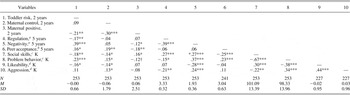
Descriptive statistics and correlations for all study variables are presented in Table 1. The toddler risk index was associated positively associated with negativity, and child aggression. Toddler risk was negatively associated with maternal positive behavior, regulation, social skills, and children's peer-reported likeability. Maternal control was positively associated with perceived peer acceptance, problem behavior, and children's aggression and was negatively correlated with maternal positive behavior, social skills, and children's likeability. Maternal positive behavior was positively associated with social skills and negatively associated with negativity and perceived peer acceptance.
Intercorrelations and descriptive statistics for study variables

aMaternal-reported outcome.
bChild-reported outcome.
cTeacher-reported outcome.
dClassroom sociometric rating.
†p < .10. *p < .05. **p < .01. ***p < .001.
Determinants of early emotional and social competence
A series of hierarchical regression models were conducted to explore the associations between maternal parenting behavior and toddler risk as predictors of children's emotional and social competence during the transition to kindergarten. The measures of emotional and social competence included children's negativity, emotion regulation, social skills, and problem behavior in kindergarten. Aspects of their peer relationships were assessed using children's perceived peer acceptance, and peer social preference and aggression ratings. The variables were entered into the model in the following order: Step 1: gender (covariate); Step 2: maternal control, maternal positive parenting, and toddler risk; Step 3: all two-way interactions (e.g., Toddler Risk × Maternal Control, Toddler Risk × Maternal Positive Parenting, Maternal Control × Maternal Positive Parenting); and Step 4: three-way interaction between Toddler Risk × Maternal Control × Maternal Positive Behavior.Footnote 1 All continuous variables were centered prior to the regression analyses. Post hoc analyses of significant interactions were conducted according to the guidelines outlined by Aiken and West (Reference Aiken and West1991). Continuous variables were plotted at high (+1 SD) and low (−1 SD) values of the variables. Next, simple slopes analyses were conducted to determine whether the slopes of the plotted simple regression lines were significantly different from zero (Aiken & West, Reference Aiken and West1991; Preacher, Curran, & Bauer, Reference Preacher, Curran and Bauer2006).
Negativity
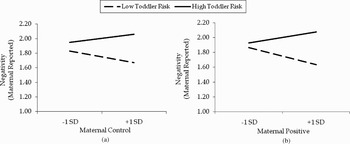
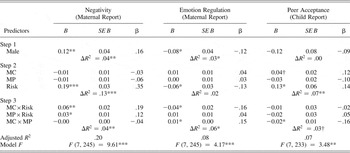
The results for negativity are reported in Table 2. The results indicated that boys exhibited higher levels of negativity than girls. A higher level of toddler risk was significantly associated with higher levels of negativity. Maternal control and positive parenting were not directly associated with children's negativity. There were two significant two-way interactions. The significant Toddler Risk × Maternal Control interaction indicated that the association between maternal control and negativity differed by toddler risk (Figure 1a). Simple slopes analyses revealed that the line representing high risk (b = 0.03, t = 1.92, p = .06) neared significance and the line representing low risk (b = −0.04, t = −2.50, p < .05) was significantly different from zero. This indicates that there was a positive association between maternal control and children's negativity when toddler risk was high, but a negative association between maternal control and negativity when toddler risk was low. There was also a significant Toddler Risk × Maternal Positive Parenting interaction (Figure 1b). Simple slopes analyses revealed that the line representing high risk (b = 0.01, t = 0.76, ns) was not significant. However, the line representing low risk (b = −0.03, t = −2.02, p < .05) was significantly different from zero. This indicates that there is a negative association between maternal positive parenting and children's negativity, but only when toddler risk was low. The three-way interaction was not significant.
(a) The interaction between maternal control and toddler risk predicting children's negativity during early childhood. (b) The interaction between maternal positive behavior and toddler risk predicting children's negativity during early childhood.

Results for hierarchical regression models predicting 5-year negativity, emotion regulation, and peer acceptance

Note: MC, maternal control; MP, maternal positive behavior. The B values are from the model that included the two-way interactions because the three-way interaction was not significant.
†p < .10. *p < .05. **p < .01. ***p < .001.
Emotion regulation
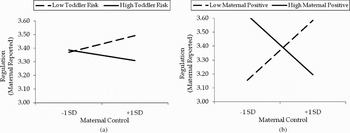
The results for emotion regulation are reported in Table 2. Boys had lower levels of emotion regulation than girls. Higher levels of toddler risk were significantly associated with lower emotion regulation. Maternal parenting behavior was not directly associated with children's emotion regulation. There were two significant interactions. There was a significant Toddler Risk × Maternal Control Interaction (Figure 2a). Simple slopes analyses revealed that the line representing high risk was not significantly different from zero (b = −0.02, t = −1.42, ns), but the line representing low risk was significantly different from zero (b = 0.03, t = 2.07, p < .05). This indicates that maternal control was positively associated with children's emotion regulation but only under conditions of low toddler risk. There was also a significant Maternal Control × Maternal Positive Parenting interaction (Figure 2b). Simple slopes analyses conducted at 1 SD above and below the mean were not significant. Simple slopes analyses conducted at 2 SD above and below the mean revealed that the line representing high levels of positive parenting was significantly different from zero (b = 0.06, t = 2.16, p = .05), and the line representing low levels of positive parenting approached significance (b = −0.04, t = −1.92, p = .06). This indicates there was a positive association between maternal control and children's emotion regulation when maternal positive parenting was high. In contrast, there was a negative association between maternal control and children's emotion regulation when maternal positive parenting was low. The three-way interaction was not significant.
(a) The interaction between maternal control and toddler risk predicting children's emotion regulation during early childhood. (b) The interaction between maternal control and maternal positive behavior predicting children's emotion regulation during early childhood.

Perceived peer acceptance
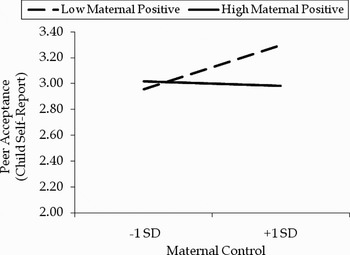
Results are reported in Table 2. There were no direct effects of sex and maternal positive parenting on children's perceived peer acceptance. Maternal control approached significance, and was positively associated with peer acceptance. Greater risk was significantly associated with higher levels of perceived peer acceptance. There was a significant Maternal Control × Maternal Positive Parenting interaction (Figure 3). Simple slopes analyses revealed that the line representing high maternal positive parenting was not significantly different from zero (b = −0.01, t = −0.27, ns), whereas the line representing low levels of maternal positive parenting was significantly different from zero (b = 0.10, t = 3.27, p < .01). This indicates that maternal control is positively associated with children's perceived peer acceptance but only under conditions of low maternal positive parenting. The three-way interaction was not significant.
The interaction between maternal control and maternal positive behavior predicting child-reported peer acceptance during early childhood.

Kindergarten social skills
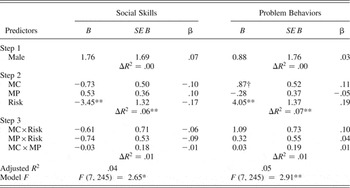
Results are reported in Table 3. Gender and maternal parenting behavior were not associated with children's social skills in kindergarten. A higher level of toddler risk was significantly associated with lower levels problem behavior in kindergarten. There were no significant interactions.
Results for hierarchical regression models predicting teacher-reported social skills and problem behavior in kindergarten

Note: MC, maternal control; MP, maternal positive behavior. The B values are from the model that included the two-way interactions because the three-way interaction was not significant.
†p < .10. *p < .05. **p < .01.
Kindergarten problem behavior
Results are reported in Table 3. There were no significant gender differences in children's level of problem behavior in kindergarten. Maternal positive parenting was not associated with problem behavior, but maternal control approached significance and was positively associated with problem behavior. In addition, a higher level of toddler risk was significantly associated with more problem behavior in kindergarten. There were no significant interactions.
Kindergarten social preference
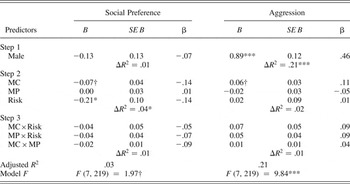
Results are reported in Table 4. There were no gender differences in children's peer reported social preference scores. Maternal control approached significance, with higher maternal control associated with lower peer social preference ratings. Maternal positive parenting was not associated with peer social preference ratings. A higher level of toddler risk was significantly associated with lower preference ratings by kindergarten peers. There were no significant interactions.
Results for hierarchical regression models predicting kindergarten classroom peer sociometric ratings

Note: MC, maternal control; MP, maternal positive behavior. The B values are from the model that included the two-way interactions because the three-way interaction was not significant.
†p <. 10. *p < .05. ***p < .001.
Kindergarten aggression
Results are reported in Table 4. The results indicated that boys were endorsed as fighting more than girls in kindergarten. Maternal control approached significance, with higher levels of maternal control associated with higher levels of aggression. Maternal positive behavior and toddler risk were not associated with peer-reported aggression in kindergarten. There were no significant interactions.
Discussion
Early indicators of children's emotional and social competence have been considered the building blocks for children's later social competence (Denham, Reference Denham2006; Miller et al., Reference Miller, Fine, Gouley, Seifer, Dickstein and Shields2006; Rose-Krasnor, Reference Rose-Krasnor1997). Such indicators include their later reactivity and regulation during stressful situations, problem behavior, and their ability to successfully manage peer relationships and the transition to kindergarten The research suggests that children's early functioning in these domains is dependent on the interaction between child factors, such as the emergence of high levels of externalizing behavior problems, children's ability to regulate their emotions, and multiple dimensions of the maternal parenting context (Denham et al., Reference Denham, Workman, Cole, Weissbrod, Kendziora and Zahn-Waxler2000; Rubin et al., Reference Rubin, Hastings, Chen, Stewart and McNichol1998). The current study, framed within the developmental psychopathology perspective, investigated whether the combination of maternal controlling and positive behavior, characterized by warmth and responsiveness differed for children with and without difficulties with behavior problems and emotion regulation. Overall, the results suggest a complex picture, such that the maternal and child characteristics that are important predictors of maternal reports of children's emotional competence are not necessarily the same for indicators of social competence. Indeed, the interaction between child characteristics and parenting behaviors were better predictors of children's emotional competence.
As expected, the results indicated that higher levels of toddler risk characterized by high levels of early externalizing behavior and poor emotion regulation were associated with poorer social and emotional outcomes (Calkins et al., Reference Calkins, Gill, Johnson and Smith1999; Campbell, Reference Campbell2002; Campbell, Shaw & Gilliom, Reference Campbell, Shaw and Gilliom2000). Specifically, we found that when toddlers were at higher risk they were significantly more likely to exhibit greater negativity and lower emotion regulation during the transition to kindergarten. In addition, teachers were more likely to identify children with higher levels of risk as toddlers, as exhibiting more problem behaviors, and having poorer social skills in kindergarten. Children with higher levels of risk as toddlers were also rated as less likeable by their classroom peers, even though greater risk was associated with higher reported peer acceptance by the child. This is consistent with other research that has found that children who exhibit higher levels of aggression often have overly positive views of their self-competence, including their levels of peer acceptance (Hughes, Cavell, & Grossman, Reference Hughes, Cavell and Grossman1997). The evidence suggests that this bias is a risk factor for children with aggressive behavior problems that tend to lead to even lower levels of peer-reported likeability (Hughes, Cavell, & Prasad-Gaur, Reference Hughes, Cavell and Prasad-Gaur2001). One possible explanation for inaccurate perceptions of peer acceptance is that children with emotion regulation and behavioral difficulties may also have problems identifying and labeling emotions. Indeed, there is some evidence that poor emotion knowledge is linked with more problem behavior in preschoolers (Denham, Reference Denham2006), suggesting that the link between risk and perceived peer acceptance could be mediated by children's emotion knowledge, although this needs to be empirically tested.
Some literature suggests that when mothers use more controlling parenting behaviors with their children, those children are likely to be more aggressive, more negatively emotionally expressive, and have problems with peers (Campbell et al., Reference Campbell, Pierce, Moore, Marakovitz and Newby1996; Paulussen-Hoogeboom et al., Reference Paulussen-Hoogeboom, Geert, Stams and Peetsma2007; Rubin et al., Reference Rubin, Hastings, Chen, Stewart and McNichol1998). However, we are now finding that the link between maternal control and children's outcomes is often moderated by other factors. This is consistent with the present results, where there were only marginal direct effects of maternal control on indicators of children's emotional and social outcomes, such as peer social preference ratings and aggression in kindergarten, and several interaction effects predicting other emotional and social outcomes.
The impact of early maternal controlling behavior on children's negativity and emotion regulation differed depending upon the child's level of risk. Specifically, the results indicated that maternal control was positively associated with negativity under conditions of high toddler risk. At low levels of toddler risk, however, greater maternal control was associated with lower levels of negativity. A similar result was found with respect to children's ability to regulate their emotions. When children were at low risk, greater maternal control was associated with better regulation. In situations where children are, at least some of the time, very difficult to manage, mothers may not be able to consistently use control strategies especially within the context of a warm and sensitive relationship; hence, a coercive family process may result (Patterson, Reference Patterson, Reid, Patterson and Snyder2002). This type of interaction style is less likely to develop in mother–child dyads where children are easier to manage. Indeed, research indicates that parental reports of parenting stress across early childhood are dependent upon the child's level of externalizing behavior problems (Williford, Calkins, & Keane, Reference Williford, Calkins and Keane2007) and parenting is often compromised when parental stress levels increase, particularly when the stress is specifically related to child rearing (Crnic & Low, Reference Crnic, Low and Bornstein2002).
Some research indicates that positive aspects of the mother–child relationship appear to be an important predictor of socioemotional development for temperamentally difficult children. Indeed, limit-setting and control in the absence of a hostile emotional context appears to decrease children's externalizing behaviors (Denham et al., Reference Denham, Workman, Cole, Weissbrod, Kendziora and Zahn-Waxler2000). This did not bear out in the current analyses. Mother's greater use of maternal control was associated with children exhibiting better regulation when their positive parenting was low and poorer regulation when maternal positive parenting was high. The distinction between adult-centered controlling practices, as assessed in the current study, and harsh parenting may be one potential explanation for this inconsistency. For instance, Rubin, Burgess, Dwyer, and Hastings (Reference Rubin, Burgess, Dwyer and Hastings2003) found that children exhibited more behavioral and emotional dysregulation when mothers used more harsh parenting behavior characterized by negative control and hostile child rearing-attitudes accompanied by displays of negative affect (e.g., hostility toward child and annoyance), although in the current study the levels of behavior seen in terms of maternal control were not necessarily hostile and angry.
Of interest, when mothers used more maternal control children had higher levels of perceived peer acceptance under conditions of low maternal positive parenting. There is some evidence that children with aggressive behavior problems display overly positive levels of perceived peer acceptance (Hughes et al., Reference Hughes, Cavell and Grossman1997). It could be that this association was driven by those children with higher levels of risk. Alternatively, considering the emotional climate of the family may be an important consideration. If family interactions are characterized by high levels of control and low levels of warmth and responsiveness, then children may not interpret the emotional cues by peers as negatively as those children who are used to high levels of warmth and responsiveness.
Contrary to our expectations that interactions among toddler risk and maternal parenting behavior would be important predictors of children's social skills and problem behavior in the classroom, only toddler risk was a significant predictor, with higher toddler risk being linked with poorer social adjustment. It could be the case that other aspects of the child's early socialization environment, that were not assessed in the current paper, are important for promoting aspects of children's social behavior. Characteristics such as cooperation and assertiveness, which were both assessed in our measure of social skills, may be influenced more by specific parenting practices than one's general parenting style. Indeed, parental modeling of behavior during their social interactions may be particularly important for children's development in these areas. Another area that is rarely studied and may be an important focus for future research is the socialization that occurs within the sibling relationship. Many cooperative behaviors such as sharing and taking turns have been found to be socialized during interactions with siblings. For example, older siblings' use of conflict resolution strategies with their toddler siblings have been linked to the younger siblings' use of conflict resolutions strategies at age 6 (Dunn & Herrera, Reference Dunn and Herrera1997). Developing a better understanding of these salient relationships will be important for understanding aspects of children's social skills as they enter kindergarten.
The current study has some limitations that must be noted. Some of the indicators of children's early emotional and social competence from the 5-year assessment were maternal report; therefore, a greater likelihood of single-rater bias exists for the toddler risk composite and these measures. However, important elements of this study included observational measures of child and maternal behaviors, teacher reports, and sociometric ratings of child behavior that would not have suffered from these problems. Children's aggression was based on a one-item peer nominated “fights a lot” sociometric rating, which is a limited assessment of children's aggression in the classroom. It was also the case that coding of maternal behavior during mother–child interactions was coded globally, and was not necessarily contingent on specific child behaviors. Finally, given that research suggests that early behavior problems seem to be an important indicator of later socioemotional development, it might be beneficial to explore whether behavior problems identified prior to age 2 are useful for identifying children who have a higher risk of developing persistent behavior problems over time. Overall, it will be important to develop a better understanding of these developmental processes linking parenting behavior and children's risk status with later developmental outcomes. These processes are likely characterized by more complex interactions than we were able to capture.
This study underscores the multiple pathways by which toddler characteristics and maternal parenting practices can influence later emotional and social competence. The results suggest that the mother's use of controlling parenting practices tend to be more detrimental in terms of children's emotional competence during the transition to kindergarten, when children exhibit early signs of risk as toddlers. In terms of social development and behavior in kindergarten, the broad maternal parenting behaviors (control and positive behavior characterized by warmth and responsiveness) appear to have less of an impact than children's early behavioral and emotional dysregulation. One potential avenue for future research is to examine whether maternal parenting practices mediates the association between children's risk and later social development. In addition, given the focus of developmental psychopathology on multiple pathways and the interaction among multiple factors at different levels of analysis, a focus on the broader family socialization context may be needed to develop a comprehensive understanding of the early pathways to children's social and emotional competence.