Introduction
Over 70 studies have investigated sex difference in smiling under various social conditions, such as when people engage in face-to-face interactions or walk past one another on the street or in hallways (e.g. Van Vianen & van Schie, Reference Van Vianen and van Schie1995; Chapell, Reference Chapell1997). Another social condition involves people being photographed for the purpose of later sharing the pictures with friends and relatives (e.g. Reis et al., Reference Reis, Wilson, Monestere and Bernstein1990; Otta et al., Reference Otta, Pereira Lira, Delvevati, Pimentel Cesar and Guirello1994; Hall et al., Reference Hall, Carter, Jiminez, Frost and Smith LeBeau2002). In nearly all investigations, females have been found to smile more than males (see reviewed by La France et al., Reference La France and Hecht2003; Ellis et al., Reference Ellis, Hershberger, Field, Wersinger, Pellis and Geary2008, p. 670).
Most attempts to explain why females smile more than males do have emphasized cultural learning factors. For example, Dodd et al. (Reference Dodd, Russell and Jenkins1999) asserted that females are taught to be friendlier and more emotionally expressive than males. As a result of this social pressure, females tend to smile more.
Another proposal was made by Henley (Reference Henley1973) and elaborated by Deutsch (Reference Deutsch1990). These researchers maintained that smiling is recognized in most, if not all, cultures as a submissive gesture, and suggested that females are taught from childhood onward to behave in more submissive ways than males. Smiling, according to Henley and Deutsch, is one manifestation of submissiveness.
More recently, a biologically based theory of social smiling was offered by Ellis (Reference Ellis2006). This theory hypothesized that neurohormonal factors were responsible for sex differences in social smiling. In particular, it argued that brain exposure to testosterone and possibly other ‘male hormones’ inhibit social smiling. Evidence supporting this theory has come from studies showing that within both sexes, tendencies to smile were inversely correlated with levels of circulating testosterone: i.e. the higher the levels of testosterone, the less individuals smiled during social encounters (Cashdan, Reference Cashdan1995; Dabbs et al., Reference Dabbs, Hargrove and Heusel1996).
The present study was undertaken with three purposes in mind. First, it sought to further document sex differences in smiling using a large sample of photographs taken from high school yearbooks. Second, the study sought for the first time to assess how smiling correlates with certain traits detectable from photographs (e.g. hair colour, physical attractiveness, masculinity/femininity). Third, by performing multivariate analyses with smiling as the dependent variable, the study sought to shed light on theoretical efforts to explain sex differences in smiling. In particular, the neurohormonal theory leads one to hypothesize that at least among females femininity will be associated with increased tendencies to smile.
Methods
Data for this study were obtained by 24 male and 45 female undergraduate students who took social science research methods classes between 2005 and 2007 at a university in the upper mid-western United States (Minot State University), where both authors formerly taught. All student raters were white non-Hispanic and ranged between 19 and 36 years of age.
As a collaborative research project, students were instructed to locate one of their (or their parent's) high school yearbooks and then rate a sample of 25 male and 25 female photographs taken at random. The student raters were not informed about the purpose of the study before providing their ratings.
In addition to measuring sex and degree of smiling, raters were asked to also provide assessments of four additional variables for each photograph: hair length, hair colour, masculinity/femininity and physical attractiveness. Three considerations lie behind the inclusion of these four additional variables. First, their measurement was easily accomplished at the same time sex and smiling was being assessed. Second, instructing raters to include these additional variables helped disguise the study's main purpose (thus reducing the chances of any rater biases concerning sex differences in smiling). Third, it was reasoned that one or more of these four variables might actually be useful in helping to account for sex differences in smiling. In particular, as explained more in the Discussion, only one of the three theories mentioned in the Introduction leads one to expect that smiling and masculinity/femininity will be correlated for females but not for males.
The variable calibrations that raters were instructed to use regarding each variable were as follows: sex (male, female), degree of smiling (from 1=frowning to 6=open mouth smile), hair length (from 1=bald or crew to 6=below shoulders), hair colour (from 1=very light to 6=black), masculinity/femininity (from 1=very masculine to 6=very feminine) and physical attractiveness (from 1=extremely unattractive to 6=extremely attractive). In approximately one-third of the photographs, ‘hair darkness’ was measured instead of hair colour because some of the photographs were in black-and-white rather than in colour.
The randomization process that the student raters were instructed to use involved first opening the yearbook they selected with their eyes shut until a page was located containing classmate photographs. Then, working on their own time, the raters were told to take every third photograph until they obtained 25 males and 25 females, with the exception that they should skip any photograph of someone they happened to have personally known.
The result from all student raters following these procedures was a set of 3446 photographs rated on the degree of smiling along with all the other traits. Four cases were excluded from the analysis because a student rater of these particular photographs neglected to report one or more of the specified traits.
The reliability of student ratings surrounding this study was assessed using a separate research methods class of fourteen students (not part of the 69 raters who provided the 3446 ratings). These students were shown 50 photographs randomly drawn from a high school yearbook chosen by the first author for 20 seconds per photograph and asked to make their ratings without consulting one another. The ratings of all fourteen students were correlated with one another and the following average correlations were obtained: smiling, 0.51; hair length, 0.68; hair colour, 0.54; masculinity/femininity, 0.37; physical attractiveness, 0.39. These average correlations are interpreted as indicating modest reliability in the ratings provided by college student raters. It should be added that the procedures used in this reliability assessment were similar, but not identical, to the procedures used in the larger study. The most notable difference was that student raters in the larger study were under no time constraints in making their ratings.
The study's main analyses compared males and females regarding all of the above traits and then correlated each of the variables with one another. Also, multiple regression was performed on the data to assess the possibility that hair length, hair colour, masculinity/femininity and physical attractiveness might be influencing smiling.
Results
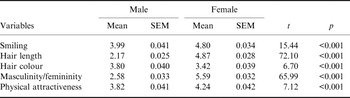
Findings confirm earlier reports that when members of each sex are being photographed (at least under the condition that their photographs will be shared with friends and family), females smile to a greater degree than do males. Table 1 shows that on a 6-point scale, the average degree of smiling for females was 4.80, compared with 3.99 for males (t=15.49, p=<0.001). Additional sex differences that are revealed in Table 1 suggest that females have significantly longer and lighter coloured hair, and were judged to be more feminine and more physically attractive than was the case for males.
Averages in smiling, hair length, hair colour, masculinity/femininity and physical attractiveness for males and females

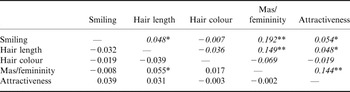
To explore how the various traits were inter-related, Table 2 presents a correlation matrix for all of the variables for males (lower left) and females (upper right) separately. Among the patterns that emerged are the following. Females who smiled most had longer hair and were judged to be more feminine and more attractive. However, smiling among males exhibited no significant relationships to hair length, or attractiveness, although, as with females, longer hair length was positively correlated with greater femininity ratings. Hair colour (darkness) was not significantly associated with smiling in either sex.
Correlations between the study variables for males (lower left) and females (upper right) separately

Significant at the *0.05 level;
** significant at the 0.01 level.
As a final step in the analysis, a multiple regression analysis was performed on the data for each sex separately. This allowed the hypothesis derived from Ellis' (Reference Ellis2006) neurohormonal theory that smiling would be predicted by femininity among females but not among males to be tested.
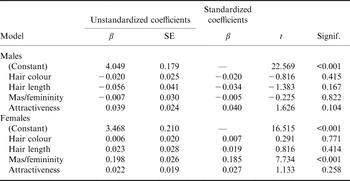
Smiling was designated as the dependent variable and hair length, hair colour, masculinity/femininity and physical attractiveness were set as independent variables. Just as the neurohormonal theory predicted, the analysis revealed a very different pattern for males and females. In the case of males, none of the four independent variables significantly impacted smiling. However, in the case of females, one factor – femininity – emerged as a very significant contributor to smiling (Table 3).
Regression analysis of the impact of hair length, hair colour, physical attractiveness and masculinity/femininity on smiling in males and females

To verify the direction of the link between femininity and smiling among females, a non-recursive structural equation model was imposed on the sample of female photographs with smiling and femininity both treated as independent and dependent variables. When smiling was the independent variable, the resulting p-value was far too high to be considered statistically significant (p=0.229). But when smiling was the dependent variable (femininity→smiling), the p-value was highly significant (p=0.003). This provides strong support for believing that the judges were not simply rating the photographs as more ‘feminine’ because they were smiling. Instead, feminine-appearing females smile more than their more masculine-appearing counterparts. Relatively feminine-appearing males, on the other hand, were not inclined to smile more than masculine males.
Discussion
The present study was undertaken to shed light on sex difference in social smiling. It did so by showing that when adolescents were being photographed (for sharing with classmates and family), females smiled more than did males. Males and females were also significantly different from one another regarding hair colour, hair length, masculinity/femininity and physical attractiveness. When the degree of smiling was correlated with these other traits, statistical significance was largely confined to the photographs of females.
The final analysis involved using multiple regression to treat hair length, hair colour, masculinity/femininity and physical attractiveness as predictors of smiling for each sex separately. None of these traits was helpful in predicting smiling for the male sample. However, for females, one trait – masculinity/femininity – emerged as a highly significant predictor.
Each of the three theories of smiling can explain the above finding, at least to some extent. Dodd et al.'s (Reference Dabbs, Hargrove and Heusel1999) theory asserts that smiling is a sign of friendliness and that females are taught to be friendlier than males. It is reasonable to argue that the most feminine-appearing females would be taught to behave in friendly ways more than masculine-appearing women, thereby being consistent with the main findings from this study. However, such an explanation would not explain why masculinity/femininity failed to be associated with smiling among males.
The social learning theory of Henley (Reference Henley1973) and Deutsch (Reference Deutsch1990) envisions smiling as a submissive gesture and asserts that females are expected to be more submissive than males. One could further hypothesize that the most feminine-appearing females would be encouraged and rewarded for smiling more than masculine-appearing females. However, such reasoning would have the same difficulty as the theory of Dobbs et al. when attempting to account for why there is no corresponding relationship between smiling and masculinity/femininity among males.
Unlike the two social learning theories, Ellis' (Reference Ellis2006) neurohormonal theory can explain why femininity is associated with smiling among females but not among males. This explanation involves noting that the ability of testosterone to alter the brain in ways that inhibits smiling is likely to occur only within certain ranges, and many more males than females exceed those ranges. Support for this proposal comes first from noting that femininity itself is enhanced by depriving the brain of androgens during fetal development (Udry et al., Reference Udry, Morris and Kovenock1995; Hines et al., Reference Hines, Golombok, Rust, Johnston and Golding2002). Also, an inverse correlation appears to exist between circulating testosterone levels and feminine behaviour among female pre-schoolers but not among male pre-schoolers (Hines et al., Reference Hines, Golombok, Rust, Johnston and Golding2002).
Taken together, the above studies suggest that only among most females will the levels of brain exposure to testosterone be within the low ranges needed to promote femininity. And, if tendencies to smiling are also promoted by depriving the brain of testosterone as Ellis' (Reference Ellis2006) theory asserts, only among females would one expect to find a significant correlation between smiling and masculinity/femininity. In other words, during perinatal development, the brains of nearly all males are exposed to far too much testosterone to facilitate social smiling, while only a few females (i.e. those who are most masculine in appearance) receive such exposure.
The only evidence that does not seem consistent with the above view comes from studies of circulating levels of testosterone. Both in males (Dabbs et al., Reference Dabbs, Hargrove and Heusel1996) and in females (Cashdan, Reference Cashdan1995) these levels are negatively correlates with tendencies to smile. However, circulating testosterone levels and perinatal levels are likely to be only modestly correlated, especially within each sex, and it is primarily perinatal levels that Ellis' (Reference Ellis2006) theory envisions as mainly responsible for sex differences in social smiling.
In conclusion, the present study further documents a sex difference in social smiling. It also shows that smiling is most pronounced in girls who have the most feminine physical appearances, with no corresponding relationship between masculinity/femininity among boys. The neurohormonal theory seems to provide the best overall explanation for these findings.