INTRODUCTION
Survey-based research suggests that the levels of anti-Black prejudice Whites express have converged over time across regions, even though White southerners continue to have higher levels of prejudice (Firebaugh and Davis, Reference Firebaugh and Davis1988; Griffin and Hargis, Reference Griffin and Hargis2008; Quillian Reference Quillian1996; Schuman et al., Reference Schuman, Steeh and Bobo1997). However, researchers differ in how they interpret these data. Some scholars suggest that the South continues to have markedly higher levels of racial prejudice relative to other regions (Kuklinski et al., Reference Kuklinski, Cobb and Gilens1997). Other scholars suggest that the racial context of the South is “now different only in minor degree” compared to other regions and that it is “often better as worse” (Reed Reference Reed1993, p. 105).
The two interpretations of contemporary regional differences in racial prejudice are noteworthy in the context of an ongoing demographic shift: African American reverse migration to the U.S. South. Since 1970, more African Americans have been migrating to the U.S. South than leaving the region (Falk et al., Reference Falk, Hunt and Hunt2004; Frey Reference Frey2004). The movement reverses the Great Migration that began around World War I, when more than five million Blacks left the South to move to the North and West (Gregory Reference Gregory2005; Lemann Reference Lemann1991; Marks Reference Marks1989; Tolnay Reference Tolnay2003). The Great Migration transformed America's economic, social, political, and cultural landscape and was a watershed event in African Americans' history. Since the racial caste system of the South powerfully shaped Blacks' experiences during the Great Migration (Du Bois Reference Du Bois1917; Price-Spratlen Reference Price-Spratlen2008; Tolnay and Beck, Reference Tolnay and Beck1992; Wilkerson Reference Wilkerson2010), it is striking that we know little about how Blacks perceive race and region as they migrate to the present-day South. Do Black southbound migrants perceive small differences across regions in levels of racial prejudice or do they perceive they are moving to a region with markedly greater racial hostility?
The purpose of this article is to analyze perceptions of race and region in the context of Black reverse migration to the U.S. South. I focus on narrative interviews with 127 non-southern-born Black migrants to Charlotte, North Carolina. I draw on literature about spatial boundaries, which focuses on how people make and manage distinctions that define place identities (Lamont and Molnár, Reference Lamont and Molnár2002; Zerubavel Reference Zerubavel1991). I focus on race-related distinctions Black migrants make to define regional identities—what it means to be in the South versus in the non-South. Specifically, I follow Essed's (Reference Essed1991) definition of “everyday racism” to analyze African Americans' perceptions of regional delineations in racism that manifest at both the micro- and macro-levels.
In contrast to a focus on whether the South is more or less racially hostile than other regions, migrants in this study were concerned more with the forms of racial prejudice across regions. Six dimensions of racism emerged in how these migrants discussed regional boundaries in their narratives—the overtness/subtlety of racial prejudice, verbal and physical harassment, physical distance, group economic opportunity, racial symbols, and paternalism. Migrants generally perceived they were trading subtler prejudice, higher levels of racial residential segregation, and greater constraints on Black economic opportunity in the North, for more overt prejudice, paternalism, and exposure to racial symbols, such as the Confederate flag, in the South. Patterns also emerged in perceptions of regional boundaries based on class, generation, gender, and having a job-related reason for moving, revealing diverse racial experiences of Black reverse migration.
THEORETICAL FRAMEWORK: PERCEIVING REGIONAL BOUNDARIES OF RACE IN THE BLACK MIGRATION TO THE SOUTH
Racial Prejudice across Regions
Research on contemporary racial attitudes across regions has focused on measuring racial prejudice of Whites (Glaser and Gilens, Reference Glaser and Gilens1997; Middleton Reference Middleton1976; Pettigrew Reference Pettigrew1959; Wilson Reference Wilson1986). Survey data have shown a convergence in anti-Black prejudice among Whites in the South and non-South in the post-World War II era, although White southerners continue to report higher levels of anti-Black prejudice (Firebaugh and Davis, Reference Firebaugh and Davis1988; Griffin and Hargis, Reference Griffin and Hargis2008; Quillian Reference Quillian1996; Schuman et al., Reference Schuman, Steeh and Bobo1997; Tuch and Martin, Reference Tuch, Martin, Tuch and Martin1997). The interpretation of these data, however, has been debated.
One perspective has been articulated by John S. Reed (Reference Reed1993) who argues that regional differences in levels of anti-Black prejudice are now “different only in minor degree” (p. 105) because of the impact of Civil Rights legislation and that scholars should begin considering everyday experiences of race across regions. This perspective corresponds to the image of a U.S. South that has moved beyond its Jim Crow past and manifests similar levels of racism to other regions. Reed argues, “The racial attitudes between White Southerners and other White Americans are now differences only of degree, and of relatively small degree at that. Those differences are smaller than they have been at any time in the recent past, and they are getting smaller still each year” (pp. 114–115).
An alternative perspective suggests the South still has markedly higher levels of racial prejudice than other regions. For instance, Kuklinski et al. (Reference Kuklinski, Cobb and Gilens1997) suggest that southern Whites have begun to provide more socially desirable answers to survey questions but still maintain much higher levels of prejudice. Using more unobtrusive data, they conclude, “Historically, the South has been the stronghold of racial prejudice, apparently it continues to be so today” (p. 346). When this perspective is juxtaposed to the demographic literature about Black in-migration to the South, it signals a need to potentially revisit qualitative distinctions in racism across regions that early race scholarship considered (Doyle Reference Doyle1937; Drake and Cayton, [1945] Reference Drake and Cayton1993) or to bridge disparate studies about contemporary qualitative racial distinctions across regions (Cohn and Fossett, Reference Cohn and Fossett1995; Emerson Reference Emerson1994; Massey and Denton, Reference Massey and Denton1993; McDermott Reference McDermott2006). There may be aspects of how Blacks perceive race and region that we do not understand.
Perceiving Regional Boundaries of Race
Boundaries are delineations of social groups, objects, time, and space (Lamont and Molnár, Reference Lamont and Molnár2002; Pachucki et al., Reference Pachucki, Pendergrass and Lamont2007; Zerubavel Reference Zerubavel1991). I examine regional boundary-work of Black migrants to the South—how they make distinctions to define regional identities and manage these distinctions during their migration processes. I conceptualize regional boundaries as physical, social, and symbolic. As people move across physical space, they also cross social boundaries, patterns of social relations that delineate the boundary. Some of the perceived distinctions in patterns of social relations I will discuss include residential segregation and group economic opportunity. Crossing physical boundaries is also a move across symbolic boundaries, as people make conceptual distinctions or perceive distinctive cultural practices to delineate the boundary (Lamont and Molnár, Reference Lamont and Molnár2002). Some cultural distinctions I will discuss include interaction styles (e.g., being direct or covert), symbols, and language. A focus on conceptual distinctions that define regions considers how physical space becomes “place” when individuals give it meaning (Gieryn Reference Gieryn2000).
To examine the metrics Black interregional migrants use to distinguish regions, I also draw on Essed's (Reference Essed1991) conceptualization of “everyday racism.” Essed's conceptualization is one perspective within race critical theories (Essed and Goldberg, Reference Essed and Goldberg2002). I include within everyday racism, migrants' comments about racial attitudes and discriminatory behaviors at the interactional-level and their comments about broader institutionalized processes of group positioning at the macro-level (Blumer Reference Blumer1958) because the former reflect and lead to the latter. Since researchers argue that we are now in an era where it is socially undesirable for Whites to express overt racial prejudice (Bobo et al., Reference Bobo, Kluegel, Smith, Tuch and Martin1997; Bonilla-Silva Reference Bonilla-Silva2006), an “everyday racism” approach takes seriously racial minorities' accounts of racism. Blacks' perceptions are important to study in their own right (Feagin and Sikes, Reference Feagin and Sikes1994). Perceptions can shape people's lives (e.g., experiences of migration), no matter the extent to which they match alternative measures of prejudice.
This study also considers diverse patterns of regional boundary-work. As Zerubavel (Reference Zerubavel1991) notes in his exposition of boundary processes, “The way we draw lines varies considerably from one society to another as well as across historical periods within the same society. Moreover, their precise location, not to mention their very existence, is often disputed and contested within any given society” (p. 3). Along these lines, I describe patterns of regional boundary-work that emerged in the narratives based on class, generation, motivation for moving, and gender.
CONTEXT
The Black Reverse Migration
This article examines African American perceptions of race and region in the context of Black reverse migration to the South since the 1970s. The South had a net loss of approximately 287,000 Blacks between 1965 to 1970, but it had a net gain of approximately 109,000 Blacks between 1975–1980, about 180,000 Blacks between 1985–1990, and about 347,000 Blacks between 1995–2000 (Frey Reference Frey2004). While Black reverse migration is part of an overall pattern of in-migration of Americans to the U.S. South, there are aspects of Black reverse migration that are distinctive. Black interstate migrants are more likely to move to the South and to move to predominantly Black areas in the South than White interstate migrants (Hunt et al., Reference Hunt, Hunt and Falk2012). While the magnitude of White migration is greater because of their greater population size, the rate of Black non-southern-born migration to the South recently has exceeded that for Whites (Hunt et al., Reference Hunt, Hunt and Falk2008). Also, non-southern-born Blacks who move to the South are younger, more highly-educated, and since the year 2000, more likely married and female than Blacks who move within the North, but non-southern-born Whites who move to the South are older, less-educated, more likely single, and more likely male relative to those who move within the North (Hunt et al., Reference Hunt, Hunt and Falk2012).
Migration scholars speculate that declining manufacturing job opportunities in the North and job growth in the South (Bluestone and Harrison, Reference Bluestone and Harrison1982; Kasarda Reference Kasarda and Farley1995) have led many African Americans to move south since the 1970s (Robinson Reference Robinson1986). Scholars also speculate that the social impact of declining jobs on neighborhoods in the North (Wilson Reference Wilson1996) have led Blacks to move to the South where their residential environments will be improved (Crowder et al., Reference Crowder, Tolnay and Adelman2001). Moreover, scholars have shown that kinship ties Blacks have in the South contributed to the migration of southern-born Blacks to the region (Cromartie and Stack, Reference Cromartie and Stack1989; Stack Reference Stack1996). Blacks also draw on information and assistance from employers, colleges and universities, and ethnic media to help route them to their destinations (Pendergrass Reference Pendergrassforthcoming). While studying the “pushes” and “pulls” of migration is important, the present study addresses a conspicuous question about how Blacks, even those who move for economic or familial reasons, perceive and manage regional boundaries when they are moving to a region that is potentially more hostile than the places they left.
We gain initial insights into perceptions of race and region among Black southbound migrants in Stack's (Reference Stack1996) ethnographic study of Black return migration to the rural South during the 1970s and 1980s. Similar to oral history evidence from other Blacks who took part in the Great Migration (Chicago Commission on Race Relations 1922; Grossman Reference Grossman1989; Trotter Reference Trotter1991), participants in Stack's ethnography did not find the North to be a safe haven from racism. The study describes the rural South as having more racial prejudice and more overt prejudice than “the city” (p. 78). The study also explains how return migrants struggled against paternalistic Black-White relations in their southern hometowns to build community organizations and to get engaged in politics. The present analysis situates these dynamics among a range of ways Blacks might perceive regional boundaries and aims to illuminate these and other ways Blacks consider race and region in migration to the South. In contrast to the southern-rooted migrants and rural context Stack studied, the present article also focuses on the experiences of non-southern-born Black migrants to the urban South.
The Case of Charlotte, North Carolina
This article focuses specifically on the case of Black migration to Charlotte, North Carolina. While it was a railroad distribution center in the late nineteenth century and a textile manufacturing center in the early- to mid-twentieth century, Charlotte began developing into the second largest financial center in the United States (after New York) in the late 1970s (Hanchett Reference Hanchett1998). These economic developments have coincided with its overall population growth over the past four decades. The Charlotte metropolitan area had a net in-migration of approximately 2700 Blacks between 1975–1980, of 7400 Blacks between 1985–1990 and of more than 23,000 Blacks between 1995 and 2000 (Frey Reference Frey2004). Blacks made up 32.7% of the city of Charlotte's population in 2000, but by 2010, they made up 35% of the city's population (U.S. Census Bureau 2012).
Charlotte also has been heralded in Black media. In 1998, it was ranked by Essence, a Black women's magazine, as the number one city for Black families and in 2007 it was ranked by BET.com, the Black Entertainment Television network's website, as the number one city for African Americans to live. In 2008, the city elected its second Black mayor and it hosts major events, such as the Central Intercollegiate Athletic Association historically Black college athletic conference. While Atlanta, Georgia has long had the highest magnitude of Black in-migration among southern metros, Charlotte's sharp increase in Black population growth started in the late 1990s. Charlotte's recent emergence provides theoretical leverage for aspects of the overall study beyond the scope of this article (e.g., economic conditions and social networks) because the study can better capture processes in the initial stages of migration flows.
DATA AND METHODS
This article draws on in-depth semi-structured narrative interviews with 127 Black interregional migrants to Charlotte that I, an African American principal investigator, conducted between May 2007 and August 2009.Footnote 2 The overall study addressed a range of aspects regarding respondents' migration processes, but this article focuses on findings related to their perceptions of regional boundaries of race. In-depth narrative interviews are well-suited for capturing spontaneous mentions of race as people tell their narratives and for enabling the interviewer to probe respondents' rationale for perceptions. I recruited respondents by using a marketing list of new Charlotte residents, contacting social organizations, attending community events, using online social networking sites, and asking for referrals. All interviews were conducted in-person and lasted between forty-five minutes and five hours, with a median length of seventy-five minutes.
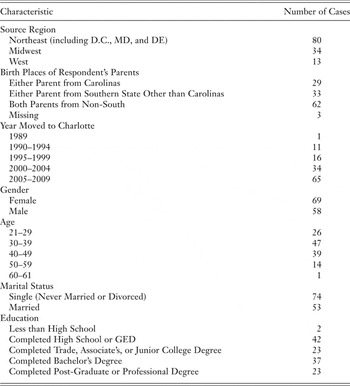
Table 1 describes the interviewees. Almost two-thirds of them came from the Northeast, including Maryland, Delaware, or Washington, D.C. The Midwest was the second most frequent region of origin followed by the West. While this study focuses on the non-southern-born, less than a quarter of interviewees had at least one parent from the Carolinas, revealing the role of family ties for some of these migrants (Cromartie and Stack, Reference Cromartie and Stack1989). Yet, about three-quarters of interviewees had parents who were born outside the South or who were born in other southern states, which highlights the stream of Black newcomers who do not have immediate family roots in the area (Adelman et al., Reference Adelman, Morett and Tolnay2000; Falk et al., Reference Falk, Hunt and Hunt2004). The earliest date at which a migrant moved was 1989, but more than three-quarters of the migrants moved after 2000. Sixty-nine interviewees were female and fifty-eight of them were male. Since the study aimed to focus on adult working-age migrants (because migration processes of retirees could be different), I only included migrants between the ages of twenty-one to sixty-one. Seventy-four of them were single or divorced and the remainder was married. I classified seventy-two respondents as middle class since they had a bachelor's degree or higher, worked in white-collar occupations, or had household incomes greater than $50,000 per year. I classified the other fifty-five respondents as working class and all but two of those had a high school diploma or GED.
Characteristics of Interviewees

In each interview, I initially allowed comments about race to emerge spontaneously as respondents answered open-ended questions about how they decided to move and what their experiences were in moving to the South. After these open-ended questions, I asked questions about race if it had not been addressed. The follow-up question I asked was some variant of, “Did you think about the history of race relations in the South before moving? If so, how did you decide to move anyway?” Given the debate in the literature on regional differences in racial prejudice I also asked, “Do you perceive there is more racial prejudice in the South, more in the North/West, or that it is about the same? How so?” To understand the role of race for migrants' incorporation into the region, I went on to ask, “Have you encountered any racial prejudice since moving to the South? How so?” Based on each respondent's narrative, I followed up on their stories and responses about regional boundaries of race.
The in-depth interviews were digitally recorded. I transcribed ninety interviews and a professional transcriptionist completed the remainder. I also wrote theoretical memos during the research process and coded all of the interviews with Atlas.ti. To analytically juxtapose the data to the debate about racism across regions, I classified each respondent's perception of the levels of racial prejudice across regions as, “more in the South,” “more in the source region,” or “the same across regions.” I classified respondents who expressed that they had never experienced or paid attention to racial prejudice in their lives as “has not encountered in either region to say.” Other respondents had comments about race and region, but could not take a position about its levels across regions. They are classified as “unclassifiable response.” I grouped respondents' more nuanced racial perceptions of regions into six codes or dimensions.
Additionally, I created matrix displays to compare the salience of perceptions across a range of respondent characteristics (Maxwell Reference Maxwell2010; Miles and Huberman, Reference Miles and Huberman1994). These characteristics included birthplace of respondents' parents, whether respondents had family in the South prior to moving, gender, age group, class, primary socioeconomic reason for the move (e.g., seeking a job or cost of living), year the respondent moved, and marital status. The numbers I present for these comparisons do not aim to be statistically generalizable. These analyses, however, illuminate salient perceptions of regional boundaries of race and their diversity among migrants.
FINDINGS
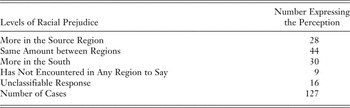
While one perspective in the literature suggests Black migrants would be moving between contexts of similar levels of racial hostility and the alternative perspective suggests migrants would be moving to a more racially hostile context, the narrative data suggest that African American migrants can emphasize a more nuanced perception of regional boundaries of race. Most respondents perceived “racism is everywhere.” As a whole, their narratives exhibited no clear consensus in where they perceived greater levels of racism. As Table 2 below shows, migrants most frequently mentioned that the amount of racism is the same across regions. The other respondents were almost evenly divided between expressing that more racial prejudice existed in their source regions and that more racial prejudice existed in the South. Other respondents did not have enough information to say or took no decisive position.
Respondents' Perceptions of Regional Differences in Levels of Racial Prejudice

An even more complex picture emerged, however, as respondents elaborated on their perceptions of race across regions. Migrants were less concerned with levels of racism across regions and more concerned with forms of racism they perceived to define regions. In the next sections, I discuss six dimensions of “everyday racism” migrants perceived to delineate regional boundaries and to be salient in the racial experience of crossing between regions. I then highlight diversity among respondents in how they perceived levels of racism across regions and in the salience of certain racial dimensions for defining regions.
The Overtness/Subtlety of Racial Prejudice
One salient dimension of regional boundaries migrants discussed was the distinction between where they perceived more overt versus more subtle racial prejudice. Thirty-five respondents spontaneously mentioned that White southerners express their racial biases in a more overt manner relative to Whites in the North who were subtler.Footnote 3 On the other hand, eight respondents said that White southerners expressed their racial biases with more subtlety because they perceived ‘southern hospitality’ is used to cover racial sentiments. An example of the predominant sentiment of more straightforward interactions in the South was expressed by Cecil,Footnote 4 a fifty-four-year-old man who left his birth state of Massachusetts because of the cost of living and to be closer to family in North Carolina. He said:
I did learn that racism exists everywhere but it's more subtle there … Here, they're real overt. They're overt. It's getting better but they'll let you know right quick, “No. We don't do your kind. We don't do you.” But in Massachusetts, they'll smile before they put a knife in your back. As opposed to here, they'll put a knife in your back and then they might smile.
Some migrants tied their perceptions of regional differences in the authenticity of White racial attitudes to class differences between the South and non-South. They believed a more sophisticated form of racial prejudice exists outside the South that is expressed among the more educated. They perceived a less refined racial prejudice in racial attitudes of southern Whites. Malcolm, a thirty-nine-year-old migrant who moved to Charlotte to start a business, explained of the North, “People don't realize that sometimes that somebody is very educated, so their racism isn't exuded in a comment. It's just exuded in a non-conversational attitude.” Other migrants perceived that the South's racial history gave southern Whites more experience with directly addressing race. One migrant explained, “The people here more or less know how to deal with Black people…. They've been dealing with us all this time. Whereas people in … the North, they still going off of what they may have seen on the cover of Time back in 1968.”
Migrants responded to the perceived regional boundary of subtle/overt racism by expressing their perceived ability to navigate Whites' anti-Black attitudes and practices better when Whites are straightforward rather than covert. Felicia, a twenty-nine-year-old woman from Pennsylvania, moved to Charlotte for job opportunities and a better living environment. She explained her perception of racism in her source region:
I find that you have your closet racists. They'll never come out to your face and say it. You know it. You feel it. You can see it all over them. But they'll never come out and admit to it. “Oh no. I have plenty of Black friends.” Things like that. You run into that. But here it's just like, “Okay. You're Black and I don't like you.” I find it to be more open. And I would rather you be open with me. “Hey, you don't like me because I'm Black? That's fine with me. I'll leave you alone.” But at home, it's like you have that closet. So I'd rather know … where you're coming from. That way I know how to interact with you—either do or don't.
Respondents' statements about more straightforward racial interactions with southern Whites did not mean they desired overt prejudice. In making these statements, they primarily referenced cross-racial everyday interactions, such as interactions on the job. They said that they could better strategize around people who are open about their biases.
Moreover, migrants often perceived that moving to urban areas in the South made them less likely to come into contact with overt racism. Sidney left New Jersey after his wife became frustrated with the quality of life in the North. He explained about racism:
One thing I've always been told is, in the North it's hidden. In the South it's outright, outward. So I would prefer to know it, to see it coming at me than not to. So I just know what I can tolerate and what I won't tolerate and I don't worry about it. Because now, I'm not going to go into one of them little small towns where they're back up in the woods. But I think, sticking closer to a city area, it's more diversified and I think it's good.
In these examples, migrants moved for social and economic reasons such as jobs, cost of housing, or social ties in the South, but they still had personal experiences or general knowledge (e.g., “I've always been told…”) of racism that they referenced during their migration process. Migrants' knowledge of demographic differences between the South and non-South (i.e., class composition) and the history of race relations across regions support their perceptions of the overt/subtle regional boundary. The respondents manage the boundary by highlighting the challenges of managing the subtle racism they encountered more in the North and by highlighting their efforts to strategize around and avoid the more overt racism they perceive in the South. These dynamics illustrate the regional boundary-work of race in the internal migration process.
Physical and Verbal Racial Harassment
Another dimension of regional boundary-work migrants discussed is physical and verbal racial harassment. While the previous dimension focused on the authenticity with which people express racial prejudice in everyday interactions, the physical/verbal harassment dimension focuses more on the relative exposure to conspicuous physical and verbal harassment events and organized racist groups. The dimension emerged in some interviews without my prompting and was discussed in other interviews in response to questions about race. Migrants recalled and responded to images from family, school, or the media of physical attack and harassment of Blacks in the South. One migrant discussed how prior to moving, he and his wife considered the image of the South as “Mississippi Burning,” a film about the murder of civil rights workers in Mississippi in the 1960s. Several migrants discussed the association of the Ku Klux Klan with the South. One migrant called her apartment complex manager before moving and asked, “Where I'm moving, are y'all still lynching folks down there?” Still another migrant discussed his images of the South before moving as “all of this water hose stuff and how they're wetting people down and siccing dogs on them.”
Migrants who had prior experiences in the South because of family ties or visits to the region may have already transformed these images. Other migrants wanted to see conditions in the South for themselves. Jackson, a migrant from Upstate New York who moved to Charlotte to look for work said, “I just think a lot of times people … hold on to memories and stuff of what it was and I'm always the type of person that wants to kind of see for myself if it's still like that…. You could always move back is the way I look at it.” Jackson heard about the threat of racial violence in the South from older family members who had lived in Mississippi. He expressed that the likelihood of experiencing the threat they lived with is low and he wanted to see what his own experiences would be.
Migrants also responded to this dimension by referencing incidents of physical and verbal racial attack in the North. Deanna, a twenty-nine-year-old migrant, wanted to leave Detroit because of crime and her frustration with physical deterioration she perceived in the city. She referenced racial harassment in Detroit as evidence to her husband of why they should not worry about moving south. She described the couple's conversations about moving:
That's the first thing my husband said. He was like, “You know they ‘r.’” and I was like, “R?…. What are you talking about? They racist here.” I was like, “Are you kidding me?”…. We lived in a city where the neighboring suburb was 85% African American and we would turn on the news there and still see people getting crosses burned on their lawn and racial slurs spray-painted on the front of their homes.
Similarly, migrants referenced personal experiences with verbal harassment or physical attack in the North. Jared, a man from Long Island, New York who transferred through his employer to Charlotte, explained his reconciliation of race in the South by citing his prior experience attending college in Atlanta, by relating an incident of being spat upon by a White male in Long Island, and by saying, “coming from the Deep North, it can't be worse than that.”
In addition, some migrants responded to this dimension by referencing a different image of physical and verbal attack they associated more with their source regions: contemporary police harassment and brutality of Blacks. Harold and his wife left New York because of the cost of living and their impression of tension in the city after September 11. He expressed that he had not experienced much racism in New York, with one exception. He said:
One thing I can say, the police are more nicer out here than in New York. That's one thing where it's just like, it's not more racist because in New York, I remember there was a time when I was in Brooklyn, I had a guy stop me because I looked like somebody who mugged somebody…. And out here, there's been times when I've been speeding and got stopped by the cops and they've been the nicest people…. And then in New York, we're constantly hearing about the cops shooting somebody or the cops doing this and the cops doing that. Here, I don't think I've heard of that…. In New York, I would see police and actually become afraid especially in the area that I was in, but out here I'm not.
Migrants had personal experiences with harassment at the hands of police or they knew about this treatment from their acquaintances. Moreover, some migrants referenced news stories about police brutality, such as the Amadou Diallo, Sean Bell, and Rodney King cases. Blacks are not immune from police harassment in the South (or in Charlotte), but these news stories were in the collective memory of migrants as they evaluated their experiences with racism across regions.
As they migrated, some respondents indeed experienced racial harassment in the South. Maria, a thirty-three-year-old migrant, moved to Charlotte because she thought a new environment would motivate her to be more independent and to pursue new goals. She believed levels of racism were “equal” across regions even as she described, “The first time I've ever been called a nigger was when I moved to Charlotte…. That whole day I was just really disturbed because I've never experienced it before.” Maria experienced the racial slur one day while walking to class at a community college in a town right outside of Charlotte. She discussed being “scared to drive at night” through the town. She said, “the cities that are right outside of Charlotte, I feel are very, I feel like I'm in the Deep South.” In turn, migrants were aware that they could experience racial physical and verbal harassment in the South. While most migrants believe the likelihood of experiencing the level of racial threat of their parents or grandparents is low, they emphasize that while it is associated more with the South, it is not confined to the region.
Physical Distance
A third dimension of racism migrants referenced to distinguish regions is physical distance. They referenced residential/social segregation and interracial dating. Twelve migrants spontaneously emphasized their perceptions of greater racial residential segregation outside the South when comparing race across regions.Footnote 5 Others discussed residential segregation in their backgrounds without making a direct comparison to the South. Benjamin left Philadelphia to get away from crime and because his brother had moved to North Carolina. He described his experiences as a child after his family was among the first Blacks in their neighborhood in Philadelphia:
When we first actually moved into the neighborhood, we had problems with some of the surrounding neighborhoods from the blocks over and things like that because they were a little racist. They weren't used to Black people so we were kind of like among the first Blacks there … we had, somebody busted out our windows before and called my family like the n--- word and this and that…. So we had like serious issues at first and as time progressed or whatever so did people's minds.
Some migrants expressed that there were certain neighborhoods in their source regions that they felt uncomfortable visiting because they were Black. I interviewed David, a Brooklyn-native, who moved to Charlotte after a family-related visit and because of his wife's perception of a racial glass ceiling on her job. As we talked at the International House of Pancakes (IHOP), he motioned around us as he observed:
As much as I didn't want to admit it, New York is more segregated than Charlotte is. Because in New York, if you live in a Black neighborhood and you go to the IHOP, you know what you're going to see. You're going to see Black and Hispanic faces. You go out to Green Acres Mall, you're going to see Black faces. You go out to another mall further out, you'll see White faces. Down here it seems like everything is mixed. We go to the restaurant and I'm like, “Dag. A whole lot of White people in here.” So that was another adjustment because we were always taught to believe it was different, that when you got down here, there were certain places you didn't want to walk into because they'd be all White. I've been in the East Village [in New York] and walked into places I shouldn't have went into…. I was just surprised that it's more racially mixed down here than it was in New York City.
Several migrants mentioned their surprise at the level of residential integration they experienced in Charlotte. This residential integration meant migrants generally felt that they and their children developed more racially integrated social networks in the South than they may have in their source cities. While there were a few neighborhoods some migrants felt were not integrated, like the upper-class Myers Park area of Charlotte, they perceived that many working- and middle-class areas they saw in the city were relatively diverse. As Adrian from Massachusetts described, “If you have the money, you can live anywhere you want, whereas up North, there's a lot of lines.”
While this article distinguishes dimensions of everyday racism for analytical purposes, they are not always clear-cut in migrants' narratives. Migrants often tied residential segregation to other dimensions, such as the overt/subtle distinction I discussed above. More than half of those who referenced residential segregation also referenced the dimension of subtle versus overt prejudice. One exemplar of this trading process is Raymond, who moved from Pennsylvania to Charlotte to start a business. He said:
So moving to the South, it's almost like a flip-flop in terms of racism. Racism's everywhere, but in the North I think they're more covert. They hide it more in the North. Down in the South, they're used to dealing with Black people. Now they might not like you but they're used to interacting with you. They're used to dealing with you. They're used to seeing you on a day-to-day basis. Where I lived in the North, I could go an entire day without seeing a White person unless I went to school.
In this case, Raymond perceives more subtle racism in the North, but he tied it to the higher level of physical distance from Whites he associated with the North as well. His comments illustrate how respondents were more focused on the configuration of dimensions of everyday racism across regions rather than on levels.
Another aspect of racial integration migrants discussed is interracial dating and marriage. No general pattern emerged in perceptions of how interracial relationships are tolerated differently across regions. Some believed interracial relationships are not tolerated as much in the South. Samuel left New Haven, Connecticut because of crime in the city. He said of Charlotte, “I got a cousin that's involved with a White girl. His car has done been scratched up and stuff happens. Stuff is happening to him because that is still not accepted down here.” A few migrants who were in interracial relationships or who had family members in them perceived southerners expressed more hostility towards interracial partnerships. They discussed hostile looks they received or challenges finding churches where people would not stare at them. Migrants from California more frequently expressed these challenges because they viewed California as more diverse and because the state has higher levels of interracial partnerships.
However, other migrants perceived a tolerance for interracial relationships in the contemporary South similar to their source regions. Hassan left Newark, New Jersey for job opportunity, lower cost of housing, and a better quality of life. He said of Charlotte:
I thought everybody would be in their own little groups like all the Filipinos and the Asians they live in their groups, which is, Blacks or Whites or whatever and they'd all be within their own little culture. But down here it's a lot more interracial dating. I see that. I walked around the mall … and I'm like, you see a lot of White men with Black girls, Black girls with White dudes, White girls with Black guys, Asian guys with Hindus and Hispanic. I'm like, [makes questioning face] “How is this the South? This is like Newark.” It's like Newark because everybody in Newark is like interracial dating…. Especially since they talk a lot about racism down here and then you see all these interracial couples. I'm like, “How is it racism if it's so many interracial couples?”
Here, Hassan defined the South by the extent to which people are living together and dating each other across race. Other respondents who made similar statements referenced the historical consequences of close interracial contact. One respondent said of the interracial partners he saw in Charlotte, “I was really surprised about that … A Black kid with a White lady more than the other way around, but you see it all day long. And I thought somebody would get killed down here for doing that [laughs].” The presence of interracial partners signals to some newcomers that there are ways the South has changed.
Black Economic Opportunity
Migrants also cited Black economic opportunity as a dimension along which they consider contemporary regional distinctions in race. The perception of greater Black economic opportunity in the South emerged in thirty-one interviews without my prompting. One migrant explained of her migration decision, “Read something in Black Enterprise magazine about North Carolina and it being a booming city for professional African Americans.” Another migrant stated, “I do think that Black people in the South are financially better off than up North.” Images in Black media outlets of Black opportunity in cities such as Atlanta and Charlotte and growth of the Black middle class in these cities signal to potential migrants that their prospects might be better in the South. In addition, some migrants attended historically Black colleges in the South and were drawn in part because of their potential exposure to other college-educated Blacks (Pendergrass forthcoming). The comments of these migrants show how economic and racial considerations can be intertwined in decision-making. Individuals may consider moving to places that provide economic opportunity for them as individuals, for their households, and for those in their social group.
Some migrants perceived a racial glass ceiling for Blacks in their source cities compared to what they experienced in the South. Frank left Western New York because of the cold weather, crime, and the “glass ceiling” he perceived in his hometown. He explained his impressions of race in Charlotte:
I don't get that sense that I'm limited…. It seems like people are just more like, “What education do you have? What credentials do you have?” The fact that you're Black, who cares?…. Whereas in [my hometown] it was more so who you know and it seemed like there was an element of racism regardless of your, I mean, if you think about it, I'm saying, I got a Master's degree. I got this professional credential, but it's not happening for me, even when things are available. Other people are getting it that don't have the credential or the education. And I'm Black and they're not, so I mean, I don't know if that's the case, but that's what it looks like.
Migrants connected group economic opportunity in Charlotte with how it would provide role models for them or their children. Raymond distinguished his experiences growing up in Western Pennsylvania with what he believed his children would experience in Charlotte. He said:
I can't tell you if I think back if I ever had a Black teacher, K-12, where my son and daughter, they're more likely to have several that will probably hopefully be sort of a role model, a good influence on them … they'll be able to look around and say, at least, I've had Black teachers, Black doctors, Black dentists, attorneys, you know what I mean? A lot of Black people in professional roles, role models that they can relate to compared to what I saw up North.
Migrants like Raymond were aware of Blacks' broader economic positioning compared to other racial groups. As they migrated south, they aimed to expose themselves and their children to racial role models to resist those group-based constraints on their economic opportunity.
Not all migrants, however, viewed the South as a place of greater economic opportunity for Blacks. Gwen, a migrant from Maryland, struggled to turn positions at temporary employment agencies in Charlotte into a secure, full-time position. She was considering leaving Charlotte, but hated to do so because her kids liked the city. As she discussed her children, she mentioned how media portrayals of Black economic opportunity in Charlotte did not apply to her. She said:
They love Charlotte, and that's why it hurts me so bad that I have to leave here, because…. I break it down to them—the bills, what's due, how we work this, and they do understand that right now we can't get jobs…. That's very detrimental, and that's why I said I don't understand where these reporters are getting their information. That's not what I'm living man.
The rosy visions of Black economic opportunities in Charlotte portrayed in the media do not match the experiences of all migrants once they get to the city.
Racial Symbols
Another dimension migrants expressed to distinguish regions is racial symbols, particularly their exposure to Confederate symbolism. Symbols condense ideas, represent entities, and convey meaning. Historically, the Confederate flag has been associated with the Confederate States of America during the Civil War. It has since been used to symbolize defiance of occupying troops during Reconstruction, resistance to desegregation and other aims of the Civil Rights Movement, and affiliation with White supremacist groups such as the Ku Klux Klan (Webster and Leib, Reference Webster and Leib2001).
While migrants may have moved for economic or social reasons, twenty-two migrants spontaneously emphasized exposure to the Confederate flag as part of their incorporation process in the South. Gabrielle left New York to gain some independence and to pursue economic opportunity. She explained an incident she had with a co-worker in Charlotte about the Confederate flag:
I have a friend … a White guy and … he worked with me so, and this place was 80% Black people, and he had this lapel pin, … he showed it to me but it was a Confederate flag or something…. I think he did it to … kind of incite an argument, just to prove that no, it's not all evil and bad, it's just people and their heritage, whatever, and, tried to say that, and I know it's true, that most people involved were just poor White people who didn't have slaves and blah blah blah, and I know that … but that's not a reason to embrace it.
Gabrielle's experience shows the interactional-level ways in which newcomers negotiate Confederate symbolism and assertions by southern Whites that it is part of their heritage.
Sylvester, a forty-year-old retail store manager, left Ohio because of a racial glass ceiling he perceived in the workplace. He demonstrates the ways African American migrants often interpret the Confederate flag. He stated:
I seen this guy in the mall that was wearing a Confederate flag shirt and I seen this girl that was wearing one one time and I'm like, to me, it's extremely offensive. I mean, Confederate flag symbolizes so much beyond the Civil War and I find it offensive for anybody. I mean, I've seen it on trucks and stuff and to me I'm just wondering, anybody I see with the Confederate flag has some like neo-Nazi group practicing in their backyard getting ready to like try to take out Obama or something…. I mean, to me, everybody who has that Confederate flag symbol, I throw in with those people that shave their heads and are crazy.
As respondents discussed the flag, they interpreted it as a symbol of slavery, the Civil War, racial violence, support for segregation, continued support for secession from the United States, Whites' fears of minority population growth, and membership in White supremacist groups.
Migrants usually responded to southerners who displayed the Confederate flag by ignoring them, avoiding them, or defining them as lower status. Adrian left Massachusetts and stayed in Charlotte after attending a historically Black college in North Carolina. He said:
Culturally, there are a lot of Confederate flags out here and being from up North, the tolerance, I mean, Massachusetts is a really liberal place and it's not tolerated nearly as much, and to me, it's offensive to me but that's the way it is here. I can't go busting windshields or arguing with every person you see that waves that flag on the back of their pickup truck. Half the time, it's a conversation not worth having because if it's on your pickup truck, we're clearly not in the same division anyway. You can't argue with someone like that.
Some migrants associated those who displayed the Confederate flag symbol with such phrases as “pickup truck” or “Bubba,” references to stereotypical images of low-income Whites. These responses enabled them to define their status above individuals who may express racial prejudice. In this way, they are managing memory of racial conflict that has defined the regional boundaries they cross as they move to the South.
Deanna, the migrant from Michigan, illustrated how respondents perceived a trade-off of exposure to the Confederate flag in the South with other dimensions of everyday racism. Her husband expressed his concerns about potential racism in the South as they were deciding to move. She said to him, “That's wherever you go…. At least down there, at least they put a Confederate flag on their lawn…. In Michigan, you don't know…. You could go to work with somebody and you don't know.” Here, Deanna explains her perception that she would be trading a form of racism in the North where people are covert in their racial prejudice with greater exposure to the Confederate flag in the South. As she continued talking, she referenced the physical and verbal harassment dimension as she highlighted incidents of racial slurs painted on homes in Michigan and she referenced the physical distance dimension as she perceived areas in her source region where Blacks were unwelcome. Deanna illustrates how the dimensions are combined in the minds of respondents and perceived as forms of everyday racism they are trading as they move to the South.
Perceptions of Paternalism
Scholars have discussed paternalistic relations among previous generations of Whites and Blacks in the South that derived from slavery (Doyle Reference Doyle1937). Masters treated slaves with benevolence to maintain the social order and slaves were supposed to respond with submissiveness. More recently, Jackman (Reference Jackman1994) has highlighted paternalism, where dominant groups maintain inequality by treating subordinates in a superficially benevolent manner that maintains the status hierarchy, as an under recognized form of group relations.
While respondents in this study do not use the term ‘paternalism,’ they are aware of its potential presence in their relationship with Whites. Thirty-six respondents spontaneously referenced this dimension of Black-White relations they perceive to distinguish the South from other regions. They use the term, “slavery mentality” to identify it. I interviewed Ebony, who left Pennsylvania after visiting Charlotte and perceiving the city had better job opportunities, low cost of living, and more Black role models for her children. She explained how people warned her about paternalistic racial dynamics after she moved.
Ebony:
I've always been told to beware. Some of them still have slavery mentality … White people still have, some of them still have slavery mentality. And—
Interviewer:
By slavery mentality, you mean?
Ebony:
I don't really question them on that, I took it as what they mean by like I worked in a place … and I had a White guy always address us as “You girls.” I never really caught on to it, but the one lady that I worked with, she pointed out that she didn't appreciate the word “you girls” because that's what they were saying back then. So … and if I come across something that's out of the ordinary and I think it's not properly said or whatever, then maybe they still have that slavery mentality.
Collective memory of slavery shaped Ebony's approach to Whites now that she is living in the South. She interpreted language such as “you girls” as attributing a child-like status to her that was tied to the child-like status Whites attributed to Blacks during slavery.
Some migrants discussed these dynamics in reference to their relations with southern Blacks. Samuel, who left Connecticut, explained:
Samuel:
A lot of African American people walk around down here in fear. I mean, they really walk around in fear. And, that's not me. I never have been.
Interviewer:
You mean, fear of?
Samuel:
White people. And, and of government, of everything. And that's a slave mentality. “I'm just going to, I'ma do my thang and do what I'm supposed to do and everything and I'm not going to buck the system.”
In this way, some migrants felt a distinction from southern Blacks. These respondents perceived southern-born Blacks to be less outspoken about racial issues and to be carrying themselves in a more submissive relationship to Whites. In turn, while Charlotte is seen as a place of opportunity for Blacks, some migrants perceive it as driven by newcomers rather than encompassing southern-born Blacks.Footnote 6
This concern about historical Black-White relations also emerged among migrants who were concerned about language such as “ma'am” and “sir” being used in the contemporary South. Among African Americans, the terms “ma'am” and “sir” can express respect for one's elders, but some migrants “cringe” when they are used in relation to Whites. Hazel, a New York-native, moved to Charlotte for better job opportunities and to provide a safer environment for her kids. She expressed a frustration with her experiences in the South:
New Yorkers respect people but we don't say like, “Yes ma'am.” “Yes sir.” And this is what they're teaching them in school. I'm uncomfortable with that. And I tell them, “As long as you say, ‘Yes and no’ that's okay.” Because when I hear that “yes ma'am and no ma'am” attached, it takes me back to the slavery mentality, the slavery existence and I'm like, “Is that what you're trying to teach my kid? That's why they have to say, ‘yes ma'am,’ ‘yes sir’?” Because I didn't grow up hearing “Yes ma'am” and “Yes sir.” I know my mother when she spoke to her father, she called him, “Yes sir.” She did. And she spoke to her mother she said, “Ma'am.”…. Other than that, in New York, I never heard that like that…. That's something in the past that needs to stay in the past.
Hazel shows how migrants negotiate memory of slavery through everyday language, like “yes ma'am,” “no sir,” “the boss man,” and other terms during their incorporation into the South. As another interviewee explained of a discussion with her mother about the interviewee's discomfort with the term “yes ma'am,” “Mammy was her mother. So that was too much like slave terms, too much like what we had referred to slaveowners as.”
Diverse Perceptions of Race and Region in the Reverse Migration
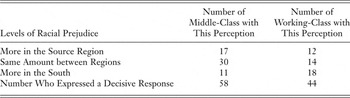
As the findings above intimate, not all African Americans who move to the South perceive regional boundaries of race in the same way. Among the 102 interviewees who expressed a decisive perception about levels of racism across regions, working-class migrants more frequently perceived greater racial prejudice in the South than in their source regions relative to the middle class. As Table 3 shows, eighteen of the forty-four working-class respondents who expressed a decisive response perceived greater racial prejudice in the South, but only eleven of the fifty-eight middle-class respondents who expressed a decisive response perceived greater racial prejudice in the South. The more negative perceptions of the South among the working class could be related to findings in parts of the broader study that show working-class migrants to be less exposed to or in agreement with media images of the South as a place of economic opportunity for Blacks; they were also less likely to move with a job in place and thus had more unsteady economic incorporation into the South relative to the middle class (Pendergrass forthcoming).
Perceptions of Regional Differences in Levels of Racial Prejudice by Class among Migrants Expressing a Decisive Response

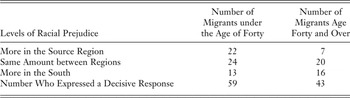
A generational pattern also emerged among those who expressed a decisive perception. Migrants under age forty leaned more toward perceiving greater racial prejudice in their source regions, while migrants age forty and over leaned more toward perceiving greater racial prejudice in the South. As Table 4 demonstrates, among those who expressed a decisive response, twenty-two of the fifty-nine respondents under the age of forty perceived greater racial prejudice in their source regions, but only seven of the forty-three respondents who were age forty and over perceived greater racial prejudice in their source regions. The more negative perceptions of the source region among younger migrants could be due to migrants under the age of forty being part of the post-Civil Rights Movement generation and having fewer salient negative images of the South relative to those who were born during the pre-Civil Rights era. It could also be related to older migrants' having more experience visiting the South over their lifetimes, including experiences in the pre-Civil Rights era.
Perceptions of Regional Differences in Levels of Racial Prejudice by Generation among Migrants Expressing a Decisive Response

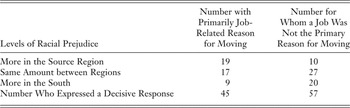
Moreover, migrants who moved for a job-related reason had more negative perceptions of race in their source regions than did those who moved for other reasons. As Table 5 illustrates, among those who expressed a decisive response, nineteen of the forty-five respondents who moved primarily for a job-related reason perceived greater racial prejudice in their source regions, but only ten of the fifty-seven respondents who moved primarily for other reasons (e.g., a better neighborhood) perceived greater racial prejudice in their source regions. The more positive perceptions of race in the South among those who moved for job-related reasons could be related to ways migrants tie perceptions of economic opportunities and perceptions of racial opportunities across regions. As I show above, perceptions of racial group economic opportunity are a salient dimension migrants used to distinguish racism across regions, so if migrants moved for jobs they likely tie this to their more positive racial perceptions of the South.
Perceptions of Regional Differences in Levels of Racial Prejudice by Job-Related Reason for Moving among Migrants Expressing a Decisive Response

Patterns also emerged in the qualitative discussions of dimensions of everyday racism across regions. For instance, men more often emphasized personal experiences of physical harassment across regions relative to women who usually referenced general knowledge of racial physical harassment of Blacks. Some men discussed experiences being spat upon, chased home when they entered White neighborhoods as teenagers, or directly interrogated by the police. While women were not immune from these experiences, the discussions suggested greater experience with more physically aggressive racism that shapes perceptions of Black men relative to Black women as they consider race across regions.
In addition, there were patterns in the discussions of Black economic opportunity. Middle-class respondents, men, and respondents who moved for job-related reasons more often emphasized greater Black economic opportunity in the South than in their source regions. The class pattern could be related to the aforementioned findings about the greater economic challenges working-class respondents faced because they often did not have a job set up prior to moving. Working-class women especially struggled to turn entry-level office positions through temporary agencies into long-term secure employment relative to the working-class men who went into warehouse, automotive, and other positions. Also, the more positive perceptions of Black economic opportunity in the South among those who moved for job reasons demonstrates how respondents view job opportunities in the South through the lens of racial opportunity and vice versa.
The experience of racial residential segregation also differs among Blacks. Middle-class Blacks often remembered being among the first Black families to enter their neighborhoods as children and seeing the White flight. These experiences in the North are among their perceptions of race and region as they move south. Also, the racial residential segregation middle-class Blacks experienced included Black middle-class areas relative to the working-class who left racially segregated areas that were lower income. Moreover, both men and women discussed racial residential segregation in their narratives but men referenced this dimension more often, a finding possibly related to gender differences in neighborhood perceptions (Guest and Lee, Reference Guest and Lee1984). There were no apparent patterns within the dimensions of subtle/overt prejudice, Confederate symbols, and paternalism.
DISCUSSION
The objective of this article was to examine how Black interregional migrants to the U.S. South perceive racial aspects of regional boundaries and how they manage these boundaries as they move to the South. This objective is important for understanding how race matters in the everyday experiences of participants in the Black reverse migration since the 1970s. It is also important for understanding how perceptions of Black reverse migrants are similar to or different from the two alternative perspectives on contemporary regional differences in racial prejudice in the literature—the perspective that regional differences in levels of racial prejudice are now minor and the perspective that the South remains a place of markedly greater racial hostility.
Findings in this article suggest that the current debate about regional differences in racial prejudice is missing some of the nuanced ways African Americans interpret regional boundaries and is overlooking some dimensions that are salient to Black migrants. As a whole, migrants in this study demonstrated no overall consensus in the amount of racism they perceived across regions. Instead, they emphasized six cultural and social dimensions of how they perceive racism to define regions. First, migrants distinguished the overtness/subtlety with which Whites express their racial prejudice and they highlighted the challenges of navigating everyday cross-racial interactions in settings such as the workplace when racism is covert in the way they perceived it in the North. Second, respondents emphasized that while incidents of racially-driven physical or verbal harassment are more associated with the South, they are not confined to the region. Third, migrants from the Northeast and Midwest generally found the South to provide more racially integrated environments, including housing and everyday interactions. While migrants still perceived that southerners stigmatize interracial relationships, the increasing presence of these couples in the South signified to migrants that the region's racial barriers are changing. Fourth, some migrants perceived that economic barriers for African Americans are more surmountable in the South than the non-South. Fifth, migrants were exposed to Confederate symbolism in the South and they responded by ignoring or avoiding those who display it or by classifying them as lower status. Sixth, migrants negotiated racial paternalism they perceived in the South that is connected to slavery. Migrants perceived themselves to be trading these forms of racism as they migrate, and migrants differed in the salience of these boundaries in their narratives based on class, generation, motivation for moving, and gender.
While analysis of minorities' self-reported experiences of racism has its limitations (Quillian Reference Quillian2006), it remains one way to consider the relationship between race and region. Studies of Whites' racial attitudes across regions often focus on attitudes toward racial segregation, racial policies, or direct statements of anti-Black prejudice. In contrast, this article demonstrates that studies of regional differences in the overtness/subtlety of prejudice, residential segregation, and economic inequality, could be considered together as multiple boundaries that distinguish regions. Other less recognized metrics of regional differences (e.g., paternalism or the incidence of police brutality) could be considered as well, since these boundaries are salient among Blacks. While this article has aimed to emphasize the idea of trading off on these various racial dimensions of regional boundaries, future research must continue to explore how the cultural dimensions support the more social dimensions and how particular configurations of these dimensions combine differently across places.
Further, I have examined African American perceptions of race and region in the context of the Black reverse migration to the South. The perspectives of these migrants demonstrate how “pushes and pulls” of economic/social network considerations and experiences of race should not be viewed as either/or aspects of the migration process, but can be intertwined. Individuals might manage racism in their incorporation process even if they move for work- or family-related reasons. They might also consider not only economic opportunity for themselves and their household, but for the racial group in their migration process (e.g., moving to a place with Black opportunity). In an era of what some call a “New South,” people can also confront collective memory of race and place as they move south for opportunity (e.g., negotiating a work supervisor using language tied to slavery or debating with a co-worker wearing a Confederate symbol).
These findings aimed to shed light on perceptions of regional boundaries of race among migrants to the South, but as with any data, the findings should be interpreted in their context and with clarity about their limitations. First, if suitable data become available, these dimensions and their patterns could be examined in a probability sample that can be generalized to the population of Black migrants who are moving to the South. Moreover, while Charlotte is the context in which the migrants I studied experienced “the South,” those experiences could differ for Black migrants to other southern cities. For instance, migrants who move to the “Deep South” might highlight perceptions of more racism in the South compared to those who move to cities associated with the “New South.”
Also, are migrants' racial perceptions simply the arbitrary, unfounded result of post-hoc rationalizing? Evidence against this conclusion can be found in the correspondence between migrants' perceptions and alternative measures (e.g., census data about greater residential segregation in metros outside the South). The repetition and patterning of the dimensions among dozens of people from different backgrounds and various parts of the country and the fact that they were expressed through narrative (e.g., remembering a conversation with a spouse about racism before moving) also suggest that the findings in this study are not simply reflections of arbitrary post-hoc rationalizing. Finally, different data are needed to examine another question—how much race matters in the entire process of moving. Qualitative data are most suited to elaborate how Black migrants perceive race, but other data are needed to examine how much. What these data showed, however, was that only nine respondents out of one hundred and twenty-seven said they had not encountered racism anywhere to have a perception of its levels across regions (see Table 2). The many spontaneous mentions of everyday racism that emerged without the interviewer's prompting also suggest this could be an important part of the experience of moving south for a number of Blacks.
At the dawn of the Great Migration, W. E. B. Du Bois (Reference Du Bois1917) supplemented analysis of large-scale data on the volume of Black migration with migrant interviews and content analysis of newspapers, and he considered not only economic aspects, but also race. This article has aimed to illuminate everyday racial experiences that are part of a new Black residential movement, while undoubtedly leaving other questions unanswered. “At any rate,” to extend Du Bois's sentiments from the Great Migration to the present movement, “we face here a social change among American Negroes of great moment and one that needs to be watched with intelligent interest” (p. 66).