On the orthodox view, to know is to have a belief that meets certain criteria. For instance, the belief must be true and, it is often thought, also supported by evidence or reliably produced or the like (e.g., Cohen Reference Cohen1966, Reference Cohen1989; Goldman Reference Goldman1976; Conee and Feldman Reference Conee and Feldman1985; Chisholm Reference Chisholm1989; Sosa Reference Sosa2007, Reference Sosa2011; Zagzebski Reference Zagzebski2009). On this approach, knowledge is a composite state that factors into a mental component (belief) and non-mental components (e.g., evidence or reliability). In a radical break from orthodoxy, Timothy Williamson has argued that knowledge is not composite in the way assumed by orthodoxy. Instead, Williamson argues, knowledge is prime. On Williamson's view, knowledge does not decompose into mental and non-mental factors. Instead, knowledge is a paradigmatic mental state itself, and not simply by courtesy of requiring belief.
If the orthodox treatment of knowledge as composite were true, Williamson notes, then it would have certain consequences. In particular, it seems to imply certain things about how our concepts of knowledge and belief develop. If knowledge were a composite of mental and non-mental factors, then we would expect children to acquire the concept of knowledge only after they acquire the concept of belief. In short, belief would be conceptually prior to knowledge. However, “data on child development suggest, if anything, the reverse order” (Williamson Reference Williamson2000: 33, n. 7). By contrast, Williamson's hypothesis is perfectly consistent with data suggesting that knowledge is conceptually prior to belief, because Williamson rejects the assumption that knowledge is a composite concept with belief as a conceptual constituent. More recently, Williamson has become known for his very thoughtful and careful critique of the relevance of experimental evidence to philosophical disputes (e.g., Williamson Reference Williamson2011, Reference Williamson2013), which lends additional weight to his suggestion in the present context about the relevance of developmental data. More generally, if Williamson is correct that knowledge is a psychological state, then we should expect a theory of knowledge to be consistent with our best psychology, just as we would expect a theory of belief to be. Consequently, I accept Williamson's observation about the relevance of developmental data and will proceed on the assumption that it is correct.Footnote 1
Although many have resisted Williamson's arguments for the primacy of knowledge (e.g., Brueckner Reference Brueckner2002; Magnus and Cohen Reference Magnus and Cohen2003; Molyneux Reference Molyneux2007; Fricker Reference Fricker, Greenough and Pritchard2009; see also papers in Greenough and Pritchard Reference Greenough and Pritchard2009), nobody has yet challenged Williamson's claim that the developmental data favor his view that knowledge is conceptually prior to belief. More recently, Jennifer Nagel (Reference Nagel2013) has presented a much more thorough discussion of psychological data, which she takes to further support Williamson's view.
My view is threefold. First, Williamson and Nagel have underestimated the complexity and ambiguity of much of the evidence. Second, relevant evidence has escaped their notice. Third, and more importantly, the evidence supports the orthodox view that the concept of belief is prior to the concept of knowledge. Thus, on my view, the psychological evidence supports the orthodox view that belief is conceptually prior to knowledge.
I begin, in Section 1, with a brief overview of epistemological orthodoxy on the priority of belief over knowledge and Williamson's charge that the psychological evidence supports the exact opposite conclusion. In Section 2, I consider evidence on children's acquisition of the mental state lexicon, arguing that the data are inconclusive on the issue of whether knowledge is prior to belief or vice versa. In Section 3, I consider evidence on children's performance in theory of mind tasks, arguing that the empirical evidence supports the orthodox view that belief is conceptually prior to knowledge.
1. PRELUDE
The orthodox view among epistemologists is that knowledge is a composite of mental and non-mental factors: it is not prime. Among epistemologists, the pre-and post-Gettier project of attempting to analyze knowledge into mental and non-mental factors has taken knowledge to entail belief (e.g., Cohen Reference Cohen1966; Lehrer Reference Lehrer1968; Armstrong Reference Armstrong1969; Jones Reference Jones1971; Sorensen Reference Sorensen1982; Steup Reference Steup and Zalta2006),Footnote 2 where this entailment is taken to suggest that belief – a paradigmatic mental state – is one of the basic mental building blocks of knowledge. The primary focus of orthodoxy has been to provide a closed list of non-mental factors which elevate belief to the status of knowledge.Footnote 3 So, among epistemologists involved in the pre- and post-Gettier tradition of analyzing knowledge, the guiding view is that knowledge is a composite of mental and non-mental factors, that belief is prior to knowledge and that the task in analyzing the composite knowledge is providing a closed list of non-mental factors which build on belief and yield knowledge.
But, as Williamson notes, there are reasons to be suspicious of orthodoxy. The pre- and post-Gettier tradition of analyzing knowledge into mental and non-mental factors has been largely unsuccessful. Additionally, “a further ground for suspicion of analyses of the concept knows in terms of the concept believes is that they seem to imply that the latter concept is acquired before the former” (p. 33). But as Williamson points out: “the data on child development suggests, if anything, the reverse order” (p. 33).
Williamson does not pursue a detailed review of the developmental literature. But Nagel, noting that “the attribution of knowledge is not taken to start from an attribution of belief, on Williamson's view; rather, the capacity to recognize belief depends on some prior mastery of the concept of knowledge” (p. 285), sets out on her foray into the psychological literature from the suggestion that “arguably, if intuitive representation of knowledge really is a composite involving intuitive representation of belief, the capacity to represent knowledge should not be available unless and until the capacity to represent belief is in place” (p. 292). And in agreement with Williamson's claim about what the developmental literature suggests, she takes the developmental literature to show that “children acquire the concept of knowledge before the concept of belief” (p. 292).Footnote 4
Epistemologists involved in the pre- and post-Gettier project of analyzing knowledge into mental and non-mental factors and who take belief as one of the basic building blocks of knowledge, should be interested in what the psychological literature suggests regarding the relative order of acquisition in the concepts know and believe. Insofar as it is reasonable to take orthodoxy as having psychological implications, it would seem that it gets the order of acquisition in the concepts know and believe exactly backwards. But as I will now proceed to argue, the psychological case for the primacy of knowledge is far from convincing. Indeed, I will argue that the extant empirical evidence actually supports the orthodox view that belief is conceptually prior to knowledge.
2. EVIDENCE FROM THE MENTAL STATE LEXICON
I want to consider two main lines of evidence that Nagel draws on in support of the priority of knowledge over belief. The first line of evidence concerns children's acquisition of the mental state lexicon and the frequency of uses of “know” and “thinks” among children and adults. My plan here is to take a closer look at the data Nagel draws on and argue that they are inconclusive on the issue of whether knowledge is prior to belief or vice versa. Setting aside evidence on the acquisition of the mental state lexicon, I will then turn to evidence on children's performance in theory on mind tasks in Section 3, presenting a case in support of orthodoxy.
Some of the work that Nagel takes to be relevant to the issue of whether the concept know is prior to belief comes from considering work on the acquisition of the mental state lexicon. Drawing on work by Bartsch and Wellman (Reference Bartsch and Wellman1995) and Shatz et al. (Reference Shatz, Wellman and Silber1983), Nagel claims that children use “know” both earlier and much more heavily than they use “thinks” (p. 292). The earlier emergence and more frequent use of “know” over “thinks”, Nagel suggests, has also been found in studies of Mandarin and Cantonese (see Tardif and Wellman Reference Tardif and Wellman2000). Indeed, Nagel points out that some work suggests that “know” appears as the main verb in upwards of 70% of children's epistemic claims, while “thinks” appears as the main verb in only 26% of children's epistemic claims (see Bartsch and Wellman Reference Bartsch and Wellman1995). Moreover, Nagel notes that this “dominance of “know” over “think” continues into adult usage … . “Know” and ‘think” are respectively the 8th and 12th most common verbs in English …” (p. 293, fn. 22).
One of the primary pieces of evidence that Nagel takes to suggest that knowledge is prior to belief comes from Shatz et al. (Reference Shatz, Wellman and Silber1983). Recall that Nagel claims that “children use “know” both earlier and much more heavily than they use “thinks” (p. 22)”.Footnote 5 But while it is true that overall Shatz et al. found that children use “know” earlier and more frequently than” think”, the crucial question is how these terms are being used. If the evidence is to bear at all on whether “intuitive representation of knowledge really is a composite involving intuitive representation of belief” (Nagel Reference Nagel2013: 285), then not any use of “think” or “know” will do. Rather one wants to know the ways in which these terms are used and their relative developmental priority in mental state ascription.
Shatz et al.’s focus is largely on a single child, Abe. In coding the occurrence of the verbs, “thinks”, “know”, etc., Shatz et al. created seven categories: mental state, modulation of assertion, directing the interaction, clarification, expression of desire, action-memory, and “I don't know”. Importantly, “know” does occur more than “thinks”. But its occurrence is largely restricted to the “I don't know” category.Footnote 6 As Shatz et al. note, the initial use is restricted to either “the idiomatic phrase ‘I don't know’ or pragmatic social routines used to direct the conversation” (p. 311). Indeed, Shatz et al. report that “thinks is the first verb used for a mental state function” (p. 311).Footnote 7 They find that the earliest use of a verb for a mental state function is at 2.8 years of age, and here only “think” is used. It is not until 2.10 years of age – two months later – that “know” is first used in what they take to be genuine mental state ascription (p. 306).
Focusing on just the Shatz et al. data, it seems that “think” is prior to “know” in making genuine mental state ascriptions. And so it seems that this data actually end up supporting orthodoxy: intuitive representation of belief is prior to intuitive representation of knowledge.Footnote 8
Though the Shatz et al. data appear to invert Nagel's conclusion and so provide some support for the view that the concept of belief is prior to the concept of knowledge, Nagel presents other evidence which she takes to favor the priority of knowledge over belief. Nagel mentions “on a database of over 200,000 spontaneous utterances by English-speaking children up to the age of six, Bartsch and Wellman found that the verb ‘know’ figured as the main verb in 70% of children's epistemic claims, with ‘think’ following at 26%” (p. 293).Footnote 9 Bartsch and Wellman (Reference Bartsch and Wellman1995) however, do not present a timetable regarding the emergence of “thinks” and “know” in genuine mental state ascription. Their goal is to investigate whether children acquire a conception of desire prior to belief. And so in investigating this, they simply lump “thinks”, “believe” and “know” under belief in order to make contrasts with various terms expressing desires.
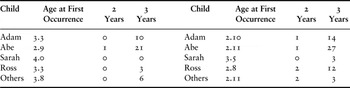
Though Bartsch and Wellman are largely concerned with the issue of whether children develop an understanding of desire prior to belief, they do present some data which might bear on the issue of whether “know” is prior to “think”. They present a timetable of false belief contrastives and uses of “know” which take into account the source of knowledge.Footnote 10Table 1 shows a partial reconstruction of the timetable.
False Belief Contrastives (Left); Knowledge Source References (Right)Footnote 11

Abe appears to produce false belief contrastives before taking into account the source of knowledge when using “know”. But notice that in the second year columns each use only occurs once. Focusing on just Adam and Ross, they appear to take into account the source of knowledge when using “know” earlier than when they first begin producing false belief contrastives. But, this initial use only occurs once for Adam and twice for Ross. It is doubtful that a single or even a pair of isolated occurrences should be taken as evidence for the developmental priority of the concept know over believe.
Perhaps increased frequency of use provides better evidence for the unfolding of the relevant concepts. But focusing just on Adam and Abe – in the third year – false belief contrastives and uses of “know” occur at similar rates. Since false belief contrastives and knowledge source reference frequencies are similar for at least two of the four children, it seems these data provide us with no way of determining whether the concept of knowledge is prior to belief or whether the concept of belief is prior to knowledge.
These issues are not unique to the Bartsch and Wellman data. They arise for all of the linguistic data which Nagel draws on in support of the claim that the concept of knowledge is prior to belief.Footnote 12 For instance, in the Shatz et al. study, Abe only used “think” in genuine mental state reference three times. The other six children out of 30 who produced mental state verbs only produced “know” a total of five times and “forget” twice (see fn. 8). The Tardif and Wellman study of Mandarin and Cantonese speakers suffers from similar issues concerning the extremely low frequency at which mental state verbs such as “think” and “know” show up in initial mental state reference.Footnote 13 But set all this aside and ask: even if children and adults use “know” more heavily than “thinks” – as Nagel suggests – what does this show about the conceptual priority between “know” and “believe”? Does it show that the representation of “know” is non-composite?
Suppose, for instance, that children and adults speak more often of “houses” than of “board” or “bricks”. Would this show that the concept “house” is conceptually prior to “boards” or “bricks”? Would it show that the representation of “house” is non-composite? It's unclear to me what the frequency of use between candidate concepts reveals about whether one is prior to another or whether a candidate concept is composite or not. Given this and the lack of clarity in the data concerning the acquisition of the mental state lexicon, it seems that, overall, these data are inconclusive on the issue of whether knowledge is prior to belief or vice versa.
3. EVIDENCE FROM THEORY OF MIND TASKS
Given that the data on children's acquisition of the mental state lexicon and evidence concerning the frequency of use for “know” and “think” among children and adults is inconclusive on the issue of whether knowledge is prior to belief or vice versa, I now want to turn to Nagel's second main line of evidence: evidence from theory of mind tasks.
Early research on the false-belief task consistently found that children do not pass the task until around 4 years of age. These initial studies were modeled after the now standard design developed by Baron-Cohen et al. (Reference Baron-Cohen, Leslie and Frith1985). In this task, children listen to a story as it is enacted with dolls and toys: The first character hides a toy in one location and leaves the room; while she is gone, a second character hides the toy in a different location. The child participant is then asked where the first character will look for her toy. Researchers have consistently found that when asked where the first character will look for her toy, 4-year-olds typically say she will look in the first location and provide appropriate justifications for their answers. In contrast, most 3-year-olds say she will look in the second (actual) location, thus failing to demonstrate an understanding that the first character will hold a false belief about the toy's location.
Other research in this area has suggested that children, at a very early age, find it much easier to distinguish knowledge from ignorance than to attribute false belief: only later in their developmental trajectory does the lag between success on knowledge-ignorance and false belief tasks close. In a study by Hogrefe et al. (Reference Hogrefe, Wimmer and Perner1986), pairs of children were given a familiar container with familiar contents to examine (a domino box with picture dominos in it). One child from each pair was then sent out of the room, and in his absence the other witnessed the contents being replaced with a different item. The second child was then asked two questions:
(1) Does [name of absent child] know what is in the box now, or does he not know?
(2) If we ask [name of absent child] what is in the box, what will he say?
The first question was aimed at probing children's ability to distinguish knowledge from ignorance while the second question was aimed at probing children's capacity to attribute false beliefs. Hogrefe et al. found that among 3-year-olds, 39% answered question (1) correctly, and only 6% answered question (2) correctly; among 4-year-olds there was improvement with 81% correctly answering (1) and 44% answering (2) correctly; and finally among 5-year-olds the gap finally closed with 88% answering (1) and 76% answering (2) correctly. The evidence from the Hogrefe et al. study seems to support the claim that knowledge is prior to belief. Indeed, as Nagel puts it “If we generally made judgments about the presence or absence of knowledge by attributing belief and then evaluating the truth or falsity of this belief, we would not expect to see such a lag between the capacity to recognize the absence of knowledge and the capacity to attribute false belief” (p. 296).
The Hogrefe et al. study is one of the primary pieces of data from the theory of mind literature that Nagel draws on in support of the claim that knowledge is prior to belief. What is interesting about the Hogrefe et al. study, in contrast to many studies investigating theory of mind, is that it takes up a developmental sequencing of children's ability to pass various theory of mind tasks. I too am going to present some work which takes up the task of sequencing children's emerging abilities to pass theory of mind tasks. Indeed, I'm going to accept the basic findings of Hogrefe et al. since the sequencing pattern they found is well established. So while I ultimately agree with Nagel and many researchers in this area that false-belief tasks tend to be passed later than knowledge-ignorance tasks, I disagree with Nagel that this shows that knowledge is prior to belief. The reason why is because evidence suggests that children understand diverse belief prior to knowledge. But before getting onto this, I want to consider other work on children's performance in false belief tasks which somewhat complicates the picture of the conceptual priority between belief and knowledge which Nagel builds up from children's performance on knowledge-ignorance and false-belief tasks.
From the Hogrefe et al. study, take the earliest age at which children's understanding of knowledge outpaces that of belief as the standard by which to judge whether other studies conform to this pattern. Specifically, let 3 years of age be the age at which children understand knowledge but not belief. Fixing 3 years of age as the standard, one can easily find studies where children are capable of passing versions of the false belief task at this age (e.g., Siegal and Beattie Reference Siegal and Beattie1991; Sullivan and Winner Reference Sullivan and Winner1993; Clements and Perner Reference Clements and Perner1994; Garnham and Ruffman Reference Garnham and Ruffman2001). To take just one example, Roth and Leslie (Reference Roth and Leslie1991) found that 3-year-old children attribute false beliefs to a target character when that character makes a deceptive statement. While these children fail the standard false belief task, in a modified version where a target character makes a deceptive statement, they nonetheless attribute a false belief to the character on the basis of the character's false assertion (see Nichols and Stich, Reference Nichols and Stich2003 and Rose et al. forthcoming for further discussion).
Indeed, there is even evidence that children can pass versions of the false belief task before the age of 3 (Chandler et al. Reference Chandler, Fritz and Hala1989; Southgate et al. Reference Southgate, Senju and Csibra2007; Surian et al. Reference Surian, Caldi and Sperber2007; Buttelmann et al. Reference Buttelmann, Carpenter and Tomasello2009; Kovács et al. Reference Kovács, Téglás and Endress2010) with some evidence suggesting that children as young as 15 months can pass some versions of the false belief task (Onishi and Baillargeon Reference Onishi and Baillargeon2005). Again, to take just one example, in a study where children had to actively deceive a protagonist, Chandler et al. (Reference Chandler, Fritz and Hala1989) found that children as young as 2½ years of age were successful in misleading a target protagonist. As they put it, “the results of this study show that even 2½-year-olds are capable of already successfully employing a range of deceptive strategies that both trade upon an awareness of the possibility of false beliefs and presuppose some operative theory of mind” (p. 1263). Taken together, if we use the Hogrefe et al. as our standard and let 3 years of age be the age at which children understand knowledge but not belief, we find evidence where children can pass versions of the false-belief task at 3 years of age and other evidence where they can pass versions of false belief tasks before the age of 3.
Perhaps one might be suspicious of the contrast between these studies and the Hogrefe et al study. One might want evidence that the same sample of children display more ease in passing versions of the false- belief task compared with versions of knowledge-ignorance tasks. To this, Wellman and Liu (Reference Wellman and Liu2004) present a meta-analysis of various studies on theory of mind tasks. For various studies where children engaged in both a knowledge-ignorance and false-belief task, Wellman and Liu computed the risk difference between performance on the two tasks.Footnote 14 While in many cases they found that children displayed more ease in passing knowledge-ignorance tasks, in other cases they found that “some studies actually report false-belief judgments to be easier than ignorance judgments” (p. 529). Computing the risk difference in studies with children between 4½ and 5½ years of age from Fabricius and Khalil (Reference Fabricius and Khalil2003), Wellman and Liu found evidence that children display more ease in attributing false beliefs over ignorance (pp. 525–6).Footnote 15 Again computing the risk difference – but this time with studies involving children averaging 3½ years of age – Wellman and Liu report that in some studies by Sullivan and Winner (Reference Sullivan and Winner1993) children displayed more ease in attributing false belief than ignorance, even when a standard false-belief task was used (p. 526). In one study from Sullivan and Winner – which involved modifying the false belief task in such a way that it involved deception of the protagonist – Wellman and Liu found an even larger split, again with children displaying more ease in attributing false belief over ignorance (p. 526). If knowledge is conceptually prior to belief, then it's surprising that some studies suggest that children display more ease in passing versions of false-belief tasks in comparison to knowledge-ignorance tasks.
But I don't take any of this as definitive or as clearly favoring orthodoxy. I only mean to suggest that the developmental picture is complicated – especially concerning the contrast between performance on various false-belief and knowledge-ignorance tasks – and sometimes turns up conflicting results. Indeed, along with many other researchers I accept that overall the data suggest that children display more ease in passing knowledge-ignorance tasks than false-belief tasks. I would only ask whether this, by itself, shows that children understand knowledge but not belief. Perhaps probing whether children understand beliefs by using false-belief tasks sets the bar too high. Instead, perhaps all that is required for probing whether children understand beliefs are tasks designed to determine whether children understand that others can hold and act on beliefs that are different from their own.
Indeed Wellman et al. (Reference Wellman, Cross and Watson2001) claim that children “can correctly judge persons’ diverse beliefs before they can judge false beliefs” (Wellman and Liu Reference Wellman and Liu2004: 528).Footnote 16 More specifically, the claim is that:
[I]n cases where the child does not know what is true, young children can first (a) correctly judge that two persons have different beliefs, and (b) correctly judge how a person's action follows from their belief (in contrast to the child's own opposite belief). Only later can children correctly make the same judgments when they do know what is true and hence can (c) correctly judge that one person's belief is true and the other person's belief is decidedly false, and (d) correctly judge how a person's actions mistakenly follow from a false belief. (Wellman and Liu Reference Wellman and Liu2004: 528)
In a meta-analysis, Wellman and Liu (Reference Wellman and Liu2004) provide support for the hypothesis that understanding diverse beliefs is easier than understanding false beliefs. More importantly, in a study of their own, Wellman and Liu found both that understanding diverse beliefs emerged earlier and was easier for children than tasks involving false-belief or knowledge attribution. Children were given a range of theory of mind tasks involving (1) diverse desires (do children understand that people can have different desires for the same thing?), (2) diverse beliefs (do children understand that people can have different beliefs about the same situation?), (3) knowledge-ignorance (do children understand that something can be true, but someone might not know that),Footnote 17 (4) false belief (do children understand that something can be true, but someone might believe something different?), and (5) hidden emotion (do children understand that someone can feel one way but display a different emotion?). Wellman and Liu then constructed a scale – the Theory of Mind Scale – which modeled the level of difficulty that children had in passing these various tasks. They found a clear sequence which can be seen in Figure 1.
Developmental Sequencing of Theory of Mind Tasks

The scale proceeds from easiest to hardest, where later tasks are successfully passed at older ages. It establishes a progression of conceptual achievements in theory of mind understanding. Importantly – concerning the sequencing from diverse belief, knowledge-ignorance and false belief – Wellman and Liu found that at an average of 3.9 years children showed an understanding of diverse beliefs, while it was not until around an average of 4.6 years of age that children displayed an understanding of knowledge, followed by false belief at an average of 4.11 years of age (p. 532).
The Theory of Mind Scale developed by Wellman and Liu is robust and maps a clear conceptual progression among diverse populations. The same sequencing that Wellman and Liu found for US children (see Figure 1) has been corroborated with other data from US children (Wellman et al. Reference Wellman, Lopez-Duran, LaBounty and Hamilton2008), data from Australian children (Peterson et al. Reference Peterson, Wellman and Liu2005; Peterson and Wellman Reference Peterson and Wellman2009) and data from deaf children (Peterson and Siegal Reference Peterson and Siegal2000; Peterson et al. Reference Peterson, Wellman and Liu2005). The scale has also been used with autistic children and children with Asperger's (Peterson et al. Reference Peterson, Wellman and Slaughter2012) and though the order between false belief and hidden emotion is reversed – with hidden emotion being easier to understand than false belief – the order between understanding diverse desire, diverse belief and knowledge-ignorance is the same as in other populations studied (see Figure 1). Though many of these studies are cross-sectional studies (probing children of different ages at one point in time) like the Hogrefe et al. study, Wellman et al. (Reference Wellman, Fang and Peterson2011) conducted a longitudinal study, obtaining the same results as in the various cross-sectional studies. Thus the scale captures conceptual development of individual children over time.
I take the robust pattern of results obtained with the Theory of Mind Scale – whereby children understand belief prior to knowledge – to provide support for epistemological orthodoxy. But there is some work which seems to threaten this. In a study by Wellman et al. (Reference Wellman, Fang, Liu, Zhu and Liu2006) with Mandarin-speaking Chinese children, they found that these children understood knowledge prior to belief. Whereas a range of diverse populations pass diverse belief tasks well before they pass knowledge-ignorance tasks, Mandarin-speaking children showed the opposite pattern, passing knowledge-ignorance tasks before diverse belief tasks. In light of these cross-cultural differences, epistemological orthodoxy – and indeed a knowledge-first view – seems to be threatened since whether one upholds the view that the representation of knowledge is composite, with belief as a conceptual constituent, or not, would amount to nothing more than a piece of cultural epistemic chauvinism.
It is well established that linguistic input about the mind plays an important role in influencing theory of mind development (e.g., Bartsch and Wellman, Reference Bartsch and Wellman1995; Brown et al. Reference Brown, Donelan-McCall and Dunn1996; LaBounty et al. Reference LaBounty, Wellman, Olson, Lagattuta and Liu2008; Turnbull et al. Reference Turnbull, Carpendale and Racine2008). And as Wellman et al. (Reference Wellman, Fang and Peterson2011) point out, parents of Chinese children speak more often of “knowledge” while parents of US children speak more often of “thinking”. So, it seems that, at least in part, early linguistic input about mental states plays an important role in conceptual development with the result that Chinese children, who receive early emphasis on “knowing”, and US children, who receive early emphasis on “thinking”, show opposite patterns between understanding diverse belief and knowledge-ignorance. If early linguistic input plays a role in influencing theory of mind development, a key question is: when linguistic input about the mind is impoverished, what developmental sequencing in theory of mind development will show up? Since linguistic input about the mind influences theory of mind development, examining the developmental unfolding of various mental state concepts when linguistic input about the mind is impoverished will provide good evidence about the natural conceptual unfolding in theory of mind understanding.
As Wellman et al. (Reference Wellman, Fang and Peterson2011) note “children who are born deaf into hearing families … are unlikely to have anyone at home to converse freely about mind-related topics like thoughts and beliefs” (p. 784). Since children born deaf into hearing families are unlikely to receive substantial input about the mind, the linguistic input they receive about the mind is impoverished relative to their hearing counterparts. Although deaf children born into hearing families show delays in theory of mind development relative to their hearing counterparts, they nonetheless conform to the same developmental pattern as shown in Figure 1 (Peterson et al. Reference Peterson, Wellman and Liu2005; Peterson and Wellman Reference Peterson and Wellman2009). That is, children who are born deaf into hearing families understand belief prior to knowledge. So, once differing linguistic input about the mind (i.e., Chinese parents’ emphasis on talk about “knowledge”; US parents’ emphasis on talk about “thinking”) is substantially stripped away, we find evidence of a natural progression in theory of mind understanding, with belief being understood prior to knowledge. Given this and its coherence with a wide swath of results from diverse populations – ranging from US children, Australian children and children with autism and Asperger's – it seems that epistemological orthodoxy is not threatened. Taken together, this work provides support for epistemological orthodoxy: belief is prior to knowledge.
4. CONCLUSION
Timothy Williamson has argued that knowledge is prime, that it is not a composite of mental and non-mental factors. Moreover, he has claimed that the orthodox view that knowledge is composite implies that the concept of belief is prior to the concept of knowledge, but that the developmental evidence suggests the exact opposite pattern. Though Williamson does not himself take up the task of assessing the psychological evidence, Nagel does.
Drawing on a range of psychological evidence, Nagel claims support for the Williamsonian view that knowledge is prior to belief. Concerning evidence from children's acquisition of the mental state lexicon, I argued that this evidence that has been misinterpreted (Section 2): it is mixed and thus lends no support to the view that knowledge is prior to belief or vice versa. Aside from this, Nagel draws on only a single study on children's performance in knowledge-ignorance and false-belief tasks – the Hogrefe et al. study (Section 3) – claiming that it supports the view that the concept of knowledge is prior to the concept of belief. But I went on to present a range of more recent evidence which supports the exact opposite view. This research suggests that children acquire an understanding of diverse belief much earlier than they acquire an understanding of either knowledge or false belief. There is, however, one final piece of evidence that might be brought to bear on the issue of whether knowledge is prior to belief: data on non-human primates.
Nagel claims that “Nonhuman primates consistently fail false-belief tests, even in competitive situations and using apparatus that enables them to pass very closely matched knowledge-ignorance tests” (p. 298). I accept – along with Nagel and many researchers – that non-human primates do tend to pass knowledge-ignorance tasks but fail false-belief tasks (for an excellent overview see Martin and Santos Reference Martin and Santos2015). In this regard, non-human primates display a similar pattern to children who also tend to pass knowledge-ignorance tasks but fail false-belief tasks. That said, I take the range of data presented in Section 2 – which shows a robust pattern whereby diverse belief is understood prior to knowledge – to support the orthodox view that belief is prior to knowledge. And as far as I'm aware, no studies have been conducted with non-human primates which explicitly look at diverse belief attribution as opposed to false-belief attribution. The extant studies have largely proceeded to contrast performance in knowledge-ignorance and false-belief tasks. If probing for an understanding of diverse belief is relevant for discerning whether subjects understand belief, then the non-human primate data doesn't speak to the relevant issue. It's an open question whether non-human primates understand knowledge prior to belief or vice versa.
Taken together, the evidence supports the orthodox view that the concept of belief is prior to the concept of knowledge. Thus, the psychological evidence reconciles the developmental unfolding of the concepts of knowledge and belief with longstanding philosophical consensus that belief is prior to knowledge.Footnote 18