Introduction
Ultrasound has become the standard of care for trauma in the emergency department. 1 - Reference Walcher, Weinlich and Conrad 5 The Focused Abdominal Sonogram for Trauma (FAST) exam is a safe and effective way to evaluate trauma patients for the presence of internal injury by looking for blood in the peritoneal cavity.Reference Moylan, Newgard, Ma, Sabbaj, Rogers and Douglass 3 , Reference McGahan, Richards and Gillen 6 A patient with suspected abdominal trauma will undergo this exam, which takes a trained physician approximately two minutesReference Wherry 7 to complete. A positive test, showing free fluid in the abdomen, will often result in immediate transfer to the operating room (OR), bypassing the computed tomography scan.Reference Moylan, Newgard, Ma, Sabbaj, Rogers and Douglass 3 It has been shown that physicians and medics can use ultrasound in the field to evaluate soldiers and trauma victims with great reliability. 1 , Reference Helling, Wilson and Augustosky 2 , Reference Freeman 8 , Reference Kirkpatrick, Sirois and Laupland 9
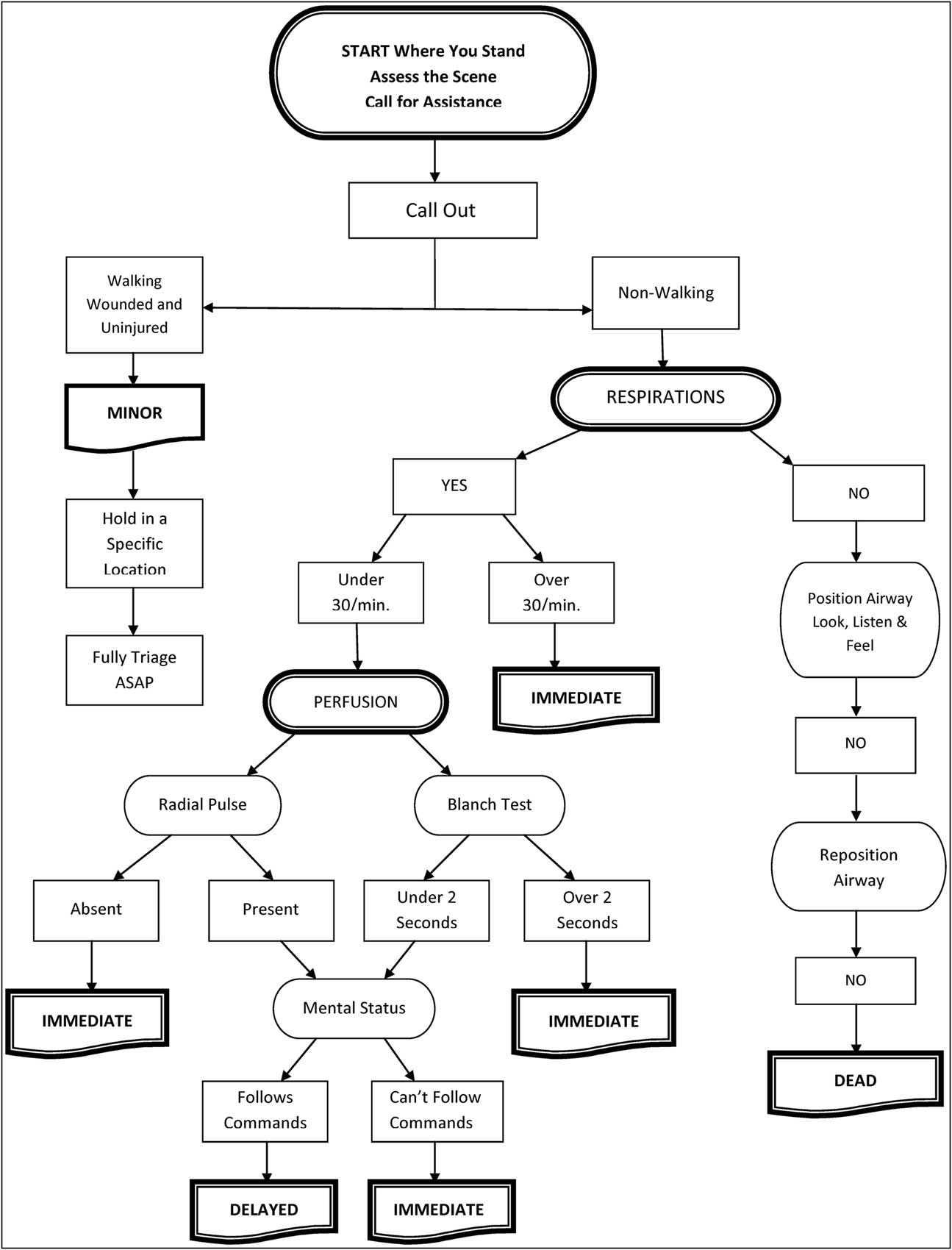
In a mass-casualty incident (MCI), there are regularly more patients than there are transport vehicles; therefore, paramedics must triage to prioritize the transport of the most serious patients first. To do this, they use the Simple Triage and Rapid Transport (START) procedure (Figure 1). This system uses rapidly-assessed decision points, such as ability to ambulate, respiration, perfusion, and mental status. At each of these decision points, patients will be categorized into classes: Green being the “walking wounded,” which can be transported at a later time; Yellow for delayed transport, but more urgent than Green; Red signals the need for immediate transport to a higher level of care; and Black designates dead, or expected to die no matter the amount of treatment received. Many times, there are more Red patients than there are immediate-transport vehicles and potential ORs. If paramedics were able to perform the FAST exam, then they would be able to quickly and more reliably evaluate the patients to determine which will need more emergent transport and which possibly will need to go straight to the OR. It is believed that the addition of this modality will aid in the effective and accurate triage at MCIs. The outcomes evaluated are the accuracy and the time taken to perform multiple FAST exams in a simulated MCI setting.
The Simple Triage and Rapid Transport (START) Flow Chart.

Methods
This study and its methods were reviewed and approved by Genesys Regional Medical Center Institutional Review Board (IRB protocol number: ME 10 0050). The authors employed a single-blinded, randomized control trial to evaluate the use of this modality in MCIs, in addition to START. Ten paramedics from a local fire department, each having at least one year of field experience, were trained to perform FAST exams. The training consisted of a 4-hour course taught by a certified ultrasonographer and board certified emergency medicine physician who was well versed in teaching this modality. The course involved both lecture and hands-on portions with access and training on both control and positives (peritoneal dialysis patients). Paramedics were trained using the Sonosite Nanomax TM Ultrasound System (Sonosite Bothell, Washington USA) with the cardiac probe. It was the same device used on testing day. After the training course, a 2-week waiting period was allowed to lapse in order to simulate real-world training in which paramedics are trained in techniques and modalities that they may not use for days, months, or even years. During this time, they were free to contact the instructor and investigator with questions about the modality, but not about the format of testing. No paramedics contacted any of the above during this time.
Peritoneal dialysis patients were used as positive patients because the free fluid in the peritoneal cavity can simulate bleeding on ultrasound. Five peritoneal dialysis patients over the age of 18 were recruited from a local dialysis center and were instructed to leave approximately 1 L of dialysis fluid in their abdomen for the simulation. Control patients were matched by age, sex, and body mass. After obtaining informed consent, both the case and control patients were wrapped with Ace bandages (3M; St. Paul, Minnesota USA) in order to blind paramedics from the peritoneal catheter. The volunteers were placed around the room on tables. Their order was randomized by picking numbers out of a hat. The paramedics were given the MCI scenario that a tornado hit a bank in town and that there were ten “Red” patients evaluated by the START triage method. They were to use the FAST exam to evaluate each patient and decide positive and negative (which patients needed more rapid transport). Each paramedic was brought in individually and was dismissed from the building after their testing in order to prevent communication between the paramedics. Data were evaluated using the Statistical Package for the Social Sciences (SPSS, IBM; Armonk, New York USA).
Results
Ninety tests were run on the experimental day; nine trained paramedics each performed ten tests. One paramedic dropped out of the study due to a family emergency. The cumulative accuracy of the paramedics was 60%, and ranged from 40% to 80% with a median of 62%. There was no correlation between the time taken for the FAST exam and the accuracy of the exam. The paramedics averaged 121.8 seconds per exam, which ranged from 73.5 to 170.1 seconds per patient exam with a median of 110.8 seconds. There was a false-positive result of 59%. This was significantly higher than the false-negative rate of 41% (P < .01). The overall sensitivity of the FAST scan in the MCI from this study was 67%, and the specificity was 56%.
Discussion
The START procedure and its decision points are set up to foster the culture over triage, thereby classifying a higher proportion of patients as more critical, decreasing their wait-for-transport time. The addition of the FAST exam supports this culture of over triage as the paramedics had a false-positive rate of 59%. This significantly higher false-positive than false-negative rate would result in early transport of a larger number of patients, decreasing the possibility that critically ill patients were misclassified, and decreasing the likelihood of deterioration in the field. This culture gets more patients to the hospital for more advanced evaluation and possible treatment.
Although the paramedics learned to perform the FAST exam rapidly, they did display difficulty in performing it with a high degree of accuracy. This fact highlights some important points. There are a myriad of reasons this may have happened. After a standard 4-hour training course, including hands-on portions, the paramedics were comfortable and accurate using this modality. Over the down time of two weeks, the paramedics lost much of their proficiency. There is a learning curve and a loss-of-knowledge curve with the introduction of any new modality into clinical practice. This has been well documented by studies of periodic training and reevaluation of paramedics, including the American Heart Association (Dallas, Texas USA) with its Basic Life Support and Advanced Cardiovascular Life Support courses.Reference Govender, Rangiah, Ross and Campbell 10 - Reference Smith, Gilcreast and Pierce 12 A downtime period helped to evaluate this modality more realistically. In a “real-world” setting, paramedics are trained in multiple modalities, such as advanced airway procedures. Some of these modalities, paramedics may not use for weeks, years, or even ever. Paramedics receive training on a periodic basis, but not continually, and they are expected to be proficient when the need arises. Using paramedics who are more experienced with MCIs allowed evaluation of the integration of the FAST exam into the START procedure with the assumption that these providers are already proficient in the evaluation and triage of MCIs.
The knowledge loss over the two weeks of downtime may also illuminate a larger issue. It is not only paramedics who have weeks, or months, of down time between uses of the FAST scan, but also physicians. While many physicians have had more extensive training and practice, how much is enough? How often should physicians participate in continuing education with this modality? It can be postulated that without the continual use and training, physician providers will also quickly lose their proficiency.
Additional factors that may have affected accuracy include a lack of understanding of both intra-abdominal anatomy and the technology of the ultrasound modality. Also, the simulated event did not provide external indicators of abdominal trauma. While the lack of external indicators helps to reduce bias, it omits valuable information that is present in “real life,” most likely decreasing accuracy in this study. The Ace bandages used to blind the subjects to the dialysis catheters also may have been responsible for a decrease in accuracy since they made access to the landmarks difficult to obtain. Finally, although it was not measured, the body mass of the “casualties” was most likely higher than “real-life” victims, at least in the military setting. It has been well documented that adipose tissue interferes with optimal imaging.Reference Seinige, Sataloff, Lieber, DellaCroce and Sorouri 13
The group of paramedics showed a broad range of accuracy and time needed to perform the exam. There was no correlation between time taken and accuracy of exam. This may exemplify the individual paramedic confidence levels. The average time of approximately 122 seconds per exam is consistent with what has been reported for physicians.Reference Wherry 7 This may signal that paramedics are able to obtain the views of the FAST exam as quickly as a physician.
Limitations
Due to the fact that this was a simulated disaster, it was impossible to account for the inherent complications of a real disaster, such as noise, lighting, patient positioning, and other detractors. In true MCIs, patients often will be wedged under objects creating the need for extraction and lack of access for the FAST. The sunlight, or lack thereof, may affect the ability of the paramedic to see the ultrasound screen and interpret the results. The paramedic group was from a highly-motivated fire department and their numbers were small. There was an increased drive to learn inherent in this group; this may have enhanced the training. Mass-casualty incident scenes normally involve many more victims than were included in this study; however, the relative number of Red patients is low compared to the total number allowing extrapolation of data.
Conclusion
In this simulation study, paramedics had difficulty performing FAST scans with a high degree of accuracy. However, they were more apt to call a patient positive, limiting the likelihood for false-negative triage.