THE GENESIS OF THE “COLLABORATIVE PROGRAMME OF DIGITIZATION AND PROMOTION OF LAW COLLECTIONS”: FROM A FERTILE COMPOST
French heritage law collections have been the focus of a collective and unprecedented effort regarding digitisation and electronic spreading. Throughout the centuries, many different organisations have stored and provided law documents, considered to be of national interest by virtue of their scientific and heritage value. The networks of legal sciences documentation include academic libraries, public libraries but also institutional and legal libraries, ministerial and parliamentary libraries, as well as associated and private libraries. At the dawn of the millennium, some among these institutions became involved in processes of digitisation, metadata creation and publication on freely accessible public websites. Due to the rapid increase in law digitisation projects, it became important to coordinate these public initiatives.
Two major French libraries took the lead in 2008; the French National Library and Cujas library. On the one hand, the French National Library's law collections are exceptional by way of the legal deposit scheme established in the 16th century. Moreover, in 1997 the French National Library launched GallicaFootnote 1, a public digital encyclopedic library which, since then, has developed through mass digitisation projects, curently reaching two million documents online. Cujas, a Parisian inter-university library, has always been one of the French leading law libraries. Cujas stores law documentation that dates back to the 15th century and covers all legal sciences. The extent of its digitisation project are accessible on Cujasnum, its digital library.Footnote 2
The French National Library and the Cujas library jointly manage a national and collaborative programme known as programme de numérisation et de valorisation concertées en sciences juridiques (Collaborative program of digitization and promotion of law collections) that aims at:
- Locating heritage law resources and digitising them with a view to giving an open access for law scholars, legal professionals and citizens;
- Increasing the online visibility of the French legal system and strengthening its international influence;
- Renewing scholarly law materials since digitising patrimony is key for successful academic research in the social sciences;
- Last, but not least, ensuring long-term conservation of digital files; in particular within a dedicated archive system developed by the French National Library called Système de Préservation et d'Archive Réparti (a digital material preservation system).
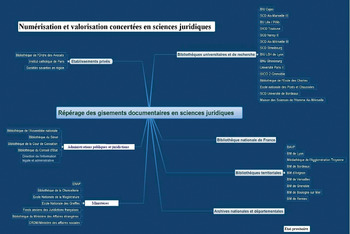
In this way, the French National Library built up a network of partners committed to national cooperation in legal sciences. The partners' diversity is shown on this heuristic map updated in August 2012 (Figure 1).
Network of partners in legal sciences – updated in August 2012

THE “COLLABORATIVE PROGRAMME OF DIGITIZATION AND PROMOTION OF LAW COLLECTIONS”: FROM A DOCUMENTARY JUNGLE TO A GARDEN à LA FRANÇAISE
The institutional and administrative collaboration programme makes one think of a structured garden à la française. In order to impose a methodical arrangement over abundant collections and many digitisation projects, the French National Library, Cujas, the Ministry of Culture and Communication and the Ministry of Higher Education and Research signed a framework agreement in 2009. A steering committee was established together with a scientific council.
The scientific council chose French law sources, based on Roman law, as the prevailing axes of the programme, namely:
- Legislative sources;
- Jurisprudential sources;
- Doctrinal sources;
- Customary sources.
To implement these decisions, the French National Library allocated money to selected, high-quality digitisation projects, offering the possibility of full-text access. Calls for proposals, with strict deadlines, were launched twice: the first in 2010–2011 and the second in 2011–2012. Nine libraries, selected in the first round, are digitising 600,000 pages, mainly local customary sources ‘in force’ before the French Revolution, and official issues, including colonial publications.Footnote 3 In the second round, three university law libraries were chosen due to the high interest of their customary corpora.Footnote 4
Moreover, the French National Library helpfully grants one-third of the current mass-digitisation commercial partnership to the partner libraries; that is to say 9 million pages of 29 million pages from 2011 to 2014, all fields taken into account. Cujas library, parliamentary libraries and the Bibliothèque de l'Hôtel de ville de Paris, one of Paris public libraries, sent around 1,585,000 pages for digitisation. As a result, an unprecedented amount of official issues is now accessible online, creating a significant corpus of legislative sources thanks to interoperability.
In a wider perspective, the French National Library and Cujas library must take up the mass-digitisation challenge from the selection of a document through to its release and, therefore, make every effort to ensure coherence, interoperability and visibility for digitised law corpora.
Digitisation in itself represents the core of any digitisation project, yet not its final goal. From a cooperative view point, it is necessary to avoid redundancies in digitisation programme and remove digital duplicates as long as the same edition is concerned. Different editions of the same title are indeed wanted provided that they include relevant critical apparatus. Therefore, considerable audit work is necessary to begin with. This scientific check is based on lists of reference books selected by scholars. The first one named, Liste raisonnée d'ouvrages de droit publiés avant 1945, compiles 2,000 titles under Yann Kerbrat'sFootnote 5 direction.Footnote 6 Since its publication in 2008, it has been a reference for the French National Library's digitisation program. Laurent PfisterFootnote 7 and Franck RoumyFootnote 8 established another 428 fundamental titles list that is a reference for Cujas library's digitisation program.Footnote 9
The financial constraints that the cultural sector is facing stand in sharp contrast with to mass-digitisation cost. Given the deterioration in public finances, a national collaborative endeavour for massive digitalisation is the only way to avoid the risk of public resources being scattered and to stay within libraries budgets.
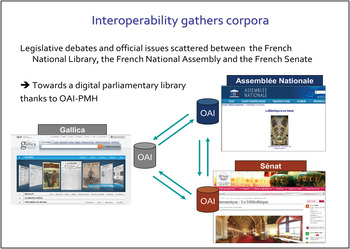
Technical compatibility and complementary access are also at stake in collaborative digitisation. Indeed, in order to virtually link and facilitate access to digital collections held by French documentary institutions or networks, Gallica references digital documents created by its partners. This functionality is built on the principles of documentary convergence and data exchange via the Open Archives Initiative's Protocol for Metadata Harvesting protocol (also known as OAI-PMH). In return, libraries may reference some or all of the French National Library's resources by retrieving descriptive data about them.
Complementary of access, the interoperability of existing repositories gathers contents physically scattered

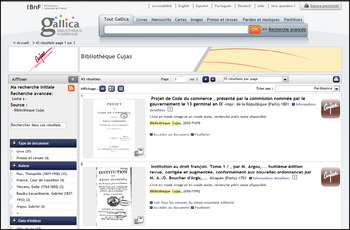
Cujas library's interface on Gallica

Besides, when referencing another library in Gallica, the French National Library creates a personalised interface adapted to the partner's identity and to the partner's demands.
As a result, the French National Library systematically promotes best practices over a wide range of technical possibilities. Successful digitisation requires collection referencing (retroconversion of printed catalogues and cataloging or indexing), interoperability and standardisation as well as long-term conservation. The French National Library provides expertise and assistance not only in these fields but also for document restoration and preservation.
In a nutshell, this programme of digitisation and promotion of law collections is a collaborative project characterised by its institutional architecture. Yet, the rhizome metaphor is much more relevant when describing law digital resources growth on Gallica. Without any hierarchical link, connections on Gallica involve following opportunities, technical developments and new law resources found.
THE DIGITAL HERITAGE LAW LIBRARY ON GALLICA: A WIDE-SPREADING ON A RHIZOME MODEL
Gilles Deleuze and Félix Guattari developed the rhizome theory as a mode of knowledge in 1988 stating, “Unlike trees or their roots, the rhizome connects any point to any other point, and its traits are not necessarily linked to traits of the same nature; it brings into play very different regimes of signs, and even non-sign states. The rhizome is reducible to neither the One nor the multiple… It is comprised not of units but of dimensions, or rather directions in motion. It has neither beginning nor end, but always a centre from which it grows and outgrows” (A thousand plateaus: capitalism and schizophrenia).Footnote 10
The ‘centre’ from which digital law resources grow and spread is Gallica, the digital library built up by the French National Library in collaboration with its partners. As a cultural public utility, Gallica is freely accessible online. The heritage law collections on Gallica were, in August 2012, around 2 million pages from partner libraries, around 185 periodical titles and around 14,114 monographs from the French National Library collections; and constitute a “law information universe”. To this must be added, 2,363 law resources from contemporary editions from which only a few pages are freely accessible on Gallica. Internet surfers can then be connected to e-distributor platforms to buy the entire book. Therefore, a ‘documentary critical mass’ has been reached, offering new opportunities to researchers. The digital law library has become an object of study per se and may lend itself to bibliometric analysis or to statistical processing, for instance cross-disciplinary studies devoted to theme appearances or to hidden correlations.
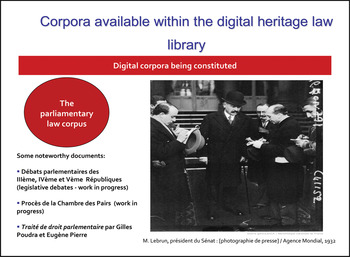
The parliamentary law corpus

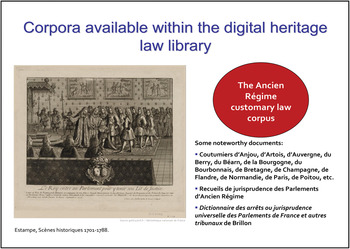
The Ancien Régime customary law corpus

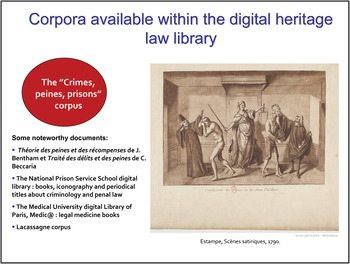
The “Crimes, sentences, prisons” corpus

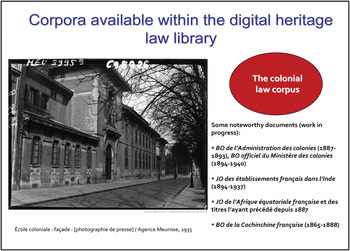
The colonial law corpus

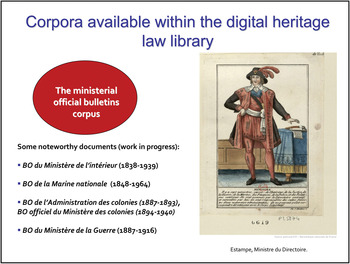
The ministerial official bulletins corpus

In order to get a survey of the digital heritage law library, in broad outline, some quantitative data was necessary. First of all, 55% of law titles were published in the XIXth century. Change was the main feature of that century, shortly after great upheavals. In fact, the French Revolution swept away the legal system of the Ancien Régime, a system built up on centuries of customs and traditions, in favour of one based on reason and legal equality. In its wake, access to the legal system was broadened and legal careers were democratised. As a result, the XIXth century, saw legal publishing characterised by numerous legal journals, dictionaries and synthesis. Flourishing publishing businesses merged, such as Sirey and Dalloz, and the public took wider interest in legal publications, such as the Gazette des tribunaux that became, in 1955, Gazette du Palais.
As far as the number of documents are concerned, with the exception of the French National Library, university libraries are the main providers (42%) and Cujas library is ranked first. Institutional and jurisdictional libraries, ministerial and parliamentary libraries come next, representing 35% of the total amount of law pages. Public libraries provide only 23% of law pages and constitute a documentary deposit which is still to be fully exploited. Online law documents mainly belong to legislative sources (61%). This is not surprising in a system that has been law-centered since the French Revolution and the Civil Code. Around 20% of law documents constitute doctrinal sources, 10% belong to customary sources and 9% to jurisprudential sources. Within these law resources, one specific corpus, dealing with ‘Crimes, sentences, prisons’, has been identified on the occasion of partnerships with the National Prison Service School libraryFootnote 11, the Medical University Library of ParisFootnote 12 and the public library of Lyon that holds Lacassagne's corpus.Footnote 13
THEMATIC SHORTCUTS INSIDE THE DIGITAL HERITAGE LAW LIBRARY ON gALLICA
Casting light on five axes allows internet surfers to discover a few law routes inside Gallica. These thematic journeys are illustrated by Gallica contents. My hope is that these shortcuts will spark readers' interest for law corpora and will keep this under constant development.
CONCLUSION
The concerted digital programme that relates to legal sciences illustrates the need for a national coordination of digitisation projects, implemented beyond institutional boundaries. Such a proactive and exemplary cooperative approach anticipated two particular recommendations made in the Digital framework for libraries, a report established in September 2009 by Bruno Racine, President of the French National Library in the context of the National Books Council.Footnote 14 The sixth recommendation underlines the importance, thanks to collaborative digitisation programmes, of the constitution of corpora as exhaustively as possible in response to public demands and to data protection requirements. Digital libraries are advised to implement interoperability in the seventh recommendation. Interoperability must become an eligibility criterion in order to grant funds. The example of the collaborative legal sciences programme has been articulated since June 2010 in art history, a second concerted programme jointly managed with the National Art History Institute.
The process of calling for legal science initiatives, presented in the text, may evolve towards a modus operandi based on interest in the corpora as well as in partner networks. The Ancien Régime customary and corporatist law digitisation lends itself to implement such an option. Indeed, each province and each Ancien Régime guild used to be governed by a set of rules of their own. Therefore, the scientific research communities, including legal history, are privileged actors to identify and locate the customary law collections related to a geographical area. Once this location research is done, repositories, whatever their status, are then able to digitise documents. Given that not much has been digitised in West customary law (Anjou, Brittany, Normandy, Poitou), an experiment in this area is to be carried out. Such a development could provide a fruitful collaboration between research and documentation. The internet being what it is and given the increasing financial pressure on public budgets, the need for cooperation has never been greater. In addition, an evaluation of the programme in legal sciences and of legal professionals' practices is scheduled for 2014. Results will allow meeting public expectations and new digital practices.
Nonetheless, the sole institutional prism does not grasp the rhizome growth of the law collections online. Gallica is similar to many other digital territories that are gathering pace in the existing world and for the benefit of that to come; like them, Gallica conceals a dynamic propagation, and is so large that consciousness struggles to embrace it. Gallica, being a still unfinished place for knowledge and memory, a digital library rebellious to any hint of possession, is not closed to itself. It is rather a data universe, data sometimes gathered together, sometimes scattered. Data dispersal is largely due to peoples' appropriation of the contents they choose in Gallica, leaving their mark in digital networks. Moreover, different periods of thought and creation coexist in an unprecedented way, just a few clicks away, in the growing virtual net, Gallica. This networking is a crucial issue for the digital public service effectiveness and for cultural democratisation.
Facing the need for mediation, the librarian attempts to organise digital contents in order to make them more visible and usable. Developing a selection of fundamental digitised law titles that could be called Gallica, Law Essentials constitutes a mediation project led by the French National Library. This is based on lists of titles prepared under the direction of scholars, Yann Kerbrat for the National Library of France, and Franck Roumy along with Laurent Pfister for Cujas library, but also on the Audit des grands textes (fundamental titles audit) run by the Department of Law, Economics, Politics of the French National Library. Moreover, one should be able to identify the law corpus within the 1.9 million documents in Gallica thanks to “guided tours” in this digital world. This is a recurrent request from researchers, as well as from all Gallica surfers.
On an international level, the digital heritage law library is approaching its goal – namely, to become the straightforward point of access for research in French law and to enhance the visibility of the French legal system. This has been a brief excursion into Gallica territory, but I hope that I have provided useful pointers to French law sources online.