Introduction
The influence of copper metallurgy on Bronze Age societies is generally considered through the impact of the produced artefacts on wealth, social complexity and stratification (Hayden Reference Hayden1998, 27; Renfrew Reference Renfrew, Renfrew and Shennan1982). Further, this craft undoubtedly stimulated the circulation of goods, ideas and innovations, through developing long-distance networks of exchange of raw materials and finished implements (Kohl Reference Kohl2007, 29; Kristiansen & Earle Reference Kristiansen, Earle, Kristiansen, Smejda and Turek2015). This is why metallurgy may be considered one of the activities conditioning the development of societies, whereas its recession accelerates their decline or demise. However, restricting the impact of metallurgy to this mercantile and utilitarian dimension might be misleading, because metallurgy was not only a craft, but also a religious fundament of importance in many Bronze Age societies (Kristiansen & Larsson Reference Kristiansen and Larsson2005, 43–61). It is why metamorphoses in the way this craft was approached may have societal consequences far beyond the impact of wealth, social hierarchy and trade. Ignoring the potential impact of metallurgy on the universe of beliefs and its evolution might obfuscate some drastic changes observed in ancient societies. This problem is illustrated here through examination of the sharp transition between Late Chalcolithic and Early Bronze Age (EBA) societies in the southern Levant.
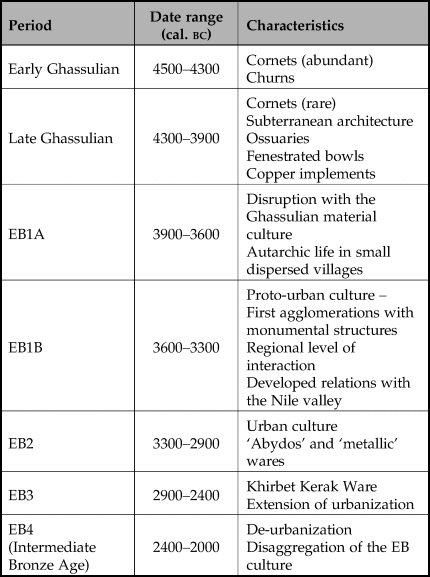
Despite the many remains left by the Ghassulians (southern Levant, Late Chalcolithic, 4500–3800 bc), this culture, its nature, its universe of beliefs and the way it disappeared remain obscure today. This lacuna largely results from the difficulty of comparing it with Chalcolithic homologous cultures and the indigenous cultures that preceded or replaced it. This problem is especially acute concerning the local EBA culture (c. 3800–2300 bc), traditionally considered to be disconnected from the Ghassulian (e.g. Gilead Reference Gilead, Biran and Aviram1993, 82; Kenyon Reference Kenyon1979, 64; Perrot Reference Perrot and Pirot1968, 349) (see Table 1).
The Late Chalcolithic–Early Bronze Age chronology in the southern Levant. (After Braun Reference Braun2009; Gilead Reference Gilead, Lovell and Rowan2011; Golden Reference Golden, Peregrine and Ember2002a; Regev et al. Reference Regev, de Miroschedji and Greenberg2012.)

In truth, cultural continuity is challenging to argue between these two periods. The EBA in the southern Levant was globally an urban culture, contrasting with Ghassulian settlement and social organization (de Miroschedji Reference de Miroschedji, Steiner and Killebrew2014, 308; Gilead Reference Gilead, Biran and Aviram1993, 90–91; Gophna & Portugali Reference Gophna and Portugali1988, 18–19). An examination of the material culture of the period of transition between the Ghassulian and EBA cultures confirms the discontinuity (especially marked in the Beer Sheba valley, the core of the Late Chalcolithic: see Golani Reference Golani2013, 99).
This transitional period (EB1A, 3900–3600 bc) features an abandonment of many of the settlements and diminution in size of most remaining ones, two features suggesting depopulation, migration or a transition to nomadic life (Gophna & Portugali Reference Gophna and Portugali1988, 21; Joffe Reference Joffe1993, 41; Lovell Reference Lovell2002, 93). A dislocation of the Ghassulian cultural unity towards regionalization accompanies this trend (Braun Reference Braun and de Miroschedji1989; Gophna Reference Gophna and Levy1998). The mode of habitat and crafts (especially pottery and metallurgy) simplified at this time (Roux & Courty Reference Roux and Courty1998; Rowan & Golden Reference Rowan and Golden2009, 69–70; Vardi & Gilead Reference Vardi and Gilead2013; Yekutieli Reference Yekutieli, Philip and Baird2000; Reference Yekutieli and Wolff2001) and most Ghassulian ritual artefacts disappeared (Braun Reference Braun1996, 24–6). The transitional period looks like a phase of dissolution of the Ghassulian culture, a ‘dark age’ from which EBA society gradually emerges. The continuity between this transitional period and the phase of urbanization (EB2) even enhances the idea of the independence of EBA culture from its predecessor (Gilead Reference Gilead1990, 90; Gophna & Portugali Reference Gophna and Portugali1988, 12).
However, no exogenous cause (invasion, war, natural catastrophe) can account for this cultural transformation, suggesting its endogenous origin. In the absence of written documents about this period, investigating the endogenous causes of this transformation remains speculative. Nevertheless, considerations about the cultural dimension of some techniques, especially throughout their early development, have led to the identification of one of the main factors of this transition.
The hypothesis of exogenous impetus
The incursion of a foreign people or culture is the simplest way to account for societal changes. The geographical position of the Levant makes it the corridor for migrations between Africa and Asia, and the installation of incomers originating from Egypt, North Africa, Anatolia, the Caucasus, the upper Euphrates and Mesopotamia. Unsurprisingly, the gap characterizing the transitional period was assumed to be a consequence of the replacement of the Ghassulians by newcomers introducing their own culture and values (de Vaux Reference de Vaux, Edwards, Gadd and Hammond1970; Reference de Vaux, Edwards, Gadd and Hammond1971; Elliott Reference Elliott1978, 52; Issar & Zohar Reference Issar and Zohar2007, 101; Kenyon Reference Kenyon1979, 64–5; Wright Reference Wright1971). However, no foreign influence is visible in the early fourth millennium bc in the southern Levant, and we see no trace of any genocide of the Ghassulian people (Joffe Reference Joffe, Adams and Roux2021, 81; Rosen Reference Rosen2013, 146; Schaub Reference Schaub and Hadidi1982). A transitional period, extending across two to three centuries, suggests a gradual evolution rather than a sudden collapse. Population changes might be the main factor of this gradual transformation. Though they are not always clearly visible in archaeology, they should still leave other traces.
Linguistic considerations
Claiming that the Semitic languages were introduced in the Levant from the Early Bronze Age is a strong contention for a cultural breakdown with the Ghassulian universe and the coming of a new people of Semitic speakers throughout the transitional period (Vardi & Gilead Reference Vardi and Gilead2013; Zohar Reference Zohar, Bar-Yosef and Khazanov1992). On this basis, Issar and Zohar (Reference Issar and Zohar2007, 91, 93, 101) assumed that the first Semitic speakers in the Levant were groups of nomadic cattle herders originating from North Africa, who replaced or assimilated the Ghassulian people, themselves belonging to the Sumerian linguistic cluster. This scenario is difficult to accept, however. A gradual transition should leave many traces of the indigenous (non-Semitic) language in proto-Canaanite, the early Semitic language spoken in the southern Levant. But these traces are missing even in metallurgy, a domain of technical superiority among the Ghassulians in comparison to the presumed incomers. Furthermore, the Semitic languages apparently spread from the Levant in the fourth millennium bc, where they were already spoken for millennia before (Kitchen et al. Reference Kitchen, Ehret, Assefa and Mulligan2009, 2707–8). The Semitic lexicon of the south Levantine flora and fauna, agriculture and breeding suggests that the earliest Semitic languages differentiated in close association with the gradual emergence of agriculture and breeding in the Levant (Diakonoff Reference Diakonoff1998, 217–19; Diamond & Bellwood Reference Diamond and Bellwood2003, 601; Militarev Reference Militarev, Bellwood and Renfrew2002,136). Consequently, linguistic considerations cannot support the assumption of exogenous input of EBA culture.
Genomic analyses
Genomic data may inform us about the movements of people and their geographic origin. On this basis, investigators recently analysed the genome of 73 individuals from the Bronze Age southern Levant. From these data, they concluded there was a genetic discontinuity with the old local genetic pool. The authors of this study concluded that there was therefore a population replacement towards the EBA in the southern Levant (Agranat-Tamir et al. Reference Agranat-Tamir, Waldman and Martin2020, 1147). The analysis of the genome of 22 Late Chalcolithic individuals buried in the Peqiin cave led to a similar conclusion about genetic discontinuity between the Late Chalcolithic and EBA periods (Harney et al. Reference Harney, May and Shalem2018, 8).
Nevertheless, these genomic enhancers of the theory of the foreign origin of the Late Chalcolithic–Bronze Age transition should be considered with caution. All 73 Bronze Age individuals analysed in the first study belong to the Middle or Late Bronze Age (Agranat-Tamir et al. Reference Agranat-Tamir, Waldman and Martin2020, 1147), two periods known for the migration of people from northern Syria, Anatolia, the Caucasus and Mesopotamia. These data cannot be extrapolated to account for a population replacement occurring long before, in the transitional period. In the study on the Ghassulian individuals from Peqi'in, the authors discovered surprising genetic continuity throughout millennia: they consider the local Neolithic population the prominent genetic pool (56 per cent ancestry) of south Levantine people from the second half of the third millennium (see Harney et al. Reference Harney, May and Shalem2018, 2 and fig. 3). These data challenge the assumption of a massive replacement of the Ghassulian people throughout the transitional period.
Foreign cultural influence
To account for a substantial foreign influence, it is sufficient to assume the migration of a political and military elite, or even the integration of the southern Levant into a foreign network of exchange and trade. These hypotheses lend disproportionate influence to the low demographic importance of the foreigners. The Early Bronze Age is a period of foreign contacts and influences in the southern Levant (de Miroschedji Reference de Miroschedji, Steiner and Killebrew2014, 312). The community of symbols and iconography attested from Egypt to Mesopotamia confirms that the southern Levant integrated a cultural koiné (Tessier Reference Tessier1987). These interferences, however, are attested mainly in the second half of the fourth millennium bc (EB1B–EB2) (de Miroschedji Reference de Miroschedji, Steiner and Killebrew2014, 312). Further migration and cultural influences originating from the Caucasus, identified by Khirbet Kerak Ware, are observed in the EB3 period (Greenberg Reference Greenberg and Lyonnet2007). However, none of them may account for transformations occurring centuries before, from the beginning of the transitional period.
In conclusion, migrations and foreign influences are probably not the central factor conditioning the dissolution of the Ghassulian culture and the transition towards the Early Bronze Age. This calls us to look for local factors conditioning this change.
The local factors
Climatic changes
Throughout the Holocene, the climate in the southern Levant oscillated between periods of drought and humidity. Risks of crop failure throughout periods of aridity may have weakened the agricultural economy to the point that it collapsed. This situation is today suggested as an explanation for societal transformations attested in the Bronze and Iron Age, including changes in social organization, demography, transitions between nomadic and sedentary lifestyles and the development of urban societies (Issar & Zohar Reference Issar and Zohar2007, 96; Kaniewski et al. Reference Kaniewski, Van Campo and Guiot2013, 4-6; Langgut et al. Reference Langgut, Finkesltein and Litt2013). Climatic changes would have proved critical for Ghassulian society, whose hearth (the northern Negev) is located at the fringe of the semi-arid area. Rowan and Golden (Reference Golden2009, 70) argue that ‘In such areas, even minor short-term fluctuations of precipitation that might be undetectable through paleoclimatic methods could have a disastrous effect on societies within just a few years, particularly those under stress from other factors.’ For all these reasons, the disaggregation of the Ghassulian society is sometimes interpreted as the consequence of a degradation of the conditions of subsistence in a transient phase of drought (Lovell Reference Lovell2002).
However, analyses of oxygen isotope ratios in the southern Levant account for enhanced humidity and rain from the beginning of the fourth millennium bc (Bar-Matthews et al. Reference Bar-Matthews, Ayalon and Kaufman1997; Reference Bar-Matthews, Ayalon, Kaufman, Issar and Brown1998). The concomitant increase in the level of the Dead Sea (Enzel et al. Reference Enzel, Bookman and Sharon2003; Frumkin et al. Reference Frumkin, Magaritz, Carmi and Zak1991) reveals that this humid trend also concerned the semi-arid areas. A transient drought is not therefore the cause for the dissolution of Ghassulian society.
A humid climate in the transitional phase potentially promotes agriculture, especially arboriculture development (Frumkin et al. Reference Frumkin, Carmi and Gopher1999, 681). It would also enhance the sedentarization of nomads previously living in the desert fringes. These changes might have profound societal consequences. Graham Philip (Reference Philip2003, 123), for example, considers this agricultural trend as an essential factor in the dissolution of Ghassulian society, arguing that ‘the EBA economy offered new routes to power that were underpinned by access to the land and the ability to invest using labour and organization skills’. This trend would promote regional autonomy and even autarky at the expense of the previous northern Negev cultural influence. This situation is proposed in the transitional period, where the level of socio-economic integration and political organization rarely overcomes the boundaries of the small villages (McDowel Burton Reference McDowel Burton2004, 42). In parallel, ceramic production becomes contained to the local domestic level and displays a low level of standardization and quality (McDowel Burton Reference McDowel Burton2004, 399–401, 625). Theoretically, the transition to a more humid climate might stimulate the dissolution of Ghassulian culture. However, even if this were the case, the markers of the Ghassulian culture would not disappear spontaneously through such a process. Another factor is probably involved here.
Religious changes
Compared with the Ghassulian period, festive ware is rare in the EB1A. This singularity denotes a decrease in collective feasting activity in the transitional period, a reality probably corresponding with the loss of rituals and collective ceremonials (McDowel Burton Reference McDowel Burton2004, 559–61). This trend coincides with the disappearance, throughout the transitional period, of the ritual artefacts typically associated with the Ghassulian culture (cornets, ossuaries, incense burners). The disintegration of the Ghassulian religious universe was apparently a part of the dissolution of this society and its fragmentation into autonomous entities organized around a rural lifestyle.
Some authors looked for a social origin of this religious collapse. They associate it with the demise of the Ghassulian elite, itself consecutive to the disruption of the production of prestige items, especially metallic items (Rowan & Golden Reference Rowan and Golden2009, 70–71). For Alex Joffe (Reference Joffe, Adams and Roux2021, 100), ‘These symbolic endings were doubly significant: they represent the abandonment of both symbols themselves and highly skilled craft production (and resource procurement) patterns. If nothing else, this represents a dramatic manifestation of ritual failure’. In this perspective, the ‘ritual failure’ observed in the transitional period is the marker of the social changes and the stimulus of the transformations observed in the transitional period. Alternativeely, warfare and internal conflicts have been considered a possible factor in this disintegration (Levy Reference Levy and Levy1995). However, whether violence escalated at the end of the period remains a matter of speculation (Joffe Reference Joffe, Adams and Roux2021, 90).
Lacking written documents, we know almost nothing about the religious universe of the Ghassulians, its system of values, cosmology and fundaments. In this light, it seems vain to look for motivations other than sociological that would account for such a religious crisis. However, this argument is not easy to defend in the absence of markers of social stratification that could potentially collapse (Bourke Reference Bourke2002; Gilead Reference Gilead1988). Also, the collective dimension of the ossuaries, their distance from habitations and the necessary anonymity of the dead confront the idea of elite and chiefdom organization in Ghassulian society (Winter-Livneh et al. Reference Winter-Livneh, Svoray and Gilead2012, 426).
The most robust argument supporting social ranking among the Ghassulians emanates from interpreting the complex metallic items as prestige artefacts (Klimscha Reference Klimscha and Minarova2011, 130; Levy Reference Levy and Levy1995, 241; Roux Reference Roux2019, 23). However, their absence from specific graves challenges both the idea of social stratification and even their interpretation as prestige artefacts (Gosić Reference Gosić2013, 268–71; Philip Reference Philip2003, 122–3; Winter-Livneh et al. Reference Winter-Livneh, Svoray and Gilead2012, 426). Instead, prestige artefacts being by definition items produced for a demanding elite, arguing the stratification of the Ghassulian society based on their interpretation as prestige artefacts is somewhat tautological.
Lacking substantial shreds of evidence for a social hierarchy among the Ghassulians, the dissolution of this society may hardly be consecutive of a prolonged struggle for authority between ancient and new elites. Further socio-economic consequences of the transformations of the Ghassulian metallurgy were considered the potential source of the societal changes (Milevski et al. Reference Milevski, Gandulla, Jaruf, Stucky, Kaelin and Mathys2016). Beyond these considerations, however, we cannot exclude that a crisis in religious values reflected by the changes in metallurgy might have caused the disintegration of Ghassulian society (Yekutiel Reference Yekutieli, Knapp and van Dommelen2014). In such a case, the EB1 culture should be approached as a self-stimulated transformation, a metamorphosis of the Ghassulian culture.
Cultural metallurgy in Ghassulian society
Metallurgy as ritualized craft
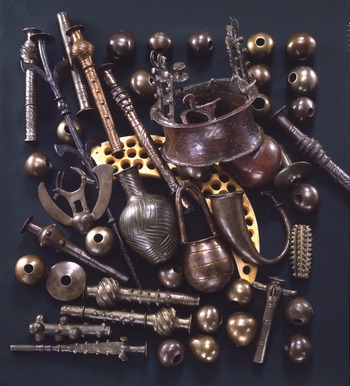
The development of metallurgy is one of the most singular characteristics of the Ghassulian culture. The smelting in furnaces from the earliest stage of copper production differentiates it from its contemporaneous homelands. In all of them, extractive metallurgy was first developed in crucibles, extending the extraction of native copper from its mineral gangue (Amzallag Reference Amzallag2009). Ghassulian metallurgy is also marked by its achievements, unveiled in the hoard of more than 400 items in the Nahal Mishmar cave (Judean Desert) (Bar Adon Reference Bar Adon1980), dated from the second half of the fifth millennium bc (Aardsma Reference Aardsma2001; Klimscha Reference Klimscha, Burmeister and Bernbeck2017, 113) (see Fig. 1).
Miscellaneous artefacts from the Nahal Mishmar hoard. (Israel Museum, Jerusalem.)

Most of the items were produced through the complex technique of lost-wax casting. For successful filling of the small space between the internal and external moulds, their hollowed nature requires the use of appropriate alloys (here arsenic-copper or antimony-copper alloys), control of the temperature, pouring process and gas release (Shalev & Northover Reference Shalev and Northover1993). The local origin of the clay making the moulds, and the high complexity and standardization in their production, suggest their local production by a group of specialized, highly skilled metalworkers operating within Ghassulian society (Goren Reference Goren2008, 390). Furthermore, the paucity of arsenic and antimony in the local ore (the Arabah mining area) betrays the origin of these additives from afar, probably the upper Euphrates or the Caucasus area (Gandulla & Jaruf Reference Gandulla and Jaruf2017).
Artifacts similar to those from Nahal Mishmar were unearthed from other Ghassulian sites, such as Giv'at Ha-Oranim (Namdar et al. Reference Namdar, Segal, Goren, Shalev, Scheftelowitz and Oren2004) and Shiqmim (Levy et al. Reference Levy, Grigson and Buikstra1991). Further, an important collection of similar implements was recently discovered in a metal workshop of the late Ghassulian site of Fazael, in the central Jordan Valley area (Rosenberg et al. Reference Rosenberg, Buchman, Shalev and Bar2020) (see Fig. 2). These findings invite us to consider the implements from Nahal Mishmar representative of the approach to metallurgy among the Ghassulians.
Metallic implements from various Ghassulian sites. (A) Decorated sceptre from Giv'at Ha-oranim (from Namdar et al. Reference Namdar, Segal, Goren, Shalev, Scheftelowitz and Oren2004, courtesy Na'ama Sheftelovitz, Tel Aviv University); (B) Upper part of copper standard from Shiqmim (from Levy et al. Reference Levy, Grigson and Buikstra1991, courtesy Thomas E Levy, UC San Diego Levantine Archaeology Laboratory); (C) Head-shaped copper standard from Fazael (from Rosenberg et al. Reference Rosenberg, Buchman, Shalev and Bar2020, courtesy Shai Bar Levy and Danny Rosenberg, Zinman Institute of Archaeology, University of Haifa.)

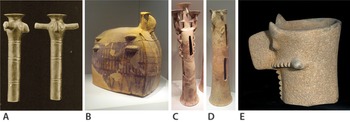
These complex items, whose production requires an extensive investment of time, means, experimentation and skill, did not serve as markers of social ranking. Their absence in the burial context or any other assemblage correlated with social ranking insinuates that they were not regarded as markers of authority, chiefdom or social hierarchy (Gosić & Gilead Reference Gosić, Gilead and Laneri2015, 164). Even the Nahal Mishmar artifacts shaped as tools (axes, chisels, adzes) do not show traces of use, and their size sometimes challenges their production for utilitarian purposes (Golden Reference Golden2009, 294–5). The Nahal Mishmar copper artifacts, including the tool-shaped ones, were identified as ‘ritual items’, in light of the proximity of the Nahal Mishmar cave to the Ein Gedi Late Chalcolithic sanctuary (Klimscha Reference Klimscha, Burmeister and Bernbeck2017, 124). Similar symbolism found in the Nahal Mishmar metallic artifacts and Ghassulian ritual implements (ossuaries, incense burners) also promotes this interpretation (Gosić Reference Gosić2013, 187). Furthermore, the parallel symbolism of some Nahal Mishmar copper implements, ossuaries and cultic items (see Figs 2C & 3), especially through the similar prominent nose (Gal et al. Reference Gal, Smithline and Shalem1999), suggests an expression of beliefs concerning death, afterlife and regeneration in both (Amzallag Reference Amzallag2018, 72–3; Ilan & Rowan Reference Ilan and Rowan2012).
Parallel symbolism (prominent nose) between copper artefacts and ceramic ‘religious items’ from the Ghassulian culture. (A) Copper standard from Nahal Mishmar; (B) Ossuary from Peqi'in; (C–D) Fenestrated incense burners from Peqi'in; (E) Basalt incense burner from Rasm Harbush (Golan). (Sources: A: Israel Exploration Society; B–D: author images; E: Israel Antiquities Authority.)

These parallels do not necessarily transform metallurgy into a ritual activity. After all, copper might have been selected as the appropriate material support for the expression of symbols and beliefs. This remains unlikely, however, for at least two reasons. The first is the synchronicity attested between the rise of the Ghassulian symbolism, the changes in burial practices and the dawn of metallurgy in the southern Levant (about the forty-fifth century bc) (Gosić Reference Gosić2013, 264; Gosić & Gilead Reference Gosić, Gilead and Laneri2015, 161). The second is the extension to the utilitarian-like implements of the ritual dimension identified in Nahal Mishmar. This feature betrays symbolic dimension and/or ritual charge attached to the metal, independent of the shape and figuration. Consequently, metallurgy was probably an integrative part of the universe of beliefs of the Ghassulians from its very beginning. Milena Gosić and Isaac Gilead (Reference Gosić, Gilead and Laneri2015, 171) even assume that the ritual dimension of metallurgy was the heart of the Ghassulian religion:
Ghassulian metallurgy introduced a new ritual behavior, starting with metal-smelting, through shaping the artefact, to the use of the finished implement in rituals. Its transformational quality demonstrated the unprecedented control of the smiths over the material world and suggests that they were most influential members in their communities.
The interpretation of the symbolism attached to some of the Nahal Mishmar implements supports this conclusion. Apparently, metallurgy opened to the Ghassulians a new universe of beliefs, especially concerning cosmology, death, afterlife, regeneration, healing and procreation (Amzallag Reference Amzallag2018). This perspective reveals that the experience of metallurgy shaped many of the beliefs and rituals of the Ghassulian religion.
Technopoiesis in the Ghassulian metallurgy
Concerning complex techniques, especially those elaborated throughout generations, the gradual emergence frequently occurs independently of the perspectives of exploitation of the end-product generally ignored at first. For example, the domesticated cereal species differentiating throughout centuries of cultivation of the wild species cannot motivate the early domestication process. Further examples indicate that a fascination with the process and its cosmological resonance frequently fuels the early development of complex techniques (Amzallag Reference Amzallag2020). Technology is inappropriate for designating such a ‘juvenile phase’ of technical development, and an alternative conceptual framework should be introduced.
Aristotle (Nicomachean Ethics, 1094a, 1–8) accounts for two types of practical activities, praxis and poiesis. The former (generally translated as action) expresses a mode of production guided by an exogenous finality, the desired issue whose representation exists before the action. Technology, in its modern meaning, is therefore a technopraxis encompassing the elaboration, improvement and exploitation of methods that abet the efficient use of techniques (clustered or considered separately) to ensure the fabrication and elaboration of desired end-products.
In the other mode, poiesis (frequently translated as art), the process is not conditioned by any external motivation, being its own finality. This distinction invites us to introduce technopoiesis for accounting for the situations where the importance of the production process prevails over that of its end-product and its perspectives of practical exploitation (Amzallag Reference Amzallag2020).
The metallurgical symbolism of some of the Nahal Mishmar copper items transforms them into the tracers of the processes that brought them forth. For this reason, these items should be considered processual artifacts, whose prestige and holiness derive from that attributed to the technical process itself. This situation creates an inversion of value regarding the technological approach in which techniques are used to gain the desired end-product. If many of the metallic artifacts produced by the Ghassulians (especially those requiring great effort) are processual rather than utilitarian/prestige artifacts, the techniques conditioning their production fit the definition of technopoiesis.
Basic features of the Ghassulian metallurgy reflect its technopoietic character. First, unlike the other homelands from the ancient Near East, Ghassulian metallurgy did not extend the exploitation of native copper. Instead, it emerged in ignorance of this end-product and its potential uses. Furthermore, Ghassulian metallurgy emerged from its very beginning from the combination of ore smelted in a furnace and copper extracted from slag in a crucible (Ackerfeld et al. Reference Ackerfeld, Abadi-Reiss and Yagel2020; Shugar Reference Shugar2000, 245–53). Neither technique was used earlier in the southern Levant, so that their simultaneous serendipitous discovery is unlikely. Instead, the development of the technique of copper production probably took generations in the southern Levant, a period during which the end-product potential use remained minimally important or even ignored.
Further characteristics of the Ghassulian metallurgy concur. Technopoiesis is generally characterized by a high level of inventiveness and technical virtuosity (Amzallag Reference Amzallag2020). Both features are especially observed in the southern Levant homeland. Furthermore, processual artifacts are typically produced throughout the juvenile phase of technical development. Finally, the cosmological dimension of Ghassulian metallurgy identifies it as a technopoiesis rather than a technology. These observations suggest that the rise of metallurgy stimulated the emergence of new religious concepts of central importance among the Ghassulians. This situation fits the observation of Rowan and Golden (Reference Golden2009, 1), stressing that the Ghassulian period ‘witnessed major cultural transformations in virtually all areas of society, most notably craft production, mortuary and ritual practices, settlement patterns, and iconographic and symbolic expression.’
The transition to technology
South Levantine metallurgy underwent a radical change from the end of the Chalcolithic period. Unlike the Ghassulian metalworkers who used copper alloys for casting complex items in lost-wax moulds, their followers from the Early Bronze Age used pure copper for casting simple implements in open or bivalve moulds.
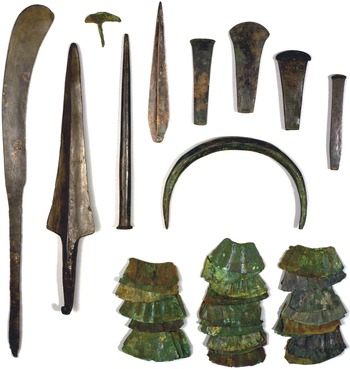
The nature of the items changed as well. Whereas the Ghassulian metalworkers turned their skill toward making processual artifacts, their followers focused on producing tools (awls, flat axes, adzes), weapons (crescentic axes, daggers, spearheads) and prestige items (Genz Reference Genz2000, 58; Golani Reference Golani and Maczynska2014, 125; Joffe Reference Joffe, Adams and Roux2021, 96) (see Fig. 4).
Collection of copper items from the Kfar Monash hoard. (Israel Museum, Jerusalem.)

The drop in the production and use of flint and bifacial tools (axes, adzes, chisels), identifiable from the transitional period (EB1A) in the Southern Levant, confirms the switch towards the use of copper as raw material for making useful items (Barkai Reference Barkai, Davis and Edmonds2011). Alex Joffe (Reference Joffe, Adams and Roux2021, 97) describes this transformation of metallurgy as follows:
a tightly circulated and ritually charged technology was demystified and widely proliferated, including internationally. Like animals, chipped stone, and olives, copper became another commodity for accumulation, conversion into other sources of wealth and power.
Here again, the most straightforward justification for such a radical shift is to presume an external influence. The integration of the southern Levant in a metallurgical province of production, diffusion and trade of utilitarian/prestige artifacts may easily substitute a utilitarian perspective for the esoteric approach to metallurgy. However, no trace of such foreign influence is visible in the southern Levant at the early fourth millennium bc. Rather, the main cultural influence at the EB1A is oriented from southern Levant to the Nile valley (Watrin Reference Watrin2004, 49–51). The Mesopotamian influence in the Southern Levant and Egypt occurs even later, from the EB1B (Middle Uruk culture, LC4) (Watrin Reference Watrin2004, 56). The use of stamp and cylinder seals at this time attests for substantial development of the network of exchange and trade (Braun Reference Braun2004).
Despite these thorough changes, the elements of continuity between the Ghassulian and EB1 techniques of metallurgy (Shalev Reference Shalev1994) suggest an indigenous evolution of the approach to this craft. Such a transformation is not difficult to conceive. It is the mere consequence of the spontaneous change of approach to metallurgy, from a process with cosmological resonance (technopoiesis) to the production of raw material for practical uses (technology) (Amzallag Reference Amzallag2020). Many observations confirm this conceptual change. During the Late Chalcolithic period, the local copper ore extracted from the Arabah valley (Timna, Faynan) was transported to small workshops, mainly located in the northern Negev. There, the metal was smelted, purified, alloyed with exotic ores and cast. No specialization is visible in these small-scale workshops, as expected for an activity centred on the technical processes, their symbolism, significance and complementarity (Golani Reference Golani and Maczynska2014, 127; MacDonald Reference MacDonald2014, 38). However, a division of labour is observed from the EB1 period, with metal production and its working both occurring in specialized workshops distant from others.
Smelting: From the EB1, the production of copper occurs in the Arabah valley, especially in the mining district of Faynan (the site of extraction of the local ore previously used by the Ghassulian metallurgists) (Genz Reference Genz2000; Golani Reference Golani and Maczynska2014, 127; Milevski et al. Reference Milevski, Gandulla, Jaruf, Stucky, Kaelin and Mathys2016). A division of labour is even attested in these production sites, including areas specialized in grinding the ore, smelting and purification (Adams & Genz Reference Adams and Genz1995; Ben-Yosef et al. Reference Ben-Yosef, Gidding and Tauxe2016; Levy et al. Reference Levy, Adams and Hauptmann2002). This decomposition betrays an organization conditioned by criteria of optimization and efficiency of the process and standardization of the end-product. This practical approach typically indicates a shift towards technology.
Copper working: In parallel with the Arabah centres specialized in copper production, an activity of refining and casting copper implements blossomed in the southern coastal plain throughout the EB1, especially in the region of Ashkelon (Golani & Segal Reference Golani, Segal, van den Brink and Yannai2002; Segal et al. Reference Segal, Halicz and Kamenski2004). No traces of smelting are visible in these coastal sites, suggesting that the raw material (semi-refined copper) originated from the Arabah production centres (Golani Reference Golani and Maczynska2014, 128–9). The amount of debris (slag, copper lumps, broken crucibles, storage pits) found in these sites reflects an extensive development of this metallurgical activity. Here again, the division of labour betrays a practical approach and its orientation towards production efficiency and standardization (Golani Reference Golani2013; Reference Golani and Maczynska2014). Also, the nature of the items produced, mainly utilitarian tools (awls, knives, axes, needles), confirms the switch between technopoiesis and technology occurred at the end of the Ghassulian period.
This market-oriented activity was not directed towards local use. Rather, most items produced on the southwestern coast were apparently sent to the Nile Delta area (the Bouto-Maadi region), the platform for their distribution across the whole Nile valley (Gophna & Milevski Reference Gophna and Milevski2003, 223; Golani Reference Golani and Maczynska2014, 126; Maczynska Reference Maczynska and Maczynska2014, 185). Copper ingots, locally transformed in the Nile Delta, were also imported (Klimscha Reference Klimscha and Minarova2011, 125; Hauptmann et al. Reference Hauptmann, Schmitt-Strecker, Levy and Begemann2015). This activity substantially contributed to the emergence of the urban culture in the Southern Levant from the EB1 (Ben-Yosef et al. Reference Ben-Yosef, Gidding and Tauxe2016, 80; Golani Reference Golani and Maczynska2014, 120; Gophna & Milevski Reference Gophna and Milevski2003, 224).
In light of the central position of metallurgy in the religious life of the Ghassulian, its spontaneous evolution from technopoiesis to technology might be the endogenous factor stimulating the crisis of Ghassulian society and its metamorphosis attested in the transitional period.
The emergence of the technological phase
Intuitively, the spontaneous transition from technopoiesis to technology is expected to occur in the Beer Sheba valley, the core of Ghassulian metallurgy. This scenario is unlikely, however, for at least two reasons. First, the Beer Sheba valley is positioned on the pathway between the Faynan mining area and the Mediterranean coast. Consequently, if the shift to technology happened there, there is no reason for the local cessation of metallurgy at the transitional phase. Second, the earliest mining area organized around efficient metal production (technological phase) is not Faynan, the region of origin of the local copper ore smelted by the Ghassulian metalworkers, but the small mining areas of Timna and Nahal Amram, located 150 km south of Faynan. This region was disconnected from the Ghassulian metallurgical network (Ben-Yosef et al. Reference Ben-Yosef, Gidding and Tauxe2016, 79; Joffe Reference Joffe, Adams and Roux2021, 96–7), indicating that the shift to technology occurred at the margins of Ghassulian culture.
Sites of copper production
In the southern Levant, the earliest traces of a technological approach to metallurgy are visible in two sites located near the Red Sea shore, 10 km south of Nahal Amram's mining area and 30 km from Timna's. Both sites, Tal al-Magass and Hujyarat al-Ghuzlan, show traces of metallurgical activity between 3900 and 3600 bc, that is, throughout the transitional period (Kerner Reference Kerner and Chesson2011, 132). The many metallurgical remains suggest that copper production was the main activity in both. Though furnaces were not discovered in this site (Klimscha Reference Klimscha and Minarova2011, 186, a feature suggesting that metallurgy occurred far from the habitations), many mortars for ore crushing, more than 600 remains of crucibles and 300 remains of moulds were unearthed from Hujyarat al-Ghuzlan (Klimscha Reference Klimscha and Minarova2011, 198; Pfeiffer Reference Pfeiffer2009, 306). Similar traces of metallurgy (copper fragments, ingots, crucible fragments, slag, ash) were discovered in Tal al-Magass (Pfeiffer Reference Pfeiffer2009, 311). The many moulds for casting copper ingots, in both areas, designate Tal al-Maqass and Hujayrat al-Ghuzlan as sites specialized in the production of raw copper transformed into implements somewhere else (Klimscha Reference Klimscha and Minarova2011, 188, 198; Pfeiffer Reference Pfeiffer2009, 312). This dichotomy between copper production and use represents the earliest indication of a technological approach to metallurgy in the southern Levant. Another singularity of these sites regarding the Ghassulian culture is the global replacement of flint by copper tools (Klimscha Reference Klimscha and Minarova2011, 197), confirming the shift towards the utilitarian use of this metal.
Sites of copper transformation
Identifying the southern Arabah as the first site specialized in the production of copper implies the existence of sites where a parallel shift from technopoiesis to technology occurred, transforming copper into utilitarian and prestige rather than processual artifacts. These first main centres of metal transformation were apparently located not in the southern Levant, but in the Nile Delta, an alluvial region deprived of copper resources (Helwing Reference Helwing, Stockhammer and Maran2017, 164).
The discovery in Maadi, at the early fourth millennium, of copper ingots of shape and size corresponding to the moulds from al-Magass and Hujayrat suggests it was the destination of the raw copper produced in the southern Arabah (Hartung Reference Hartung2013, 184; Kerner Reference Kerner and Chesson2011, 130; Klimscha Reference Klimscha and Minarova2011, 199; Pfeiffer Reference Pfeiffer2009, 323). The discovery, in Tal al-Magass, of a greenish plaque resembling the cosmetic palettes from Egypt confirms the relationship between these two areas (Notroff et al. Reference Notroff, Schmidt, Siegel and Khalil2014, 262). The finding of malachite in Maadi suggests (minor) smelting activity; substantial traces of metalworking (copper ingots, prills, slag fragments and ash layers) were also identified (Hartung Reference Hartung2013, 184). These finds indicate the transformation of the copper ingots from the southern Levant into tools, ornaments and prestige artifacts (Pfeiffer Reference Pfeiffer2009, 321). Here again, the utilitarian nature of the produced items fits a technological perspective comparable to the one attested in the southern Arabah at the same time. The shift to technology complementary to metal production occurred also at the periphery of Ghassulian society.
The identity of the promoters
A technological approach to metallurgy is visible in the other homelands of metallurgy, at the transition from the fifth to the fourth millennia bc. It is revealed by the small tools (chisels, awls, hooks and knives), weapons (projectile points, daggers, axes) or ornaments (rings, beads, pendants) produced in the earliest sites of extractive metallurgy (fifth millennium bc) in Iran (Frame Reference Frame2009), Anatolia and upper Euphrates (Stork Reference Stork2013, 81; Reference Stork2015, 117, 119), the Caucasus (Courcier Reference Courcier, Roberts and Thornton2014; Meliksetian Reference Meliksetian, Kraus, Pernicka and Yalçin2011) and the Balkans (Antonovic Reference Antonovic2002; Chernakov Reference Chernakov2018; Jovanovic Reference Jovanovic2009). The absence of visible ritual dimension of metallurgy in these homelands, and the lack of processual artifacts, corroborate this premise. Consequently, interpreting the shift as resulting from such foreign influence is theoretically possible. Nevertheless, the geographic isolation of the earliest centres of copper production (southern Arabah) renders this hypothesis unlikely.
The first traces of human activity in Hujayrat date from the early fourth millennium bc, a feature suggesting that this site was devoted to the production of copper from its very beginning. However, the adjacent site of Tal al-Magass shows traces of occupation from the late fifth millennium bc (Avner Reference Avner, Bienkowski and Galor2006, 61; Notroff et al. Reference Notroff, Schmidt, Siegel and Khalil2014, 254–5). It also denotes continuity in the material culture between this early phase of occupation and the following one in the early fourth millennium. Consequently, the shift towards technological metallurgy looks like a local initiative promoted not by the Ghassulian metalworkers but rather by people living in these mining areas, at the margins of Ghassulian culture.
At the early fourth millennium bc, the ceramic unearthed in both sites displays more affinities with the Late Chalcolithic than the EB1 ware. However, unlike most Ghassulian ceramic, this pottery remains rough and simple and is rarely decorated, with a limited repertoire of shapes (Kerner Reference Kerner and Chesson2011, 136, 140; Klimscha Reference Klimscha and Minarova2011, 114). In parallel, the lithic industry shows a low level of specialization and technical achievements (Rosen Reference Rosen2013, 141). These characteristics integrate Tel al-Magass and Hujayrat in the Timnian culture identified in the southern margins of the Ghassulian culture: Arabah, Sinai, southern Negev and northwestern Arabia (Rosen Reference Rosen2013, 142).
The EB1 material culture in the Faynan area adds further details. The ceramic discovered on the sites of proto-industrial copper production displays affinities with the Timnian culture (Ben-Yosef et al. Reference Ben-Yosef, Gidding and Tauxe2016, 80; McDowel Burton Reference McDowel Burton2004, 636–9). This similarity contrasts with the rarity of sites belonging to the Timnian culture in the Negev highland in the Late Chalcolithic period, a region influenced by the Ghassulian culture (Rosen Reference Rosen2013, 142). Consequently, it seems that the technological approach to metallurgy results from the development of a local smelting activity among miners, probably inspired by Ghassulian metallurgy but independent of it.
The becoming of the Ghassulian metalworkers
Within the 75 Ghassulian sites identified in the northern Negev, only eight show traces of occupation at the end of the EB1. The sites with metallurgical activity (especially in the Beer Sheba valley) are no longer inhabited (Rowan & Golden Reference Rowan and Golden2009, 70). This region was more affected than the others, where the transition was more gradual (MacDonald Reference MacDonald2014, 38). If the metallurgical activity ceased when the settlements disappeared, we might presume that the Ghassulian metalworkers moved away.
Southern Levant
The sites of copper production in the Arabah (EB1) do not show significant markers of the Ghassulian culture, suggesting low participation of the Ghassulian metalworkers in their emergence. However, the situation differs in other areas, where traces of the Ghassulian culture are visible in EB1 sites of metallurgical activity.
Tel Halif/Nahal Tilla
The Tel Halif terrace/Nahal Tilla site is located northward from Beer Sheba, at the junction between the northern Negev, the Hebron hills and the coastal plain. Already active in the Late Chalcolithic period, the site shows a demographic decline at the transitional period (Alon & Yekutieli Reference Alon and Yekutieli1995). Beyond the continuity in the utilitarian ceramic vessels between the two periods (holemouth jars, churns: see Dessel Reference Dessel2009, 60–71, 96–101, 107), the site is of particular interest for metallurgical activity in the EB1 period, revealed by the abundance of fragments of crucibles, slag, copper prills, ores and ashes. These fragments suggest that casting, copper purification and even smelting were performed in the transitional period and even later (Golden Reference Golden, van den Brink and Levy2002b, 226–7; Pfeiffer Reference Pfeiffer2009, 314).
Tel Halif is also exceptional for the markers of the Ghassulian culture dated from the transitional period. The site includes ceramic ritual artifacts such as cornets and a violin-shaped stone figurine (Dessel Reference Dessel and Wolff2001; Reference Dessel2009, 105–7; McDowel Burton Reference McDowel Burton2004, 360–61, 417; Yekutieli Reference Yekutieli and Wolff2001). Once gathered, these findings suggest the moving to this site of metalworkers from the Beer Sheba valley in the early fourth millennium bc. However, unlike the processual artifacts produced by the Ghassulian metalworkers, their followers from Tel Halif fabricated simple functional implements. This trend is frequently identified as a ‘recession’ with regard to Ghassulian metallurgy and its achievements (Golden Reference Golden, van den Brink and Levy2002b, 235). Here, it reveals that the shift from technopoiesis to technology was also performed by metalworkers originating from the Ghassulian horizon. Interestingly, ceramics of Egyptian form types (rolled-rim bowls, lotus-shaped bowls, jars) are also visible in the EB1A period at Tel Halif (Dessel Reference Dessel2009, 107–19), a feature revealing relationships between the Nile valley and this site of production of metallic items in continuity with the Ghassulian culture. This singularity integrates Tel Halif into the network of exchanges between the Nile valley and the southern Levant emerging in the EB1A (Dessel Reference Dessel2009, 138–9), apparently organized around the trade of raw metal and implements.
Ashkelon
In the Early Bronze Age, the region of Ashkelon became specialized in producing utilitarian implements from the raw copper originating from the Arabah area of production. As an intermediate between copper production in the Arabah and its distribution in the Nile valley, Ashkelon metallurgy integrates the newly emerging technological framework. Nevertheless, elements of the Ghassulian culture remain visible in this area throughout the transitional period and even later. This trend concerns the pottery-making traditions, the shape of the utilitarian ceramic and flint tools and especially the presence of specific markers of Ghassulian culture, such as cornets and basalt vessels (Alon & Yekutieli Reference Alon and Yekutieli1995; Braun Reference Braun, Philip and Baird2000; Dessel Reference Dessel and Wolff2001; Golani Reference Golani2013, 98). Additionally, the burial traditions attested in Ashkelon display a greater affinity with Ghassulian burials than those from the EB1 (Golani Reference Golani2013, 104). These findings indicate that the people settling in the region of Ashkelon did not originate from the Timnian culture from which the technological approach of metallurgy emerged. The preservation of the Ghassulian culture combined with a metallurgical activity is rather compatible with the movement of Ghassulian metalworkers from the Beer Sheba valley to this new pole of metallurgical activities (Golani Reference Golani2013, 96; McDowel Burton Reference McDowel Burton2004, 410–11).
Relocation to northern Egypt
From the early fourth millennium bc, the Nile delta area became a region of transformation of raw copper and its distribution in the Nile valley (Maczynska Reference Maczynska and Maczynska2014, 182, 185; Rizkana & Seeher Reference Rizkana and Seeher1989, 17, 137–41; Watrin Reference Watrin2000). The early relations with the Tel al-Magass and Hujayrat sites and the utilitarian uses of copper reveal that this Egyptian expansion of the southern Levant metallurgy integrated the technological framework from its very beginning.
The remains from the Nile delta (especially from Bouto and Maadi) suggest the presence of south Levantine people in the early fourth millennium bc (Faltings Reference Faltings, van den Brink and Levy2002; Kerner Reference Kerner and Chesson2011, 134; McDowel Burton Reference McDowel Burton2004, 637–9, 651; Wilkinson Reference Wilkinson, van den Brink and Levy2002). The oval subterranean structures identified in these sites are similar to those found in the Late Chalcolithic Beer Sheba (Rizkana & Seeher Reference Rizkana and Seeher1989, 49–56). The discovery in Maadi of a cluster of houses with this characteristic even suggests the existence of a ‘foreign quarter’ inhabited by people extending the Ghassulian way of life (Faltings Reference Faltings and Eyre1998, 374; Watrin Reference Watrin and Eyre1998, 1218). Other markers of the Ghassulian culture (such as V-shaped bowls and fenestrated bowl-stands) are also present. The petrographic analysis of the pottery reveals that some of these pieces were imported from the southern Levant, whereas others were locally produced (Commenge & Alon Reference Commenge, Alon, van den Brink and Levy2002, 146; Faltings Reference Faltings and Eyre1998, 367; Maczinska Reference Maczynska and Maczynska2014, 187; Rizkana & Seeher Reference Rizkana and Seeher1987, 31–2, 46–7, 108–11). All these features leave few doubts that people belonging to the Ghassulian culture moved to the Nile delta in the early fourth millennium bc (Golani Reference Golani and Maczynska2014, 130; McDowel Burton Reference McDowel Burton2004, 651).
This migration might be a consequence of the collapse of the Ghassulian culture, especially in the Beer Sheba region (Commenge & Alon Reference Commenge, Alon, van den Brink and Levy2002). However, the perspective of metallurgical activities in the Nile delta might have been a central motivation in this relocation. With metallurgy absent in Egypt before the early fourth millennium bc, its sudden development in the Nile delta suggests the reinstallation of metalworkers attached to the Ghassulian culture after its collapse.
These observations reveal that the specialized craftsmen from the Ghassulian culture did not disappear. Rather, their involvement in the new centres of production and distribution of metallic implements suggests that many adapted their activity to the new technological horizon.
Refurbishing Ghassulian values in the Bronze Age
With the transition to technology, a practical approach and the perspectives of wealth accompanying it replace the cosmological dimension attached to technopoiesis (Amzallag Reference Amzallag2020, 17–18). This substitution may explain why the metallurgical foundations of the Ghassulian culture evanesce throughout the transitional period. By extension, the transient survival of these beliefs and rituals (especially in sites specialized in copper working, see above) becomes an atavism postponing their definite disappearance. Alternatively, the survival of some markers of Ghassulian culture might prelude their refurbishment in the religion blossoming in the Early Bronze Age. This latter eventuality is examined below.
Southern Levant
A survival of the Ghassulian religion is visible through the similarities between the plan of the Chalcolithic shrines of Ein Gedi and Tuleilat Ghassul, and the sacred area later edified in the EB1 (Caselli Reference Caselli and Iamoni2020, 176). These sacred areas are surrounded by similar temenos enclosing a rectangular edifice with an aperture on one of the two long walls. This extension of Ghassulian shrine architecture, visible up to Byblos, became a characteristic of southern Levantine temples throughout the Early Bronze Age (Sala Reference Sala2011, 3). It is noteworthy that this conservatism does not result from any EB1 extension of the use of shrines that already existed. Even shrines that were newly erected, such as the Meggido sanctuary (mid fourth millennium bc, EB1B period), follow this Ghassulian pattern (Caselli Reference Caselli and Iamoni2020, 176).
The discovery of metallic implements in Bronze Age temples from Byblos and Megiddo corroborates this trend. Frequently approached as votive offerings, the location of some of them under the temple or even within its walls suggests they are foundation deposits (Philip Reference Philip1988, 191–6). This religious importance of metallurgy in the Bronze Age echoes similar Ghassulian practices: copper (processual) artifacts were deposited under the wall of a public building from Shiqmim, near Beer Sheba (Levy et al. Reference Levy, Grigson and Buikstra1991, 33–4).
The discovery of crucibles, stone moulds, miniature ingots and lumps of copper in the vicinity of the Bronze Age sanctuaries in Kamid el Loz (Metzger Reference Metzger1991, table 17), Hazor (Artzy Reference Artzy2000, 27–8), Tel Nami (Yahalom-Mack et al. Reference Yahalom-Mack, Gadot and Eliyahu-Behar2014, 25–30) and Tel Dan (Ben Dov Reference Ben Dov2011) confirm that metallurgy preserved a religious dimension in the Bronze Age, independently of the utilitarian perspective guiding the fabrication of its end-products. Also in ancient Egypt, an examination of the foundation deposits of Old Kingdom temples reveals the presence of metallic implements, as well as ores, solidified metal flows and ingots, all promoting a symbolic homology between the temples and areas of metal production (Aufrère Reference Aufrère1991, 189–93). Further attributes of the gods sponsoring metallurgy confirm that this craft served as religious esoteric fundament in the ancient Near East (Amzallag Reference Amzallag, Goldfus, Gruber, Yona and Fabian2019; Kristiansen & Larsson Reference Kristiansen and Larsson2005, 49–57). The technopoietic dimension of metallurgy must have therefore remained a religious fundament in the southern Levant for millennia after the disaggregation of the Ghassulian culture.
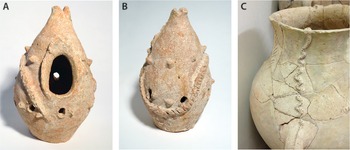
Religious symbols are similarly continuous. The sacred area of Jebel al-Mutawwaq (Jordan) comprises many representations of dotted serpents and zigzag motifs on ritual vessels dated from the EB1 period. A cultic ware with a serpent's head positioned near the rim advocates the close relation of this symbol with the liquid element filling the jar (Caselli Reference Caselli and Iamoni2020, 177, 179; Polcaro et al. Reference Polcaro, Muniz, Alvarez and Mogliazza2014, fig., 7; Sala Reference Sala2011, 6–7). A similar use of the serpent motif is observed in Jericho (EB1). The motif of the ‘dotted serpent’ is already attested in Ghassulian culture, visible on pottery discovered in the sacred areas of Ein Gedi and Ghassul (Caselli Reference Caselli and Iamoni2020, 178). The importance of the motif is confirmed by the discovery of the ceramic head of a dotted serpent in Shiqmim near metallurgical installations (Levy et al. Reference Levy, Grigson and Buikstra1991, fig. 5), and by the representation of serpents on incense burners and ossuaries, two artifacts typically associated with the Ghassulian universe of beliefs (see Figs 3C & 5).
The motif of the dotted serpent in the Chalcolithic and EBA Southern Levant. (A–B): Miniature ossuary with a dotted serpent, Ben Shemen (Chalcolithic) (Israel Antiquities Authority); (C) Cultic jar with serpent from Jebel al-Mutawwaq (EB1) (from Polcaro et al. Reference Polcaro, Muniz, Alvarez and Mogliazza2014, courtesy Andrea Polcaro, Università degli Studi di Perugia).

The dotted serpent symbol extends far beyond the Ghassulian period, and is encountered in a cultic context in Arad, Megiddo, Hazor, Gezer, Sechem, Ein Samiya, Bet Shemesh, Bet Misrim, Jericho and Tel Dan up to the Late Bronze Age (Joines Reference Joines1974, 62–9; Koh Reference Koh1994, 45–61). The evolution of this symbol, across more than 25 centuries, reveals that its expression is not merely an atavism inherited from the Ghassulian traditions, but rather a central element of religious life in the Bronze Age (Joines Reference Joines1974, 62; Koh Reference Koh1994, 53, 60).
The serpent is frequently approached as a symbol of fertility, a meaning which easily justifies its perpetuation far beyond the demise of the Ghassulian culture and independent of its metallurgical fundaments. Nevertheless, the dotted serpent is a symbol apparently attached to a species, Echis coloratus, typically encountered in the Arabah valley, the area of origin of the copper ore (Amzallag Reference Amzallag2015). The serpent's relationship with metallurgy is confirmed by the typical production of copper serpent symbols in the southern Levant. The homonymy in Canaanite languages between copper (nḥšt) and serpent (nḥš) concurs, as this latter appellation substitutes ḥwy and lwy in all other Northwest Semitic languages. The discovery of a copper serpent in the sanctuary from Timna (end of the second millennium bc) located in the mining area and the metallurgical activity performed in its midst conform the metallurgical symbolism of this creature (Rothenberg Reference Rothenberg1988, 147).
This conclusion corroborates the extensive use of the serpent symbol in the ancient Near East from the mid fourth millennium bc, a period coinciding with the first wave of expansion of metallurgy. For example, Ptah, the patron of metalworkers, was identified with the cosmic serpent Ir-ta (Sauneron & Yoyotte Reference Sauneron and Yoyotte1959, 33–8). In Sumer, too, the cosmic serpent is called the ‘seed of fire’ (Jestin Reference Jestin1947, 55–7). Also Enki, the crafty god, is called ‘the snake’ (mus Enki), and Dilmun, his terrestrial residence, was the homeland of the serpent worship (Espak Reference Espak2006, 51–3).
Egypt
Despite the technological dimension of metallurgy in the Nile valley from its very beginning (early fourth millennium bc), many religious practices from the Predynastic period onwards are inspired by metallurgy. For example, malachite served as grave deposits, and it was spread on the dead before burial, as revealed by the green colour frequently observed on bones (Midant-Reynes Reference Midant-Reynes2003, 164–74,180–84). The presence of charcoals, slag and furnace residuals in funeral contexts confirms the metallurgical dimension of this practice attested in the Predynastic period. This practice reveals that the grave was likened to a copper furnace, in which the rust-like body of the deceased was expected to revitalize through re-melting. This belief echoes the relationship between metallurgy and the life/death transition attested in Ghassulian culture.
In parallel with the Early Bronze Age sanctuaries from the southern Levant, the Old Kingdom temples had foundation deposits of metallurgical nature, including copper miniature ingots, metallic ores and fragments of solidified metal flows (Aufrère Reference Aufrère1991, 189–91). Beyond the symbolic homology between temples and areas of metal production (Aufrère Reference Aufrère1991, 193), this practice reflects an approach to metallurgy as the fundament of the Egyptian religion. This central importance stresses further parallels with the Ghassulian religion.
The importance of the serpent symbol in Egyptian religion concurs. The uraeus, for example, was a symbol of holiness, wealth, power, and kingship in the Old Kingdom period (Andrews Reference Andrews1994, 74). It shares its protective functions with Mehen, the cosmic coiled serpent protecting the god Ra against the forces of chaos and destruction threatening his integrity (Piccione Reference Piccione1990, 43, 46). Here again, the holiness of the serpent symbol seems closely related to metallurgy in ancient Egypt, as the appellation of Mehen as ‘the fiery one’, ‘flame face’, ‘the burned one’, ‘the flaming one’ and ‘high of flame’ reveals (Joines Reference Joines1974, 44–5). The serpent representation of Wadjet, the main goddess of Lower Egypt at the Predynastic period later identified with Hathor (the patroness of copper mining), concurs (Watterson Reference Watterson1999, 129–31). Even the Egyptian patron of metalworkers, Ptah, was identified with the cosmic serpent Ir-ta (Sauneron & Yoyotte Reference Sauneron and Yoyotte1959, 33–8). Though he was not the only Egyptian god closely related to serpents, his association with the primeval snake denotes an essential link with this symbol (Cruz-Uribe Reference Cruz-Uribe1994, 173, 188).
An examination of the attributes of the holy serpent in Early Egypt unveils affinities with the southern Levant iconography. Mehen is represented as a dotted serpent (Piccione Reference Piccione1990, 51, fig. 4), a characteristic closer to the Echis coloratus species from the Arabah valley than the serpents living in the Nile valley. Also, the uraeus, though represented as a cobra, expresses attributes typically attached to Echis coloratus (Amzallag Reference Amzallag2015, 116–18). These features betray the introduction of the southern Levant serpent symbol. Here again, the central importance of metallurgy in the early Egyptian religion looks like an extension of the Ghassulian traditions introduced with the installation in the Nile Delta of a population of metalworkers.
Conclusion
Today, metallurgy is systematically interpreted as a technique of production of goods (tools, ornaments or prestige artifacts). The present study shows how this technological perspective cannot apply to Ghassulian metallurgy and how it obfuscates the importance of the process itself in terms of its religious and cosmological dimension. Instead, identifying metallurgy's technopoietic character reveals these dimensions. This character also clarifies the contrast between the low level of social stratification of Ghassulian society and its outstanding metallurgical achievements. This perspective illuminates the process of disaggregation of this culture: the transition to technology disconnecting metallurgy from its cosmological dimension undermines the religious fundaments of the Ghassulian culture without promoting any alternative.
Other singularities elucidate further. For example, ignoring technopoiesis, we presume a parallel between the evolution from household to proto-industrial metallurgy and the improvement of techniques and achievements. The reason for this is simple: a specialization accompanying the transition to a proto-industrial mode of production is expected to improve craftsmanship and skill. However, the opposite situation is observed in the southern Levant. This counter-intuitive trend corresponds to the transition from technopoiesis to technology on the fringes of Ghassulian society, which accounts for the degradation of metallurgical skill and the archaism of the material culture of those people involved in the transition to technology. Furthermore, the distinction between technopoiesis and technology enables the reconstitution of substantial parts of the challenges accompanying the transition, even in the absence of written documents.
At first sight, the religious dimension prevalent in the technopoiesis phase should evanesce throughout the transition to technology. This is partly reflected through the disappearance of the Ghassulian culture, rituals and beliefs throughout the transitional period. However, unexpectedly, what remains is an outstanding level of preservation of the religious fundaments of metallurgy, independent of their original expression in the Ghassulian culture. This legacy is visible long after the transitional period, in the Bronze Age religions from the southern Levant and Egypt. This influence might even extend far beyond since the same fundaments (including the diffusion of the serpent symbol) are observed in further ancient Near East cultures (such as Mesopotamia and Elam) at the fourth millennium bc (Amzallag Reference Amzallag2021). The expression of this religious dimension of metallurgy in Predynastic Egypt reveals that the metalworkers inheriting the Ghassulian traditions were involved in their diffusion and their transformation into religious fundament. It should not be excluded that the esoteric dimension of metallurgy identified in many Bronze Age religions (Kristiansen & Larsson Reference Kristiansen and Larsson2005, 51–60) emanates from this survival of the technopoietic values of metallurgy in a universe now conditioned by the technological approach of this craft.
Acknowledgements
I would like to thank Professor Isaac Gilead, Dr Peter Fabian, the two anonymous reviewers and the editor for their help and comments, which all contribute to improve substantially the quality of this paper. My thanks go also to Thomas Levy, Danny Rosenberg, Na'ama Sheftelowitz and Andrea Polcaro, for sharing some of the photographs published here.