Introduction
Migraine is a common disabling primary headache disorder characterized by recurrent attacks at high risk of chronicity.Reference Charles 1 Spontaneous oscillations of complex networks have been hypothesized as leading to activity changes in certain subcortical and brainstem areas that in turn might constitute functional changes of descending pain-modulating pathways, and thus the generation of migraine pain.Reference Schulte and May 2 Inter- and intra-individual differences have been documented in the perception of pain in patients with migraine. Consistent data indicate that pain threshold is lower during the ictal phase than during the interictal phase of migraine or healthy controls. There is evidence for preictal sub-allodynia, whereas interictal results are conflicting due to either reduced or no observed difference in pain threshold. In addition, converging observations support the concept that migraine attacks are characterized by an increased pain intensity perception, which normalizes between episodes.Reference Russo, Coppola and Pierelli 3
In addition to nociceptive activation, pain is an individual and internal experience consciously perceived, modulated, and transformed according to its emotional contexts.Reference Hooten 4 For instance, chronic pain is the result of ongoing subconscious changes in the brain function, which are modulated by internal and external processes,Reference Borsook, Youssef and Barakat 5 and psychologicalReference Borsook, Youssef and Barakat 5 and environmental factors.Reference Fava, Tomba and Brakemeier 6
The complexity of pain is nicely represented by the fact that four broad categories have been identified to describe it: nociception, perception of pain, pain behaviors, and suffering.Reference Loeser and Melzack 7
Suffering can be the result of painReference Loeser 8 and exists in the mind of human beings.Reference Sensky 9 Suffering has been described as mental pain,Reference Saunders 10 , Reference Saunders 11 which emphasizes the connection between physical pain and mental suffering. Over the time, several attempts have been made to refine the concept of mental pain referring to the sense of emptiness,Reference Frankl 12 the experience of loss,Reference Bakan 13 an aversive state of inadequacy,Reference Baumeister 14 psychache,Reference Shneidman 15 , Reference Shneidman 16 feeling broken,Reference Bolger 17 and perception of negative changes in the self.Reference Orbach, Mikulincer and Sirota 18 In 2016, FavaReference Fava 19 , Reference Fava 20 operationalized the concept of mental pain in a comprehensive way by identifying 10 indicators: feeling of pain, feeling of heart brokenness, feeling of loss, feeling that pain is everywhere, feeling that pain is always with the individual, inability to understand the cause of pain, sense of emptiness, loss of meaning of life, helplessness, and suicidal behaviors as an escape from the pain. Mental pain was thus conceived as a unitary subjective state of psychological and emotional suffering resulting from behavioral and cognitive processes, having a natural course to run and possibly becoming the source of positive insights that prelude to adaptive changes.Reference Fava, Tomba and Brakemeier 6
Mental pain was found highly connected to physical painReference Saunders 10 , Reference Saunders 11 through psychological distress,Reference Orbach, Palgi and Stein 21 –Reference Orbach, Mikulincer and Cohen 23 to high sensitivity to bodily pain in nonsuicidal patients, and to low sensitivity to bodily pain in suicidal patients.Reference Orbach, Palgi and Stein 21 –Reference Orbach, Mikulincer and Cohen 23 We have currently no data on mental pain in patients with migraine although they present attacks of migraine pain.
Among those living with pain, some individuals have unusual intensity and frequency, and commonly the presence/absence of a peripheral disorder is not well correlated with the presence/absence of pain.Reference Engel 24 EngelReference Engel 24 defined these persons as “pain-prone.” Among them, beginning from a primitive protective system, both as a warning system or a mechanism of defense, pain may help avoiding or warding off unpleasant situations or feeling states, and offers the means whereby certain gratifications can be achieved at a price.Reference Engel 24 Blumer and HeilbronnReference Blumer and Heilbronn 25 refined the clinical features of the pain-prone patient observing that he has hypochondriacal preoccupation on the painful body part and/or presents an image of himself as a “solid citizen” (ie, he strongly denies difficulties in interpersonal relationships and describes family relations in idealized terms), and/or views himself as an independent person, and/or has a history of excessive work and restless activity prior to the occurrence of pain and a complete loss of initiative following the onset of pain, and/or has a family/personal history of depression/alcoholism, abuse, or chronic pain. Interestingly, the literature on migraine proposes the concept of headache-prone individuals who were described as subjects prone to manifest headache, who present high levels of hypochondriasis, depression, hysteria, psychasthenia, and social introversion.Reference Ziegler and Paolo 26 We have currently no data on pain-proneness (PP) in patients with migraine although they might be headache-prone and present specific psychological characteristics.
The aim of the present research, called PAINMIG study, was to carry out a cohort study in patients with migraine enrolled at a tertiary care unit in order to (1) verify whether mental pain and PP are more severe or more prevalent in patients with chronic migraine (CM) compared to patients with episodic migraine (EM) and healthy subjects (HS) and (2) identify, among mental pain and PP dimensions, potential risk factors associated to the condition of CM vs EM vs HS.
Methods
Participants
Participants were migraine outpatients consecutively enrolled from September 2016 to September 2019 at the Headache and Clinical Pharmacology Center of the Careggi University Hospital, Florence, Italy. They had to meet the following inclusion criteria: (1) age from 18 to 64 years and (2) a diagnosis of EM or CM according to the International Classification of Headache Disorders, third edition (beta version). 27 The exclusion criterion was (1) cognitive deficits or other impairments affecting the ability of reading and understanding.
HS were recruited from the general population of Tuscany (Centre Italy) during the study period via flyers posted in common places which specified that subjects had to be healthy and with no migraine. HS had to be 18 to 64 years old. The exclusion criteria were (1) cognitive deficits or other impairments affecting the ability of reading and understanding and (2) a diagnosis of EM or CM according to the International Classification of Headache Disorders, third edition (beta version). 27
Patients with CM, patients with EM, and HS were individually matched for sex and age (ratio 1:1:1) according to the nearest neighbor matching.Reference Rubin 28 The CM group was the reference group (n = 100), and people were recruited into the other two groups in order to match for age and sex.
The study was approved by the Institutional Review Board of the Careggi University Hospital, Florence, Italy.
Procedure
Patients were evaluated by the physicians of the migraine center and diagnosed with CM (≥15 days of migraine/month) or EM (<15 days of migraine/month) according to the International Classification of Headache Disorders, third edition (beta version). 27 Thereafter, they were evaluated by trained clinical psychologists who collected sociodemographic information, data on pharmacological and nonpharmacological treatments, and on the clinical history of organic diseases via an ad hoc set of questions already used in the past.Reference Cosci and Fava 29 , Reference Cosci, Abrams and Schruers 30 The following assessment instruments were then administered: the Migraine Disability Assessment Score (MIDAS) questionnaire,Reference Stewart, Lipton and Dowson 31 the Brief Pain Inventory (BPI),Reference Caraceni, Mendoza and Mencaglia 32 the Structured Clinical Interview for DSM-5 disorders (SCID-5),Reference First, Williams and Karg 33 the Semi-Structured Interview for Diagnostic Criteria for Psychosomatic Research–Revised (SSI-DCPR-R),Reference Cosci, Svicher and Romanazzo 34 the Clinical Interview for Depression (CID),Reference Guidi, Fava and Bech 35 the Euthymia Scale (ES),Reference Fava and Bech 36 the PsychoSocial Index (PSI),Reference Piolanti, Offidani and Guidi 37 the Mental Pain Questionnaire (MPQ),Reference Fava 20 and a checklist based on Blumer and HeilbronnReference Blumer and Heilbronn 25 criteria for PP.
HS were evaluated by trained clinical psychologists using the same assessment methodology. Trained clinical psychologists were blind to the participants’ group.
Instruments
The MIDAS questionnaireReference Stewart, Lipton and Dowson 31 is a self-administered five-item tool assessing the impact of migraine on patient’s life as well as the level of pain and disability due to migraine. It has shown good internal consistency, high reliability, and good clinical utility.Reference Stewart, Lipton and Dowson 31
The BPIReference Caraceni, Mendoza and Mencaglia 32 is a tool assessing the intensity and interference of pain on the patient’s life (available as either self- or observer-rated scale) via three subscales: pain severity, emotional interference of pain, and working interference of pain. The items measuring the severity of pain have a 10-point Likert response (from 0 = “no pain” to 10 = “the strongest pain imaginable”). The seven items assessing how much pain interferes with the functioning have a 10-point Likert response (from 0 = “does not interfere” to 10 = “completely interferes”). The instrument has shown excellent psychometric properties.Reference Caraceni, Mendoza and Mencaglia 32 For the present study, the self-rated version was used.
The SCID-5Reference First, Williams and Karg 33 is a semi-structured interview allowing to formulate the diagnosis of psychiatric disorders according to the Diagnostic and Statistical Manual of Mental Disorders, fifth edition (DSM-5). It has five diagnostic and five tree-structure modules.Reference First, Williams and Karg 33 It represents the gold standard for assessing mental disorders. It showed high reliability scores (kappa values 0.60-1.00) and good test–retest validity.Reference Glasofer, Brown, Riegel and Wade 38
The SSI-DCPR-RReference Cosci, Svicher and Romanazzo 34 is a semi-structured interview based on the Diagnostic Criteria for Psychosomatic Research–Revised.Reference Orbach, Palgi and Stein 21 It has four diagnostic modules (ie, stress, illness behavior, psychological manifestation, and personality) to formulate the diagnoses of Allostatic Overload, Health Anxiety, Disease Phobia, Hypochondriasis, Thanatophobia, Illness Denial, Persistent Somatization, Conversion Symptoms, Anniversary Reaction, Somatic Symptoms Secondary to a Psychiatric Disorder, Demoralization, Demoralization With Hopelessness, Irritable Mood, Type A Behavior, and Alexithymia. The interview focuses on the last 6 to 12 months and has 79 yes/no items. The DCPR-R showed good criterion-related validity.Reference Cosci, Svicher and Romanazzo 34
The CIDReference Guidi, Fava and Bech 35 is a clinician-administered tool derived from the Hamilton Scale for DepressionReference Hamilton 39 and covering 20 symptomatic areas assessed on a 7-point Likert scale. The individual anchor points are specified based on gravity, frequency, and/or quality of symptoms. It has shown a high sensitivity to change and is an instrument of choice for a broad evaluation of affective symptomatology.Reference Guidi, Fava and Bech 35
The ESReference Fava and Bech 36 is a self-administered scale of 10 items rated on a yes/no or true/false format. It evaluates the individual’s balance among psychic forces leading to a high level of resilience and frustration tolerance.Reference Fava and Bech 36 The higher the score, the higher the level of euthymia reached. The ES has shown good clinimetric properties.Reference Carrozzino, Svicher and Patierno 40
The PSIReference Piolanti, Offidani and Guidi 37 is a 55-item self-rated questionnaire assessing stress, well-being, psychological distress, abnormal illness behavior, and quality of life. Most of the items require a yes/no answer, and some are rated on a 4-point Likert scale (from “not at all” to “a great deal”), whereas the item on quality of life has five possible choices (from “awful” to “excellent”). The PSI has shown good clinimetric properties.Reference Piolanti, Offidani and Guidi 37
The MPQReference Fava 20 is a self-rating 10-item scale assessing mental pain. The items are rated on a yes/no format. The higher the score, the higher the level of mental pain experienced. The MPQ has shown good clinimetric properties.Reference Svicher, Romanazzo and De Cesaris 41
A checklist based on Blumer and Heilbronn’s Reference Blumer and Heilbronn 25 12 criteria for PP was used to perform a brief clinical interview. Answers were rated on a present/absent format. The following domains were covered: somatic symptoms, which include continuous pain of obscure origin, hypochondriacal preoccupation, and desire for surgery; solid citizen, which includes denial of conflict, idealization of self and of family relations, and ergomania pre-pain; depression, which includes anergia post-pain, anhedonia, insomnia, depressive mood, and despair; and family/personal history, which includes family and personal history of depression and alcoholism, past abuse by spouse, crippled relative, and relative with chronic pain.
Statistical analysis
Comparisons between and among groups were run via the chi-square test in case of categorical variables (eg, sex), via the t test for independent samples and the one-way ANOVA in case of continuous variables normally distributed (eg, age), and via the Mann–Whitney test and the Kruskal–Wallis test for independent samples in case of continuous variables non-normally distributed (eg, MPQ and ES). The bivariate comparisons were run post-hoc, after identifying a significant difference between the three groups overall.
PP was studied evaluating the presence/absence of at least one item per dimension since, according to Blumer and Heilbronn,Reference Blumer and Heilbronn 25 there is no need to have all the items present to qualify for a pain-prone patient.
Binary regressions were run to define the models for multivariate logistic regressions. Being in the status of CM vs EM vs HS, being in the status of CM vs HS, being in the status of EM vs HS, and being in the status of CM vs EM were used as reference. BPI-subscale scores, DSM-5 diagnoses, DCPR-R diagnoses, CID depression and anxiety scores, ES total score, PSI-subscale scores, MPQ total score, and each PP domain were used as independent variables.
Thereafter, a multivariate logistic regression analysis was run to identify independent predictors of being in the status of CM vs EM vs HS. BPI-subscale scores, DCPR-R diagnoses (ie, Allostatic Overload, Health Anxiety, Persistent Somatization, Demoralization, and Type A Behavior), CID-subscale scores, ES total score, PSI quality of life, PSI psychological distress, and PSI well-being were entered as adjusting variables. MPQ total score, PP solid citizen, PP depression, and PP personal/family history were entered as independent variables. A post-hoc analysis of power of the multivariate logistic regression analysis (predictors = 15, observed R 2 = 0.188, P = .05, n = 300) showed an observed statistical power of 0.999.
A multivariate logistic regression analysis was run to identify independent predictors of being in the status of CM vs HS. DCPR-R diagnoses (ie, Allostatic Overload, Health Anxiety, Persistent Somatization, and Type A Behavior), CID-subscale scores, ES total score, PSI quality of life, PSI psychological distress, and PSI well-being were entered as adjusting variables. MPQ total score, PP solid citizen, PP depression, and PP personal/family history were entered as independent variables. A post-hoc analysis of power of the multivariate logistic regression analysis (predictors: 14, observed R 2 = 0.416, P = .05, n = 200) showed an observed statistical power of 1.0.
A multivariate logistic regression analysis was run to identify independent predictors of being in the status of EM vs HS. CID anxiety score, PSI quality of life, and PSI psychological distress were entered as adjusting variables. PP solid citizen, PP depression, and PP personal/family history were used as independent variables. A post-hoc analysis of power of the multivariate logistic regression analysis (predictors = 6, observed R 2 = 0.225, P = .05, n = 200) showed an observed statistical power of 0.999.
A multivariate logistic regression analysis was run to identify independent predictors of being in the status of CM vs EM. BPI-subscale scores, DCPR-R Irritable Mood, CID depression score, ES total score, PSI quality of life, PSI psychological distress, PSI abnormal illness behavior, and PSI well-being were entered as adjusting variables. MPQ total score was used as independent variable. A post-hoc analysis of power of the multivariate logistic regression analysis (predictors: 11, observed R 2 = 0.169, P = .05, n = 200) showed an observed statistical power of 0.996.
The Statistical Package for Social Sciences (SPSS) version 24.0 and SAS 9.4 were used to perform the statistical analyses. Following Rothman,Reference Rothman 42 a P value ≤.05 was used as statistically significant level.
Results
A total of 432 subjects were invited to participate (137 CM, 145 EM, and 150 HS), and 377 (113 CM, 138 EM, and 126 HS) were eligible. Among them, 43 (13 CM, 19 EM, and 11 HS) declined for time reasons and 34 (19 EM and 15 HS) were excluded since it was not possible to match them. Three hundred subjects were enrolled: 100 CM, 100 EM, and 100 HS. Females were 240 (80%), mean age was 42.72 ± 11.72 years. CM, EM, and HS were individually matched for sex (80 females per sample) and age (CM: 42.65 ± 11.76 years, EM: 42.34 ± 11.60 years, HS: 43.18 ± 11.90 years).
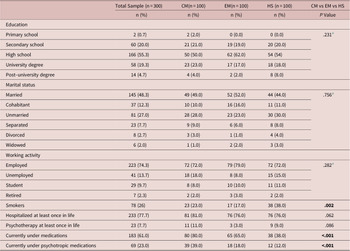
Table 1 shows comparisons among CM, EM, and HS concerning descriptive variables. No differences were found for education, marital status, and working activity, while statistically significant differences were found for smoking status, being currently under medications, and being currently under psychotropic medications. Concerning the latter variable, among CM, selective serotonin reuptake inhibitors (SSRIs) were prescribed to 20 patients, serotonin noradrenaline reuptake inhibitors (SNRIs) to 6 patients, tricyclic antidepressants (TCAs) to 10 patients, other antidepressants to 2 patients, benzodiazepines (BZDs) to 14 patients, anticonvulsants to 13 patients, and antipsychotics to 4 patients. Among EM, SSRIs were prescribed to 1 patient, SNRIs to 2 patients, TCAs to 11 patients, BZDs to 1 patients, and anticonvulsants to 2 patients. Among HS, SSRIs were prescribed to 8 subjects, TCAs to 2 subjects, BZDs to 4 subjects, and antipsychotics to 1 subject.
Comparison Among CM, EM, and HS Concerning Descriptive Variables, via Chi-Square and Fisher Test

Abbreviations: CM, chronic migraine; EM, episodic migraine; HS, healthy subjects.
a Fisher test.
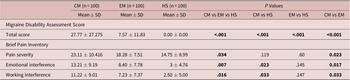
Table 2 shows the comparison among and between CM, EM, and HS regarding migraine disability (MIDAS) and the intensity and interference of pain on patient’s life (BPI). The MIDAS total score was higher in CM than in EM as well as the BPI-subscale scores. HS had BPI-subscale scores significantly different from the ones found in CM but not from those found in patients with EM.
Comparison Among and Between CM, EM, and HS Concerning Migraine Disability and the Intensity and Interference of Pain on the Patient’s Life

Mann–Whitney test for independent samples.
Abbreviations: CM, chronic migraine; EM, episodic migraine; HS, healthy subjects; SD, standard deviation.
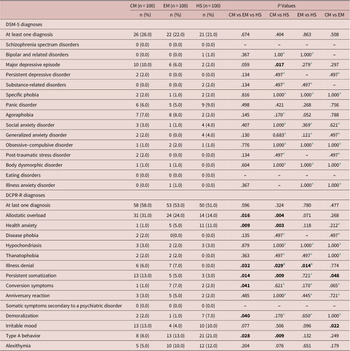
Table 3 shows comparisons among and between CM, EM, and HS as to DSM-5 and DCPR-R diagnoses. No differences were found considering the variables “at least one DSM-5 diagnosis” or “at least one DCPR-R diagnosis.” Patients with CM had significantly higher rates of Major Depressive Episodes than HS. Patients with CM had significantly higher rates of Allostatic Overload, Illness Denial, and Persistent Somatization, and lower rates of Health Anxiety and Type A Behavior than HS. EM differed from HS for Illness Denial, having a significantly higher rate. Patients with CM had significantly higher rates of Persistent Somatization and Irritable Mood than EM.
Comparison Among and Between CM, EM, and HS Concerning DSM-5 and DCPR-R Diagnoses, via Chi-Square and Fisher Test

Abbreviations: CM, chronic migraine; DCPR-R: Diagnostic Criteria for Psychosomatic Research–Revised; DSM-5: Diagnostic and Statistical Manual of Mental Disorders, fifth edition; EM, episodic migraine; HS, healthy subjects.
a Fisher test.
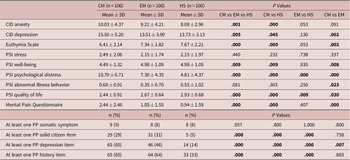
Table 4 shows comparisons among and between CM, EM, and HS on psychological variables. Patients with CM had significantly higher levels of anxiety, depression, and psychological distress than HS as well as lower levels of euthymia, quality of life, and well-being. Patients with EM had significantly higher psychological distress and lower quality of life than HS. CM had significantly higher levels of depression, psychological distress, and abnormal illness behavior than EM, as well as lower levels of euthymia, quality of life, and well-being.
Comparison Among and Between CM, EM, and HS Concerning Psychological Variables

Mann–Whitney test for independent samples for non-normally distributed continuous variables. Chi-square and Fisher test for categorical variables.
Abbreviations: CID: Clinical Interview for Depression; CM, chronic migraine; EM, episodic migraine; HS, healthy subjects; PP: pain-proneness checklist; PSI: PsychoSocial Index; SD, standard deviation.
a Fisher test.
Regarding mental pain, patients with CM had significantly higher levels than EM and HS (Table 4). Regarding PP, patients with CM and EM were more likely to report at least one positive item in solid citizen, depression, or personal/family history domains than HS. CM and EM differed for depression domain, which was significantly more frequent among patients with CM (Table 4).
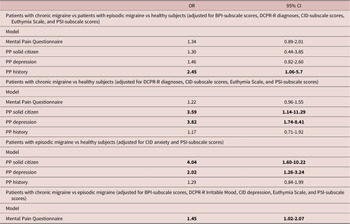
Based on the results of the multivariate logistic regression analyses, subjects presenting at least one item in the PP history domain were more likely to be CM than EM and HS. Subjects reporting PP solid citizen and PP depression were more likely to be CM or EM than HS. Finally, subjects displaying higher mental pain were more likely to be CM than EM (Table 5).
Multiple Logistic Regression Analyses

Abbreviations: BPI, Brief Pain Inventory; CI, confidence interval; CID, Clinical Interview for Depression; DCPR-R, Diagnostic Criteria for Psychosomatic Research–Revised; OR, odds ratio; PP, pain-proneness checklist; PSI, PsychoSocial Index.
Discussion
The present research showed that CM, EM, and HS have distinct pain and psychological profiles. Those with greater mental pain were more likely to be CM than EM. Those with PP were more likely to be CM or EM than HS.
The study has some limitations. It is a cross-sectional research, whereas a longitudinal observation would have made it possible to study a potential cause-effect relationship between the variables under study and migraine status. Subjects were enrolled in a single tertiary care center; thus, the results might have been biased by the specific characteristics of the population belonging to that center. However, this limitation seems weak since the recruiting center is the center of reference for migraine of central Italy and its basin of patients is representative of a large geographical area of central Italy. Unfortunately, duration of migraine since onset or diagnosis was not collected. Since most of the patients with CM experience EM before their symptoms become chronic, it could be hypothesized that the CM group had a longer illness history than the EM group, and this could be a confounding variable. Similarly, the success (or otherwise) of treatment for migraine could be a confounding variable, which was not collected. Finally, we followed Blumer and Heilbronn’sReference Blumer and Heilbronn 25 advice about considering at least one item of the PP interview for identifying pain-prone subjects. However, this interview has not undergone validation and some of the items are not particularly specific.
The main strength is new data potentially helpful in the care of patients with migraine.
Discussion of the results based on the literature
As what concerns comparisons among CM, EM, and HS, the following results are consistent with the literature:
-
1. Major Depressive Episodes more prevalent among CM than HSReference McLean and Mercer 43; Allostatic Overload, Illness Denial, and Persistent Somatization more prevalent among CM than HSReference Demjen and Bakal 44 –Reference Williams, Raczynski and Domino 48; greater anxious/depressive symptoms Reference Ziegler and Paolo 26 , Reference Ashina, Bendtsen and Buse 49 , Reference Chu, Liang and Lee 50 and psychological distressReference Moon, Seo and Park 51 as well as lower quality of lifeReference Stuginski-Barbosa, Dach and Bigal 52 and well-beingReference Krøll, Hammarlund and Westergaard 53 among CM than HS.
-
2. Illness Denial more prevalent among EM than HS,Reference Demjen and Bakal 44 , Reference Williams, Raczynski and Domino 48 which was different from what observed in primary careReference Piolanti, Gostoli and Gervasi 54; greater psychological distressReference Strine, Chapman and Balluz 55 and lower quality of lifeReference Stuginski-Barbosa, Dach and Bigal 52 among EM than HS.
-
3. Irritable Mood more prevalent among CM than EMReference Peres, Mercante and Tobo 56; greater depressive symptoms,Reference Chu, Liang and Lee 50 psychological distress,Reference Chu, Liang and Lee 50 , Reference Stuginski-Barbosa, Dach and Bigal 52 abnormal illness behavior,Reference Seng, Buse and Klepper 57 and lower quality of lifeReference Stuginski-Barbosa, Dach and Bigal 52 among CM than EM.
-
4. Low rates of DSM-5 diagnoses compared to DCPR-R diagnoses among patients with migraine.Reference Cosci and Fava 58
-
5. Higher rates of at least one positive item under the PP domain of depression among CM than HS and among EM than HS.Reference Hagen, Åsberg and Stovner 59 -Reference Fuller-Thomson, Schrumm and Brennenstuhl 64 These results are not new since the PP domain clusters with clinically relevant aspects, which are usually studied separately. However, the use of such domain might contribute in building a unitary disease conceptReference Slater and Slater 65 of migraine.
-
6. Higher rates of at least one positive item under PP depression domain among CM than EM. Once again, the symptoms included in this domain have been largely studied as separate features or as part of the diagnosis of depression.Reference Buse, Silberstein, Manack, Papapetropoulos and Lipton 66
Still concerning comparisons among CM, EM, and HS, the following results are new in the literature:
-
1. Those with migraine are expected to have a higher prevalence of psychiatric morbidity than the general population, data not found in the present study except for Major Depressive Episodes. This may be due to the therapeutic effects of psychotropic medications prescribed to patients with migraine and/or to the fact that those who volunteered were a self-selected group and not representative of the local population.
-
2. Lower rates of Health Anxiety and Type A Behavior among CM than HS. The result might be explained by the fact that patients with migraine are routinely followed up at the migraine center and receive several suggestions to promote health via lifestyle modifications in order to reduce the risk of migraine attacks; thus, they might be less prone to develop anxiety for their health feeling to be followed by the clinicians of the center and are more likely to adopt healthy lifestyles, which are not commonly observed in Type A Behavior subjects.
-
3. Persistent Somatization more prevalent among CM than EM. We can infer that patients with CM tend to manifest persistent symptoms, in the context of both migraine and illness behavior, consistently with high levels of hysteria and psychasthenia observed in headache-prone individuals.Reference Ziegler and Paolo 26
-
4. Higher rates of DCPR-R Allostatic Overload and Anniversary Reaction and lower rates of DCPR-R Somatic Symptoms Secondary to a Psychiatric Disorder and Demoralization than in primary care settings.Reference Piolanti, Gostoli and Gervasi 54 The first two results seem related to the distress burden due to migraine. The third result seems related to the low rate of psychiatric disorders observed among patients with migraine. The fourth result may suggest that patients with migraine are prone to develop mental pain more than Demoralization and that these two clinical phenomena are independent.
-
5. Lower euthymia among CM than HS and among CM than EM. This confirms how CM can be detrimental for a bio-psycho-social health balance, being euthymia here measured as the balance among psychic forces leading to a high level of resilience and frustration tolerance.Reference Fava and Bech 36 This is also informative since euthymia has been assessed for the moment only in patients with diabetesReference Carrozzino, Svicher and Patierno 40 and in primary care.Reference Guidi, Piolanti and Gostoli 67
-
6. Greater mental pain among CM than HS and among CM than EM. The characteristics of mental pain associated with medical disease have not been sufficiently explored. However, there may be considerable overlaps, even in brain networks, with pain of somatic origin.Reference Yager 68 EngelReference Engel 24 observed that some individuals are more prone than others to use pain as a psychic regulator, whether the pain includes a peripheral source of stimulation or not. On the contrary, mental pain confirms not to coincide with depression or depressive manifestations,Reference Guidi, Piolanti and Gostoli 67 being Major Depressive Episodes and Demoralization similarly prevalent among CM and EM.
-
7. Higher rates of at least one positive item under the PP domain of solid citizen among CM or EM than HS. The PP solid citizen domain includes denial of conflict, idealization of self and of family relations, and ergomania pre-pain. Patients with migraine reported higher family burden due to migraine than did their partner and reduced participation in family activities; many perceived that their partner did not believe the severity/impact of their headaches and felt they would be better parents without headaches.Reference Buse, Scher and Dodick 69 Thus, the literature does not suggest idealization of self and of family relations,Reference Buse, Scher and Dodick 69 while denial of conflict and ergomania pre-pain was not explored. Interestingly, in the present cohort study, denial of conflict was found in 3 patients with CM, 2 with EM, and 2 HS; idealization of self and of family relations was found in 2 patients with CM, 3 with EM, and 0 HS; and ergomania pre-pain was found in 28 patients with CM, 27 with EM, and 4 HS;
-
8. Higher rates of at least one positive item under the PP domain of personal/family history among CM or EM than HS. The PP personal/family history domain includes personal and family history of depression and alcoholism, past abuse by spouse, crippled relative, and relative with chronic pain. The literature suggests a longitudinal/developmental relationship between major depression and headacheReference Pine, Cohen and Brook 70, and physical abuse, emotional abuse, and emotional neglect as risk factors for developing chronic headache.Reference Tietjen, Brandes and Peterlin 71 The relationship between alcohol and migraine is still controversial.Reference Onderwater, van Oosterhout and Schoonman 72 No data are available on the relationship between family history of depression, alcoholism, crippled relative, chronic pain and migraine besides the clinical relevance of family factors in chronic pain.Reference Roy 73
The multiple regression analyses overall suggest that patients with CM or EM are more likely to have at least one item under the PP solid citizen or depression domains than HS, and that patients with CM are more likely to have greater mental pain than EM.
From birth on, everyone builds up a “library” of pain experiences, originating from the variety of peripheral painful stimulations experienced during the life.Reference Engel 24 This “peripheral signature” creates “pain memories,” and the capacity to experience pain which originally developed from peripherally induced experiences may occur without the corresponding nociceptive stimulation.Reference Engel 24 Pain also acquires an affective tone that contributes to create a “psychic signature.”Reference Engel 24 A disordered pattern, involving rate, amplitude, time, and space in nerves or neural circuits, provides the neurophysiological conditions that can be experienced as pain, but they do not account for pain per se. Reference Gooddy 74 This has to do with how the individual experiences pain,Reference Gooddy 74 with illness behavior,Reference Cosci and Fava 58 and with patient’s private concepts of how his bodies function may influence the description of pain.Reference Engel 24
In this framework, it can be hypothesized that patients with migraine have a “library” of pain experiences different from HS being exposed to migraine pain and that CM migraine patients have an enriched “library” of pain experiences due to a high-frequency exposure to migraine pain attacks. Such “library,” together to the affective tone acquired by pain, creates a “psychic signature” which is represented by PP solid citizen and depression domains if we consider patients with migraine as a whole, and which is represented by mental pain if we consider patients with CM in particular.
Complex interactions between biology and biography affect disease risk and highlight a strategy to develop narratives that establish the integration of biology and biography as the scientific basis for precision medicine,Reference Lobitz, Armstrong and Concato 75 which may be important in this patient population.
Discussion of the implications of the results
Further studies are warranted to explore whether mental pain is associated to despair and suicidal ideation, being depression and suicidal ideation highly represented in migraineursReference Fuller-Thomson, Schrumm and Brennenstuhl 64 and being mental pain differently associated to bodily pain in suicidal and nonsuicidal patients.Reference Orbach, Palgi and Stein 21 –Reference Orbach, Mikulincer and Cohen 23 Further research might also help in clarifying whether the connection between mental pain and migraine pain passes through psychological distress, as it was shown for the connection between mental pain and physical pain.Reference Orbach, Palgi and Stein 21 -Reference Orbach, Mikulincer and Cohen 23
PP solid citizen and depression domains deserve further investigation before been translated into clinical practice. The PP interview we used has not undergone validation, some of the items are not specific, and domains might include items having different load in contributing to the total score (eg, items of the PP solid citizen dimension) according to the population taken under study. Study validation of the interview is warranted. In addition, it would be interesting to create a rating scale based on Blumer and HeilbronnReference Blumer and Heilbronn 25 and verify its scalability,Reference Bech 76 that is whether it is a statistically sufficient measure of PP.
Conclusion
Migraine is an unpleasant sensory and emotional experience associated with psychosocial manifestations that might contribute to the level of suffering of the patients. Its affective component can be part of the process of creation of a “psychic signature,”Reference Engel 24 having specific psychological and social characteristics. Patients with migraine might thus be qualifiable as migraine-prone individuals,Reference Engel 24 and mental pain seems the variable that most differentiates patients with CM from patients with EM.
Funding
No grants were received to support the present research.
Disclosures
The authors have no conflicts of interest.