Introduction
The debate on overlap of psychotic symptomatology in schizophrenia and bipolar disorder (BD) from the perspective that these disorders may pose a diagnostic continuum with shared etiology (van Os and Reininghaus, Reference van Os and Reininghaus2016) is ongoing. Some argue that the psychosis continuum extends from BD, to schizoaffective disorder and at the other end typical schizophrenia, and reflect increasing level of severity (van Os et al., Reference van Os, Hanssen, van Bijl and Ravelli2000; Craddock et al., Reference Craddock, O'Donovan and Owen2005; The International Schizophrenia Consortium et al., 2009). Overlapping illness characteristics between these disorders are the presence of childhood trauma, high level of distress and cognitive impairment (Read et al., Reference Read, van Os, Morrison and Ross2005; Green, Reference Green2006; Bora et al., Reference Bora, Yücel and Pantelis2010). Cognitive impairment in BD is reported during mania and depression and persists during the euthymic phase of the disorder (Martínez-Arán et al., Reference Martínez-Arán, Vieta, Colom, Torrent, Sanchez-Moreno, Reinares, Benabarre, Goikolea, Brugue, Daban and Salamero2004), however less severe than in schizophrenia (Krabbendam et al., Reference Krabbendam, Arts, Os and Aleman2005). The factors that are of influence on cognitive function in BD are still unclear but may inform of the relevance of intelligence quotient (IQ) in a psychosis continuum (Zammit et al., Reference Zammit, Allebeck, David, Dalman, Hemmingsson, Lundberg and Lewis2004; Robinson et al., Reference Robinson, Thompson, Gallagher, Goswami, Young, Ferrier and Moore2006; Jabben et al., Reference Jabben, Jabben, Arts, van Os and Krabbendam2010). Particularly since cognitive impairment in schizophrenia is often considered a core feature of the illness that remains present in the absence of psychotic symptoms (Kahn and Keefe, Reference Kahn and Keefe2013). Therefore, the question is whether BD patients with psychotic symptoms display similar cognitive deficits. Within the bipolar spectrum, a history of psychotic symptoms has been associated with several demographical and clinical characteristics including symptom severity, worse psychosocial outcome, lower response to lithium (Maj et al., Reference Maj, Pirozzi, Bartoli and Magliano2002; Maj, Reference Maj2003), more comorbidity (Coryell et al., Reference Coryell, Leon, Turvey, Akiskal, Mueller and Endicott2001), earlier age of disease onset (Upthegrove et al., Reference Upthegrove, Chard, Jones, Gordon-Smith, Forty, Jones and Craddock2015), higher frequency of mood episodes, hospitalizations, and more severe cognitive impairment (Glahn et al., Reference Glahn, Bearden, Barguil, Barrett, Reichenberg, Bowden, Soares and Velligan2007; Özyildirim et al., Reference Özyildirim, Çakir and Yazici2010; Simonsen et al., Reference Simonsen, Sundet, Vaskinn, Birkenaes, Engh, Færden, Jónsdóttir, Ringen, Opjordsmoen, Melle, Friis and Andreassen2011; Levy et al., Reference Levy, Medina and Weiss2013). Some of these characteristics resemble characteristics of schizophrenia and therefore feed the debate whether BD is part of a psychosis continuum and whether BD with psychotic symptoms may represent a distinct subtype of BD in level of severity (Potash et al., Reference Potash, Yen-Feng, MacKinnon, Miller, Simpson, McMahon, McInnis and DePaulo2003). To answer this question, it is relevant to investigate how BD patients with psychosis differ from those without psychotic symptoms in cognitive and global functioning, disease course, and etiological factors such as history of childhood maltreatment. However, as the distinction psychosis v. non-psychosis is broad, further investigation of types of psychotic symptoms (hallucinations, delusions, mood incongruent symptoms, Schneiderian symptoms, and formal thought disorder) could inform this debate from the perspective that these subgroups of psychotic symptoms may have distinct etiology (Upthegrove et al., Reference Upthegrove, Chard, Jones, Gordon-Smith, Forty, Jones and Craddock2015; Allardyce et al., Reference Allardyce, Leonenko, Hamshere, Pardiñas, Forty, Knott, Gordon-Smith, Porteous, Haywood, Di Florio, Jones, McIntosh, Owen, Holmans, Walters, Craddock, Jones, O'Donovan and Escott-Price2018).
Previous studies already showed the relevance of psychosis in BD type I (BDI). High frequencies of a lifetime history of psychotic symptoms were reported in BDI patients, ranging between 56% and 70% (Goodwin and Jamison, Reference Goodwin and Jamison1990; Keck et al., Reference Keck, McElroy, Havens, Altshuler, Nolen, Frye, Suppes, Denicoff, Kupka, Leverich, Rush and Post2003; Bora et al., Reference Bora, Yücel and Pantelis2010; Upthegrove et al., Reference Upthegrove, Chard, Jones, Gordon-Smith, Forty, Jones and Craddock2015). Schneiderian symptoms (which include hallucinations of one's thoughts being spoken aloud, arguing or running commentary, and delusions of thought withdrawal, insertion, or broadcasting) may have some specificity for schizophrenia according to some studies (Tandon and Greden, Reference Tandon and Greden1987; O'Grady, Reference O'Grady1990). Schneiderian symptoms have been reported in BD up to 20% and are associated with worse outcomes (Tohen et al., Reference Tohen, Tsuang and Goodwin1992; Carlson et al., Reference Carlson, Kotov, Chang, Ruggero and Bromet2012). In addition, mood incongruent symptoms in BD occur in the same frequency range of 20% (Fennig et al., Reference Fennig, Bromet, Tanenberg Karant, Ram and Jandorf1996; Keck et al., Reference Keck, McElroy, Havens, Altshuler, Nolen, Frye, Suppes, Denicoff, Kupka, Leverich, Rush and Post2003) and were associated with higher relapse risk, worse outcome (Tohen et al., Reference Tohen, Tsuang and Goodwin1992) and more frequent comorbid anxiety disorders (Keck et al., Reference Keck, McElroy, Havens, Altshuler, Nolen, Frye, Suppes, Denicoff, Kupka, Leverich, Rush and Post2003). Formal thought disorder is not specific to schizophrenia either; thought disorder is common in mania with an average prevalence of 19% (Goodwin and Jamison, Reference Goodwin and Jamison1990) and rates are comparable to the rate in schizophrenia (McElroy et al., Reference McElroy, Keck and Strakowski1996; Dunayevich and Keck, Reference Dunayevich and Keck2000). Another point of interest are the determinants of these psychotic features in BD. Childhood trauma, regardless of its type, is known to increase the risk of schizophrenia and psychosis in general (Varese et al., Reference Varese, Smeets, Drukker, Lieverse, Lataster, Viechtbauer, Read, van Os and Bentall2012). One study suggests that childhood abuse is associated specifically with auditory hallucinations, but not with delusions, in BD (Upthegrove et al., Reference Upthegrove, Chard, Jones, Gordon-Smith, Forty, Jones and Craddock2015). But the relationship between childhood adversity and psychosis in BD is as yet inconclusive (Upthegrove et al., Reference Upthegrove, Chard, Jones, Gordon-Smith, Forty, Jones and Craddock2015).
The current study is the most comprehensively characterized large sample of BDI patients (N = 1342) to date and provides a detailed description of psychotic symptoms subdivided into delusions, hallucinations, mood incongruent symptoms, Schneiderian symptoms, and formal thought disorder. The relationship of psychotic features with measures of disease course, neurocognitive functioning, and childhood maltreatment was analyzed. We hypothesize that patients with a history of psychotic symptoms have a more severe illness course (reflected by more comorbid psychiatric disorders, a higher number of episodes and hospitalizations, and younger age at disease onset), lower level of global functioning (reflected by marital and employment status, socio-economic status, and general scale of global functioning), lower level of cognitive functioning (reflected by measures of IQ, premorbid IQ, and educational level), and higher levels of childhood maltreatment. In addition, we hypothesize that patients with Schneiderian and mood incongruent psychotic symptoms would have the most severe illness course if the hypothesis that BD with (specific) psychotic symptoms is part of a psychosis continuum with schizophrenia were to be true.
Methods
Study design and participants
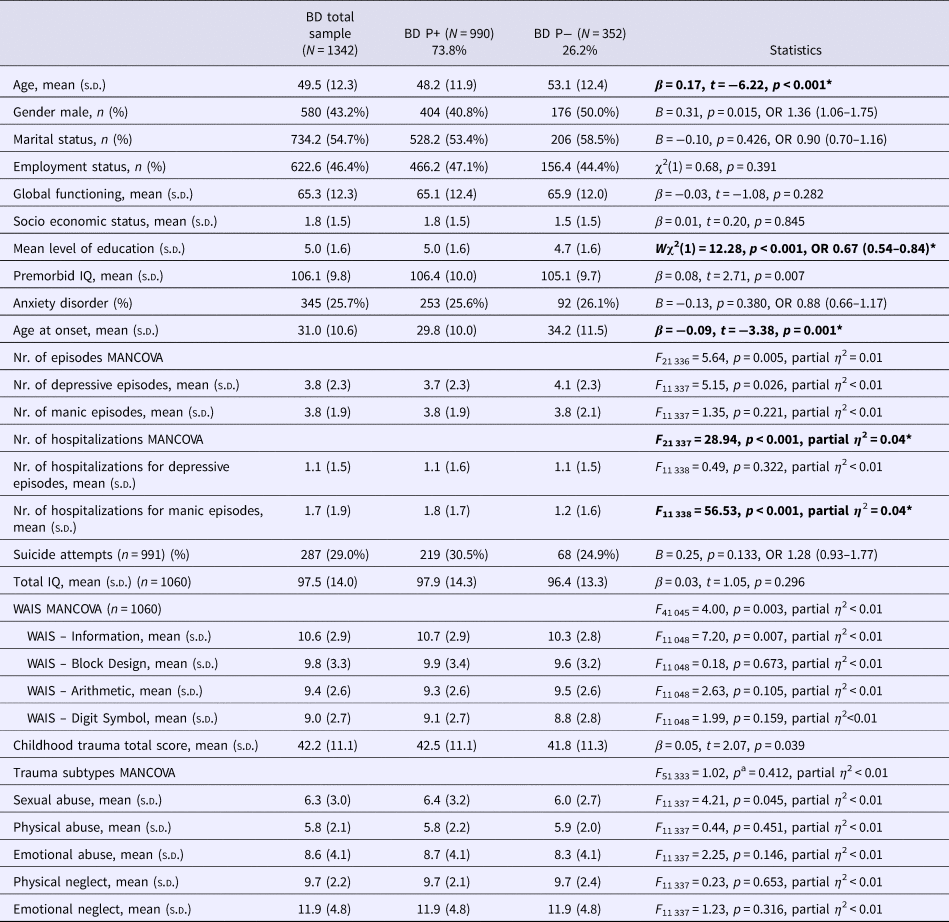
Data were collected by the Dutch Bipolar Cohort (DBC) Study from June 2011 until April 2015. DBC is a National Institute of Mental Health funded collaborative study of the University of California Los Angeles (UCLA) and University Medical Center Utrecht (UMCU). The DBC investigated genetic and phenotypic information of patients with BDI, first-degree relatives, and controls. Patients were recruited in collaboration with several Dutch health care institutes: Altrecht Institute for Mental Health Care, GGZ InGeest, University Medical Center Groningen, Delta Center for Mental Health Care, Dimence, Parnassia Group (PsyQ), and Reinier van Arkel. Inclusion criteria for all participants were: (1) age 18 years or older; (2) at least three Dutch-born grandparents; (3) a good understanding of Dutch language. Patients with a somatic illness that could have influenced the diagnosis of BD were excluded. The study was approved by the medical ethical committee of the UMCU and all participants gave written informed consent. Patients were recruited via clinicians (19.2%), the Dutch BD patient association (15.8%), pharmacies (33.6%), advertisements (6.9%), self-referral (5%), participated in previous studies of the UMCU (4.5%), or from miscellaneous undocumented resources (15.0%). More information on this cohort is provided in the study of Vreeker et al., (Reference Vreeker, Boks, Abramovic, Verkooijen, van Bergen, Hillegers, Spijker, Hoencamp, Regeer, Riemersma-Van der Lek, Stevens, Schulte, Vonk, Hoekstra, van Beveren, Kupka, Brouwer, Bearden, MacCabe and Ophoff2016). For this study, a total of 3364 potential BDI patients were contacted and screened via a short interview by telephone. Clinical assessments were completed in 1575 patients. After exclusion of 23 patients with schizoaffective disorder, 86 patients with BD type II, 25 patients with recurrent depression, 11 patients with BD not otherwise specified, and 59 bipolar type I patients with incomplete data on lifetime psychotic symptoms, the total sample for analysis consisted of 1342 BDI patients. Sample characteristics are presented in Table 1.
Demographical and clinical characteristics of BD with (BD P+) and without psychotic symptoms (BD P−)

*Significant between-group difference (p < 0.0029). Bold fonts are used to highlight significance.
a Hotelling's Trace.
Clinical assessments
The complete assessment consisted of a standardized clinical interview, neurocognitive tasks, and an Internet questionnaire. BDI diagnosis was assessed using the Structured Clinical Interview for DSM-IV (SCID-I) (First et al., Reference First, Spitzer, Gibbon and Williams1997). The assessments were administered by one group of researchers of the UMCU. The team was supervised by two clinical psychiatrists (MB and AvB). All members were at least bachelor-level psychology or medical students. Training of the team consisted of a SCID-I and Wechsler Adult Intelligence Scale-III (WAIS-III) (Wechsler, Reference Wechsler1997) training. Consensus on the ratings was obtained by two raters after every assessment. New team members were supervised for the entire assessment at least the first three inclusions.
Psychosis in BD
Psychosis was defined as the presence of lifetime psychotic symptoms using the SCID-I. The nature of psychotic symptoms (hallucinations, delusions, and Schneiderian) in BD was investigated using the SCID-I. Schneiderian symptoms are defined by the presence of auditory hallucinations and the presence of delusions of thought withdrawal, insertion, or broadcasting. The Comprehensive Assessment of Symptom History (CASH) (psychosis section) provided information on the presence of lifetime mood (in)congruent psychotic symptoms and lifetime disorganized speech as a measure of formal thought disorder. All variables are dichotomous.
Psychometric tests
IQ was estimated based on four subtasks of the Dutch version of the WAIS-III consisting of the subtests ‘Information’, ‘Block design’, ‘Digit Symbol Coding’, and ‘Arithmetic’ (Wechsler, Reference Wechsler1997). The correlation of this combination of subtests with full-scale IQ has been shown to be high for both schizophrenia patients (R 2 = 0.90) and controls (R 2 = 0.86) (Blyler et al., Reference Blyler, Gold, Iannone and Buchanan2000). The average test–retest reliability is 0.95–0.97 (Spreen et al., Reference Spreen, Strauss and Sherman1998). The National Adult Reading Test (NART Dutch version) was used to estimate the premorbid IQ level (Schmand et al., Reference Schmand, Bakker, Saan and Louman1991; Bright et al., Reference Bright, Jaldow and Kopelman2002). The NART is a single word, oral reading test consisting of 50 words testing previously obtained word knowledge. Reliability, test–retest reliability, and inter-rater reliability estimates of the NART are respectively 0.90, 0.92, and 0.88 (Spreen et al., Reference Spreen, Strauss and Sherman1998). The presence of traumatic experiences and maltreatment in childhood was assessed by the Childhood Trauma Questionnaire (CTQ) measuring emotional, physical and sexual abuse, and emotional and physical neglect (Bernstein et al., Reference Bernstein, Ahluvalia, Pogge and Handelsman1997). CTQ is a validated and widely used self-report instrument for both clinical and non-clinical populations. Correlations with therapists ratings of abuse were reported to be statistically significant ranging from 0.36 to 0.75 (Spreen et al.,Reference Spreen, Strauss and Sherman1998). Although the CTQ is prone to recall bias (Lewinsohn and Rosenbaum, Reference Lewinsohn and Rosenbaum1987), the validity of the 25 clinical CTQ items, including a Dutch translation, has been demonstrated in clinical and population samples (Bernstein et al., Reference Bernstein, Stein, Newcomb, Walker, Pogge, Ahluvalia, Stokes, Handelsman, Medrano, Desmond and Zule2003; Thombs et al., Reference Thombs, Bernstein, Lobbestael and Arnstz2009; Fergusson et al., Reference Fergusson, Horwood and Boden2011). In fact, there is also evidence that the retrospective assessment of childhood maltreatment tends to underestimate rather than over-report real incidence rates (Schreier et al., Reference Schreier, Wolke, Thomas, Horwood, Hollis, Gunnell, Lewis, AThompson, Zammit, Duffy, Salvi and Harrison2009). Childhood maltreatment was also investigated in relation to gender differences and the risk for psychotic symptoms. The inter-rater reliability of the global assessment of functioning ranges from 0.53 to 0.95 (Rey et al., Reference Rey, Starling, Wever, Dosseter and Plapp1995; Startup et al., Reference Startup, Jackson and Bendix2002).
Demographic characteristics
Marital and employment status was provided by the SCID-I. Socio-economical status was assessed by an Internet questionnaire based on the Family Affluence Scale (Currie et al., Reference Currie, Molcho, Boyce, Holstein, Torsheim and Richter2008). Information on educational performance was gathered by asking the participants their highest completed level of education based on the Dutch education system which consists of primary (4–12 years of age), secondary (low, intermediate, high preparatory vocational, and pre-university), and tertiary education (intermediate professional education, higher professional education, and university). Educational level was categorized in seven levels with university as highest level as previously reported (Vreeker et al., Reference Vreeker, Boks, Abramovic, Verkooijen, van Bergen, Hillegers, Spijker, Hoencamp, Regeer, Riemersma-Van der Lek, Stevens, Schulte, Vonk, Hoekstra, van Beveren, Kupka, Brouwer, Bearden, MacCabe and Ophoff2016). In addition, Global Assessment of Functioning was assessed using the SCID-I.
Clinical course
Information on clinical course was obtained by the self-report section B of the Questionnaire of Bipolar Disorders providing information on the number of manic and depressive episodes, number of hospitalizations for manic and depressive episodes and age at disease onset (Leverich et al., Reference Leverich, Nolen, Rush, McElroy, Keck, Denicoff, Suppes, Altschuler, Kupka, Kramlinger and Post2001). The number of hospitalizations for hypomanic and manic episodes or manic or hypomanic episodes were considered together, because the distinction is difficult to make in a retrospective assessment. Age of disease onset was defined as the age of first pharmacological treatment. This definition was chosen given the insidious onset of BDI and the high probability of recall bias in the retrospective assessment of first reported symptoms (Leverich et al., Reference Leverich, Nolen, Rush, McElroy, Keck, Denicoff, Suppes, Altschuler, Kupka, Kramlinger and Post2001; Suppes et al., Reference Suppes, Leverich, Keck, Nolen, Altshuler, McElroy, Rush, Kupka, Frye, Bickel and Post2001). Suicidal behavior, categorized if a person attempted to commit suicide ever (once or more) or never, was assessed using the suicide questions of the CASH (Andreasen et al., Reference Andreasen, Flaum and Arndt1992).
Substance and medication use
Information on current cannabis use was derived from an online Cannabis Use Inventory questionnaire to asses current and last 2 years cannabis use (Schubart et al., Reference Schubart, Sommer, van Gastel, Goetgebuer, Kahn and Boks2011). Alcohol use was defined by the maximum total amount of glasses of alcohol per week in the past 12 months provided by the Composite International Diagnostic Interview (CIDI) (Robins et al., Reference Robins, Wing, Wittchen, Helzer, Babor, Burk, Farmer, Jablenski, Pickens, Regier, Sartorius and Towle1988), section B. Data on lifetime substance abuse and dependence were provided by sections J and L of the CIDI. The presence of a lifetime comorbid anxiety disorders was assessed by the SCID-I, section F. Information on current and lifetime use of mood stabilizers, antipsychotics, and antidepressants was assessed using a questionnaire on the use of psychotropic medication. Data on current and lifetime psychotropic medication use were available in, respectively, 1240 and 922 BDI patients. In addition, current lithium use (n = 1342) was assessed using a lithium satisfactory questionnaire.
Statistical analyses
Differences between patients with and without lifetime psychotic symptoms were investigated for all selected demographical and clinical variables using logistic or linear regression with the presence of psychosis as a main indicator. In case of categorical measures, χ2 tests were performed. Correlated outcome measures, including WAIS subtasks and number of episodes and hospitalizations, were analyzed with a multivariate analysis of co-variance (MANCOVA) including post hoc analysis of co-variance. Analyses of all variables were adjusted for age and gender. Confounding analyses were conducted for comorbid anxiety disorder and socio-economic status in the total set, and alcohol use, cannabis use and drug abuse and dependence in the available subset. Confounding was operationalized as those measures that have a significant association (all correlations above 0.7) with the main indicator and the outcome (psychotic symptoms) and that lead to a larger than 10% change in the β of the main indicator (Lee, Reference Lee2014). All variables that matched this criterion were included as covariate. Unadjusted results are reported in online Supplementary Tables S1, S2A and B. Analyses of IQ measures were adjusted for premorbid IQ and a sensitivity analysis was conducted to investigate the role of missing values. To explore the nature of the psychotic symptoms, groups of symptoms (the presence of delusions, hallucinations, disorganized speech, Schneiderian, and mood incongruent symptoms) were used as indicators in one single model simultaneously in order to adjust for their dependencies.
Assumptions were tested for all statistical analyses. In case of logistic regression, assumptions of multicollinearity were not violated in any of the analysis [all correlations <0.43 and variance inflation factor (VIF) <1.3]. In addition, the Hosmer–Lemeshow test for goodness of fit was violated not at the p < 0.001 level except in the case of employment status for which we performed a χ2 test. For linear regression analysis, no multicollinearity was present as determined by VIF and normality of residuals was established by the Shapiro–Wilk test. Socio-economic status was transformed in Z score and CTQ total score was log transformed to reach approximately normal distributions of all dependent variables. An ordinal regression was performed in case of educational level. The assumption of proportional odds was violated but outcomes were confirmed by six additional logistic regression analyses, with increasing level of education as split.
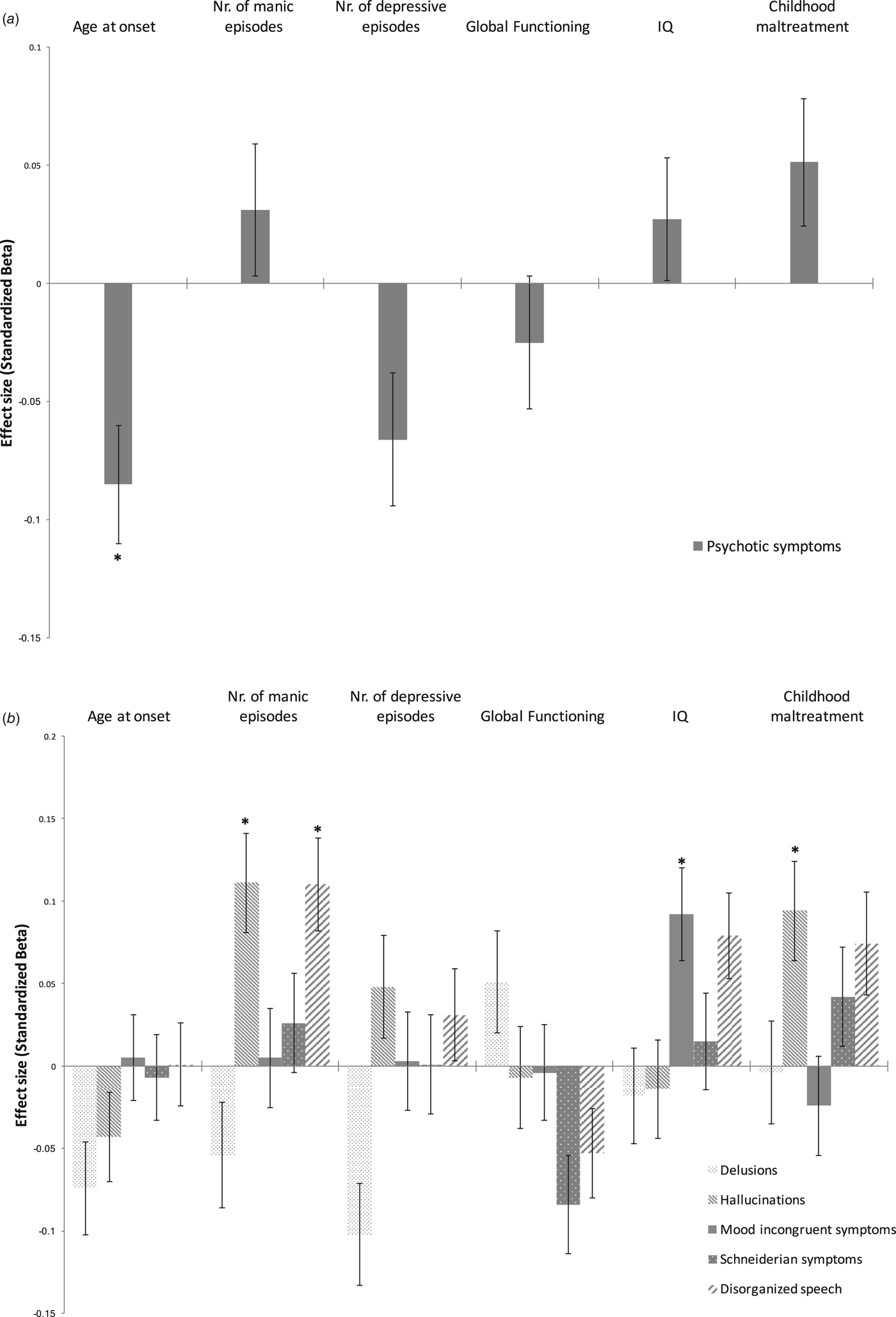
For MANCOVA analysis homogeneity of covariance matrices was analyzed by the Box's M test with the threshold set at p < 0.01 and was violated for the childhood adversity scales and therefore the Hotelling's Trace is reported to provide a more robust type I error estimate. Standardized βs were obtained of six most relevant risk factors to allow comparisons of the effect size per psychotic symptom group as presented in Fig. 2. In an additional analysis to investigate which combination of risk factors provides the best classification of the psychosis v. non-psychosis distinction, a forward stepwise logistic regression as implemented in SPSS was conducted with psychosis as outcome and all demographical characteristics, number of episodes, age of disease onset, presence of comorbid anxiety disorder, level of premorbid IQ, total IQ, and childhood maltreatment as potential indicators. SPSS implements an algorithm whereby addition of each variable to the model is based on the likelihood ratio statistic, prioritizing the most statistically significant improvement of the fit (the cut-off point being 0.05). Subsequently, a logistic regression was performed to investigate the interaction with gender with childhood maltreatment on the outcome of psychotic symptoms (hallucinations). The differences in psychotropic medication use between BDI patients with and without psychotic symptoms were analyzed by a χ2 test. Bonferroni correction for the 17 statistical tests was applied, setting the threshold for statistical significance at p < 0.0029.
Missing values were handled using multiple imputation (He, Reference He2010) except for variables with over 15% missing such as in case of: alcohol use (n = 807), substance abuse (n = 976) and dependence (n = 1029), suicide attempt (n = 991), and IQ (n = 1066). These data were analyzed in the subset of complete data after establishing representativeness for the entire cohort. Finally, the results for IQ (WAIS) were checked for possible confounding of a current mood episode. Data analysis was performed in SPSS, version 22.
Results
Psychotic symptoms in BD
A total of 990 (73.8%) of the 1342 BDI patients had experienced psychotic symptoms at least once during their lifespan. All demographic and clinical variables and test statistics are listed in Table 1. The group of patients with a history of psychotic symptoms (BD P+) was significantly different to the group without a history of psychosis with respect to: a younger age, an earlier age of onset, more frequent hospitalizations for a manic episode, and a higher mean level of education. Additional analysis using six logistic regressions with increasing levels of educations as split yielded very similar results (data not shown).
Total IQ did not differ significantly between the groups. The sensitivity analysis showed that participants with incomplete WAIS data had significantly lower educational level [t (402) = −3.30, p = 0.001], global functioning [t (490) = −10.9, p < 0.001], and premorbid IQ [t (399) = −3.10, p = 0.003] as compared with participants with complete data. In addition, participants with incomplete data were less frequently employed [χ2(1) = 35.71, p < 0.001] and married [χ2(1) = 16.52, p < 0.001] but did not differ in the prevalence of psychotic symptoms [χ2(1) = 0.14, p = 0.713]. A current mood episode was not related to the WAIS results. Total childhood maltreatment level was not significantly different between the two groups, nor were the levels of the five maltreatment subtypes. The optimal logistic regression to classify lifetime psychotic symptoms as outcome showed that a higher level of educational performance [B = 0.14, p = 0.002, OR 1.15 (1.05–1.26)], less frequent depressive episodes [B = −0.12, p < 0.001, OR 0.89 (0.83–0.95)], being female [B = −0.32, p = 0.025, OR 0.72 (0.54–0.96)], and a lower age of disease onset [B = −0.04, p < 0.001, OR = 0.96 (0.95–0.97)] significantly contributed to the classification. The Nagelkerke R 2 of the optimal model was 0.09.
Prevalence of delusions and hallucinations
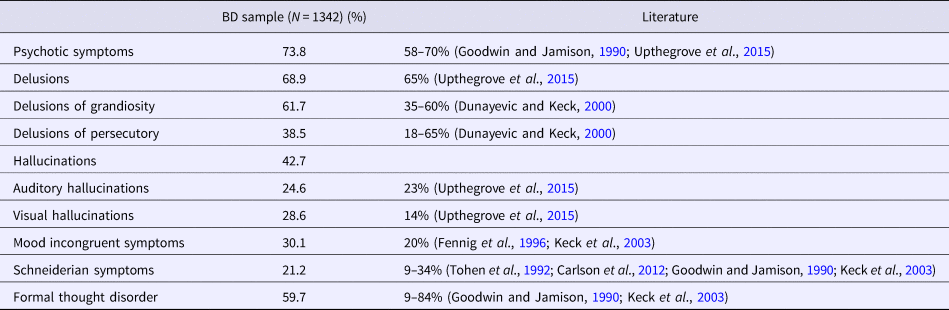
In the BD P+ group, 916 patients (92.5%) had experienced delusions. Within this group, 61.7% had a history of delusions of grandiosity, 61.5% delusions of reference, and 38.5% persecutory delusions. Other delusions, including somatic, erotomanic delusions, and delusions of jealousy and guilt, occurred in 39.9% of the psychotic patients. A history of hallucinations occurred in 58.0% of the BD P+ patients, of which 33.4% had a history of auditory hallucinations and 39.0% visual hallucinations, 20.9% of the BD P+ had both. Table 2 provides the rates of all reported psychotic symptoms and a comparison to other studies.
Comparison of rates of psychotic symptoms between this study and others

A history of delusions and hallucinations occurred isolated in, respectively, 411 (42.0%) and 62 (6.3%) of the BD P+ group. The combination of a history of hallucinations and delusions was present in 505 (51.6%) of the BD P+ group. The bipolar patients with a history of delusions only (n = 411) reported delusions of grandiosity in 60.6% of the cases, delusions of reference also in 60.6%, and persecutory delusions in 35.0% of the patients compared with: delusions of grandiosity in 70.1%, delusions of reference in 69.5%, persecutory delusions in 46.1% in patients with both hallucinations and delusions [delusions of grandiosity: χ2(1) = 8.37, p = 0.004, delusions of reference: χ2(1) = 8.02, p = 0.005, persecutory delusions: χ2(1) = 11.64, p = 0.001]. The overlap of all five psychotic symptom groups is displayed in Fig. 1.
Venn diagram of overlap of patients with delusions/hallucinations/mood incongruent symptoms/Schneiderian symptoms/disorganized speech, N = 1155.

Determinants of delusions and hallucinations
Delusions
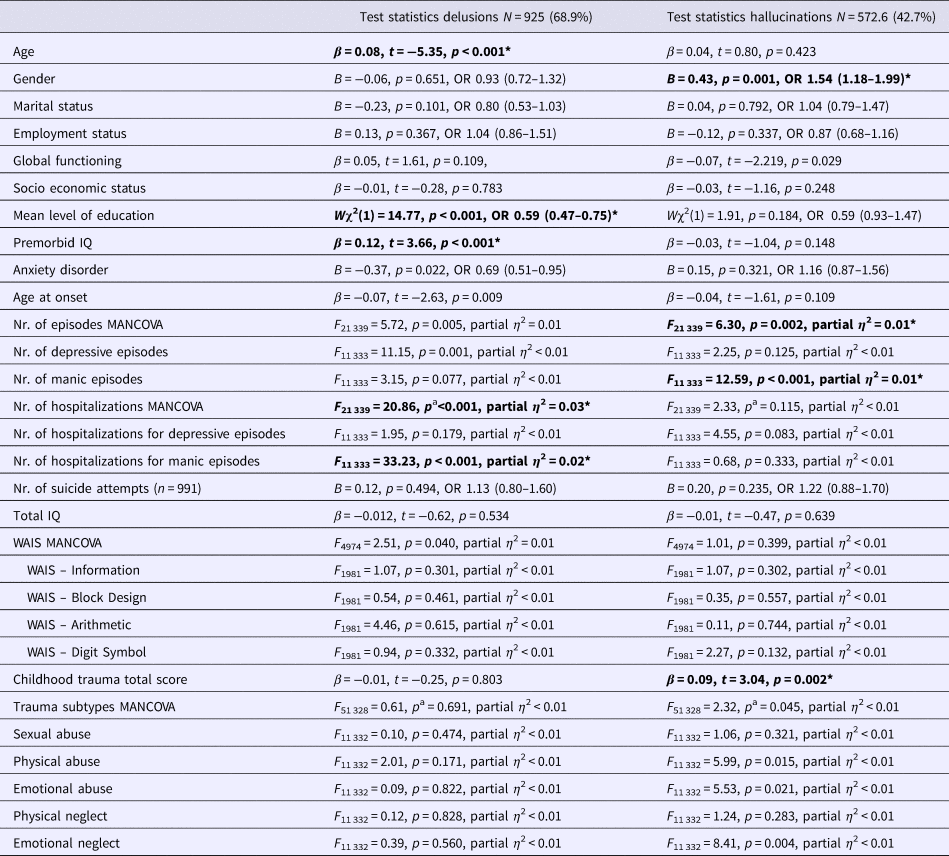
Patients with a history of delusions (n = 916, 68.9%) were significantly younger and had a significantly higher mean level of education and premorbid IQ compared with the overall BDI group.
In addition, the presence of a history of delusions was significantly associated with more frequent hospitalizations for a (hypo) manic episode. Table 3 provides a complete overview of the clinical and demographic and neurocognitive features of delusions in BDI.
Association of hallucinations and delusions with demographical and clinical characteristics in BD type I patients

*Significant between-group difference (p < 0.0029). Bold fonts are used to highlight significance.
a Lawley's Hotelling's Trace.
Hallucinations
A history of hallucinations was present in 567 (42.7%) patients. Patients with a history of hallucinations were more often female, suffered significantly more manic episodes, and childhood maltreatment. Particularly, auditory hallucinations were significantly associated with higher levels of childhood maltreatment (β = 0.08, t = 2.66, p = 0.008), in contrast to visual hallucinations (β = 0.04, t = 0.02, p = 0.255). Women reported significantly higher levels of childhood maltreatment (t = 2.46, p = 0.014) but no interaction between gender and childhood maltreatment on the risk for hallucinations was present (gender × childhood maltreatment W = 0.08, B = 0.00, p = 0.782). See Table 3 for a complete overview of the clinical, demographic, and neurocognitive features of BDI patients with lifetime hallucinations.
Determinants of mood incongruent symptoms, Schneiderian symptoms, and disorganized speech
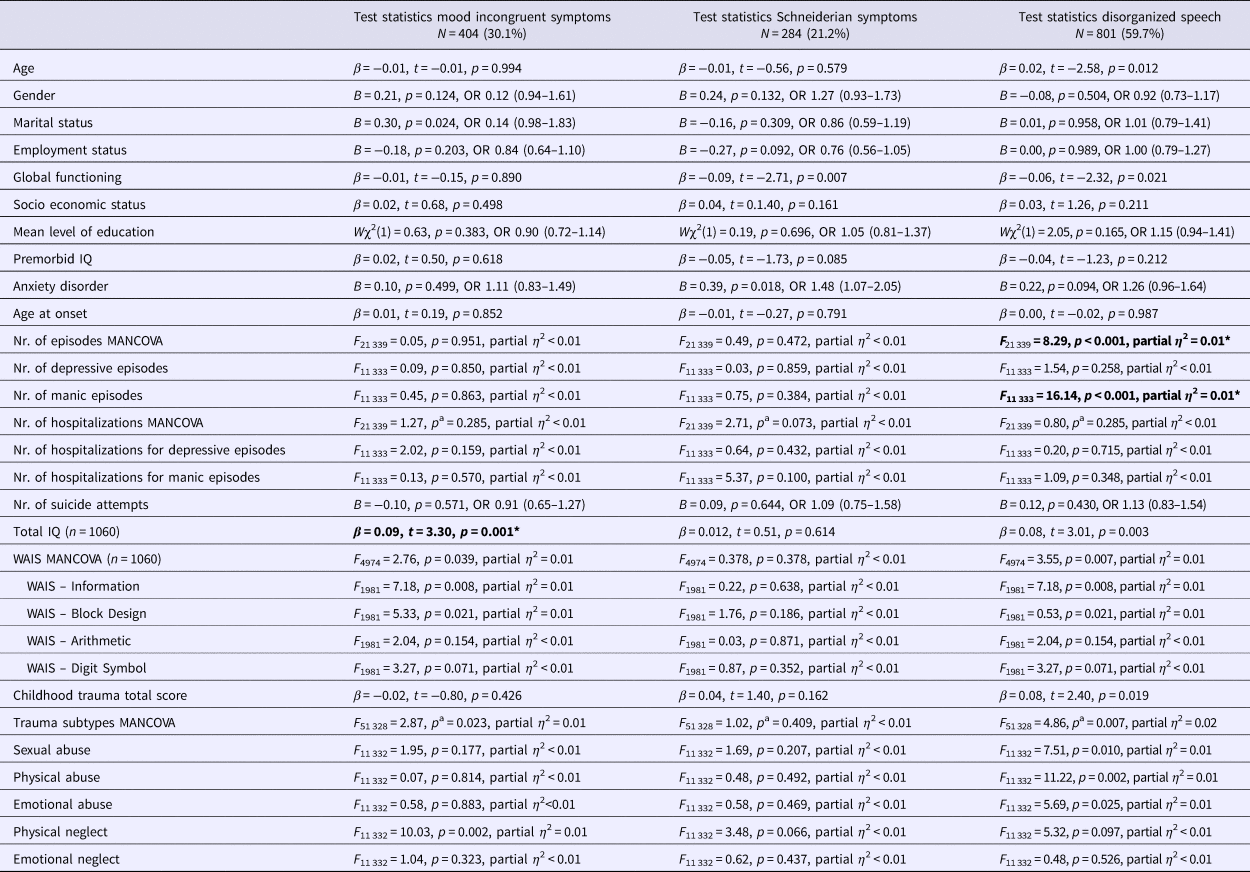
The prevalence of a history of mood incongruent symptoms, Schneiderian symptoms, and disorganized speech in this BDI cohort was respectively 404 (30.1%), 284 (21.2%), and 801 (59.7%). Patients with a history of mood incongruent symptoms scored significantly higher on total IQ and patients with a history of disorganized speech had more frequent manic episodes. The presence of a history of Schneiderian symptoms showed no significant associations with any of the investigated variables.
See Table 4 for a complete overview of the clinical, demographic, and neurocognitive features of BDI patients with a history of mood incongruent symptoms, Schneiderian symptoms, and disorganized speech.
Association of mood incongruent symptoms, Schneiderian symptoms, and disorganized speech with demographical and clinical characteristics in BD type I patients

*Significant between-group difference (p < 0.0029). Bold fonts are used to highlight significance.
a Lawley's Hotelling's Trace.
To provide an overview of the relationship between psychotic symptoms and the selected risk factors, we presented the standardized effect size (β) of the six most important risk factors for psychotic symptoms in Fig. 2.
(a) Relationship between psychotic symptoms and age at onset, number of episodes, global functioning, IQ, and childhood maltreatment (*significantly associated with psychotic symptoms, p < 0.0029, for graphical purposes standardized βs were obtained from separate binary logistic regressions). (b) Relationship between delusions/hallucinations/mood incongruent symptoms/Schneiderian symptoms/disorganized speech and age at onset, number of episodes, global functioning, IQ, and childhood maltreatment (*significantly associated with psychotic symptoms, p < 0.0029, for graphical purposes standardized βs were obtained from separate binary logistic regressions).

Medication use
No significant differences between patients with or without psychosis was found for current use of antidepressants [χ2(1) = 2.2, p = 0.138], mood stabilizers [χ2(1) = 1.9, p = 0.166], antipsychotics [χ2(1) = 4.6, p = 0.060] nor for a history of antidepressant [χ2(1) = 2.2, p = 0.073] and mood stabilizers [χ2(1) = 1.5, p = 0.221]. Also, current lithium use was not significantly different either between the groups [χ2(2) = 0.59, p = 0.751]. As to be expected, lifetime use of antipsychotics in BDI patients with a history of psychotic symptoms was significantly more frequent [χ2(1) = 45.8, p < 0.001].
Comorbid anxiety disorders and socio-economic status:
All analyses of psychotic symptoms were adjusted for comorbid anxiety disorders and/or socio-economic status, based on our definition of potential confounding.
Substance use
In the subset (N = 922) with data on substance use, alcohol use, lifetime substance abuse, or dependence were not confounding the reported relations with lifetime psychotic symptoms. Similarly, alcohol and substance use did not confound the relations with delusions, hallucinations, mood incongruent symptoms, Schneiderian symptoms, and disorganized speech (all correlations below 0.7 and changes in β after inclusion as covariate <10%).
Discussion
In a large comprehensively characterized sample of 1342 BDI patients, we observed a high frequency of lifetime psychotic symptoms (73.8%) including delusions (68.9%), hallucinations (42.7%), mood incongruent symptoms (30.1%), Schneiderian symptoms (21.2%), and formal thought disorder (59.7%). Psychotic symptoms were associated with a more severe illness course, an earlier onset of disease, and more frequent hospitalizations.
The characteristics of patients with different types of psychotic symptoms were considerably overlapping but were significantly different with respect to the level of childhood maltreatment. Auditory hallucinations stood out as the psychotic feature that was associated with higher levels of childhood maltreatment. Women were significantly more likely to have a history of hallucinations as compared with men.
Prevalences of (specific) psychotic symptoms
The reported prevalences in this study are in line with previous studies reporting on a history of psychotic symptoms (Goodwin and Jamison, Reference Goodwin and Jamison1990; Keck et al., Reference Keck, McElroy, Havens, Altshuler, Nolen, Frye, Suppes, Denicoff, Kupka, Leverich, Rush and Post2003; Bora et al., Reference Bora, Yücel and Pantelis2010; Upthegrove et al., Reference Upthegrove, Chard, Jones, Gordon-Smith, Forty, Jones and Craddock2015) and the frequency of specific psychotic symptoms, including delusions (Dunayevich and Keck, Reference Dunayevich and Keck2000; Upthegrove et al., Reference Upthegrove, Chard, Jones, Gordon-Smith, Forty, Jones and Craddock2015), mood incongruent symptoms (Fennig et al., Reference Fennig, Bromet, Tanenberg Karant, Ram and Jandorf1996; Keck et al., Reference Keck, McElroy, Havens, Altshuler, Nolen, Frye, Suppes, Denicoff, Kupka, Leverich, Rush and Post2003), Schneiderian symptoms (Goodwin and Jamison, Reference Goodwin and Jamison1990; Keck et al., Reference Keck, McElroy, Havens, Altshuler, Nolen, Frye, Suppes, Denicoff, Kupka, Leverich, Rush and Post2003; Carlson et al., Reference Carlson, Kotov, Chang, Ruggero and Bromet2012), and formal thought disorder (Goodwin and Jamison, Reference Goodwin and Jamison1990; Keck et al., Reference Keck, McElroy, Havens, Altshuler, Nolen, Frye, Suppes, Denicoff, Kupka, Leverich, Rush and Post2003) (see Table 2). However, the observed frequency of visual hallucinations (28.6%) is much higher than the 14% for visual hallucinations reported by Upthegrove et al. (Reference Upthegrove, Chard, Jones, Gordon-Smith, Forty, Jones and Craddock2015). This difference in frequency may reflect differences between the study populations or differences in the assessment of the hallucinations between studies. The reported rate of visual hallucinations in this BDI sample are comparable to those in schizophrenia (Bauer et al., Reference Bauer, Schanda, Karakula, Olajossy-Hilkesberger, Rudaleviciene, Okribelashvili, Chaudhry, Idemudia, Gscheider, Ritter and Stompe2011). In contrast to the prevalences of auditory hallucinations, Schneiderian symptoms and mood incongruent symptoms in our study are low compared with the rates reported in schizophrenia (Mueser et al., Reference Mueser, Bellack and Brady1990; Baethge et al., Reference Baethge, Baldessarini, Freudenthal, Streeruwitz, Bauer and Bschor2005).
Demographic characteristics and life course
We found that woman were more likely to suffer from hallucinations compared with men [OR 1.54 (1.18–1.99)] in contrast to equivalent gender rates reported in several smaller studies (Keck et al., Reference Keck, McElroy, Havens, Altshuler, Nolen, Frye, Suppes, Denicoff, Kupka, Leverich, Rush and Post2003; Bora et al., Reference Bora, Yücel and Pantelis2010; Özyildirim et al., Reference Özyildirim, Çakir and Yazici2010). However, the largest study by Upthegrove et al. (n = 2019) also reported more woman in the psychosis group (Upthegrove et al., Reference Upthegrove, Chard, Jones, Gordon-Smith, Forty, Jones and Craddock2015). Of note is that sex ratios in BD are nearly equal (Weissman et al., Reference Weissman, Bland, Canino, Faravelli, Greenwald, Hwu, Joyce, Karam, Lee, Lellouch, Lépine, Newman, Rubio-Stipec, Welss, Wickrmamaratne, Wittchen and Yeh1996; Hendrick et al., Reference Hendrick, Altshuler, Gitlin, Delrahim and Hammen2000) but for schizophrenia an excess of males that have a more severe disease course is reported (Aleman et al., Reference Aleman, Kahn and Selten2003). In our study, the patients with a history of hallucinations (being more frequently female) suffer a more severe disease course, reflected by a more (hypo) manic episodes. This raises the question whether a misclassification has occurred whereby women with psychotic symptoms are diagnosed with BD rather than with schizophrenia. Another potential explanation for the gender differences may be found in the association with childhood maltreatment. In general and also in this study, women report higher level of childhood maltreatment. The relation of childhood trauma with the risk for psychosis in affective disorders may be specific for women (Fisher et al., Reference Fisher, Morgan, Dazzan, Craig, Morgan, Hutchinson, Jones, Doody, Pariante, McGuffin, Murray, Leff and Fearon2009). Our data did not support this explanation as no significant interaction between gender and childhood maltreatment on risk to develop psychotic symptoms was found.
The association of childhood maltreatment with a history of auditory hallucinations in BDI is in agreement with previous studies that reported an association of hallucinations with early life events in BD (Hammersley et al., Reference Hammersley, Dias, Todd, Bowen-Jones, Reilly and Bentall2003; Upthegrove et al., Reference Upthegrove, Chard, Jones, Gordon-Smith, Forty, Jones and Craddock2015). This study replicates these reports and further provides evidence that the relationship between childhood adversity and psychosis in BD is particularly strong for auditory hallucinations. Such a relationship is reported in schizophrenia as well, unrelated to specific type of childhood adversity (Read et al., Reference Read, van Os, Morrison and Ross2005; Varese et al., Reference Varese, Smeets, Drukker, Lieverse, Lataster, Viechtbauer, Read, van Os and Bentall2012), suggesting the relation is present across diagnostic boundaries of psychiatric disorders.
Clinical characteristics
Our study adds support for a more manic disease profile (as defined by more frequent hospitalizations for manic episodes) (Özyildirim et al., Reference Özyildirim, Çakir and Yazici2010) as characteristic of BDI patients with psychosis. The presence of psychosis is also accompanied by an earlier disease onset (Bora et al., Reference Bora, Yücel and Pantelis2010; Upthegrove et al., Reference Upthegrove, Chard, Jones, Gordon-Smith, Forty, Jones and Craddock2015), more frequent hospital admissions, mood episodes (Bora et al., Reference Bora, Yücel and Pantelis2010; Özyildirim et al., Reference Özyildirim, Çakir and Yazici2010; Upthegrove et al., Reference Upthegrove, Chard, Jones, Gordon-Smith, Forty, Jones and Craddock2015), and higher symptom severity (Coryell et al., Reference Coryell, Leon, Turvey, Akiskal, Mueller and Endicott2001; Özyildirim et al., Reference Özyildirim, Çakir and Yazici2010). Of note is that the most recent genome wide association study (GWAS) of over 100 000 bipolar and schizophrenia patients conducted by the Bipolar Disorder and Schizophrenia Working Group of the Psychiatric Genomics Consortium (PGC) (Bipolar Disorder and schizophrenia Working Group of the Psychiatric Genomics Consortium, 2018) demonstrated that bipolar patients with psychotic features have significantly higher schizophrenia polygenic risk scores than bipolar patients without psychotic features. Moreover, they showed that higher polygenic risk scores for schizophrenia in bipolar patients are associated with a more severe illness course reflected by more frequent hospitalizations and an earlier onset of the disease (Bipolar Disorder and schizophrenia Working Group of the Psychiatric Genomics Consortium, 2018). This is consistent with our finding that BD patients with a history of psychotic symptoms have an earlier disease onset and more hospitalizations for a manic episode v. patients without psychotic symptoms. Together, this suggests that within the bipolar spectrum, a (genetic) differentiation may be present that clinically presents with psychotic features and a more severe disease course.
In contrast to the association of psychosis to a manic and more severe disease profile, patients with mood incongruent and Schneiderian symptoms did not show differences in disease profile. Particularly, previous reports of more depressive episodes in BDI patients with mood incongruent symptoms (Tohen et al., Reference Tohen, Tsuang and Goodwin1992; Toni et al., Reference Toni, Perugi, Mata, Madaro, Maremmani and Akiskal2001) could not be replicated. However, these were relatively small studies (n ⩽ 155) and the other large study (Upthegrove et al., Reference Upthegrove, Chard, Jones, Gordon-Smith, Forty, Jones and Craddock2015) did not report on clinical characteristics in relation to a history of mood incongruent symptoms.
Neurocognitive characteristics
The relationship between cognitive function and psychotic symptoms was ambiguous. A higher educational performance in the psychosis group but the absence of significant differences in IQ are in contrast to most studies that reported no differences between BD with or without psychotic symptoms for these measures (Glahn et al., Reference Glahn, Bearden, Cakir, Barrett, Najt, Monkul, Maples, Velligan and Soares2006, Reference Glahn, Bearden, Barguil, Barrett, Reichenberg, Bowden, Soares and Velligan2007; Savitz et al., Reference Savitz, van der Merwe, Stein, Solms and Ramesar2009; Simonsen et al., Reference Simonsen, Sundet, Vaskinn, Birkenaes, Engh, Færden, Jónsdóttir, Ringen, Opjordsmoen, Melle, Friis and Andreassen2011; Aminoff et al., Reference Aminoff, Hellvin, Lagerberg, Andreassen and Melle2013). However, one previous study also showed a higher level of premorbid functioning BDI patients with a history of psychotic symptoms (Selva et al., Reference Selva, Salazar, Balanzá-Martínez, Martínez-Arán, Rubio, Daban, Sánchez-Moreno, Vieta and Tabarés-Seisdedos2007). The largest study to date on cognitive function in 774 bipolar patients showed greater severity of cognitive deficits in those with psychotic symptoms (Bora et al., Reference Bora, Yücel and Pantelis2010) in accordance with similar findings in schizophrenia (MacCabe, Reference MacCabe2008; Kahn and Keefe, Reference Kahn and Keefe2013). An explanation of these discrepancies may be found in previous reports of increased educational performance in BD patients particularly in those with a tendency toward manic episodes (MacCabe et al., Reference MacCabe, Lambe, Cnattingius, Sham, David, Reichenberg, Murray and Hultman2010; Vreeker et al., Reference Vreeker, Boks, Abramovic, Verkooijen, van Bergen, Hillegers, Spijker, Hoencamp, Regeer, Riemersma-Van der Lek, Stevens, Schulte, Vonk, Hoekstra, van Beveren, Kupka, Brouwer, Bearden, MacCabe and Ophoff2016). There also may be influence of the presence of an academic environment or pressure for academic achievement, which the current study did not take into account. Sampling bias provides a likely explanation, particularly considering the bias in this study for drop out in participating in the IQ measurements for those with low educational level.
Limitations
Strength of our study lies in the very comprehensive assessment in a large sample of BDI patients although the retrospective and the cross-sectional data collection poses an inherent limitation. A further limitation is that the measures of reliability of all used psychometric tests were limited to reporting general reliability statistics. However, all instruments are widely used, have a longstanding record of validity, and were used by one team of well-trained collaborators in one single university hospital. Despite the fact that we cannot rule out rater variability, there is also no reason to assume this variation is systematic and has led to bias. The self-report online assessment in our study, consisting of the CTQ and medical questionnaire, is reported to be fairly equivalent to paper–pencil versions (Prescott et al., Reference Prescott, Bank, Reid, Knutson, Burraston and Eddy2000; Vallejo et al., Reference Vallejo, Jordán, Díaz, Comeche and Ortega2007; Vleeschouwer et al., Reference Vleeschouwer, Schubart, Henquet, Myin-Germeys, van Gastel, Hillegers, van Os, Boks and Derks2014). Despite multivariate analysis, residual confounding may remain as we did not adjust for several unmeasured potentially confounding factors, such as the number of psychotic episodes, the age of onset of psychosis, and comorbid disorders other than anxiety disorders. Also, whereas the current selection of clinical characteristics is comprehensive and constitutes the most relevant items, it is by no means exhaustive and other measures may have additional value for identifying distinct subgroups of patients. Multiple testing was handled by using a Bonferroni correction avoiding type I error inflation and report more reliable findings albeit at the expense of power. Finally, despite our large sample, we cannot be sure that our population is representative although there also is no reason to assume bias, particularly considering the predominantly non-clinical recruitment.
Summary
Overall, we showed in a large well-characterized sample of 1342 bipolar type I patients that 73.8% of the patients presented a history of psychotic symptoms including delusions, hallucinations, formal thought disorder, mood incongruent, and Schneiderian symptoms. The uniqueness of this study is the comprehensive data collection, including demographic, clinical, and neurocognitive characteristics in a large cohort of bipolar type I patients. This study is the most comprehensive analysis of determinants and characteristics of psychotic symptoms in BD to date.
Overall, our findings suggest that psychotic symptoms in BD are associated with a more severe, predominantly manic illness course. BDI patients suffering from distinct psychotic symptoms (including hallucinations, delusions, formal thought disorder, mood incongruent and Schneiderian symptoms) showed interesting difference in disease course and history of childhood maltreatment. Hallucinations stood out by its association with a history of childhood maltreatment. Nevertheless, the overlap between patients with a particular symptom type was large as can also be seen in the Venn diagram (Fig. 1). Moreover, a classifier built from all characteristics could accurately predict just about 8% of the cases showing that the current set of risk factors does not provide a good distinction between the psychosis and non-psychosis group. In summary, our results do not point to a clear categorical distinct psychotic subtype but do support a differentiation in severity within BDI based on psychosis vulnerability (Bipolar Disorder and schizophrenia Working Group of the Psychiatric Genomics Consortium, 2018). In future research, the role of distinct risk factors such as trauma in relation to specific psychotic symptoms could be better investigated by prospective studies across psychiatric diagnostic boundaries. This combined with recent genetic insight may provide a lead in further unravelling the etiology of psychosis across psychiatric disorders.
Supplementary material
The supplementary material for this article can be found at https://doi.org/10.1017/S0033291718002854.
Acknowledgements
We are grateful for the generosity of time and effort by the patients and all the researchers who make the Dutch Bipolar Cohort project possible. We appreciate and would like to thank the patient association ‘Vereniging voor Manisch Depressieven en Betrokkenen’ and the pharmacy network ‘UPPER’ for their assistance in recruiting participants. We would also like to thank Diandra Bouter, M.Sc. (Erasmus Medical Center), Ellen Bleijenburg, M.Sc. (UMC Utrecht), and Yoon Jung, M.Sc. (UCLA) for their efforts in collecting and managing the data for which they received financial compensation.
Author's contributions
Ms van Bergen had full excess to all of the data in the study and takes responsibility for the integrity of the data and the accuracy of the data analyses. Study concept and design: Ophoff, Boks, Kahn. Acquisition, analysis, or interpretation of data: all authors. Drafting of the manuscript: van Bergen, Boks, Sommer, Kahn, Ophoff. Critical revision of the manuscript for important intellectual content: all authors. Statistical analyses: van Bergen, Boks. Obtained funding: Ophoff. Administrative, technical, or material support: Boks, Kahn, Ophoff. Study supervision: Boks, Kahn, Ophoff.
Financial support
This work is supported by the National Institute of Mental Health (Grant number: R01MH 090 553).
Role of Funder
The funder had no role in the design and conduct of the study; collection, management, analysis, or interpretation of the data; preparation, review, or approval of the manuscript; and decision to submit the manuscript for publication.
Conflict of interest
None.