


Introduction
The United Nations High Commissioner for Refugees (UNHCR, 2018) estimated that in 2017 worldwide there were 25.4 million people who were refugees. Many of these people have been exposed to multiple traumatic events (Bogic et al., Reference Bogic, Njoku and Priebe2015; Fazel et al., Reference Fazel, Wheeler and Danesh2005) resulting in exceptionally high rates of post-traumatic stress disorder (PTSD; Steel et al., Reference Steel, Chey, Silove, Marnane, Bryant and Van Ommeren2009). While trauma-focused cognitive behaviour therapy (TF-CBT) has been found to be an effective treatment in reducing post-traumatic stress symptoms (PTSS) among Western populations (Cusack et al., Reference Cusack, Jonas, Forneris, Wines, Sonis, Middleton and Gaynes2016; Kar, Reference Kar2011), limited research exists among refugees, especially those living in humanitarian settings in developing nations. This paucity of research pertaining to the wellbeing of what is clearly a substantial number of people, evidences the strong rationale for further research that specifically addresses PTSS treatment methods for refugees living in camps and settlements in developing nations.
Refugees are often exposed to multiple traumatic events that accumulate throughout their lives (Porter and Haslam, Reference Porter and Haslam2005). Prior to migration, refugees are likely to experience persecution, violence and warlike conditions (Gerritsen et al., Reference Gerritsen, Bramsen, Devillé, van Willigen, Hovens and Van Der Ploeg2006; Onyut et al., Reference Onyut, Neuner, Ertl, Schauer, Odenwald and Elbert2009). Many flee to refugee camps and settlements in neighbouring countries where they face uncertainty about their futures which may involve extended stays in refugee camps or settlements, resettlement in industrialised nations, or voluntary or forced repatriation (Crisp, Reference Crisp2010; Khawaja et al., Reference Khawaja, White, Schweitzer and Greenslade2008). Difficult living conditions where food and safety are not guaranteed further exacerbate trauma; many refugees are under-nourished, economically disadvantaged, and at risk of ongoing trauma (Andrew, Reference Andrew2016; Karunakara et al., Reference Karunakara, Neuner, Schauer, Singh, Hill, Elbert and Burnha2004; Onyut et al., Reference Onyut, Neuner, Ertl, Schauer, Odenwald and Elbert2009).
Although estimates of PTSD rates among refugees vary greatly depending on the conflict setting, a meta-analysis of 141 studies (n = 64,332) by Steel et al. (Reference Steel, Chey, Silove, Marnane, Bryant and Van Ommeren2009) found the average rate of PTSD to be 30.6% among refugees worldwide. This rate is considerably higher than rates reported by general populations in both Western and non-Western countries which typically range from 0 to 9% (Dückers et al., Reference Dückers, Alisic and Brewin2016). Consequently, it is imperative that the disorder is addressed within refugee populations.
Ehlers and Clark’s (Reference Ehlers and Clark2000) cognitive model posits that PTSD results from trauma being processed in a way that produces a sense of current and serious threat. Specifically, excessively negative appraisals of the trauma and its sequelae, as well as disturbances in the nature of the trauma memory, lead to the development and maintenance of the disorder. Consequently, treatment should seek to elaborate and integrate trauma memories into the broader context of the autobiographical memory, modify excessively negative appraisals that maintain a sense of current threat, and remove maladaptive cognitive and behavioural strategies that maintain and exacerbate PTSD (Ehlers and Clark, Reference Ehlers and Clark2000). One framework that achieves these outcomes is TF-CBT. Although TF-CBT has been found to be effective in treating PTSD among Western populations (Cusack et al., Reference Cusack, Jonas, Forneris, Wines, Sonis, Middleton and Gaynes2016), very little research exists for its efficacy among refugees, especially those in developing nations.
Recent meta-analyses have found initial studies into TF-CBT and its derivative, narrative exposure therapy (NET), support the efficacy of these approaches in reducing PTSS in refugee populations (Lambert and Alhassoon, Reference Lambert and Alhassoon2015; Thompson et al., Reference Thompson, Vidgen and Roberts2018). However, several limitations were acknowledged. Much of the research included small sample sizes, had methodological problems, and involved specific cultural variants of therapy designed for particular groups of refugees, limiting the generalisability of the results. Additionally, most of the studies examined refugees resettled in the United States and Europe; very few were conducted in humanitarian settings in developing nations. Given that the daily stressors and potential for ongoing trauma are markedly different between these two groups (Bhugra and Becker, Reference Bhugra and Becker2005), the results of such previous research is unlikely to generalise to refugees residing in camps and settlements in resource-poor nations. Notably, the UNHCR (2018) estimated that in 2017 these regions hosted 85% of the world’s refugees, and suggested that there was a significant gap in our understanding of effective treatment for the vast majority of refugees.
Two studies that were undertaken in developing nations found that NET, a derivative of TF-CBT, effectively reduced refugees’ PTSS when delivered in Ugandan settlements by both highly trained professionals (Neuner et al., Reference Neuner, Schauer, Klaschik, Karunakara and Elbert2004) and lay counsellors (Neuner et al., Reference Neuner, Onyut, Ertl, Odenwald, Schauer and Elbert2008). Neuner et al. (Reference Neuner, Onyut, Ertl, Odenwald, Schauer and Elbert2008) reported that treatment gains were maintained at a 1-year follow-up despite participants reporting exposure to additional traumas during this time. Neuner and colleagues concluded that NET was effective in treating refugees’ PTSS, even in the context of a refugee settlement where participants are exposed to ongoing trauma. However, the therapy’s individual mode of delivery limits its feasibility and capacity for dissemination, even when provided by trained lay counsellors.
Small et al. (Reference Small, Kim, Praetorius and Mitschke2016) suggest that the best intervention for refugees is determined not only by its capacity to improve symptoms, but also by its feasibility and accessibility. Consequently, Small et al. recommended group- or community-based approaches as a way of meeting the substantial mental health needs of refugees. A pilot study by Otto et al. (Reference Otto, Hinton, Korbly, Chea, Ba, Gershuny and Pollack2003) found that Cambodian refugees randomly assigned to pharmacological treatment combined with 10 sessions of group TF-CBT (n = 5) reported significantly greater PTSS reductions than participants assigned to pharmacological treatment alone (n = 5). However, the Otto et al. (Reference Otto, Hinton, Korbly, Chea, Ba, Gershuny and Pollack2003) study was limited by its pilot nature and small sample size. Similarly, Čavić and Pejović (Reference Čavić and Pejović2005) investigated the impact that twenty 1-hour sessions of group TF-CBT had on PTSS among 70 refugees living in eastern Europe. Participants, who were allocated to groups of 15–18 people, reported significant reductions in PTSS from pre- to post-test measures with a large effect size. However, the absence of a control condition precludes the conclusion of causal inferences. Overall, while the evidence for group TF-CBT is scarce and limited by small sample sizes and methodological problems, there is preliminary support for its efficacy. However, no known research to date has investigated the effectiveness of group TF-CBT in treating PTSS among refugees living in camps and settlements in developing nations. Consequently, further research is required to substantiate the effectiveness of group TF-CBT for refugees, especially among those living in humanitarian settings.
One promising intervention that has been found to have a positive impact on war-affected individuals’ mental health is EMPOWER (Sonderegger, Reference Sonderegger2011); a culturally sensitive manualised group TF-CBT programme. Sonderegger et al. (Reference Sonderegger, Rombouts, Ocen and McKeever2011) piloted the intervention in a randomised control trial among 202 internally displaced persons in northern Uganda. Participants who received the intervention reported significantly greater reductions in depression- and anxiety-like symptoms than a waiting-list control group, as well as significantly greater improvements in prosocial behaviours; treatment gains were all maintained at a 3-month follow-up assessment (Sonderegger et al., Reference Sonderegger, Rombouts, Ocen and McKeever2011). While Sonderegger and colleagues’ study suggests that EMPOWER may be effective in addressing the psychosocial needs of war-affected individuals, no studies to date have investigated its effectiveness in treating PTSS.
Research aim and questions
Based on the saliency of this topic area and limitations of previous research, the present study aimed to assess the effectiveness of a culturally sensitive group TF-CBT intervention (EMPOWER; Sonderegger, Reference Sonderegger2011) among a sample of Congolese refugees living in a Ugandan refugee settlement. To achieve this aim, this study examined three specific research questions (RQs):
(1) Does EMPOWER reduce participants’ PTSS severity?
(2) Are there any differences in age, gender, pre-intervention levels of PTSS, or time spent in the refugee settlement between those who completed the intervention and those who did not?
(3) Which participant characteristics (age, gender, pre-intervention levels of PTSS, number of trauma categories experienced, time spent in the refugee settlement, time since most recent trauma, marital status, or education level) are associated with PTSS improvements among those who complete the intervention?
Method
This study utilised a quasi-experimental, longitudinal, between-groups survey design. Data linkages were conducted on information gathered by a non-governmental organisation (Tutapona) as part of their monitoring and evaluation of the trauma rehabilitation they deliver to refugees in Uganda.
Participants
The de-identified dataset provided by Tutapona included 188 refugees from two communities in a Ugandan refugee settlement; specific locations have been omitted to protect participants’ anonymity. Inclusion criteria consisted of Congolese participants over the age of 18 years and living in the settlement; those who did not fulfil the criteria were excluded from analyses. Specifically, participants under 18 years of age (n = 10) and of Burundian nationality (n = 2) were removed; another two participants with incomplete demographic questionnaires were also excluded due to unknown age and nationality. Consequently, the final sample consisted of 174 Congolese refugees aged 18–80 years (mean = 33.4, SD = 11.7); 49% were male. Participants had been in the settlement for up to 14 years (mean = 1.7, SD = 2.0), and identified as either single (28%), married/cohabitating (44%), separated/divorced (7%), or widowed (18%); 2% stated their partners’ whereabouts were unknown. Most participants identified as Christian (91%) and reported no occupation (74%). Regarding the highest level of education completed, 16% reported no education, 13% reported primary, 46% reported secondary, and 24% reported tertiary education. From this sample, 145 participants completed the intervention with an overall completion rate of 83%.
Of those who completed the trauma checklist (n = 103), an average trauma load (the number of trauma categories endorsed) of 8.45 (SD = 3.11) was reported with the most recent trauma occurring an average of 39.0 months prior to the final assessment (SD = 47.3). Regarding the types of traumatic events experienced, 70% reported a life-threatening illness, 64% had experienced an accident, fire or explosion, 62% reported robbery or looting, 61% had witnessed a murder or suicide, 57% had been the victim of poisoning or witchcraft, 45% had experienced a dangerous evacuation, 44% had experienced a natural disaster, 43% reported being in combat or a warzone, 43% had experienced sexual assault by someone known, 47% reported sexual assault by a stranger, 41% reported non-sexual assault by someone known, 51% reported non-sexual assault by a stranger, and 25% had experienced imprisonment. Furthermore, 67% reported other non-traumatic but stressful life events.
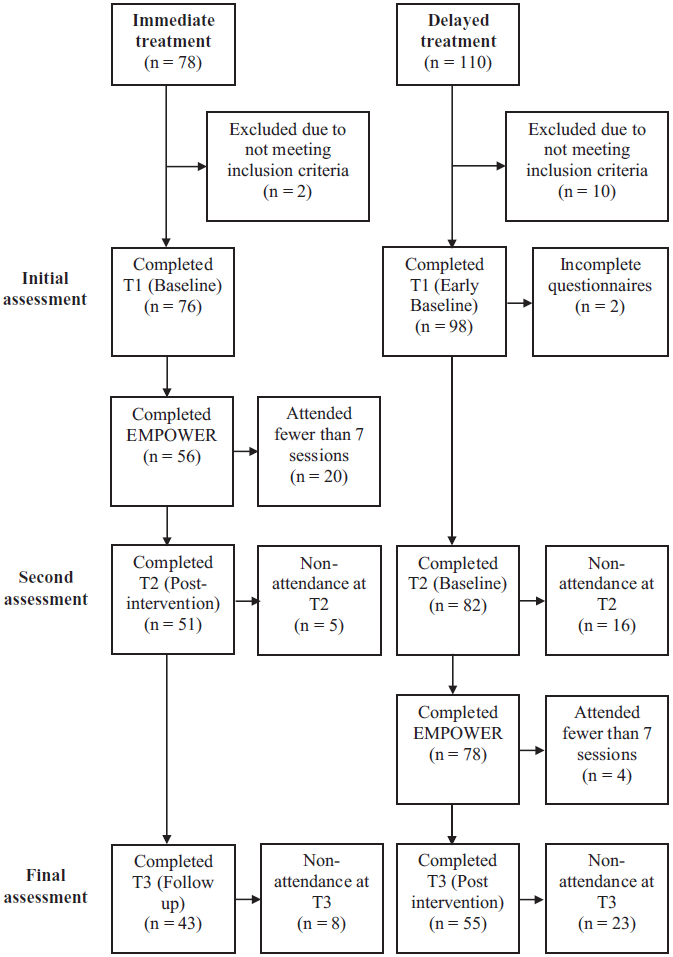
For the intervention, participants were separated into the immediate treatment group (ITG; n = 76) and delayed treatment group (DTG; n = 98) based on the community in which they lived. Of this sample, 98 participants (n ITG = 43, n DTG = 55) completed the entire study, attending a minimum of seven intervention sessions and completing questionnaires at the initial, second and final assessments. There were no significant differences in drop-out rates between the groups: χ2(1, n = 174) = 0.00, p = .952. Figure 1 depicts the flow of participants through the study.
Flow of participants through the study by treatment group.

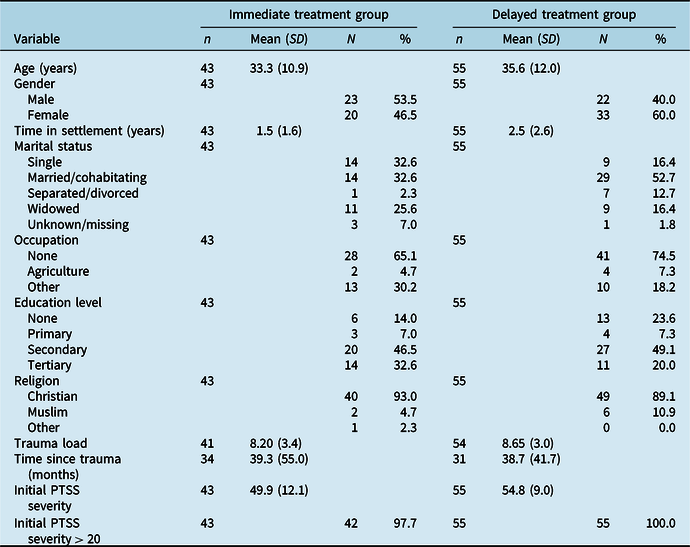
For RQ1, only participants who completed the entire study (n = 98) were included in analyses. Participants’ demographics and trauma characteristics (by group) are detailed in Table 1. The only variables on which the ITG and DTG differed significantly were marital status, p < .05 (Fisher’s exact test), time in the refugee settlement, t (96) = 2.20, p < 0.5, η2 = .048, and PTSS severity at the initial assessment, t (96) = 2.04, p < .05, η2 = .042. Specifically, the DTG reported a significantly greater percentage of married/cohabitating participants, longer time spent in the settlement, and higher levels of PTSS than the ITG. Notably, almost all participants (99%) had PTSS scores above the recommended cut-off of 20 (E. Carlson, personal communication, 5 March 2016). However, as the scale is only a screening instrument and has not been validated in Swahili, no inferences about PTSD diagnoses were made. Nevertheless, these scores indicate extremely high levels of distress among this sample of refugees.
Descriptive statistics for participant demographics and trauma characteristics by treatment group

Trauma load, number of trauma categories endorsed on the trauma event checklist; PTSS, post-traumatic stress symptoms.
For RQ2, the entire final sample (n = 174) was analysed as a pooled group; between-group differences were not considered. For RQ3, participants who completed both baseline and post-intervention measures, in addition to at least seven sessions of the intervention, were included; unlike RQ1, completion of the follow-up or early baseline measures were not required for the ITG or DTG, respectively. Participants were pooled into one group (n = 106) as no between-groups analyses were conducted.
Procedure
Tutapona provides a range of psychosocial services to refugees and victims of war in Uganda including EMPOWER, follow-up services, one-on-one therapy, and a post-traumatic growth programme. They operate within Ugandan refugee settlements with permission from Uganda’s Office of the Prime Minister and routinely gather data as part of their ongoing monitoring and evaluation strategy. Ethics approval was granted by the University of the Sunshine Coast to conduct data linkages on pre-existing data from two communities in which Tutapona worked (approval number S181229).
Tutapona received permission from local authorities before entering each village. Community members were then invited to participate in the programme irrespective of trauma history or PTSS severity. The intervention was advertised as a programme that teaches people how to manage trauma symptoms; methods of recruitment included announcements by local authorities, mega-phone broadcasts and word-of-mouth. Participants were informed about the programme’s content, structure, location and schedule for data collection. They were also advised that no incentives (such as food or money) would be provided for participation and that no information would be shared with organisations involved with resettlement (due to concerns that participants may over-report symptoms for better resettlement prospects). Participants were informed that they would receive a copy of the Swahili programme manual upon treatment completion; those who completed the intervention and questionnaires at all three time points also qualified for a certificate of completion. People were then invited to take part and informed consent was indicated by participation.
All participants were invited to complete the Screen for Post-Traumatic Stress Symptoms (SPTSS; Carlson, Reference Carlson2001) at three time points: before any participants completed the intervention (initial assessment), 1-week after the ITG completed the intervention (second assessment), and 1-week after the DTG completed the intervention (final assessment; see Fig. 1). The demographic questionnaire and trauma checklist were completed at the initial and final assessments, respectively. Questionnaires were administered in groups of 15 and the primary facilitator read questions aloud to ensure standardisation between groups. While filling out questionnaires, participants sat in subgroups of 3, each of which was assigned a trained staff member or translator who assisted with questionnaire comprehension and completion. All questionnaires were completed by pen and paper. The ITG began the intervention the day after the initial assessment, while the DTG started the day after the second assessment. Data collection and interventions took place in churches within each community and were delivered in Swahili, the lingua franca in both the eastern Democratic Republic of the Congo and the refugee settlement.
Facilitators
Data collection and programme delivery were conducted by four Ugandan facilitators who had worked for Tutapona for an average of 2.13 years (range = 1.75–2.75). Staff held relevant formal qualifications in counselling, psychology and development studies. Each staff member received 3 months of training and supervision which included extensive training in the EMPOWER protocol, facilitation techniques, and CBT components such as psychoeducation, goal setting, behavioural experiments, cognitive restructuring and exposure therapy. They also received ongoing professional development in counselling skills, case management and therapeutic techniques. All four staff members conducted assessments at the first and second time points. For the final assessment, two facilitators were absent due to personal commitments. Consequently, two staff members from a different site with similar training and experience assisted with data collection. Two external translators were also employed to assist with questionnaire delivery at all three time points; staff members and translators all received training in questionnaire completion before the initial assessment.
Intervention
EMPOWER (Sonderegger, Reference Sonderegger2011) is a manualised culturally sensitive group-based CBT trauma rehabilitation programme consisting of 13 sessions. However, Tutapona made several modifications to the programme delivery to maximise their limited resources. First, although the intervention was designed to be delivered in small groups, the number of refugees requiring assistance necessitated much larger groups. Consequently, attendance was uncapped resulting in up to 215 and 189 participants attending the ITG and DTG sessions, respectively. Participants sat in a circle with several rows and were invited to participate in group discussions and activities. The four staff members took turns facilitating the entire group. The second modification involved condensing the programme into nine 90-minutes sessions conducted each weekday over a 2-week period, rather than Sonderegger et al.’s (Reference Sonderegger, Rombouts, Ocen and McKeever2011) schedule of thirteen 2-hour sessions delivered daily. Due to the intensive nature of the programme, each community was given autonomy over the time and location of the intervention and attendance was voluntary. The third refinement incorporated additional culturally relevant activities and metaphors throughout the programme. Although one-on-one sessions were available to participants requiring additional support, no participants received additional therapy during the data collection period.
The nine sessions included (1) introduction to the programme, trust-building, understanding and managing expectations, and relaxation exercises; (2) motivation, identifying challenges, and goal-setting; (3) identifying and understanding physiological responses to stress and trauma; (4) exploring trauma and sharing mildly distressing events with a partner; (5) controlling emotions using relaxation techniques; (6) understanding and identifying false and unhelpful beliefs; (7) challenging negative cognitions; (8) acceptance and forgiveness; and (9) the importance of forgiveness, testimony sharing, and programme graduation. To address trauma-related cognitions, group facilitators provided psychoeducation to the whole group on what unhelpful beliefs are, including examples, and how they maintain distress. Guidance was also given on how to manage and reframe such negative cognitions. Participants practised these thought-identifying and -challenging strategies in smaller groups and were then encouraged to share some examples with the entire group at the end of the sessions.
Measures
Demographics
Demographic questions measured age, gender, ethnicity, year of migration, marital status, occupation, highest level of education and religion. Year of migration was used to estimate the number of years spent in the refugee settlement, and ethnicity was clarified to determine participants’ nationalities. The form was in English due to logistical constraints regarding translation; trained translators assisted participants to complete the questionnaire using a page of standardised translations.
Post-traumatic stress symptoms
PTSS severity was measured using the Screen for Post-Traumatic Stress Symptoms (SPTSS; Carlson, Reference Carlson2001), a 17-item self-report scale that parallels the DSM-IV symptom criteria for PTSD. Participants indicated the frequency of symptoms (e.g. ‘I feel very irritable and lose my temper’) experienced over the previous week on a 5-point Likert scale ranging from 0 (not at all) to 4 (more than once every day). SPTSS scores were calculated by summing responses (range = 0–68); scores above 20 are suggestive of a PTSD diagnosis (E. Carlson, personal communication, 5 March 2016). The scale was translated into Swahili using numerous steps of translation, blind back-translation, and subsequent corrections by Tutapona staff. Although the Swahili version had not been validated, the SPTSS was deemed to be most appropriate for the sample as it is brief, suitable for low literacy populations, and not keyed to a single traumatic event (and thus appropriate for participants who had experienced multiple traumas).
The English SPTSS version has good psychometric properties including high internal consistency (α = .91), good concurrent validity (evidenced by strong correlations with other measures of PTSD, anxiety and dissociation), and good construct validity (demonstrated by significant differences in SPTSS scores between individuals with and without trauma histories; Carlson, Reference Carlson2001). Criterion validity was assessed by comparing those who screened positive for potential PTSD (SPTSS score > 20) against PTSD diagnoses made using the Clinician-Administered PTSD Scale (Blake et al., Reference Blake, Weathers, Nagy, Kaloupek, Gusman, Charney and Keane1995) among 40 American adult survivors of traumatic injury of self or a loved one; sensitivity and specificity rates were .90 and .80, respectively (E. Carlson, personal communication, 5 March 2016). However, this cut-off point has not been validated for the Swahili version, nor among a Congolese sample. Consequently, caution was used when interpreting findings and no inferences about PTSD diagnoses were made. For this study, the Swahili SPTSS had good internal reliability at the initial assessment (α = .87).
Trauma Checklist
Exposure to traumatic and stressful life events was assessed using an adapted version of the trauma checklist from Foa et al.’s (Reference Foa, Cashman, Jaycox and Perry1997) Posttraumatic Diagnostic Scale. Only items 1–12 of the scale were included; ‘sexual contact before you were age 18 with someone who was 5 or more years older than you’ was removed due to concerns about cultural sensitivity. Four additional items deemed relevant to the population were included based on previous studies with similar samples (Karunakara et al., Reference Karunakara, Neuner, Schauer, Singh, Hill, Elbert and Burnha2004; Onyut et al., Reference Onyut, Neuner, Ertl, Schauer, Odenwald and Elbert2009): ‘witnessing murder or suicide’, ‘poisoning or witchcraft’, ‘robbery or looting’ and ‘dangerous evacuation’. Consequently, the total scale consisted of 16 items; participants indicated which events they had experienced (if any) and scores were summed (range = 0–16). The frequency of each event was not assessed as research suggests that measuring and summing event types provides a practical and accurate indication of trauma load (Wilker et al., Reference Wilker, Pfeiffer, Kolassa, Koslowski, Elbert and Kolassa2015). Participants were also asked how long it had been since the most recent trauma they had experienced and were provided with an opt-out if desired. The checklist was translated into Swahili by Tutapona staff, although logistical difficulties precluded back-translation and verification procedures.
Data analysis
Data were analysed using the Statistical Package for Social Sciences version 24.0 (IBM Corporation, 2016). Missing data for demographic and trauma characteristics were not replaced; SPTSS item-level missing data were replaced with the series mean where two or fewer items were missing, or otherwise excluded. The item ‘torture’ from the trauma checklist was removed from analyses due to concerns about mistranslation. Consequently, trauma load scores ranged from 0 to 15. Two-tailed tests with an alpha level of 5% were utilised for all analyses. Effect sizes were calculated using Cohen’s d, the coefficient of determination (r 2), and partial-eta squared (ηp2) utilising the metrics: small (d ≥ .20; r 2 and ηp2 ≥ .01), medium (d ≥ .50; r 2 and ηp2 ≥ .06) and large (d ≥ .80; r 2 and ηp2 ≥ .13; Cohen, Reference Cohen1973; Cohen, Reference Cohen1988).
Kolmogorov–Smirnov tests indicated that several variables violated the assumption of normality. However, skewness and kurtosis z scores for trauma load were within 95% confidence intervals so normality was assumed. Transformations corrected the skew for initial PTSS, age and time in settlement but not for time since trauma. Consequently, non-parametric tests were used for time since trauma. No transformations normalised all six (group by time) distributions for SPTSS scores. However, visual inspection of boxplots and histograms revealed that the data approximated normality and no outliers were detected. Consequently, parametric analyses were conducted on the untransformed data. Mauchly’s test of sphericity for PTSS over time was non-significant, χ2(2, n = 98) = 0.17, p = .917, but Levene’s test suggested heterogeneity of variances between groups’ PTSS at the initial assessment, F (1,96) = 3.99, p < .05, and second assessment, F (1,96) = 8.34, p <.01. However, Glass et al. (Reference Glass, Peckham and Sanders1972) suggest that ANOVAs are robust to such violations and therefore no adjustments were made. All other assumptions for the respective statistical tests were met.
RQ1 used a 2 × 3 mixed design 2-way factorial ANOVA to examine the effects of group (ITG, DTG) and time (initial, second and final assessments) on PTSS severity, operationally defined as participants’ SPTSS scores. Where justified by significant ANOVA main effects or interaction, planned comparisons using paired samples t-tests were conducted; the critical p-value for these comparisons was adjusted using a Bonferroni correction to maintain an alpha level of 5% and guard against an inflated type I error. For RQ2, factors associated with programme completion (operationally defined as attending a minimum of seven out of nine EMPOWER sessions) were assessed using a 2 × 2 crosstab with a chi-square test of independence (for gender) and independent samples t-tests (for age, initial PTSS and time in settlement). For RQ3, PTSS improvement was calculated by subtracting participants’ post-intervention from baseline SPTSS scores, with a positive value reflecting a reduction in symptoms. Factors potentially influencing PTSS improvement were analysed using an independent samples t-test (for gender), bivariate Pearson’s correlations (for age, initial PTSS, time in settlement and trauma load), a Spearman’s rank-order correlation (for time since trauma), and one-way ANOVAs (for marital status and education level).
Results
Effectiveness of EMPOWER
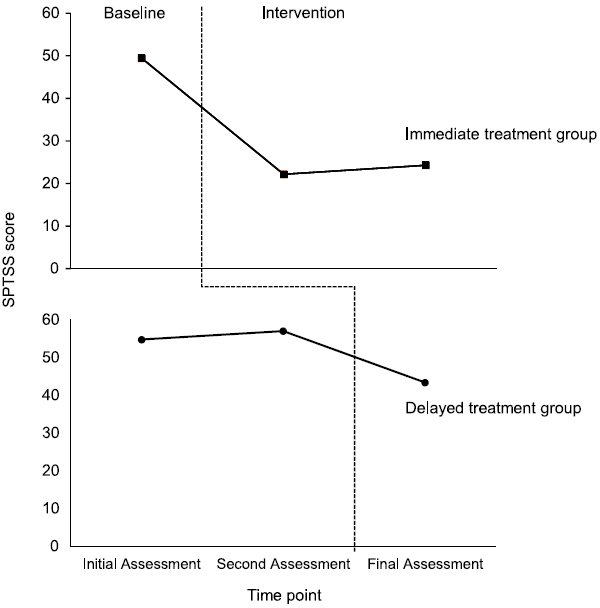
Analyses for RQ1 revealed statistically significant main effects for time, F (2,192) = 77.78, p < .001, and group, F (1, 96) = 101.40, p <.001, both with large effect sizes (ηp2 = .448 and .514, respectively). There was also a significant group by time interaction, F (2,192) = 48.25, p < .001, which also had a large effect size (ηp2 = .334; see Fig. 2).
Post-traumatic stress symptoms by group across time.

Planned comparisons revealed statistically significant reductions in PTSS from baseline to post-intervention scores with large effects sizes for both the ITG (meanbaseline = 49.92, SD baseline = 12.09; meanpost = 22.43, SD post = 15.73), t (42) = 9.48, p < .001, d = 1.93) and DTG (meanbaseline = 57.10, SD baseline = 10.81; meanpost = 43.01, SD post = 13.86), t (54) = 6.30, p < .001, d = 1.11). The ITG’s follow-up SPTSS scores (mean = 24.54, SD = 14.94) were also significantly lower than their baseline scores, t (42) = 10.81, p < .001, with a large effect size (d = 1.84), but did not differ significantly from their post-intervention scores, t (42) = 1.20, p = .238. Finally, the DTG reported no significant differences in PTSS from early baseline (mean = 54.77, SD = 9.04) to baseline scores, t (54) = 1.56, p = .124. Given the significant non-equivalence of the two groups’ initial PTSS scores, no between-group analyses were conducted.
Factors associated with programme completion
For RQ2, the only significant difference between completers (n = 145) and non-completers (n = 29) was their initial levels of PTSS, with those completing the program reporting significantly greater PTSS (mean = 52.21, SD = 10.75) than those who did not (mean = 44.96, SD = 16.13), t (172) = 2.64, p = .009, d = 0.53. Programme completion did not differ significantly according years of age (meancomplete = 33.9, SD complete = 11.9; meannon-complete = 30.7, SD non-complete = 10.5), t (172) = 1.43, p = .153, d = 0.29) or years spent in the settlement (meancomplete = 1.8, SD complete = 2.1; meannon-complete = 1.4, SD non-complete = 2.0), t (172) = 1.32, p = .189, d = 0.20). Furthermore, there was no significant difference in completion rate according to gender, χ2 (1, n = 174) = 1.33, p = .249, V = 0.09, with 80% of males and 87% of females completing the programme.
Factors associated with improvements in post-traumatic stress symptoms
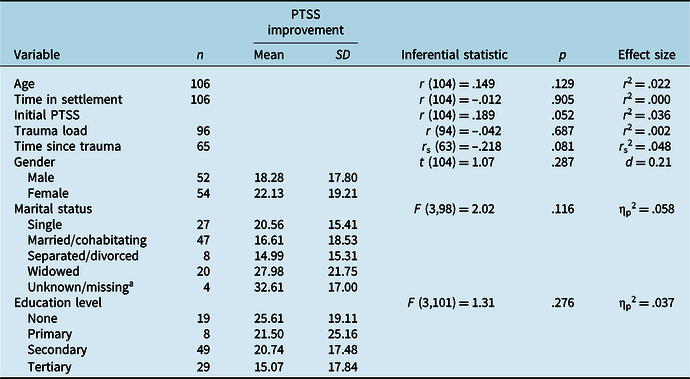
For RQ3, there were no sociodemographic factors or trauma characteristics significantly associated with improvements in SPTSS scores from baseline to post-intervention (see Table 2).
Descriptive and inferential statistics for factors associated with improvements in post-traumatic stress symptoms

Inferential statistic: Pearson’s product-moment correlation, Spearman’s rank-order correlation, independent samples t test, or one-way between-groups analysis of variance (ANOVA); effect size: Cohen’s d, the coefficient of determination (r 2) or partial eta squared (ηp2). aPresented for information but not included in ANOVA due to limited sample size.
Discussion
This study sought to investigate whether a culturally sensitive, group-based TF-CBT intervention effectively reduced refugees’ PTSS when delivered in a refugee settlement, and whether any sociodemographic factors or trauma characteristics were associated with programme completion or treatment gains. Analyses for RQ1 revealed that there was a significant change in PTSS severity between the groups across time. Planned comparisons demonstrated that both groups reported significant PTSS reductions between baseline and post-intervention assessments, providing support for the effectiveness of EMPOWER in reducing PTSS. Importantly, the DTG demonstrated no significant difference in PTSS between the initial and second assessments (both before treatment) during which time the ITG reported significant treatment gains. These findings suggest that the change in PTSS observed in the ITG were the result of the intervention rather than non-specific effects or spontaneous remission. Furthermore, the ITG reported no significant changes in symptoms from post-intervention to the follow-up assessment 3 weeks later, suggesting that the treatment gains were maintained after intervention completion.
Despite the two treatment groups being equally matched on almost all sociodemographic variables, the DTG reported significantly greater PTSS severity at the initial assessment than the ITG, rendering the two groups non-equivalent and precluding between-groups analyses. Notably, the ITG reported significantly greater treatment effects (d = 1.93) than the DTG (d = 1.11) which may be due to several factors. First, the DTG’s greater initial symptom severity may have reduced the effectiveness of the intervention as documented in other research (Haagen et al., Reference Haagen, ter Heide, Mooren, Knipscheer and Kleber2017; van Wyk et al., Reference van Wyk, Schweitzer, Brough, Vromans and Murray2012). Additionally, logistical problems resulted in the DTG changing location mid-therapy and two facilitators being absent for some of the intervention sessions which may have negatively influenced treatment effectiveness. Furthermore, the DTG reported the death of a child within their community while receiving the programme, which may have exacerbated symptoms. Overall, however, the symptom reductions reported by the DTG were still large despite these complicating factors.
The effect sizes seen in this study are comparable with those seen in previous research into interventions among refugees. For example, the meta-analysis by Lambert and Alhassoon (Reference Lambert and Alhassoon2015) found that trauma-focused therapies led to significantly greater reductions in PTSS than those seen in control groups with a large effect size (Hedge’s g = .91), while Thompson et al.’s (Reference Thompson, Vidgen and Roberts2018) meta-analysis found a large effect size in favour of individual TF-CBT compared with inactive/waiting-list control groups (standard mean difference = 1.14). Medium to large effect sizes have also been observed in group CBT interventions (d = 0.7–1.1; Čavić & Pejović, Reference Čavić and Pejović2005; Otto et al., Reference Otto, Hinton, Korbly, Chea, Ba, Gershuny and Pollack2003), and NET delivered within Ugandan refugee settlements (d = 0.6 and 1.4; Neuner et al., Reference Neuner, Schauer, Klaschik, Karunakara and Elbert2004; Neuner et al., Reference Neuner, Onyut, Ertl, Odenwald, Schauer and Elbert2008). Therefore, the results of the current study are generally comparable to, if not greater than, other interventions, suggesting EMPOWER is a promising intervention which can be delivered in a group setting within a refugee settlement to meaningfully reduce refugees’ levels of PTSS.
For RQ2, the only factor associated with intervention drop-out rates was participants’ PTSS at the initial assessment; those who initially reported greater symptom severity were more likely to complete the programme than those with lower levels of distress. These findings are intriguing given that one of the four PTSD symptoms clusters is avoidance, a behavioural pattern which could theoretically motivate avoidance of trauma-focused therapy. Indeed, some research suggests that participants who are more symptomatic are more likely to withdraw from treatment (Garcia et al., Reference Garcia, Kelley, Rentz and Lee2011; Najavits, Reference Najavits2015). The findings of the present study could indicate the desperation and need for treatment among those experiencing high levels of distress. Alternatively, the group-format and absence of one-on-one exposure (as found in most TF-CBT programmes) may have made the intervention less confronting for participants, thereby increasing retention rates among the most distressed. Age, gender and time in the settlement were unrelated to programme completion, suggesting that the intervention was equally palatable and engaging for both males and females, people of all ages, and refugees who had been in the settlement for any length of time.
Analyses for RQ3 revealed that no sociodemographic factors, trauma characteristics or PTSS symptoms were associated with better treatment outcomes. Previous research into moderators of treatment outcomes have produced conflicting findings. Some studies suggest poorer treatment outcomes among males, those with greater symptom severity, and those with higher trauma loads (e.g. Cloitre et al., Reference Cloitre, Petkova, Su and Weiss2016; Ehlers et al., Reference Ehlers, Grey, Wild, Stott, Liness, Deale and Manley2013; Stenmark et al., Reference Stenmark, Guzey, Elbert and Holen2014). Conversely other studies, both with and without exposure treatment components, have found that these factors were not significantly related to treatment response (e.g. Buhmann et al., Reference Buhmann, Mortensen, Nordentoft, Ryberg and Ekstrøm2015; Haagen et al., Reference Haagen, ter Heide, Mooren, Knipscheer and Kleber2017). Consistent with the latter body of literature, the present study found there were no moderators of treatment outcomes, suggesting EMPOWER is equally effective for all participants irrespective of their age, gender, marital status, level of education, time spent in the settlement, trauma load, time since the most recent trauma, or initial levels of PTSS.
This study had limitations. The research design was not a true experiment as participants were not randomly allocated to treatment groups. Additionally, the Swahili versions of the SPTSS and trauma event checklist were not validated and therefore the results should be approached with caution. Analyses for factors associated with PTSS, programme completion and treatment gains may have lacked statistical power to detect between-group differences due to small group sizes, and no long-term follow-ups (e.g. 6- or 12-month assessments) were conducted to examine the sustainability of therapeutic gains after treatment completion. Furthermore, as logistical constrains precluded the collection of session-by-session measures, intention to treat analysis could not be conducted, which may have biased the results. Consequently, future research should include randomisation to treatment conditions, larger sample sizes and long-term follow-up assessments. Additionally, it would be beneficial to investigate the programme’s effect on other domains such as depression, anxiety, somatisation, social functioning and functional impairment, and evaluate the tolerability of the intensive nature of the intervention. Assessments such as the SPTSS should also be validated in other languages like Swahili to facilitate further studies into African refugee and non-refugee populations.
In conclusion, this study demonstrates that a culturally sensitive group-based TF-CBT programme delivered in a refugee settlement meaningfully reduces refugees’ PTSS severity and is equally effective for all participants, with the highest retention rates found among those in greatest need of treatment.
Findings from our study have substantial implications for addressing the significant mental health concerns faced by millions of refugees worldwide. Group-based interventions provide a cost-effective, accessible, disseminable and effective treatment approach to treating PTSS among large groups of people. Additionally, group-based interventions can combat the isolation often experienced by those with trauma, providing participants with social support and a sense of belonging (Sloan et al., Reference Sloan, Bovin and Schnurr2012). This may be particularly important in non-Western environments, especially in African cultures with an ubuntu worldview which values collectivism, cooperation and sharing (Van Dyk and Nefale, Reference Van Dyk and Nefale2005). Furthermore, group therapy can help participants normalise their symptoms, gain perspective, and learn from others’ experiences (Yalom and Leszcz, Reference Yalom and Leszcz2005). However, group interventions also have several drawbacks. Sharing in front of others may be overwhelming and uncomfortable for some, especially when talking about traumatic experiences and trauma-related cognitions. Personality clashes may also arise with some group members seeking to dominate the conversation. Furthermore, the group format may not allow for participants to catch up on any sessions they miss, and individuals’ idiosyncratic trauma-related cognitions may not be addressed, limiting the effectiveness of the intervention. Such limitations must be considered and managed (e.g. providing one-on-one sessions for those who need further assistance) in order to maximise treatment outcomes.
Acknowledgements
The authors would like to acknowledge the contributions of Tim Manson who provided operational support and guidance for this project, and Samuel Balinda, Rosemary Nyirangoroye, Sophie Nakayiza and Walter Engola who assisted with program delivery and data collection.
Financial support
This work was supported by the University of the Sunshine Coast, Australia.
Conflicts of interest
Dr Robi Sonderegger is the author of EMPOWER, the intervention investigated in the current study. Consequently, he was not directly involved in data collection and analysis but consulted on issues relating to the intervention’s design. Elsa Goninon, Lee Kannis-Dymand, Doddy Mugisha and Geoff Lovell have no conflicts of interest with respect to this publication.
Ethical statements
The authors have abided by the Ethical Principles of Psychologists and Code of Conduct. This study was approved by the research ethics committee of the University of the Sunshine Coast, Australia (approval number S181229).
Additional information
EMPOWER training and materials can be obtained by contacting Family Challenge Australia. A copy of the modified version used in this study can be obtained by contacting Elsa J Goninon, School of Social Sciences, University of the Sunshine Coast, Queensland, Australia, 4556. Email: egoninon@usc.edu.au



Comments
No Comments have been published for this article.