Introduction
The sterile insect technique (SIT) was first applied successfully in the 1950s against the New World screwworm Cochliomyia hominivorax (Coquerel) (Diptera: Calliphoridae) on the island of Curaçao. In the subsequent 50 years, this pest was eradicated from the USA, Mexico, Central America and Panama, using an area-wide integrated pest management approach that included the release of sterile insects (Klassen and Curtis, Reference Klassen, Curtis, Dyck, Hendrichs and Robinson2005). This approach to pest management has also been used successfully against several fruit fly species in the family Tephritidae (Rull Gabayet et al., Reference Rull Gabayet, Reyes Flores, Enkerlin Hoeflich, McPheron and Steck1996), e.g. the programme implemented in the 1970s that eradicated the Mediterranean fruit fly Ceratitis capitata (Wiedemann) from south-eastern Mexico so as to stop it from invading other parts of Mexico (Hendrichs et al., Reference Hendrichs, Ortiz, Liedo, Schwarz and Cavalloro1983). The SIT has been applied in Mexico against the Mexican fruit fly Anastrepha ludens (Loew) since 1994 (Reyes et al., Reference Reyes, Santiago, Hernández and Tan2000) and against the West Indian fruit fly A. obliqua (Macquart) since 2001 (Artiaga-López et al., Reference Artiaga-López, Hernández, Domínguez-Gordillo, Moreno, Orozco-Dávila and Barnes2004); there are plans to also apply this technology against the American guava fruit fly A. striata (Schiner) and the sapote fruit fly A. serpentina (Wiedemann).
The SIT requires that large numbers of the target pest be reared and then the male sex be sterilized and sequentially released in the target area. An important aspect of rearing fruit flies is culturing the larvae that require an oligidic diet while still allowing low-cost raw ingredients to be used and promoting the development of insects with the desired characteristics for release in the field (Vargas et al., Reference Vargas, Chang and Williamson1983). To develop a new diet for a new species, it is recommended that the performance of the insect on previously formulated diets of closely related species be assessed (Cohen, Reference Cohen2004; Parker, Reference Parker, Dyck, Hendrichs and Robinson2005). A good example is the modified diet of C. capitata that provided good results for rearing A. ludens (Stevens, Reference Stevens1991), A. obliqua (Artiaga-López et al., Reference Artiaga-López, Hernández, Domínguez-Gordillo, Moreno, Orozco-Dávila and Barnes2004) and the tropical fruit fly (Pinson et al., Reference Pinson, Tejada, Toledo, Enkerlin, Celedonio-Hurtado, Valle, Pérez and Liedo2005). Although the contents of the various diets are very similar and the ingredients are of similar quantities, until now the feasibility of using only one general formulation for several species has not been tested. One diet formulation would simplify diet preparation into one operation.
In the Moscafrut Facility, 13.8 metric tonnes, 2.6 metric tonnes and 30 kg of diet are prepared every day for rearing A. ludens, A. obliqua and A. serpentina, respectively. An independent process is required for each diet; this includes weighing the ingredients and then handling and transporting the diet components from the store to the preparation room where a diet mixer is located. If a generic diet were developed, it would require only one line for processing the diet; this would save time and reduce labour costs. Therefore, the objective of this study was to determine whether a generic diet could be developed for the three species: A. ludens, A. obliqua and A. serpentina.
Materials and methods
Biological material
The A. ludens, A. obliqua and A. serpentina flies used in this study were obtained from eggs produced at the Moscafrut Fruit Fly Facility DGSV-SAGARPA located in Metapa de Domínguez, Chiapas, Mexico. The insects were reared following procedures described by Stevens (Reference Stevens1991), Artiaga-López et al. (Reference Artiaga-López, Hernández, Domínguez-Gordillo, Moreno, Orozco-Dávila and Barnes2004) and Pinson et al. (Reference Pinson, Tejada, Toledo, Enkerlin, Celedonio-Hurtado, Valle, Pérez and Liedo2005), respectively.
Laboratory test
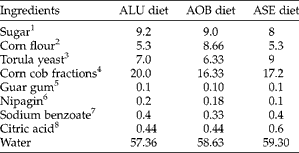
The larval diets were based on existing formulations used for mass-rearing A. ludens (ALU diet) (Stevens, Reference Stevens1991), A. obliqua (AOB diet) (Artiaga-López et al., Reference Artiaga-López, Hernández, Domínguez-Gordillo, Moreno, Orozco-Dávila and Barnes2004) and A. serpentina (ASE diet) (Table 1). Each diet was a separate treatment and was replicated six times. For each replicate, a plastic tray (772 × 397 × 73 mm, Model 805208; Molded Fiber Glass Tray Co., Linesville, PA, USA) was loaded with 7 kg of diet for A. ludens and A. serpentina larvae each and 6 kg of diet for A. obliqua larvae.
Composition (%) of the various diets used for mass-rearing Anastrepha ludens (ALU), A. obliqua (AOB) and A. serpentina (ASE) larvae in the Moscafrut Facility at Metapa, Chiapas, Mexico
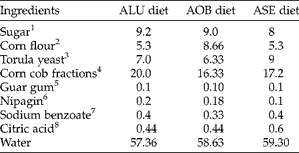
1 Ingenio Huixtla, Chiapas.
2 Maíz Industrializado del Sureste, S.A. de C.V., Arriaga, Chiapas.
3 Lake States Div., Rhinelander Paper Co., Rhinelander, WI.
4 Corn cob fractions 100, Mt. Pulaski Products, Inc., Chicago, IL.
5 Tic Gums, Inc., Belcamp, MD.
6 Mallinckrodt Specialty Chemicals Co., St Louis, MO.
7 Cia. Universal de Industrias, S.A. de C.V., Mexico.
8 Anhidro acidulante FNEUM, Mexana, S.A. de C.V., Morelos.
Each tray containing the experimental larval diet was seeded with 2 ml of A. obliqua or A. serpentina eggs or 1.5 ml of A. ludens eggs. Previously, the eggs had been disinfected with chlorine at 100 ppm and then suspended in 50 ml of 0.4% gum agar solution. Once homogenized, the solution was poured onto the diet. During the first 2 days, the diet trays were kept at 29 ± 1 °C and 90% relative humidity (RH) for the completion of egg hatch. Thereafter, trays with the diet and larvae were kept in a room at 27 ± 1 °C and 85–90% RH for another 7 days until the completion of larval development. Then, the diet was diluted with water and the larvae were removed with a sieve (mesh 14). To eliminate excess water, the larvae were mixed with fine vermiculite (Strong-Lite Fine; Sungro Horticulture, Seneca, IL).
Pupating larvae were put in a tray without substrate and kept in a room at 21 ± 1 °C and 70% RH. After 24 h, the pupae were covered with vermiculite and transferred to and kept in a second room at 25 ± 1 °C and 80% RH for 14 days. On the completion of pupal development, the pupae were separated from the vermiculite with a sieve (mesh 18) and then counted, weighed and placed inside oviposition cages for adult emergence.
Quality control parameters were assessed following the procedures described by Orozco-Dávila et al. (Reference Orozco-Dávila, Schwarz-Gehrke and Pérez-Romero1983), FAO/IAEA/USDA (2003), Hernández et al. (Reference Hernández, Flores-Breceda, Sosa-Iturbe, De La and Ezquivel2005) and Rivera et al. (Reference Rivera, Hernández, Toledo, Salvador and Silva2007). Larval recovery was defined as the percentage of eggs transferred to the diet that developed into mature larvae and pupal recovery as the percentage of larvae that developed into pupae. The mean weights of larvae and pupae were estimated by counting the total number of individuals in three samples of 7.5 g each. Adult emergence was assessed from eight samples of 50 pupae each in cylinders (140 mm high and 80 mm wide), considering only normal adults that emerged within 5 days. Flight ability was estimated from three samples of 150 pupae each, and once the flies emerged, only fliers were quantified.
Mass-rearing test
The ALU diet was used in tests to mass-rear A. obliqua and A. serpentina using 62 replicates, each consisting of a plastic larval tray (as described above) containing 6 or 7 kg of larval diet, respectively. The preparation of the diet and the handling of the diet and the biological material were the same as those described above.
Data analysis
Data on larval recovery, pupation, adult emergence and flight ability were arcsine-transformed (Underwood, Reference Underwood2005) before being subjected to an ANOVA. In the case of significant differences, the means were separated using Tukey's honestly significant difference (HSD) test at the P≤ 0.05 level (JMP Statistical, Discovery Software, version 5.0.1.; SAS Institute Inc., Cary, NC, USA). Data on larval yield per g diet and on larval and pupal weights were also subjected to ANOVA and the means separated using Tukey's HSD test at the P≤ 0.05 level (JMP Statistical, Discovery Software, version 5.0.1.; SAS Institute Inc., Cary, NC, USA).
Results
Laboratory test
Anastrepha obliqua
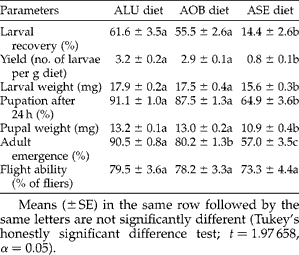
As shown in Table 2, the larval recovery of A. obliqua was significantly different when reared on the three diets, with 61.6, 55.5 and 14.4% of mature larvae developing on the ALU, AOB and ASE diets, respectively (F 2,15= 69.91; P <0.001). Yields (F 2,15= 77.39; P< 0.001) were 3.2 larvae per g of the ALU diet and 2.9 larvae per g of the AOB diet (P>0.05), whereas the ASE diet yielded significantly fewer larvae (0.8 larvae per g diet). The weight of larvae was significantly different when reared on the three diets tested (F 2,15= 14.64; P= 0.0003), with a similar weight being observed for larvae reared on the ALU and AOB diets (17.9 and 17.5 mg, respectively), but the weight of larvae (15.6 mg) reared on the ASE diet was significantly lower. Larvae reared on the ALU diet had the highest pupation rate of 91.1% after 24 h. Pupal recovery was significantly lower (64.9%) for larvae reared on the ASE diet and similar (87.5%) for larvae reared on the AOB diet (F 2,15= 44.07; P< 0.001). Pupal weight was 13.2 and 13 mg for larvae reared on the ALU and AOB diets (P>0.05), respectively, whereas pupae that developed as larvae on the ASE diet were significantly lighter (10.9 mg) (F 2,15= 23.38; P< 0.001). Adult emergence was highest (90.5%) for larvae reared on the ALU diet, and there were no significant differences with respect to flight ability among larvae reared on the three diets.
Quality control parameters of Anastrepha obliqua reared on various larval diets
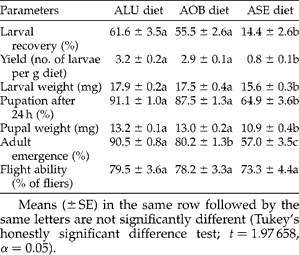
ALU, A. ludens; AOB, A. obliqua; ASE, A. serpentina.
Means ( ± SE) in the same row followed by the same letters are not significantly different (Tukey's honestly significant difference test; t= 1.97 658, α = 0.05).
Anastrepha ludens
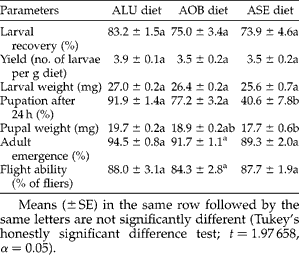
No significant differences were observed with respect to larval recovery ( ≥ 73.9%) (F 2,15= 2.10; P= 0.157), yield per g diet ( ≥ 3.5 larvae) (F 2,15= 2.18; P= 0.148), larval weight ( ≥ 25.6 mg) (F 2,15= 3.24; P= 0.067), adult emergence and flight ability among A. ludens larvae reared on the ALU, AOB and ASE diets. Pupation after 24 h was 50% lower for larvae reared on the ASE diet than for those reared on the ALU diet (F 2,15= 28.60; P< 0.001), and pupal weight was significantly lower for larvae reared on the ASE diet than for those reared on the ALU diet (Table 3).
Quality control parameters of Anastrepha ludens reared on various larval diets
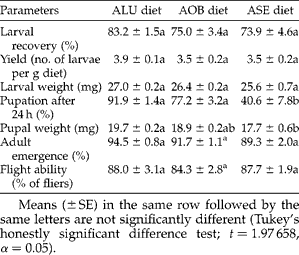
ALU, A. ludens; AOB, A. obliqua; ASE, A. serpentina.
Means ( ± SE) in the same row followed by the same letters are not significantly different (Tukey's honestly significant difference test; t= 1.97 658, α = 0.05).
Anastrepha serpentina
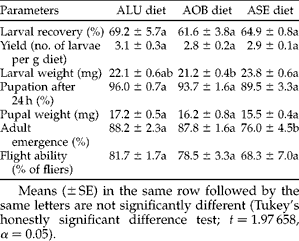
Larval recovery (F 2,15= 0.96; P= 0.406), larval yield per g diet (F 2,15= 0.93; P= 0.415), percentage of pupation after 24 h (F 2,15= 2.20; P= 0.145), pupal weight (F 2,15= 1.98; P= 0.172) and flight ability (F 2,15= 2.06; P= 0.162) were all similar for A. serpentina larvae reared on the three diets. However, larvae reared on the ASE diet were significantly heavier (F 2,15= 5.89; P= 0.013) than those reared on the AOB diet, and adult emergence for larvae reared on the ASE diet was significantly lower (F 2,15= 5.02; P= 0.021) than that for larvae reared on the other two diets (Table 4).
Quality control parameters of Anastrepha serpentina reared on various larval diets
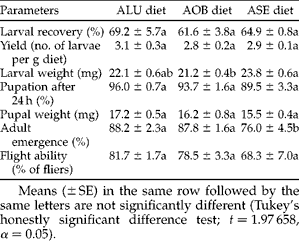
ALU, A. ludens; AOB, A. obliqua; ASE, A. serpentina.
Means ( ± SE) in the same row followed by the same letters are not significantly different (Tukey's honestly significant difference test; t= 1.97 658, α = 0.05).
Mass-rearing test
Anastrepha obliqua
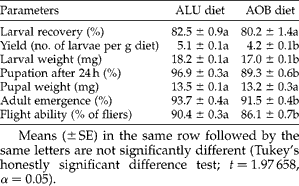
Larval recovery (F 1,122= 0.44; P= 0.334) and pupal weight (F 1,122= 1.41; P =0.237) were similar for A. obliqua larvae reared on the ALU and AOB diets. However, for the other parameters tested (larval yield per g diet (F 1,122= 90.04; P< 0.001), larval weight (F 1,122= 88.06; P< 0.001), percentage of pupation after 24 h (F 1,122= 162.83; P< 0.001), adult emergence (F 1,122= 18.07; P< 0.001) and flight ability (F 1,122= 30.78; P< 0.001), the performance of larvae was better on the ALU diet than on the AOB diet (Table 5).
Quality control parameters of Anastrepha obliqua under mass-rearing conditions
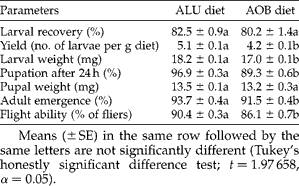
ALU, A. ludens; AOB, A. obliqua.
Means ( ± SE) in the same row followed by the same letters are not significantly different (Tukey's honestly significant difference test; t= 1.97 658, α = 0.05).
Anastrepha serpentina
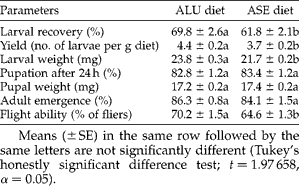
Larval recovery (F 1,158= 7.09; P= 0.009), number of larvae per g diet (F 1,158= 4.95; P= 0.023), larval weight (F 1,158= 33.36; P< 0.001) and flight ability (F 1,158= 8.62; P =0.0038) were all higher for A. serpentina larvae reared on the ALU diet than for those reared on the ASE diet (Table 6). Pupation after 24 h (F 1,158= 0.003; P= 0.99), pupal weight (F 1,158= 0.002; P= 0.961) and adult emergence (F 1,158= 0.77; P= 0.381) were similar for larvae reared on the two diets.
Quality control parameters of Anastrepha serpentina under mass-rearing conditions
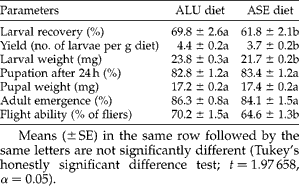
ALU, A. ludens; ASE, A. serpentina.
Means ( ± SE) in the same row followed by the same letters are not significantly different (Tukey's honestly significant difference test; t= 1.97 658, α = 0.05).
Discussion
The results clearly indicate that using the ALU diet, routinely used for mass-rearing A. ludens, significantly increased the performance parameters of A. obliqua when compared with using the AOB diet. The number of larvae recovered per g diet increased by 21.4%, larval weight by 7%, percentage of pupation after 24 h by 8.5%, adult emergence by 2.4% and flight ability by 4.9%. Similar observations were made when the ALU diet was used for rearing A. serpentina larvae. In comparison with those observed on rearing larvae on the ASE diet, larval recovery increased by 12.9%, the number of larvae recovered per g by 18.9%, larval weight by 9.6% and flight ability by 8.6%. These results suggest that the three species of Anastrepha have similar nutritional requirements and strongly suggest that the ALU diet be used as a generic diet.
Our data support the concept that developing new diets for closely related species should start with assessing their performance on existing diets (Cohen, Reference Cohen2004; Parker, Reference Parker, Dyck, Hendrichs and Robinson2005).
This is the first report on using a generic diet to mass-rear closely related fruit fly species. The use of a generic diet in a mass-production facility for several closely related species would greatly simplify the preparation and distribution of the diet, saving time, space and work. It would also reduce the work related to the quality control of the three colonies.
This study has provided basic information on a potential generic diet for the larval development of three Anastrepha species. However, the results are not definitive, and additional studies are needed to assess whether the effect of the generic diet on quality control parameters will change with ageing of the colonies. For example, during the colonization of Bactrocera invadens Drew, Tsuruta and White (Ekesi et al., Reference Ekesi, Nderitu and Chang2007), pupal recovery was found to increase throughout the generations. The same result was observed for pupal weight, demographic parameters and mating attributes during the colonization of C. capitata (Liedo et al., Reference Liedo, Salgado, Oropeza and Toledo2007). In addition, research is needed on how to use this generic diet for colonizing wild flies.
Acknowledgements
The authors are grateful to Y. Margoth García for assistance in the rearing procedures. This research was partially funded by the Joint FAO/IAEA Programme of Nuclear Techniques in Food and Agriculture (contract no. 13023/R0, 2005–2010) and the Campaña Nacional Contra Moscas de la Fruta, Programa Moscamed-Moscafrut (SENASICA–SAGARPA).