Despite rises in the proportion of women and girls within the violent offender population (Snyder & Sickmund, Reference Snyder and Sickmund1999), the development of aggression in girls is not as well understood or studied as that of boys (Chesney-Lind & Shelden, Reference Chesney-Lind and Shelden1992; Odgers & Moretti, Reference Odgers and Moretti2002). Yet aggression is one of the few areas of psychology in which gender differences are consistently documented (Hyde, Reference Hyde2005). In addition to differences in rates of aggressive behavior, aggressive girls also exhibit higher rates of psychopathology and childhood victimization compared to their male counterparts (Dembo, Williams, & Schmeidler, Reference Dembo, Williams and Schmeidler1993; McCabe, Lansing, Garland, & Hough, Reference McCabe, Lansing, Garland and Hough2002; Timmons-Mitchell et al., Reference Timmons-Mitchell, Brown, Schulz, Webster, Underwood and Semple1997). Thus, many researchers argue that gender-specific theories are needed to explain the divergent mental health profiles of aggressive girls versus boys (Chesney-Lind & Shelden, Reference Chesney-Lind and Shelden1992; Dembo et al., Reference Dembo, Williams and Schmeidler1993; Odgers & Moretti, Reference Odgers and Moretti2002). Some speculate that such theories should emphasize the role of dysfunctional relationships and account for how early victimization contributes to the development of this pattern (Odgers, Moretti, & Reppucci, Reference Odgers, Moretti and Reppucci2005). However, the absence of large samples of aggressive girls has made it difficult to develop and test such theories.
Borderline personality disorder (BPD) is a syndrome characterized by unstable relationships, impairments in emotion regulation, and volatile behavior (American Psychiatric Association, 2000). BPD has been implicated as a risk factor for violence in some samples (Johnson et al., Reference Johnson, Cohen, Smailes, Kasen, Oldham and Skodol2000; Warren et al., Reference Warren, Burnette, South, Chauhan, Bale and Friend2002) and a separate literature links BPD to prior abuse exposure (Rogosch & Cicchetti, Reference Rogosch and Cicchetti2005; Wonderlich et al., Reference Wonderlich, Crosby, Mitchell, Thompson, Smyth and Redlin2001). However, no studies have examined whether emerging BPD symptoms may explain the association between abuse and aggression observed among girls. If true, such a model would have implications for the treatment of the large population of young female offenders.
Comprehensive Assessment of Aggression
Because little is known about the development of aggression in girls, a comprehensive understanding of aggression in girls entails assessing the full spectrum of aggressive behaviors in this population and examining whether the same risk factors hold for different types of aggression and different levels of severity. Although traditional definitions of aggression emphasize the physical nature of this behavior, which can range on a spectrum from relatively normative overt aggression (e.g., physical aggression, such as hitting, kicking, physical threatsFootnote 1) to violent offending behavior (e.g., muggings, shootings), increasingly, awareness has grown regarding the phenomenon of relational aggression, defined by Crick and Grotpeter (Reference Crick and Grotpeter1995) as interpersonal acts of aggression, such as spreading rumors and social ostracism. Among normative samples, this form of aggression is more frequent in girls than overt aggression (Crick & Rose, Reference Crick, Rose, Miller and Kofsky Miller2000).
Although relational and overt aggression appear highly correlated with one another (r = .60−.80; Crick, Reference Crick1996; Odgers & Moretti, Reference Odgers and Moretti2002), evidence suggests that they are distinct constructs (Little, Jones, Henrick, & Hawley, Reference Little, Jones, Henrick and Hawley2003). For example, although overt aggression has been linked to peer ratings of antisocial behavior, relational aggression has not (Little et al., Reference Little, Jones, Henrick and Hawley2003). At present, little is known about the characteristics of relational aggression among girls who exhibit high rates of overt aggression or violent offending behavior. In addition, theories to explain the development of all forms of aggression (e.g., overt, relational, violent offending) have not been tested among large samples of incarcerated girls.
Relationships and Aggression in Girls
The need to incorporate relationships into models of girls' aggression is supported by studies noting gender differences in the qualitative aspects of aggression. The victims of girls' violence are more likely to be an acquaintance, friend, or partner compared to boys (Archer, Reference Archer2000; Snyder & Sickmund, Reference Snyder and Sickmund1999). In fact, girls' aggression appears to be an ongoing pattern within relationships rather than an isolated incident, in which they are both perpetrators and victims. Although the victims of girls' aggression are less apt to sustain serious physical injury, girls are twice as likely to become victims themselves within these exchanges (Archer, Reference Archer2000; Rennison & Welchans, Reference Rennison and Welchans2000). Together, these data provide a compelling argument for understanding the overall pattern of aggression and how interpersonal functioning may contribute to the maintenance of this pattern over time.
Many studies have documented an association between childhood physical abuse (CPA) and the development of aggression among both boys and girls (English & Widom, Reference English and Widom2002; Fergusson & Lynskey, Reference Fergusson and Lynskey1997). Previously, the relationship between CPA and development of aggression has been conceptualized within a social learning theory framework, in which children learn aggression by imitating behavior that has been rewarded or observed in their environment (Bandura, Reference Bandura1978). Similarly, there is evidence that children internalize maladaptive social cognitions, which may also influence their aggressive behavior (Dodge, Petit, Bates, & Valente, Reference Dodge, Petit, Bates and Valente1995). However, the theory does not account for higher rates of abuse and psychopathology seen among aggressive girls; nor can it explain findings such as those of Herrera and McCloskey (Reference Herrera and McCloskey2001), which indicate that girls with prior CPA might be even more likely than boys with CPA to commit future violent offenses.
A growing sentiment suggests that to understand girls' aggression, the behavior needs to be placed in the context of girls' lives, which are based in relationships (Odgers, Moretti, & Reppucci, Reference Odgers, Moretti and Reppucci2005). This notion is consistent with the work of Chodorow (Reference Chodorow1978), who argues that girls are more relationally oriented than boys because of differences in early bonding experiences. She posits that in infancy, girls are tasked with identifying with their mothers whereas boys differentiate from mothers. This translates into gender differences in identify formation, such that girls' sense of self tends to be characterized by empathy toward others and linked to their relationships with others, whereas boys' sense of self is characterized more by autonomy and independence. Extending this theory to aggression, Gilligan (Reference Gilligan1993) points out that traditional views of aggression have conceptualized it as an innate impulse that needs to be managed or controlled but argues that it can be reconceptualized in relational terms as “the fracture of human connection.” This relational conceptualization of aggression emphasizes the need to understand the role of prior relationships on girls' current behavior, particularly those in which girls experienced trauma or abuse, to understand their aggression.
Attachment theory, which emphasizes the role that early relationships play in later functioning (Bowlby, Reference Bowlby1973), may represent a more appropriate theoretical framework in which to understand girls' aggression. Within this framework, dysfunctional bonding caused by abuse or separation in infancy or early childhood damages one's internal working model of relationships, thereby causing future relationship problems and psychopathology (Bowlby, Reference Bowlby1973). BPD has recently been conceptualized as a disorder of attachment that results when early trauma causes the formation of an unpredictable conceptualization of relationships and interferes with ones ability to regulate emotional states (Levy, Reference Levy2005). Indeed, several studies document an increased incidence of trauma exposure in childhood among individuals with BPD symptoms (McLean & Gallop, Reference McLean and Gallop2003; Rogosch & Cicchetti, Reference Rogosch and Cicchetti2005; Wonderlich et al., Reference Wonderlich, Crosby, Mitchell, Thompson, Smyth and Redlin2001).
A growing body of literature also implicates BPD in the emergence of aggression. BPD symptoms have been linked with aggression across the life span, including ratings of aggression in young children (Rogosch & Cicchetti, 2005), violence toward others among inpatient adolescents (Johnson et al., Reference Johnson, Cohen, Smailes, Kasen, Oldham and Skodol2000), and self-reported institutional aggression among incarcerated women (Warren et al., Reference Warren, Burnette, South, Chauhan, Bale and Friend2002). Crick, Murray-Close, and Woods (Reference Crick, Murray-Close and Woods2005) suggest that BPD symptoms may also be associated with nontraditional forms of aggression, or relational aggression. However to date, studies have focused on either CPA or BPD in understanding aggression, rather than exploring the potential mediating role of BPD in understanding the link between abuse and aggression.
The current study tested a mediation model of aggression in which the relationship between CPA and aggression was mediated by the presence of BPD symptoms. A secondary aim was to explore whether this model was appropriate to understanding the spectrum of aggression in girls, including relational aggression, overt aggression, and severely violent behavior.
Method
Participants
Participants included 121 girls sentenced to a custodial disposition in a Virginia juvenile correctional facility. The girls ranged from 13 to 19 years of age, with a mean age of 16.23 years (SD = 1.25). When asked to self-identify, 37.9% of the girls identified as Caucasian, 48.3% as African American, and the remaining 13.8% as other minority groups (e.g., Native American, Hispanic) or declined to report. A large number of participants came from lower socioeconomic status households; 53.3% reported that their mother had received income assistance (e.g., welfare, food stamps) at some point in the past, as had 12.8% of their fathers. With regard to maternal education, 25.2% reported that their mother had not finished high school (29.3% of fathers).
Procedures
All girls at the correctional facility were eligible for participation. For girls who were under 18 years of age, active parental consent was obtained. Parents were either contacted by mail or in person and were provided with information about the study and a consent form. All girls with active parental consent or who were over the age of 18 were asked to participate. Ninety-three percent of eligible girls accepted; refusals included participants for whom parental consent was denied. Research was conducted in compliance with the governing institutional review boards and a Federal Certificate of Confidentiality ensured privacy of information. Girls were compensated with small snacks and refreshments for their time.
Prior to each assessment, institutional files were reviewed and coded for pertinent background information. Next, each participant completed a structured interview and a series of self-report inventories, which were administered in groups or in an individual setting for those girls with reading difficulties (as determined by institutional testing data). Structured interviews were conducted by trained graduate students in psychology.
Measures
CPA
CPA was assessed using the Conflict Tactics Scale—Revised (CTS-R; Straus, Reference Straus1979, Reference Straus1995) to determine aggressive and abusive acts done to the participant by a family member, peer, or romantic partner. Parental physical abuse subscales, which comprised 12 items measuring the frequency of physical abuse by maternal and paternal caregivers, were used. Items included how often a participant was hit, kicked, or punched by each parent, which were rated on a 1 (never) to 4 (always) scale. Scores represent the sum across all items (α = .93).
BPD symptoms
Symptoms of BPD were measured using the Structured Interview for DSM-IV Personality (SIDP-IV; Pfohl, Blum, & Zimmerman, Reference Pfohl, Blum and Zimmerman1997). The SIDP-IV consists of a semistructured interview, organized by domains (interests and activities, close relationships, self-perceptions) to measure criteria for the 10 DSM-IV personality disorders. Items are scored on a 0 (not present) to 2 (strongly present) scale and the scores represent the sum across the nine criteria assessing symptoms of BPD. Interviewers were doctoral students in psychology and interrater reliability on nine paired cases was high (interclass correlation = .95).
Violent offending was assessed using a modified version of the Self-Report of Offending—Revised (SRO-R; Huizinga, Esbensen, & Weiher, Reference Huizinga, Esbensen and Weiher1991), which measures lifetime violent offending behavior, including robbery, shootings, and attempted murder. For the current study, a subset of six representative items were selected (e.g., carrying a gun, used a weapon to rob someone, used a weapon in a fight, been in a fight, attacked someone, and shot at someone); scores represent the number of violent acts endorsed (α = .72).
Overt aggression
Overt aggression was measured using the aggression subscale of the Youth Self-Report (YSR; Achenbach, Reference Achenbach1991). The YSR aggression subscale is commonly used to measure aggression in adolescents (DeFrancesco, Armstrong, & Russolillo, Reference DeFrancesco, Armstrong and Russolillo1996; Song, Singh, & Singer, Reference Song, Singh and Singer1994) and was selected to represent less serious forms of physical or overt aggression, including hitting, threatening, and bullying others. Each of the 19 items was scored on a 0 (not at all true) to 2 (very true) scale (α = .87); scores represent the sum across items.
Relational aggression
Relational aggression was measured using the relational aggression subscale of the Form–Function Aggression Measure (FFAM; Little et al., Reference Little, Jones, Henrick and Hawley2003). The FFAM is a self-report inventory, in which statements are presented and girls are asked to rate how typical that behavior was of themselves on a 1 (not at all) to 4 (very much) scale. The relational aggression subscale included 13 items, such as “If others upset or hurt me, I often tell my friends to stop liking them,” and “I am the kind of person who tells my friends to stop liking someone.” Scores represent the sum for all items (α = .87).
Results
Analyses
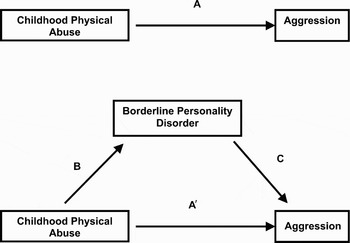
Regression analyses were conducted in which each measure of aggression was predicted from CPA with BPD entered as a mediator (see Figure 1). Preacher and Hayes (Reference Preacher and Hayes2004) have provided SPSS macro syntax, which allows for the testing of mediation according to the traditional Baron and Kenny (Reference Baron and Kenny1986) model (i.e., effect of CPA alone vs. effect of CPA when BPD is entered in the model, represented by pathway A vs. A′ in Figure 1), as well as a test of indirect effects consistent with the Sobel test (Reference Sobel1982), which tests whether the indirect effects are significantly different from zero (represented by multiplying pathways B and C in Figure 1). In addition, this syntax provides bootstrapped estimates of the confidence interval around the indirect effect; bootstrapped estimates make no assumption of normality regarding the distribution of effect sizes.
Models of CPA, BPD, and aggression.

Because of positive skew, a square root transformation was performed to normalize the distribution of aggression variables. Regressions were conducted on raw and transformed variables, but yielded similar results. Only raw variable models are presented for ease of interpretation. An alpha of p < .05 was used to evaluate significance of effect sizes.
The mean level of CPA on the CTS-R, was 6.78, with 47% of girls stating they were slapped by maternal caregivers at least rarely and 29% by paternal caregivers. The mean score for BPD symptoms was 7.81 (SD = 3.70) out of a possible 18. Using DSM-IV criteria, 22.1% of the girls exhibited enough symptoms to receive a diagnosis of BPD.
Levels of aggression, as expected, were relatively high. For violent offending, the mean number of acts reported on the SRO-R was 2.52 (SD = 1.69), with 89.3 admitting they had been in a fistfight, and 34.4% admitting to attacking someone with the idea of seriously hurting or killing that person. The mean age for first reported violent act was 10.5 years (SD = 2.93). For overt aggression, the mean on the YSR was 12.14 (SD = 6.9), with 40% admitting they got into fights a lot and 82% admitting they had a temper. The mean relational aggression score was a 20.07 (SD = 5.97) on the FFAM, with 65.5% of girls admitting they put others down to get what they wanted.
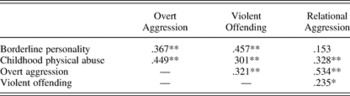
Bivariate associations between variables are shown in Table 1. Violent offending and overt aggression were significantly correlated with BPD and CPA; however, relational aggression was not correlated with BPD.
Correlations between aggression borderline symptoms and childhood physical abuse

* p < .05. **p < .01.
Tests of mediation
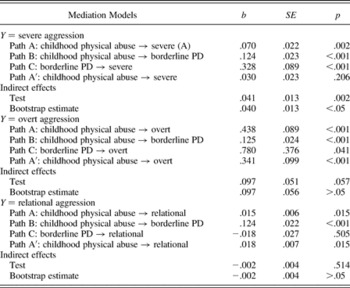
Table 2 displays regression coefficients for mediation analysis. Although the regression coefficient for CPA predicting violent offending was significant in a direct effects only model, once BPD was entered into the model, CPA was no longer significant. The direct effect for BPD on violent offending was significant, as was the effect of CPA on BPD. In addition, the combined indirect effects were significantly different from zero using both the traditional confidence intervals and bootstrapped estimates.
Mediation models predicting aggression from childhood physical abuse and borderline personality disorder symptoms
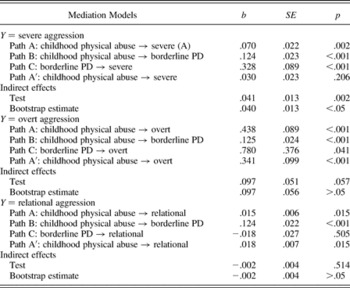
Note: Paths A, B, C, and A′ correspond to the pathways represented in Figure 1. The test of indirect effects tests whether the effect of Path B × Path C is significantly different from zero. PD, personality disorder.
In a model predicting less severe overt aggression, CPA was significant in a direct effects only model, but remained significant once BPD was entered in the model. Although the direct effect of BPD on overt aggression was significant; and CPA was a significant predictor of BPD symptoms, the combined indirect effects were not significant using either the traditional confidence intervals or bootstrapped estimates (see Table 2).
Last, the mediation model of BPD and relational aggression was not significant. Although CPA demonstrated a direct effect on relational aggression, there was no evidence that BPD mediated this relationship. This was not surprising, given the finding in bivariate tests that BPD was not associated with relational aggression (see Tables 1 and 2).
Discussion
The current study conceptualized girls' aggression within a relationship context in order to test whether the association between abuse and aggression could be explained by emerging symptoms of BPD. We found support for this model in explaining violent offending, suggesting a need to consider treatment of these symptoms among incarcerated girls. However, the mediation model did not explain less severe forms of aggression, such as overt aggression or relational aggression, suggesting a need for further research in these areas. A divergent pattern of findings across the spectrum of aggression emphasizes the importance of measuring aggression along a continuum, as well as the need to understand better the development of relational aggression in girls. The implications of these findings for the treatment and understanding of girls' aggression are discussed below.
BPD symptoms appear to mediate the relationship between CPA and violent offending in our sample. This suggests that relationships, and more specifically girls' internal models of relating to others, are key constructs in understanding severe forms of violence. Girls' aggression, which is typically targeted at partners or family members, may be partially explained by early abuse exposure, which interferes with identify formation, emotion regulation, and the formation of stable, healthy relationships.
The above finding may have implications for gender-specific programming for violent offending. Specifically, the extension of empirically validated treatments for BPD may hold great promise for incarcerated girls. Dialectical behavior therapy has proven effective in reducing many symptoms of BPD in adult samples (Linehan, Cochran, & Kehrer, 2000). Haugaard (Reference Haugaard2004) provides several recommendations for successful treatment of BPD in youth, including pharmacological therapy aimed at reducing impulsivity and mood swings and psychotherapeutic techniques to lower anxiety about relationships with others and encourage appropriate expression of feelings. Future studies should evaluate whether such treatments are effective in the reduction of violent offending as well as BPD symptoms in developing adolescents. Because the long-term stability of BPD in girls has not yet been evaluated, we advise against using a formal diagnosis of BPD with this population. However, given the relative stability of symptoms over the short term (Chanen et al. Reference Chanen, Jackson, McGorry, Allot, Clarkson and Yuen2004; Crick et al., Reference Crick, Murray-Close and Woods2005) and their potential association with violence, it may be prudent to target BPD symptoms for intervention. The relative flexibility of adolescent personality development presents an ideal argument for targeting these interventions at girls who are beginning to demonstrate some BPD symptoms in adolescence, in the hopes of avoiding further solidification into adult personality pathology.
Our findings also suggest a need to better understand the correlates and risk factors for girls' aggression across the full spectrum of behavior, as these may differ depending on the type and severity of aggression. For example, BPD was not correlated with relational aggression, and although correlated with overt aggression, did not act as a mediator between CPA and overt aggression. This raises several questions regarding what other mediators may act to explain the association between abuse and less severe forms of aggression. One possibility is that the measure we used to assess BPD captured only the most severe forms of interpersonal deficits, but that more subtle symptoms may mediate the relationship between CPA and overt or relational aggression. Another explanation is that these two types of aggression are better explained by a divergent etiological pathway altogether.
In addition, more information is needed regarding the etiological or temporal linkages between forms of aggression. In our sample, all three forms of aggression were strongly correlated with one another. Anecdotally, when asked about aggressive behaviors, girls often reported relationally aggressive situations (e.g., gossip over a boyfriend or having a group of girls ignore her) that culminated with an overtly aggressive act. However, no studies exist to document the temporal relationship between episodes of relational and overt aggression in girls, nor are there longitudinal studies documenting the evolution of relational and overt aggression developmentally among violent girls or boys.
Shortcomings and Future Research
Several caveats limit the generalizability of our findings. First, aggression was measured by self-report. The addition of observational measures, collateral reports, and even historical data on aggression, would be helpful in improving the study of aggression in girls. Second, the present study examined one theoretical model of aggression and did not examine differences in race or other sociodemographic factors that may also be important to understanding the development of aggression. Third, and most important, these findings should be interpreted cautiously, as these data are cross-sectional. Longitudinal studies are needed to examine this process over time among high risk girls, because it is questionable whether CPA preceded the development of BPD symptoms or whether both preceded the development of aggression.
Conclusion and Recommendations
Understanding girls' aggression requires reframing our notions of why girls act aggressively. We found some evidence that for severe forms of violence, current levels of BPD symptoms were an important mediator of the relationship between violence and prior CPA. We make three recommendations for researchers, clinicians, and individuals working with girls within the juvenile justice system. First, although personality pathology, specifically borderline symptoms, is not traditionally thought of as a necessary part of formal intake assessment for incarcerated girls, our results suggest these symptoms have already begun to manifest in youth (22.1% of our girls aged 13 to 19 met the diagnosis for BPD) and may be important to understanding aggression. Although we do not advocate diagnosing BPD among young girls, BPD symptoms could be reconceptualized from a measure of violence risk or pathology into an index of interpersonal deficits to be addressed in treatment. Second, treatment of girls' aggression may require interventions aimed at addressing barriers to healthy relationship formation (potentially the impact of CPA and BPD symptoms). Interventions for BPD symptoms may be a useful addition to current treatment programs for violent girls. Third, our findings suggest a lack of knowledge on the prevalence and development of less severe forms of aggression in girls, including relational aggression. Such research may inform more effective prevention efforts for would be offenders, or contribute to more comprehensive treatment programs for girls already identified as highly aggressive. Efforts to identify other potential mediators or risk factors should bear in mind the importance of relationships in girls' lives.
We conceptualized girls' aggression within a relationship framework in which we tested whether the association between CPA and aggression could be explained by the presence of BPD symptoms. Our findings suggested that this hypothesis was accurate for severe forms of aggression (e.g., actions that rise to the level that could result in criminal charges), but was not supported in mediation models predicting less severe forms of overt aggression or relational aggression. Together, these findings suggest that longitudinal studies are needed to evaluate whether BPD and/or other forms of pathology relevant to relationship functioning, may explain the association between CPA and aggression. Moreover, such studies should test these associations across the full spectrum of aggressive behavior.