In the West, recent years have witnessed a big increase in accepting sexual fluidity, as manifested in the growing visibility of the LGBT community. It was different in antiquity, where a binary culture of masculinity and femininity prevailed, although reality will have been more diverse. Ancient historians and literary scholars have worked on concepts of masculinity in antiquity,Footnote 1 but more recent studies of Greek religion have mainly analysed positions and representations of women, in so far as they have focused on gender differences at all.Footnote 2 I will therefore first look at some elements of the female life cycle and daily life (§1), then consider representations of women in art and myth, and goddesses as possible role models (§2), and conclude with a discussion of the most important women's festivals (§3).Footnote 3 At all times, we should keep in mind, however, that the real life of women probably differed significantly from male ideologies of their worth and proper place. This means that, although I focus on female gendered roles, male gendered roles will play a role too, even if more indirectly than directly in this chapter.Footnote 4
1. The life cycle and daily life
In Athens, gender differentiation was immediately apparent at birth,Footnote 5 since parents hung a woollen fillet on the doorpost for girls and an olive wreath for boys.Footnote 6 The symbolism seems clear: weaving and spinning were among the main activities of Greek women, whereas an olive wreath was the prize given to meritorious citizens in Athens and the male winners of the Olympic and Panathenaic Games. Regarding young girls, little is known about religious activities in general, but we are reasonably well informed about their coming-of-age rituals, which have been well researched.Footnote 7
But before we come to these, we have to note a typically Greek manner of looking at girls. As was the case with boys (Chapter IV, §3), adolescent girls were seen as ‘untamed’ fillies or deer and their initiation as a kind of ‘domestication’, which on vases was often represented as a ‘capture’ of a fleeing girl by a youth.Footnote 8 The metaphor is very clearly expressed in Euripides’ Hippolytus when the chorus evokes how Aphrodite gave the girl Iole to Heracles, ‘a filly, unyoked to the marriage bed, husbandless before’ (546–7). Moreover, girls were compared to unruly heifers, and myth pictured both Io and the daughters of Proitos wandering around as cows.Footnote 9 Yet the metaphor of the marriage yoke suggests an important difference from boys’ initiation. Despite the similarities, boys became free men on adulthood, whereas women were always imagined as being ‘yoked’.
The ‘domesticating’ function of marriage was represented on the level of cult and ritual as well. Spartan girls worshipped certain pre-nuptial heroines, the Leukippides, whose name, ‘White Mares’, reflected their transitional position between youth and married adulthood, as did their sometime appearance as adolescents and as newlyweds. Myth also related their capture by the Dioskouroi, the mythical models of the young Spartan males, whom Alcman significantly calls ‘tamers of fast horses’ (fr. 2 Calame = 2 Page/Davies). The capture ended in marriage, which was a direct reflection of the Spartan wedding custom of ‘kidnapping’ the bride. The Thessalians even acted out the equestrian metaphor in their wedding ritual. Here, as Aelian (c. ad 170–240) relates
a man about to marry, when offering the wedding sacrifice, brings in a war-horse bitted and even fully equipped with all its gear; then when he has completed the sacrifice and poured the libation, he leads the horse by the rein and hands it to his bride. The significance of this the Thessalians must explain. (NA 12.34)
We need not share Aelian's despair, since the meaning of the gesture seems clear: among the horse-loving Thessalians a man expected his wife to act like a completely domesticated and tamed horse.Footnote 10
Typical motifs of Greek female initiations were the prominence of aristocratic girls, seclusion, humiliation, choral dancing, physical exercise, and attention to beauty, as the following examples may illustrate. In Athens, four girls of noble families, the arrhêphoroi, lived on the Acropolis for a number of months (see below). In Attic Brauron, noble girls stayed for a while as arktoi (‘she-bears’), in the sanctuary of Artemis, where they passed their time with dancing, running, and weaving. In Corinth, seven boys and seven girls of the most prominent families spent a year in the temple of Hera Akraia on the Acropolis dressed in black clothes and with close-cropped hair. In Ilion, two maidens of the best families of Locri had to spend one year in the temple of Athena Ilias, which they had to keep clean, while being barefoot, their hair cut short, and with only one dress to wear. Finally, on Keos marriageable girls had to spend the day in sanctuaries with sport and dancing, but at night they had to perform menial duties in other people's homes. All these rituals are most easily understood as transformations of initiations, since these are their closest parallels.Footnote 11
In Sparta, female initiation lasted longer than anywhere else in Greece. Here the girls received a thorough physical training in palaestras and racing courses to become fit for producing firm and vigorous children. During the later part of their initiation some girls received a female lover. The seventh-century poet Alcman describes the principal girls of a chorus, Hagesichora and Agido, as being in love with each other (fr. 3 Calame = 1 Page/Davies).Footnote 12 Comparable ‘lesbian’ relationships existed on the island of Lesbos, where girls received pre-matrimonial training by means of dance and song in various circles: the poems of Sappho, the ‘mistress’ of one of these circles, testify to her passionate love for some of her pupils.Footnote 13
In the final part of their initiation, Spartan girls participated in the cult of Helen, who in Sparta was worshipped as a goddess. An important element in her service was running, which was not unique to Sparta: girls in Brauron ran races (see above); in Chios girls ran against boys, and during Hera's festival in Elis girls ran in a very short dress, hair loosened, and right shoulder and breast bare.Footnote 14 In Helen's service, the girls also performed choral dances during which these ‘little Helens’ sang patriotic songs and displayed their beauty. This connection between beauty and female adolescence was widespread. In Athens, it is well illustrated by the maidens on the Parthenon frieze, and an aristocratic, marriageable girl could simply qualify her function as carrier of the sacrificial basket in processions (kanêphoros) with ‘when I was a beautiful girl’. In Arcadian myth, the exemplary female novice was significantly called Kallisto, or ‘the most beautiful’. In fact, in several places female initiation ended with a beauty contest. The parallels suggest that originally the situation in Sparta had not been all that different, but Spartan males, being a minority, had intensified the traditional physical exercise and concern for beauty to ensure that their domination over the Messenian helots was supported in all possible ways.Footnote 15
Although the ritual elements were largely comparable, local myths varied widely and tied the rites more closely to their communities. For example, in the myth of the arrhêphoria, which is widely but not universally believed to reflect an initiation scenario, the three daughters of Athens’ first king Kekrops (Aglauros,Footnote 16 Pandrosos, and Herse), also called the Aglaurides,Footnote 17 grew up in the palace on the Acropolis. The goddess Athena gave them a basket to guard and sternly forbade them to look inside it, but one night the sisters opened the basket and saw the child Erichthonius/Erechtheus and two snakes. Panic-stricken by this view they cast themselves from the Acropolis. In addition to explaining the presence of precincts of Aglauros and Pandrosos on the heights and slopes of the Acropolis, this myth associated the arrhêphoroi with the heart of the Athenian tradition and motherhood: Erichthonius/Erechtheus was the first human king; a snake who was believed to guard the city was the most famous inhabitant of the Acropolis; and Athenian women put gold amulets in the form of snakes around their own babies, ‘observing the custom of their forefathers and of earth-born Erichthonius’ (Euripides, Ion, 20–1).Footnote 18
Why did only a few aristocratic girls usually participate in these ‘initiatory’ rites and why was the coming of age of ‘lower-class’ girls not ritualized? An answer to this difficult question may perhaps be found in Crete, where only the aristocratic boy had a pederastic relationship, even though the other boys ‘graduated’ with him (Chapter IV, §3). Similarly, the relationship of Hagesichora and Agido seems to have been paradigmatic for the other Spartan girls. Evidently, aristocratic youths played a more prominent role in the ancient puberty rites than other adolescents. When in the course of the archaic period the puberty rites lost their original significance, perhaps because of urbanization, they were not totally abolished but reduced to a symbolic participation of a few boys and/or girls. It is only understandable that these few ‘exemplary’ youths were recruited from the nobility, considering its dominant position. In democratic Athens, such an exclusively aristocratic privilege became no longer tolerable, as is shown by a vote that all Athenian girls had to be a ‘bear’ at Brauron, reported by the fourth-century historian Krateros (FGrH 342 F 9). This discontent in Athens with the prominent place of aristocratic girls had already come to the fore in the archaic period, when non-aristocrats frequently dedicated statues of their daughters (korai) on the Acropolis to advertise their own status.Footnote 19 In many places in Greece, however, after the disintegration of the puberty rites the wedding seems to have become the main rite dramatizing the transition from youth to adulthood for girls of all classes.Footnote 20
Married Greek women would soon experience how religion helped to sustain a social system in which they occupied an inferior position, but which, paradoxically, also enabled them temporarily to escape from that system. Women were considered to be more susceptible to impurity and pollution, and giving birth was sometimes linked with defecating and urinating as the three important taboos on sacred ground, which illustrates a regular association of women with ‘dirt’ and pollution. This association also spilled over into secular life. In the Hippocratic tradition, for example, only female patients were ‘purified’ with excrements. These negative associations appeared in other ways too. Statues of goddesses were more often washed than those of gods, sexual abstention seems to have been more strictly enforced for priestesses than for priests, and women were more often excluded from sanctuaries, especially from those of macho gods and heroes, like Poseidon (Chapter II, §3) and Heracles (Chapter II, §2).Footnote 21
Still, it was not all gloom for women in religion. Priestesses must have been respected everywhere, and decrees praising their services were widespread in all regions of Greece.Footnote 22 Some of them clearly fulfilled highly important positions. The priestesses of Hera in Argos were the basis for Hellanicus of Lesbos in creating ‘a chronological scaffolding upon which to hang the events of Greek history from the very beginning’; Aristophanes’ Lysistrata is widely, and probably rightly, believed to have been modelled on Athena Polias’ long-serving priestess Lysimache; and in Delphi the Pythia must have been a prestigious position for local women, just as another ecstatic seer, the Sibyl, seems to have been active in (especially western) Anatolia. More recently, several inscriptions have shown that female seers were more active than the literary evidence would suggest. It may well be that our male-dominated evidence has given us a skewed idea of the importance of women in religious functions.Footnote 23
As regards female sociability, fetching water from fountains must have long provided an opportunity for women to meet and exchange views and gossip. The importance of the fountain is well illustrated on vase-paintings and in mythology, where fountains are places for gods and heroes to meet mortal women, such as Poseidon and Amymone, Achilles and Polyxena, or Heracles and Auge.Footnote 24 Female festivals likewise enabled women to move among other women, albeit for a limited period only (below, §3). Greek males must have realized the importance that women attached to these events. We hear that Democritus did his utmost not to die during the most important women's festival, the Thesmophoria (§3), in order that his sister would not be prevented from attending (Diog. Laert. 9.43).
Women could also show their activities and trades by way of votives, as the many loom weights in sanctuaries show.Footnote 25 More importantly, they could even found private shrines and play an important role in the new cults and ‘sects’ that gradually infiltrated the Greek world – a phenomenon well attested for late antiquity, when women were instrumental in the spread of Manichaeism, a post-Christian world religion which survived until about 1500 in China and Japan, and, in particular, for early Christianity itself. Older Athenian women, who actively used their possibilities of wandering more freely in the streets than was allowed to pre-menopause women, propagated cults of Kybele and Sabazios (Chapter VII, §2).Footnote 26 If these women often give the impression of belonging to the lower social strata, this cannot be said of those who were interested in Bacchic teachings. It is rather striking that several of the Orphic Gold Leaves, which derived from Bacchic groups (Chapter VII, §2), have been found in graves of wealthy women in various parts of the Greek world.Footnote 27
From a religious point of view, clearly more went on behind the closed doors of Greek women's quarters than was dreamt of in most scholars’ philosophies. Yet male Greeks were not prepared to allow women too much freedom in religion, and festivals such as the Thesmophoria were closely supervised by males. In the fourth century the Athenians executed at least two women for introducing new cults and would have put to death the courtesan Phryne for the same reason, if her lawyer had not spectacularly bared her breasts in front of the male jury.Footnote 28
2. Representations and role models
What images, attitudes, and associations of Greek women were mediated through religion? An answer cannot be exhaustive, but two areas especially deserve our attention.Footnote 29 Numerous Attic vases display women, especially young ones,Footnote 30 practising or participating in various rites, especially wedding rites (above, §1). They often mark the bride's beauty and thus reflect the Greek view of upper-class female adolescents (§1). These vases were given as a wedding present to the bride, and women may well have internalized this view and appreciated these gifts. Equally popular were vase-paintings of women performing libations for departing warriors or participating in funerals as mourners and, especially after the first half of the fifth century, as visitors at a grave. These vases present us with positive roles of women but nearly always being subject to or serving men.Footnote 31 This subordinated position also appears on Athenian marble votive reliefs of women, where they are portrayed more often than men in a suppliant position, although their clothing shows a greater variety than that of the males, thus granting them a certain degree of self-expression.Footnote 32
Although positive images of women, then, were not absent, they did not dominate. Mythology, in particular, played an important role in spreading and sustaining negative images of women in all stages of their lives, starting with the myths surrounding the first woman, Pandora, who was credited with bringing evils such as disease and old age to humanity through her curiosity.Footnote 33 The recurrent motif of young girls falling in love and betraying their own family presents a more negative portrayal. It is already alluded to in the Odyssey (11.321–5), where Odysseus sees Ariadne, whose assistance had been decisive in Theseus’ conquest of the Minotaur (Chapter V, §3). Another early example is Medea, who had helped Jason to procure the Golden Fleece. Neither girl fared well after her betrayal, as was to be expected: Greek myth could hardly have condoned such behaviour. In these and similar cases, the ambiguous action of the girls (helping and betraying) reflected the ambiguous position between their own and (future) husbands’ families in an early society where the support of the family was all-important (Chapter V, §2).Footnote 34 In writing his Antigone, Sophocles shifted this type of family conflict to a level that fitted the occasion of a public festival attended by many Athenians, perhaps even by many Athenian women, as Antigone has to choose between her brother and the polis, a conflict that still elicits many differing reactions among modern students of the play.Footnote 35
Sophocles had probably been inspired by Herodotus’ account of Intaphernes’ wife, who preferred her brother over her husband (3.119).Footnote 36 Other adult women were pictured as betraying their husbands, witness Eriphyle's betrayal of the seer Amphiaraos (Chapter III, §3) for a golden necklace, whereas other women, such as the Lemnian ones and the Danaids, murdered their husbands.Footnote 37 Similarly terribly, in the myths of the Phineids the sons are blinded by their mother or, sometimes, their stepmother, and in the myth of Ino Themisto killed her own children by accident while trying to murder her stepchildren. The collective imagination probably considered a murdering mother too harsh and therefore constructed the killing as an accident or replaced the mother by a stepmother, since in some versions of these myths the mother alternates with the stepmother. But they are not the only mothers who killed their children. Greek tragedy even put killing mothers, such as Medea and Procne, on the stage as, presumably, frightening examples. The message seems clear: Greek males and their offspring were highly vulnerable in the family sphere and the loyalty of their wives was never to be taken for granted, despite such positive examples as Penelope.Footnote 38
We find similar ideas about women well beyond child-bearing age, as can be seen from the number of terrifying females who were represented as old women: Empousa, Erinyes, Graiai, Lamia, and Moirai.Footnote 39 From adolescence to old age, then, myth regularly depicted women in more or less negative ways, even though some women could be monstrous and beautiful at the same time. It is important to note that these mythical representations were not seen as something from a distant past but explicitly connected with the present. When Odysseus meets Agamemnon in the underworld, the latter complains about his murder by his wife, Clytaemnestra, and comments: ‘she has brought shame on herself and future generations of women, even if one of these were to be honest’ (Od. 11.433–4, trans. Heubeck and Hoekstra 1989).
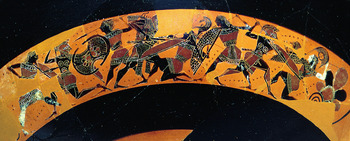
Myth not only depicted women as threatening the male order (of the city), but even located them outside the borders of the Greek world. The Iliad (3.189, 6.186) only alludes to a tribe of warrior women, the Amazons, ‘women equal to men’, but the formula looks old and Homer may not have told everything he knew. Other epics were more informative, and the Aethiopis related the fight between Achilles and Penthesileia, the queen of the Amazons.Footnote 40 In the archaic period, Heracles’ battle against the Amazons became one of the most popular feats in the visual arts (Figure 12), only to be succeeded by Theseus. The few data from the tradition made the Amazons into a myth without much content which could be filled by successive periods with their most favourite heroes. This ‘emptiness’ is also reflected in the widely diverging interpretations of modern scholars: from nineteenth-century matriarchy via initiation to the contemporary ‘Other’. Every age gets the Amazons it deserves.Footnote 41
Battle of the Amazons against Heracles (whose head is missing) with his heroic friends. One side of an Attic black-figure band-cup, Phrynos Painter, c. 555 bc.

If mythology supplied few females as attractive role models for Greek women,Footnote 42 what about goddesses?Footnote 43 The armed Athena did not conform to a stereotypical femininity, and Hera's marriage to Zeus was not a real model of harmony, whereas Aphrodite was probably too much associated with physical love to be a proper example. Eileithyia, the goddess presiding over birth (Chapter III, §2), seems to have played only a functional role in the lives of Greek women, but Demeter, the goddess by whom women swore oaths, must have been more attractive to them, in particular because of her Thesmophoria festivals (below, §3). However, Greek parents never gave their daughters the name Demeter, since the distance between gods and mortals was normally too great to give a child the name of a god (Chapter II, §1). In the classical era, the only exception to this rule was Artemis. From the fourth century onwards, girls could be called after the goddess, although perhaps not daughters of Athenian citizens, and the reason seems apparent. In the Odyssey, Nausicaa's pre-eminence among her friends is compared to Artemis’ position among her nymphs (6.102–9). By naming a daughter Artemis, parents probably hoped for a similar pre-eminence among her contemporaries.Footnote 44
The reason why goddesses were hardly satisfactory role models lies in one of the peculiarities of the Greek pantheon which we have not yet mentioned: representations of gods and goddesses in no way directly reflected the common role patterns of the sexes in human life. On the contrary, the Greek pantheon contained a striking asymmetry. Whereas the gods did not play important roles in typically female activities, goddesses were often connected with typically male ones. Admittedly, Athena supervised spinning and weaving, but she was also the goddess of artisans, closely connected with war, and always represented in armour (Chapter II, §3). Hera and Aphrodite (Chapter IV, §3) were also, in varying ways, connected with war,Footnote 45 and Artemis was the goddess of the hunt (Chapter II, §2). Burkert once argued that archaeological findings prove that this prominent position of goddesses in the male world goes back to pre-agricultural hunting cultures, but the darkness of prehistory prevents any further understanding.Footnote 46 Greek mythology, then, did not offer many positive female role models, and this makes the role of female festivals even more important.
3. Women's festivals
The most widespread women's festivals were the Thesmophoria festivals.Footnote 47 I purposely use the plural because modern research regularly discusses the festival in the singular as if it was the same all over Greece, which clearly was not the case. I will sketch the festivals in outline and apply a certain ‘ritual logic’ in my reconstruction of the order of events during the festivals, but we have to remain aware that they were old, Panhellenic, and displayed local differences.
The festivals generally lasted three days, for which the Athenian names have been preserved, but they were celebrated in Sicily for ten days, since here Demeter and Kore occupied important positions in the local pantheon. In Athens participation was restricted to married women from noble families, but such social differentiation need not have taken place always and everywhere; in some places, girls also seem to have attended.Footnote 48 In Athens, the first day was known as Anodos because it started with the ‘Ascent’ of the women with their equipment, food, and shrieking piglets to the sanctuaries of Demeter, which were often situated on the tops or slopes of hills (Chapter III, §2). They built huts in which they stayed during the festivals, and made beds with twigs of withy, fleabane, and certain types of laurel – all antaphrodisiac plants.Footnote 49 On the level of myth, this absence of sexuality was symbolized in Demeter's gift of the Thesmophoria to an old woman (Corinth) or to the maiden daughters of the first king (Paros) – both belonging to categories on either side of licit sexuality. In a Peloponnesian version, the Danaids who had murdered their husbands during their wedding night had brought the festival from Egypt: an interesting indication of the festival's perceived ‘otherness’.Footnote 50 Since the women had temporarily deserted marriage, the absence of sexuality was heavily marked during the seclusion – which may well have reassured the husbands.
The second day was called Nesteia, or ‘Fasting’, which the women spent without food, sitting on the ground, and without the usual flowery garlands. This is the day on which Aristophanes has situated a meeting of all Athenian women in his Thesmophoriazusae, although in reality Athenian women never celebrated the festival together but met only in their own demes.Footnote 51 As Versnel suggests, it fits the ‘abnormal’ character of the day that on this day Athens released its prisoners and suspended court sessions and council meetings: the ‘reversals’ strongly contrasted the ‘Fasting’ with the return to ‘normality’ on the last day, when fertility of land and humans became the main focus of activities.Footnote 52 And just as the death of Sophocles occurred on the most sombre day of the Anthesteria (Chapter IV, §3), so Plutarch located the death of Demosthenes on ‘the most gloomy day of the Thesmophoria’ in his Life of Demosthenes (30), even if probably wrongly.
Demeter's fasting during her search for Persephone came to an end when, in one version of the myth, an old lady, Baubo, made her laugh by lifting her skirt. As the Demeter myth was closely connected with the Thesmophoria in various places in Greece, it is attractive to connect the lifting of the ritual fasting with the reports about mocking, sham fights, and indecent speech during the festivals: the return to ‘normality’ had to be marked by a period of highly ‘abnormal’ female behaviour. Herodotus (2.171.2) mentions that not everything about the Thesmophoria could be freely told, and these ‘secrets’ may well relate to this part of the festivals. In any case, secrecy was an important part of the festival as the sanctuaries often had high walls, and various anecdotes told of the bad end of males who had tried to break that secrecy.Footnote 53
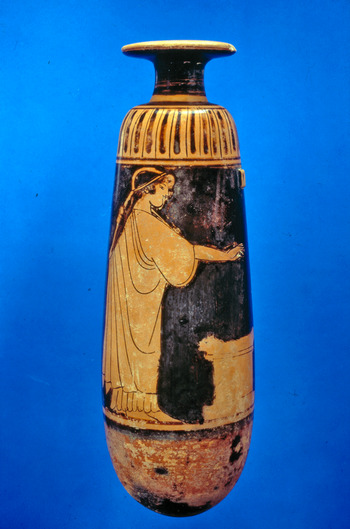
On the third day, the Kalligeneia, decayed remains of piglets were fetched up from subterranean pits (megara or magara),Footnote 54 where they had been left to rot for some time, and placed on altars as future manure. In addition to this concern for the fertility of the land, there was concern for human procreation: Kalligeneia was invoked as goddess of birth in Athens on this day. It is probably these positive aspects of the day which were celebrated with the sacrifice of pigs, the sacrificial victim appropriate to Demeter (Chapter IV, §2).Footnote 55 In a famous study, Marcel Detienne once argued that women themselves were not allowed to sacrifice but that sacrifice was strictly a male business. Yet literary, epigraphical, and archaeological (see Figure 13) evidence all attest to the contrary, and in Bronze Age graves women were buried with sacrificial knives,Footnote 56 even though in Sicily quite a few terracotta figurines have been found of women offering small bread, cakes, and fruit, suggesting that women perhaps practised non-animal sacrifice more often.Footnote 57 With the sacrifices, normality returned. The women had to return to their homes and their wool baskets: the temporary reversal of the ordinary had only reformulated the status quo.
Girl sacrificing at an altar. Attic red-figure alabastron, Painter of Copenhagen 3830, c. 470 bc.

If the women at the Thesmophoria might have behaved in an unseemly way at times, it was a very different matter with the maenads, the female followers of Dionysos in myth and ritual, whose ecstatic rituals took place every other year on mountains in the winter.Footnote 58 Greek myth abounds with startling pictures of their mad behaviour, culminating in the description of their murderous ecstasy in Euripides’ Bacchae: running over mountains, moving like birds, handling fire and snakes, attacking men, and tearing apart animals, children, and even the Theban kingFootnote 59 – although more in literature than on vase-paintings.Footnote 60 Literature and art have provided us with much information about these rituals, which are also reflected in some of the names of maenads on vases, such as the references to the nightly character of the ritual in the names ‘Torch’ (Lampas) and ‘All night long’ (Pannychis): apparently, the rituals could be relatively freely observed or talked about.Footnote 61 In recent times much attention has been directed to the disentanglement of myth and ritual in these reports; to distinguishing those images of maenads which matched the visual experience of a contemporary viewer from those which were ‘invented’ by the painter or copied from other images; to the representation of the maenads in literature and art; and to the origin and function of the ritual. Let us look at a few elements of these discussions.
By taking into account distinctions between myth and ritual (Chapter V, §3) and comparative evidence, we can often reasonably decide in what ways the mythical imagination ‘processed’ elements of ritual.Footnote 62 When in the Bacchae maenads are said to eat raw meat, a judicious comparison with the tasting of small portions of meat from domesticated animals in epigraphically attested maenadic ritual shows that the carnivorous women operated only on the level of myth. In the case of the ritual, though, comparisons with ecstatic rituals from all over the world strongly suggest that elements such as walking barefoot, headshaking, moving to shrill music and clappers, and singing in high-pitched voices were not invented by the ancient sources.Footnote 63 Regarding the representations on the vases, we can investigate which elements are consistently attested or note the lack of functionality of certain details. For example, long ago it was argued, not unpersuasively, that the consistency in the ways in which the women's poses in maenadic dances were pictured and their absence in other female Dionysiac representations implied that they reflected ‘real life’ dances. And when for no obvious reasons round cakes (?) appear at the shoulders of the ‘idol’ of Dionysos on the so-called Lenaean vases, they will hardly have been invented by the painter.Footnote 64
It is clear that poets and painters have been much intrigued by the maenads. Homer compares Andromache to a ‘maenad’ when she rushes through the house in fear for Hector's life (Il. 6.389), and tragedy abounds with allusions to maenadism, especially in Euripides. Sometimes maenadism enables Euripides to let a female character move freely outside her house, as in his Antigone. In other cases, mythical maenads are used as a point of comparison for the frenzied behaviour of his male protagonists, as in the Heracles.Footnote 65 Vase-painters also showed great curiosity about the maenads but certainly not at all times.Footnote 66 The high points of interest seem to have been the end of the sixth century and the fourth century. Moreover, interest was clearly limited to certain contexts. Maenads are absent from white-ground lekythoi and, considering the interest of Bacchic mysteries in afterlife (Chapter VII, §2), it is at least noteworthy that maenads never appear on funerary pots.Footnote 67
There is little known about the origin of maenadism, although a background in initiation is not unlikely,Footnote 68 but maenadic ritual, albeit with many local variants, was widespread in the Greek world.Footnote 69 It must have fulfilled various functions in Greek women's lives – that is, in the lives of ‘upper-class’ women, as the ritual was probably limited to that class. First, it gave the women the possibility of a genuine religious experience through their identification with Dionysos during the ritual. Second, the rituals provided occasions for leaving the home and staying with other women without the immediate supervision of males. Third, by going into a trance the women could perhaps reach a more authentic self-expression than in their normal fixed roles. Yet the limited occurrence of the rituals (only every other year), the restricted participation (see above), and the male supervision from a distance should warn us against overrating the importance of these rituals for Greek women, however fascinating they were for Greek males (and modern scholars!).
Our last festival is the Adonia, which took place yearly in high summer.Footnote 70 During the festival, women of all classes mourned the death of the divine youth Adonis with ecstatic, nightly dances and planted quickly germinating green salad stuff on sherds, which at the end of the festival were thrown into the sea. The cult, which served more or less the same functions as maenadic ritual, is attested first in the eastern part of the Greek Mediterranean.Footnote 71 It clearly derives from Syro-Palestine: witness the connection of Adonis’ name with the Semitic title ‘adôn (‘Lord’), and testimonies about the offering of incense to Baal on flat rooftops (Jeremiah 32:29). The growing of the gardens seems to have originated in the widespread agricultural custom to grow a few plants in order to test the quality of seeds, but it is obscure how or why this custom was incorporated into the Adonis ritual.Footnote 72 In myth, Adonis is painted in very negative colours. He is the product of incest, the toyboy of Aphrodite, a coward who hides himself among lettuce plants, is passive in love affairs, and perishes in a hunt: from a male point of view not a very threatening figure. Did the women accept the male negative view or were there female voices whose independent opinions have been lost?
According to a female anthropologist, twentieth-century rural Greek women seemed to have internalized the male negative views about them.Footnote 73 There are really no indications that ancient Greek women had developed an alternative ideology.Footnote 74 One thing seems sure. As this discussion of the rituals, myths, and festivals has shown, cult provided only limited possibilities to Greek women for status, support, and self-expression. Lower-class women may have fared worse than aristocratic females in this respect, although they perhaps had more possibilities for self-expression by being able to work outside the house.Footnote 75 Mythology produced and maintained a stream of negative images about women. In the end, Greek religion was not so very different from the women-unfriendly spirit of Greek culture at large.