Introduction
Subglacial water is of importance in both the hydrology and dynamics of glaciers. A hydrological network at the bed of a glacier must allow movement of water produced by melting at places with high pressure to places of low pressure where refreezing occurs, and permit the transfer of large quantities of melt water down-glacier. Variations in the rate of sliding of a temperate glacier are probably affected markedly by the availability of subglacial water. The nature of a subglacial hydrological system remains problematical, and water films (Reference WeertmanWeertman, 1964), conduits (Reference NyeNye, 1973; Reference Behrens, Behrens, Bergmann, Moser, Ambach and JochumBehrens and others, 1975), and water-filled cavities (Reference LliboutryLliboutry, 1968) have been postulated. It is generally accepted that water flows in networks of englacial and subglacial conduits (Reference RöthlisbergerRöthlisberger, 1972; Reference ShreveShreve, 1972; Reference Krimmel, Krimmel, Tangborn and MeierKrimmel and others, 1973) though the location, structure, and functioning of such networks have not been settled.
Because the stream emerging from a glacier portal transports large quantities of sediment, flow within a glacier is inferred to occur at the bed in a network consisting of permanent channels incised into bedrock and temporary conduits incised upwards into the ice, which may suffer closure from meeting bedrock protuberances as the glacier moves (Reference NyeNye, 1973). Tunnels in ice tend to close under the ice overburden pressure but this tendency is opposed by melting of the walls by frictional heat produced by the flow of water, by melting if the water is initially warmer than ice, and because of water pressure in the tunnel if the cross-section is fully occupied. From calculations of theoretical water pressures, Reference RöthlisbergerRöthlisberger (1972) showed that water must flow in main arteries and that basal conduits can co-exist with lateral streams at the hydraulic grade line. The size of these channels probably adapts slowly to the quantity of melt water entering the system, such that at times of high discharge, there is insufficient time for capacity to adjust to supply and water pressure within the conduit network is increased.
The few direct observations of subglacial water channels have been made from adduction galleries designed to capture subglacial torrents for hydro-electric developments (Reference Vivian and ZumsteinVivian and Zumstein, 1973; Reference VivianVivian, 1977). These observations show that subglacial drainage is unstable, with stream courses continually changing positions. Indirect observations of water flow, using dye and salt tracers from individual moulins at the surface, to the glacier portal indicate rapid passage of melt waters across the ablation area (Reference StenborgStenborg, 1969; Reference Krimmel, Krimmel, Tangborn and MeierKrimmel and others, 1973), probably under open-channel flow conditions (Reference Behrens, Behrens, Bergmann, Moser, Ambach and JochumBehrens and others, 1975), and Reference Ambach, Ambach, Behrens, Bergmann and MoserAmbach and others (1972) considered that no large water-filled cavities existed at the bed of Hintereisferner, Ötztal Alps. Basal water-pressure measurements are difficult to interpret, since bore holes may or may not penetrate the subglacial conduit system (Reference HodgeHodge, 1976). From analysis of hydrographs of the river draining from Gornergletscher, Reference EllistonElliston (1973) considered that flow resulted from diurnal variations in water pressure of englacial reservoirs caused by variations in rates of water supply. Studies of the distinctive diurnal hydrographs of melt streams draining from glacier portals are inconclusive with respect to measurement of water flow at the bed.
This study aims to apply a method for the separation of the proportion of total discharge routed through the subglacial hydrological system to two Alpine valley glaciers. Water-quality characteristics are used as a means of determining the hydrographs of flow at the beds of the glaciers and understanding the functioning of their internal hydrological systems. Temporal observations were undertaken in order to evaluate changing subglacial flow capacities, and any interaction between conduit flow and temporary storage of water which may occur in cavities existing at the ice–rock interface (Reference LliboutryLliboutry, 1968). In non-glacierized catchments, portions of total discharge from delayed flow through the ground-water system and quick flow arising from precipitation have been determined from measurements of temporal changes of stream hydrochemistry (Reference Pinder and JonesPinder and Jones, 1969). In glacierized catchments, the chemical composition of ice and snow results from atmospheric influences, whereas run-off quality is determined also by terrestrial factors. This problem is complex because of the interaction in run-off of ice and snow melt, precipitation on the glacier surface and over the non-glacierized area, and a possible ground-water component.
Hydrochemical separation of components of flow within glaciers
Components of water flow through glaciers
During the summer ablation season, flow is principally derived from the melting of snow and ice at the glacier surface, since internal and subglacial melting together produce negligible quantities of water. Streams on the ice-free slopes of the catchment provide a significant contribution to total discharge only until all the snow has melted, and at times of heavy rainfall. At times with no precipitation in July and August, variations in the chemical quality of melt waters leaving the glacier portal reflect the interaction of water with sources of solutes within or beneath the ice, and any ground-water contribution.
Diurnal inverse variations of solute concentration of portal melt streams with discharge, during summer, result from dilution of solute-rich melt waters by relatively pure waters flowing rapidly through the glacier from the surface (Reference Rainwater and GuyRainwater and Guy, 1961; Reference CollinsCollins, [1978]). At least two routes for water flow through a glacier are suggested. Water derived from the surface can flow through the glacier without delay and without chemical enrichment. Since ice away from glacier soles is relatively solute-free (Reference RenaudRenaud, [1952]; Reference Hallet, Hallet, Lorrain and SouchezHallet and others, 1978), flow through an englacial, sediment-free, ice-walled conduit system would provide a route in which enrichment was minimized. Water routed through the subglacial zone, probably at overall slower rates, would become increasingly concentrated with ions on account of contact with the solute-rich basal hydrochemical environment (Reference Souchez, Souchez, Lorrain and LemmensSouchez and others, 1973; Reference Souchez and LorrainSouchez and Lorrain, 1975). Determinations of chemical composition have shown that subglacial waters in cavities beneath Alpine glaciers are relatively solute-rich (Reference Vivian and ZumsteinVivian and Zumstein, 1973). Observations in immediate pro-glacial areas from which temperate glaciers have recently retreated have demonstrated the occurrence of both calcite and silicate precipitation at glacier soles (Reference Ford, Ford, Fuller and DrakeFord and others, 1970; Reference HalletHallet, 1975), which reflect high solute concentrations in subglacial waters.
The subglacial hydrological system has channels which may be moraine-walled or cut in bedrock, and in which sediment transport occurs.
Solutes may be added to subglacial melt waters from bedrock, subglacial morainic sediments, sediment-laden basal ice and from suspended sediments in transit in streams. Rapid desorption, ion-exchange, and solution within the subglacial hydrochemical environment is assumed to bring subglacial waters to a uniform equilibrium concentration. The supply of ionic material is maintained by fracture of mineral lattices of basal particles and the bed by glacial erosion. Crushing and frictional wear of subglacial morainic layers mobilize ionic particles as the sediments are continually deformed. Most effective enrichment probably occurs where slowly moving dilute melt waters first enter sedimentary environments, especially in circulation through pores and capillaries in basal moraine. Subglacial spring water, considerably enriched chemically during slow seepage through bedrock cracks and pores, may add to the solute load of water at the bed.
Large quantities of englacially routed waters flowing from moulins and in arterial conduits located at the bed, under the ablation area, dilute waters circulating from the subglacial system. No enrichment occurs in arterial conduits because of large volumes and high rates of flow, and limited areas of contact with materials supplying ions. In this paper, “englacial” is used to describe the conduit system in which chemical enrichment does not occur. Englacial does not necessarily define conduit location, since arterial tunnels located at the bed form part of this system. The “subglacial" hydrological system is that in which enrichment takes place, and of necessity is located at the ice–bedrock interface but excludes basal arterial conduits.
Quantitative model
Concentration of solutes in total run-off results from the contributions of water and dissolved material from the two components of flow:

where Q represents the run-off proportions, C the total dissolved solids content or the concentration of an individual ion in solution, the subscripts refer to the total discharge from the glacier (t), flow routed through the subglacial system (s), and flow through the englacial system (e), and Q t = Q s+Q e.
Equation (1) can be solved for the portion of total discharge routed through the subglacial system:

Mass-balance Equation (2) can be used to determine subglacial flow (which separated on a chemical basis includes any ground-water flow) provided that both components of total run-off have a uniform density of 1 Mg m–3, no chemical reaction occurs when the components mix, and there is no reaction between suspended sediments from the subglacial system and englacially routed water when they meet. Sedimentary particles in suspension retain significant quantities of ions adsorbed to their surfaces, even in transit away from the portal (Reference Lorrain and SouchezLorrain and Souchez, 1972), suggesting that solution of particles (Reference SlattSlatt, 1972) and cation exchange between suspended load and melt waters (Reference CollinsCollins, [1978]) play only a minor role modifying the chemical composition of melt waters once flow is in large channels.
parameter estimation
In order to determine temporal variations in the subglacial flow of water, continuous records of both discharge and solute concentrations were required. Electrical conductivity was adopted as a measure of the total dissolved load of melt waters, since it can be monitored continuously with portable field instruments. Measured electrical conductivity is the sum of the conductances of the individual ions. Although conductivity may be used only as a measure of overall chemical composition, because the proportions of individual ions are not constant through time, inaccuracy resulting from this variability is considered to be negligible in the operation of this model. The conductivity (C e) of englacially routed water was taken as an average value of measurements of the input: ice and snow-melt waters on the glacier surface. Measurement of the electrical conductivity characterizing the hydrochemical environment beneath the glacier (C s) was not possible, and this parameter was obtained indirectly. During recession flow, when surface ablation ceases or is greatly reduced (for example, during the lying of snow from summer precipitation), the reduction of dilute melt-water input and the steady draining of englacially and subglacially stored water allows the solute concentration of total discharge from the portal to increase towards that pertaining in the subglacial system. The maximum conductivity repeatedly recorded during recession flows provides a minimum estimate of the true subglacial value, though some dilution probably occurs at all times during the ablation season.
Field measurements
Study area
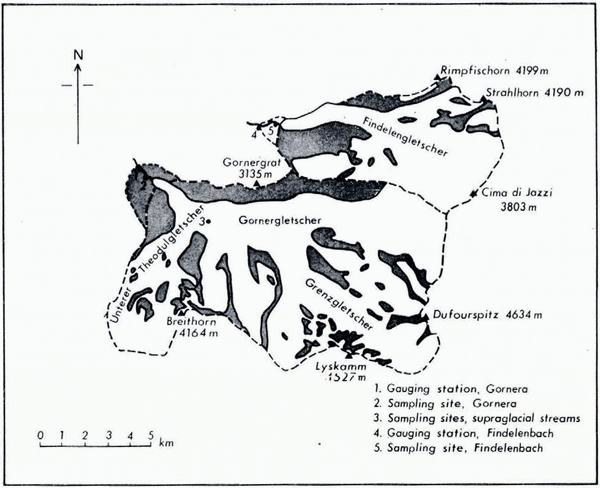
The observations were made in the adjacent catchments of Findelengletscher and Gornergletscher, Canton Wallis, Switzerland (Fig. 1). Each glacier has only one pro-glacial meltwater stream emerging from its snout. The catchment of the Findelenbach extends over 24.9 km2, 76.7% of which is glacierized, and the stream is gauged 0.4 km from the snout of Findelengletscher. The Gornergletscher catchment has an area of 82 km2, which is currently 83.7% glacierized and the Gornera is gauged about 1 km from the snout. Characteristics of the catchment areas and glaciers are given in Table 1. Both catchments have considerable altitudinal range, from heights over 4 000 m a.s.l. to about 2 000 m a.s.l. Gornergletscher receives several tributary glaciers from southern snow-fields, including Unterer Theodul-gletscher, Zwillingsgletscher, and Grenzgletscher. Approximately 50% of the glacier surface of each of Findelengletscher and Gornergletscher lies in the ablation zone in summer (Reference Müller, Müller, Caflisch and MüllerMüller and others, 1976).
Map showing the catchments of the Findelenbach and Gornera, and the sites of gauging stations and sampling sites.


Both catchments are underlain by rocks of igneous and metamorphic origins, granite, gneiss, schists, serpentine, amphibolite, and gabbro (Reference Lütschg, Lütschg, Huber, Huber and de QuervainLütschg and others, 1950), with a very small outcrop of calcareous rocks around Gornergrat (Reference BearthBearth, 1953). The bedrock topography of Gornergletscher is known in detail, but discrepancies between ice thicknesses determined by drilling and seismic methods suggest that a subglacial moraine layer may be up to 50 m thick at the centre of the glacier (Reference Bezinge, Bezinge, Perreten and SchaferBezinge and others, 1973).
Electrical conductivity
Records of conductivity of melt waters were obtained using immersed Sproule electrolytic cells of carbon electrodes in resin probes (cell constant = 1.0) attached to modified Walden Precision Apparatus CM 25 conductivity meters. The probes were positioned in the turbulent main flow lines of the Gornera and Findelenbach, at depths suitable to prevent the probe being left out of water during lowest discharges and to minimize the possibility of damage by bed-load movement. Probes were removed frequently to ensure that electrodes were intact, and that no sediment became lodged. Cells were calibrated against 0.01 M KCl at 25°C before and after use, and showed no temporal changes. Conductivity was monitored at a site 250 m from the glacier portal at Gornergletscher, and within 20 m of the ice margin at Findelengletscher.
Records were obtained for the Gornera during the ablation season of 1975, for a large surface melt stream on Gornergletscher during August 1976, and for the Findelenbach during August 1977. Several breaks resulted from recorder instrumental failures. Conductivity was measured in the presence of suspended sediment and was not corrected to a standard temperature, since individual melt-water samples were found to increase in conductance with temperature at different rates (Reference CollinsCollins, [1978]). Water temperatures ranged from 0.1 to 1.2°C in the Gornera, were consistently 0.1 °C in the supraglacial stream, and ranged from 0.1 to 4.0°C in the Findelenbach. The maximum errors introduced by the above-mentioned non-standardization are about 8% for the Gornera and 15% for the Findelenbach.
Samples of snow and ice melt waters were collected at several locations on the glacier surfaces. Conductivity was measured immediately on collection using platinum electrodes in glass dip cells (cell constants accurately calibrated in the range 0.10–1.65) attached to a WPA E1 conductance module.
Discharge
Both the Gornera and Findelenbach are gauged at the intakes of hydro-electric schemes. Between June and September, Grande Dixence, S.A. record continuous hydrographs of total discharges in flumes. Hourly mean discharges have been used in this paper, to remove short-term irregularities in flow.
Variations of electrical conductivity of melt waters
Ranges of variation
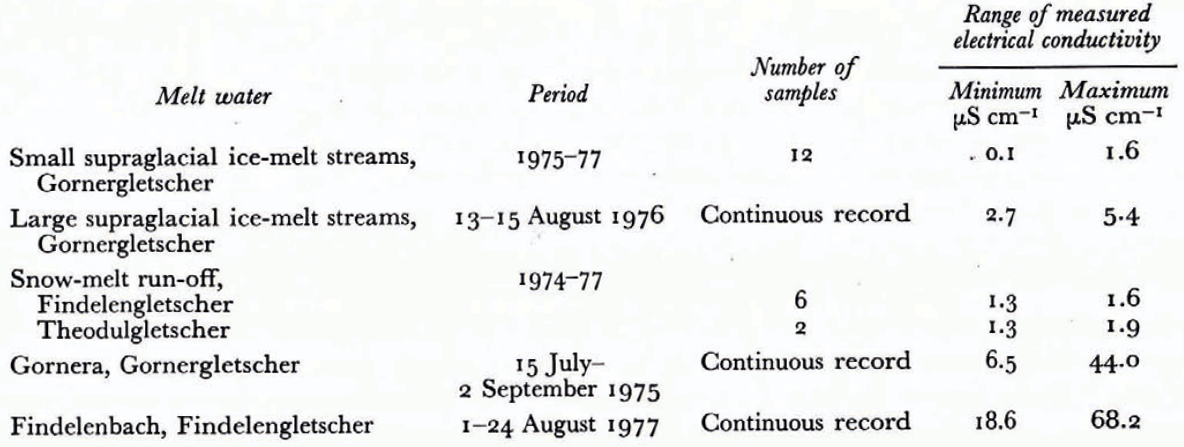
Ranges of variations of electrical conductivity of snow and ice melt waters and of outwash streams are shown in Table II for periods during summer ablation seasons. The results show very low conductivity values for all supraglacial streams irrespective of glacier and source. These dilute waters represent the atmospheric ionic input at the time of precipitation, as subsequently modified during firnification and regelation. The minimum conductivity recorded in the Gornera is almost within the range of the surface melt-water determinations, whereas for the Findelenbach the minimum is considerably higher. The maximum measured conductivity of the Findelenbach is considerably higher than that of the Gornera. Reference Lütschg, Lütschg, Huber, Huber and de QuervainLütschg and others (1950) considered that the ground-water component of winter discharge of the Findelenbach resulted in its having several individual ionic concentrations about ten times higher than those of melt streams draining neighbouring glaciers. The nature of the igneous and meta-morphic rocks would suggest that ground-water flow is unlikely in both catchments. Reference SlattSlatt (1972) found that bedrock type was not an important variable determining melt-stream hydrochemistry. In this study, only relative concentrations of melt waters within each stream are of importance.
Diurnal variations
Discharge hydrographs and continuous records of electrical conductivity of the run-off in the Findelenbach are shown in Figure 2 for the period 1–24 August 1977. Discharge exhibits the usual distinctive diurnal rhythm of flow with the daily peaks superimposed on a slowly fluctuating background flow. The hydrographs show little short-term fluctuation and the only precipitation event to influence markedly the discharge occurred between 00.00 h and 01.00 h on 17 August, when 2.5 mm of rain fell over the catchment. Diurnal hydrographs are asymmetrical, showing a rapid rise to peak in response to the daily increase in energy supply for ablation followed by a slower decline. Maximum discharge occurred between 17.00 h and 19.00 h and minimum flow between 08.00 h and 10.00 h. Daily variations of conductivity of melt water occur in inverse phase compared with discharge. As flow increases, conductivity decreases rapidly as surface ablation waters pass quickly to the portal. During the night, solute concentration builds up slowly as the proportion of chemically-enriched subglacial water increases.
Discharge hydrographs and chemographs of recorded electrical conductivity of melt water in the Findelenbach, draining from Findelengletscher from 1 to 24 August 1977, and precipitation at a gauge close to the glacier snout.

A similar inverse relationship between daily variations of discharge and electrical conductivity was observed in the Gornera (Fig. 3). The proportions of daily flows accounted for by the peaks were smaller than for the Findelenbach. Daily conductance minima often fell beneath 10.0 μS cm–1 (Fig. 3), suggesting that during the peak discharge periods much of the flow of the Gornera was derived from water passing through the englacial network without undergoing chemical change. Both the proportions and amounts of subglacial flow are reduced at times of high surface input to the glacier hydrological system.
Discharge hydrographs and chemographs of recorded electrical conductivity of melt water in the Gornera, Gornergletscher, 20 July–2 September 1975.

Estimates of conductivity subglacial waters
The conductivities of subglacial water were taken as the highest observed conductivities during recession flows of the melt streams draining from the snouts. Records for the Gornera show that 44.0 μS cm–1 was a repeated maximum value of conductivity during several periods of snow-fall-induced recession in 1974 (Reference CollinsCollins, [1978]) and 1975. During observations at Findelengletscher, such recession occurred for only one period (21–24 August 1977). The maximum observed conductivity was 68.2 μS cm–1. A longer period of observation, extending into the winter recession flow, is needed to check the accuracy of these estimates as indicators of chemical conditions beneath the two glaciers.
Hydrographs of the components of discharge
Findelengletscher
The proportions of total discharge flowing through the englacial and subglacial hydro-logical networks, calculated from Equation (2), are shown in Figure 4. During the build-up of flow from 1 to 5 August 1977, the subglacial component of flow remained constant with a discharge of about 1.0 m3 s–1. The englacial conduits enabled rapid transport of ablation melt waters to the snout during the day, and the hydrographs of the flow through the englacial system are perfectly in phase with those of total flow, and are asymmetrical. Discharge from the englacial system continues throughout the night, suggesting that some water is delayed in flow, probably water arising from melting in the lower parts of the accumulation zone.
Proportions of the total discharge of the Findelenbach routed through englacial and subglacial conduits of Findelengletscher calculated from measurements of electrical conductivity of melt waters and discharge.

Increased total discharge from 6 to 13 August was accompanied by a slight increase of mean daily flow in the subglacial conduits to 1.4 m3 s–1, with low-amplitude diurnal variation of subglacial flow, having maxima and minima in phase with those of the total discharge. A high subglacial flow on 11 August appears to have suddenly altered the subglacial conduit capacity. Subsequent incomplete data, while not showing evidence of diurnal rhythm, illustrate the increase of capacity of flow of subglacial conduits to about 2.2 m3s–1 as ablation was maintained. Reduction of energy supply during overcast days at the end of the observation period was marked by reduction of the flow through the subglacial system. The englacial system produced hydrographs of increased peak flows with considerable temporal variation, some flow at night and maintaining asymmetry. The asymmetry of flow probably results from the time–concentration curve resulting from the shape and extent of the glacier.
In early August, the proportion of englacial flow increased steadily to a maximum of about 60% of the total discharge. The subglacial system became increasingly important as the season progressed, and also carried most of the discharge when surface inputs were low. Following the high subglacial flow on 11 August, the proportion of water routed subglacially increased from 40 to 60%. Diurnal variations of proportions of water routed through the subglacial system are great, reflecting the importance of englacial conduits as routes for the transmission of much of the diurnal melt component through the ablation area.
Gornergletscher
The diurnal rhythmic component of discharge of the Gornera occurs in phase with variations of flow through the englacial conduits of Gornergletscher as at Findelengletscher (Fig. 5). Both total flow and the englacial component have asymmetrical hydrographs, with steep rising limbs concurrent with increasing melt at the surface in the morning. Rising-limb gradients are steeper for the hydrographs of the englacial component and recession of peak flow decreases more rapidly than the curve of total discharge of the Gornera. The proportion of flow in the englacial system occurring during diurnal peaks is greater than for total discharge. Some flow continues through the englacial system after ablation has ceased, probably supplied by ablation in the higher remote parts of the tributary glaciers, traversing long distances to the portal. During times of sustained ablation, 60–80% of the total flow was routed through the englacial conduits.
Components of flow in englacial and subglacial conduits of Gornergletscher derived from measurements of discharge and electrical conductivity in the Gornera.

In contrast with Findelengletscher, as total flow through Gornergletscher varies diurnally, calculated discharge through the subglacial hydrological system shows an inverse hydrograph with reverse asymmetry. During afternoon and evening, when discharge of the Gornera is highest, both the quantity and proportion of flow through the subglacial conduits are much reduced. As total and englacial flows decline overnight, the discharge routed through the subglacial system increases approximately exponentially but fairly irregularly. The peak of subglacial discharge is rapidly terminated as flow through the englacial system builds up in the morning.
The diurnal cycle of subglacial flow was superimposed on a steady background basal discharge of 1.5–3.5 m3 s–1, which occurred throughout the period when ablation produced rhythmic diurnal variations of total flow in the Gornera. Maximum daily discharge in basal conduits varied from 3.2 to 8.3 m3 s–1 during sustained ablation. Flow in subglacial conduits may increase to two or three times its daily minimum during mid-morning, and subsequently decrease rapidly by about 80% in 7 h. The minimum percentage of total flow passing subglacially occurred at the same time as both minimum subglacial discharge and maximum total discharge, and vice versa, suggesting a delicate interdependence between englacial and subglacial components. The daily ranges of proportions of flow routed subglacially were greater than for Findelengletscher. During continuing ablation, between 10 and 25% of total flow always flows subglacially, but for a few hours each day 30–70% may be so routed. Total subglacial flow is variable from day to day, and this variability over-rides any trend which might result from the evolution of subglacial conduits during the ablation season. Day-by-day variations of total discharge and subglacial discharge are not released, implying glacial self-regulation of subglacial flow rather than hydrological or hydraulic pressure control.
The usual diurnal rhythm of flow of the Gornera was curtailed for three separate periods. On 15–16 August 1975, discharge remained at the early evening level throughout the night. The usual peak flow of the subglacial system was suppressed at this time, while increased flow through the englacial system produced a subsidiary peak between 00.00 h and 03.00 h, maintaining high flow until the onset of ablation in the morning. This event shows the control of subglacial flow by englacial flow within Gornergletscher. Since no precipitation occurred on these days, the increased englacial discharge probably resulted from the sudden draining of an englacial water body. Low temperatures and cloud cover from 8 to 13 August reduced the englacial contribution of total flow, but a break in the recording sequence has prevented the determination of the impact of precipitation. Diurnal flow regimes were maintained in both the en- and subglacial systems.
During the period 22–27 August, marked depletion occurred because of raised albedo and delayed run-off resulting from summer snow-fall. Reference EllistonElliston (1973) attributed the continuation of depletion flow for several days after snow-fall to the draining of englacial reservoirs. The flow of the englacial system effectively ceased after one day on 23 August, showing that water passes readily without storage through the conduit network. When some snow melt occurred on 24 August, the englacial conduits allowed a small volume of melt water quick access to the glacier portal. As englacial flow decreased, flow from the subglacial network increased for 16 h to a maximum of 6.4 m3 s–1 before subglacial storage became subject to depletion. During recession flow from 22 to 27 August, the subglacial component increased to 90% of the total.
From 28 August to the end of the observation period, slow recovery of flow through the englacial system resulted in low-amplitude daily peaks with an increasing background flow, suggesting flow retention in englacial conduits, either resulting from decreased capacity due to closure by ice-overburden pressure, or because low flows are associated with low velocities in open channel flow. Diurnal fluctuation of subglacial system discharge only re-commenced on 1 September, probably as depleted subglacial reservoirs re-filled.
Discussion
The simple two-component mixing model appears to give a useful impression of the contrasting behaviour of water beneath two Alpine glaciers, on the basis of measurements of chemical composition of melt waters. The method has the advantage of integrating the effects of water flow throughout the bed area, and provides an indication of average conditions at the bed, in contrast to isolated measurements of pressure in bore holes or moulins or dye tracing from individual moulins. Further, temporal variations of subglacial hydrological conditions can be determined, although no secular trend in flow was found at Gornergletscher. The separation of subglacial flow does not distinguish between groundwater and other components of basal discharge. Unfortunately, the model does not allow the estimation of total water storage at the base of a glacier but enables determination of rates of addition to and depletion from reservoirs.
Some inaccuracy in the calculated proportion of total flow routed through the subglacial system of a glacier will follow from errors resulting from the choice of conductivity values to represent subglacial hydrochemical environment conditions (C s) and englacial or surface melt-water characteristics (C e). If different estimates were used for these parameters, the percentage of total flow routed subglacially would be changed, with consequent effects on the actual quantities of melt waters calculated as passing through both the subglacial and englacial systems. In the calculations, the value of C s was taken as the maximum conductivity determined in the melt stream draining from each glacier during summer, and is a minimum estimate of C s. For Gornergletscher, should for example 88.0 μS cm–1 be the true value of conductivity associated with the subglacial environment (rather than 44.0 μS cm–1 used in the calculations), both the proportion of total flow routed subglacially (Q s/Q t) and the actual quantity Q s would be reduced by about 51% throughout the range of total discharges in comparison with the results presented here. The choice of value of C e also has an effect on the proportion of discharge passing subglacially and on Q s, reduction of which varies directly with Q t and inversely with C t. Taking C e as 4.0 μS cm–1, instead of 2.0, with C s = 44.0, the values of Q s given in this paper would be reduced by approximately 21% at highest total discharges, the percentage reduction in Q s declining towards zero as discharge decreases. Q e would be subject to corresponding numerical increases in respect of both parameter estimation errors since Q e = Q t — Q s. Although there may be errors in estimation of parameters, the true shapes of the hydrographs of subglacial flow will be similar to those presented here (albeit for reduced absolute discharges and with reduced or accentuated amplitudes).
The results of separation of the subglacial component of flow at Findelengletscher provide evidence of seasonal changes in the nature of the internal drainage system of the glacier. The calculated subglacial discharges for the beginning of the observation period support the observations by Reference Behrens, Behrens, Bergmann, Moser, Rauert, Stichler, Ambach, Eisner and PesslBehrens and others (1971) that a steady basal component of flow is maintained beneath Alpine glaciers, with only slight diurnal variations. However, when total discharge from the glacier is high, the subglacial system acquires an in-phase diurnal rhythm of flow, alongside that of the englacial system, which responds rapidly to changes of input caused by surface hydrometeorological conditions. Interconnection between subglacial and englacial systems is probably widespread, allowing increased water pressures in the englacial hydro-logical system occurring at the times of highest discharges to cause in-phase variation of subglacial discharge. During the observation period, the subglacial drainage network was well developed, and water was able to pass through without storage in either cavities or subglacial moraine. Some cavities may occur at the bed but they are integrated with conduit water flow. Similar conditions were inferred from dye-tracing experiments at Hintereisferner (11.2 km2, length 6.9 km) (Reference Ambach, Ambach, Behrens, Bergmann and MoserAmbach and others, 1972; Reference Behrens, Behrens, Bergmann, Moser, Ambach and JochumBehrens and others, 1975).
The functioning of the internal hydrological system of Gornergletscher appears to depend on variations of total water supply from the surface. As water supply increases with ablation in the morning, flow through the englacial system rises rapidly. Not all supplied melt water can run off through the englacial conduits, which are probably adjusted to a mean discharge over several days (Reference RöthlisbergerRöthlisberger, 1972). Consequently, water pressure builds up in the conduits, when rates of channel widening fail to keep pace with increasing supply. Some increase in flow will occur on account of the pressure head. Subglacial water pressure also rises, assuming a network interconnecting englacial and subglacial systems. Subglacial water pressure will be relatively high at all times but it becomes increased at times of high water supply. Hydraulic pressure in the basal conduits may exceed the hydrostatic pressure of ice around the channel margins. The ice-pressure distribution over an irregular bed will not be uniform, and areas of reduced overburden pressure may occur down-stream of upstanding protuberances. Ice can separate from the bed down-stream of irregularities to form cavities (Reference LliboutryLliboutry, 1968).
It is suggested that water is diverted under pressure into cavities, which continue to expand provided water supply is maintained. Channel-margin storage in cavities can account for decreased conduit flow when water pressure is relatively high. The thick morainic layers beneath Gornergletscher may also store water which is forced at high pressure into inter-granular spaces. Although flow is reduced in the subglacial network, the actual quantity of water held at the bed is greatest during high water pressures. Evidence for diurnal fluctuations of water pressures at the bed has been obtained at Gornergletscher (Reference Bezinge, Bezinge, Perreten and SchaferBezinge and others, 1973) and at other glaciers (Reference Vivian and ZumsteinVivian and Zumstein, 1973; Reference HodgeHodge, 1976). When ablation decreases in late afternoon, the supply of surface melt waters is reduced, and falling subglacial water pressure is exceeded by the ice-overburden pressure. Water from the cavities and moraine, now chemically enriched, is returned slowly to the conduits.
The daily fluctuation of water storage beneath Gornergletscher suggests that about 30% of the total water flowing within the glacier spends at least 12 h in traversing through the basal conduits. The development of water-filled cavities at the bed may be related to high rates of glacier sliding (Reference LliboutryLliboutry, 1968), and the difference between water pressure in conduits and ice-overburden pressure, which also determines the closure rate of conduits (Reference RöthlisbergerRöthlisberger, 1972). High water pressures may result from the head of water within the thick glacier, or relate to the occurrence of closed depressions found in the long profile of the glacier (Reference BearthBearth, 1953). Water pressure appears to be transmitted from the englacial conduits to the glacier bed.
The importance of the non-enriched englacial components, as separated by the mixing model, supports Röthlisberger’s hypothesis of the existence of major arterial conduits. While these are probably located at the glacier bed, significant englacial cavities have been proved to exist within South Cascade Glacier (Reference HodgeHodge, 1976). The possible existence of drainage conduits away from the bed in the lower areas of ablation zones of Alpine glaciers would be of considerable practical importance in the subglacial collection of waters for hydro-electric development. Irregularity of the identified subglacial component suggests that the role of ground-water springs beneath glaciers is insignificant in summer, in contrast with late winter conditions previously reported (Reference Lütschg, Lütschg, Huber, Huber and de QuervainLütschg and others, 1950; Reference StenborgStenborg, 1965).
Conclusion
Separation of components of melt-water flow through Alpine glaciers on the basis of chemical composition has allowed some insight into the possible functioning of their internal hydrological systems. Although the parameters of the simple mass-balance equation may not be accurate, the two-component model of flow has enabled the identification of two contrasting basal hydrological regimes within Alpine valley glaciers. The model provides an overall approach to integrating the hydrological characteristics over wide areas of the glacier beds.
Some subglacial build-up of water in cavities occurs beneath some glaciers, but this phenomenon may not be general. Englacial and arterial conduits transmit significant proportions of total discharge irrespective of subglacial hydrological conditions. A better knowledge of subglacial hydrology may result from measurements of basal water pressures alongside observations of chemical composition of melt waters of several glaciers with differing sizes, thicknesses, and bedrock characteristics in order to determine the relationships between conduit flow and cavity storage.
Acknowledgements
The author wishes to thank A. Bezinge and J. P. Perreten of Grande Dixence, S.A., who have generously provided field support and made available discharge limnigraphs for the Findelenbach and Gornera.
Discussion
A. Iken: On Findelengletscher diurnal variations of horizontal surface velocity were observed in 1973. This seems to indicate that the glacier possessed a well interconnected subglacial system in the following sense: during the time of largest daily melt-water production, a high pressure builds up in the subglacial system and simultaneously in a dense network of cavities, thus affecting the sliding velocity. Some hours later the system drains quickly.
D. N. Collins: This observation is in agreement with the results I have described. A well-developed subglacial conduit system is indicated for Findelengletscher carrying a greater proportion of total discharge than that of Gornergletscher. In-phase discharge variations through both en- and subglacial systems suggests that cavity development is limited, but that there is an interconnected conduit network in which water pressure will increase at times of high discharge from the glacier portal.
C. C. Smart: It is possible to calculate the volume of water stored subglacially during the diurnal cycle you observe?
Collins: No. It is possible to make estimates only of the amount of water derived from storage in subglacial conduits and cavities; some water may remain in the cavities at all times and not be returned into conduit flow when conduit water pressure lowers.
T. Stenborg: Just a comment on your use of the terms “englacial" and “subglacial”. What you call englacial flow in fact comprises englacial and arterial subglacial flow, and your subglacial flow means the subglacial water outside at least the major subglacial arteries. Is that correct?
Collins: Englacial channels are envisaged as being those in which there is no chemical enrichment of melt water, whereas in subglacial conduits suspended sediments, morainic channel margins, and bedrock provide readily available solute supply sources. In the main arterial channels, I have assumed that no further chemical enrichment takes place when dilute waters from the ice-walled englacial channel system join. This is justified by the observations of melt waters appearing at the portal with solute characteristics similar to those of surface melt water, and that significant quantities of ions remain surface-adsorbed on sediment particles in suspension in pro-glacial streams. The main arterial channel can therefore be thought of as forming part of the englacial system, although it is located at the ice–rock interface. The englacial system effectively transmits water rapidly without solute enrichment, whereas flow in the non-arterial subglacial system is slower and involves chemical change.