1. INTRODUCTION
Linguists had long neglected spoken language until European and North American structuralists, such as Saussure and Sapir, pointed out the primacy of spoken language over written language. However, it’s not until the 1970s that some serious attempts were made to describe features of spoken language (Gadet, Reference Gadet1996: 14). These attempts have yielded some authoritative works (Halliday, Reference Halliday1985; Blanche-Benveniste and Jeanjean, Reference Blanche-Benveniste and Jeanjean1987; Blanche-Benveniste et al., Reference Blanche-Benveniste, Bilger, Rouget and Van den Eyende1990; Blanche-Benveniste, Reference Blanche-Benveniste1997; Miller and Weinert, Reference Miller and Weinert1998). A comparative study of both spoken and written languages can probably better reveal the features of spoken language. This is crucial for theoretical and applied linguistics (Tannen, Reference Tannen1980). Nowadays, with regard to languages like French or English, spoken and written tend to be two realizations of the same language (Halliday, Reference Halliday1985; Blanche-Benveniste, Reference Blanche-Benveniste1997; Morel and Danon-Boileau, Reference Morel and Danon-Boileau1998; Gadet, Reference Gadet1996, Reference Gadet2007a; Béguelin, Reference Béguelin1998). Moreau (Reference Moreau1977: 236) underlines that these two realizations do not distinguish between themselves in terms of the grammatical phenomena per se, but in the frequency of these grammatical phenomena.
According to Chafe and Tannen (Reference Chafe and Tannen1987: 387), the first linguistic quantitative comparison of spoken and written productions goes back to 1977, which is concerned with English. More recently, Liu, Niu and Liu (Reference Liu, Niu and Liu2012, Reference Liu, Niu and Liu2013) have compared spoken and written Chinese based on Chinese syntactically annotated corpora. The quantitative researches on spoken French alone are numerous, covering the fields of phonology, prosody (Berns, Reference Berns2015; Meinschaefer, Bonifer and Frisch, Reference Meinschaefer, Bonifer and Frisch2015; Avanzi, Gendrot and Lacheret, Reference Avanzi, Gendrot and Lacheret2010; Brunetti, Avanzi and Gendrot, Reference Brunetti, Avanzi and Gendrot2013), and grammar (Henry and Pallaud, Reference Henry and Pallaud2003; Coveney, Reference Coveney2004; De Cat, Reference De Cat2005). Labbé (Reference Labbé2003) has statistically conducted a comparative study into the coordination and subordination in written and spoken French, which has two limitations. First, the data, as the author himself recognized, are not representative enough. Labbé’s spoken corpus is made up of interviews of sociologists, and his written corpus is literary texts mainly. Second, the author focused on the word classes and the word forms. This approach permitted him to conclude that grammatical words are used in spoken French to establish logical links between utterances, rather than to construct complex sentences in written French. Our research represents a straight continuation of Labbé’s work. Using syntactically annotated corpora as materials, we will try to give a global quantitative account of differences and similarities between written and spoken French. We will focus on syntactic categories, namely, parts of speech and syntactic relations, and their organization in sentence, from the point of view of word order and dependency distance. Investigating the interaction between semantics, syntax and pragmatics on the one hand, and the interaction between discourse competence and cognition on the other, is essential to explain speakers’ linguistic choices and preferences. Much promising progress has been achieved in this direction (e.g. Arnold, Reference Arnold2001; De Cat, Reference De Cat2011, Reference De Cat2012; Serratrice and De Cat, Reference Serratrice and De Cat2019). These aspects, however, go beyond the scope of our study. The question we ask might be synthesized as: what are the quantitative differences and similarities between written and spoken French from a quantitative syntactic perspective? To tackle this issue, we will investigate the following four aspects:
1. Parts of speech: How parts of speech are distributed in spoken and written French? What are the differences, between spoken and written French, in the syntactic roles occupied by these parts of speech?
2. Syntactic relations: How syntactic relations are distributed in spoken and written French? Can we observe evident differences in syntactic relations of spoken and written French?
3. Word order: Is the word order of spoken French different from that of written French?
4. Comprehension difficulty: For spoken and written French, which is more difficult to process syntactically?
Our study tried to make the language materials as representative as possible, which is a crucial condition in order to ensure the scientific value of the findings.
2. MATERIALS AND DEFINITIONS
With the development of information sciences, and natural language processing in particular, many resources of written but also of spoken French are now available to researchers. We can not only record, store and transcribe hours of speech, but also automatically process large texts, and annotate them with syntactic information. It is on this kind of resources, or treebanks, that this study is based.
2.1. The syntactic annotation of the written and spoken treebanks
Nowadays, sentences in most treebanks are annotated with dependency relations. Here are the three properties that are generally seen as the kernel features of a dependency relation (Tesnière, Reference Tesnière1959; Hudson, Reference Hudson1990, Reference Hudson2007):
1. It is a binary relation between two linguistics units.
2. It is usually asymmetrical, with one of the two units acting as the governor (G) and the other as dependent (D).
3. It is classified in terms of a range of general grammatical relations, as shown conventionally by a label on top of the arc linking the two units.
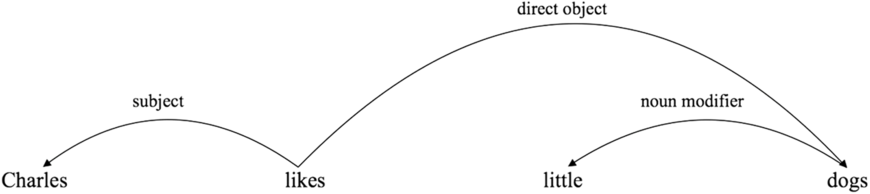
From a functional point of view, the dependency relationship is not between a Governing word and a Depending word, but between a Governing word and a complete subtree depending on it. A Governor is a terminal in the dependency tree and can have many such complements, which are non-terminal constituents. In Figure 1, the Governor likes has two complements, Charles and little dogs, and not just Charles and dogs. Each complement as a whole is characterized by one grammatical function; most morpho-syntactic features (case, agreement, word order) apply to the whole complement and not just to one word on it (Hellwig, Reference Hellwig and Ágel2003: 603). The dependency relations in Figure 1 are subject, direct object and noun modifier.
A sentence analysed with dependency relations.

For the sake of comparative study, both the spoken and the written corpora should be annotated with the same annotation scheme. Otherwise, the consistency can hardly be guaranteed. Universal Dependencies (UD) is a collaborative project that aims at developing a cross-linguistically consistent annotation scheme for treebanks (Nivre et al., Reference Nivre, De Marneffe, Ginter, Goldberg, Hajič, Manning, McDonald, Petrov, Pyysalo, Silveira, Tsarfaty and Zeman2016). As pointed out by Gerdes et al. (Reference Gerdes, Guillaume, Kahane and Perrier2018), in order to maximize parallelism between languages, UD made the controversial choice of using content words as governors, because content words are more consistent across languages than function words. This choice, however, goes against syntactic tradition, which defines syntactic functions by the distributional properties of words. Gerdes et al. (Reference Gerdes, Guillaume, Kahane and Perrier2018) also pointed out another weakness of the UD scheme: the relation of a word is labeled with both its category – a clause or a noun, etc. – and its syntactic function – a subject or an object, etc. “As an alternative to UD”, Gerdes et al. (Reference Gerdes, Guillaume, Kahane and Perrier2018) proposed the Surface-syntactic Universal Dependencies (SUD) scheme. The authors developed a tool that converts UD to SUD and SUD to UD. These tools are freely distributed, and SUD treebanks are available on the Internet.Footnote 1 In the present study, we used two of the SUD treebanks. The two treebanks we used are the SUD Sequoia treebank and the SUD Spoken-French treebank, converted respectively from the UD Sequoia treebank (version 2.2) and the UD Spoken-French treebank (version 2.2). The UD Sequoia treebank is the result of the automatic annotation with manual correction of the Sequoia corpus (Candito and Seddah, Reference Candito and Seddah2012). The UD Spoken-French treebank is an automatic conversion with manual correction of the Rhapsodie treebank (Lacheret et al., Reference Lacheret, Kahane, Beliao, Dister, Gerdes, Goldman, Obin, Pietrandrea and Tchobanov2014). The SUD Sequoia treebank is used to investigate written French, while the SUD Spoken-French treebank investigates spoken French.
The tokenization strategies are slightly different. In the Sequoia SUD treebank, compound words with hyphen-like sous-préfet (‘sub-prefect’), auto-financement (‘self-financing’) or savoir-faire (‘know-how’) were treated as one token, whereas in the Spoken-French SUD treebank, such compound words — chef-d’oeuvre (‘work of art’), rond-point (‘roundabout’), mi-temps (‘first half’) — were split into two different tokens. Compound proper nouns like Alsace-Lorraine or Reuilly-Diderot are similarly treated in the two treebanks. Because this kind of lexical unit is easy to recognize automatically with the presence of the hyphen, we modified the tokenization in the Spoken-French treebank congruously. Grammatical compound words like grâce à (‘thanks to’) are annotated with the Universal Dependencies fixed relation systematically in the Sequoia treebank but unsystematically in Spoken-French treebank. With the list of the grammatical compound words of the Sequoia treebank, and the list of grammatical compound words of the Orféo project (Debaisieux, Benzitoun and Deulofeu, Reference Debaisieux, Benzitoun and Deulofeu2016), we completed and merged the annotation of grammatical compound words in our two treebanks. We also merged the annotation of parts of speech (POS). In Sequoia, avoir (‘to have’), être (‘to be’) and the causative faire (‘to make’) were annotated as auxiliary, whereas in Spoken-French, in addition to avoir and être, modal verbs like pouvoir (‘to be able’), vouloir (‘to want’) and devoir (‘to have’) were also treated as auxiliaries. Following the majority of French grammars (Le Goffic, Reference Le Goffic1993; Jones, Reference Jones1996; Grevisse and Goosse, Reference Grevisse and Goosse2008; Riegel, Pellat and Rioul, Reference Riegel, Pellat and Rioul2016), we annotated only avoir and être as auxiliaries. The written treebank contains 28,987 tokens and the spoken treebank 28,960. Before presenting how the components of our written and spoken treebanks are organized, we have to define the notions of written and spoken languages.
2.2. Definitions of written and spoken languages
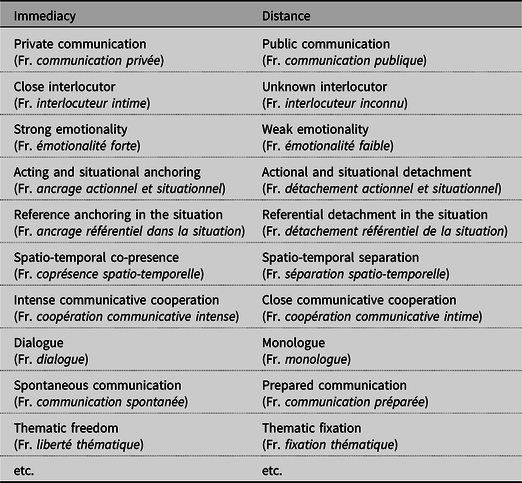
The difference between written and spoken languages can vary throughout the ages. In ancient China, the language used by public servants to write official texts was very distinct from the language they used in daily conversation. The difference can also vary from one language to another. Arabic-speaking communities nowadays are in a situation of diglossia, because there is an important disparity between classical Arabic and spoken Arabic (Halliday, Reference Halliday1985: 41–42). Whether French is in a situation of diglossia or not is still a matter of debate (Coveney, Reference Coveney2002, Reference Coveney, Martineau and Nadasdi2011; Gadet, Reference Gadet2007b; Massot, Reference Massot2010; Massot and Rowlett, Reference Massot and Rowlett2013; Zribi-Hertz, Reference Zribi-Hertz2011), but the reality of grammatical variation is undisputed. Whereas written French is codified and fixed, spoken French is less controlled and more unstable. The division between spoken and written French, though, remains unclear (Gadet, Reference Gadet1996: 16–17). As Koch and Oesterreicher (Reference Koch and Oesterreicher2001) have pointed out, the opposition between the phonic and graphic media is dichotomous; whereas spoken and written are not polar opposites, instead the relationship between them forms a continuum. The opposite ends of this continuum are defined by a set of parameters that are themselves gradable. They characterize two communicative situations, immediacy (Fr. immédiat) and distance (Fr. distance). These parameters are shown in Table 1 below. We also added the translations of the original French terms (written in brackets and in italics).
Communicative situations parameters (Koch and Oesterreicher, Reference Koch and Oesterreicher2001: 586)
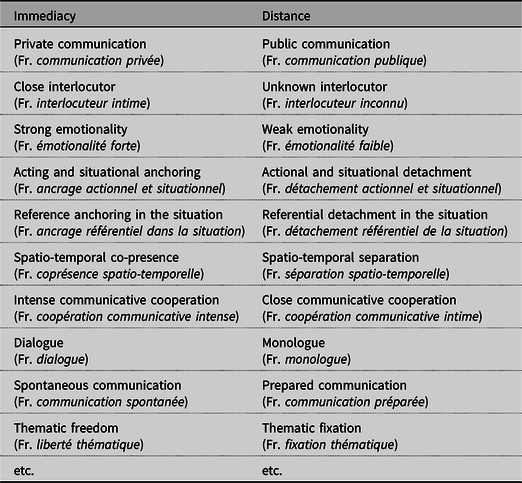
In practice, the phonic medium is closely related to immediacy and the graphic medium is closely related to distance (Gadet, Reference Gadet2007b: 48).
2.3. The composition of the written and spoken treebanks
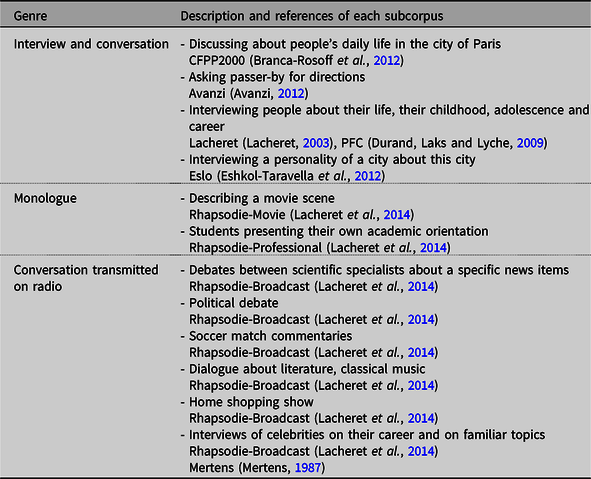
Based on the notions of immediacy and distance, opposed to the graphic and phonic media, we established two treebanks based on different genres. Each genre corresponds to one or more corpus. These resources have all been presented in diverse kinds of publications. Table 2 and Table 3 below present the relevant information.
Composition of the written French treebank
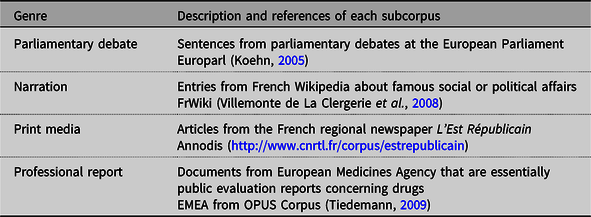
Composition of the spoken French treebank
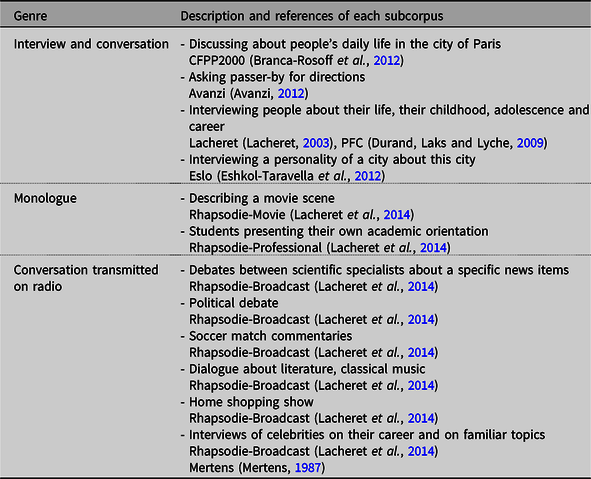
The genres composing the spoken treebank are transcriptions of more or less immediate spoken French, whereas the genres composing the written treebank are texts of more or less distant written French. For instance, the genre of professional report in the written treebank verifies the parameters of preparation, weak emotionality and spatio-temporal separation. On the other hand, the genre of political debate in the spoken treebank verifies the parameters of spontaneity, strong emotionality, and spatio-temporal co-presence. This is to say, this study will focus on the relationship between genres of a rather distant written French and of a rather immediate spoken French. We can now investigate on how spoken and written French differ from each other syntactically.
3. PARTS OF SPEECH AND SYNTACTIC ROLES
3.1. The distribution of the POS in both corpora
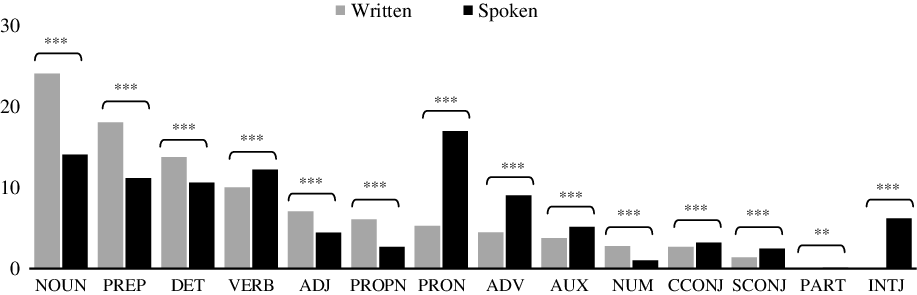
There is a great difference in POS between spoken and written productions, as has been emphasized by Halliday (Reference Halliday1985), who distinguished between them in terms of informational density. Written language has a higher lexical density, whereas spoken language has a higher grammatical density (Halliday, Reference Halliday1985: 64, cited by Gadet, Reference Gadet1996: 23). Our data presented in Figure 2 confirm Halliday’s finding. This graph displays the percentage of each POS occurrence to the total number of words (ignoring the category X that describes these words that cannot be assigned to any POS). The percentage of lexical words in written texts is higher (54.61%) than the percentage of grammatical words (45.16%).Footnote 2 On the contrary, lexical words account for 43.61% and grammatical words 56.09% in the spoken corpus.
The distribution of POS in written and spoken FrenchFootnote 3.
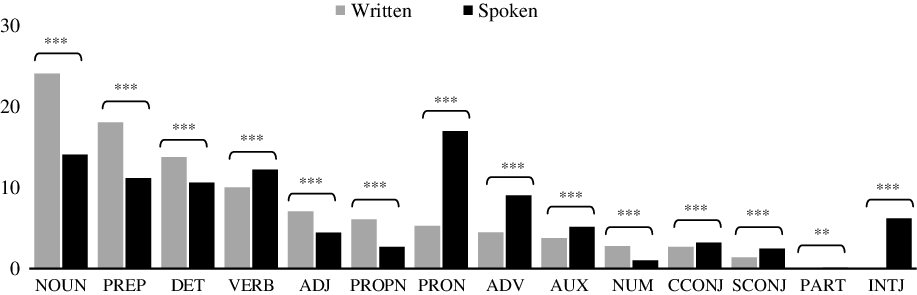
Additionally, the fact that the writer is not under time pressure during the production results in a higher proportion of lexical noun phrases in the written language than in the spoken language (Mazur-Palandre, Reference Mazur-Palandre2015). In her study on around 120 French speakers and writers, Mazur-Palandre (Reference Mazur-Palandre2015) found that the mean number of lexical noun phrases per clause is higher in the written texts as opposed to the spoken texts. As the author puts it, it corroborates the idea that the modality of production impacts the specific characteristics of production (e.g. Berman and Verhoeven, Reference Berman and Verhoeven2002; Fayol, Reference Fayol1997; Jisa, Reference Jisa1998; Ravid et al., Reference Ravid, van Hell, Rosado and Zamora2002). In the written corpus, the proportion of nouns to the total number of words reaches 24.12% (6,991 ex.). In spoken French, nouns are scarcer, accounting for only 14.12% (4,090 ex.).Footnote 4 The difference is significant (Z(1) = 759.48, p < 0.001). In contrast, the percentage of verbs is 10.05% (2,914 ex.) in written French, and 12.24% (3,546 ex.) in spoken French (Z(1) = 61.83 p < 0.001). The difference of pronouns frequency is even more significant (Z(1) = 1,773.9, p < 0.001).
3.2. The syntactic roles occupied by the POS
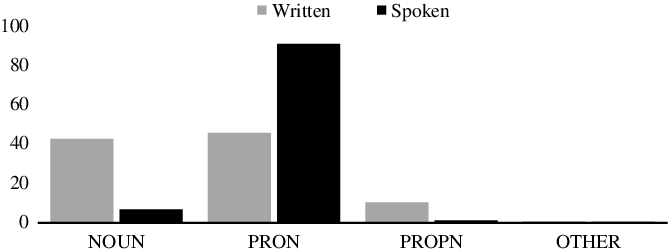
The most prominent syntactic roles in French are subject and object. Figure 3 below shows that the nominal subjects are six times less frequent in spoken French (6.91%) than in written French (42.81%). It corroborates the findings of Blanche-Benveniste (Reference Blanche-Benveniste1994, cited by Gadet, Reference Gadet1996: 24). In contrast, in spoken French, the percentage of pronominal subjects (91.22%) is twice as much as that in written French (45.91%). In other words, in written French, nouns and pronouns respectively account for about 50% of subjects, whereas in spoken French, the majority of subjects are pronouns.
The distribution of POS occupying the role of subject.
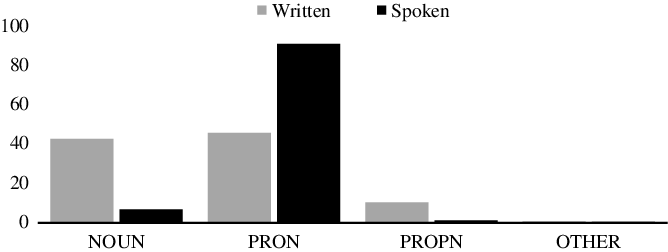
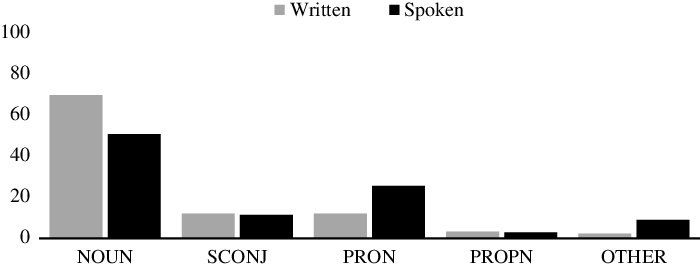
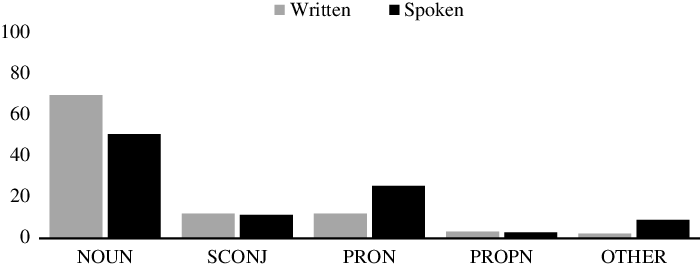
Figure 4 shows the distribution of POS occupying the role of object. As in the case of subjects, there are more nominal objects in written than in spoken French, and more pronominal objects in spoken than in written French. But the difference in the percentages of nominal objects is not so striking as the difference in the percentages of pronominal objects. The percentage of nominal objects in written French (69.96%) is only 1.4 times as much as that in spoken French (50.88%), while the percentage of pronominal objects in spoken French (25.62%) is twice as much as that in written French (12.14%). The percentages of subordinating conjunction introduced clauses occupying the role of object are similar (around 12%) in written and spoken French.
The distribution of POS occupying the role of object.
These results reflect one of the Preferred Argument Structure constraints, which is that lexical noun phrases rarely occupy the subject role of a transitive clause (Du Bois, Reference Du Bois1987). As stated by Mazur-Palandre (Reference Mazur-Palandre2015), ‘accumulating the production of lexical noun phrases and putting them in subject position seems to be much too costly. To avoid such a cognitive burden, lexical nouns are preferentially in non-subject position’. This is consistent with our findings for spoken French, in which the most frequent clause pattern may not be a SVO, but a VO pattern (Blanche-Benveniste et al., Reference Blanche-Benveniste, Bilger, Rouget and Van den Eyende1990; Blanche-Benveniste, Reference Blanche-Benveniste1995; François, Reference François1974; Jeanjean, Reference Jeanjean1980; Lambrecht, Reference Lambrecht and Tomlin1987; Ashby and Bentivoglio, Reference Ashby and Bentivoglio1993). In sum, written French verifies an SVO clause pattern, whereas spoken French verifies a VO clause pattern.
4. SYNTACTIC RELATIONS
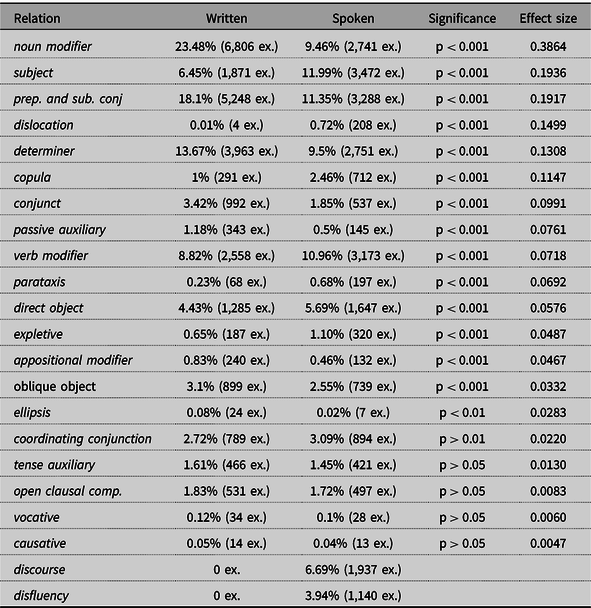
We can distinguish micro-syntactic relations (we call syntactic functions), which describe strong cohesion between words (such as subject and direct object), from macro-syntactic relations, which describe the relation of non-governed elements (such as discourse and parataxis). Some relations are paradigmatic (such as conjunct and disfluency). Table 4 below shows differences in the distributions of syntactic relations in spoken and written French.
Percentages of each relation in the written and spoken treebanks, significance of the frequency difference and effect sizeFootnote 5
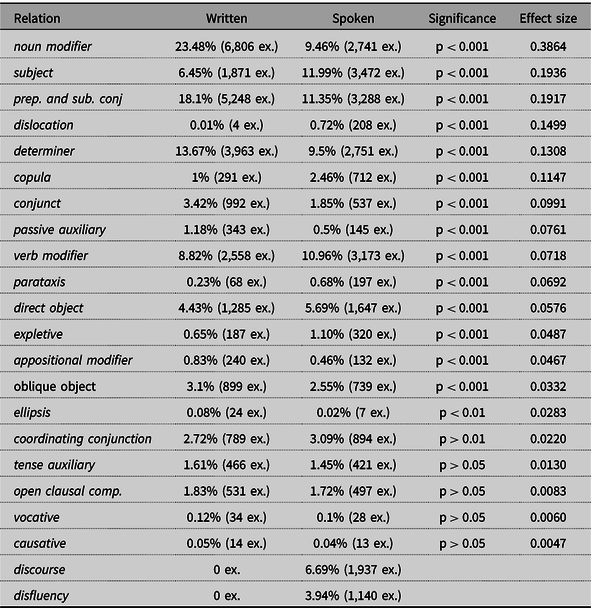
The effect size indicates the size of difference between spoken and written French relations frequency. The four relations where the effect size is the highest are noun modifier (0.3864), subject (0.1936), preposition and subordinating conjunction (0.1917), and dislocation (0.1499).
4.1. An overview of the syntactic relations’ frequency
4.1.1 The two absent relations: discourse and disfluency
The discourse and disfluency relations only occur in the spoken treebank. The discourse relation accounts for 6.69% (1,937 ex.) of the relations and the disfluency relation, 3.94% (1,140 ex.). Of the 22 relations of the spoken treebank listed in Table 4, discourse and disfluency relations are the sixth and eighth most frequent relations. This means that they play a significant role in spoken French. The spoken conception is defined by parameters of spatio-temporal co-presence, intense communicative cooperation and acting, and situational anchoring. Discourse particles (bon, eh, bah), which punctuate the speech are material effects of these conceptional characteristics (1).
(1) bah honnêtement pas vraiment (Spoken / Interview and conversation / CFPP)
‘well honestly not really’
The spoken modality implies that the speaker undergoes time pressure on the one hand, and on the other hand that the production is invisible and impermanent. As a result, the speaker cannot modify his production (Gadet, Reference Gadet2007b: 49; Mazur-Palandre, Reference Mazur-Palandre2015: 29). Hesitations, repetitions (2a) and reformulations (2b) described by the disfluency relation are material effects of these medial characteristics.
(2a) c’est c’est c’est surtout l’hôpital qui m’attire (Spoken / Interview and conversation / CFPP)
‘it’ it’s it’s especially hospital that attracts me’
(2b) là je viens de faire mes des vaccins par exemple (Spoken / Interview and conversation / CFPP)
‘I just made my some vaccines for example’
4.1.2 Subjects and copula
The percentage of subjects in spoken French (11.99%, 3,472 ex.) is almost twice as that in written French (6.45%, 1,871 ex.), and the difference is significant (Z(1) = 479.73, p < 0.001). This is not astonishing due to the higher frequency of verbs in the spoken treebank, and consistent with the assumption that the spoken language is a mode of action (Halliday, Reference Halliday1985: 81): an action implying a process, the verb and an agent, prototypically the subject. Apart from these general principles, specific grammatical phenomena tend to explain the preference of spoken French for subjects, for instance the frequently used illocutionary units which imply a subject, like je vois (‘I see’) or je pense (‘I think’). And the important proportion of subjects in spoken French has to be associated with the frequency of attributives, described with the copula relation.
In spoken French, the percentage of the copula relation is 2.46% (712 ex.), in written French, it is 1% (291 ex.). The difference of frequency is significant (Z(1) = 176.71, p < 0.001). As in any attributive construction, the complement of copula can either be a nominal phrase (3), an adjective, a prepositional phrase, a pronoun, a proper noun or an adverb.
(3) c’est un fauteil crapaud un véritable (Spoken / Interview and conversation / PFC)
‘it’s an easy chair a real one’
In written French, 42.61% (124 ex.) of the subjects of this relation (when there are no auxiliaries or semi-auxiliaries) are pronouns, and 36.77% (107 ex.) are nouns. In spoken French, 83.01% (591 ex.) are pronouns, and 8.57% (61 ex.) are nouns.
4.1.3 The modifying and argumental relations
Noun modifiers can be adjectives (un pays formidable ‘a great country’), prepositional phrases (la fin de la guerre ‘the end of the war’), nominal phrases (activité théâtre ‘theatre activity’), etc. The percentage of the noun modifier relation is higher in the written treebank (23.48%, 6,806 ex.) than in the spoken treebank (9.46%, 2,741 ex.), and the difference of frequency is significant (Z(1) = 1730.8, p < 0.001). This is probably due to the great number of nouns and nominalizations in written French (Gadet, Reference Gadet1996: 23). In (4), traitement (‘treatment’) is a nominalization of the verb traiter (‘to treat’), the instrument role is realized by the prepositional phrase par Aclasta (‘by Aclasta’). Similarly, renouvellement (‘turnover’) is a nominalization of renouveler (‘to renew’). The patient role is realized by the adjective osseux (‘bony’).
(4) Le traitement [par Aclasta] réduit rapidement la vitesse [de renouvellement [osseux]], à partir de taux [post-ménopausiques] [élevés]. (Written / Professional report / Emea)
‘Aclasta treatment rapidly reduces the rate of bone turnover from high postmenopausal levels’
This statement is corroborated by the fact that in the written corpus, nominal noun modifiers account for 4.43% of all the nouns, whereas in the spoken corpus they occupy 1.37%. On the contrary, the verb modifier relation is significantly more frequent in the spoken treebank than in the written treebank (Z(1) = 65.996, p < 0.001). The distribution of nouns and verb modifiers has much to do with the distribution of nouns and verbs presented in subsection 3.1. Verbs are more frequent in the spoken French corpus, and as a result, the verb modifier relation is also more frequent. Verbal verb modifiers account for 2.68% of all the verbs in written, and their proportion is lower in the spoken corpus with 1.52%. All these results lead to the same conclusion that written French has a greater preference for modification than does spoken French.
The z-test indicates that the objects are significantly (Z(1) = 44.694, p < 0.001) more frequent in the spoken treebank (5.69%, 1,647 ex.) than in the written treebank (4.43%, 1,285 ex.). The percentage of the verbs to appear with the realization of an object in the spoken treebank is 44.16%, while 43.34% appear in the written treebank. On the contrary, oblique objectsFootnote 6 are significantly (Z(1) = 15.629, p < 0.001) more frequent in the written treebank (3.1%, 899 ex.), than in the spoken treebank (2.55%, 739 ex.). The percentage of the verbs to appear with the realization of an oblique object in the written treebank is 27.66%, and 20.05% in the spoken treebank. The difference of the frequency of open clausal complement relations (Les parents ne semblent pas connaître les dangers ‘Parents seem not being aware of the dangers’; étant considérée comme accidentelle ‘being considered as accidental’) is not significant (Z(1) = 1.1245, p > 0.05).
4.1.4 The grammatical relations
Chafe (Reference Chafe1979, cited by Redeker, Reference Redeker1984:44) reported that the written language has more passives than the spoken language, which is confirmed by our data: 1.18% (343 ex.) of the relations in the written treebank are passive auxiliary relations, whereas only 0.5% (145 ex.) in the spoken treebank. The difference in frequency is significant (Z(1) = 80.336, p < 0.001). The determiner and the preposition and subordinating conjunction relations’ frequencies in the written treebank are significantly higher than in the spoken treebank. The analysis on the noun part of speech and the noun modifier relation above explains the reason for these distributions: the more the nouns, the more the determiners, and the more the noun modifiers, the more the prepositions (i.e. la fin de la guerre ‘the end of the war’, mes études de médecine ‘my medical studies’). There are fewer tense auxiliary relations in spoken French (1.45%, 421 ex.) than in written French (1.61%, 466 ex.), however, the difference is not significant (Z(1) = 2.283, p > 0.05). The next section presents the distributions of two phenomena often discussed in studies on spoken language, namely dislocation and parataxis.
4.2. Dislocation and parataxis
4.2.1 Dislocations
Dislocation is a common phenomenon in spoken French (Larsson, Reference Larsson1979; Campion, Reference Campion1984; Barnes, Reference Barnes1985; Lambrecht, Reference Lambrecht1994, Reference Lambrecht and Haspelmath2001; Blasco-Dulbecco, Reference Blasco-Dulbecco1999; De Cat, Reference De Cat2002, Reference De Cat2007; Prévost, Reference Prévost2003; Avanzi, Reference Avanzi2012). It is impossible to do justice here to all syntactic and pragmatic aspects that have been discussed in the abundant literature on the subject. We recommend the reader to De Cat (Reference De Cat2007) for a thorough study on the interaction between prosody, cognition, pragmatics and syntax at play in this phenomenon. We will limit ourselves to give an overview of how dislocation is represented in our written and spoken corpora, based on a broadly accepted definition and taxonomy. We can define dislocations as grammatical constructions that serve to mark a constituent as denoting the topic (or theme) with respect to which a given sentence expresses a relevant comment (e.g. Dik, Reference Dik1978; Gundel, Reference Gundel, Hammond, Moravcsik and Wirth1988; Lambrecht, Reference Lambrecht1981, Reference Lambrecht1994, Reference Lambrecht and Haspelmath2001). The referent of the dislocated constituent has to be accessible in the hearer’s short-term memory (Lambrecht, Reference Lambrecht and Haspelmath2001: 1075; Horváth, Reference Horváth2018: 51). When the dislocated constituent is placed on the left side of the sentence, it is a left dislocation; on the right, it is a right dislocation.Footnote 7 Based on this definition, four criteria can be used to identify a dislocation (Lambrecht, Reference Lambrecht and Haspelmath2001: 1050):
(i) extra-clausal position of a constituent
(ii) possible alternative intra-clausal position
(iii) pronominal co-indexation
(iv) special prosody
These four criteria can only be met simultaneously in typical cases. In fact, only the first one is necessary to identify a dislocation. For example, a dislocated constituent can neither have a possible alternative intra-clausal position, nor be co-indexed with a resumptive element in the clause, as shown in the example (5) from (Barnes, Reference Barnes1985: 101):
(5) Le métro, avec la carte orange, tu vas n’importe où.
‘The subway, with Orange Card, you go anywhere.’
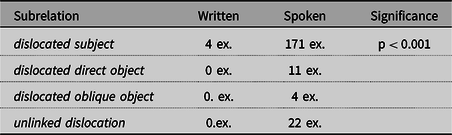
This kind of dislocated constituent is called unlinked dislocated constituents. Unlinked dislocations can be further classified (Barnes, Reference Barnes1985; Fradin, Reference Fradin1990; Stark, Reference Stark and Guimier1999; Horváth, Reference Horváth2018), or included in a broader category, which is hanging topic (Deulofeu, Reference Deulofeu1979; Berrendonner and Reichler-Béguelin, Reference Berrendonner, Reichler-Béguelin, Cheshire and Stein1997). When the dislocated constituent is resumed by an element in the clause (a clitic or the pronoun ça), it can have one of the following syntactic roles: subject, direct object, oblique object or modifier. The presence of the pronoun in the clause is an important indicator distinguishing this dislocated constituent from a typical modifier of the clause. Compare the modifier aujourd’hui ‘today’ in the sentence Aujourd’hui, Pierre ne travaille pas (‘Today, Pierre doesn’t work’) with the dislocated constituent sur le pont (‘on the bridge’), resumed by the clitic y, in [Sur le pont d’Avignon]i, on y i danse tout en rond (‘On the Avignon bridge, people dance all around’) (Lambrecht, Reference Lambrecht and Haspelmath2001: 1055). We did not find, in our corpus, dislocated sentences where the clitic has the function of modifier. We distinguished different subrelations of the relation dislocation, according to the syntactic role played by the co-indexed pronoun. Table 5 shows the distributions of these subrelations in our two corpora.
Frequencies of different types of dislocations
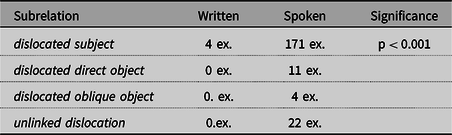
In the example below, the element that resumes the dislocated constituent within the clause is underlined. In the written treebank, the only subrelation that appears is dislocated subject. There are significantly (Z(1) = 159.37, p < 0.001) more dislocated subjects in the spoken corpus (6b) than in the written corpus (6a).
(6) dislocated subject
a. Faire s’exprimer les enfants à travers cette activité, c’est important. (Written / Print media / Annodis)
‘Let children express themselves throughout this activity, it’s important’
b. et moi je suis allé en Ethiopie […] (Spoken / Interview and conversation / Lacheret)
‘and me I went to Ethiopia […]’
The dislocated direct object (7), dislocated oblique object (8) and unlinked dislocation (9) subrelations occur only in the spoken treebank:
(7) dislocated direct object
tel tel et tel cas on les verrait pas en hô∼ en hôpital privé (Spoken / Interview and conversation / CFPP)
‘such such and such case we won’t see them in a private hospital’
(8) dislocated oblique object
je vois euh moi la fac ça m’a fait beaucoup de bien (Spoken / Interview and conversation / CFPP)
‘I see eeh me college it did me a lot of good’
(9) unlinked dislocation
bah f∼ déj∼ déjà les teintes bon faut savoir que tu as une base euh pff (Spoken / Interview and conversation / PFC)
‘well first of all tints you must know you have a basis eeh pff’
Dislocations are not peculiar to spoken French, as pointed out by Blanche-Benveniste (Reference Blanche-Benveniste1991). However, it may be more frequent in spoken than in written French. Dislocations are not only more frequent in spoken French, but they are also more diverse in usage. Besides dislocation, the parataxis phenomenon is also more frequent in spoken French (Gadet, Reference Gadet1991: 110).
4.2.2 Parataxis
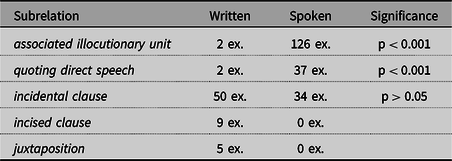
According to the Universal Dependencies annotation scheme, the parataxis relation is meant to describe two clauses or sentences placed side by side without any explicit coordination or subordination. This relation describes a heterogeneous set of clausal junctions. It is more relevant to reach a conclusion from the frequency of each of these subtypes than from the relation parataxis alone. Table 6 below shows the percentages of these different subtypes of parataxis in both treebanks.
Proportions of different types of parataxis
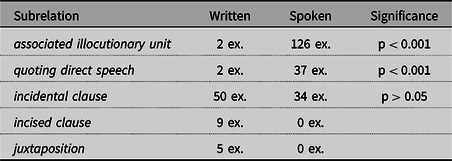
The difference in frequency of associated illocutionary units in the two corpus is significant (Z(1) = 120.12, p < 0.001). Associated illocutionary units are idiomatic expressions that punctuate the speech of a speaker (écoute ‘listen’, tu vois ‘you see’, on dirait ‘it seems’). In this respect, they may be found in written-to-be-spoken genres like political discourse (see 10a). The spoken conception is typically dialogical, which implies more involvement of the locator in the communicative situation. This may explain the high frequency of associated illocutionary units, which are material effects of these conceptional characteristics in spoken discourse (10b).
(10) associated illocutionary unit
a. Permettez-moi enfin de vous dire que notre Parlement s’est, je crois, très largement retrouvé dans les propos que vous avez tenus. (Written / Parliamentary debates / Europarl)
‘Finally, let me tell you that our Parliament, I believe, widely agree with what you have declared.’
b. les policiers sont arrivés en raison du du du vacarme je p∼ je pense (Spoken / Monologue / Rhapsodie-Movie)
‘Policemen came because of the din I think’
As Redeker (Reference Redeker1984: 44) puts it, ‘speakers and listeners in a typical conversational situation tend to be more involved in their communication than writers and readers’. For Chafe (Reference Chafe1979), this involvement results in an important usage of direct speech. And indeed, we found a significant difference (Z(1) = 31.41, p < 0.001) of quoting direct speech between the frequency of the written (11a) and the spoken treebanks (11b):
(11) quoting direct speech
a. Il est inconcevable que la Comission puisse dire “cela n’est pas très important pour nous” […] (Written / Political discourse / Europarl)
‘It is incredible that the Commission can say “this is not very important to us”’
b. je me disais j’irai peut-être à Vire (Spoken / Interview and conversation / PFC)
‘I told to myself I will maybe go to Vire’
Writers prefer to report speech with incised clause (12). This relation is absent from the spoken treebank.
(12) incised clause
Jean-Claude Méry, expliquait-il, lui avait mis “le couteau sous la gorge”. (Written / Narration / FrWiki)
‘Jean-Claude Méry, he explained, “put a gun to its head”’
Simple juxtapositions of two independent illocutionary clauses have only been found in the written treebank (13).
(13) juxtaposition
Frégates de Taïwan : l’ancien directeur adjoint de la Société générale témoigne, Sud Ouest, 13 mars 2002 (Written / Print media / Annodis)
‘Taiwan frigates: Former Deputy Director of General Society in Taiwan testifies, Sud Ouest, March 13, 2002’
The difference of incidental clause relations (14) frequency between the two treebanks is not significant (Z(1) = 3.0476, p > 0.05).
(14) incidental clause
a. […] il est assez incroyable de se trouver dans cette salle – je ne puis guère parler d’assemblée à ce moment précis – et de devoir constater que […] (Written / Parliamentary debates / Europarl)
‘[…] it is quite incredible to be in this room – I can not speak of an assembly in this actual moment – and to see that […]’
b. alors que Heinze c’est quand même assez extraordinaire hein c’est le patron de la défense (Spoken / Soccer match commentaries / Rhapsodie-Broadcast)
‘whereas Heinze it’s quite extraordinary he’s the boss of defense’
This section presented an overview of the distributions of POS and syntactic relations in both corpora, the next section will give more details about word order.
5. WORD ORDER
5.1. The distributions of word order in some syntactic relations
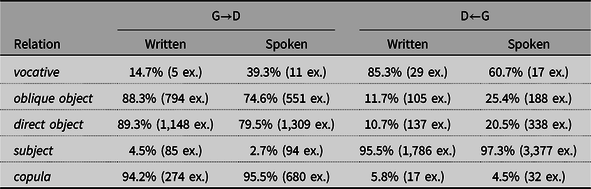
As defined earlier, a relation is a labeled asymmetrical link between two linguistic units: G—r→D where G is the Governor, D the Dependent, and r the label of the relation. According to Tesnière (Reference Tesnière1959: 22), if the dependent precedes the governor, the order is governor-final; if the dependent follows the governor, the order is governor-initial. This is defined as the dependency direction of a dependency relation (Liu, Reference Liu2010). Dependency direction is a useful concept in comparative studies on the syntax of different languages or different genres (Liu, Zhao and Li, Reference Liu, Zhao and Li2009; Liu, Reference Liu2010; Jiang and Liu, Reference Jiang and Liu2015). Table 7 shows the percentages of word order for each relation in the two treebanks. Many relations in spoken and written French do not present much difference in terms of word order because the order is fixed, determined by grammatical rules, such as the relations of determiner, expletive, open clausal complement, tense auxiliary and causative. We also excluded the relations of apposition, conjunction, parataxis and disfluency from Table 7, because they are orthogonal to syntax. The dislocation relation’s occurrences are too scarce in the written treebank (4 ex.) to reach any conclusions. The relations verb modifier and noun modifier describe large arrays of linguistic facts, consequently they are also not considered here.
Percentages of word order in each relation
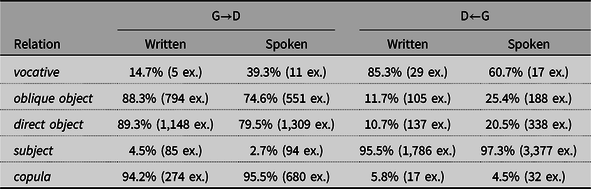
Table 8 shows that vocative, direct object, oblique object are the first three relations that give rise to the most obvious difference in terms of word order. If vocatives in the written treebank are placed before the head of a clause (85.3%) (15a) in most cases, the word order is more variable in the spoken treebank (60.7%) (15b).
(15a) Madame la Présidente, le président de groupe M. Barón Crespo s’est aussi adressé à moi. (Written / Parliamentary debates / Europarl)
‘Madam President, the group president Mr. Barón Crespo also addressed me’
(15b) Emmanuelle est-ce que vous avez déjà fait sortir un amant ou une maîtresse par la fenêtre en catastrophe ? (Spoken / Conversation on radio / Rhapsodie-Broadcast)
‘Emmanuelle, have you ever brought a lover out the window in a panic?’
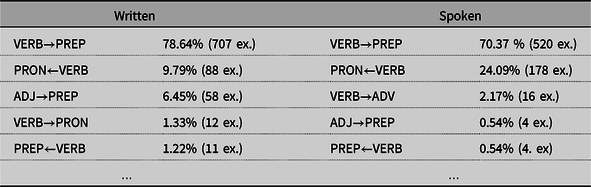
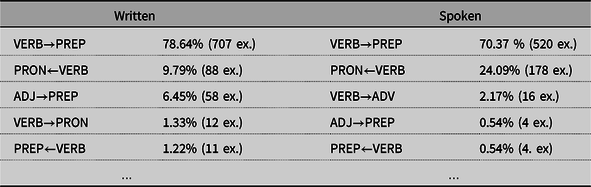
Constructions of the oblique object relation
The distributions of word order in the copula and subject relations are similar in the written and spoken treebanks, that is, subjects are rarely governor final (4.5% in written, 2.7% in spoken).
5.2. The difference of word order in relations direct object and oblique object
5.2.1 Oblique objects
In the written treebank, 88.3% of the oblique object relations are governor-initial; whereas in the spoken treebank, the percentage is 74.6%. In order to better interpret these results, we have to further analyse the corresponding constructions of this relation. Table 8 shows a higher percentage of the PRON←VERB construction in spoken French (24.09%) than in written French (9.79%).
This may be due to the preference of spoken language for pronouns, as mentioned in section 3.1. Additionally, a grammatical rule imposes that clitic pronouns are placed before the verbs on which they depend (except if the verb is in the imperative modality). This increases significantly the proportion of governor-final oblique object relations. The same logic stands to explain the word-order difference in the direct object relation between spoken and written French.
5.2.2 Direct objects
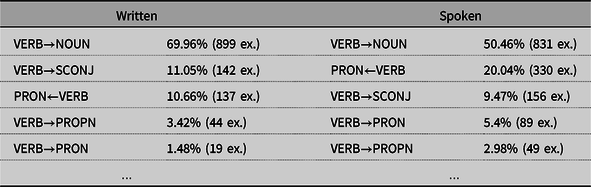
The direct object relation presents differences in word order between spoken and written French. In written French, 89.3% of the direct object relations are governor-initial, while in the spoken treebank, 79.5%. Table 9 shows the most frequent constructions corresponding to the direct object relation with the percentages of frequency.
Constructions of the direct object relation
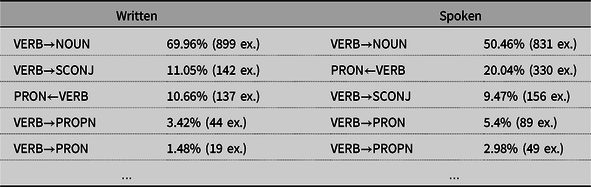
Table 9 indicates that the PRON←VERB construction is much more frequent in the spoken treebank (20.04%) than in the written treebank (10.66%). This section actually provides the evidence that spoken and written French are two systems of the same language. They share the same grammatical rules, namely that the objects have to follow the verb they depend on, and that the subjects have to precede. If we observed a difference of word order in oblique object and direct object relations, this difference can be explained by the preference of spoken French for clitic pronouns. A real difference of word order between written and spoken French is manifested on the macro-syntactic level with vocative nominal phrases. It is insisted by some that spoken French is easier than written French. This belief may be rooted in the higher frequency of dislocations and parataxis in spoken French. Indeed, the speech is fragmented by dislocations and parataxis into short blocks, which could leave the impression of simple structures. In the next section, we try to cast some doubt in this lasting belief.
6. COMPREHENSION DIFFICULTY
6.1. The Mean Dependency Distance of the corpora
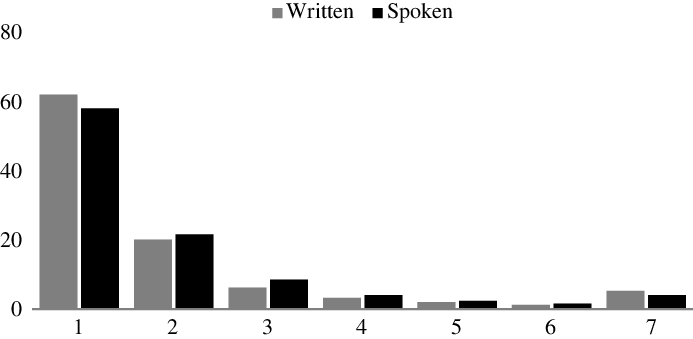
According to Halliday (Reference Halliday1985), both spoken and written languages are complex but not in the same way: ‘The complexity of the written language is static and dense. That of the spoken language is dynamic and intricate’ (Halliday, Reference Halliday1985: 87). Halliday employs different criteria to evaluate their complexity. In terms of intricacy of movement, spoken language is more complex; but in terms of density of substance, written is more complex. What if we compare spoken and written language complexity in terms of the same criterion? Yngve (Reference Yngve1960) described the depth of a sentence as ‘the maximum number of symbols needed to be stored during the construction of a given sentence’. The depth of a sentence cannot exceed a certain threshold, which is nearly equal to the capacity of human working memory (Miller, Reference Miller1956; Cowan, Reference Cowan2001, Reference Cowan2005). By introducing the Depth Hypothesis, Ygnve addressed the need of a universal metric for language comprehension difficulty. The principle of Early Immediate Constituent and the Dependency Locality Theory (Hawkins, Reference Hawkins1994; Gibson, Reference Gibson1998, Reference Gibson and Marantz2000) then established further a link between linear order and comprehension difficulty. They have been tested experimentally on different languages (Gibson, Reference Gibson1998; Hsiao and Gibson, Reference Hsiao and Gibson2003; Grodner and Gibson, Reference Grodner and Gibson2005). Grodner and Gibson (Reference Grodner and Gibson2005) emphasized on the fact that ‘the difficulty associated within integrating a new input item is heavily determined by the amount of lexical material intervening between the input item and the site of its target dependents’. In other words, the longer the distance between two words, the more the working memory is affected, the more the processing difficulty arises. The dependency distance of a sentence in a dependency treebank can be computed by the following method (Liu, Reference Liu2008). For any dependency relation between the two words Wa and Wb, the dependency distance is the difference in their positions in the sentence: a-b. For adjacent relations, the dependency distance is 1. Figure 5 displays the distribution of DD in both treebanks. The DD in Figure 5 is the absolute value, that is |a-b|.
Dependency distances frequencies.
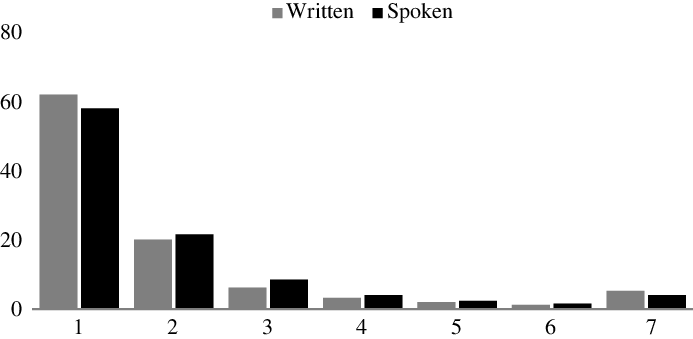
The written treebank has a higher percentage of adjacent dependencies (61.93%) than the spoken treebank (57.92%). The higher percentage of adjacent dependencies in written French may be caused by the large number of relations that impose the dependent and the governor to be close to each other: determiner, tense auxiliary and preposition and subordinating conjunction. The overall complexity of a sentence is measured by the mean dependency distance (MDD), which is defined as follows:
 $$MDD\left( {the\;sentence} \right) = {\rm{ }}{1 \over {n - 1}}\sum\limits_{i = 1}^{n - 1} {\left| {D{D_i}} \right|} $$
In this formula, n is the number of words in the sentence and |DDi| is the absolute dependency distance of the i-th syntactic link of the sentence. In the sentence Charles likes little dogs (Figure 1), the distance of the three dependencies are respectively 1, 2 and 1. The DD of the root node is 0. Applying Formula [1], we can compute the MDD of this sentence, which is 4/3 = 1.33. We give two examples to show their different MDDs:
(16) Suzanne Sequin n’est plus. (Written / Print Media / Annodis)
‘Suzanne Sequin is no more.’
MDD = 1.5
(17) donc on peut penser que c’est une tradition euh ici qui est représentée (Spoken / Interview and conversation / Interview classical music)
‘so we can think that it is a tradition eh here which is represented’
MDD = 1.92
MDD can also be used as a complexity measure of a text or a collection of texts, computed with the following formula:
 $$MDD\left( {the\;sample} \right) = {\rm{ }}{1 \over {n - s}}\sum\limits_{i = 1}^{n - s} {\left| {D{D_i}} \right|} $$
In this formula, n is the number of words, s is the total number of sentences. The longer the MDD of a sentence, the more difficult the sentence is; and the longer the MDD of a text, the more difficult the text is. MDD has been proved to be an efficient index for studies on language typology and genre (Liu, Zhao and Li, Reference Liu, Zhao and Li2009; Liu and Xu, Reference Liu and Xu2012; Wang and Liu, Reference Wang and Liu2017; Liu, Xu and Liang, Reference Liu, Xu and Liang2017).
Using Formula [2], we computed the MDDs of the written and the spoken treebanks, which are rather similar: the MDD of spoken French is 2.1 and the MDD of written French is 2.13. Adjacent dependencies play an important role in minimizing dependency distance (Liu, Reference Liu2008). Annotation scheme of the treebanks is also another factor that impacts this measure (Jiang and Liu, Reference Jiang and Liu2015; Yan and Liu, Reference Yan and Liu2019), and that has to be taken into account in order to better interpret the results.
6.2. The Mean Dependency Distance of the relations
In this section, we use Formula [3] to compute the MDD of these major syntactic functions: subject, direct object, oblique object, open clausal complement and noun modifier.
 $$MDD\left( {relation} \right) = {\rm{ }}{1 \over n}\sum\limits_{i = 1}^n D {D_i}$$
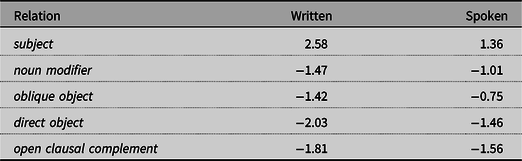
In Formula [3], n is the number of occurrences of this relation, and DDi is the distance of the i-th dependency that belong to this type. If the result is positive, this means that the relation tends to be governor-final. If it is negative, the relation tends to be governor-initial. The MDD of these relations are displayed in Table 10.
MDD of the syntactic functions
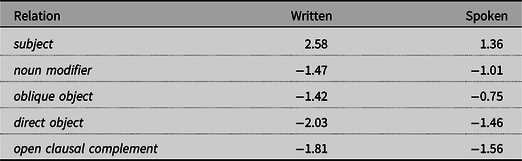
Table 10 shows that except for the subject, all other syntactic functions tend to be governor-initial. In addition, the MDD of these relations are greater in written French than in spoken French. For instance, the MDD of the subjects in written French is 2.58, and 1.36 in spoken French. However, the difference of both languages’ MDD seems to be rather slight, which suggests no substantial difference in comprehension. In other words, we cannot firmly claim that spoken French is less difficult to process than written French.
It would be noteworthy to investigate the reasons why the MDDs of spoken and written French treebanks are similar while the MDD of each syntactic function visually presents differences. It would also be interesting to study the MDD across the genres of French, as it has been previously done on Chinese (Liu, Zhao and Li, Reference Liu, Zhao and Li2009) and English (Wang and Liu, Reference Wang and Liu2017). In particular, this measure could help to pursue the investigation on the relationship between the genres and the media (Biber, Reference Biber1988; Biber and Conrad, Reference Biber, Conrad, Schiffrin, Tannen and Hamilton2003). How different is the MDD of French written narrations, political discourses, scientific conferences, spontaneous conversations (online messages) from that of its spoken counterparts?
7. CONCLUSION
Based on syntactically annotated corpora, our research quantitatively probed into the grammatical features of the genres of a rather distant written French and a rather immediate spoken French (we called written and spoken French). Confirming the lasting assumption that written and spoken French do not differ in the syntactic categories but in the frequencies of these categories, we showed that written and spoken French have different distributions of parts of speech and syntactic relations. The quasi totality of subjects in spoken French is pronouns, and more diverse dislocated sentences are more frequently used. A significant difference of word order between written and spoken French has been found in the placement of vocatives. The Mean Dependency Distance (MDD) is slightly higher in written French than in spoken French. The same difference in dependency distance is also found in syntactic functions, especially the subject.
ACKNOWLEDGEMENTS
We thank three anonymous reviewers and Dr Chunshan Xu for valuable suggestions and comments. This study was supported by the National Social Science Foundation of China (Grant No. 17AYY021) and the MOE Project of the Center for Linguistics and Applied Linguistics, Guangdong University of Foreign Studies.