INTRODUCTION
Traumatic brain injury (TBI) is prevalent among children, annually affecting over 500,000 children aged 0 to 14 years in the United States (Faul, Xu, Wald, & Coronado, Reference Faul, Xu, Wald and Coronado2010). The highest incidence rates are seen in infants and preschool-aged children 0–4 years old (Faul et al., Reference Faul, Xu, Wald and Coronado2010). Preschool-aged children are especially vulnerable to negative outcomes following a TBI (Anderson, Catroppa, Morse, Haritou, & Rosenfeld, Reference Anderson, Catroppa, Morse, Haritou and Rosenfeld2005), possibly because damage to the young brain is more likely to have a negative impact on the development of emerging abilities, as compared to older children, whose abilities are more established (Crowe, Catroppa, Babl, & Anderson, Reference Crowe, Catroppa, Babl and Anderson2012).
On average, children with TBI demonstrate a wide array of negative outcomes, including lower cognitive and academic abilities (Ewing-Cobbs et al., Reference Ewing-Cobbs, Prasad, Kramer, Cox, Baumgartner, Fletcher and Swank2006), poorer language skills (Crowe, Anderson, Barton, Babl, & Catroppa, Reference Crowe, Anderson, Barton, Babl and Catroppa2014), behavioral problems (Schwartz et al., Reference Schwartz, Taylor, Drotar, Yeates, Wade and Stancin2003), and social impairments (Yeates et al., Reference Yeates, Swift, Taylor, Wade, Drotar, Stancin and Minich2004). One specific cognitive domain in which children with TBI often demonstrate deficits is executive functions (EF), which include attention (Bigler et al., Reference Bigler, Jantz, Farrer, Abildskov, Dennis, Gerhardt and Yeates2015; Garcia, Hungerford, & Bagner, Reference Garcia, Hungerford and Bagner2015; Konigs et al., Reference Konigs, Heij, van der Slujis, Vermeulen, Goslings, Luitse and Oosterlaan2015; Papoutsis, Stargatt, & Catroppa, Reference Papoutsis, Stargatt and Catroppa2014), decision making (Schmidt et al., Reference Schmidt, Hanten, Li, Vasquez, Wilde, Chapman and Levin2012), goal setting (Beauchamp et al., Reference Beauchamp, Catroppa, Godfrey, Morse, Rosenfeld and Anderson2011), and behavior regulation (Potter et al., Reference Potter, Wade, Walz, Cassedy, Yeates, Stevens and Taylor2011). EF refers to higher order cognitive processes involved in goal-directed behavior. Deficits in EF can persist for at least 5–10 years after childhood TBI (Beauchamp et al., Reference Beauchamp, Catroppa, Godfrey, Morse, Rosenfeld and Anderson2011; Mangeot, Armstrong, Colvin, Yeates, & Taylor, 2010).
Although differences in EF are clearly apparent at a group level following TBI, individual outcomes are heterogeneous. A variety of factors may help to predict lower scores on EF measures after childhood TBI, including lower verbal intellectual ability, greater injury severity, and younger age at injury (Slomine et al., Reference Slomine, Gerring, Grados, Vasa, Brady, Christensen and Denckla2002). Surprisingly, however, little research has examined the role of environmental factors as predictors of long-term EF following early childhood TBI.
In healthy children, various aspects of the home environment, such as parental responsiveness, environmental enrichment, and family companionship, predict EF in middle childhood (Blair et al., 2014; Sarsour et al., Reference Sarsour, Sheridan, Jutte, Nuru-Jeter, Hinshaw and Boyce2011). Negative parenting practices, such as harsh punishment and inconsistent discipline, are also related to poorer development of EF, specifically inhibition (Roskam et al., 2014). The relationship between the home environment and children’s EF has also been examined in clinical populations of preschool-aged children with low birth weight (LBW), with findings from one study indicating protective effects of sensitive parenting on EF (Camerota et al., 2015).
Family factors also are known to account for significant variability in the outcomes of early childhood TBI. For instance, parenting style, family functioning, and the quality of the home predict behavioral adjustment and social competence in preschool-aged children with TBI (Wade et al., Reference Wade, Cassedy, Walz, Taylor, Stancin and Yeates2011; Yeates et al., 2010). Moreover, the home environment can be an important moderator of the effects of TBI in young children, attenuating negative outcomes for children from better home environments but exacerbating deficits for those from less advantageous home environments (Yeates et al., 2010).
Only two studies, however, have specifically examined the relationship of the home environment to children’s EF after early TBI. One study found that higher levels of family dysfunction and maladaptive parenting styles (i.e., permissive and authoritarian parenting) predicted deficits in behavioral EF (i.e., parent report on questionnaires regarding children’s everyday EF) following early childhood moderate and severe TBI (Kurowski et al., Reference Kurowski, Taylor, Yeates, Walz, Stancin and Wade2011). In a second study, authoritarian and permissive parenting styles moderated the effect of moderate and severe TBI on children’s behavioral EF (Potter et al., Reference Potter, Wade, Walz, Cassedy, Yeates, Stevens and Taylor2011). Specifically, higher levels of authoritarian and permissive parenting predicted EF in children with TBI relative to those with orthopaedic injuries (OIs). Both of these studies, however, relied on parent ratings rather than on performance-based tests to measure EF, assessed the home environment at a single point in time, and followed children for a maximum of 5 years. No studies to date have examined both the early and the late home environment as predictors of performance on performance-based tests of EF more than 5 years post-injury.
The current study examined the relationship between the early (i.e., shortly after injury) and late (i.e., at the time of the long-term follow-up) home environment and long-term EF following early childhood TBI. Children with OIs were also included to assess the effects of TBI relative to an other-injury comparison group. We used data drawn from the same parent study as that reported on by Kurowski et al. (Reference Kurowski, Taylor, Yeates, Walz, Stancin and Wade2011) and Potter et al. (Reference Potter, Wade, Walz, Cassedy, Yeates, Stevens and Taylor2011), which involved children who were hospitalized for severe TBI, complicated mild/moderate TBI, or OI between 3 and 6 years of age. In this analysis, we examined the relationship of the early and late home environment (i.e., quality of the home environment, family functioning, caregiver psychological distress) to performance-based tests of EF at an average of 6.8 years post-injury.
Given evidence for the effects of early parenting on the development of EF, we hypothesized that measures of the early home environment would be associated with EF across all groups, such that better home environments would predict better performance on EF measures. We expected that measures of the late home environment would be similarly associated with EF across groups, perhaps acting as a mediator of the effects of the early home environment. Finally, although we hypothesized that better home environments would be associated with better EF across groups, we anticipated that these effects would be amplified in the context of TBI, with previous research suggesting that moderation would be most pronounced for children with complicated mild/moderate TBI (e.g., Yeates et al., 2010).
METHODS
Study Design
The current study drew on data from a larger, prospective cohort study, which aimed to examine environmental factors related to long-term functional outcomes following early childhood TBI. Children and caregivers participated in an initial assessment around the time of injury, as well as a series of follow-up assessments, including a final one as the child entered middle school/early adolescence, an average of 6.8 years post-injury (range: 4.5–10.6 years). During the initial assessment, caregivers completed several measures designed to measure aspects of the family environment (i.e., family functioning, caregiver psychological distress), which was followed up by a visit to the child’s home to assess the quality of the home environment. These measures were re-administered at the time of the long-term follow-up, during which children were administered tests of executive functioning.
Participants
The original parent study enrolled 206 children, ages 3 to 6 years, 11 months, who sustained a severe TBI (n=23), complicated mild/moderate TBI (n=64), or OI (n=119). They were recruited through four tertiary care hospitals in the Midwestern United States (three children’s hospitals, one general hospital). Inclusion criteria for both TBI groups included overnight hospitalization for a brain injury resulting from blunt trauma, absence of pre-injury neurological problems or neurodevelopmental disorders, and English as the primary language in the home.
Participants were excluded if the cause of the injury was documented as child abuse. Severity of TBI was defined as the lowest recorded Glasgow Coma Scale (GCS; Teasdale & Jennett, Reference Teasdale and Jennett1974) score after admission to the emergency department. Severe TBI was defined as a GCS score of <8, moderate TBI was defined as a GCS score of 9–12, and complicated mild TBI was defined as a GCS score of 13–15 with associated brain imaging abnormalities. The latter two groups were combined into a complicated mild/moderate TBI group because of research suggesting the two types of injuries have similar outcomes (e.g., Kashluba, Hanks, Casey, & Mills, Reference Kashluba, Hanks, Casey and Mills2008), as well as to preserve power due to the small sample size of each group. Eligibility criteria for the OI group included overnight hospitalization for an injury not involving the head, as well as absence of impaired consciousness or any other signs or symptoms suggestive of possible head trauma.
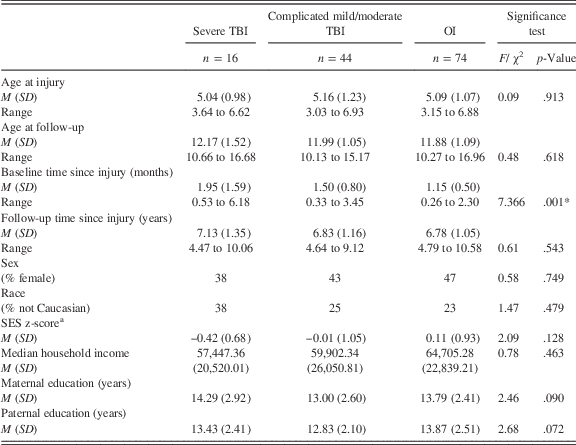
At the time of the long-term follow-up, participants were contacted by both phone and mail, inviting both the child and caregiver to participate in a final assessment. The caregiver was the biological parent in all but two cases, and the caregiver changed from baseline assessment to follow-up in eight cases. Approximately 35% of participants did not participate in the follow-up assessment, leaving 16 severe TBI, 44 complicated mild/moderate TBI, and 74 OI (N=134; see Table 1 for demographic characteristics of the sample). No differences were observed between those who participated in the long-term follow-up and those who did not in age at injury, sex, race, socioeconomic status (measured by mean sample Z-scores for census tract income and guardian education), or early home environment measures. The institutional review boards of all involved sites approved the parent study, and written informed consent was received from the legal guardians of all participants.
Demographic characteristics of study sample

a Based on census track income and parent/caregiver education at baseline.
*p<.05
Measures
Home environment
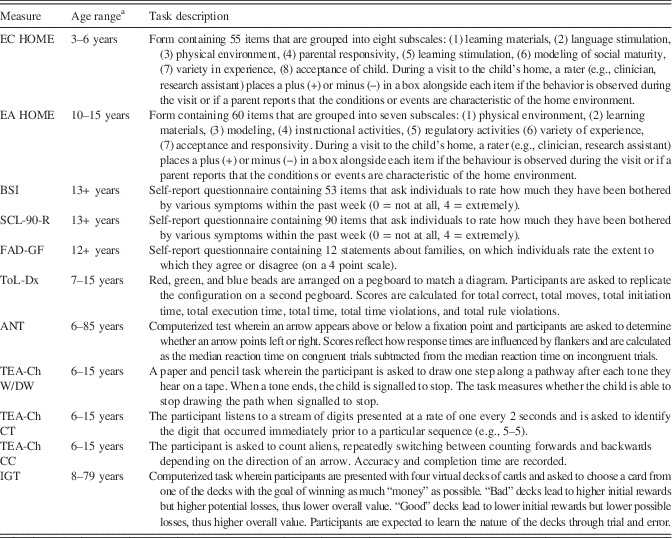
Three measures were administered to assess different aspects of the home environment: quality of the home environment, caregiver psychological distress, and family functioning. Quality of the home environment was measured using the Home Observation for Measures of the Environment (HOME; Bradley & Caldwell, Reference Bradley and Caldwell1984; Caldwell & Bradley, Reference Caldwell and Bradley1984), administered in the participants’ homes by trained research assistants. The HOME is a comprehensive measure designed to assess aspects of the home environment conducive to child development through a combination of parent interviews, direct observation of parent–child interactions, and assessment of available play and learning materials. The early childhood version of the HOME (EC-HOME) was administered shortly after the time of injury (i.e., early) and the early adolescent version of the HOME (EA-HOME) was administered at follow-up (i.e., late). Two research assistants administered the HOME independently during approximately 5% of the home visits to assess inter-rater reliability (r=.92). Total scores of the HOME were analyzed in this study, with higher scores indicative of a better quality home environment.
Parent/caregiver psychological distress was measured at baseline using the Brief Symptom Inventory (BSI; Derogatis & Melisaratos, Reference Derogatis and Melisaratos1983) and the Symptom Checklist-90-Revised (SCL-90-R; Derogatis & Lazarus, Reference Derogatis and Lazarus1994) at follow-up. The BSI is an abbreviated version of the SCL-90-R. Studies have reported a high correlation of the BSI and the SCL-90-R (r=0.93 according to Derogatis, Reference Derogatis2000). Both scales are self-report measures of severity of psychological symptoms in domains that include somatization, obsessive-compulsive symptoms, interpersonal sensitivity, depression, anxiety, hostility, phobia, paranoia, and psychoticism. The Global Severity Index was included as a measure of psychological distress. Higher scores are indicative of greater caregiver psychological distress.
Family functioning was assessed using the General Functioning subscale of the McMaster Family Assessment Device (FAD-GF; Byles, Byrne, Boyle, & Oxford, Reference Byles, Byrne, Boyle and Oxford1988; Miller, Bishop, Epstein, & Keitner, Reference Miller, Bishop, Epstein and Keitner1985). This 12-item subscale measures general communication, relationships, and well-being among family members. At the initial assessment, parents were asked to complete the FAD-GF with reference to the family’s functioning before the child’s injury. Higher scores are indicative of worse family functioning.
Executive functioning
Several measures of EF were administered at the long-term follow-up. The Tower of London-Drexel (ToL-Dx; Culbertson & Zillmer, Reference Culbertson and Zillmer1998) assesses planning and problem solving as measured in this study by the standard score for total correct items, with higher scores reflecting better performance. The Attention Network Task (ANT; Fan, McCandliss, Sommer, Raz, & Posner, Reference Fan, McCandliss, Sommer, Raz and Posner2002) is a flanker task that provides a measure of EF related to the executive control of attention, as measured by the Conflict score, with higher scores reflecting worse performance. Scores are not standardized by age.
The Test of Everyday Attention for Children (TEA-Ch; Manly, Robertson, Anderson, & Nimmo-Smith, Reference Manly, Robertson, Anderson and Nimmo-Smith1999) is an adaptation of the Test of Everyday Attention (Robertson, Ward, Ridgeway, & Nimmo-Smith, Reference Robertson, Ward, Ridgeway and Nimmo-Smith1996). Three TEA-Ch subtests were administered: Walk/Don’t Walk, to assess inhibitory control; Code Transmission, to assess working memory; and Creature Counting, to assess cognitive flexibility. Scaled scores for each TEA-Ch subtests were included in analyses, with higher scores reflecting better performance.
Finally, the Iowa Gambling Task (IGT; Bechara, Damasio, Damasio, & Anderson, Reference Bechara, Damasio, Damasio and Anderson1994) is a decision-making task that measures risk-taking in relation to rewards and penalties in a computerized card game. The total score for the IGT, measured as the difference in proportions of favorable versus unfavorable decisions, was included in the analysis, with higher scores reflecting better performance. This score also is not standardized by age. See Appendix A for detailed task descriptions.
Statistical Analyses
Statistical analyses were conducted using IBM SPSS, Version 21. Hierarchical linear regression analyses were performed with group and the home environment measures entered as predictors and EF measures examined as dependent variables. Two dummy variables were created to compare the severe TBI and complicated mild/moderate TBI groups to the OI group. For each hierarchical regression analysis, predictors were entered in five steps: (1) two dummy variables for group; (2) three early home variables (i.e., early FAD-GF, early BSI, and early HOME); (3) three late home variables (i.e., late FAD-GF, late SCL-90-R, and late HOME); (4) interactions between group and the early home measures (i.e., interaction terms for each dummy variable and the early FAD-GF, early BSI, and early HOME variables); and (5) interactions between group and the late home measures (i.e., interaction terms for each dummy variable and the late FAD-GF, late SCL-90-R, and late HOME).
Regression analyses were run separately for each of the six outcome variables. Significant interactions, indicative of moderation of group differences by the home environment, were explored using the PROCESS macro (Hayes, 2013), which allows for plotting of group scores on an outcome variable at different levels of a predictor (moderator) variable. The program was used only to explore the nature of significant interactions and was not used for statistical analysis of the data. Multicollinearity among predictors was limited (i.e., VIF<1, >10; tolerance values ranging from .37 to .94). Additionally, separate regressions for early and late home environment measures obtained results that were highly similar to the full regression models.
RESULTS
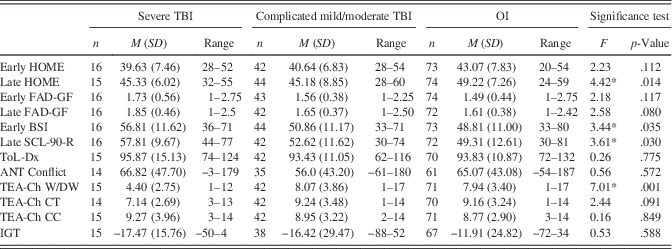
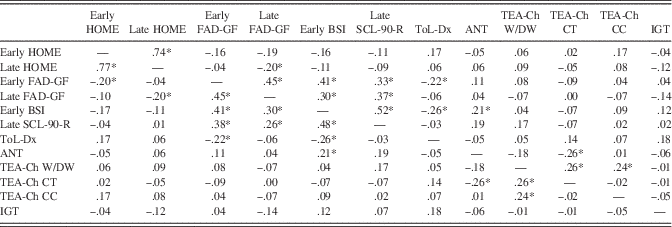
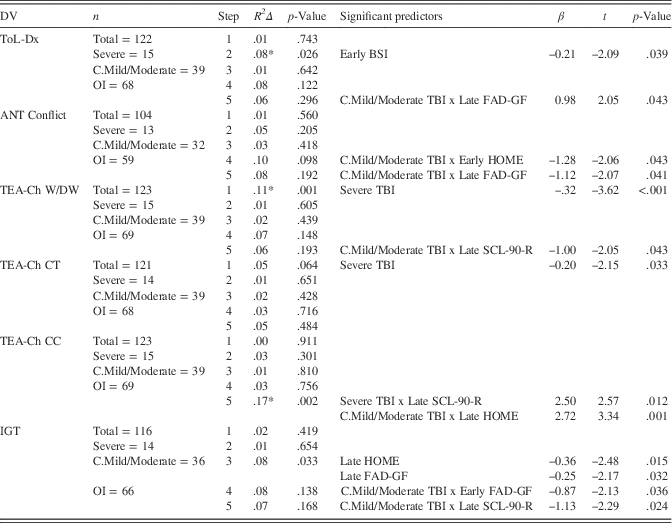
Group means and standard deviations for each of the home environment variables at both time points (early, late) and for the six outcome variables are presented in Table 2. The groups differed in the quality of the home environment at the long-term follow-up, with the lowest mean quality found in the severe TBI group. The groups also differed in parental psychological distress at both occasions, again with the greatest average distress reported in the severe TBI group. Mean within-group correlations are presented in Table 3. The results of the regression analyses are summarized in Table 4. Detailed results of the regression analyses are presented in Supplementary Tables 5–10.
Group means and standard deviations on home environment and executive functioning measures

HOME=Home Observation for Measures of the Environment; FAD-GF=Family Assessment Device - General Functioning subscale; BSI=Brief Symptom Inventory; SCL-90-R=Symptom Checklist-Revised; ToL-Dx=Tower of London-Drexel (total standard score); ANT=Attention Network Test (total score); TEA-Ch=Test of Everyday Attention for Children (W/DW=Walk/Don’t Walk, CT=Code Transmission, CC=Creature Counting; total scaled score); IGT=Iowa Gambling Task (total score).
*p<.05.
Mean within-group correlations

HOME=Home Observation for Measures of the Environment; FAD-GF=Family Assessment Device - General Functioning subscale; BSI=Brief Symptom Inventory; SCL-90-R=Symptom Checklist-Revised; ToL-Dx=Tower of London-Drexel (total standard score); ANT=Attention Network Test – Conflict Score (total score); TEA-Ch=Test of Everyday Attention for Children (W/DW=Walk/Don’t Walk; CT=Code Transmission; CC=Creature Counting; total scaled score); IGT=Iowa Gambling Task (total score).
*p<.05.
Summary of regression analyses

Step 1: Group (i.e., Severe TBI dummy coded variable, Complicated Mild/Moderate TBI dummy coded variable). Step 2: Group, Early HOME, Early FAD-GF, Early BSI. Step 3: Group, Early HOME, Early FAD-GF, Early BSI, Late HOME, Late FAD-GF, Late SCL-90-R. Step 4: Group, Early HOME, Early FAD-GF, Early BSI, Late HOME, Late FAD-GF, Late SCL-90-R, Severe TBI x Early HOME, Severe TBI x Early FAD-GF, Severe TBI x Early BSI, Complicated Mild/Moderate TBI x Early HOME, Complicated Mild/Moderate TBI x Early FAD-GF, Complicated Mild/Moderate TBI x Early BSI. Step 5: Group, Early HOME, Early FAD-GF, Early BSI, Late HOME, Late FAD-GF, Late SCL-90-R, Severe TBI x Early HOME, Severe TBI x Early FAD-GF, Severe TBI x Early BSI, Complicated Mild/Moderate TBI x Early HOME, Complicated Mild/Moderate TBI x Early FAD-GF, Complicated Mild/Moderate TBI x Early BSI, Severe TBI x Late HOME, Severe TBI x Late FAD-GF, Severe TBI x Late SCL-90-R, Complicated Mild/Moderate TBI x Late HOME, Complicated Mild/Moderate TBI x Late FAD-GF, Complicated Mild/Moderate TBI x Late SCL-90-R.
*p<.05.
Main Effects of Group
Across the six measures of EF, when the two dummy variables representing group membership were entered first into the regression analyses, the overall effect for group was significant only for the TEA-Ch Walk/Don’t Walk subtest (R 2 =.11; p=.001). Follow-up tests revealed that the severe TBI group performed significantly worse than the OI group, t(120)=−3.62, p<.001, but no other group comparisons were significant.
Main Effects of the Home Environment
When the three measures of the early home environment were added to the regression analyses in the second step, they accounted for significant variance in performance on only the ToL-Dx. The early BSI was a significant unique predictor of ToL-Dx performance, t(116)=−2.09, p=.039, such that more parental distress was associated with poorer performance. The three measures of the late home environment, when added in the third step, accounted for marginally significant variance in performance on only the IGT. The late HOME was a significant unique predictor of IGT performance, t(107)=−2.48, p=.015, but the direction of effect was opposite to expectations, with higher quality of the home associated with poorer performance.
Given that late HOME scores were also negatively associated with IGT when considered in isolation (see Table 4), the latter result did not appear to reflect a suppression effect. In contrast, the late FAD-GF predicted IGT performance in the expected direction, with poorer family functioning associated with poorer performance, t(107)=−2.17, p=.032. Overall, the early home environment measures accounted for 1% to 8% of the variance in EF test performance (R 2 Δ), with the late home environment measures accounting for an additional 1% to 8% of variance.
Moderating Effects of the Early Home Environment
Group ×early home environment interaction terms were added fourth to the regression models to test for moderation of group differences by the early home environment. Across the six EF measures, the early HOME significantly moderated the difference between the complicated mild/moderate TBI and OI groups on the ANT Conflict score, t(89)=−2.06, p=.043, and the early FAD-GF significantly moderated the difference between the complicated mild/moderate TBI and OI groups on the IGT, t(101)=−2.13, p=.036. As predicted, follow-up moderation analyses suggested that, at lower values of the early HOME (i.e., 1 SD below the sample mean, indicative of lower quality home environments), the complicated mild/moderate TBI group performed worse than the OI group on the ANT, but their performance was better than the OI group at higher values of the HOME (i.e., 1 SD above the sample mean).
A similar moderating effect was found for the early FAD-GF. At low values of the early FAD-GF (1 SD below the sample mean, indicative of better family functioning), the complicated mild/moderate TBI group performed better than the OI group on the IGT, but they performed worse than the OI group at high values of the early FAD-GF (i.e., 1 SD below the sample mean, indicative of worse family functioning).
Moderating Effects of the Late Home Environment
The last step in each regression involved the addition of group × late home environment interaction terms, to test for moderation of group differences by the late home environment. Significant interactions were found for five of six measures of EF, with most involving moderation of the difference between the complicated mild/moderate TBI and OI groups. The late FAD-GF significantly moderated the difference between the complicated mild/moderate TBI and OI groups on both the ToL-Dx, t(101)=2.05, p=.043, and the ANT Conflict, t(83)=−2.07, p=.041. Unexpectedly, follow-up moderation analyses for both measures revealed that, at higher levels of the FAD-GF (i.e., worse family functioning), performance of the complicated mild/moderate TBI group was better than that of the OI group. These results did not change when early home environment measures were excluded from the regression model, suggesting the unexpected interactions were not an artifact of multicollinearity.
The late SCL-90-R was a significant moderator of the complicated mild/moderate TBI versus OI comparison for both the TEA-Ch Walk/Don’t Walk subtest, t(102)=−2.05, p=.043, and the IGT, t(95)=−2.29, p=.024. On the TEA-Ch Walk/Don’t Walk subtest, contrary to predictions, the complicated mild/moderate TBI group performed worse than the OI group at low values of the late SCL-90-R (1 SD below the sample mean, indicative of lower caregiver distress) and better than the OI group at high values (i.e., 1 SD above the sample mean, indicative of greater caregiver distress).
In contrast, on the IGT, the complicated mild/moderate TBI group performed better than the OI group at low values of the late SCL-90-R and worse at high values. The late SCL-90-R was also a moderator of the severe TBI versus OI comparison on the TEA-Ch Creature Counting subtest, t(102)=2.57, p=.012. Again, unexpectedly, the severe TBI group performed worse relative to the OI group at low values of the late SCL-90-R and better at high values. These results were replicated when early home environment measures were excluded from the regression model, suggesting the unexpected findings were not the result of multicollinearity. Finally, the late HOME was a significant moderator of the difference between the complicated mild/moderate TBI and OI groups on the TEA-Ch Creature Counting subtest, t(102)=3.34, p=.001. Follow-up moderation analyses showed that, as predicted, performance of the complicated mild/moderate TBI group was worse than the OI group at low values of the late HOME and better at high values.
Corrections for the false discovery rate were applied to address potential concerns about multiple comparisons. Many effects did not remain significant after controlling for multiple comparisons, and results should be interpreted in light of this limitation. Only the main effect of group in the prediction of TEA-Ch Walk/Don’t Walk performance, as well as the moderating effect of the late HOME on the difference between the complicated mild/moderate TBI and OI groups on the TEA-Ch Creature Counting subtest, remained significant after controlling for the false discovery rate. Notably, the latter interaction was in the predicted direction.
DISCUSSION
This study examined the association between the early and late home environment and long-term EF following early childhood TBI. In view of previous evidence for long-term effects of TBI on EF (e.g., Beauchamp et al., Reference Beauchamp, Catroppa, Godfrey, Morse, Rosenfeld and Anderson2011; Mangeot et al., 2010), we anticipated poorer outcomes for the TBI group than for the OI group. Based on the importance of the home environment in shaping EF in both healthy children and those with chronic health conditions (e.g., see Camerota et al., 2015; Roskam et al., 2014; Sarsour et al., Reference Sarsour, Sheridan, Jutte, Nuru-Jeter, Hinshaw and Boyce2011), we also expected that measures of the early and late home environment would be associated with EF across groups, with higher quality home environments predicting better performance on EF measures. An additional prediction was that the home environment would moderate the effects of TBI, with lesser effects of complicated mild/moderate TBI relative to OI for children with higher HOME scores.
Our analyses revealed only one group difference that was not moderated by a measure of the home environment and only two associations of the home environment with EF that did not vary across injury groups. Specifically, scores on the TEA-Ch Walk/Don’t Walk subtest were lower for the severe TBI group than the OI group, and the quality of the home environment was associated with scores on the ToL-Dx and the IGT. In contrast, group differences were evident on all EF measures except for the TEA-Ch Code Transmission test when the early and late home environments were considered as moderators of group differences. The relative absence of main effects for either group membership or home environment in isolation underscores the importance of understanding how the home environment influences the effects of injury on EF. The findings also indicate that moderating effects were generally more pronounced for the complicated mild/moderate TBI than for the severe TBI group. Follow-up moderation analyses revealed several findings consistent with the predicted direction of effect, as well as some that were unexpected.
When examining the early home environment, lower quality home environments (i.e., low scores on the early HOME, high scores on the early FAD-GF) were associated with lower scores on EF tests for the complicated mild/moderate TBI group relative to the OI group, while these group differences diminished for children from higher quality home environments. These results are consistent with our predictions, suggesting that the long-term effects of TBI on EF may be moderated by the family environment, with better family environments increasing children’s resilience to TBI and lower quality family environments increasing the risks of worse outcomes.
However, some of the findings involving the late home environment were not supportive of our hypotheses. We found six instances in which the late home environment was a significant moderator of differences between either the complicated mild/moderate TBI or severe TBI group and the OI group. In four of those instances, the direction of effect was opposite to our expectations. Performance on only two outcome measures was moderated by the late home environment in the expected direction, with both instances involving the difference between the complicated mild/moderate TBI and OI groups (i.e., late SCL-90-R as a moderator of the group difference on the IGT; late HOME as a moderator of the group difference on the TEA-Ch Creature Counting subtest).
However, both the late SCL-90-R and late FAD-GF moderated group performance on several EF measures in the direction opposite to that predicted, with three interactions involving the complicated mild/moderate TBI group and one the severe TBI group. The lone significant instance of moderation in the severe TBI group could be spurious. However, the unexpected findings involving the complicated mild/moderate TBI group are more difficult to dismiss. One potential explanation is that greater parental distress, as reflected in higher BSI scores, may reflect the cumulative effect of parents’ efforts to support their children with TBI. That is, perhaps the longer a caregiver works to support their child’s development after a TBI, the more distress they experience, a possibility consistent with findings from a previous TBI study indicating associations of active parent coping with greater burden (Wade et al., Reference Wade, Borawski, Taylor, Drotar, Yeates and Stancin2001).
This notion, however, is somewhat inconsistent with the negative correlation between the late HOME and late SCL-90-R (r=−.19; p=.027), which suggests that lower parental distress is associated with higher quality home environments. Notably, two of the four interactions involving the home environment that were in the predicted direction, and none of those in the opposite direction involved the HOME, suggesting that the quality of the stimulation provided in the home environment may moderate EF after TBI in a manner more consistent with our predictions, while parental distress and family functioning act in a less consistent manner as moderators.
Notably, although early home environment measures did significantly moderate group differences on two of the EF measures (i.e., ANT Conflict, IGT), more moderating effects were found for late home environment variables (i.e., all but one measure of EF). These findings suggest that, although the early home environment may affect early EF following TBI in preschool-aged children (see Kurowski et al., Reference Kurowski, Taylor, Yeates, Walz, Stancin and Wade2011), the late home environment also has a role to play, particularly for children with complicated mild/moderate TBI. If we could be confident that better quality home environments were consistently associated with better EF in children with mild/moderate TBI, then interventions to improve the home environment later in childhood might have the potential to mitigate the effects of early childhood TBI on long-term EF. However, given that better home environments were not consistently related to better EF performance, and that our findings largely concern individual variation within the normal range, further research is needed to understand the contributions of the home environment to post-injury performance-based EF.
Finally, the findings were consistent with our expectations that the moderation of group differences by the home environment would be most apparent for children with complicated mild/moderate TBI. Although research on school-age children has found the strongest moderating effects of the home environment in children with severe TBI (Taylor et al., Reference Taylor, Yeates, Wade, Drotar, Stancin and Minich2002; Yeates et al., Reference Yeates, Taylor, Drotar, Wade, Klein, Stancin and Schatschneider1997, Reference Yeates, Taylor, Woodrome, Wade, Stancin and Drotar2002), we have previously reported that moderating effects in preschool-aged children are more pronounced for children with less severe TBI (Yeates et al., 2010). Children who sustain severe TBI at a young age may be less able to overcome the deleterious effects of those injuries than older children, even in the context of a supportive family environment. In contrast, young children with less severe TBI may have more potential to benefit from a higher-quality home environment. An alternative possibility in this study is that the relative absence of significant interactions involving the severe TBI group reflects the relatively small sample size in that group and attendant low power to detect interactions.
The results should be interpreted in light of several other study limitations. As already noted, the sample size is somewhat small, especially in the severe TBI group, and likely reduced the power to detect group differences in EF or evidence of moderation involving that group. Second, the possibility that some of the significant findings were spurious must be acknowledged, particularly given the large number of predictors entered into each model (i.e., of 19 predictor variables in each model, only 13 significant univariate effects were found across all 6 outcomes).
On the other hand, the models as a whole accounted for between 16% and 30% of the variance in EF test performance, reflecting medium to large effect sizes, suggesting that the relationship of group membership and the home environment to outcomes is non-trivial. Moreover, some findings remained significant after controlling for multiple comparisons. Third, potential confounding variables could play an important role in EF (e.g., other cognitive abilities or other environmental variables), but were not controlled in these analyses. Future studies should consider these possibilities by incorporating larger samples and measures of additional environmental variables (e.g., peer relationships, school environment) that may affect the development of EF in later childhood. Finally, EF measures included in this study were treated as individual measures; however, in future studies, composite scores representing specific EF constructs (e.g., inhibitory control, cognitive flexibility) may be more a powerful approach to understanding these relationships.
In conclusion, the current study suggests that both early and late home environments play a role in moderating long-term EF after a TBI in early childhood, especially among children with a complicated mild/moderate TBI. The late home environment may play a particularly important role as a moderator, although the direction of effect is inconsistent and the mechanisms by which these effects occur remain unclear. The results provide tentative support for the implementation of interventions to improve the quality of the stimulation provided in the home environment after injury to potentially mitigate negative effects of early childhood TBI on long-term EF, but do not suggest that reducing parental distress or improving family functioning will necessarily have similar benefits.
Acknowledgments
This research was supported by Grant R01 HD42729 from NICHD, in part by USPHS NIH Grant M01 RR 08084, Trauma Research grants from the State of Ohio Emergency Medical Services, as well as the National Center for Research Resources and the National Center for Advancing Translational Sciences, National Institutes of Health, through Grant 8 UL1 TR000077-04. Dr. Yeates received support from career development Grant K02 HD44099 from NICHD. The authors wish to acknowledge the contributions of Christine Abraham, Andrea Beebe, Lori Bernard, Anne Birnbaum, Beth Bishop, Tammy Matecun, Karen Oberjohn, Elizabeth Roth, and Elizabeth Shaver in data collection. The Cincinnati Children’s Medical Center Trauma Registry, Rainbow Pediatric Trauma Center, Rainbow Babies & Children’s Hospital, Nationwide Children’s Hospital Trauma Program, and MetroHealth Center Department of Pediatrics and Trauma Registry provided assistance with recruitment. Finally, Ms. Laliberté Durish received funding from Alberta Innovates-Health Solutions and the Alberta Children’s Hospital Research Institute in the form of a graduate studentship. The authors do not declare any conflicts of interest.
SUPPLEMENTARY MATERIAL
To view supplementary material for this article, please visit https://doi.org/10.1017/S1355617717000595
Appendix A