Paroxysmal supraventricular tachycardia in children is usually caused by a re-entry mechanism involving an accessory atrioventricular connection. In a small proportion of cases, the re-entry producing the tachycardia occurs within the atrioventricular node.Reference Ko, Deal, Strasburger and Benson1 Such atrioventricular nodal re-entrant tachycardia is usually rare during infancy, with only a limited number of cases reported during the first years of life,Reference Crosson, Hesslein, Thilenius and Dunnigan2, Reference Gross, Epstein, Walsh and Saul3 albeit that the mechanism becomes progressively the most common paroxysmal supraventricular tachycardia in adolescents and young adults.Reference Josephson and Kastor4, Reference Brembilla-Perrot, Marcon and Bosser5 Although selective radiofrequency transcatheter ablation of the slow pathway into the atrioventricular node has become the preferred therapy for adults with atrioventricular nodal re-entrant tachycardia,6 the risk of producing inadvertent atrioventricular block during childhood, with the subsequent necessity of long-term permanent pacing, means that ablation has been reserved for those symptomatic children refractory to medical treatment, or on the basis of parental choice.Reference Friedman, Walsh and Silka7 Little information is available, however, regarding the natural history of this arrhythmia in children. Moreover, the variability of clinical course in terms of frequency of episodes in the same patient, and between different patients, further complicates the definition of an appropriate strategy for management. In order to define the most appropriate treatment, we analyzed retrospectively the electrophysiological features, clinical characteristics, and the final outcome of all children and adolescents with a diagnosis of slow-fast atrioventricular nodal re-entry tachycardia undergoing follow-up at our Institution.
Materials and methods
Population studied
We included all children less than 18 years old with the diagnosis of slow-fast atrioventricular nodal re-entry tachycardia as made by a transoesophageal electrophysiological study from January, 2002, to January, 2008. Using the clinical records, we analysed the demographic characteristics, electrophysiological features, clinical course of the arrhythmia, and the modalities used for treatment.
Transoesophageal electrophysiological study
Transoesophageal electrophysiological studies were performed with a previously described technique.Reference Benson, Dunnigan, Benditt, Pritzker and Thompson8 Antiarrhythmic therapy was discontinued for at least 5 half-lives before the study. All children were studied in the fasting state after informed consent had been obtained from the parents. An intravenous line was inserted, sedation with isoflurane being used in uncooperative children. A tetrapolar oesophageal lead was introduced through the nose and positioned so as to achieve stable atrial capture using the lowest amplitude of the stimulus. The oesophageal electrogram was recorded from the stimulator (8817 FIAB, Italy) simultaneously with standard limbs leads and chest leads V1, V2 and V3. A standard electrocardiogram interfaced with the stimulator was used for recording at a paper speed of 25 or 50 millimetres per second. After a drive pulse train of eight beats with a cycle length of about 80% of the underlying sinus rhythm, single, double and triple extrastimuluses were delivered at a progressively closer coupling interval until the point of atrial refractoriness. Incremental atrial pacing was then performed until there was second degree atrioventricular block. If tachycardia was not initiated under basal conditions, the pacing protocol was repeated during an infusion of isoproterenol at 0.01 to 0.2 μg per Kg per minute.
Diagnostic criterions
We diagnosed the presence of typical atrioventricular nodal re-entry when
• There was induction of a narrow QRS tachycardia
• The ventriculoatrial interval during tachycardia was less than of 60 milliseconds.Reference Schaffer and Gillette9
Anterograde dual atrioventricular nodal physiology was defined by the demonstration of a jump in atrioventricular nodal conduction during the delivery of a single extrastimulus, with an increase of the interval between the stimulus and the QRS complex of more than 50 milliseconds after a reduction of 10 milliseconds in the extrastimulus coupling interval. In children with dual atrioventricular node physiology the effective anterograde refractory period of the fast pathway was defined as the shortest interval of the extrastimulus permitting conduction along the fast pathway.
Management after diagnosis
Conversations with the child and the parents
After diagnosis of atrioventricular nodal re-entry tachycardia, we undertook a conversation with the parents. They were instructed about the modality of onset and cessation of paroxysmal supraventricular tachycardia in order to detect possible recurrences. Moreover, the child was advised to lie down during episodes of tachycardia, and was instructed, together with the parents, about the execution of the Valsalva manoeuvre. We emphasised that there are no known cases of death related to atrioventricular nodal re-entry tachycardia in children,Reference Drago, Grutter, Silvetti, De Santis and Di Ciommo10 and that effort or physical activity have not been demonstrated to trigger the arrhythmia. We also explained the potential modalities for medical as opposed to interventional treatment.Reference Bertram, Windhagen-Mahnert and Bokenkamp11–Reference Silka, Halperin, Hardy, McAnulty and Kron13
Medical treatment
Pharmacological treatment was started in children with frequent episodes of sustained tachycardia with associated disabling symptoms. The episodes of tachycardia were considered frequent when they had a mean incidence of one episode every two months. From a clinical standpoint, episodes of tachycardia were considered sustained if they were sufficiently prolonged to necessitate medical intervention. After the first episode of atrioventricular nodal re-entry tachycardia we effected a “wait and see” policy. An antiarrhythmic drug was administered after a second episode only if it was recorded during the first two months, it was sustained enough to be interrupted with intravenous medication, or if symptoms were poorly tolerated. We have used oral flecainide,Reference Anderson, Platt, Guarnieri, Fox, Maser and Pritchett14, Reference Henthorn, Waldo and Anderson15 at a mean dosage of 5 milligrams per kilogram per day in 2 doses, as the first line of medication. This drug has been demonstrated to be effective in controlling recurrences,Reference Niazi, Naccarelli, Dougherty, Rinkenberger, Tchou and Akhtar16, Reference Bexton, Hellestrand, Nathan, Spurrell and Camm17 working mainly on the retrograde limb of the re-entry circuit, and also suppressing the triggers usually considered responsible for producing spontaneous premature beats.Reference Akhtar, Jazayeri, Sra, Blanck, Deshpande and Dhala18 Since the year 2005, we have used oral nadololReference Mehta and Chidambaram19 at a dose of 0.5–1 milligrams per kilogram per day as the first line medication, taking advantage of the option for a single daily administration. Antiarrhythmic therapy was considered effective in the absence of further episodes of atrioventricular nodal re-entry tachycardia, or if we achieved a significant reduction in the episodes in severely symptomatic patients.
Follow-up
The follow-up consisted of a visit and electrocardiogram every six months. In children treated with antiarrhythmic drugs, the dosage was adjusted to the body weight. In all children, we recorded the frequency, duration, and symptoms during episodes of tachycardia. A 48 hour Holter monitoring was performed every 12 months in all children.
Statistical analysis
Continuous variables were presented as mean plus or minus standard deviations, and compared using Student’s unpaired t test. Categorical variables were presented as counts and percentages, and compared using Fischer’s exact test. All data were analysed using the Statistical Package for the Social Sciences, version 15, as obtained from SPSS, Chicago, Illinois, United States of America.
Results
General characteristics
Among 32 children with a normal electrocardiogram and a supraventricular tachycardia induced at the transoesophageal electrophysiological study, 19 (59%) were diagnosed as having typical atrioventricular nodal re-entry tachycardia, 12 being female and 7 male. Diagnosis was made at a mean age of 11 plus or minus 4 years, with a range from 1 to 17 years. In a single case, diagnosis was made during the first year of life. The patient was a 12-months old baby referred to our Institution for the evaluation of a supraventricular tachycardia diagnosed during the neonatal period that had been successfully treated for the first year of life with oral flecainide. All children had a structural normal heart except one with a large atrial defect within the oval fossa.
Electrophysiological features
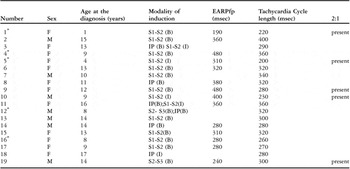
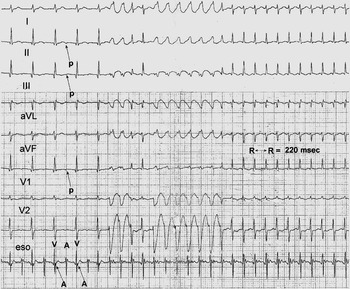
The electrophysiological characteristics of all children are summarized in Table 1. Sedation with isoflurane was necessary in 5 children (26%). The arrhythmia was induced in the basal condition in 16 children (84%), and during infusion of isoproterenol in the remaining 3. Induction was obtained at the basal state with a single premature stimulus in 10 children, a double extrastimulus in 2, and continuous pacing in the remaining 4. During infusion of isoproterenol, the tachycardia was induced with single extrastimulus in 2 children, and with continuous pacing in the other. Dual atrioventricular nodal physiology was demonstrated in 14 children (73%), being present in 83% of the females and 54% of the males, this difference not being statistically significant. We also found no statistically significant differences in the incidence of dual atrioventricular nodal physiology between those aged less than 10 years and teenagers. In those with dual atrioventricular nodal physiology, the mean effective anterograde refractory period of the fast pathway was 333 plus or minus 83 milliseconds. The mean cycle length of the re-entry tachycardia was 297 plus or minus 50 milliseconds. In 5 children (26%), we observed periods of 2 to 1 atrioventricular block during tachycardia, finding no significant difference in age for those with or without this finding, at 8.0 plus or minus 5.4 years and 12.1 plus or minus 3.0 years, respectively. There was, however, a favourable trend toward younger age in those with 2 to 1 atrioventricular block (p equal to 0.17). The mean cycle length of the tachycardia in those with 2 to 1 atrioventricular block was 246 plus or minus 42 milliseconds. This value was significantly shorter than the mean cycle length of 315 plus or minus 40 milliseconds observed in children without 2:1 atrioventricular block during the tachycardia (p equal to 0.004). In the baby studied at the age of 1 year, we observed a 40 milliseconds jump during programmed atrial stimulation, this being considered incompatible with decremental atrioventricular conduction.Reference Van Hare, Chiesa, Campbell, Kanter and Cecchin20 Atrioventricular nodal re-entry tachycardia in this baby was induced with a single premature stimulus. The baby also presented at onset with 2 to 1 atrioventricular block, along with evidence of negative p waves in the inferior leads, suggestive of retrograde midline activation. When 1 to 1 atrioventricular conduction resumed, after a short aberrancy with left bundle branch block morphology, it was difficult to measure a ventriculoatrial interval on the oesophageal lead because of the superimposition of the atrial and ventricular deflections (Fig. 1). We repeated the transoesophageal electrophysiological study when the child was aged 2 years, failing at this time to demonstrate dual atrioventricular nodal physiology, albeit that atrioventricular nodal re-entry tachycardia was still inducible at baseline state with a single premature stimulus.
Electrophysiological characteristics for the entire cohort.

*Children sedated; M: male; F: female; B: baseline; I: isoproterenol; S1-S2: single extrastimulus; S2-S3: double extrastimulus; IP incremental pacing; EARPfp: effective anterograde refractory period fast pathway; msec: milliseconds.
Passage from 2:1 atrioventricular block to 1:1 atrioventricular conduction in the 1 year-old baby. During 2:1 conduction negative p waves are evident on the inferior leads (arrows). This finding is consistent with concentric retrograde ventriculo-atrial conduction. During 1:1 atrioventricular conduction virtually fused atrial and ventricular electrograms were recorded on the oesophageal lead.

Management after diagnosis
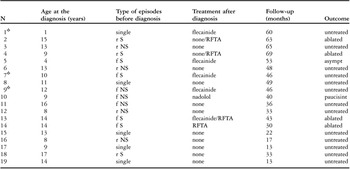
In Table 2, we summarize the clinical characteristics of episodes of tachycardia, the modalities of treatment, and the final outcome for all patients after a mean period of follow-up of 41 plus or minus 17 months. After the diagnosis of atrioventricular nodal re-entry tachycardia, 12 children (63%) were not treated pharmacologically. This group included 4 children experiencing a single episode of tachycardia, 4 with rare and non-sustained episodes of tachycardia, 3 with rare and sustained episodes, and 1 with relatively frequent but non-sustained episodes of tachycardia. We treated 6 children pharmacologically, using flecainide in 5, and nadolol in 1. The remaining child, a boy aged 14 years, had been treated pharmacologically at another institution since he was 3 years old. He has been asymptomatic whilst taking amiodarone for 5 years and sotalol for 6 years. After diagnosis of atrioventricular nodal re-entry tachycardia, he was submitted to transcatheter ablation on the basis of parental choice.
Clinical features of episodes of tachycardia, modality of treatment after diagnosis, and final outcome for all the children studied.

φTherapy discontinued; r NS: rare non sustained; r S: rare sustained; f NS: frequent non sustained; f S: frequent sustained; RFTA: radiofrequency transcatheter ablation; paucisint: paucisintomatic.
Follow-up
Children not treated pharmacologically
In this group of children, the mean follow-up was of 32 plus or minus 18 months, with a range from 12 to 68 months. We found that 4 children who suffered a single episode of tachycardia remained asymptomatic. Another group of 4 children reported rare and non sustained episodes of paroxysmal palpitation brief enough to terminate at home or at school. After diagnosis, 2 children with rare but sustained episodes experienced a further single episode over 1 year, but the episode was sufficiently long to require interruption in the Hospital setting. Both of these patients, one a boy aged 15 years and the other a girl 9 years old, were submitted to radiofrequency transcatheter ablation. Interventional therapy was deemed the best option for the boy taking into account the opinions of the parents, his age, and his sporting activities. At the time of diagnosis, the girl had experienced three episodes of tachycardia over a period of 3 years. Of these episodes, 2 were treated with intravenous administration of verapamil, the other being interrupted again in the Hospital setting by performing a Valsalva manoeuvre. After a further episode, we decided, together with the parents, to perform transcatheter ablation of the slow pathway. In another girl aged 16 years, suffering frequent but non-sustained episodes of tachycardia, only brief episodes were recorded every 2 to 3 months. During the period of follow-up, she reported an optimal quality of life, never feeling the necessity to start pharmacological therapy or to consider transcatheter ablation. One other girl, aged 17 years, had suffered 3 episodes of sustained tachycardia over a period of 7 years prior to diagnosis, but suffered no further episodes during the period of follow-up.
Children treated pharmacologically
In this group the mean follow-up was 40 plus or minus 16 months, with a range from 6 to 56 months. Antiarrhythmic therapy was considered effective in all children treated. In the baby diagnosed during the first year of life, we were able to discontinue flecainide at the age of 3. This patient suffered a single brief episode of palpitation lasting for about 20 minutes after 7 months, but was without further recurrence at the age of 6. A girl diagnosed at the age of 4 remained asymptomatic whilst taking oral flecainide over a period of 5 years. A 10 year old boy was treated with flecainide after surgery for atrial septal defect and had suffered no recurrences over a period of 2 years. Therapy was then discontinued, and only a few episodes of non-sustained tachycardia were then experienced over a period of 2 years. We treated a girl aged 12 years with oral flecainide for 1 year, then discontinuing therapy in favour of radiofrequency transcatheter ablation. Subsequent to stopping medical treatment, however, she suffered only 2 brief episodes of palpitation over 1 year, so that interventional therapy was not undertaken. We treated only one of our patients, who suffered frequent non-sustained episodes of tachycardia, with oral nadolol. During the period of follow-up, this patient suffered only sporadic brief episodes of palpitation. We treated a boy aged 14 years suffering frequent and sustained episodes of tachycardia with oral flecainide for 6 months, but we then discontinued medication, the parents opting for ablative therapy.
Discussion
Atrioventricular nodal re-entrant tachycardia is a rare arrhythmia in children. In this report, we present the results of analysis of a group of 19 children with this diagnosis made by transoesophageal electrophysiologic study. This technique has been demonstrated, in children, to be highly accurate in the characterization of various mechanisms of supraventricular tachycardia.Reference Samson, Deal, Strasburger and Benson21 We found an incidence of 59% for typical atrioventricular nodal re-entry encountered amongst our children with a normal electrocardiogram and supraventricular tachycardia inducible at the transoesophageal study. In another paper, such incidence was reported to be of 88% amongst adolescents with a normal electrocardiogram and paroxysmal palpitation. This higher incidence can probably be explained by the higher mean age of the patients studied by these authors.Reference Brembilla-Perrot, Marcon and Bosser5 We were able to induce the abnormal rhythm in the baseline state in over four-fifths of our patients, significantly more than the finding of less than half being inducible in a larger cohort of children studied prior to undergoing radiofrequency transcatheter ablation.Reference Van Hare, Chiesa, Campbell, Kanter and Cecchin20 In our series, transoesophageal electrophysiological study was performed without any kind of sedation in almost three-quarters of the patients. It is possible, therefore, that the difference in inducibility could be explained by our less frequent use of sedation. Considering that we have induced the arrhythmia in the baseline state in 4 of 5 children studied during sedation, even the kind of drugs used for sedation could be playing a role. Atrioventricular block at 2 to 1 is reported in one-tenth of adults during atrioventricular nodal re-entrant tachycardia.Reference Man, Brinkman and Bogun22 We observed this finding in one-quarter of our children, a similar incidence being reported previously.Reference Silka, Halperin, Hardy, McAnulty and Kron13 Such functional block is usually located within or below the His bundle.Reference Lee, Tai and Chiang23 As has been found in adultsReference Man, Brinkman and Bogun22 a significantly shorter cycle length was observed in or children with 2 to 1 block when compared to those without such block. We found an incidence of dual atrioventricular nodal physiology in three-quarters of our cohort. Such dual nodal physiology has been shown to be an age related phenomenon,Reference Cohen, Wieand, Rhodes and Vetter24 with an increasing incidence among adolescents and adults.Reference Silka, Halperin, Hardy, McAnulty and Kron13, Reference Blaufox, Rhodes and Fishberger25, Reference Lee, Chen, Chiang, Tai, Yu and Hwang26 Interestingly, such physiology was present in 6 of our 7 children aged less than 10 years, including our baby first seen at 1 year of age. In this latter patient, the electrophysiological study performed after another year failed to demonstrate dual nodal physiology, even though the tachycardia itself remained inducible. Several factors can influence the properties of conduction through the slow and fast pathways into the node,Reference Blaufox and Saul27 including autonomic influences.Reference Natale, Klein, Yee and Thakur28 It can be assumed that the relative weight of these influences may contribute to the variability of clinical manifestation, both in the same patient and amongst different patients.
In our children, subsequent to the diagnosis of the tachycardia, we based our strategies for treatment on the frequency and duration of episodes of tachycardia. In fact, in our population, episodes of tachycardia were usually well tolerated and never accompanied by syncope or other disabling symptoms, especially when the children remained quiet and at rest after the onset of tachycardia. After diagnosis, it has not proved necessary to treat 12 of our children, albeit that, during the period of follow-up, 2 of these children have been submitted to radiofrequency transcatheter ablation. Both of them presented rare episodes of tachycardia requiring interruption with intravenous antiarrhythmic therapy. Despite a single-dose oral administration of the drug, the so called “pill in the pocket” strategy has been proposed for patients with infrequent and well tolerated episodes of supraventricular tachycardia.Reference Musto, Cavallaro, Musto, D’ Onofrio, Belli and De Vincentis29, Reference Alboni, Tomasi and Menozzi30 It is our opinion that this approach cannot routinely be used when treating children because of the need for a fully cooperative home environment, and because of the possibility, especially in young children, of inappropriate administration. For this reason, in both these children, the parents opted for interventional therapy rather than waiting for the next episode of tachycardia. Considering, nonetheless, that during the period of follow-up 3 more children have discontinued pharmacological therapy, suffering only brief and non-sustained episodes of tachycardia, we can affirm that in over two-thirds of our cohort the tachycardia has benign clinical characteristics. In only 4 teenagers was it necessary to resort to radiofrequency transcatheter ablation, in all instances on the basis of parental choice. Long term antiarrhythmic therapy is usually warranted in severely symptomatic children. Given the poor known natural history of the arrhythmia in childhood, the main concern is to treat such a paroxysmal arrhythmia as a chronic disease. In 3 of the children initially treated with oral flecainide, withdrawal proved possible after only a few brief episodes of palpitation, and therapy was not recommenced. Of this group, 1 is the infant diagnosed at the end of the first year of life. In this baby, atrioventricular nodal re-entrant tachycardia was still inducible at 2 years of age, so we preferred to continue medical treatment until the age of 3. Subsequent to withdrawal of medical therapy, only a single brief episode of palpitation was recorded over a period of 3 years. These findings suggest that a period of clinical observation after pharmacological wash-out could be considered even in severely symptomatic children prior to undertaking radiofrequency transcatheter ablation, especially after long lasting oral therapy. In fact, given the well-known age-related modification of the electrophysiological properties of the atrioventricular node, and potential changes in autonomic tone with increasing age, clinical improvement is theoretically possible in these children, so that interventional therapy, even with the safer and equally efficacious cryoablation,Reference Avari, Jay and Rhee31 can be delayed and eventually performed at an older age. Previous studies have demonstrated a well defined natural history of supraventricular tachycardia in children with Wolff-Parkinson-White syndrome, with a high percentage of resolution of symptoms in children diagnosed during infancy.Reference Perry and Garson32, Reference Vignati, Balla, Mauri, Lunati and Figini33 A benign clinical course of atrioventricular nodal re-entrant tachycardia has previously been reported in infants. At all events, we do not know the course over the long term when the arrhythmia is first seen during infancy, and in particular we have no information about the significance of the inducibility of tachycardia in the absence of clinical recurrences.Reference Crosson, Hesslein, Thilenius and Dunnigan2 Because of this, we do not know if children diagnosed with atrioventricular nodal re-entrant tachycardia during infancy will have a later reappearance of symptoms, nor if they have a different clinical course in respect to patients diagnosed during adolescence. It has been demonstrated in adults that age is the more important variable in predicting recurrence of supraventricular tachycardia, and that younger patients could expect to experience more frequent and symptomatic attacks of tachycardia with increasing age.Reference Clair, Wilkinson, Mc Carthy, Page and Prichett34, Reference Chen, Chiang and Tai35 On this basis, the benign course we have found among our patients can be explained by the fact that most children experience their first episode of tachycardia during adolescence, so that only a limited period of follow-up is available before they reach adulthood. Our study presents some limitations. First, the mean duration of follow-up of 41 months is short considering our cohort is made up of children. Moreover, an accurate evaluation of symptoms in children, especially when treated with an antiarrhythmic medication, is often difficult considering the age of the patients. This limitation, nonetheless, is partially mitigated by the presence of a considerable number of adolescents in our population.
In our experience, therefore, atrioventricular nodal re-entry tachycardia as encountered in children and adolescents is often a benign disturbance. Medical treatment is usually effective in preventing recurrences in severely affected children, with long-term pharmacological treatment being justified in only a small number of our patients. When necessary, interventional therapy with radiofrequency transcatheter ablation or with cryoablation is an effective therapy in older children, and is preferred to long lasting oral therapy.Reference Friedman, Walsh and Silka7
Acknowledgements
We thank Maria Concetta Falanga and Nadia Negrini for their invaluable support during the transoesophageal electrophysiological studies.