Introduction
Cerambycidae is one of the largest insect families, with at least 20 000 described species worldwide, and an estimated 1100 species in Canada and the United States (Yanega Reference Yanega1996). Most cerambycid species bore into and feed on plant tissue, attacking a wide range of woody and herbaceous plants either living or dead (Yanega Reference Yanega1996). The white-spotted sawyer beetle, Monochamus scutellatus (Say) (Coleoptera: Cerambycidae), feeds on dead or dying conifers, including fresh cut pulpwood, logging debris, and fire-killed trees (Wilson Reference Wilson1962). Monochamus scutellatus is found throughout most of North America (Yanega Reference Yanega1996), and its primary host is Eastern white pine (Pinus strobus Linnaeus) (Pinaceae), but it will also feed on other species of pine, spruce, and fir throughout its range (Wilson Reference Wilson1962). The white-spotted sawyer is not a primary pest species, but it can kill healthy trees and significantly degrade the economic value of standing trees (Richmond and Lejeune Reference Richmond and Lejeune1945; Wilson Reference Wilson1962). Monochamus scutellatus has also been reported as vectoring the pinewood nematode, Bursaphelenchus xylophilus (Steiner and Bührer) (Nematoda: Aphelenchoididae), which is the causative agent of pine wilt disease in North America and Asia (Nickle et al. Reference Nickle, Friedman and Spilman1980; Kinn Reference Kinn1987). However, M. scutellatus also serves a beneficial role as a nutrient recycler, feeding on deadwood, and returning organic nutrients to the soil (Cobb et al. Reference Cobb, Hannam, Kishchuk, Langor, Quideau and Spence2010).
There have been very few investigations into the acarofauna of cerambycids. In Maine, four families of mesostigmatic mites and two other mite families (Acari: Sarcoptiformes) were collected from four cerambycid species, including M. scutellatus (Soper and Olson Reference Soper and Olson1963). In Louisiana, 13 species and three families of mesostigmatic mites were collected from five cerambycid species (Kinn and Linit Reference Kinn and Linit1989). In North America, five Mucroseius Lindquist species (Mesostigmata: Melicharidae) were collected from seven Monochamus species, including M. scutellatus (Lindquist and Wu Reference Lindquist and Wu1991). The main objective of this study was to characterise the diversity, prevalence, intensity, and attachment site preferences of mesostigmatic mites associated with the white-spotted sawyer beetle in eastern Ontario, sampled in two sites over 2 years. Secondarily, because mite abundance or prevalence occasionally differs between male and female insect hosts (e.g., Lajeunesse et al. Reference Lajeunesse, Forbes and Smith2004), and because female M. scutellatus are more intimately associated with the egg niche (small incision or pit cut into the bark by an ovipositioning female), where mites presumably enter the gallery (Soper and Olson Reference Soper and Olson1963), we assessed whether there was a sex bias in the abundance and prevalence of mites associated with M. scutellatus.
Materials and methods
Study sites and sampling design
Wood-boring beetles were sampled in two study sites in eastern Ontario from mid-April to late August in 2008, and from mid-April to early August in 2009. The two study sites were in the boreal shield ecozone in Algonquin Provincial Park (PP): site 1 (S1) (45.902°N, 77.605°W) and site 2 (S2) (45.895°N, 78.071°W). Four Lindgren 12-unit funnel dry traps (Synergy Semiochemicals Corporation, Burnaby, British Columbia, Canada) with four 1 cm3 pest strips (Ortho Home Defense Max, Scotts Company, Marysville, Ohio, United States of America; to kill beetles and mites) and baited with lures, were placed in each site at least 16 m apart, with the collection cups ∼80 cm off the ground and at least 2 m from any host trees (distance from trees, trap height, and distance between traps based on Miller and Duerr Reference Miller and Duerr2008). Traps were baited with α-pinene and 95% ethanol (released at 2 g/day and 400 mg/day, respectively) lures (Synergy Semiochemicals Corporation, Burnaby, British Columbia, Canada) to attract beetles seeking dead or dying coarse woody debris. Traps were emptied approximately every 2 weeks, trap lures were replaced every 8 weeks, insecticide strips were replaced during each visit to maintain effectiveness, and any mites detached from their host were discarded. Each beetle specimen captured was placed individually into a 2.0 mL microfuge tube with 80% ethanol.
Identifications and mite associations
Cerambycids were identified to species using a dissecting microscope and taxonomic literature (Yanega Reference Yanega1996). The presence, abundance, and attachment location of mesostigmatic mites (hereafter mites) was recorded; other mites (e.g., Prostigmata, Astigmata) were not studied. Prevalence was defined as the percentage of all examined hosts with one or more mites of a given species. Intensity was defined as the number of mites of a given species, carried per beetle with mites (beetles without mites excluded). All mites were removed from the host, cleared in 85% lactic acid for 1–24 hours depending on the degree of opacity, slide-mounted in a polyvinyl alcohol medium and cured on a slide warmer at about 40°C for 3–4 days. Slide-mounted specimens were examined using a compound microscope and identified to species using descriptions from the literature (Hirschmann Reference Hirschmann1960, Reference Hirschmann1972; Hurlbutt Reference Hurlbutt1967; McGraw and Farrier Reference McGraw and Farrier1969). Voucher specimens are deposited in the Canadian National Collection of Insects, Arachnids, and Nematodes, in Ottawa, Canada.
Chi-square and Mann–Whitney U tests were performed using SPSS v17 (SPSS Inc., Chicago, United States of America), to assess whether the prevalence or abundance of mites, respectively, diverged significantly between male and female hosts.
Results
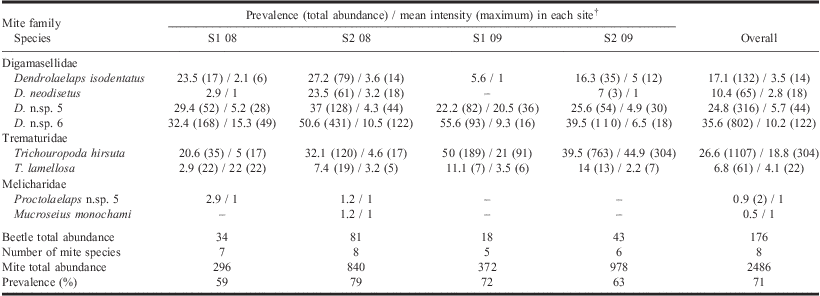
A total of 176 M. scutellatus specimens were collected in Algonquin, across both sites and years (Table 1). Beetle abundance was greater in 2008 than in 2009, with 1.9 times more beetles collected in 2008. Site S2 in 2008 had the highest abundance with 46% of all beetles collected (Table 1).
Prevalence (%) (total abundance) and mean intensity (maximum)Footnote * of mites associated with Monochamus scutellatus collected across two sites in Algonquin Provincial Park, Ontario in 2008 and 2009.

* Prevalence defined as the percentage of all examined hosts with one or more mites of a given species. Intensity defined as the number of mites of a given species, carried per beetle with mites (beetles without mites excluded).
† S1 = Algonquin Provincial Park site 1, S2 = Algonquin Provincial Park site 2.
Instances where total abundance or maximum intensity = 1 were not reported.
n.sp., new species.
Overall, 71% of hosts had at least one mesostigmatic mite (hereafter mites). Total prevalence per site and year varied from 59%–79% (Table 1). A total of 2486 mites representing eight species, four genera, and three families (Digamasellidae, Melicharidae, and Trematuridae) were collected across both sites and years (Table 1). Mite species richness was greater in each site in 2008 than in 2009, despite a slightly greater abundance in 2009, with 54.3% of all mites collected in 2009 (Table 1). Higher species richness in 2008 is mostly due to the presence of two rarely collected melicharid species. Mite diversity and abundance was highest in site S2 in both years, with overall eight species, and 2.6–2.8 times more mites collected each year (Table 1). Typically, when mites were present there were 1–10 (59.8%) or 11–20 (17.7%) mites per beetle; more rarely, 21–30 (8.1%) or 31–100 (11.2%) mites were found per beetle, and few hosts had ≥100 mites (3.2%), including one male specimen from site S2 in 2009 that had 328 mites. Among beetles that had mites, most were associated with only one or two species of mites (35.5% and 28.2%, respectively), fewer had three (22.6%), four (9.7%), or five (3.2%) species, and the maximum was six species collected from a female specimen from site S2 in 2008.
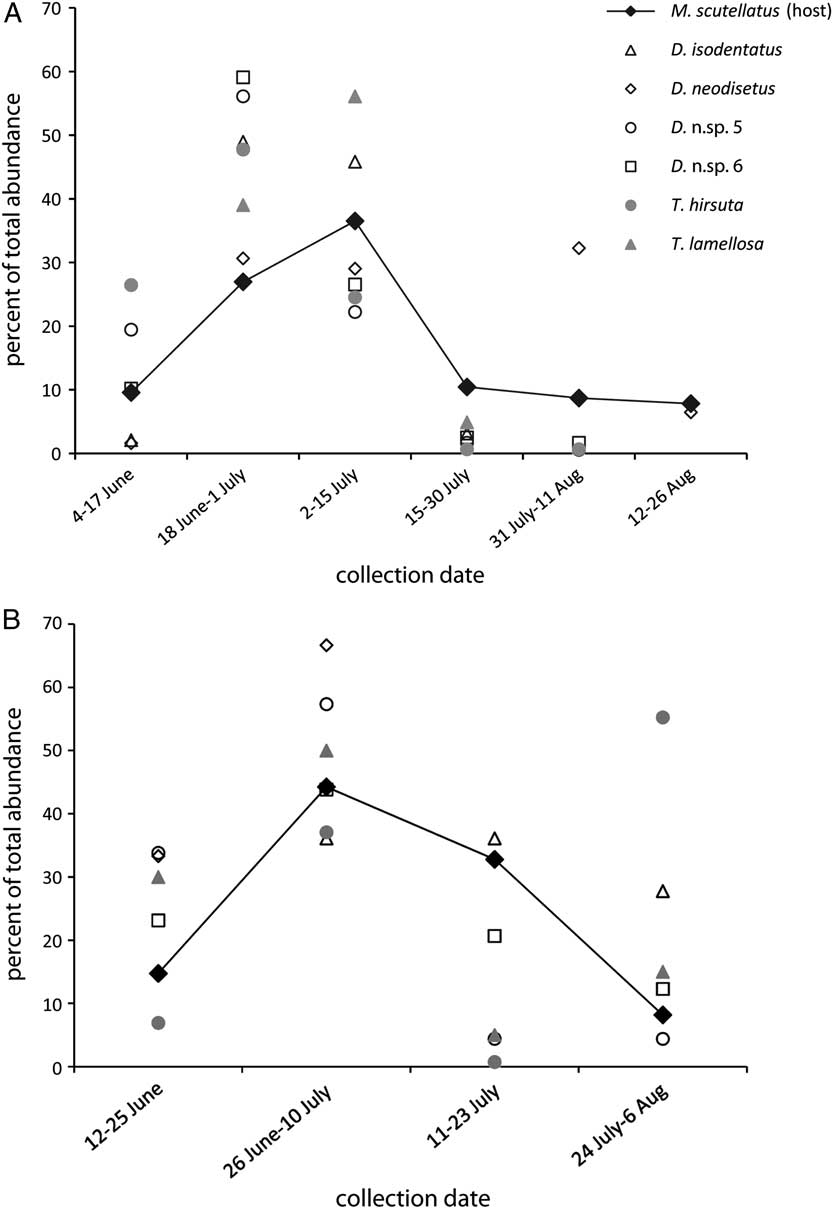
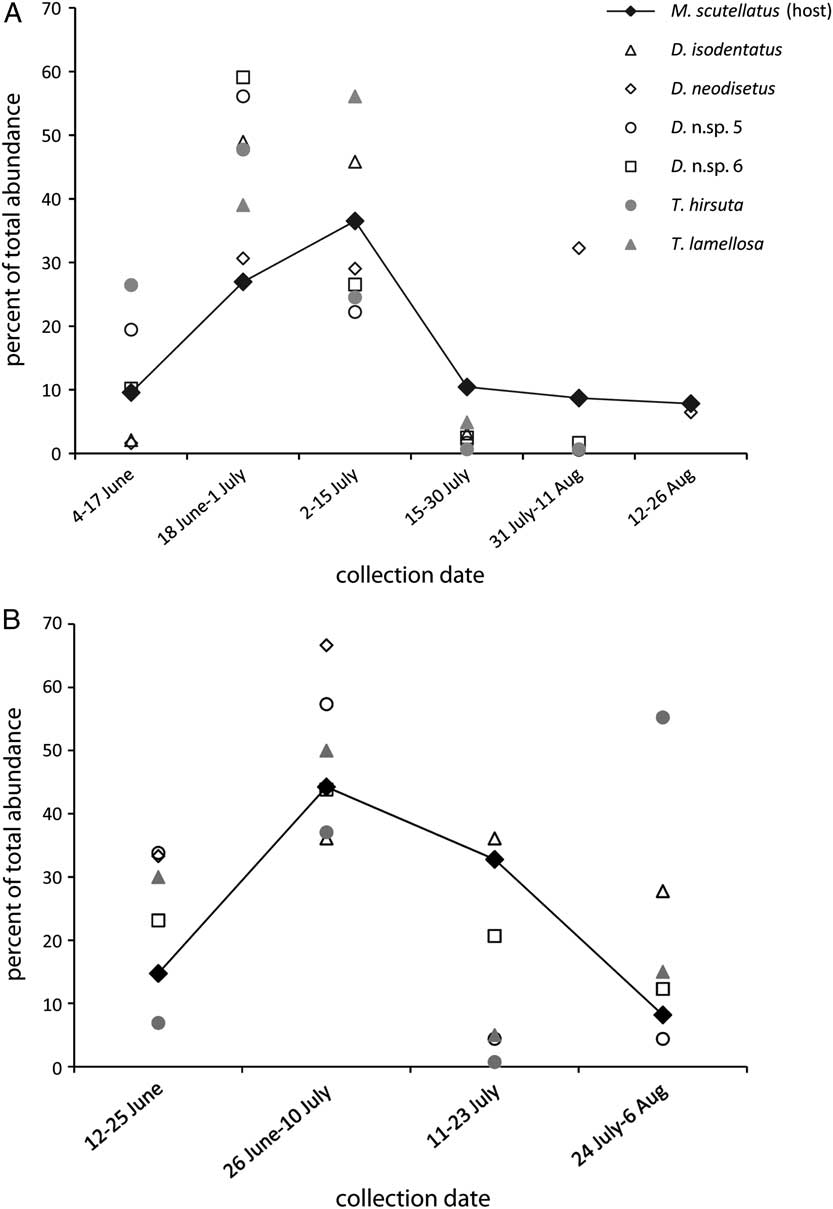
Traps were deployed from April to August across both years, however, M. scutellatus specimens were only found in the traps from June to August. In 2008, beetles and mites were found from early June to late August, and the majority of specimens were collected from mid-June to mid-July (Fig. 1A). In 2009, beetles and mites were collected from mid-June to early August, and the majority were collected from mid-June to late July (Fig. 1B). Peak beetle abundance was in the first 2 weeks of July in both 2008 and 2009 (Fig. 1). Mites were most frequently encountered when beetles were most abundant (Fig. 1).
Percentage of total abundance of Monochamus scutellatus and six associated mite species (Dendrolaelaps isodentatus, Dendrolaelaps neodisetus, D. n.sp. 5, D. n.sp. 6, Trichouropoda hirsuta, and Trichouropoda lamellosa), across ∼14-day collection intervals in sites S1 and S2 (Algonquin Provincial Park) from 4 June to 26 August 2008 (A) and 12 June to 6 August 2009 (B).
The Digamasellidae (Dendrolaelaps Halbert spp.) was the most prevalent, abundant and diverse family of mites overall, with five species representing 52.9% of all mite individuals collected (Table 1). The Trematuridae (Trichouropoda Berlese spp.) was the second most prevalent, abundant and species rich family, with two species representing 47% of all mites collected (Table 1). The Melicharidae (Proctolaelaps Berlese, Mucroseius) was rarely encountered, with two species and 0.1% of all mites (Table 1). Overall, Dendrolaelaps new species (n.sp.) 6 and Trichouropoda hirsuta Hirschmann showed the highest prevalence (35.6% and 26.6%), abundance (802 and 1107 mites), and mean intensity (10.2 and 18.8, respectively) (Table 1). These two species reached prevalence levels of 55.6% and 50% in site S1 in 2009, respectively (Table 1). In a given site T. hirsuta and T. lamellosa Hirschmann had the highest mean intensity, with 45 and 22 mites per beetle in site S2 in 2009 and S1 in 2008, respectively (Table 1). Three mite species are undescribed (D. n.sp. 5, D. n.sp. 6, and P. n.sp. 5), and the gap in the numerical designation for these species reflects numbering of additional undescribed species collected from bark beetles (Knee Reference Knee2011).
There was no significant sex bias in the abundance or prevalence of mites between male and female M. scutellatus (z = −0.192, n = 176, P = 0.848; χ 2 = 0.317, df = 1, P = 0.573). Six of the eight mite species collected were sufficiently abundant to test for sex bias within a single mite species. None of the six species showed a significant sex bias in the prevalence of each mite species (χ 2 = 0.050–2.637, df = 1, P = 0.104–0.823), or abundance (Mann–Whitney z = −0.156–1.784, n = 176, P = 0.074–0.876); however, one species, Dendrolaelaps isodentatus (Hurlbutt), was 1.7 times more prevalent and abundant on female than on male hosts, and these differences were marginally significant (χ 2 = 3.653, df = 1, P = 0.056; z = −1.956, n = 176, P = 0.050, respectively).
Different families and species of mites appear to attach to different regions on host individuals. All of the mesostigmatic mite specimens, excluding uropodoids, were collected under the elytra of their hosts. In contrast, most uropodoids (Trematuridae: Trichouropoda) were found glued to the prothorax with an anally secreted pedicel (90%), with 79% of mites on the pronotum and 11% on the prosternum; the remaining Trichouropoda specimens were found attached to the underside of the elytra (10%). Trichouropoda species showed site-specific preferences: T. lamellosa was found mostly (83%) on the underside of the elytra, and T. hirsuta mostly (98.4%) on the prothorax.
Discussion
Monochamus scutellatus was associated with a prevalent and moderately diverse assemblage of mites in Ontario. Similar mite diversity and composition were observed in other studies on other cerambycid species in North America. Monochamus titillator (Fabricius) was associated with eight mesostigmatan species, from four genera and three families (Digamasellidae: Dendrolaelaps, Longoseius Chant; Melicharidae: Mucroseius; Trematuridae: Trichouropoda) in Louisiana (Kinn Reference Kinn1987; Kinn and Linit Reference Kinn and Linit1989). Monochamus carolinensis (Olivier) was associated with four species (Dendrolaelaps and Trichouropoda spp.), and Neacanthocinus obsoletus (Olivier) had six species (Dendrolaelaps, Longoseius, and Trichouropoda spp.) in Louisiana (Kinn Reference Kinn1987; Kinn and Linit Reference Kinn and Linit1989). Average mite abundance per beetle (or ratio of total number of mites/beetle) varied somewhat across studies and/or cerambycid species. In this study, average mite abundance was 14 mites per beetle, whereas 16 and 106 mites per beetle were found on N. obsoletus and M. titillator in Louisiana, respectively (Kinn Reference Kinn1987).
Although based on data from only eight beetles, the mite fauna of M. scutellatus in two more southern sites in Ontario (44.500°N, 76.072°W; 44.447°N, 76.577°W), studied under a similar sampling regime in 2008, appears to be similar to that of M. scutellatus in Algonquin PP, with five of the same mite species (D. isodentatus, D. n.sp. 5, D. n.sp. 6, T. hirsuta, and T. lamellosa) and relatively high mite abundance (151 mites/8 beetles, or 19 mites/beetle) and prevalence (62.5%) (W.K., unpublished data). In contrast, the acarofauna associated with M. scutellatus in northern Alberta, Canada (56.950°N, 111.417°W; beetles hand-collected near Fort McMurray), seems impoverished with 277 mites representing only two species (T. hirsuta and T. lamellosa) collected from 38 beetles (7 mites/beetle) (H.W.K. and W.K., unpublished data). However, overall prevalence in Alberta remains high, with 58% of beetles having at least one mesostigmatic mite (H.W.K. and W.K., unpublished data).
Mite associations with other host species
Many of the mite species collected in this study have been reported from other cerambycid species as well as other families of wood-boring beetles. The Digamasellidae dominated the mesostigmatic mite fauna on M. scutellatus. The ecology and impact of digamasellids on their hosts is poorly understood, except for the few species that have been studied. Dendrolaelaps neodisetus (Hurlbutt), a putative mutualist of bark beetles that feeds on entopathogenic nematodes (Kinn Reference Kinn1980), was rarely collected here, except in one site in 2008. However, this species is considered to be primarily associated with bark beetles, and is one of the most common mites associated with Dendroctonus frontalis Zimmermann, and Ips De Geer spp. (Scolytinae) in southern pines (Kinn Reference Kinn1984). It has also been collected from three other cerambycid species (M. titillator, M. carolinensis, N. obsoletus) in Louisiana (Kinn and Linit Reference Kinn and Linit1989). Dendrolaelaps isodentatus was frequently collected from M. scutellatus in this study, and has also been collected from M. titillator and M. carolinensis (Moser and Roton Reference Moser and Roton1971; Kinn and Linit Reference Kinn and Linit1989) as well as five bark beetle species (Ips, Trypodendron Stephens, and Gnathotrichus Eichhoff spp.) from southern United States of America and Ohio, United States of America (Moser and Roton Reference Moser and Roton1971).
Only two melicharid species were collected in this study, and both were rarely encountered. Monochamus scutellatus and M. notatus (Drury) are considered to be the primary hosts of Mucroseius monochami Lindquist, but it has also been found on four other Monochamus Dejean spp. (Kinn and Linit Reference Kinn and Linit1989; Lindquist and Wu Reference Lindquist and Wu1991). Mucroseius monochami can reach high abundance levels, reportedly filling the spiracular atria of its host (Lindquist Reference Lindquist1962). Mucroseius monochami is widespread in North America, but it may represent a species complex (Lindquist and Wu Reference Lindquist and Wu1991; Kinn and Linit Reference Kinn and Linit1989).
The natural history and ecological relationships of trematurid mites associated with cerambycids is unknown. Trichouropoda hirsuta was one of the most prevalent and abundant species collected in this study. This species is a host generalist, occurring on multiple families of wood-boring beetles, including scolytines, weevils, tenebrionids (unpublished data), and at least four additional cerambycid species from Louisiana (Kinn and Linit Reference Kinn and Linit1989). The high prevalence of T. hirsuta on Ontario M. scutellatus (21%–50%) was similar to that of Alberta M. scutellatus (24% of 38 beetles) (unpublished data). Trichouropoda lamellosa is often found in association with cerambycids, but in this study it was sporadically associated with M. scutellatus. Trichouropoda lamellosa is also on many hosts, occurring on at least four other species of cerambycids in Louisiana (Kinn and Linit Reference Kinn and Linit1989), and four bark beetle species (Ips and Dendroctonus spp.) (Moser and Roton Reference Moser and Roton1971). The prevalence of T. lamellosa on M. scutellatus from Ontario (6.8%) was much lower than that of M. scutellatus in Alberta (42.1%) (unpublished data). Trichouropoda hirsuta and T. lamellosa occasionally reach high abundances on other cerambycid species (Monochamus and Neacanthocinus Dillon), with average abundances of 10 and 37 mites/beetle, respectively (Kinn Reference Kinn1987).
Phoretic attachment location
The specific site of attachment of associated mites to an insect host is selected primarily to minimise the likelihood of active dislodgement by the host, or passively during host dispersal (Binns Reference Binns1982). Dendrolaelaps, Proctolaelaps and Mucroseius species lack specialised structures for phoretic dispersal, residing under the elytra may provide the greatest protection against dislodgement. Dendrolaelaps species use their leg ambulacra and chelicerae to clamp onto setae and attach to the body surface of their host (Hirschmann and Rühm Reference Hirschmann and Rühm1953). Mucroseius species are often found in the metathoracic spiracular atria of their host (Lindquist and Wu Reference Lindquist and Wu1991), although, in this study, and in Louisiana (Kinn Reference Kinn1987), M. monochami was only found under the elytra. In contrast to the above mentioned mites, trematurids and all other phoretic Uropodoidea attach to a host using an anally secreted pedicel, which is a flexible and resilient structure that provides a low likelihood of dislodgement by the host, and provides more freedom for attachment site selection (Faasch Reference Faasch1967; Binns Reference Binns1982). However, the two host generalist trematurid species collected in this study were attachment site-specific: T. lamellosa was mostly found under the elytra, and virtually all T. hirsuta were found on the prothorax. The same two species showed the same site preferences on four additional cerambycid species in Louisiana (Kinn Reference Kinn1987).
Sex bias
Mites dispersed equally on males and females: there was no sex bias in the abundance or prevalence of mites between male and female M. scutellatus. The absence of sex bias in mite load has also been reported for M. alternatus Hope, with the mesostigmatan species, Dendrolaelaps fukikoae Ishikawa, D. unispinatus Ishikawa, and Proctolaelaps hystrix (Vitzthum), showing no preference for male or female hosts (Tamura and Enda Reference Tamura and Enda1980). We had hypothesised that phoresy on female M. scutellatus would be a more effective strategy because females are more closely associated with the egg niche, in which mites presumably enter the host gallery (Soper and Olson Reference Soper and Olson1963). The behaviour of associated mites has never been observed during host mating and ovipositioning; however, mites are reportedly associated with cerambycid larvae and pupae (Soper and Olson Reference Soper and Olson1963), which would indicate that mites enter the host gallery. Female M. scutellatus select a host tree, and after mating they chew a hole in the bark in which they lay eggs and then deposit a light brown jelly over the hole (Peddle et al. Reference Peddle, de Groot and Smith2002). Mites attached to females should have the best opportunity, in terms of time and proximity, to access the egg niche, while those attached to males may have a lesser chance. However, males often (but not always) closely guard females before and after copulation (Hughes Reference Hughes1979; Peddle et al. Reference Peddle, de Groot and Smith2002), therefore, mites phoretic on males may have a chance to enter the egg niche. The absence of a sex bias in our study suggests that there is no selective advantage for mites dispersing on female beetles. There may be other routes that male-associated mites reach the egg niche, for example, by dispersing across the bark of a host tree, or via sexual transmission during copulation and mate guarding, as seen in Coccipolipus hippodamiae (McDaniel and Morrill) associated with coccinellid beetles (Webberley et al. Reference Webberley, Hurts, Husband, Hinrich, Schulenburg and Sloggett2004), or the mite, Parobia husbandi Seeman and Nahrung, from chrysomelid beetles (Seeman and Nahrung Reference Seeman and Nahrung2004).
Acknowledgements
We would like to thank Hubert Knee for sampling for beetles in northern Alberta. We also thank the Ontario private land owners who permitted sampling on their property. This research was conducted with a permit to collect in Provincial Parks issued by Ontario Parks. This study was funded by a Natural Sciences and Engineering Research Council of Canada (NSERC) Discovery Grant to M.R. Forbes, and an NSERC Alexander Graham Bell Canada Graduate Scholarships award to W. Knee.