In October 2017, a West Virginian middle school teacher named Jay O’Neal invited his fellow teachers to join a Facebook group to discuss shared grievances of low pay and cutbacks to their health insurance (Quinn Reference Quinn2018). Facing months of continued resistance from the legislature and governor, teachers in O’Neal’s group proposed what had previously seemed unthinkable: walking out of work. Not only does West Virginia law bar public employees—including teachers—from striking but the state also tilts far to the political right. In the 2016 election, for instance, President Donald J. Trump beat Clinton by 68% to 26%.
Against those long odds, on February 22, 2018, West Virginian school unions announced a statewide strike, which would continue to March 7. Even more surprising was the support teachers received from West Virginians. Each day of the strike, thousands of parents and community members joined teachers and school staff in protests at the statehouse to increase pressure on lawmakers. That pressure paid off, and teachers ended the strike after the legislature and governor agreed to grant teachers a 5% pay raise.
Seeing the success that West Virginian teachers had in pressuring an otherwise unfriendly state government to boost school spending and pay, educators in Kentucky, Oklahoma, Arizona, Colorado, and North Carolina followed suit with mass walkouts and strikes of their own throughout the spring and summer. Just as in West Virginia, these teachers were responding to decades of stagnant teacher wages and under-resourced public schools. And just as in West Virginia, teachers in these other states managed to secure gains, including pay raises and increased school spending, from formerly reluctant governors and legislatures.
The mass teacher strike wave poses a number of questions for scholars of American politics and political economy. For one, the strikes challenge the narrative on both the Left and the Right that the labor movement is “basically dead”—even as it stands at just 10% of the workforce in 2018 (Ghilarducci Reference Ghilarducci2015). Coming on the heels of major state-level and judicial cutbacks to public employee union rights (Finger and Hartney Reference Finger and Hartney2019; Hertel-Fernandez Reference Hertel-Fernandez2019), the strike wave also suggests that conservative efforts to retrench labor power may be generating a backlash from government employees.
But perhaps the most significant question raised by the strikes is what their political impact has been beyond the teachers themselves. It is this question that we address, asking whether large-scale work stoppages like the 2018 teacher strikes can change the ways that other members of the public—and especially the individuals most exposed to the strikes—think about unions and the labor movement more generally. Theorists of labor action have long hypothesized that collective actions like strikes can build solidarity and class consciousness among workers (Ahlquist and Levi Reference Ahlquist and Levi2013; Fantasia Reference Fantasia1988; Lenin Reference Lenin, Utechin and Utechin1963 [1902]; cf. Golden Reference Golden1997; Michels Reference Michels1962 [1919]). And decades of research on other social movements, especially the civil rights movement, suggest that large-scale protests like the teacher strikes can inspire additional mobilization, introduce new values and frames, and shift public opinion (i.e., Amenta et al. Reference Amenta, Caren, Chiarello and Su2010; Andrews Reference Andrews2004; Tarrow Reference Tarrow2011). Yet perhaps surprisingly, we lack similar research on the direct effect of strikes, especially large-scale public sector strikes, on how Americans outside of unions think about the labor movement (but see Schmidt Reference Schmidt1993 on the effect of media coverage of strikes).
To answer this question, we draw on an original survey of nearly 4,500 adults in the six 2018 teacher walkout states that we conducted in January 2019, as well as monthly internal polling conducted for the AFL-CIO from February 2016 to November 2018. In our survey, self-reported firsthand exposure to the strikes was correlated with greater support for the strikes and walkouts, greater support for the striking teachers and the labor movement in general, and greater personal interest in joining a union and going on strike. Public support for unions in general was also higher in the strike states after the strikes compared to before them, according to the internal AFL-CIO polling.
We next leveraged an oversample of parents in our original January 2019 survey to measure the causal effect of firsthand exposure to the 2018 teacher strikes on attitudes about unions. Our strategy was to compare parents with school-age children (age 5 or older to age 17 or younger) to parents without school-age children (younger than 5 or older than 17)—groups of parents who are otherwise quite similar but whose firsthand exposure to the strikes is very different. Parents with school-age children, we document, were substantially more likely to have direct experience with the strikes from their children’s schools than were parents without school-age children. These parents with school-age children were also more likely to say that they supported greater legal rights for teachers’ unions, including the right to strike; that they desired a stronger labor movement more generally; and that they were more interested in going on strike themselves in the upcoming year.
Our results suggest the strikes had large, direct, and positive effects on mass attitudes, even nearly a year after they occurred. Not only did firsthand contact with the strikes among the most affected population—parents of school-aged children—appear to boost support for the striking teachers and their demands but the strikes also increased individuals’ own interest in labor action, suggesting a potential multiplier effect that could inspire greater labor mobilization. The results are especially pronounced among conservatives, Republicans, and those lacking personal connections to unions; they are weaker for single parents, who may have been the most inconvenienced by the lack of childcare during the strikes.
These findings have implications for a variety of literatures. Most directly, they document the effectiveness of strikes as a political strategy for unions, adding to the existing literature on unions as political organizations that shape the preferences of their members (Ahlquist and Levi Reference Ahlquist and Levi2013; Kim and Margalit Reference Kim and Margalit2017), teach their members civic skills and recruit them to participate in politics (Macdonald Reference Macdonald2019; Schlozman, Verba, and Brady Reference Schlozman, Verba and Brady2012), mobilize working-class voters in elections (Feigenbaum, Hertel-Fernandez, and Williamson Reference Feigenbaum, Hertel-Fernandez and Williamson2019; Leighley and Nagler Reference Leighley and Nagler2007; Rosenfeld Reference Rosenfeld2014), make campaign contributions to pro-labor candidates (Stegmueller, Becher, and Käppner Reference Stegmueller, Becher and Käppner2018), and lobby local, state, and national governments (Anzia and Moe Reference Anzia and Moe2015; Becher, Stegmueller, and Käppner Reference Stegmueller, Becher and Käppner2018; DiSalvo Reference DiSalvo2015; Hacker and Pierson Reference Hacker and Pierson2010; Moe Reference Moe2011). Strikes, we show, can complement these other tactics by building support for unions in the mass public.
That we identify positive effects of the teacher strikes also speaks to separate literatures on the distinctive nature of public sector employment and the disruptive nature of government employee labor action. As we describe in more detail in this article, there are good reasons to doubt that the teacher strikes would boost public support for the labor movement. Given the direct, service-based interaction between teachers and children, labor action seems likely to carry substantial costs to parents and broader communities (for other service-sector contexts, see, e.g., Gruber and Kleiner Reference Gruber and Kleiner2012; Naidu and Reich Reference Naidu and Reich2018). And more generally, conservative advocates have succeeded in mobilizing resentment against public sector employees in many states (Cramer Reference Cramer2016; Hertel-Fernandez Reference Hertel-Fernandez2019; Kane and Newman Reference Kane and Newman2017; McCartin Reference McCartin, Schulman and Zelizer2008). Our findings suggest that, instead of building resentment or anger against government employees, public sector strikes can increase support for workers and unions more generally, possibly by emphasizing the public goods that unions provide.
Lastly, our article engages with a broader set of studies examining the long-run effects of social movements on public attitudes and orientations (Enos, Kaufman, and Sands Reference Enos, Kaufman and Sands2019; Madestam et al. Reference Madestam, Shoag, Veuger and Yanagizawa-Drott2013; Mazumder Reference Mazumder2018). Our results add to this growing literature (Amenta et al. Reference Amenta, Caren, Chiarello and Su2010), documenting the persistent political effects of a distinctive form of collective action by labor unions. Our study also goes beyond this past work to show how disruptive social mobilization, like strikes, does not just change political attitudes in the mass public but may also inspire individuals previously outside the movement to become interested in it and potentially undertake costly actions of their own (cf. Givan, Roberts, and Soule Reference Givan, Roberts and Soule2010).
Unions and the Political Logic of Public Sector Strikes
Although unions most frequently try to influence workers’ compensation, working conditions, and voice in workplace decisions by bargaining collectively with management, unions have also long attempted to improve worker outcomes through policy. Teachers face naturally monopsonistic labor markets (see, e.g., Ransom and Sims Reference Ransom and Sims2010) and thus have particularly strong needs for collective representation and policy influence. They have built their political power both in the electoral process, by making campaign contributions to politicians and mobilizing their members and local communities to vote for favored candidates (Becher, Stegmueller, and Käppner Reference Stegmueller, Becher and Käppner2018; Feigenbaum, Hertel-Fernandez, and Williamson; Moe Reference Moe2011; Rosenfeld Reference Rosenfeld2014; Schlozman, Verba, and Brady Reference Schlozman, Verba and Brady2012; Stegmueller, Becher, and Käppner Reference Stegmueller, Becher and Käppner2018), and in the legislative process, by lobbying elected officials in local, state, and national government (Hacker and Pierson Reference Hacker and Pierson2010; Lichtenstein Reference Lichtenstein2002). Since the New Deal, unions have also established an especially close “enduring” or “anchoring” alliance with the Democrats, trading grassroots mobilization and campaign support for influence on party legislative agendas (Dark Reference Dark1999; Schlozman Reference Schlozman2015). Despite declining membership, scholars have documented the persistent influence of unions on local, state, and national politics, especially those public sector unions that continue to maintain high levels of membership (Anzia and Moe Reference Anzia and Moe2015; Flavin and Hartney Reference Flavin and Hartney2015).
Yet existing work on labor’s political influence has neglected how unions can affect politics through another channel: by shaping the public’s perceptions of the labor movement and support for union causes. In particular, we focus on how large-scale collective action through labor strikes can be a strategy for unions to extract demands from management and to build public support for union-preferred policy change and for the labor movement in general.
We suspect that the motivation for public-facing strikes may have increased in importance in recent decades for two reasons. First, as unions grow weaker, they have stronger incentives to broaden the scope of their conflicts to include the general public and thereby obtain more political support (cf. Dark Reference Dark1999; Schattschneider Reference Schattschneider1960). Second, the rise of public sector labor unions since the 1970s has meant that an increasing share of unions depends more centrally on political support for their success.
At the same time, public sector labor union strikes may have an especially difficult time—as compared to private sector union strikes or other social movements—generating public support for their efforts, and this challenge may be particularly acute for teachers. Like many other public sector employees, teachers are service workers, which means that what they are producing is, to a large extent, an interaction with customers or clients (students and families, in the case of teachers; Hochschild Reference Hochschild1983).
This service model of production matters because, across a wide range of cases and industries, strikes and other labor disputes are associated with a decline in productivity and production quality (Gruber and Kleiner Reference Gruber and Kleiner2012; Mas Reference Mas2006, Reference Mas2008; Naidu and Reich Reference Naidu and Reich2018). But this deterioration has different implications for the relationship between worker protest and public support in the service versus manufacturing sectors. Whereas someone shopping for a tire is unlikely to blame Bridgestone/Firestone workers if the product turns out to be a lemon (Krueger and Mas Reference Krueger and Mas2004), when workers withdraw their labor from service contexts, those workers seem likely to receive the lion’s share of the blame from the public, because they are the ones who are no longer providing the same level of care or service to clients or customers (Naidu and Reich Reference Naidu and Reich2018). Moreover, in the case of a teacher’s strike, the recipients of the degraded service—children—command considerable public sympathy.
Although the existing literature on the effects of teachers’ strikes on student learning is somewhat sparse, recent studies suggest that teachers’ strikes are indeed associated with declines in student outcomes (Baker Reference Baker2013; Belot and Webbink Reference Belot and Webbink2010), and Argentinian evidence suggests even long-term effects on earnings (Jaume and Willén Reference Jaume and Willén2019). A more developed literature on the relationship between teacher absences and educational outcomes is even more definitive, clearly demonstrating a causal relationship between absenteeism and declines in educational achievement (Clotfelter, Ladd, and Vigdor Reference Clotfelter, Ladd and Vigdor2009; Herrmann and Rockoff Reference Herrmann and Rockoff2012; Miller, Murnane, and Willett Reference Miller, Murnane and Willett2008).
To the extent that students bear the costs of teacher strikes, it would be unsurprising if parents, and other community members, were opposed to them. Given these motivations, our backlash hypothesis predicts that teacher strikes ought to reduce support for unions and the labor movement in the general public and especially for the parents of children who are most affected by strikes. This hypothesis receives support from high-profile past episodes, like the 1981 air traffic controllers strike, during which protesting public sector employees received considerable scorn, rather than support, from frustrated members of the public most affected by the strikes (e.g., McCartin Reference McCartin, Schulman and Zelizer2008).
Yet it may be the case that, although the short-term consequences of striking are negative for students, the long-term effects of teachers’ strike demands are positive. Although there remains some debate in the literature, existing evidence suggests that teacher unionization in the United States has a positive effect on student performance (Eberts Reference Eberts2007; Eberts and Stone Reference Eberts and Stone1987; Steelman, Powell, and Carini Reference Steelman, Powell and Carini2000; but see Hoxby Reference Hoxby1996). If, in the context of a strike, the short-term interests of teachers and students diverge but their longer-term interests converge, the question becomes whether teachers’ unions are able to gain parental support for these longer-term gains (Ahlquist and Levi Reference Ahlquist and Levi2013).
The question we examine is whether teachers’ unions can provide information and interpretation to convince parents and members of the broader community of the merits of their cause. Such a finding would be consistent with recent work documenting how social movements in other areas, like civil rights protests, have boosted public support for those movements, even in cases of violent protests (Enos, Kaufman, and Sands Reference Enos, Kaufman and Sands2019; Madestam et al. Reference Madestam, Shoag, Veuger and Yanagizawa-Drott2013; Mazumder Reference Mazumder2018). This forms our public support hypothesis.
We are also interested in whether the strikes can change parent and community members’ attitudes toward the labor movement more generally. It may be the case that individuals witnessing the strike relate to it not only as parents and community members but also as workers themselves. This learning or informational effect is consistent with a large literature in sociology that has explored the diffusion of social protests. Threshold models suggest that protest behaviors spread because people’s (and groups’) decisions about participation in contentious action depend on the decisions of others (Granovetter Reference Granovetter1973; Oliver, Marwell, and Teixeira Reference Oliver, Marwell and Teixeira1985). Imitation models, in contrast, suggest that protests diffuse not because of the interdependence of preferences but because protest provides new information to potential activists about opportunities for action (Conell and Cohn Reference Conell and Cohn1995) or about tactics (McAdam Reference McAdam1982; Wang and Soule Reference Wang and Soule2012). Accordingly, the long-term impact of these strikes may extend well beyond the schoolhouse, building greater interest in unionization and labor action in other sectors of the economy as well. This forms our third hypothesis: public inspiration or imitation.
As these contrasting hypotheses suggest, we note that “exposure” to the strike is a multidimensional treatment that might affect parent attitudes through at least two different channels. For our backlash hypothesis, exposure implies that parents bear the burden of teachers’ withdrawal of their labor. For our public support, public inspiration, and imitation hypotheses, exposure implies the transmission of information from teachers and teachers’ unions to parents. Our survey does not permit us to directly examine the extent to which the strikes burdened parents or the details about the form or content of the information conveyed to parents by teachers. Our main analysis thus focuses on the aggregate result of the variety of channels by which exposure to the strike might have affected parents, although we conduct some preliminary analyses of mechanisms in the final section of the article, “Exploring Mechanisms for the Strike Effect.”
Situating the 2018 Teacher Strikes in Historical Perspective
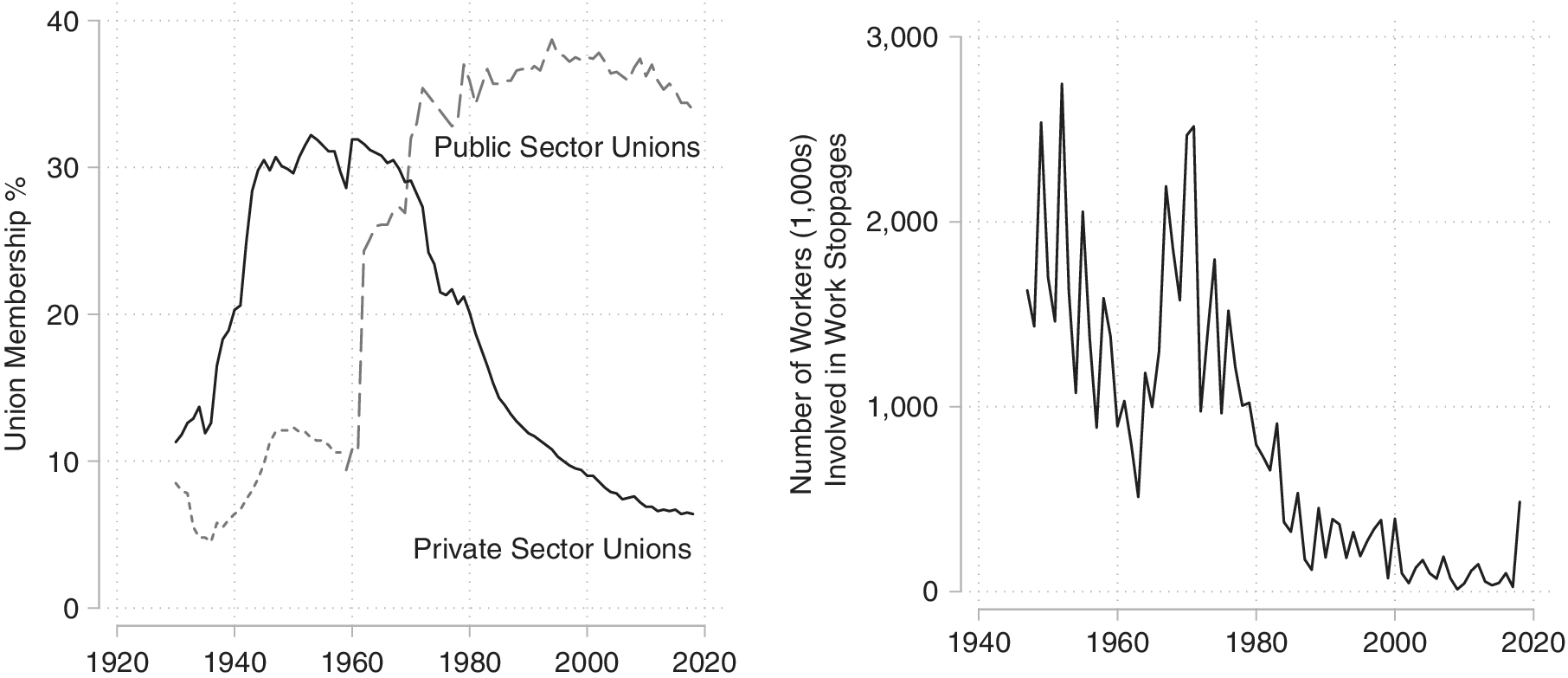
A long generation of scholars have recognized the strike as “by far the most important source of union power” (Burns Reference Burns2011, 1). Yet, despite their potential power, strikes have become substantially less common in the United States (Burns Reference Burns2011; Rosenfeld Reference Rosenfeld2014). Figure 1 shows that the number of workers involved annually in major work stoppages (involving 1,000 or more workers) has declined sharply from a peak of more than 2.7 million in the 1950s to an average of fewer than 100,000 from 2001 to 2017. The year 2018, however, stands out for an uptick in strike activity, precisely because of the mass teacher strikes that we describe later.
Labor Union Membership and Mass Strike Activity, 1920–2020
Notes: Work stoppage data from the Bureau of Labor Statistics; union density before 1972 from the Troy-Sheflin series reported in Eidlin Reference Eidlin2018; Bureau of Labor Statistics thereafter. Public sector union membership divided into pre- and post-1959 periods, reflecting when the first state (Wisconsin) legalized government employee collective bargaining.

The sharp drop in strike activity since the 1950s corresponds to a more general decline in labor union membership in the United States, especially in the private sector, where union membership has fallen from around one-third of all private sector employees to just 6% by 2018. Public union membership, in contrast, has taken a very different trajectory, a reflection of the bifurcated political and legal structure of the labor movement (Freeman and Ichniowski Reference Freeman and Ichniowski1988; Johnston Reference Johnston1994; Walker Reference Walker2014). Private sector workers gained the federal legal right to organize and bargain collectively under the New Deal-era National Labor Relations Act. Public sector employees would need to wait until the 1950s and 1960s for efforts to expand legal recognition of government employee unions, primarily at the state and local levels.
The most significant component of the newly enlarged public union movement comprised teachers, who by 2017 represented about half of all state and local union members. Indeed, the largest union today is the National Education Association, counting more than three million educators and teaching professionals as members. Given their clout and federated structure, teachers’ unions are often very politically powerful in local, state, and national politics (Anzia Reference Anzia2013; Anzia and Moe Reference Anzia and Moe2015, Reference Anzia and Moe2016; DiSalvo Reference DiSalvo2015; Flavin and Hartney Reference Flavin and Hartney2015; Moe Reference Moe2011).
That power is waning, however, in the face of a continued conservative backlash against unions, especially public sector unions. An increasing number of states have passed laws restricting the ability of public sector unions to collect dues and fees (through right-to-work laws), to collectively bargain, and to participate in politics (Hertel-Fernandez Reference Hertel-Fernandez2019). In addition, the Supreme Court’s 2018 Janus vs. AFSCME decision applied right-to-work laws to all public sector employees and may thus hamper the abilities of teachers’ unions to support their affiliates in conservative states (Finger and Hartney Reference Finger and Hartney2019).
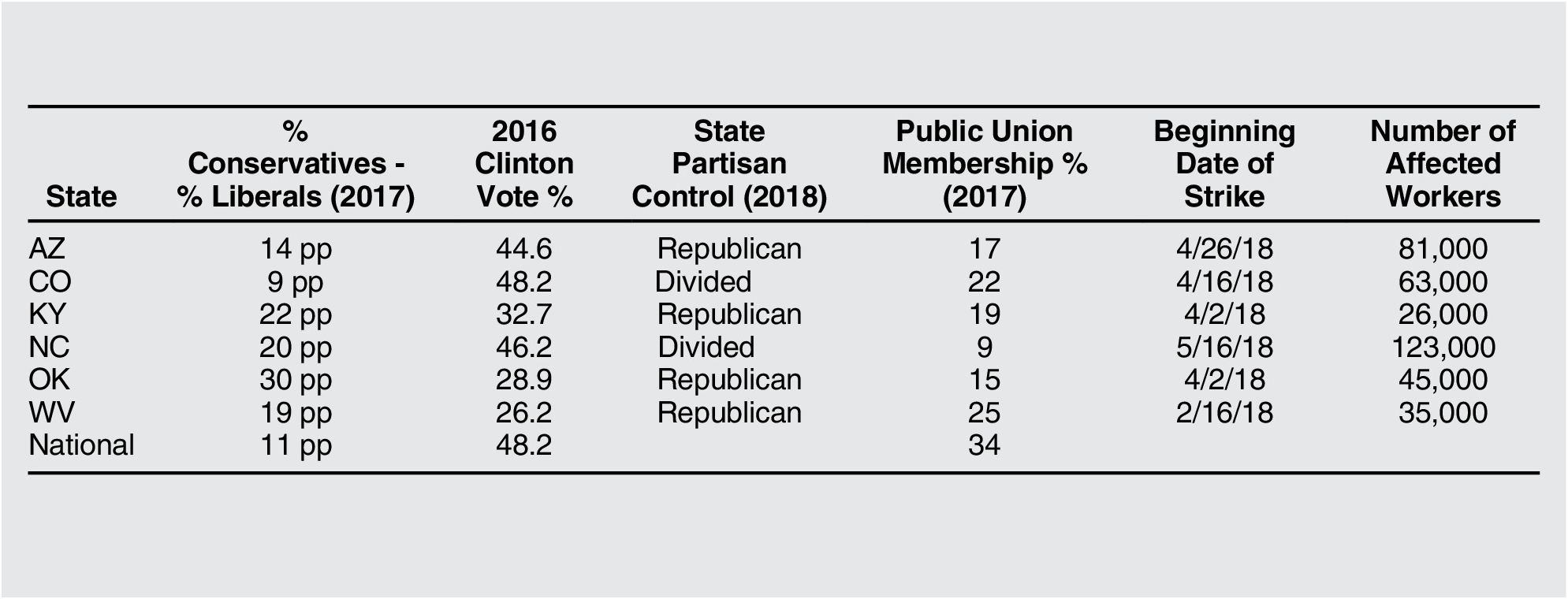
Against this backdrop of diminishing strength, large and sustained teacher strikes in 2018 took many by surprise—especially because the walkouts occurred in generally conservative states with Republican-controlled state governments and weak labor unions (see Table 1).Footnote 1 In all, there were six states with widespread teacher walkouts: West Virginia (beginning in February and ending roughly in March); Oklahoma (throughout April); Kentucky (throughout April); Colorado (April to May); Arizona (April to May); and North Carolina (in May). Each of these mass collective actions unfolded in different ways. Some, like West Virginia and Oklahoma, involved formal strikes stretching over multiple days, whereas North Carolina involved job actions building to a one-day walkout. Moreover, in West Virginia the strike went wildcat at one point, meaning that it was not authorized by the union during this time.
Key Characteristics of 2018 Teacher Walkout States

Notes: Conservative and liberal identifiers: Gallup (2017 tracking poll data); 2016 Clinton vote share: US Election Atlas; state partisan control: National Conference of State Legislatures; public union membership: Bureau of Labor Statistics; beginning date of strike and number of affected workers: Bureau of Labor Statistics Work Stoppages series.
Nevertheless, there were several common themes running through all these labor actions. First, all the walkouts involved a significant proportion of the teacher workforce and affected a substantial number of students and schools. In West Virginia, roughly 250,000 students were left out of school as a result of the strike (Hauser Reference Hauser2018); in North Carolina the estimate was some 700,000 students (Carson Reference Carson2018); in Colorado the estimate was at least 600,000 (McKay Reference McKay2018); and in Arizona it was perhaps as many as 850,000 (McKay Reference McKay2018). This represents some 93% of all students in West Virginia, 75% in Arizona, 66% in Colorado, 60% in Oklahoma, and 45% in North Carolina.
Second, the walkouts all involved substantial public engagement, including extensive outreach to community groups, churches, and other organizations, as well as coordinated protests at state capitals that incorporated teachers alongside other school employees, administrators, and community members (Blanc Reference Blanc2019; Greenhouse Reference Greenhouse2019). Third, although the demands articulated by the teachers differed, they generally related to increased teacher compensation and increased spending on education overall. And lastly, while the popular coverage of the strikes emphasized the fact that much of the initial energy and mobilization were accomplished outside the unions by teachers acting on their own, labor leaders were often heavily involved in the later organizing efforts, providing key resources like staffing and financial support.
Perhaps even more surprising than the emergence of the walkouts was the fact that they managed to secure a number of concessions from partially or fully Republican-controlled legislatures and governors. The question we pose in this article, however, is broader than legislative gains: Did the striking teachers change how individuals (including parents) thought about public schools, teachers, and their unions, as well as the labor movement more generally?
The 2019 Teacher Walkout Survey
To answer this question, we commissioned an original survey sample from Qualtrics, which provided us with 4,468 respondents from their opt-in survey pool that matched the 2017–18 monthly Current Population Survey distribution of adults living in the six walkout states on gender, age (in five binsFootnote 2 ), race (in five binsFootnote 3 ), Hispanic ethnicity,Footnote 4 education (in four binsFootnote 5 ), and whether they had a child in the household.Footnote 6 We gave Qualtrics the demographic targets for these characteristics within each of the six states. We deliberately oversampled parents, including 2,968 parents and 1,500 nonparents in the final sample. The survey was open to responses from January 7–February 7, 2019.
We estimated raked survey weights using the anesrake R package to match the overall distribution of these characteristics across all six walkout states, but the results do not change much with or without these weights applied. Supplemental Appendix 1 summarizes the distribution of demographic targets and survey respondents, with and without raked survey weights applied. Comparing our results to the 2016 Cooperative Congressional Election Study, we find that our sample closely matches the distribution of partisans across the six states, as well as average levels of political engagement.
The survey instrument, which we reproduce in full in Supplemental Appendix 2, covered a variety of topics, including respondents’ recollection of the walkouts or strikes; how they learned about the strikes; their perceptions of the strikes, including their support for the strikes and what effects they thought they had; more general perceptions about the labor movement in the United States; and detailed demographic characteristics.
In all, around 80% of respondents recalled hearing about or experiencing the walkouts, though this ranged from 93% in Oklahoma to 70% in North Carolina. That is consistent with an open-response item we fielded at the very start of the survey that asked respondents, “In just a few words, what do you remember a union doing recently?” Although the most common bi-grams involved variants on “don’t know,” a significant proportion of respondents indicated that they were thinking about the teacher strikes, as shown in Supplemental Appendix 3. We interpret these responses as indicating that, for a large number of respondents in the walkout states, the strikes remained highly salient and top of mind as they were thinking about the labor movement.
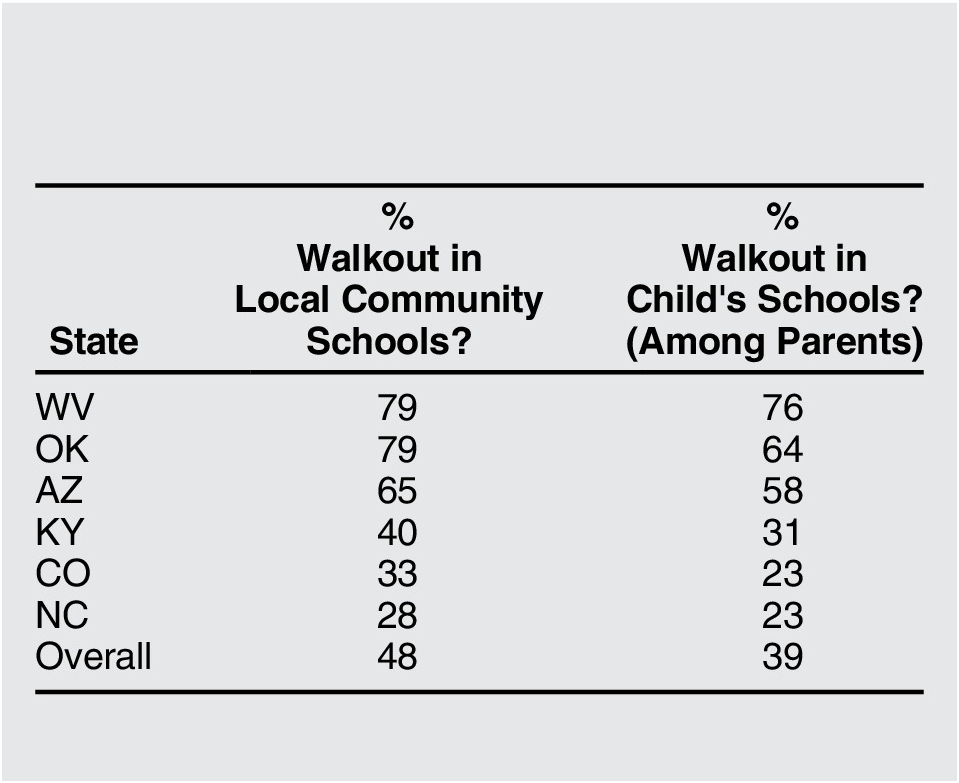
About half (48%) of all respondents said that there were walkouts or strikes in their local community schools.Footnote 7 Among parents, about 39% said that they recalled walkouts at their children’s schools.Footnote 8 This was highest in West Virginia and Oklahoma and lowest in Colorado and North Carolina. We summarize these differences in Table 2.
Were There Walkouts in Local Community Schools or Child’s Schools?

Notes: N = 4,468 (among all respondents); N = 1,798 (among parents). Survey weights applied.
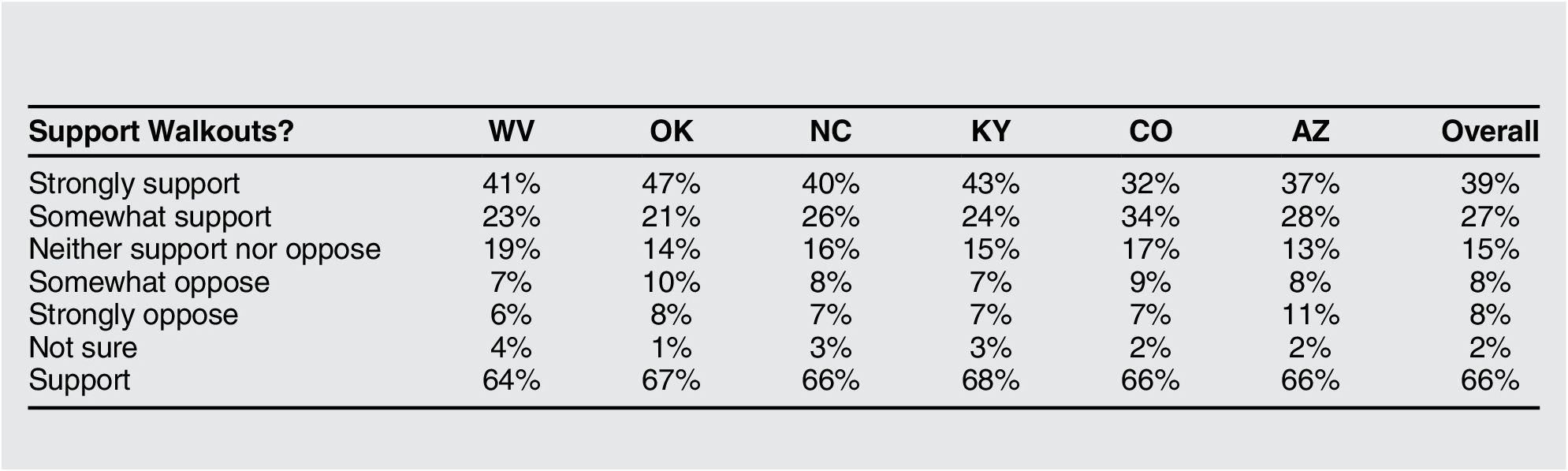
A final item asked respondents if they personally opposed or supported the walkouts.Footnote 9 By far, most respondents indicated that they either strongly or somewhat supported the walkouts: 39% said that they strongly supported the walkouts, and another 27% said that they somewhat supported the walkouts. Only 16% of respondents said that they somewhat or strongly opposed them. Table 3 summarizes how support for the walkouts varied across the six walkout states. Next, we asked respondents if they personally participated in the teacher walkouts.Footnote 10 Six percent of respondents said they did.
Overall Support for Walkouts

Notes: N = 3,632 (among respondents who recalled walkouts). Survey weights applied.
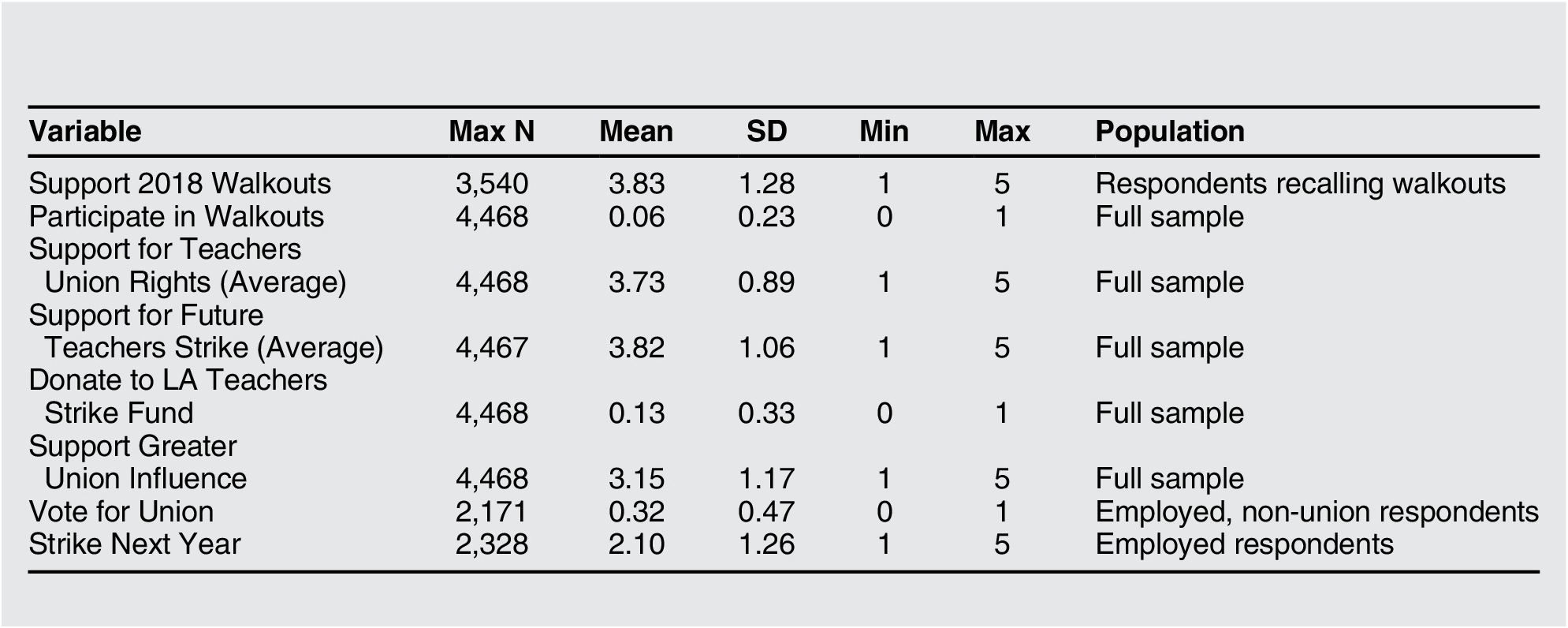
In addition to the questions directly related to the walkouts, we asked respondents about their support for teachers’ unions, as well as their personal interest in labor action and joining a union. We first asked about respondents’ support for teachers’ union rights, including collective bargaining, agency fees (fees charged to nonmembers to cover the costs of collective bargaining and grievance procedures), and striking.Footnote 11 Respondents could choose from strongly oppose to strongly support on a five-point scale: across all three items, respondents selected a 3.7 out of 5 on average.
We next asked about respondents’ support for future teachers strikes concerning pay, benefits, and overall student spending, also each measured on a five-point scale ranging from strongly oppose to strongly support.Footnote 12 On average, respondents selected a 3.8 out of 5. We also probed respondents’ behavioral support for teachers unions by asking if respondents would donate money to a Los Angeles teachers’ strike fund (as opposed to the United Way, the National Right to Work Foundation, or no option at all; during the survey implementation phase, Los Angeles teachers were preparing to strike).Footnote 13
To measure respondent support for the labor movement in general, we asked whether respondents would like to see the labor movement have more influence in the future. On a five-point scale from strongly oppose to strongly support, respondents fell at a three out of five on average.Footnote 14 To reduce measurement error, we averaged standardized versions of these preceding variables—support for the walkouts, participation in the walkouts, support for teachers’ union rights, support for future strikes, donations to the LA teachers’ strike fund, and support for the labor movement in general—into a single scale, centered on zero. Combining multiple measures together into a single scale is consistent with best practices in survey research (Ansolabehere, Rodden, and Snyder Reference Ansolabehere, Rodden and Snyder2008; Cronbach’s alpha: 0.76).Footnote 15
Finally, to gauge personal interest in unionization and labor action we asked whether non-unionized, employed respondents would be interested in joining a labor union at their job if a union election were held immediately: 32% of respondents said that they would vote for the union, 28% said that they would vote against it, and 41% were undecided.Footnote 16 We also asked respondents how likely they would be to participate in a strike or walkout at their job next year on a five-point scale from not at all likely to very likely.Footnote 17 The average respondent fell at about a two out of five. Table 4 summarizes the descriptive statistics for our main outcomes.
Descriptive Statistics for Study Outcomes

Note: Survey weights applied.
Results
Preliminary Analysis: General Strike Experience and Labor Attitudes
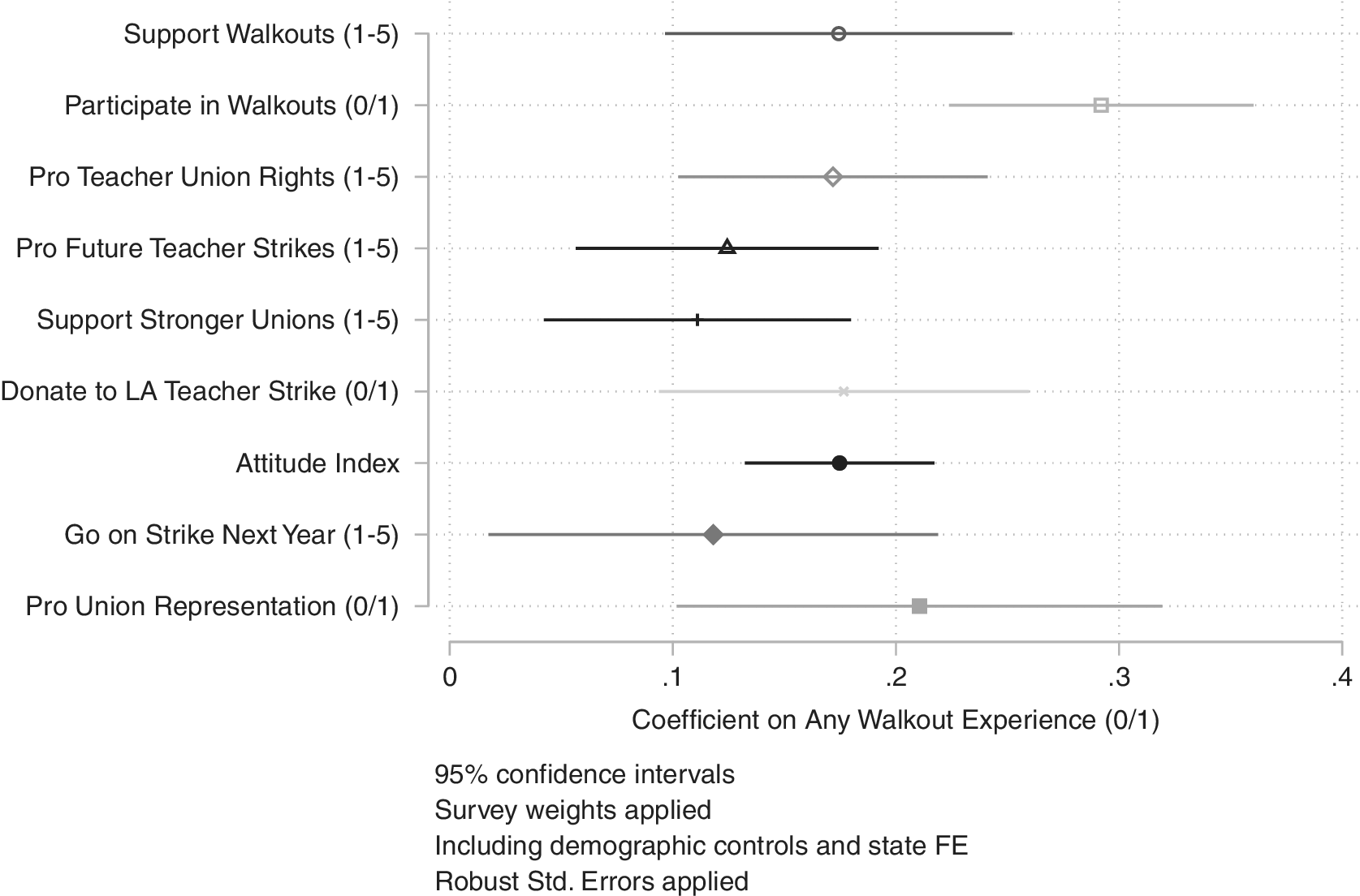
We first examine whether greater general experience with the teacher strikes was related to the outcome measures we described earlier in the full sample of respondents who recalled the walkouts. Our measure of general experience with the strikes is whether a respondent reported strikes in one’s community schools or child’s schools if a parent. As we noted, this measure captures both the firsthand exposure to teachers and media coverage and the broader experience of the walkouts or strikes. In Figure 2, we present a series of OLS regressions examining the correlation between having general strike experience and attitudes and behaviors in support of the labor movement. Each row represents a separate regression with a different outcome, standardized to have a mean of zero and standard deviation of one to ease comparisons across outcomes. We estimate specifications of the following form, where i indexes individuals and s indexes states:
 $$ {y}_i=\beta {StrikeExperience}_i+{X}_i\gamma +{\delta}_s+{\epsilon}_i $$
Correlational Analysis of General Strike Experience and Support for Labor
Notes: OLS regressions. Each marker indicates a coefficient on firsthand school walkout experience and an outcome variable, controlling for demographic characteristics and state fixed effects. The outcome variables are standardized to have a mean of zero and a standard deviation of one to ease comparisons across models. Survey weights and robust standard errors applied and 95% confidence intervals shown. “Go on strike next year and “pro union representation” models restricted to employed respondents only; “pro union representation” further restricted to non-union members. N = 3,509–4,380 for full sample and N = 2,146–2,302 for employed respondents. The figure shows that respondents reporting general experience with the strikes (i.e., that there was a strike or walkout in their local community) were more likely to support teachers and their unions and to be more interested in labor action and union representation at their own jobs (if respondents were employed).

All models include survey weights and state fixed effects. For each outcome, we further estimate models with and without individual controls, which include partisanship (coded as Democrat, Republican, or Independent), political ideology (on a seven-point scale), an index of economic liberalism (averaging support for a $15/hour minimum wage, the belief that income differences are too large, and support for government redistribution)Footnote 18 ; a dummy for having children, gender, age, age squared, race, and ethnicity (with indicators for White and Hispanic); logged family income; education (in six categories); union membership; reporting knowing a union member as a friend or family member; and religious attendance (on a six-point scale).Footnote 19 Across the rows in Figure 2 we can see that having general strike experience is strongly related to support for the teacher walkouts and also for the labor movement more generally.
To further probe the face validity of our hypotheses, we examine data from the AFL-CIO polling consortium, which consists of regular polling of a representative sample of between 1,000 to 2,000 registered voters (typically monthly; November 2018 had an unusually high 8,612 respondents). We use data from 44 surveys conducted in February 2016 through November 2018. There are 6,813 observations from strike states in this sample: 4,819 observations before the strikes and 1,994 observations after them. Each survey wave contains a feelings thermometer for respondents’ attitudes about labor unions, ranging from 0 to 100, our outcome of interest. The average union thermometer response was 45 (SD: 29, applying survey weights). We next create an indicator for whether a survey took place before or after the strikes in each strike state—thereby indicating whether respondents had the possibility of general strike experience. (Unfortunately, the surveys did not have more specific measures of contact or exposure to the strikes.) Looking across the teacher-strike states, we find that the average union thermometer rating was 43.6 before the strikes and 47.5 after the strikes (difference in means significant at p < 0.01, applying survey weights), consistent with the strikes leading to modestly more favorable attitudes toward the labor movement. The difference is equivalent to about 13% of a standard deviation, is larger in models controlling for demographic characteristics and state/survey wave fixed effects (about 10 percentage points; see Supplemental Appendix 5), and is largest for parents, suggestive of an effect from the teachers’ strikes themselves.
In all, the results in Figure 2 and from the AFL-CIO polling data provide suggestive evidence that having closer contact and experience with the strikes—whether through exposure in one’s community schools, media coverage, or learning about the strikes from teachers or their unions—relates to stronger support for the unions, consistent with our public support hypothesis, rather than the backlash hypothesis. But it may be that individuals more predisposed to the strikes and unions were more likely to seek out information and contact with the strikes or that the strikes happened in areas more favorable to unions. To gauge the causal effects of contact with the teachers’ strikes, we turn to an approach based on the ages of parents’ children using our original survey.
Evidence from Parents and School-Age Eligibility Thresholds
Our logic is as follows: parents with school-age children should be substantially more likely than other respondents to have firsthand experience with the strikes through their children’s schools. That intuition is borne out in the survey data: 58% of parents with children in school reported firsthand experience with strikes, compared to 46% of respondents without children enrolled in school (difference significant at p < 0.01). But parents with children enrolled in school are likely to be different from other respondents on a variety of other characteristics.Footnote 20 As a result, we focus on a comparison between two groups of parents who are likely to be more similar to one another: parents with at least one child whose age puts them just over or just under the typical cutoff for school, with parents with non-school-age children forming the control group. In our main results presented in the article, we focus on the tightest age window: parents with children age 4–6 and 16–18 (in the supplemental appendices we also show results for children within age bands of 2–8 and 14–20). The “treatment” group thus includes parents with at least one child 5 or older or 17 and younger, and the “control” group counts parents with all children younger than 5 or older than 17. Within our main set of child age windows (4–6 or 16–18) we have 886 treated parents and 136 control parents.
Our assumption—which we test in Supplemental Appendix 7—is that these two groups of parents are likely to be relatively similar to one another except for their child’s enrollment in school and therefore their exposure to the 2018 teacher strikes.Footnote 21 We did observe a good balance between parents with children on either side of the age cutoffs along the following variables: age, gender, race/ethnicity, party identification, economic liberalism, political ideology, family income, union membership, and knowing a union member. The only significant differences are for education and religious attendance: parents with just-school-age children are slightly more religious and less educated than parents on the other side of the cutoff. In all, this exercise validates our use of the child-age design, and note we also include all these variables as covariates in subsequent regressions.
Parents with just-school-age children are relatively similar to their counterparts without school-age children. But are they more likely to have children actually enrolled in school who were exposed to the 2018 teachers’ strikes; that is, can we validate the first stage of our design? We assess these first-stage effects in Supplemental Appendix 8, which documents that parents with just-school-age children were substantially more likely to have children enrolled in school, to have children enrolled in traditional public schools, and to have firsthand exposure to walkouts in their children’s schools.
Reduced-Form Effect of Just-School-Age Children on Labor Attitudes
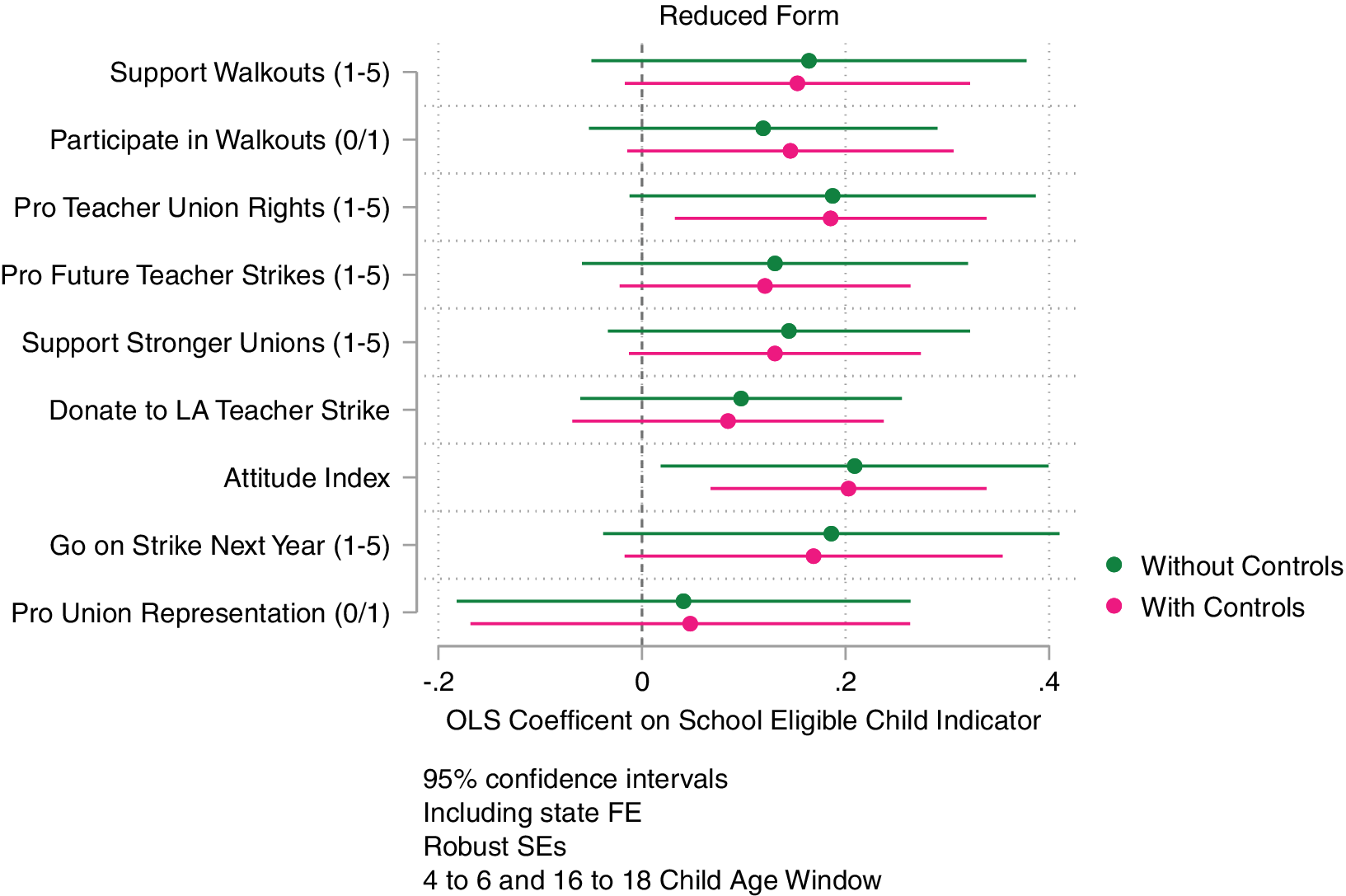
Having established the validity of the child-age cutoff design, we analyze the effect of having a just-school-age child on support for the teacher strikes and teachers’ unions and personal interest in unions and labor action. Figure 3 summarizes the results of a series of OLS regressions with teacher and union support variables as the outcomes and the just-school-age child indicator as the explanatory variable, with and without controls. Each estimate comes from a separate regression. We also include state fixed effects. To ease comparisons across outcomes with different scales, we standardize these variables to have a mean of zero and a standard deviation of one.
Reduced-Form Effect of Having Just-School-Aged Children on Support for Labor
Notes: OLS regressions. Each marker indicates a coefficient on having a just-school-aged child and an outcome variable, with or without demographic controls. All models include state fixed effects. The outcome variables are standardized to have a mean of zero and a standard deviation of one to ease comparisons across models. 95% confidence intervals shown and robust standard errors applied. “Go on strike next year and “pro union representation” models restricted to employed respondents only; “pro union representation” further restricted to non-union members. N = 817–1,022 in full parent sample; N = 618–67 for employed parents. This figure shows that parents of just-school-aged children were more likely to support teachers and their unions and to be more interested in labor action at their own jobs (though not necessarily through union representation).

As Figure 3 indicates, parents with a just-school-age child generally have more positive attitudes about the walkouts, teachers’ union rights, and future collective action—though the estimates are noisily estimated and not always significant at the 95% level. Looking at the combined attitude index, we see that parents of just-school-age children were about 20% of a standard deviation more supportive of teachers and their unions. For context, that represents about 30% of the observed difference in attitudes between union members and nonmembers. Employed parents of just-school-age children were also more interested in collective action at their own jobs, though not necessarily in formal union representation. The difference between parents with just-school-age children and those without in strike interest is about 20% of a standard deviation, or about 18% of the observed difference between union members and nonmembers.
The contrast between strike interest and interest in voting for union representation among employed respondents is notable, suggesting that strike-exposed individuals are supportive of labor unions and collective action, including at their own job, but not necessarily supportive of traditional unions for themselves. (We discuss possible explanations in the final section, “Strikes and Labor Power in an Era of Union Decline.”) In all, Figure 3 suggests support for the public support hypothesis over the backlash hypothesis, as well as partial support for the imitation hypothesis, indicating that strike-exposed parents learned about possibilities for labor action and how they could apply those lessons to their own workplaces (though were not necessarily more interested in traditional unions).
Instrumental Variables Effect of Just-School-Age Children on Labor Attitudes
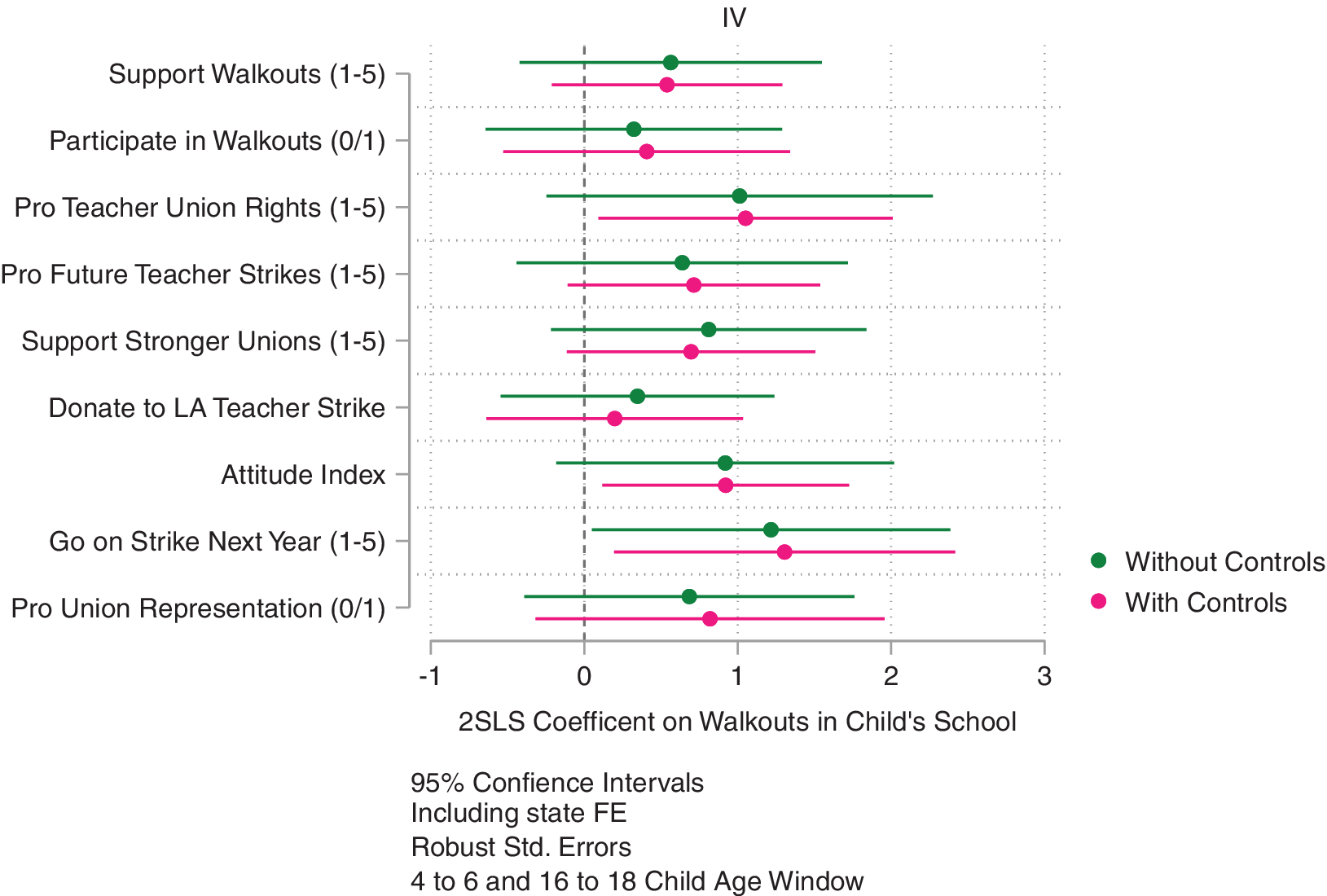
The results we presented in Figure 3 are reduced-form estimates, showing the causal effect of having a just-school-age child on union support and interest as it might run through firsthand exposure to the teacher strikes—but also through other potential mechanisms as well. An alternative approach is to estimate the effect of having a just-school-age child as it runs through exposure to the teacher strikes with two-stage least squares (i.e., an instrumental variable approach, using just-school-age children as an instrument for exposure to the teacher strikes in a child’s school). Doing so (as reported in Figure 4), we find noisy but positively signed and substantively significant relationships between exposure to the teacher strikes and support for unions, especially support for union rights, future teacher strikes, and a stronger labor movement. Indeed, as in the reduced-form estimates, the strike interest estimates continue to be the strongest and most consistently substantively and statistically significant across all specifications.
Instrumental Variables Effect of Firsthand Strike Exposure on Support for Labor
Notes: 2SLS regressions. Each marker indicates a coefficient on firsthand school walkout experience (i.e., to have reported walkouts in their child’s school; as instrumented by having a just-school-aged child) and an outcome variable, with or without demographic controls. All models include state fixed effects. The outcome variables are standardized to have a mean of zero and a standard deviation of one to ease comparisons across models. 95% confidence intervals shown and robust standard errors applied. “Go on strike next year and “pro union representation” models restricted to employed respondents only; “pro union representation” further restricted to non-union members. N = 817–1,022 in full parent sample; N = 618–67 for employed parents. This figure shows that parents with firsthand strike exposure through their children were more likely to support teachers and their unions and to be more interested in labor action at their own jobs (though not necessarily through union representation).

To interpret the instrumental variable estimates as the causal effect of strikes on individual union attitudes and preferences, we need to satisfy four assumptions: relevance, monotonicity, independence, and the exclusion restriction. We already tested the relevance of our instrument—the child-age cutoff—in Supplemental Appendix 8, which shows that having a just-school-age child is very strongly correlated with child enrollment in public schools and exposure to strikes in children’s schools. Indeed, the F statistics on the first-stage regressions are generally well above the usual recommended threshold of 10. The assumption of monotonicity cannot be tested directly, but it seems unlikely that parents with just-school-age children would ever become less likely to have firsthand exposure to the strikes by virtue of having a just-school-age child or more likely to have firsthand exposure because they lack a just-school-age child. The independence assumption—that there are no common causes of having a just-school-age child and attitudes toward unions—similarly cannot be tested directly, but we present a variety of checks in Supplemental Appendix 7 to show that parents of children within the age windows we study are very similar to one another on the demographic characteristics that might otherwise confound our analysis.
Lastly, the exclusion restriction dictates that the only way that having a just-school-age child could affect union attitudes is through exposure to the walkouts. This assumption is potentially more problematic, especially for the outcomes most directly related to the teachers and their unions. Parents of just-school-age children may have other reasons for supporting teachers and their unions independent of the strikes; for instance, because of their personal investments in the school system or their knowledge about the school system.
We can indirectly test this concern by subsetting our analysis and looking separately at the two different child-age windows: 4–6 and 16–18. Parents whose children have just entered school and parents whose children will soon enter school (4–6) presumably have similar personal investments in school quality, though different exposure to the strikes. Parents whose children will soon leave school and parents whose children have just left school (16–18) presumably have similar knowledge about the school, though different exposure to the strikes. When we look at the 4–6 window alone, we find that exposure to the strikes continues to be associated with more positive attitudes toward the teachers, the teachers’ strikes, and the labor movement, though not necessarily with an interest in striking.Footnote 22 Conversely, when we look at the 16–18 window alone, we find that exposure to the strikes continues to be correlated with more interest in striking, though not necessarily with more support for the labor movement (the coefficient is positive but imprecisely estimated).Footnote 23 Suggestively, exposure to the strike among those with the most personal investment in the schools (i.e., parents of young children) is more strongly associated with positive attitudes about teachers and teachers’ unions, whereas exposure to the strike among those whose children will soon be leaving the school system (i.e., parents of older children) is more strongly associated with parents generalizing the lessons of the strike to their own workplaces. Although not a definitive test, these analyses do suggest that having additional exposure to the strikes above and beyond having knowledge about or personal interest in the schools leads to different views about teachers and their unions. In addition, our examination of mechanisms in the next section further suggests that having a just-school-age child did not change how parents were thinking about schools or their knowledge about schools.
Subgroup Analysis: Political Views, Union Ties, and Personal Costs
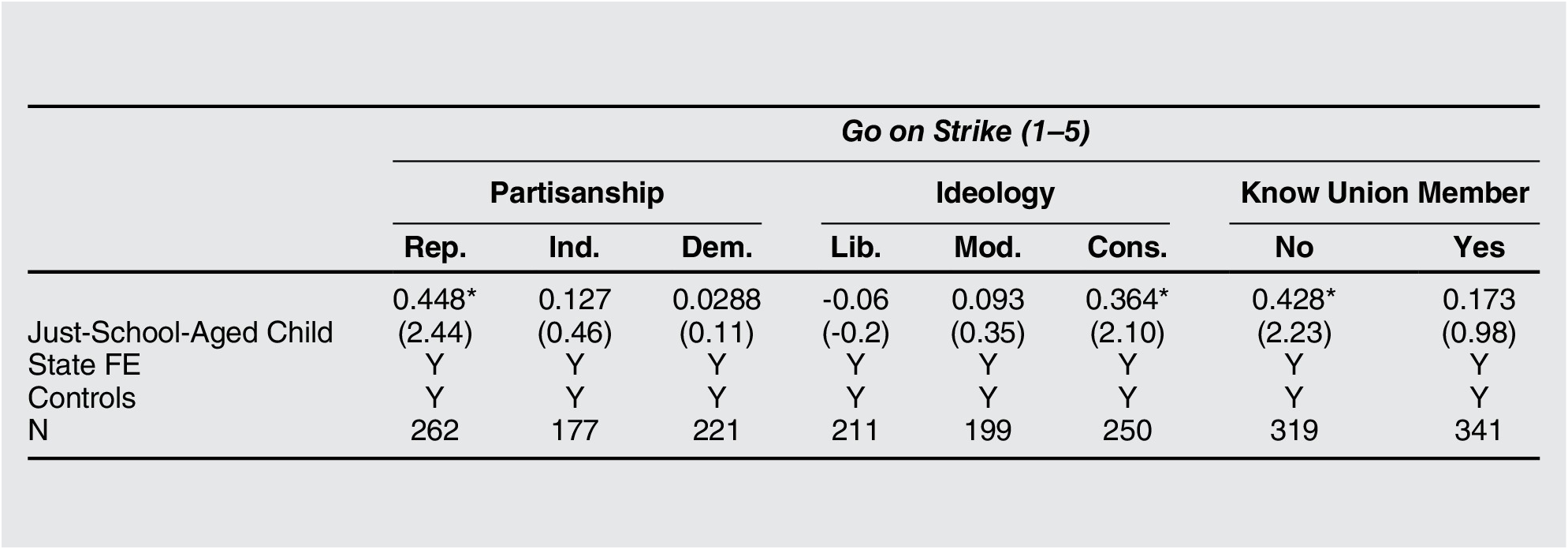
Another question is who was most affected by the mass teacher strikes.Footnote 24 Focusing on interest in going on strike at one’s job, we find that our results are driven by individuals who were least likely to support unions before the strikes: conservatives, Republicans, those who were never union members, and those who did not have family or friends in the labor movement. Table 5 provides illustrative results, looking at the difference in the effect of having a just-school-age child on strike interest by political ideology, partisanship, and knowing a union member personally. These results lend support to a theory of persuasion: it was individuals who might not have otherwise supported or been interested in unions who gained the most from the strikes as they thought about their own jobs and what unions could do for them. The results from this subgroup analysis may also reflect ceiling effects, because liberals, Democrats, and individuals with personal relationships to the labor movement were already strongly supportive of unions and the walkouts.Footnote 25
Effect of Just-School-Age Child on Strike Interest, by Subgroup

Notes: OLS regressions. t statistics in parentheses; * p < 0.05. Only 4–6; 16–18 age cutoff window used. Only employed respondents included. Robust standard errors applied.
A second subgroup analysis suggests that personal costs and inconvenience may have also played some role in moderating individual responses to the strikes. Examining the difference in the strike effect between married parents or those with live-in partners and single parents, we found that our results were concentrated among those who were married or who had live-in partners. One potential explanation for this finding is that single parents were more personally inconvenienced by the walkouts—lacking readily available childcare—than parents with a live-in partner or spouse.Footnote 26 Indeed, many news stories written about the walkouts emphasized this cost to parents.
Exploring Mechanisms for the Strike Effect
Why were the parents most exposed to the strikes more favorable toward teachers and their unions and more interested in labor action at their own workplaces? We see the strikes as offering new information to parents and spell out four distinct but related types of information that teachers and unions might have provided to parents. However, we caution that we are limited in our ability to adjudicate between these different explanations; therefore, the following analysis ought to be seen as exploratory, rather than definitive.
The first mechanism involves information about the strikes and unions: parents with just-school-aged-children may have been more likely to recognize that the strikes were happening and that they involved teachers and their unions. The second mechanism involves information about school quality: the strikes may have raised awareness among parents about the poor quality of public schools. The third mechanism involves information about individual teachers’ experiences with poor educational resources and compensation, communicated firsthand by teachers themselves. And the fourth mechanism involves information about what teachers and their unions were doing to fight for public goods that would improve public schools and their broader communities. To preview our results, we do not find evidence consistent with the first three mechanisms, but we find suggestive evidence for the last channel.
To assess the first mechanism, we turn to the free response item that we asked respondents to complete before the start of the survey. This item asked respondents what they recalled a union doing recently (importantly, before being cued to think about the teacher strikes). We first coded any response that included the words “don’t know” or “not sure,” indicating that individuals could not recall off of the top of their heads something about unions. About 70% of respondents used these words. We also separately coded whether respondents mentioned concepts related to strikes or walkouts (13% of respondents used these words) or teachers or schools (7% of respondents used these words).Footnote 27 If the strikes were changing opinion by simply providing more information to parents about the strikes and walkouts themselves, then we should see parents of just-school-age children being less likely to say that they could not remember anything about unions and more likely to remember the teacher strikes specifically. As we indicate in Supplemental Appendix 11, this is not what we find. Parents of just-school-age children were no more likely to recall unions or strikes in their written responses, nor were they more likely to mention teachers or schools in their responses.
To test whether the strikes were conveying information about school quality to parents and whether this information changed parents’ opinions about teachers and their unions, we turn to a survey item in which we asked parents to rate public schools in their community from A to F (with a not sure option).Footnote 28 If the strikes were conveying new information about the poor quality of schools in the affected states, we should see parents of just-school-age children being more likely to assign a lower grade to public schools and to be less likely to indicate that they did not hold an opinion on this issue. In Supplemental Appendix 12, we show that parents of just-school-age children did not have statistically distinguishable opinions about public school quality from parents of younger or older children. Parents of just-school-age children were also no more likely to hold any opinion about the quality of their public schools. (This test also somewhat addresses concerns about the exclusion restriction in our instrumental variable results, indicating that parents with just-school-age children did not have systematically different opinions or were more knowledgeable about their schools.)
For the third mechanism, involving information about teachers’ individual experiences, we looked to see whether parents of just-school-age children were more likely to indicate that they heard about the strikes from a teacher or a union. Although this is only an indirect measure of information about teachers’ personal experiences, we believe that it captures the channel through which such experiences would be shared with parents. In Supplemental Appendix 13, we show that parents of just-school-age children were no more likely to indicate that they had heard about the strikes directly from teachers than were parents with older or younger children.
Lastly, we probed whether parents were learning about the public goods that teachers and unions were providing to schools, parents, children, and their communities. We did this by looking for words in the free response text item related to unions’ efforts to raise working standards, education spending, classroom resources, and school conditions.Footnote 29 In all, only 6% of respondents mentioned these concepts, but as we indicate in Supplemental Appendix 11, these concepts were disproportionately mentioned by the parents of just-school-age children. These parents were especially likely to invoke phrases like “getting more funding for schools” or “bringing the community together,” alongside “fighting for better teacher pay” and “fighting for education budget increases.” In all, parents of just-school-age children were about three to five percentage points more likely to mention such phrases than were parents of younger or older children.
We thus hypothesize that one reason the teachers strikes were so effective at moving public opinion was what information teachers were conveying to parents—more specifically, how unions were fighting for better conditions for themselves and for parents, children, and their broader communities. Indeed, a qualitative review of the striking teachers’ activities underscores how leaders prioritized political education among parents. As Eric Blanc writes in Red State Revolt (2019, 78), teachers were aware that the success of their strikes depended on the support of local parents and students and were concerned that they would be seen as having “walked out on students.” In West Virginia and Arizona, teachers thus “took every opportunity for discussion with parents, explaining that educator working conditions were students’ learning conditions” (78).
Interviews we conducted with teacher strike leaders in West Virginia, Oklahoma, and Arizona further reinforce just how much organizers were conscious of the need for community support.Footnote 30 “All of the action [building up to the walkouts and the strikes] was driving to two things: get educators to take increasing risks around their activism and…around community awareness and support,” explained one labor leader in Arizona.Footnote 31
The strategy most emblematic of teachers’ prioritization of community support was the “walk-in,” in which teacher leaders brought together community members, business leaders, parents, and children and the assembled group “stood with [the teachers] before school started, and they talked about why the school was important to the community, why it was important to have real opportunities for students, why the teachers were important to the community.…We wanted to take it to the community to help them understand why we were taking these actions, especially the strike.”Footnote 32 The walk-ins received widespread community support: labor reporter Steven Greenhouse (Reference Greenhouse2019, 317) estimated that more than110,000 people participated in the early walk-ins in Arizona.
Notably, teachers also made a concerted effort in the strike states to ensure that children who depended on free or reduced meals at school were fed while the schools were closed and that there were childcare opportunities for stressed parents. In West Virginia, for instance, teachers packed lunches for children and delivered meals door-to-door to families during the strike (Bacon Reference Bacon2018). Similarly, in Oklahoma, teachers worked with churches to provide childcare to parents with no other options during the strike (Hinton Reference Hinton2019). The upshot for our analysis is that teachers seemed particularly concerned about communicating the public benefits of the strike to parents and students attending their schools and also in minimizing the burden of the strike on disadvantaged parents.
Strikes and Labor Power in an Era of Union Decline
We examined the political consequences of large-scale teacher strikes, studying how firsthand exposure changed mass attitudes and public preferences. Across a range of specifications and approaches, we find that increased exposure to the strikes led to greater support for the walkouts, more support for legal rights for teachers and unions, and, especially, greater personal interest in labor action at people’s own jobs, though not necessarily through traditional unions.
Returning to the theoretical expectations we outlined earlier, the teacher strikes appear to have changed the ways that parents think about the labor movement, generating greater public support. The results regarding workers’ interest in undertaking labor action in their own jobs also suggests evidence in favor of the public inspiration and imitation hypothesis, underscoring the role that social movements and mobilizations can play in teaching non-involved members about the movement and tactics. Still, an important caveat to these findings is that strike-exposed parents were not more likely to say that they would vote for a traditional union at their jobs, possibly reflecting the fact that the strikes emphasized individual teachers and not necessarily teacher unions as organizations either in schools or in parents’ own workplaces. Further research might explore this difference, together with the fact that we find somewhat stronger evidence in favor of the imitation hypothesis (i.e., support for labor action at one’s own work) than for the public support hypothesis (i.e., support for the striking teachers).
Before we discuss the broader implications of our findings for the understanding of the labor movement, we briefly review and address several caveats to the interpretation of our results. One concern is whether the results we identify from a single survey can speak to enduring changes in public opinion about the strikes and unions. Given the timing of the teacher strikes in the first half of 2018, our respondents were reflecting on events that happened 7–12 months in the past. We therefore think that our results represent more durable changes in opinion as a result of the strikes, in line with other studies of historical mobilizations and long-term changes in attitudes (Mazumder Reference Mazumder2018). The AFL-CIO time-series polling data, moreover, further suggest that there were increases in aggregate public support for unions in the strike states after the strikes occurred. Nevertheless, follow-up studies should examine how opinion toward, and interest in, unions evolve in the mass teacher strike states, and it would be especially interesting to understand whether unions have begun capitalizing on the interest in the labor movement that the strikes generated. We also note that, despite the large sample size of our original survey, we still lack sufficient statistical power to fully explore the effects of the strikes on all of our survey outcomes. Future studies ought to consider alternative designs with the power to probe the individual outcomes that were not considered in this study.
Another question is how to generalize from our results to other strikes and labor actions. Although it is beyond the scope of this article to develop and test a more general theory of strike action, there are factors that suggest that the teacher strikes we study here represent a hard test for building public support. The affected states had relatively weak public sector labor movements, meaning that few individuals had personal connections to unions; most were also generally conservative and Republican leaning, further potentially reducing the receptivity of the public to the teachers’ demands. And lastly, the type of work we study—teaching—involves close interaction with a very sympathetic constituency: children and their parents. This should make strike disruptions more controversial and increase the likelihood of political backlash (and indeed, we do find that the strikes were less persuasive for parents who may have lacked access to childcare). Nevertheless, additional factors may have strengthened the effects of the strikes; namely, that education spending in the strike and walkout states had dropped so precipitously since the Great Recession, giving teachers the opportunity to connect their demands to broader public goods.
Considering these factors together, we feel comfortable arguing that strikes are likely to be successful in other contexts where involved employees can successfully leverage close connections to the clients and customers they serve and connect their grievances to the interests of the broader community. This is likely to be especially true in cases where individuals feel they are not receiving the level of quality service they deserve from businesses or governments. The flip side of our argument is that strikes are less likely to be successful—and may produce backlash—when the mass public views striking workers’ demands as illegitimate or opposed to their own interests or when individuals are especially inconvenienced by labor action and do not have readily available alternatives (such as lacking childcare during school strikes). This suggests that teachers’ unions’ provision of meals and childcare to parents (as happened in a number of the recent strikes) is a particularly important tactic to avoid public backlash.
In addition, our results suggest that future strikes on their own are unlikely to change public opinion if all they do is to provide information about workers’ grievances or disrupt work routines. Our exploratory analysis of the mechanisms driving our results suggests that it was not necessarily information about poor school quality or the strikes themselves that changed parents’ minds, but perhaps the fact that the teachers were discussing the public goods they were seeking for the broader community. We anticipate that strikes or walkouts that adopt a similar strategy—similar to the notion of “bargaining for the common good”—would be most likely to register effects like ours in the future (McCartin Reference McCartin2016). Notably, that is exactly the strategy deployed by teachers in Los Angeles, who spent several years building ties to community members and explaining the broader benefits that a stronger union could offer to their community in the run-up to a strike in early 2019 (Caputo-Pearl and McAlevey Reference Caputo-Pearl and McAlevey2019).
In all, our results complement a long line of work arguing for the primacy of the strike as a tactic for labor influence (e.g. Burns Reference Burns2011; Rosenfeld Reference Rosenfeld2006; Rubin Reference Rubin1986). Although this literature generally has focused on the economic consequences of strikes, we have shown that strikes can also have significant effects on public opinion. Even though private sector strikes have long sought to amass public support, public-facing strikes are even more important for public sector labor unions, given their structure of production and the fact that their “managers” are ultimately elected officials. But how should we view strikes relative to the other strategies that public sector unions might deploy in politics, such as campaign contributions, inside lobbying, or mobilization of their members (cf. DiSalvo Reference DiSalvo2015; Moe Reference Moe2011)? Given the large cost of mass strikes in terms of time and grassroots organizing, we expect that public sector unions will be most likely to turn to public-facing strikes (like the 2018 teacher walkouts) when these other lower-cost inside strategies are unsuccessful and when their demands are popular in the mass public.
Under these circumstances, government unions have every reason to broaden the scope of conflict to include the mass public (cf. Schattschneider Reference Schattschneider1960). But when unions can deploy less costly activities (like simply having a lobbyist meet with lawmakers) or when they are pursuing demands that are more controversial with the public, we suspect that unions will opt for less public-facing strategies (on the logic of inside versus outside lobbying more generally, see, for example, Kollman Reference Kollman1998). Indeed, our results complement work by Terry Moe and Sarah Anzia describing how teacher unions work through low-salience and low-visibility strategies, such as capturing school boards, pension boards, or education bureaucracies, when they are pushing policies that tend not to be supported by the public (Anzia Reference Anzia2013; Anzia and Moe Reference Anzia and Moe2015; Moe Reference Moe2011).
Our results yield a final implication for thinking about the historical development of the labor smovement: they suggest that the decline of strikes we tracked in Figure 1 may form a vicious cycle for the long-term political power of labor. As we have documented, strikes seem to be an important way that people form opinions about unions and develop interest in labor action. As both strikes and union membership have declined precipitously over the past decades, few members of the public have had opportunities to gain firsthand knowledge and interest in unions. Moreover, strikes appear to foster greater interest in further strikes, feeding on one another. If unions are to regain any economic or political clout in the coming years, our study suggests that the strike must be a central strategy of the labor movement.
Supplementary Materials
To view supplementary material for this article, please visit http://dx.doi.org/10.1017/S1537592720001279.
*Data replication sets are available in Harvard Dataverse at: https://doi.org/10.7910/DVN/CDA5FN