Implications
Before the second vaccination (V2), the physiology of a pig vaccinated against gonadotrophin releasing hormone is the same as that of an entire male. The literature on the response of entire males to intake is abundant, which is not the case for pigs after V2 when sexual hormones decline. This study showed that feed restriction after V2 reduced the average daily gain and increased skin lesions, but did not influence the feed conversion ratio and had little influence on the lean meat content at slaughter. This implies that the ad libitum feed intake was probably not considerably in excess of the minimum feed intake necessary to maximize the expression of the pig's potential protein deposition rate and that in modern, fast-growing pigs, feed restriction after V2 is not advisable. Other breeds, with greater tendency towards fat deposition, need to be studied before a general conclusion can be made.
Introduction
Over the last few years, the physical castration of entire males without anaesthesia has increasingly been questioned in Europe with regard to animal welfare considerations (Fredriksen et al., Reference Fredriksen, Font I Furnols, Lundström, Migdal, Prunier, Tuyttens and Bonneau2009). The production of entire males has been considered as an alternative to physical castration, provided that the problem of boar taint can be solved. Androstenone and skatole are the two main compounds that are involved in this unpleasant odour from the meat of sexually mature entire males. An alternative to surgical castration is the immunological castration of entire male pigs using the vaccination against gonadotrophin releasing hormone (GnRH). The immunized pigs receive two doses of an incomplete analogue of GnRH conjugated to an immunogenic carrier protein (Improvac®, Pfizer Animal Health). This protocol induces an antibody response that causes a reduction in gonadal steroid production, especially testosterone and androstenone, with an associated increase in hepatic metabolism and depletion of skatole. According to the recommendation of the vaccine producer, slaughter should be performed between 4 and 6 weeks after V2. During this post-V2 period, Dunshea et al. (Reference Dunshea, Colantoni, Howard, McCauley, Jackson, Long, Lopaticki, Nugent, Simons, Walker and Hennessy2001), Hémonic et al. (Reference Hémonic, Courboulay, Kuhn, McLaughlin, Martin, Brock and Pearce2009) and Lealiifano et al. (Reference Lealiifano, Pluske, Nicholls, Dunshea, Campbell, Hennessy, Miller, Hansen and Mullan2011) reported a substantial increase in the average daily feed intake (ADFI).
Different relationships between whole-body protein or lipid deposition rates and energy intake have been clearly established by Campbell and Taverner (Reference Campbell and Taverner1988) and Quiniou et al. (Reference Quiniou, Dourmad and Noblet1996) in entire and castrated males. In particular, entire males were found to present a higher potential for protein deposition rate, reached at a lower energy level than castrated males and with a better efficiency. As indicated by the increased feed conversion ratio (FCR; Pauly et al., Reference Pauly, Spring, O′Doherty, Ampuero Kragten and Bee2009; Škrlep et al., Reference Škrlep, Šegula, Zajec, Kastelic, Košorok, Fazarinc and Čandek Potokar2010; Batorek et al., 2012) and/or carcass fatness (Bonneau et al., Reference Bonneau, Dufour, Chouvet, Roulet, Meadus and Squires1994; Dunshea et al., Reference Dunshea, Colantoni, Howard, McCauley, Jackson, Long, Lopaticki, Nugent, Simons, Walker and Hennessy2001; Fàbrega et al., Reference Fàbrega, Velarde, Cros, Gispert, Suárez, Tibau and Soler2010) in immunologically castrated males when compared with entire males, the extra energy intake after V2 may be associated with changes in the protein to lipid ratio in the BW gain, due to the energy intake per se and the transition from an entire male to a castrated male status. No information is presently available on the response of immunologically castrated pigs (so-called immunocastrates) to different feeding levels after V2. The aim of the present study was to quantify the consequence of a restricted feed allowance at the end of the fattening period on the performance and behaviour of immunocastrates.
Material and methods
Experimental design
A total of 120 crossbred entire male pigs from 24 litters (crossbred Large White × Landrace sows inseminated with semen from crossbred Piétrain × Large White sires) were included in an experiment conducted at the experimental station of IFIP (Romillé, France). At the beginning of the experiment, the pigs were allocated to one of the three treatments based on their dam or sire and BW at 62 days of age. Pigs were housed in groups of five. The aim was to obtain eight replicates of three pens each in which the mean initial BW was similar and to assign littermates or half-brothers to the three pens within each replicate. Thereafter, each pen within replicate was randomly assigned to one of the three treatments. In one group, feed was offered ad libitum (AL treatment) during the overall fattening period. In treatments R2.50 and R2.75, pigs were offered feed ad libitum until a maximum feed intake was reached (2.50 or 2.75 kg/day per pig, respectively). The study was conducted in accordance with the French legislation on animal experimentation and ethics. The certificate of Authorization to Experiment on Living Animals no. 35-07 was provided by the Ministry of Agriculture to N. Quiniou to conduct experiments at the IFIP facilities in Romillé, France.
Animal management
All pigs were administered 2 ml Improvac® subcutaneously twice. The first dose was administered at 62 days of age, the day before they were transferred from the post-weaning unit to the fattening rooms. The second dose was administered at 130 days of age and pigs were slaughtered 4 or 5 weeks after the second vaccination. The pigs were slaughtered on 2 days, separated by 1 week. Pen mates were all slaughtered on the same day.
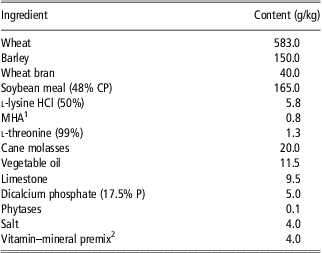
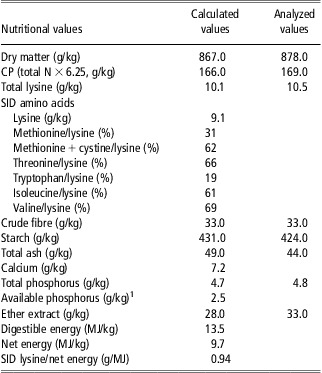
A single diet was used and provided as pellets (Table 1). The diet was calculated to contain 9.7 MJ/kg net energy (NE) and was formulated to ensure that no nutrients would be limiting (Table 2). A higher standardized ileal digestible lysine content (0.94 g/MJ NE) was used compared with that usually used (0.90 g/MJ) for females and castrated males. This level was based on the amino acid requirements of entire males at the beginning of the fattening period assessed by Quiniou et al. (Reference Quiniou, Courboulay, Salaün and Chevillon2010).
Ingredient and nutrient composition of the experimental growing-finishing diet, as-fed basis

MHA = methionine hydroxy analog.
1MHA supply was supposed to be equivalent to 80% dl-methionine.
2Supplied the following nutrients/kg of diet: vitamin A, 7000 UI; vitamin D3, 1000 UI; vitamin E, 10 Ul; vitamin K3, 1 mg; thiamine, 1 mg; riboflavin, 4 mg; niacin, 10 mg; pantothenic acid, 8 mg; vitamin B6, 2 mg; vitamin B12, 0.02 mg; Mg, 100 mg; Mn, 40 mg; Zn, 100 mg; Cu, 15 mg; Fe, 80 mg; I, 0.5 mg; Se, 0.3 mg.
Nutritional composition of the experimental diet, as-fed basis

SID = standardized ileal digestible.
1Diet was used as pellets.
Housing conditions
Replicates were randomly assigned to one of the two similar experimental rooms used simultaneously. Each pen was equipped with a single-space feeder, with a 25 kg storage capacity. For pigs offered feed ad libitum, it was ensured that the trough never remained empty. When the ADFI of pigs from treatments R2.75 and 2.50 reached the maximum feed allowance, they were fed once a day in the morning (0730 h). Pigs had free access to water through a nipple drinker. Ambient temperature was regulated similarly for both rooms; during the first 14 days, it was decreased from 24°C to 22°C and thereafter it was maintained constant at 22°C.
Measurements
The pigs were weighed at the beginning of the experiment (62 days of age) and thereafter every 2 weeks until slaughter. Pigs slaughtered 5 weeks after V2 were weighed 4 and 5 weeks after V2. On the day of weighing, the pigs were fasted from 0800 until 1400 h and then weighed. The cumulated feed intake per pen was measured weekly as the difference between the feed allowance and the refusals collected.
Pig behaviour was recorded during the growing period using a simplified and instantaneous scan sampling technique. When the observer arrived in the room, pigs were encouraged to stand and move. Observations started 10 min later. Every pig inside each pen was observed five times, with an interval of 2 min between two successive observations. The ethogram consisted of a description of the type of activity observed: social behaviour (i.e. interactions among pigs), either positive (sniffing, nosing, licking, moving gently a part of the animal without aggressive or flight reaction from this individual) or negative (biting, aggression and social interaction inducing a reaction from the receiving pig), sexual behaviour (successful or unsuccessful mounting, sheath nosing), pen investigation, feeding and drinking activities or resting (pig lying motionless). No distinction was made between other behaviours. This method of observation does not allow a proper evaluation of the time budget between the different behaviours, including resting behaviour, because of the stimulation of the pigs by the observer. However, it provides an indication of the type of behaviour performed when the animals are active. These observations were performed twice per day of measurement beginning at 1400 and 1600 h. The observation sessions were repeated three times: 7 days before V2 when all the pigs were still offered feed ad libitum (V − 1 week); 6 days after V2 (V + 1 week); and 20 days after V2 (V + 3 weeks).
On the day following these observations, the pigs were inspected for body lesions using a protocol similar to that developed in the welfare assessment tool Welfare Quality® (2009). Lameness was visually recorded by one observer using a 4-point scale (0: normal gait, 1: abnormal gait but still using all legs, 2: minimum weight bearing on one leg and 3: serious lameness). For each animal, the number of skin lesions was counted on different body areas: ear, front, flanks, hind-quarters and legs, on both sides of the pig. The lesions were also categorized based on their size and the cumulated score corresponded to the sum of scratches or wounds observed multiplied by a coefficient that depended on the size of the lesions (1 when the size was smaller than 2 cm, 5 for scratches or wounds between 2 and 5 cm and 16 for scratches, wounds or open wounds greater than 5 cm).
At slaughter, the hot carcass was weighed; it corresponded to both half-carcasses with the feet and the head without the kidney fat and the tongue. The backfat thickness and the Longissimus dorsi muscle depth were measured between the third and the fourth last ribs using an invasive probe (CGM, Sydel, Lorient, France). After 24-h chilling, 102 left half-carcasses (36 pigs from AL group, 33 from R2.50 and 33 from R2.75) were scanned using an X-ray computed tomography (CT) scanner to measure the volumetric lean meat content in the carcass. Each half-carcass was prepared before CT scanning as it would have been prepared before a European Union reference dissection (Walstra and Merkus, Reference Walstra and Merkus1996): the spinal cord, tail and visceral fat were removed. The CT scanning was performed according to the manufacturer's specifications (Siemens Emotion Duo, Erlangen, Germany) using the following parameters: spiral acquisition, 130 kV, 30 mA s, voxel size: 0.9 × 0.9 × 3 mm and 3 mm slice spacing. Approximately 450 Dicom images were generated for each half-carcass. The lean meat volume was measured on the Dicom images in selecting pixels with Hounsfield values between 0 and 200 and the total half-carcass volume was measured with −500 and 3000 Hounsfield value thresholds. The lean meat content corresponds to the ratio between these two measurements. Computer calculations on the images were carried out by automatic routines developed in C# language.
Calculations and statistical analyses
Growth performance was calculated over different BW ranges: from the beginning of the fattening period until slaughter (total period), from the beginning of the fattening period until V2 (before V2) and from V2 until slaughter (after V2). The ADFI was calculated as the ratio between the cumulated feed intake during the period, the number of pigs and the duration of the period. The FCR corresponded to the ratio between the cumulated feed intake and the cumulated BW gain per pen during the period.
Data were analyzed using the Statistical Analysis System (version 8; SAS Institute Inc., Cary, NC, USA). Data obtained on an individual basis (BW, average daily gain (ADG), carcass traits) during the overall fattening period were subjected to a multifactorial ANOVA on repeated measurements with the treatment (n = 3) as the main effect, the replicate (n = 8) as the random effect and the pen as the experimental unit with PROC MIXED. Observations recorded at the pen level (ADFI and FCR) were analyzed similarly but with only one data available per pen. Carcass traits were analyzed with the slaughter BW included in the statistical model as a covariate.
The variables used to describe the different components of behaviour were expressed as a percentage of the active behaviour (non-resting) performed per pen and per stage of observation. An ANOVA was performed on repeated measurements with the pen as the dependent variable and treatment, stage of measurement and their interaction as the main effects (PROC MIXED). Variables that were not normally distributed were analyzed using a Kruskall–Wallis test (PROC NPAR1WAY) and comparisons were made among subgroups and among stages of measurement, separately. Lesion scores were log-transformed to achieve a normal distribution. Thereafter, an ANOVA was performed on repeated measurements with the pig as the dependent variable and treatment, stage of measurement, their interaction and the pen as the main effects (PROC MIXED). When the interaction was significant, data were analyzed by treatment or by stage of observation.
Results
Performance during the overall experimental period
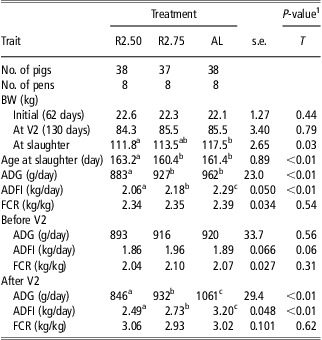
The initial sample consisted of 120 pigs, of which eight died during the trial (n = 3 from R2.50 treatment; n = 3 from R2.75 treatment; n = 2 from AL treatment). Pigs were studied between 22 and 114 kg BW on average. A significant difference was observed in ADG among treatments (Table 3). The ADG of R2.50 pigs was 78 g/day lower than that for AL pigs (P < 0.01), R2.75 pigs being intermediate. Slaughter was performed on 2 days separated by 1 week, and the proportion of each group slaughtered differed on the two occasions (>50% of AL and R2.75 pigs v. 25% of R2.50 pigs were slaughtered on the first day). This reduced the difference in the final BW. However, it remained different between treatments (P = 0.03).
Effect of the feeding strategy on performance

T = treatment; ADG = average daily gain; ADFI = average daily feed intake; FCR = feed conversion ratio.
Data are presented as least square means; s.e. = pooled standard error.
Means with different superscripts within the row differ at P < 0.05.
1Multifactorial ANOVA with T as the main effect, the replicate as the random effect and the pen as the experimental unit.
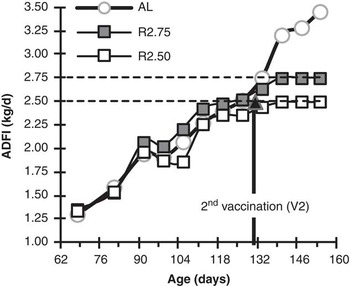
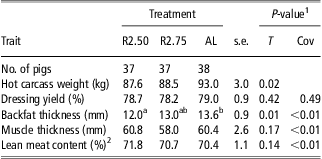
The ADFI averaged 2.29, 2.18 and 2.06 kg/day, respectively, for AL, R2.75 and R2.50 pigs. Pens allocated to R2.50 or R2.75 treatments did not reach their maximal feed allowance on the same day; only six pens from treatment R2.50 and five pens from treatment R2.75 were already restrictively fed before V2. Figure 1 was drawn taking into account the respective evolution of the average ADFI per week per pen and it indicates that all pens had reached their maximum feed allowance a few days after V2. However, taking into account the age of pigs from different pens and the number of pigs per pen on the day when feed restriction started, they were on average 129 and 128 days old at this stage, respectively, for treatments R2.50 and R2.75. The backfat thickness at slaughter averaged 12 mm for R2.50 pigs (Table 4), which was lower than that for R2.75 and AL pigs (P = 0.01), but not associated with a significant difference in the lean meat content (P = 0.14) despite the lower value obtained in the AL treatment when compared with the R2.50 and R2.75 treatments.
Evolution of the average daily feed intake (ADFI) recorded every 2 weeks with age (average age during each 2-week period).

Effect of the feeding strategy on carcass characteristics

T = treatment; Cov = covariate.
Data are presented as least square means; s.e. = pooled standard error.
Means with different superscripts within the row differ at P < 0.05.
1Multifactorial ANOVA with T as the main effect, the replicate as the random effect, the pen as the experimental unit and the slaughter BW (114 kg on average) as Cov.
2Assessed by tomography.
Performance before and after V2
The pigs were 130 days old when the second vaccination was performed and their BW averaged 85 kg. Before V2, the ADFI tended to be higher for the R2.75 treatment (1.96 v. 1.86 and 1.89 for R2.50 and AL treatments, P = 0.06; Table 3). However, the ADG and FCR did not differ among treatments and averaged 910 g/day (P = 0.56) and 2.07 (P = 0.31), respectively. After V2, the different feed allowances were associated with differences in ADG (from 846 to 1060 g/day, respectively, for R2.50 and AL pigs, P < 0.01), whereas no effect was observed on FCR (3.00 on average, P = 0.61).
Behaviour and skin lesions
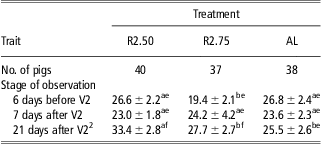
Differences in the type of exhibited behaviour were limited between treatments, whichever stage of observation was considered. At 3 weeks after V2, AL pigs tended to perform more social behaviours than the other groups (Table 5). The cumulated frequency of scratches and wounds was used to assess individual pig skin lesions. It was significantly influenced by the treatment and the stage of measurement (Table 6). Major differences between treatments were observed only during the late fattening period. Skin lesions remained stable during the period under ad libitum feeding, whereas more lesions were observed 21 days after V2 for restrictively fed pigs. At this stage of observation, the pigs on higher feed restriction also showed the highest score of scratches and wounds.
Effect of the feeding strategy on pig behaviour before and after the second injection (V2), expressed as a proportion of active behaviour

T = treatment; S = stage of observation.
Data are presented as means and standard error; n = 8 pens per treatment.
V2 = day when the second injection was performed.
1ANOVA on repeated measurements with T, S and T × S as fixed effects, and the pen as the experimental unit.
2The effect of the treatment was tested separately at each stage of observation using the Kruskal–Wallis test. The P-values were 0.93, 0.15 and 0.30 during the three stages of observation, respectively.
Effect of the feeding strategy and the stage of observation on body lesions (scratches and wounds)1

Data are presented as means and standard error; n = 8 pens per treatment.
Within the stage of observation considered, means with different superscripts a and b differ at P < 0.05 among the three treatment groups, in rows.
Within the treatment considered, means with different superscripts e and f differ at P < 0.05 among the three stages of observation, in columns.
1ANOVA on repeated measurements with the treatment (T), the stage of observation (S), the interaction T × S and the pen as fixed effects and the pig as the experimental unit. Due to a T × S interaction (P = 0.04), both effects are tested separately.
2Only 39 pigs from treatment R2.50 were observed 21 days after V2.
Discussion
After the second injection, the immunocastrates under ad libitum feeding exhibited a marked increase in both ADFI and ADG, in agreement with previous observations published by Zamaratskaia et al. (Reference Zamaratskaia, Andersson, Chen, Andersson, Madej and Lundström2008), Hémonic et al. (Reference Hémonic, Courboulay, Kuhn, McLaughlin, Martin, Brock and Pearce2009) and Pauly et al. (Reference Pauly, Spring, O′Doherty, Ampuero Kragten and Bee2009). In contrast, Škrlep et al. (Reference Škrlep, Šegula, Zajec, Kastelic, Košorok, Fazarinc and Čandek Potokar2010) did not report any difference in ADG, despite the increased ADFI. According to all these authors, this increase in ADFI was associated with a lower carcass leanness than in entire males but still higher than that in castrated males. These results indicate changes in the composition of BW gain, which may be due to (i) the change in the hormonal status of the pig, (ii) the distribution of energy intake for different needs (BW gain, activity, etc.) and (iii) the response of protein deposition to energy intake.
A linear relationship was observed between the protein deposition rate and energy intake in the ‘improved’ entire males studied by Campbell and Taverner (Reference Campbell and Taverner1988). A linear–plateau relationship was characterized in conventional and fatter types of entire male pigs by these authors and by Quiniou et al. (Reference Quiniou, Dourmad and Noblet1996), in females by Bikker (Reference Bikker1994) and in castrated males by Quiniou et al. (Reference Quiniou, Dourmad and Noblet1996). When a linear–plateau relationship was obtained, all authors reported an improved FCR and carcass leanness when the feeding level was decreased. In the current trial with modern crossbred pigs selected against fat deposition and for improved FCR, feed restriction was not associated with a significant difference in FCR and carcass leanness appeared to be only marginally (not significantly) improved, whereas ADG was markedly reduced. Such a response would be consistent with a linear–plateau relationship, in which plateau would be very short, that is, with an ad libitum energy intake that would be only slightly above the level required for maximizing protein gain and minimizing lipid gain. Our results indicate that the maximum level of protein deposition of immunologically castrated pigs might not be achieved in the 4 to 5 weeks following V2 (the time when the hormonal status changes from that of an entire male to that of a castrated male) even if feed intake increases considerably. However, this does not imply that the whole-body protein gain remained constant after V2.
A high level of anabolic hormones such as androgens and oestrogens is associated with a reduced ADFI (Claus and Weiler, Reference Claus and Weiler1994). After V2, the production of these hormones is reduced because of the immunization against GnRH. Therefore, the significant increase in feed intake after V2 may be associated with the reduced synthesis of testicular steroids (Bauer et al., Reference Bauer, Lacorn and Claus2009). However, these authors reported an increased synthesis of IGF-I at the same time, resulting from this increased ADFI. In pigs offered 3.0 kg/day from V2 at 22 weeks of age until 28 weeks of age, they reported an increased protein synthesis without any difference in protein breakdown. Bauer et al. (Reference Bauer, Lacorn and Claus2009) concluded that it was possible to increase ADFI above 3.0 kg/day without accumulating body fat. Obtained from somewhat younger pigs (between 18 and 22–23 weeks of age), our results are in agreement with the results obtained by Bauer et al. (Reference Bauer, Lacorn and Claus2009) as the ad libitum feed intake level in our study (3.20 kg/day) was slightly above the highest feed allowance studied by Bauer et al. (Reference Bauer, Lacorn and Claus2009), but the lean content obtained at slaughter and the feed efficiency were not different from those recorded with a 2.75 kg/day feed intake. Consequently, not only did the ADFI vary after V2 but also the potential protein deposition rate. Under such conditions, it was less surprising that the increase in ADFI after V2 was not significant enough to exceed by a large amount the minimal amount of energy required to express the potential protein deposition rate, as suggested before.
No major effect of the treatment was observed on pig behaviour. Sexual behaviour was less pronounced than that in the study of Cronin et al. (Reference Cronin, Dunshea, Butler, McCauley, Barnett and Hemsworth2003) over the same BW range. The observed reduction in sexual behaviour after V2 agrees with a report of Fàbrega et al. (Reference Fàbrega, Velarde, Cros, Gispert, Suárez, Tibau and Soler2010) for immunocastrates studied under an ad libitum feeding condition. In terms of skin lesions, major differences between treatments were observed only during the late fattening period. At the previous stage of observation, the intensity of feed restriction was probably not sufficiently pronounced to induce marked changes in aggressive behaviour and in hierarchy. At the end of the fattening period, however, the feed allowance to R2.75 and R2.50 pigs was 15% and 22% lower than the ad libitum feed intake level, respectively. The progressive increase in the feed restriction intensity resulted in a higher frequency of skin lesions in restrictively fed pigs due to a change in the competition for access to the feeder. They also exhibited less social behaviour at the end of the fattening period, which was probably a way to limit interactions among pigs within the pen as soon as the hierarchy was re-established in the order to get feed.
Conclusion
According to our study performed with a lean type of immunologically castrated pig, comparison of ad libitum or restrictive feed allowances indicates that the feeding level after the second vaccination did not influence the feed efficiency. The slight effect on carcass leanness was associated with an increase in skin lesions at the end of the fattening period that could diminish the carcass value. When fed restrictively, more evidence of aggression was observed. Consequently, these results suggest that, after V2, restrictive feed allowance is not recommended and that pigs should be offered feed ad libitum. This response should be extensively studied on other, that is, fatter, types of pigs before the conclusion can be generalized. Finally, additional knowledge is required now about the evolution of the metabolism or BW gain composition over short time intervals and under different nutritional contexts to characterize more precisely the evolution of nutrient requirements after V2.
Acknowledgements
The authors wish to thank J.-P. Commeureuc, T. Lhommeau, D. Loiseau, M. Pouet, R. Richard, L. Coudray and B. Faucheux for their technical assistance with data collection and care provided to the animals and J. Allison for valuable comments on the manuscript. The study was supported by the French Ministry of Agriculture and Pfizer Animal Health.