

Introduction
There is a tendency to study United Nations peace operations and their ‘successes’ or ‘failures’ as if they were mere instruments at the disposal of the international community to solve problems of peace and security. This problem-solving approach obscures the fact that peace operations are the result of a highly politicised multilateral process, and that the decision to use military force in pursuit of international security is a political rather than technical one.Footnote 1 Though critical approaches have gone a long way in identifying the dynamics of inequality and power that traverse UN peacekeeping,Footnote 2 they can also picture UN peace operations as a simple tool in service of this power. Both approaches hold an instrumentalist view of peacekeeping–as either a rational problem-solving exercise or as a way of furthering power motives that are the ‘true’ purpose of peacekeeping.
The ‘micro turn’ in studies of international intervention presents a welcome alternative to instrumentalist approaches. Integrating ethnographic and sociological insights into analyses of peacekeeping and peacebuilding, micro approaches focus on the how rather than the why of intervention.Footnote 3 Based on the assumption that ‘everyday practices shape overall interventions from the bottom up’,Footnote 4 the micro approach reveals how interveners’ culture and habitus Footnote 5 often lead them to isolate themselves from local populations, to ignore local dynamics, and to privilege universal over local knowledge.Footnote 6 In emphasising the unintended aspects of intervention, the micro turn poses a serious challenge to instrumentalist approaches. But the micro turn can also err in the opposite direction: focus on the everyday can disconnect international intervention from the institutional and geopolitical context from which it emerges. Policy recommendations suggesting that international intervention could be more successful if only interveners were better trained, less insular, and more open to local concerns and values reduce intervention to a face-to-face between interveners and intervened upon. By laying the blame for interventions’ failure at the feet of individual interveners, the micro turn can obscure not only the structural violence inherent in intervention, but also that interveners are as often moved by their habitus as they are by institutional constraints and pressure from above.
How can we study peace operations if we acknowledge that they are at once an instrument of global politics, a fundamentally public endeavour that must be negotiated and legitimated, and an everyday practice that is implemented by actual people? This article develops a practice-based approach to peace operations that brings the tensions in this multiple nature to the forefront. The argument is developed through the case of the UN Stabilization Mission in Haiti (MINUSTAH) (2004–17). MINUSTAH saw the introduction of new practices within the context of a UN peace operation, namely the use of joint military-police forces to conduct offensive action against armed groups that were labelled as ‘gangs’. To explain the emergence of this new practice, a rational instrumentalist view would argue that MINUSTAH was simply adapting to the situation and following its mandate, given that Haitian gangs constituted a threat to stability in Haiti. This would be in keeping with the idea that we are facing a ‘criminalisation’ of conflict and that criminal groups constitute international security threats.Footnote 7 A more critical view would see MINUSTAH as serving the interests of powerful UN member states. For instance, it is well known that the US, France, and Canada have a long history of meddling in Haitian politics and had no sympathy for the deposed President Aristide, whose return the gangs were allegedly supporting.Footnote 8 Finally, a microanalysis of this new practice would emphasise continuity in interveners’ habitus and the politics of knowledge, pointing out, for instance, that the Brazilian military was leading MINUSTAH and had a history of intervening in Brazilian favelas. In all cases, the fact that MINUSTAH could launch joint military-police offensive actions against gangs is considered as unsurprising.
However, the introduction of this new practice was far from an easy affair. Indeed, accounts by participants reveal that there were tensions between, on the hand, interveners’ sense of what ‘doing peacekeeping’ means and in which contexts it is appropriate, and on the other new practices developed as part of a focus on ‘criminal’ groups as threats to the stability of the Haitian state. The practice-based approach developed in this article moves away from an objectivist view, which assumes that problems are ‘out there’ for UN peace operations to solve, to investigate how interveners build their object of intervention. In addition, this approach alerts us to the fact that MINUSTAH cannot proceed as if the mission were a tabula rasa, but must contend with existing practices and discourses of peace operations. It foregrounds problems of interpretation (what is going on?) and struggles related to what ‘doing peacekeeping’ means (are these practices part of UN peace operations?). Contrary to micro approaches that emphasise interveners’ unwillingness to consider local dynamics and their propensity to impose pre-established templates, the article reveals how interveners struggled with making sense of the situation and the appropriate response, and how it was UN headquarters that imposed meaning from above to make raids against gangs possible.
This article does three things: (1) It argues for the benefits of applying an International Practice Theory (IPT) lens to peace operations while (2) proposing to develop theoretical and methodological approaches that have been less prominent in IPT. Theoretically, it posits that IPT can better articulate practice and discourse by paying more attention to what actors say about what they do. This insight is put to work methodologically through a study of texts produced by MINUSTAH participants during the period 2004–07. In addition, (3) the insights derived from MINUSTAH’s offensive actions against gangs are used as a springboard for a broader reflection on the link between crime and international peace and security. The first section of the article briefly presents MINUSTAH’s actions in Haiti and places them in the context of debates on the link between organised crime and international peace and security. The second section develops an IPT approach to UN peace operations that foregrounds the articulation between discourse and practice. The third section focuses on the stories that were mobilised by MINUSTAH’s leadership to make sense of the situation in Haiti and of the raids against gangs in 2004–07. The last section investigates the practices and techniques used by MINUSTAH, traces their origin and evolution, and provides a brief assessment of MINUSTAH’s operations against gangs from the point of view of participants. The article concludes on what this means for how we understand and study UN peace operations.
I. UN peace operations, gangs, and international peace and security
The Security Council authorised the deployment of MINUSTAH in April 2004 in the wake of a coup against democratically-elected President Jean-Bertrand Aristide and the intervention of a US-led Multinational Interim Force.Footnote 9 Established under Chapter VII of the UN Charter, the mission was given a standard multidimensional mandate,Footnote 10 which included establishing a secure and stable environment, supporting the political process, and promoting and protecting human rights. Shortly after its deployment, however, MINUSTAH found itself engaged in rather non-standard tasks. On 6 July 2005, about 1,400 heavily armed peacekeepers (military and police) entered the low-income neighbourhood of Cité Soleil in Port-au-Prince to conduct an early-morning raid against suspected gang members. During the 12-hour raid, dubbed ‘Operation Iron Fist’, MINUSTAH peacekeepers fired 22,700 rounds of ammunition and 78 grenades, leaving over 20 civilians dead and injuring dozens.Footnote 11 This was but one example of offensive action against gangs conducted by MINUSTAH in 2004–07.Footnote 12
For UN observers accustomed to the glacial pace of change within the organisation, the fact that MINUSTAH could send hundreds of peacekeepers into densely populated urban neighbourhoods to capture or kill alleged gang members should be puzzling. This makes Haiti one of the few instances where UN peacekeepers have used lethal offensive force against ‘spoilers’. More importantly, it is the only instance where these ‘spoilers’ deserving of offensive violence were deemed to be criminals, rather than participants in ongoing conflict. How did this happen?
The natural inclination is to respond that Haitian gangs indeed constituted a threat to the stability of the Haitian state, and therefore to broader international peace and security, and that MINUSTAH simply adapted to this reality. The link between crime, conflict, and peacekeeping has been a topic of reflection at least since the intervention in Bosnia in the early 1990s.Footnote 13 In the context of simultaneous wars ‘on terror’ and ‘on drugs’, accounts portraying transnational organised crime and transnational gangs as threats to international peace and security have proliferated. A 2005 publication by the US Army War College, for instance, argues that street gangs amount to a new ‘urban insurgency’Footnote 14 that directly threatens states through what the author refers to as ‘coup d’streets’.Footnote 15 Crime is often depicted as both an agent of destabilisation within (weak) states and as a transnational challenge. The alleged link between (or even merging of) terrorist groups and organised crime,Footnote 16 in particular, has contributed to transforming criminal groups into international security threats. In the field of peace operations, researchers in both policy and academic circles have drawn attention to the ‘crime-conflict nexus’Footnote 17 and have reflected on how peacekeeping missions should deal with criminal ‘spoilers’.Footnote 18
The conceptualisation of crime as a threat to international peace and security has been challenged along three lines of criticism. The first empirically contests the characterisation of crime as a transnational threat to state and international security; the second does not necessarily question that there exists a crime-conflict nexus, but is concerned about the effects that such characterisation entails, notably in terms of militarisation of law enforcement; and the last one takes a step back from the current moment to interrogate how labels of criminality have been historically used to delegitimise opponents.
Are gangs and organised criminal groups a transnational threat to states and to peace and security? Critics argue that pitting illicit criminal groups against threatened licit state actors is misleading, as it ignores the ‘dialectical’ relations between them.Footnote 19 A review on the conceptualisation of gangs as armed groups found that there was little evidence to support the alarmist idea that gangs were representing a new ‘urban insurgency’.Footnote 20 Gangs may constitute an ‘indirect threat’ to states in the sense that they represent ‘an alternative to government in areas where government is weak and ineffective’,Footnote 21 but this is quite different from the idea that gangs are out to take over state power. Furthermore, the ‘transnational’ nature of criminal groups tends to be exaggerated, as they often organise on a local basis rather than through federal-like structures of command.Footnote 22
Depicting transnational crime as threat to international security may not only be misleading, it also produces policy responses that are at best counterproductive, and at worst in direct contravention of international human rights and humanitarian law. Whereas ‘conflict’ calls for political processes based on inclusion, ‘labelling a phenomenon “crime” implies the need for a punitive response, excluding criminals from legitimate social interactions’.Footnote 23 In peacekeeping/peacebuilding contexts, automatically labelling criminal actors as ‘spoilers’ obscures ways in which they can be fruitfully included in reconciliation and reconstruction processes.Footnote 24 Furthermore, it ends up ‘characterizing entire populations engaged in conflict as “criminals” that must be repressed’.Footnote 25 Approaches to crime as a transnational security threat are tautological: because of the destabilising consequences of crime to states, ‘responses seek to neutralise gangs through shoring up state institutions, particularly the security sectors’.Footnote 26 As with general efforts to shore up state capacity in ‘failed states’, the focus on order and coercive state institutions often comes at the expense of addressing political, social, and economic issues, and has a strong status quo bias.Footnote 27 In this sense, criminal groups have become ‘convenient scapegoats’.Footnote 28
In fact, we should not forget that characterising opposition as ‘criminal’ is a time-honoured strategy of states facing opposition. During the US occupation of the Philippines, for instance, ‘the November 1902 Bandolerismo Statute classified all forms of internal resistance as banditry and labelled any armed group brigands’.Footnote 29 In Haiti itself, the armed groups resisting US occupation in 1915–34 were labelled as ‘bandits’.Footnote 30 As a study of the international response to organised crime in Bosnia points out, ‘criminal enterprise too often provides an easy and convenient villain’.Footnote 31 We should therefore be sceptical of claims that we are witnessing a ‘criminalization of conflict’ in the context of ‘new wars’ motivated by ‘greed’ and characterised by indiscriminate levels of violenceFootnote 32 on the part of ‘warlords’Footnote 33 or ‘gangs’.
These critiques suggest two interesting avenues to investigate the UN intervention in Haiti. First, they draw our attention to problems of labelling and interpretation, and to the political dimensions of labelling and its legitimising effects. Second, they reveal how the identification of crime as a transnational threat to peace and security alters practices of intervention and legitimises new practices, in particular a militarisation of law enforcement. Both issues – interpretation/labelling and new practices – were at the forefront of debates and tensions within MINUSTAH. The next section explores how IPT provides both a powerful theoretical lens and methodological tools to examine them.
II. International practice theory, discourse, and practitioners
The previous section suggests that, if there is indeed a ‘criminalisation’ of conflict, it may be less (or not only) in the sense that we are seeing a transformation of conflict on the ground and more (or also) in the sense that new discourses and practices of intervention are criminalising conflict. This insight is relevant to how we understand peace operations’ response to ‘criminal’ actors, in a context where ‘the “problems” that peace operations seek to address are not “discovered” but are created’.Footnote 34
This article conceptualises peace operations as an established international practice, a ‘performance’, a ‘process of doing something’ that is ‘patterned, in that it generally exhibits certain regularities over time and space’, and can be ‘more or less competent in a socially meaningful and recognizable way’.Footnote 35 In MINUSTAH’s case, IPT provides a process-based mode of explanation that understands the mission as being nested in existing practices within the UN (and beyond), rather than as a discrete exercise in problem solving. Any new practice developed in the context of MINUSTAH – such as armed raids against gangs – must be ‘nested in other practices, both in the sense that it emanates from a set of similar practices existing elsewhere …, and in the sense that it has to fit in with other practices that already play themselves out in the new field into which it is being inserted.’Footnote 36 MINUSTAH does not occur in a vacuum, but can and must draw on existing practices, understood here as both discursive practices that make sense of and legitimise intervention and actual techniques of intervention.
Discourse and practice
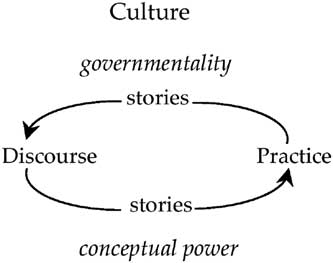
The articulation of discourse and practice is central but thorny in IPT. In his seminal article on returning practice to the linguistic turn, Iver B. Neumann provides perhaps the clearest articulation of the two. Using a recursive model (see Figure 1), he argues that discourse does not only follow practice to legitimise it post hoc, but also precedes it. He builds on de Certeau’s concept of ‘stories’ that ‘“go in a procession” ahead of social practices in order to open a field for them’.Footnote 37 In this model, stories inform practice. They tell us who we are and how we do things, as well as what is going on: they are ‘stories of what things should be like’.Footnote 38 Stories are part of the process, they are not just told at the end of it: ‘In concrete, everyday situations people are constantly faced with the task of not only figuring out what to do, but also of how to account for whatever they did. Stories are a representation of this ongoing process – not after the fact, but in vivo, on line. They present an account not only of the actions and the situations that occasioned those actions, but also of the warrants for those actions’.Footnote 39 Some authors have referred to these as ‘narratives’, highlighting that ‘narrative is a central component of the organisation of a practice’ as it ‘provides identity’ and ‘a moral compass to interpret events and situations’.Footnote 40 Here I use the term ‘stories’ partly for consistency’s sake, as it is the one Neumann chose, but also because, although story and narrative are very close concepts, ‘stories’ better conveys the public nature of the practitioner accounts I am interested in (this is further explored below).
Neumann’s loop.

The articulation of discourse and practice has proven difficult to implement. This is partly due to a ‘division of labour’ between those who focus more on practices and those who prefer to study discursive practices. But the problem runs deeper: IPT (in some of its iterations) has developed a certain distaste for text (methodologically) and for taking the discourse of actors at face-value (epistemologically). Methodologically, text is often seen as an inferior source to the direct observation of practices. Neumann’s article precisely criticised ‘armchair analysis’, which he understood as ‘text-based analyses of global politics that are not complemented by different kinds of contextual data from the field’.Footnote 41 While this was an attempt to remedy a perceived imbalance between text analysis and the study of practices in vivo, it may have contributed to bending the stick in the other direction. Indeed, for those interested in practices, the study of text is often seen as second best to actual observation. Vincent Pouliot for instance argues that though ‘written texts are, in general, easier to obtain’, ‘when it comes to understanding the practical logics that go into practices, discourse analysis is often insufficient’.Footnote 42
The second problem has more to do with epistemology and the question of whether actors have anything interesting to say about their own practices, and therefore whether we should take seriously the stories they tell. While Neumann’s interest in stories suggests that we should, this is far from obvious far a large swath of IPT inspired by Bourdieu. Indeed, Bourdieu’s sociology was precisely based on the idea that actors’ reflexivity was limited.Footnote 43 In this approach, the sociologist may start with what practitioners say about their experience, but must then break with the self-understanding of actors: ‘it is the explanandum, not the explanans, and it has to be explained with reference to something they do not and cannot possibly grasp – the “hidden truth” – that somehow causally influences them behind their backs’.Footnote 44
My wager is that, if we want to articulate practice and discourse, we have much to gain from taking seriously not only what practitioners do, but also at the stories they tell. If we take Neumann’s idea of a recursive loop between practice and discourse seriously, then we need to move away from Bourdieu towards Boltanski. Boltanski’s ‘pragmatic sociology’ is based on the premise that ‘actors, thanks to their critical capacities and reflective competences, possess relevant knowledge about the world; thus an adequate theory of practice can only be developed in a joint enterprise which integrates their interpretations of the world as the main elements in theoretical construction.’Footnote 45
Some strands of IPT have highlighted the importance of stories in situations of crisis, uncertainty, and contradiction. In what Christian Bueger and Frank Gadinger call ‘the narrative approach’ in IPT, ‘the invitation is to study the strategies and tactics by which orders become legitimate, actors are capable to proceed with their actions even in the light of contradictions and thereby manage to successfully cope with their everyday life’.Footnote 46 This echoes Neumann’s understanding of the role that stories play in the establishment of new practices. Stories are performative in two ways: upstream, they ‘open a field’ for and authorise new or established practices, and downstream they naturalise them by saying ‘this is how we have always done things’.Footnote 47 In the case of UN peace operations, upstream stories tell us about what ‘peacekeeping’ is and in which situations it applies, and downstream stories reaffirm the legitimacy of the practices that constitute peacekeeping. In MINUSTAH’s case, the flow of stories from discourse to practice was disrupted by the question of whether ‘peacekeeping’ was appropriate against ‘criminal’ actors, and whether the new practices that this entailed were really part of ‘peacekeeping’.
Practitioners’ stories
If we are interested in stories, whose stories are we talking about, and where do we find them? In this article, I focus on the ‘meso level’ of UN peace operations, the mission command that is located between UN headquarters and rank-and-file peacekeepers. Concretely, these actors are those who oversee the implementation of the mandate coming from the Security Council while having to deal with the situation on the ground. It is precisely at this meso level that tensions and contradictions linked to the multiple nature of peace operations – as instruments of global politics, public endeavours that must be negotiated and legitimated, and everyday practices – are likely to be deeply felt.
And these actors seem to have stories that they want to tell, judging by the fact that many of them have written about their experience. The corpus used for this article includes five articles, four books, and three book chapters. As far as I know, this is a comprehensive list of the texts written by members of MINUSTAH who were present in Haiti in the period when the mission conducted offensive raids against gangs (2004–07) and which address that period. I also use two in-depth interviews in the public record because these were both conducted within the context of a project that seeks to let practitioners reflect on their experience, their ‘stories’.Footnote 48 The final corpus includes 15 texts representing the experience of 11 individuals who belonged to the military (4), police (2), and civilian (5) branches of MINUSTAH and originate from 8 different countries.
These ‘ego-documents’Footnote 49 obviously do not give us unmediated access to the practices of interveners, but they offer incomparable insight into the stories they tell about these practices. To some extent, these stories are personal narratives that ‘answer the questions we ask of any experience, whether our own or somebody else’s: what happened? What was it like? How did it feel?’Footnote 50 The stories of UN peace operations practitioners are not unlike the ‘soldiers’ tales’Footnote 51 that are the source of a rich scholarship on the experience of war. In these stories, soldiers try to make sense of what happened and ‘reflect on the expectations and demands placed on them by their interpretation of appropriate behaviour’.Footnote 52
These are not just stories that participants tell themselves in private in order to make sense of a practice, they are also stories for the public forum. Indeed, many of these documents aspire to be academic texts (published in journals or in university presses) that use the author’s experience to make authoritative ‘truth claims’ and prescriptions.Footnote 53 They are a performance, in the sense that ‘telling personal narratives does something in the social world’, it is used ‘not only to recapitulate past events but to negotiate present and future events’.Footnote 54 These documents are not inert, non-reactive texts but active agentsFootnote 55 in debates about what went on in Haiti and what peacekeeping is about. Though they share characteristics with private interviews (for instance the fact that participants want to present the best version of themselves), these texts differ in the sense that they are meant to become public. In other words, these practitioners want to engage with the world. They retell their experience to make authoritative claims, but also actively to shape how we will think of their legacy.
Reading practitioners’ stories: a methodology
In these books, articles, and interviews, participants attempt to make sense of and explain what happened in Haiti not only for themselves but for public consumption. They are engaged in interpretation as well as public legitimation.Footnote 56 In this context, can we trust these accounts, and how can we disentangle the various arrows of Neumann’s loop? (see Figure 1)
On the question of trustworthiness, it is beside the point if one is interested in the stories told in personal narratives. Indeed, these ‘are of interest precisely because narrators interpret the past in stories rather than reproduce the past as it was’.Footnote 57 But this creates complications if one is interested in also reconstructing practices from these texts. As noted above, many international practice theorists are sceptical that text can give us access to lived practices. Here we can resort to some extent to triangulation, thanks to a small but diverse pool of stories written by MINUSTAH participants. But this is eluding the larger issue that practices do not speak for themselves outside of a cultural context that also involves discourse and stories, to use Neumann’s terminology. If we take this seriously, the idea that we could have unmediated access to practices if only we did not use text is moot. It is not the case that practices can simply be described while discourse requires interpretation.Footnote 58 They both require interpretation – they are first interpreted by the actors and then by the researcher.
Can we reconstitute Neumann’s loop from a text written ex-post facto? Would the loop not just collapse, since there is no way of disaggregating stories that precede from stories that follow practices? One response would be that this is a problem embedded in such recursive processes, and that maybe Neumann’s model should be understood as a heuristic device. Here I propose a modest solution: if stories that follow practices ex-post facto are to naturalise and legitimise them, we should expect them to be coherent retellings of what happened and what the actors did. As Hendrik Wagenaar puts it, ‘stories are a sleight of hand to present reality as more coherent and more meaningful than it is, and could ever be, in reality’.Footnote 59 Incoherences and contradictions are thus particularly revealing, and suggest that the tension between old stories of how we do things and new practices have not been resolved. In my analysis of stories written by former members of MINUSTAH, I find numerous such contradictions within individual accounts and among these accounts.
Where does that leave us in terms of methodology? To the best of my knowledge, this is the first attempt to study together accounts of one period by different practitioners. This approach serves two purposes: to assess the overall coherence/incoherence of the stories emerging and, more prosaically, to triangulate information to reconstruct practices. The method I adopt has been described by Patrick Thaddeus Jackson as ‘textual ethnography’, ‘a form of disciplined reading in which one engages in a kind of “participant observation” of the textual records …, jotting “field notes” as one reads – much as one would when studying the social practices of some group of people.’Footnote 60 This allows me to build a topography of concepts (for example, gangs), issues (for example, military-police integration), and episodes (for example, specific raids) to see whether the stories that participants tell about these are internally coherent and stable (hermeneutic reading) and coherent and stable among themselves (intertextual reading). The results are explored in the next section, which shows that MINUSTAH’s leadership expressed resistance against conducting offensive actions against gangs, in great part because these officials did not think that this was appropriate. Their attempts to reconcile offensive action against gangs with the concept of a UN peace operation were only partially successful. The fourth section reconstructs the emergence of practices and techniques that made militarised action against gangs as part of a UN peace operation possible. In addition to the stories produced by participants, this part of the work relies on UN policy documents, reports from civil society organisations, media reports, and academic texts.
III. Haiti and discourses of peacekeeping
What kinds of stories do members of MINUSTAH tell about what they set out to do, what they encountered in Haiti, and what they eventually did? Action against gangs only officially became part of MINUSTAH’s mandate in 2006,Footnote 61 two years after the mission’s deployment. In fact, MINUSTAH was originally supposed to prevent a civil war, not neutralise gangs. And yet raids against gangs became such a central part of MINUSTAH’s activities in Haiti in 2004–07 that participants could later claim that MINUSTAH was specifically deployed to deal with the gang problem. Writing several years later, former Deputy Force Commander (DFC) Eduardo Aldunate recalls that MINUSTAH’s ‘mandate was to prevent chaos in Haiti. Specifically, it was instructed to protect the population against the attacks of armed gangs.’Footnote 62
While this suggests that MINUSTAH’s action against gangs was normalised, a close reading of the stories’ participants tell about the mission shows that they faced conflicts of interpretation and debates about what peace operations do. These tensions can be summarised as two key questions: (1) what the nature of the ‘gangs’ was, how to label them, and whether they constituted primarily a political or a criminal phenomenon; and (2) whether dealing with criminality was part of peacekeeping practices.
Making sense of Haiti
According to some analyses of MINUSTAH’s actions in Haiti, in the wake of the 2004 coup there was a clear shift from politically motivated to criminally motivated violence,Footnote 63 from ‘grievance’ to ‘greed’, with armed supporters of Aristide’s Lavalas party turning to criminality after his forced removal.Footnote 64 However, looking at how MINUSTAH’s leadership understood and described the phenomenon reveals a less clear-cut reality. Their conceptual analysis of the ‘gangs’ was characterised by a tension between defining these groups as a politically-motivated threat and as a depoliticised problem of criminality. This resulted in a curious mix of depoliticisation of conflict and politicisation of criminality and contributed to blurring the line between armed conflict and law enforcement.
MINUSTAH’s leadership struggled with finding the appropriate framework (or ‘story’) to make sense of Haiti, and therefore of their mission. This is encapsulated in a debate that occurred in a briefing on 17 August 2005. On the one hand, former Special Representative of the Secretary General (SRSG) Juan Gabriel Valdés ‘dismissed criticisms of MINUSTAH’s use of force, noted that the mission had prevented a civil war’ and stressed the importance of holding legitimate elections. On the other, Force Commander (FC) Heleno ‘pointed out that the country was facing what was at root a police problem – specifically, criminal gangs had sunk their roots deep into a society beset by extreme poverty’.Footnote 65 These analyses of the situation in Haiti are contradictory and imply very different responses.
Participants disagreed on which conceptual box Haiti should be placed in. Was it a case of civil war, of quasi-genocide, of anarchical chaos, or of instability resulting from poverty and under-development? Early in the mission, the civil war frame was dominant. This should not be surprising in a context where Aristide had been overthrown by an armed insurgency led by former members of the Haitian armed forces. In an interview published in 2005, Juan Gabriel Valdés argued that ‘this mission arrived to stabilize a country that was on the brink of civil war, where the possibility of the division of the territory and the appropriation of the territory by different armed groups was a reality.’Footnote 66 Participants report that they were concerned that this civil war could evolve into a bloody conflict akin to what happened in Rwanda in 1994. DFC Aldunate recounts that, according to SRSG Valdés, ‘Haiti was facing a situation similar to the one in Rwanda, where the hatred between the Tutsis and the Hutus ran so deep that they were ready to hack each other to death with machetes.’Footnote 67 Former MINUSTAH Operations Officer Horacio Sanchez Mariño also makes the comparison with Rwanda, noting that although the world failed Rwanda, it did not fail Haiti.Footnote 68 This paints MINUSTAH as a successful mission to protect civilians, but does not really fit into a civil war framework (who is massacring whom?), nor a criminality framework. Already we see that the coherence of the story about MINUSTAH is affected by problems of interpretations and labelling.
Some participants defined the situation in Haiti as one of anarchy in the context of a failed state, with no identifiable groups confronting each other and no peace process to enforce. Former Operations Officer Sanchez Mariño argues that Haiti was not facing a coup d’état but a ‘Hobbesian situation’ of war of all against all.Footnote 69 According to SRSG Valdés, the gangs were just out there to produce chaos.Footnote 70 Such framework is consistent with the discourse surrounding apparently apolitical and barbaric ‘new wars’ that emerged in the 1990s. It depoliticises conflict by suggesting that there are no sides, simply indiscriminate violence. Yet this depoliticisation was not shared by all participants. According to Former MINUSTAH Director of Political Affairs and Planning Gerard Le Chevallier, ‘we have reasons to be optimistic in Haiti; after all, its problem is a political conflict, which has no ethnic, religious or territorial dimensions’.Footnote 71 For some participants, the gangs were of concern not because they were producing chaos, but because they were actively opposed to the government that MINUSTAH was mandated to support. For instance, former Police Commissioner Beer argues that ‘the gangs viewed MINUSTAH as an occupying force: an extension of the Multinational Force (MNF), which had managed Aristide’s departure. Moreover, they saw it as supporting the country’s economic elite, the interim government, and Haitian National Police (HNP), and fundamentally anti-Aristide and anti-Lavalas.’ However, Beer stops short of calling the gangs organized political actors, on the ground that ‘there was no unified position, manifesto, or constitutional plan for reform’.Footnote 72
What do peace operations do?
The contested nature of the ‘gangs’ and differing interpretations of the situation in Haiti directly fed into another set of questions: what was a peace operation to do in the face of apparently ‘criminal’ armed groups, and what was the appropriate use of force to support the mandate in this context?
Former FC Heleno makes the point that, because the mission was under Chapter VII and recognised only one side as legitimate (the transition government), it should have been qualified as peace enforcement, rather than peacekeeping.Footnote 73 This is echoed by his assistant, Colonel Carlos Chagas Braga, who argues that MINUSTAH’s mandate challenged the key principles of UN peacekeeping, since ‘a mandate that only recognized the [Haitian government] and the HNP, that ignored or considered illegitimate other involved parties, could hardly be considered completely impartial.’Footnote 74 However, Heleno notes that, because most of the contingents did not want to use force, they preferred to frame the mission as peacekeeping, rather than peace enforcement.Footnote 75 According to former Police Commissioner Beer, ‘some contingents were willing to engage the gangs; others were not. And some military leaders continued to question the military’s role in this nontraditional fight.’Footnote 76
Former DFC Aldunate reports that SRSG Valdés, FC Heleno, and himself were reluctant to use force because they were unsure that military action was the right instrument.Footnote 77 The mission leadership often argued that development, not military action, was needed. During a meeting in late 2005 with ‘a top official of an important country’ who was pushing for more forceful action against the gangs, Aldunate recalls that he gave the following answer: ‘Do you think this is how we’re going to solve the problem of crime in this country? You’re wrong – it’s not bullets they need, it’s work, education, health, respect for human rights, in short, other instruments.’Footnote 78 FC Heleno was criticised for not acting more forcefully against the gangs and for putting too much focus on development. According to Former Special Advisor of the Secretary-General Reginald Dumas, Heleno’s insistence that the solution was development caused him ‘to be pigeonholed by an increasing number of the population … as a development economist or a philosopher rather than a soldier’.Footnote 79
The mission leadership’s insistence that the solution was development rather than military action illustrates the tensions that arise when trying to reconcile a Chapter VII peace operation with a focus on criminality. Concretely, the military leaders of MINUSTAH were not convinced that military action against the gangs was appropriate. For them, a criminality frame called for a development response. Offensive use of force against gangs was also difficult to reconcile with a protection of civilians framework. Indeed, the mission leadership was acutely aware that combat operations in the densely populated neighbourhood of Cité Soleil, where most people lived in tin shacks, was bound to lead to ‘collateral damage’.Footnote 80 Aldunate recounts many occasions during which the mission leadership expressed concerns about how such civilian casualties would affect the legitimacy of the mission. Both Aldunate and Heleno publicly worried that the mission leadership could face war crimes charges before the International Criminal Court.Footnote 81
MINUSTAH’s leadership was reluctant to use force while being under intense pressure from outsiders to make the gangs a priority. Former DFC Aldunate complains about the obsession of ‘outsiders’ (‘transitional government officials, foreign ambassadors, and visiting delegates’) with Cité Soleil.Footnote 82 According to him, from October 2005 to January 2006 MINUSTAH was under heavy pressure from the transitional government and the business community in Port-au-Prince to go into Cité Soleil and deal with the gangs.Footnote 83 Former FC Heleno similarly recalls that the US, France, and Canada in conjunction with the Haitian elite were pushing the mission leadership to use more violence in the repression of armed groups.Footnote 84 Pressure came directly from the Security Council: ‘Amid accusations that MINUSTAH was too passive, the Security Council signaled its approval of a more robust approach in the report of a mission all fifteen members took to Haiti in April. This was reinforced by Resolution 1608, adopted on 22 June 2005, which authorized an increase in the mission’s strength and addition of a “rapid reaction force”.’Footnote 85
This pressure, combined with personnel turnover that saw sceptics replaced, eventually overcame resistance within MINUSTAH to conduct offensive actions against gangs. Ninety per cent of MINUSTAH’s efforts became concentrated on Cité Soleil in late 2005 to early 2006.Footnote 86 According to former Police Commissioner Beer, ‘security (in Port-au-Prince particularly) became the all-consuming priority, and effort and resources were diverted from other stated objectives of the multifaceted mandate that included aid, capacity building, and human rights issues.’Footnote 87 This shift supposed new practices of intervention.
IV. Peacekeeping as militarised urban policing
Most studies of MINUSTAH agree that the mission’s success with the gangs was due to three main evolutions: better coordination and integration between police and military, use of specific instruments of intervention (in particular Formed Police Units [FPUs]), and intelligence.Footnote 88 In this section, I focus on these elements not by studying how and why they were indeed the right instruments to confront the gangs, but by asking how it was possible to mobilise them to begin with. Indeed, the mission’s adoption of these instruments was anything but natural and easy. While one scholar argues that ‘MINUSTAH’s “war on gangs”, when it came, came almost by accident’,Footnote 89 this obscures the work that went into making the war on gangs fit within a UN peace operation.
Integrated mission
One key problem in 2004–07 was to get the military and police components to work jointly against the gangs. This was eventually achieved by appealing to the established concept of ‘integrated mission’, which is supposed to ensure better coordination between all UN activities (for example, military, political, and humanitarian).Footnote 90
The difficulty of integrating military and policeFootnote 91 illustrates the tensions that arise when attempting to reconcile a peace mission framework with a criminality framework. Former DFC Aldunate points out that lack of integration between police and military was a problem throughout his tenure from September 2005 to September 2006.Footnote 92 According to him, it was the police arm of MINUSTAH that was reluctant to engage offensively against the gangs, as they ‘thought they were participating in the mission under Chapter VI rather than Chapter VII’.Footnote 93 However, former Police Commissioner David Beer argues the reverse, that ‘the military interpreted its role as limited to support and considered criminal gangs a police issue, outside primary military responsibility’.Footnote 94 According to Beer, ‘in 2004, MINUSTAH military and police were not working to a singular purpose and did not even interpret the gang threat similarly’.Footnote 95
Mission integration did not come from within the mission but from above. The Security Council in its renewal of MINUSTAH in mid-2005 authorised the deployment of additional troops ‘with the understanding that MINUSTAH will optimize at all levels the coordination between military and police components to ensure efficient and better-integrated operations’.Footnote 96 Former Police Commissioner Beer recalls that
mission integration was of such concern to DPKO [Department of Peacekeeping Operations] that it dispatched [the] former head of the DPKO Military Division, to study the mission’s security operations and integration … the review proved to be the catalyst for the MINUSTAH military contingent to assume responsibility for a frontline role in confronting the gangs and for coordination, particularly with the UN police, to form an integrated mission response.Footnote 97
Use of FPUs
As the military took the lead in confronting the gangs, militarisation of policing was also visible in the role given to FPUs. In this case, MINUSTAH was an early adopter of practices that have since spread to other UN operations. Use of FPUs began in 1999 and has since dramatically increased, to the point that they now form the majority of UN police contingents, thus ‘substantially altering the character of UN police activities’.Footnote 98 In Haiti’s case, former DFC Aldunate recalls:
The UN Police (UNPol) had about 1,897 men from 34 countries. Of this force, 1,000 were in the assault units – that is, in Formed Police Units (FPUs) – whose main function was to handle riots. … They had powerful weapons and armoured vehicles – indeed, they had even more of them than some military contingents and were organized rather much like army companies (100 soldiers).Footnote 99
In 2006, a Jordanian SWAT team composed of forty men was added to the mission.Footnote 100
Participants note that FPUs fitted in the grey zone between armed conflict and law enforcement. According to former Police Commissioner Beer,
the formed police unit is a sort of necessary evolution in response to a conflict environment … where it was nontraditional and where the military was somewhat apprehensive to intervene against gangs, against armed gangs and insurgent-like activity, where they felt a stronger police role was required.Footnote 101
His successor Graham Muir similarly argues that FPUs are the ‘missing link to transition from military to police’.Footnote 102
While FPUs have indeed been promoted as ‘filling the gap’ between military and police,Footnote 103 they also raise concerns that police activities will become more militarised.Footnote 104 In Haiti’s case, participants have pointed out that FPUs ‘looked an awful lot like the military’ and ‘could be effectively interchangeable on the field depending on any operational requirement’.Footnote 105 In the grey zone between armed conflict and law enforcement, FPUs also contributed to blurring the line between combatants and civilians. According to one scholar, on one occasion the mission’s FPUs ‘performed crowd control functions, effectively removing the threat of aggression by civilian crowds’.Footnote 106 The concept of ‘threat of aggression by civilian crowds’ should certainly give us pause, particularly in a context where MINUSTAH was supposed to protect civilians.
Intelligence
The capacity to collect intelligence on gang members was the third element that made offensive action against them possible. Indeed, the mission leadership was reluctant to use force against gangs without such intelligence, as it could lead to civilian casualties.Footnote 107 However, some within MINUSTAH’s leadership were also hesitant to develop an intelligence capacity within the mission, as this was not usual peacekeeping practice. MINUSTAH’s intelligence arm was created ‘at the urging of the UN Security Council’, and used local informants ‘despite initial opposition within the mission’.Footnote 108
Some consider MINUSTAH to have set a new standard for the use of intelligence in UN peace operations.Footnote 109 While intelligence has long been used informally in UN missions, it had never been officially integrated into peacekeeping doctrine. Former Police Commissioner Beer, for instance, notes that ‘the UN Mission in Kosovo had successfully employed an intelligence capacity against criminals (and beyond military needs), but the success had not translated to doctrine, policy, or operational acceptance at the political level’.Footnote 110 The fact that MINUSTAH led to a doctrine change shows that this experience speaks to broader trends beyond the Haitian case.
In MINUSTAH’s case, the use of intelligence was supported by UN headquarters and by the UN member states. MINUSTAH’s ‘Joint Mission Analysis Center’ (JMAC), the hub for intelligence collection and analysis, was established through Security Council Resolution 1608. In addition, MINUSTAH received the budget to build a network of paid informants. It was ‘unusual’ for a UN mission to have ‘special funds to build such relationships’.Footnote 111 Concretely, JMAC’s work allowed MINUSTAH to produce ‘target packages’ identifying gang members to arrest or kill.Footnote 112 The paradoxes that arise when a ‘peace’ operation undertakes such offensive actions to neutralise spoilers is well illustrated by one observer’s remark that in Haiti ‘it was necessary to “know the enemy”, though strictly speaking the United Nations has no human enemy’.Footnote 113
Success?
The narrative that MINUSTAH successfully solved the gang problem is shaky and contested. Though some tout MINUSTAH’s offensive actions against gangs as a model for future UN missions,Footnote 114 participants show a significant degree of ambivalence in their evaluation of the mission’s success, in particular on the appropriateness of the military to deal with a problem of criminality. As we have seen earlier, the mission leadership frequently stressed that development, rather than military action, was needed.
The political nature of the gangs comes back to the forefront in several participants’ assessment, illustrating the fragility of the criminality framework. Some argue that offensive action against the gangs failed to address the fact that the Haitian elites were manipulating some of these armed groups for their own purposes. According to former Police Commissioner Beer, ‘since criminal justice in the country was dysfunctional and the capacities of the police … alone were insufficient to dismantle the linkages between political elites and the gangs, there seemed no other solution to the violence but to neutralize the gangs in a military sense’.Footnote 115 Indeed, ‘investigating the economic elites that exploited the gangs was a low priority where those same elites’ cooperation was essential to national economic recovery’.Footnote 116 In a context where MINUSTAH had no real law enforcement strategy,Footnote 117 its actions amounted to a strategy of ‘containment’ rather than a real political solution.Footnote 118
Some participants express very explicit concerns that MINUSTAH was used by the Haitian political and business elites to liquidate the remnants of Aristide’s Lavalas party and keep the poor majority under control. As we have seen above, MINUSTAH was under constant pressure from these elites to conduct offensive actions in the poorest neighbourhoods of Port-au-Prince to deal with the ‘gang’ threat. Former Under-Secretary General (USG) for peacekeeping operations Jean-Marie Guéhenno recalls that ‘at a dinner in an elegant restaurant of Pétionville, “La Souvenance”, where I met with key figures of la bourgeoisie … the message I heard was loud and clear: the UN mission has to do whatever it takes to purge Haiti of its dangerous elements; it has to rein in the dangerous class, the poor.’Footnote 119 Former head of DDR Desmond Molloy makes a particularly forceful critique of MINUSTAH on that ground: ‘We lacked a clear grasp on the revolving history of Haiti, and we underestimated the malignant nature of the continuing aspirations of the elite (the bourgeoisie) in their subjugation an exploitation of the marginalized masses of Haitians. The UN as a whole failed to realize that for those holding power and wealth, nothing has changed.’Footnote 120
Participants’ concerns suggest that although new practices developed by MINUSTAH were successful – in the sense that joint police-military raids indeed succeeded in at least displacing gangs – MINUSTAH was not a peacekeeping success. Former USG Guéhenno articulated this very clearly, noting that MINUSTAH’s actions looked less like peacekeeping than ‘an approximation of counterinsurgency’, and that its failure to achieve political success should raise question for robust peacekeeping.Footnote 121
Conclusion
How can we do justice to the multiple natures of peace operations as instruments of global politics, public endeavours that must be negotiated and legitimated, and everyday practices ‘filled with real people’?Footnote 122 This article proposed to use the stories practitioners tell as an entry point into the tensions generated by this manifold nature. It showed that interveners face conflicts of interpretation and struggles for the meaning of what they do, in a context where they are caught in dynamics that are partly out of their control. Stories written by practitioners reveal the tension between their sense of what doing peacekeeping means and the contradictory demands placed on them. As the article demonstrated, MINUSTAH’s leadership faced many such contradictions, including pressure to use the military to deal with what was defined as a problem of criminality, or to deal robustly with the gangs while also being mandated to protect civilians. Even in public documents, in which practitioners have every interest to present reality as more coherent and more meaningful than it is,Footnote 123 the articulation of practices and stories is difficult and unstable.
This suggests potentially fruitful points of contact between the micro turn and more macro critical approaches to peacekeeping, through a better articulation of what goes on in UN peace operations and the dynamics of decision-making power.Footnote 124 The micro turn can be more attuned to the fact that the practice of peacekeeping is not only driven by the culture and habitus of interveners, but also by a set of contextual factors that include, ‘in the first instance, the state of political relations among the members of the Security Council’.Footnote 125 In this context, how much of interveners’ behaviour reflects coping mechanisms in the face of contradictory demands, rather than socialisation and habitus?Footnote 126 Critical approaches focused on the global political role of peace operations, in turn, can benefit from the fine-grained perspective developed by practice-theoretical accounts, which allows us to see how and when power is exercised and to recover moments of contention and alternative pathways that were not followed.
Finally, using MINUSTAH’s case, the article revealed that the criminalisation of conflict is producing new practices backed by unstable narratives. In Haiti, the introduction of the new practice of offensive raids against gangs generated unstable discourses about what was going on and what doing peacekeeping means. The stories that this required – based on depoliticisation of conflict and politicisation of criminality – are shaky and contested. This reveals a disjuncture between the discourse and practice of UN peacekeeping, with practices evolving outside of the discourses that make sense of and justify them. As critics of the criminalisation of conflict thesis have pointed out, these practices led to militarised law enforcement approaches, in which criminal ‘spoilers’ became legitimate targets of lethal force based on intelligence collection. As MINUSTAH’s command feared, militarised urban policing also entailed significant ‘collateral damage’ in communities where the mission intervened, with civilians killed or injured and many houses destroyed during raids.Footnote 127 In the end, it is difficult not to conclude that MINUSTAH’s focus on gangs did more to protect state institutions of dubious legitimacy than to protect civilians and resolve conflict in Haiti.
Acknowledgements
I am grateful to the editor and the anonymous reviewers for their help in getting the article to its current form. Thanks also go to people who commented on earlier versions of the article during a workshop at McGill in the spring of 2017 and at the 2017 meeting of the Latin American Studies Association in Lima. This article is part of my doctoral research, which is funded by a Vanier Canada Graduate Scholarship (2015–18).
Lou Pingeot is a PhD candidate in the Department of Political Science at McGill University. Her research interests revolve around the global governance of international security, in particular UN-led peace operations and transnational policing.