Introduction
Auditory hallucinations (AH) are a common feature of schizophrenia. In some patients the hallucinations are refractory to pharmacological treatment. In a small minority they occur frequently, or almost continuously, making them extremely distressing. Repetitive transcranial magnetic stimulation (rTMS) involves the use of strong, fluctuating magnetic fields to stimulate the superficial layers of brain cortex. Repeated sessions of rTMS can result in lasting changes to neuronal excitability. As altered activation in networks, including cortical areas accessible to rTMS, have been implicated in the pathophysiology of AH (Hoffman et al. Reference Hoffman, Hampson, Wu, Anderson, Gore, Buchanan, Constable, Hawkins, Sahay and Krystal2007), rTMS has been proposed as a treatment option for refractory AH.
Recent meta-analyses and reviews of rTMS treatment studies of AH found evidence for its efficacy (Aleman et al. Reference Aleman, Sommer and Kahn2007; Stanford et al. Reference Stanford, Sharif, Corcoran, Urban, Malaspina and Lisanby2008; Tranulis et al. Reference Tranulis, Sepehry, Galinowski and Stip2008), although examination of individual sham-controlled trials reveals that a substantial proportion of these did not find rTMS superior to sham stimulation. The differing results between studies could be explained by variation in rTMS parameters used, suboptimal targeting of site of stimulation in trials where it was not based on individual magnetic resonance imaging (MRI) scan results, or the use of different measurement scales, some of which were not designed specifically to measure AH and hence lacked sensitivity. Most trials have involved the administration of rTMS to the left temporoparietal cortex, but the relative importance of left or right hemispheric stimulation has been minimally explored. In considering the evidence from imaging studies, it is far from conclusive that abnormalities associated with AH are specific to the left hemisphere (Sommer et al. Reference Sommer, de Weijer, Daalman, Neggers, Somers and Kahn2007).
The present study used a double-blind treatment design to assess the effects of right and left temporoparietal stimulation, compared to a sham control, using an intra-individual cross-over design. Stimulation was targeted at the superior temporal gyrus, identified for each individual from MRI brain scans. rTMS was administered at a higher intensity and using a larger coil than in previous studies. We also included observer ratings of mood, to examine whether benefits from stimulation were secondary to improvements in mood rather than due solely to the direct effects on hallucinations.
Method
Participants
The participants (n=18) were 12 males and six females with persistent AH ranging in age from 20 to 74 years (mean=33.8 years, s.d.=12.2). Sixteen participants had a diagnosis of schizophrenia and two had a diagnosis of schizo-affective disorder. Two participants also met the criteria for major depressive episode. All the participants were experiencing AH at least five times per day, despite treatment with antipsychotic medication. Their hallucinations had persisted despite adequate trials of an average of 4.4 (s.d.=1.4) antipsychotic medications, including at least one second-generation atypical antipsychotic, prior to study entry. The mean age of onset of AH was 25 years (s.d.=8.9), with a mean of 9.6 years (s.d.=7.5) since diagnosis of schizophrenia/schizo-affective disorder, and 8.8 years (s.d.=7.7) since the onset of AH.
All the participants were on antipsychotic medication during the study, with dosage of medication being kept stable throughout the study and for at least 3 months prior to study entry. In addition, three were taking mood stabilizers (anti-epileptic medications), four were taking benzodiazepines, and seven were on antidepressants. Exclusion criteria included drug or alcohol abuse or dependence (past 12 months), a history of epilepsy or significant neurological disease, and the presence of a pacemaker or other implanted electronic device.
Study design
In a cross-over design, participants received 3 consecutive days of rTMS to each of the following stimulation sites: right temporal, left temporal, and vertex (control site). The experiment was conducted over 3 consecutive weeks, with a gap of 4 days between stimulation conditions. The six possible sequences of stimulation order were counterbalanced such that each stimulation sequence was received by three participants. Participants were randomly allocated to these stimulation sequences. After the cross-over phase, participants were given the option of receiving up to 6 weeks of rTMS in an open continuation phase, given on each weekday using identical stimulation parameters, and administered on the site that led to the greatest improvement in the Auditory Hallucination Rating Scale (AHRS) total scores during the cross-over phase. Participants who improved most with vertex stimulation were assigned to continue with left temporal rTMS in the open continuation phase.
Identification of stimulation site
For 12 participants, the stimulation site (posterior half of the left and right superior temporal gyri) was identified from surface-rendered images reconstructed from each participant's structural MRI brain scan. The corresponding scalp stimulation sites were marked on each participant's head using the BrainVoyager frameless stereotaxic system (BrainVoyager, The Netherlands). For six participants who refused or were unable to have an MRI scan, the superior temporal gyrus stimulation site was measured as 6 cm superior and 2.5 cm posterior to the external auditory meatus, corresponding to measurements taken from the Talairach atlas.
rTMS
The resting motor threshold for each participant was measured as described previously (Loo et al. Reference Loo, Taylor, Gandevia, McDarmont, Mitchell and Sachdev2000). rTMS was given using a Magstim Super rapid machine (Magstim Company, UK), with a 90-mm circular coil centred on the stimulation site (see Fig. 1), at the following parameters: 1 Hz, 110% motor threshold, 4-, 4- and 8-min stimulation (separated by 1-min breaks during which overheated stimulation coils were changed). For temporal cortex stimulation the coil was held tangential to the scalp. For the vertex (control) stimulation the coil was held touching and at 90° to the scalp, out of the participant's line of sight. Participants were not told whether a particular stimulation site was proposed to be active or sham. Earplugs were worn by participants and experimenters during rTMS.
Diagram showing placement of the coil for the temporal stimulation site.

Measurement of outcomes
The primary outcome measure was the AHRS (Hoffman et al. Reference Hoffman, Keith, Hawking, Gueorguieva, Boutros, Rachid, Carroll and Krystal2003), rated by a psychiatrist blind to the participants' stimulation condition, prior to rTMS on the first day of stimulation and the day after the 3 consecutive days of stimulation, for each condition. Participants' mood was also rated by the psychiatrist at these time points, using the Montgomery–Asberg Depression Rating Scale (MADRS; Montgomery & Asberg, Reference Montgomery and Asberg1979).
Participants self-rated their hallucinations using the Daily Voices Ratings questionnaire (Mental Health Research Institute, Australia) before rTMS on each day of stimulation and the day after rTMS.
Audiometry tests were conducted at baseline and after the third day of rTMS for each stimulation site to check for any changes in hearing threshold across the 0.125–8 kHz frequency range. Participants also completed a brief language test involving 10 comprehension, repetition and word-finding questions, immediately after rTMS on the first day of each stimulation site to check for any receptive or expressive dysphasia, given that the temporal stimulation site was near language and speech centres.
Statistical analysis
The AHRS (total score and items 1, 4, 6, 7) and Daily Voices Ratings data were analysed using a series of repeated-measures MANOVAs with stimulation site (right, left, vertex) and time (occasions of ratings) as the repeated-measures factors, controlling for the effects of mood across the rTMS course. Contrast analyses were used to determine whether active (right, left) treatment resulted in better outcomes than sham (vertex) treatment, and whether there were any differences between the two active treatment sites (right and left). Interaction contrasts were also computed to examine whether the differences between stimulation sites varied across time.
A repeated-measures ANOVA was conducted on the MADRS scores to determine any differences from pre- to post-rTMS between the three stimulation sites. Paired-samples t tests were also conducted on the MADRS scores to assess for significant changes from pre- to post-treatment for each of the three stimulation sites independently.
Response to rTMS treatment was defined as ⩾20% reduction from baseline on the AHRS questionnaire (total score). χ2 tests were used to determine any differences in response rates across the three stimulation sites.
Results
AHRS
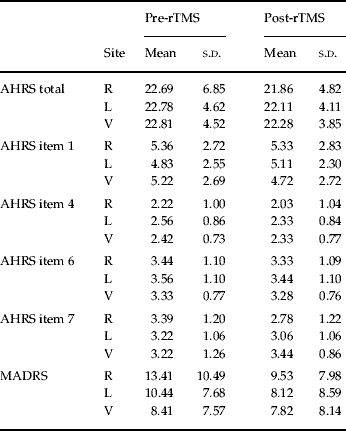
None of the MANOVA results reached significance using p<0.05 (see Table 1 for raw scores). For item 7 (level of distress associated with AH) there was a trend for patients to experience the AH as less distressing while receiving active treatment than sham treatment (F=3.32, p=0.087). The corresponding interaction contrast also approached significance (F=4.41, p=0.052), indicating that active treatment reduced the level of distress associated with the AH from pre- to post-rTMS, whereas sham treatment increased the level of distress from pre- to post-treatment.
Outcomes on the Auditory Hallucination and Montgomery–Asberg Rating Scales

rTMS, Repetitive transcranial magnetic stimulation; AHRS, Auditory Hallucinations Rating Scale: item 1, frequency; item 4, loudness; item 6, attentional salience; item 7, level of distress; MADRS, Montgomery–Asberg Depression Rating Scale; R, right; L, left; V, vertex; s.d., standard deviation.
Scores reported are raw scores for each of the three stimulation sites on each item pre- and post-rTMS.
Daily voices
The repeated-measures MANOVA revealed that there were no differences across the four time points or between the three stimulation sites; nor were the interactions significant (p<0.05).
MADRS scores
The repeated-measures ANOVA revealed there was a significant effect of time [F(1, 16)=12.43, p<0.01]. There was also a significant effect of stimulation site [F(2, 32)=3.59, p<0.0], but the interaction was non-significant (p>0.05). Paired t tests revealed that there was a decrease in MADRS scores from pre- to post-rTMS for right temporal rTMS [t(16)=2.45, p<0.05] and left temporal rTMS [t(16)=2.27, p<0.05] but not after sham stimulation (p>0.05).
Response rates during the cross-over phase
There were three responders (based on the total score of the AHRS) in the right condition, and two in each of the left and vertex conditions. One participant responded to both the left and vertex sites, resulting in a total of six participants responding to one or more of the stimulation sites. χ2 tests revealed no differences between the numbers of participants responding to each of the three stimulation sites (p>0.05).
Safety outcomes
Eight participants reported experiencing side-effects during the active treatment (right or left), with the most commonly reported side-effect being twitching during the stimulus. No side-effects were reported during the vertex (control) phase of treatment. All participants obtained the maximum score on language tests on all occasions. In one participant a 15-dB increase in auditory threshold (0.5–6 kHz range) was measured after he had received the three sessions of right temporal rTMS, with thresholds returning to pre-TMS levels 3 days later. Another participant had a 10-dB increase at 4 kHz after 10 sessions of open-label left temporal rTMS. In other subjects thresholds were unchanged or slightly improved.
Open continuation treatment phase
Nine participants continued with left temporal rTMS and six participants with right temporal rTMS, receiving between 1 and 6 weeks of additional rTMS. After 10 sessions of ongoing rTMS, the mean AHRS scores decreased from 22.3 to 18.3 (t=1.8, p<0.1). Four out of 14 participants (3/9 left temporal, 1/5 right temporal) met the criterion for response. These results were not significantly different between the right and left groups. Subjectively, 10 participants reported that they thought rTMS had been beneficial in reducing the intensity, frequency or associated distress of their hallucinations, even when this was not reflected in formal ratings.
Discussion
This study did not show that rTMS was superior to placebo in treating refractory AH, apart from the trend finding that hallucinations were less distressing after active than sham rTMS. One reason for our negative finding and the discrepancy between previous studies may have been the scale used to measure AH. Of interest, most participants subjectively reported an overall improvement in their hallucinations, although this was not reflected in the formal scores. The AHRS is a structured scale designed to measure change in AH, but may not have been sufficiently sensitive to capture the individual nature of changes experienced by each participant.
The clearest evidence for reduction in hallucinations after rTMS in sham-controlled trials was reported in studies where the Hallucination Change Scale (HCS) was used (Hoffman et al. Reference Hoffman, Boutros, Hu, Berman, Krystal and Charney2000, Reference Hoffman, Keith, Hawking, Gueorguieva, Boutros, Rachid, Carroll and Krystal2003, Reference Hoffman, Hampson, Wu, Anderson, Gore, Buchanan, Constable, Hawkins, Sahay and Krystal2005). Unlike the AHRS, the baseline for this scale is anchored according to each participant's individual narrative of their hallucinatory experience, with subsequent changes scored relative to this baseline. In the Hoffman et al. studies (Reference Hoffman, Boutros, Hu, Berman, Krystal and Charney2000, Reference Hoffman, Keith, Hawking, Gueorguieva, Boutros, Rachid, Carroll and Krystal2003, Reference Hoffman, Gueorguieva, Hawkins, Varanko, Boutros, Wu, Carroll and Krystal2005), significant differences between active and sham rTMS were found on HCS scores, although not on total AHRS scores or on Positive and Negative Syndrome Scale (PANSS) scores. Some items of the AHRS did, however, show significant changes; for example, frequency and attentional salience. It should be noted, however, that not all studies that used the HCS reported positive findings (Fitzgerald et al. Reference Fitzgerald, Benitez, Daskalakis, Brown, Marston, de Castella and Kulkarni2005). As such, it is possible that much of the variability in findings across studies has arisen from the difficulty of finding an appropriate scale for the measurement of changes in the hallucinatory experience.
The failure to find robust differences between active and sham rTMS in this study may also be attributed to the fact that only 3 consecutive days of stimulation were given in each condition. Other studies have, however, found significant improvements after only four daily sessions of rTMS (Hoffman et al. Reference Hoffman, Boutros, Hu, Berman, Krystal and Charney2000; Chibbaro et al. Reference Chibbaro, Daniele, Alagona, Di Pasquale, Cannavo, Rapisarda, Bella and Pennisi2005). Jandl et al. (Reference Jandl, Steyer, Weber, Linden, Rothmeier, Maurer and Kaschka2006) noted that the onset of response in those who improved occurred after the second day of treatment. In the open extension phase of our study, after a further 10 sessions of rTMS over 2 weeks (i.e. a treatment duration comparable to that of most previous studies), less than a third of our subjects showed ⩾20% improvement, although the mean AHRS scores improved.
It is unlikely that the stimulation parameters we used accounted for this modest response, as we used a comparable number of stimuli per session, higher stimulation intensity than hitherto used, and a larger coil, which is associated with less decline of the magnetic field with distance (Barker, Reference Barker1991). Consistent with previous studies, this study trialled 1 Hz rTMS for the treatment of auditory hallucinations, with the aim of inhibiting cortical excitability; however, it is possible that other stimulus parameters may be more effective. One patient whose hallucinations did not improve with 1 Hz rTMS subsequently responded to 20 Hz rTMS (Dolfus et al. Reference Dolfus, Larmurier-Montagne, Razafimandimby, Delcroiz, Allio, Membrey and Etard2008). There is also empirical evidence that the stimulus waveform (i.e. monophasic versus biphasic) may be important to the induction of lasting effects (Taylor & Loo, Reference Taylor and Loo2007). Our protocol included two brief 1-min breaks within the stimulation session, inserted partly for subject comfort and partly to allow changing of overheated stimulation coils, due to limitations of the technology. It is possible that these breaks may have reduced the efficacy of the stimulation paradigm, although there is no empirical evidence to support or refute this.
Most studies to date have trialled rTMS to the left temporoparietal area; however, both right and left temporal activation have been associated with auditory hallucinations in neuroimaging studies (Shergill et al. Reference Shergill, Brammer, Williams, Murray and McGuire2000; Sommer et al. Reference Sommer, de Weijer, Daalman, Neggers, Somers and Kahn2007). Consistent with this, the current study and the few other studies that examined left and right temporal rTMS for the treatment of hallucinations failed to find that either produced consistently better results (Lee et al. Reference Lee, Kim, Chung, Jung, Bahk, Jun, Kim, George and Chae2005; Jandl et al. Reference Jandl, Steyer, Weber, Linden, Rothmeier, Maurer and Kaschka2006; Aleman et al. Reference Aleman, Sommer and Kahn2007). Possibly, the advantage of left- or right-sided stimulation may be individually determined, depending on the underlying pathophysiology. This was suggested in the study by Sommer et al. (Reference Sommer, de Weijer, Daalman, Neggers, Somers and Kahn2007), in which the best results were obtained when rTMS was guided by functional MRI to areas of activation during hallucinations, whether in the left or the right hemisphere.
This study demonstrated that rTMS was well tolerated and safe. Minor changes in auditory threshold were noted in two participants. In one case these were transient, and the 10-dB change in the other participant at a single frequency could have resulted from measurement error, as intensity is incremented by 10 dB in the testing. These results emphasize the importance of participants wearing earplugs during rTMS.
The major limitation of this study was that only 3 days of stimulation were given to each test site, and this was probably insufficient to fully assess the benefits of rTMS. For example, the literature on rTMS treatment suggests that longer stimulation periods (e.g. every weekday for 4 weeks) and even twice-daily sessions are necessary to elicit the full benefits of rTMS (Loo & Mitchell, Reference Loo and Mitchell2005; Poulet et al. Reference Poulet, Brunelin, Bediou, Bation, Forgeard, Dalery, d'Amato and Saoud2005; Loo et al. Reference Loo, Mitchell, McFarquhar, Malhi and Sachdev2007; Jorge et al. Reference Jorge, Moser, Acion and Robinson2008). It is also possible that carry-over effects from the previous stimulation condition may have obscured the results, even though the order of stimulation was counterbalanced across participants. Additionally, the positive and negative symptoms of schizophrenia were not measured here, which may have affected hallucinations results.
The strengths of this study include the testing of left and right temporal rTMS versus a control condition, the precise localization of the stimulation site from individual MRI scans in the majority of participants, the use of more detailed assessment of mood and audiometry changes than in previous studies, and the use of higher stimulation intensity. The improvement in mood scores after only three sessions of rTMS was surprising, but might be associated with the use of a circular coil, which was larger and had a greater area of effective stimulation (across temporal, frontal and parietal areas) than the more typically used figure-of-eight coil. This approach has been minimally tested in depression trials (Loo & Mitchell, Reference Loo and Mitchell2005) and may be worth further examination.
Overall, these results did not support the effectiveness of rTMS as a treatment for AH. Given the caveats above, however, further research is encouraged, with particular attention to the measures used to assess changes in hallucinations, exploration of the role of right and also left temporoparietal stimulation, and different stimulation parameters.
Acknowledgements
This study was supported by research grants from the NSW Schizophrenia Fellowship, Rebecca Cooper Medical Research Foundation, and the National Health and Medical Research Council (NHMRC) Programme Grant no. 510135. Recruitment of participants for this study was supported by the Australian Schizophrenia Research Bank Register, which is funded by a NHMRC Enabling Grant, the Pratt Foundation, Ramsay Health Care and the Schizophrenia Research Institute. We thank Professor D. Copolov of the Mental Health Research Institute, Victoria, Australia, for advice on study design, and use of the Daily Voices Ratings questionnaire developed at the Institute.
Declaration of Interest
C. K. Loo, P. Mitchell and P. S. Sachdev were involved in the multicentre trial of rTMS in depression sponsored by Neuronetics (USA), which was independent of this study.