In the course of a Grand Tour undertaken between 1794 and 1796 and much of it spent in Greece and Asia Minor, John Bacon Sawrey Morritt of Rokeby, a wealthy country gentleman, member of parliament and knowledgeable classicist, wrote to his mother and sister Anne that in the Greek lands he had already amassed two hundred coins and medals and that he hoped soon to have two thousand. On visiting Pella he employed what he termed a ‘town crier’ to assist in increasing his collection, a move which resulted in the acquisition of several coins bearing representations of Philip of Macedon and Alexander the Great.
In Athens in 1795 he negotiated, in the event unsuccessfully, with the Turkish commandant of the Acropolis for the acquisition of one or two of ‘the alto-rilievos of Phidias which are over the grand colonnade’ of the Parthenon. ‘Do not you think,’ he wrote to Anne, ‘I shall make a pretty addition to the marbles at Rokeby’, his country house on the border between Durham and Yorkshire. While in Athens, he noted that above almost every door was ‘an antique statue or basso-rilievo’. ‘Some,’ he wrote, ‘we steal, some we buy.’Footnote 1 It was this mania for collecting (and, if necessary, stealing) on the part of those making the Grand Tour which affords the most likely explanation for the fact that the ornate tombstone of Meletios II, who was Archbishop of Constantinople, New Rome and Ecumenical Patriarch for some months in 1768–9, has lain for an unknown number of years in the extensive grounds of a mansion in the North London suburb of Muswell Hill.
So far we have found no evidence as to how the tombstone ended up in the garden of North Bank, a large Victorian mansion in Pages Lane, Muswell Hill, which now houses as an annexe Muswell Hill Methodist Church. Six miles from Charing Cross, Muswell Hill was developed at the turn of the nineteenth and twentieth centuries by two builders, W. J. Collins and J. Edmondson, and became one of the largest Edwardian suburbs in the country. To acquire land for development they bought a number of the large mansions with extensive grounds in Muswell Hill, for which the area was renowned. These had names such as Norton Lees, Rookfield, Grove Lodge, Leawood, Roseneath, Midhurst and Fortismere. A few had conventional names such as The Firs, The Limes and the Elms. These estates figure prominently in the 1896 Ordnance Survey map of Muswell Hill.Footnote 2
North Bank was built circa 1860 and is the last of the large mansions in Muswell Hill to survive. It is a substantial house of sixteen rooms. An indication of the wealth of occupants of the mansion is afforded by nineteenth-century census records. The young family living in the house in 1871, for instance, employed a staff of eight (five domestic servants, a gardener, a stable boy and a coachman). According to the 1881, 1891, 1901 and 1911 census returns, the house was owned by William Cooke, his wife Clara and their seven children. William Cooke was recorded as being a ‘carpet manufacturer’. When one of the Cookes’ sons who had lived in Northbank died in 1924, Guy Chester, a wealthy Lloyd's underwriter, purchased the house for the use of the Methodist Church.
While nothing appears to be known about where, when and by whom the tombstone of the Ecumenical Patriarch Meletios II was acquired or when it was placed in the grounds of North Bank, it would appear possible that this occurred during the long ownership by the Cooke family who lived at North Bank for half a century, between 1874 and 1924. It could be that William Cooke might, in the course of his business as a ‘carpet manufacturer’, have travelled in the Near East and come across the tombstone and transported it back to North Bank as a picturesque, if somewhat mysterious, garden ornament; but this can only be speculation.
Richard Clogg, a long-time resident in Muswell Hill, first learned of the existence of the tombstone in 1975 following a query by the Museum of London. Many years later, in October 2007, at the suggestion of Jon Bolter of Rees Bolter Architects and at the invitation of the Methodist minister, the Revd Andrew Dart, and the Warden of Chester House, Andrew Parkins, the late Julian Chrysostomides, at the time Director of The Hellenic Institute, Royal Holloway, University of London, together with her colleague, Dr Charalambos Dendrinos, visited North Bank and examined the tombstone. By this time the tombstone, which was already by 1975 broken into eight pieces, had been scattered through the grounds by vandals. The pieces had been gathered together and re-assembled with great care by Frank Cano, the North Bank gardener and an amateur archaeologist. A report was subsequently submitted by Miss Chrysostomides and Dr Dendrinos to Andrew Parkins. Much of the present article is based on this report.Footnote 3 Once the historical interest of the tombstone had been recognized it was safely secured on the North Bank premises.
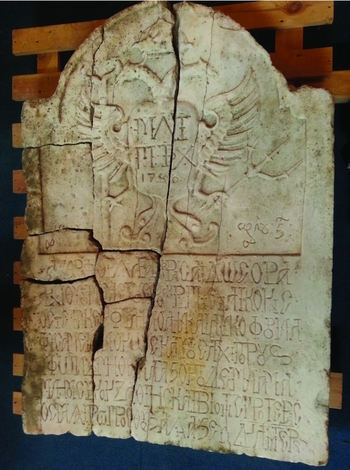
The Greek inscription on the memorial slab, incised on marble in epigraphical majuscule script, is decorated in relief with the insignia of the Ecumenical Patriarch of Constantinople, namely the double-headed eagle supporting the Byzantine imperial crown, and holding the pastoral staff and the trikēron (triple candlestick) representing the Holy Trinity (Fig. 1).
Tombstone of Ecumenical Patriarch Meletios II.

The inscription reads as follows:
Μ<Ε>Λ<ΕΤ>Ι<ΟΣ>
Π<Α>ΤΡ<ΙΑΡ>Χ<ΗΣ>
1780
Ἰανου αρίου 5:
+ ἌΝΘΡΩΦ᾿ ὍΝ ΛÃΑΝ ἈΦΟΡÃΣ. ΑἹΔΩΣ. ὍΡΑ ·
ΑΡΧΙΘΥΤΟΥ ΜΕΛΕΤΙΟΥ ἜΝΘΑ ΚΡΥΠΤΕΤΑΙ ΚΟΝΙΣ ·
ὋΣ ΤΕΤΙΜΗΚΕΝ ΦΥΛΗΝ ὍΛΗΝ ΚΑΙ ΛΥΚΟΦΡΟΝΑ ·
ΦΥΣΑΜΈΝ[Η]Ν ὋΝ ΩΣ ΚΑ᾽ΥΤΟΥΣ ΑΓΧΙΠΟΡΟΥΣ ·
ὙΦ᾿ ὯΝΔ᾿ Ὃ ΜΗΘΕΝ ΑΓΑΣΤ`ΟΝ ΤΌΔΕ ΜΝΆΜΑ
ΜΝΗΜΌΣΥΝΟΝ ΖΑΘΊΗΣ ΚΑ`Ι ΒΙΟΤ
 Σ ΠΡΟΤΈΡΑΣ ·
ὋΣ ΜΆΛΑ
 Ω ΠΡΟΣ Θ(ΕΟ)Υ ΣΤΑΛΗ ἌΣΤΕΥ Δ(ΈΣΠΟΙ)ΝΑ ΜΆΤΕΡ
The following is an edition and translation of the text:

Originally, the memorial slab must have been erected to mark the grave of the Ecumenical Patriarch of Constantinople, Meletios II (1768-9), as the name (ἀρχιθύτου Μελετίου), initials (ΜΛΙ ΠΤΡΧ., i.e. Μ<Ε>Λ<ΕΤ>Ι<ΟΣ> Π<Α>ΤΡ<ΙΑΡ>Χ<ΗΣ>) and date of death (5 January 1780) on the inscription indicate. Where he was buried is not known for certain but his grave may have been in his native island, Tenedos.
In his biographical sketch of Meletios, Sergios Makraios remarks on his strong personality, his humble and frugal character, and the quality and extent of his pastoral work, which earned him the respect of both clergy and laity.Footnote 5 Meletios distinguished himself by his love for education. During his brief patriarchate he paid particular attention to the re-organization and improvement of the Great School of the Nation (Μεγάλη τοῦ Γένους Σχολή), building up its library, securing regular funding and issuing regulations regarding the School's property, teachers’ salaries, students’ duties and the academic syllabus (comprising philosophy, literature and mathematics).Footnote 6
Born on the island of Tenedos in the Northern Aegean in 1700, Meletios was tonsured and ordained at an early age by the Metropolitan of Nicomedia Gabriel, who appointed him as his protosynkellos (chancellor). The administrative skills and experience that Meletios had acquired were put to good use when, at the age of fifty, he was elected to the Metropolitan See of Larissa, Greece, in June 1750. He succeeded in clearing the enormous debts that he inherited from his deceased predecessor, Metropolitan Iakovos, an achievement which eventually attracted the attention of the Holy Synod in Constantinople, which elected him to succeed Patriarch Samuel I (1763-8). Despite his initial reservations, Makraios remarks, Meletios accepted the nomination and ascended the Patriarchal throne of Constantinople on 6 November 1768. He remained in office for barely six months. On 16 April 1769 he resigned and was succeeded by Theodosios II (1769-73).Footnote 7
This short patriarchate was by no mean untypical. During the eighteenth century the office of Ecumenical Patriarch changed hands with extraordinary frequency. Between 1702 and 1797 there were no fewer than twenty-two patriarchs, some of whom held office on more than one occasion. This rapid turnover was occasioned in many cases by bribery and the endemic corruption that characterized the Ottoman system of government. The remark of an Armenian, a banker but who was nonetheless described as an honest man, to Athanasios Komninos Ypsilantis, the well-known chronicler of the Ecumenical Patriarchate and the Orthodox world in general in the Ottoman Empire after the Fall of Constantinople, that ‘you [Greeks] change your patriarchs more often than you change your shirts’ was uncomfortably near the bone.Footnote 8
A different aspect of Meletios’ character and personality was highlighted by Ypsilantis.Footnote 9 It seems that he has nothing good to say about Meletios and especially the powerful Grand Dragoman Nikolaos Soutzos, who is described as a ruthless person and a master of intrigue, whom Ypsilantis held responsible for the forced abdication of the long-suffering (πολύπαθος) Patriarch Samuel on 4 November 1768 and the election and enthronement of Meletios the next day. Ypsilantis’ hatred of Soutzos is revealed when he relates the accident ‘justly’ suffered by one of his sons (he fell from his horse and fractured his skull), ostensibly as a result of his father's breaking of his oath (ἐπιορκία).Footnote 10 Ypsilantis describes how Meletios promoted members of his coterie, including Anthimos of Mesembria to the Metropolitan throne of Cyzicus, and the son of the doctor Giannakis and grandson of Militsa by the name of Makarios to the Metropolis of Larissa.Footnote 11 In the meantime Soutzos’ feelings towards Meletios changed from ‘friendship to enmity and hatred’ as a result of the former's absurd demands.Footnote 12 What follows in this section of Ypsilantis’ work is a long account of the events that led to the outbreak of the Russo-Turkish War of 1768–74 during Meletios’ patriarchate, highlighting once more Soutzos’ sinister role and mentioning the declaration by Prince Nikolai Vasilyevich Repnin, in the treaty of Warsaw (1768), of the Russian Empress Catherine the Great as ‘Queen of the Greeks in all provinces in Asia and of the duchy of Courland’ (βασίλισσα τῶν Γραικῶν ὅλων τῶν ἐπαρχιῶν τῆς Ἀσίας καὶ τοῦ δουκάτου τῆς Κουρλανδίας).Footnote 13
The last part of Ypsilantis’ account gives details of Meletios’ arrest and incarceration. Ypsilantis places the blame for this on two unnamed Corfiot doctors who, in order to attract the favour of the Sultan, offered Turkish people their services without payment (‘θέλουν ἰατρεύει τοὺς ἀρρώστους Τούρκους ἀμισθί’).Footnote 14 This gesture actually had the opposite effect as it raised suspicion. The two doctors were accused of being collaborators of the Russians, were arrested and imprisoned. When they were interrogated under torture they at first repeated that they simply wanted to attract the favourable attention of the Sultan through their charitable works, but when the torture continued, in an effort to save themselves, they made up a story (‘ἔπλασαν’) that they had carried a letter from Stephen of Montenegro to the former Metropolitan of Larissa, the Ecumenical Patriarch Meletios. The Grand Vizier concluded that Stephen was linked to Meletios and that the latter was hiding him. To make things worse, the Vizier used the fact that the two doctors were carrying with them a τουλοῦμιFootnote 15 of saltpetre which they used to treat fever, accusing them of intending to poison the water and thus destroy the Ottoman army. So he ordered the army not to drink water from the wells and reported Meletios and the saltpetre to the Sultan. As a result the Ottoman authorities entered the Patriarchate by force on Lazarus Saturday, the day before Palm Sunday, searching for Stephen, and when they did not succeed in finding him they took Meletios and those present, who included the archidiakonos and oikonomos of the Patriarchate, and imprisoned them in the jail of the bostancıbaşı, the commander of the imperial guards charged with patrolling the shores of the Bosphorus, which he combined with the role of executioner of prominent figures.
The archpriests wrote to the Sultan denying the accusation that they were hiding Stephen, adding that they were ready to pay with their lives if this proved to be true. Subsequently Meletios was exiled to Mitylene on the island of Lesbos, ‘where’, so Ypsilantis claims, ‘soon afterwards he found, by divine providence, the reward (‘τὰ ἐπίχειρα’) of his maltreatment (‘παροινίας’) of Samuel, while the archpriests were ordered to elect a new patriarch’, namely Theodosios II of Thessaloniki, who was elected on Maundy Thursday, 16 April 1769.
The circumstances of Meletios’ resignation, as we have seen, are related to the Russo-Turkish War which was declared on 25 September 1768 and which led to the expansion of Russian influence in the Ottoman Empire with the signing of the Treaty of Küçük Kaynarca on 21 July 1774. In a short autobiographical note (signed and dated 23 May 1769) Meletios gave a detailed description and the dates of the events leading to his deposition and subsequent persecution,Footnote 16 which should be read in parallel with Ypsilantis’ account. Falsely accused of treason for allegedly siding with the Montenegrins against the Ottoman authorities, an accusation which carried the death penalty, Meletios was incarcerated together with more than thirty other clerics of the Ecumenical Patriarchate and lay members of the Greek community in Constantinople on 8 April 1769.Footnote 17 Though they were eventually cleared of the accusation on 18 April, Meletios was nonetheless deposed and exiled to Mitylene on 27 April 1769.Footnote 18
Following the victorious naval operations of the Russian Baltic fleet in the Mediterranean under the command of Count Aleksey Grigoryevich Orlov and the unsuccessful Greek uprising in the Peloponnese instigated by Orlov (February 1770), the Christian population suffered severe reprisals at the hands of the Ottomans. In a long autograph note (dated 10 January 1774) in the same codex, Meletios gives a detailed and vivid description of the persecution of the Greeks following the departure of the Russian fleet after the destruction of the Ottoman fleet at the battle of Çeşme off the coast of Asia Minor (7 July 1770). Meletios’ residence in Mytilene was looted and he himself was tortured, narrowly escaping death at the hands of irregular Turkish soldiers (14 July 1770).
Meletios was first incarcerated by the Ottomans, together with the Metropolitan of Mytilene Gerasimos and fifteen other members of the Greek community, in a private house, before they were moved to two successive prisons. A year later (31 October 1771) the Russian fleet bombarded Mytilene and landed on the island (2 November). Before leaving the island, the Russians looted not only Turkish but also Christian property in order to forestall Turkish accusations of Christian collaboration with the enemy. Meletios and the other prisoners were freed on 7 November 1771.
Following the death of Sultan Mustafa III (1757-74) on 10 January 1774, Meletios secured permission (8 July 1775) from his successor Abdülhamid I (1774-89) to return to Tenedos (24 July 1775). Two years later (26 April 1777), through the mediation of the Ecumenical Patriarch Sophronios II (1774-80), he was granted permission to travel to Constantinople to attend to private matters, on condition that he would remain in the Monastery of St George on the island of Antigone and would not extend his stay beyond sixty-one days.Footnote 19 This is Meletios’ last piece of autobiographical information written just before his departure for Constantinople.
Two letters addressed to Meletios IΙ are preserved in the archive of the Hellenic Institute of Byzantine and Post-Byzantine Studies in Venice (AEIB, Α′. Ὀργάνωση-λειτουργία, 4. Γραμματεία, Κατάστιχο 2, ff. 3–9). These letters are part of a dossier with correspondence (20 October 1768-10 June 1769) between the Greek Community in Venice and officials in Constantinople (including the Venetian bailo Girolamo Ascanio Giustinian and the dragomans Christophoros Rallis and Antonios Pinis), requesting the transfer of Nikephoros Mormoris, Bishop of Cythera, to Venice in order to fill the vacant see of the bishop of Philadelpheia after the death of their Bishop Gregorios.Footnote 20 Apparently, the first letter (ff. 4–5), dated 26 November 1768, was not answered, and therefore a second, similar letter (ff. 5–6) was dispatched to Meletios a month later (26 December 1768), again receiving no reply. Subsequently, the Greek Community renewed their request on 30 May 1769 with a third letter (ff. 12–13), this time addressed to Patriarch Theodosios II, as Meletios had been deposed a month earlier (27 April).
Nothing is known about the last years of Meletios’ life. The unpublished inscription on the memorial slab in the garden of North Bank in London is the only evidence we possess of the date of his death (5 January 1780). According to unconfirmed information, Meletios died in extreme poverty on the island of Tenedos, where he had been born.Footnote 21 Unfortunately there is no reference to the place of his death or his burial on the inscription that would confirm this.
Clearly, Ypsilantis paints a different picture of Meletios’ character and personality than other sources which stress his abilities as a financial administrator (first in Larissa and then in Constantinople), his educational work, and his painful experiences following his forced abdication.Footnote 22 It seems that Ypsilantis was much attached to Samuel, and this explains his antipathy towards Meletios and all those who he considered had taken advantage of Samuel and finally brought about his downfall, above all Nikolaos Soutzos. However this may be, Meletios appears to have been remembered with great affection by his anonymous friends and relatives who commissioned the marble memorial slab. The precise circumstances of his death and burial remain so far unknown, as does the question of the how the tombstone ended up in Muswell Hill.
After the death of Julian Chrysostomides on 18 October 2008, the attention of the Ecumenical Patriarchate and the Archdiocese of Thyateira and Great Britain was drawn to the existence of the tombstone. Following discussion with the Methodist authorities the return of the tombstone to Constantinople was agreed.
On 23 May 2013, His Eminence the Archbishop Gregorios of Thyateira and Great Britain visited the Muswell Hill Methodist church at North Bank and the adjoining Guy Chester Methodist Centre to receive the tombstone on behalf of the Ecumenical Patriarchate, in the presence of a small circle of friends from both confessions who gathered on this special occasion.
On his arrival at the church, Archbishop Gregorios was greeted by the director of the Guy Chester Centre, Fraser Mackay, the minister of the Methodist Church at North Bank, the Revd Mike Long, and the Revd David Gamble, former President of the Methodist Conference and subsequently chair of the Methodist Council. A ceremony took place in the church, with the tombstone placed before the altar for blessing. After a short welcome by Fraser Mackay, the Revd David Gamble addressed the gathering and read a prayer. Archbishop Gregorios expressed the gratitude of the Ecumenical Patriarchate to the Methodists for their willingness to return Meletios’ tombstone. Assisted by Bishop Athanasios of Tropaeou, Presbyter Evangelos-Nikolaos Liassis, and Deacon Meliton B. Oakes, he then chanted a memorial service, in Greek and English, for the late Patriarch.
In this moving ecumenical atmosphere the tombstone was transferred to the Archdiocese of Thyateira in London, before it continued on its final journey to Constantinople, as a reminder of the remarkable life of the Ecumenical Patriarch Meletios II and as a symbol of Christian unity. It must be right that this tombstone, one of the oldest memorials of an Ecumenical Patriarch, should rest at the heart of the Orthodox world.