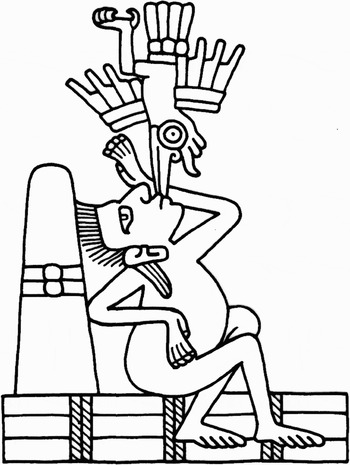
A Late Classic painted plate from the Maya Lowlands shows a beautiful young woman sitting in front of a dreadful insect (Figure 1; De Castro Reference de Castro2007; Object 159). The creature's skeletal head is decked with eyeballs, its ear pierced by a red-stained paper strip, and the ak'bal sign on its wing marks it as a nocturnal being. The annoying pest bites the lady's nipple with a long, pointed sting, while she raises her hand, as if ready to slap it dead. Yet, her outward distress may conceal an ambivalent attitude towards the insect's harassment. As interpreted in this paper, this is no ordinary insect bite. The plate shows a portent that appears recurrently in Mesoamerican myths: the impregnation of a maiden by a disguised god, a crucial juncture in the theogony of ancient and modern Mesoamerican peoples.
Mosquito biting a maiden's breast. Detail of Classic Maya plate, Object 159 in De Castro (Reference de Castro2007). Drawing by the author, after a photograph courtesy of Inés de Castro.

Importantly, this Lowland Maya plate can be explained only by comparison with mythical narratives that have been recorded in other Mesoamerican regions, including the Pacific Coast, Oaxaca, central Mexico, and the Gulf Coast. In this paper, I trace the subtle ways in which the Classic Maya depicted this episode in the light of parallel myths recorded throughout Mesoamerica. Furthermore, I show that narratives from the Maya area and elsewhere are relevant for the interpretation of related mythical passages in central Mexican sources. Ancient and modern versions of the myth are inextricably rooted in the Mesoamerican religious tradition, characterized by Alfredo López Austin (Reference López Austin1996a:34–40) as an organized whole that includes widely different forms of thought and cult, integrated by historical processes. In the following pages, the essential unity of Mesoamerican religion is underscored by the identification of widespread beliefs related to weaving and spinning that intertwine consistently with this mythical thread.
Several scholars have noted the myth's broad geographic distribution. In his compilation of Maya creation stories, Eric Thompson (Reference Thompson1970:370–371) compared the hummingbird's role in sun and moon tales with parallel passages in Mixe, Chatino, and Aztec narratives. Eva Hunt (Reference Hunt1977) and Elizabeth Benson (Reference Benson and Preuss1989) explored the bird's mythological role related to warfare, love, and solar symbolism, while both Benson and López Austin (Reference López Austin1996a:34) found striking parallels in South American religions. Michel Graulich (Reference Graulich1983:577–581; Reference Graulich1997:52–59) related the Maya stories with the Aztec myth of Tamoanchan, which he interpreted as a major rupture that resulted in the end of immortality, the introduction of death and procreation, the origin of the sun and the moon, and the creation of cultigens.
H. E. M. Braakhuis (Reference Braakhuis2001, Reference Braakhuis2005) used the term “hummingbird myths” in reference to mythical episodes in which a hero attempted to marry the daughter of an earth god, using a magical transformation to achieve his goal. In contemporary Maya stories, the hero invariably takes the shape of a hummingbird—often called burrión or gorrión in common Guatemalan usage (Sandoval Reference Sandoval1941). Elsewhere, other beings and even objects may take its place, and yet the hummingbird recurs frequently enough to justify the application of Braakhuis's label to a wide group of stories, not all of which involve the bird's participation. Comparing episodes from several places across Mesoamerica, López Austin (Reference López Austin1996a:338–341) concluded that the transformational identity of the male partner and even his actions were superfluous to the nodal subject of the myth: the hierogamy of two mythical characters that personify heaven and earth. Invariably, this union took place against the will of the maiden's parents, initiating an extraordinary sequence of creational events.
The myth's broad distribution and numerous variants suggest great antiquity. The range of variation present in contemporary accounts opens the question of how to recognize ancient representations of stories that must have varied considerably through time and space. Potentially, storytellers from every community and language group may have developed a wide array of variations, which must have evolved through time. Indeed, this supposition is supported by the iconographic analysis of pre-Columbian imagery.
López Austin's meticulous study of Mesoamerican mythology offers a way to approach these problems. This paper is grounded in his discussion of “synonymies,” episodes that recur in slightly variable ways and yet are so similar to each other that they suggest a significance beyond the level of “heroic subjects,” the particular feats that may vary in every single version of a myth (López Austin Reference López Austin1996a:328–329). Comparison of multiple versions in search for synonymies is a heuristic procedure that leads to the identification of “nodal subjects,” the essential themes of mythical narratives. Nodal subjects refer to basic creative processes, revealing the profound significance of feats. They lie at the core of myths and may remain stable through time and space, while the specific actions that form the narrative thread may vary (López Austin 1993:247–259; Reference López Austin1996a:320, 388). The heroic subjects of myths provided a rich source of visual images for ancient artists and craftsmen. It is the task of modern researchers to identify the nodal subjects behind images, unraveling the complex interplay between oral narratives and artistic representations. Synonymies in oral and written literature throughout Mesoamerica provide insights for the interpretation of pre-Columbian imagery in the Maya area and elsewhere.
THE ABDUCTION
Traditional marriage petitioning ceremonies in the Guatemalan highlands involve the recitation of long prayers by religious specialists, acting on behalf of the groom and his family, at the bride's parents' house. Mythical narratives form the core of prayers recorded by Palomino (Reference Palomino1972) among the Ixil of Chajul and by van Akkeren (Reference van Akkeren2002) in the K'iche town of Rab'inal. In both cases, the prayers refer to mythical unions that took place against the will of the heroine's father. The Rab'inal prayer recounts the magical impregnation of a maiden and her flight from her father's rage. After escaping his executioners and enduring much hardship, she gave birth to the son of God. While the prayer is strongly influenced by Christianity, van Akkeren notes its parallels with the story of Lady Xkik', as told in the Popol Vuh. In the sixteenth-century K'iche epic, the magical impregnation of Lady Xkik' was a turning point that ultimately resulted in the birth of maize and the origin of the sun and the moon (Christenson Reference Christenson2003:128–134).
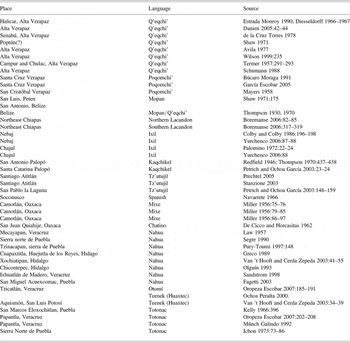
The Ixil prayer tells a different story, about the seduction of a maiden by a disguised hero, who took the shape of a hummingbird, and their eventual flight from her father's rage (Palomino Reference Palomino1972:129–149). Best known from the Q’eqchi’ of Alta Verapaz, the story has also been recorded in the Maya Lowlands, among the Mopan and Lacandon, and in the highlands, among the Poqomchi', Ixil, Kaqchikel, and Tz'utujil. The narratives that were studied for this paper are listed in Table 1. The reader is referred to this table for bibliographic references that are sometimes omitted in the text for the sake of readability.
Ethnographic versions of the hummingbird myth consulted in this paper

One of earliest and most elaborate versions of the story was recorded by Pablo Wirsig in 1909, as narrated by Juan Caal, and later published by Quirin Diesseldorff (Reference Quirin Diesseldorff1966–Reference Quirin Diesseldorff1967) and Estrada Monroy (Reference Estrada Monroy1990). The moon was a young weaver who lived with her father. Trying to entice her, the sun first posed as a hunter, carrying a stuffed deer skin, but the trick failed when he slid on the maize-cooking water that she threw on his path, following her father's advice. The sun then borrowed the hummingbird's feathers and flew over a tobacco plant that had grown at the place where the ash-stuffed deer skin fell. Attracted by the beautiful bird, the girl asked her father to capture it alive for her, which he did by shooting it with his blowgun. She first put it in the gourd where she kept her yarn, but the bird was restless, so she placed it inside her blouse, where it stayed quiet. She went to bed with the bird on her chest. At midnight, he manifested himself as a man and they escaped, fearing her father's anger. Realizing the deception, the old god asked for help from his relative, Lightning, who stroke them with his axe as they reached a lake. Sun escaped by hiding inside a turtle carapace. Moon hid inside the armadillo's armor, but it broke and Lightning killed her, spilling her blood in the water. With the help of dragonflies, Sun recovered the blood and placed it in thirteen jars. When he opened them thirteen days later, the first twelve jars contained all kinds of serpents, lizards, biting insects, spiders, scorpions, centipedes, and caterpillars. He asked a woodcutter to throw the jars in the lake, but the curious man opened them, and the vermin came out. Moon appeared in all her beauty from the thirteenth jar. They finally rose to the sky as the sun and the moon.
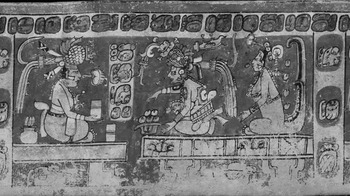
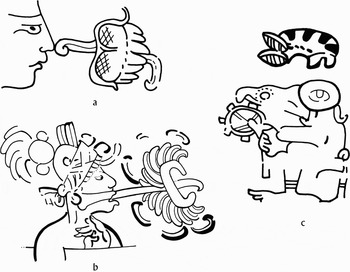
The characters represented on the Classic Maya vase K504Footnote 1 (Figure 2) are strikingly similar with those of the Q’eqchi’ story. A young moon goddess shares a celestial throne with an old god—possibly the paramount celestial god Itzamnaaj—who gestures over a plate full of tamales. He is about to receive two drinking vases from a young man who occupies a lower, unadorned bench on the left side of the scene—an indication of his lower status (cf. Houston Reference Houston and Houston1998:341). This young man poses as a hummingbird, as suggested by the flower-piercing, curved beak projecting from his nose (Figure 3). Seler (Reference Seler and Comparato1996:231) first showed that representations of hummingbirds in the Maya codices were distinguished by a circle of dots on the beak—now known to represent a pierced flower. While the vase includes no hint of the relationship among these three characters, their relative age and position in the scene are compatible with the myth's argument: the young moon goddess is likely the old god's daughter, while the hummingbird man is her suitor.
The old god, the moon maiden, and the hummingbird. Classic Maya vase K504. Rollout photograph by Justin Kerr, Maya Vase Data Base (http://www.mayavase.com).

Representations of hummingbirds and hummingbird impersonators in Maya art, characterized by their long, curved beaks with pierced flowers. (a) Detail of Vase K504; (b) Detail of Late Classic vase from the Naranjo region, in the collection of the Museo de Arqueología y Vidrio Moderno, Antigua Guatemala; (c) Detail of Madrid Codex (p. 20c), with the glyphic name tz'unun, “hummingbird”. Drawings by the author.

No episode involving a direct negotiation between the hummingbird and his potential father-in-law appears in the Q’eqchi’ myth. However, the vase may derive from a different version of the story, one in which the girl's father received the suitor's respects. Indeed, Kaqchikel and Ixil versions, including the Chajul marriage petitioning prayer (Palomino Reference Palomino1972), involve such a passage. Discovering their illicit affair, the old god allowed the couple to marry, under the condition that his son-in-law fulfill Herculean tasks for him, such as building a large house or planting and harvesting an entire maize field in short periods. The hero succeeded thanks to magical help from his wife, and they ran away only after finding it impossible to satisfy the demanding father-in-law, who killed the girl with lightning. In these versions, the girl's remains generated all kinds of game animals and honey bees (Colby and Colby Reference Colby and Colby1986:196–198; Redfield Reference Redfield1946; Thompson Reference Thompson1970:365–366).
Bridal service was also imposed on the Lacandon hero who had hunted all the gophers in the forest and disguised himself as a hummingbird to approach the death god's daughter. He had to bring the god's disgusting food and firewood—wood mushrooms, pus, larvae, and human bones. He also had to clean his father-in-law's house and milpa, and make balche for him. Most importantly, he had to replace all the animals that he had killed—by procreating gophers with his wife (Boremanse Reference Boremanse2006:82–85). Related stories throughout Mesoamerica omit the suitor's initial transformation while concentrating on the couple's magical fulfillment of impossible tasks and their flight from the maiden's insatiable father (Abramo Lauff Reference Abramo Lauff2004; Münch Galindo Reference Münch Galindo1994:162–163; Thompson Reference Thompson1930:167–178).
In his penetrating analyses, Braakhuis (Reference Braakhuis2001, Reference Braakhuis2005) explained the myth's sexual symbolism. In Maya narratives, the relationship of man to the earth and its products is construed as analogous to the pursuit of wives. By abducting the earth god's daughter, the hero fails to fulfill his obligations toward his father-in-law, thus incurring his rage. Without proper compensation, the old god refuses to let him harvest the earth's yield, personified in his daughter. “The relationship of man to the earth and its bounty can apparently be viewed as an affinal relationship or, rather, as a permanent state of being a suitor…” (Braakhuis Reference Braakhuis2005:174) As noted, alternative versions make the earth god's daughter capable of generating useful products such as game animals, honey bees, and, sometimes, the basic staple, corn.
THE HIEROGAMY
Most contemporary Maya accounts concentrate on the hero's conflict with his father-in-law and the couple's flight from his rage. In this respect, they approximate the narrative of the Popol Vuh, which also recounts the escape of Lady Xkik' from her father. Unlike the Popol Vuh, most Maya myths fail to mention heroic offspring from this tragic romance. Exceptions include a Tzotzil version from highland Chiapas (Guiteras Holmes Reference Guiteras Holmes1986:153–154), and a Tz'utujil account published by Stanzione (Reference Stanzione2003:79). In the latter, the weaver YaSar found a hummingbird—the Sun—lying on the floor and placed it between her breasts. Her son was MaNawal Jesukrista', a god whose story coincides only partly with that of the Christian Jesus.
By contrast, the product of the illicit affair is the focus of non-Maya accounts. A good example is Howard Law's story of Tamakasti, from the Nahua town of Mecayapan, Veracruz, as told by Víctor Cruz. The daughter of a she-devil (tsitsimilama) fell in love with a bird that could speak. He wanted to marry her, but the girl's mother opposed the marriage, arguing that she had a lot of work to do making napkins. Without the mother's consent, the bird danced upon the girl, who became pregnant. He never came back. When Tamakasti was born, his grandmother cooked and ground him, and tried to feed him to the ants and fish, but he escaped unharmed. She threw him in a lake, only to find him three days later, shaped like an egg that floated on the water. The women put him inside a trunk that burst open thirty days later, giving birth to various animals. After playing several magical tricks on the tsisimilama, he reappeared as a boy and stayed with the family. His grandparents plotted to eat him, but he first killed the grandfather and let the grandmother drink his blood. Then he boiled her in a cauldron and burned their bones together. He entrusted a toad to take the ashes and throw them across the ocean, but the unworthy envoy threw them on the shore, freeing mosquitoes, flies, and gnats. The story ends with the hero's search for his father and his eventual marriage, in a series of episodes that may be influenced by European folk tales (Law Reference Law1957). The story of Tamakasti parallels numerous myths that relate to the origin of maize or the origin of the sun and the moon, not all of which include the hero's mother's magical impregnation (cf. Graulich Reference Graulich1987; Braakhuis Reference Braakhuis, van Zantwijk, de Ridder and Braakhuis1990).
Despite the divergent episodes, this account has much in common with Maya myths, beyond its inception with the maiden's love affair with a bird. A critical feature is the maiden's seclusion. Most stories make clear that she kept away from men, either by her own will or by her parents'. Also essential is the parents' contempt of her suitor, which prompts his trickery, setting in motion various conflicts, either between the hero and his unwilling in-laws or between the illegitimate offspring—sometimes twins—and their mother's family. The outcome of these tales seems divergent—the creation of the sun and the moon in the Q’eqchi’ story and the origin of maize in the Nahua versions from Veracruz, Puebla, and Hidalgo. However, a comparison with related accounts blurs this contrast. In some Q’eqchi’ and Poqomchi' stories, the girl was not killed by her father. Instead, she remained hidden in a cave, where she became maize (Búcaro Moraga Reference Búcaro Moraga1991:71; Mayers Reference Mayers1958:6; Schumann Reference Schumann1988). In Mixe and Chatino stories from Oaxaca, the girl's offspring eventually became the sun and the moon, while in Totonac versions, the girl's son—or twins—planted a maize field before transforming into the sun and the moon (Kelly Reference Kelly1966:396; Münch Galindo Reference Münch Galindo1992). The overlap is not trivial; in ancient and contemporary Maya thought, the origin of maize and the advent of the first dawn are regarded as aspects of the same creational event (Carlsen and Prechtel Reference Carlsen and Prechtel1991:31–32; Tedlock Reference Tedlock1996:225–226).
A crucial detail in Law's Nahua myth is the maiden's work making napkins. Her role as a weaver is emphasized in most Maya and Mixe accounts, although it is rarely mentioned elsewhere. The significance of this role goes far beyond the bare indication of her daily chores. A comparison of related episodes highlights the synonymous nature of these mythical narratives while revealing details of widespread Mesoamerican beliefs associated with weaving and spinning.
THE POWER OF THE LOOM
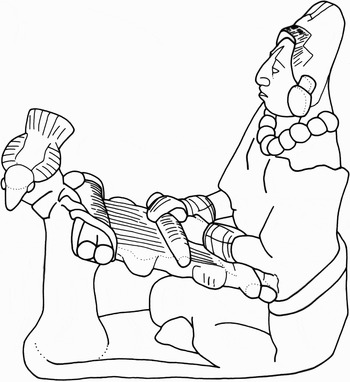
Donald and Dorothy Cordry (1968:46) and Hilda Delgado (Reference Delgado1969) first saw the weavers represented in Jaina-style figurines as representations of the young weaver that instigated the bird's passion in many versions of the myth (Figure 4). The best-documented example, excavated by Delgado on Jaina Island, has a bird perched on the stump that holds the loom. The mischievous bird teasing the dutiful weaver is a charming motif, particularly close to Mixe and Maya versions of the myth in which the girl is almost invariably a dedicated weaver. As such, she embodies the ideal of a perfect, well-raised woman and a desirable wife. These were the thoughts of the sun hero, in Wirsig's Q'eqchi text: “She is good!—he said in his heart—she I would take for my wife” (Estrada Monroy Reference Estrada Monroy1990:111).
The weaver and the bird, represented on a Late Classic Maya clay figurine from Jaina Island. Drawing by the author, after Schmidt et al. (Reference Schmidt, de la Garza and Nalda1998:158).

Weaving in ancient Mesoamerica was an inherently female craft that involved physical training and corporal adaptation since childhood (Burkhart Reference Burkhart, Schroeder, Wood and Haskett1997; Hendon Reference Hendon2006; McCafferty and McCafferty Reference McCafferty, McCafferty, Schevill, Berlo and Dwyer1991; Sullivan Reference Sullivan, Benson and Boone1982). Together with spinning, it lay at the root of femininity, likened to both sexual intercourse and procreation. For the contemporary Tz'utujil, weaving is a creational process that shares the qualities of birthing. The loom is a living creature whose parts are named after human body parts such as the head, the heart, and the buttocks. The loom is fed in the weaving process and the back and forth motion of the weaver's hips simulates childbirth. The weaving sticks, identified as aspects of important female deities, are placed by midwives on the stomach of pregnant women to aid delivery (Prechtel and Carlsen Reference Prechtel and Carlsen1988).
The magical power of the loom is subtly reflected in the more elaborate Q'eqchi versions of the hummingbird myth. As long as she keeps weaving, the eager suitor cannot triumph over the dedicated maiden. Therefore, he must find a way to turn her away from the loom. An intriguing sentence in Thompson's account from San Antonio, Belize, highlights the break in her labor. Distracted by the beautiful creature, she suspended weaving to pick the hummingbird that fell to the ground, stunned by her father's shot. “As she stooped down, the strap which passed round her waist and held the loom taut slipped, and the loom fell to the ground” (1930:127). Seemingly inconsequential, this sentence marks the moment in which the bird overcame her resistance; her defeat was the consequence of her loosing the magical protection of the loom.
In Mario de la Cruz Torres's Q’eqchi’ version from Senahú, the maiden developed a strong toothache after the hero threw fifteen red corn grains over her house. The nature of her pain was not casual. A medical survey revealed the Q’eqchi’ belief that toothache could be caused by sexual transgressions, and young men suffering toothache were suspected of making a woman pregnant or having sex with pregnant women (Avila Reference Avila1977). In the Senahú story, the maiden's toothache was propitious for the suitor's aim because it kept her away from weaving. While she cried, he borrowed the hummingbird's outfit and flew over the tobacco plant, sucking nectar from the flowers. The very sight of the bird calmed her pain, and she resumed weaving after placing the bird in the gourd where she kept her yarns—a likely allusion to her womb—but she started making only bird patterns. In several versions of the story, the girl tells her father that she wants the bird as a model for her weaving designs (Búcaro Moraga Reference Búcaro Moraga1991:70; Colby and Colby Reference Colby and Colby1986:196; Petrich and Ochoa García Reference Petrich and Ochoa García2003:149). Thus, the suitor's magic allows him to enter the ultimate domain of her womanhood—her weaving.
The necessity of neutralizing women's weaving magic also applies to the evil grandmother. In stories recorded among the Chatino, Mazateca-Popoloca, and Tlapaneca of Oaxaca and Guerrero, the mischievous twins that she adopted made the old woman angry by messing up her cotton yarns and weaving tools (Bartolomé Reference Bartolomé1979:23; Van der Loo Reference Van der Loo and Sullivan2002:76; Weitlaner Johnson and Basset Johnson Reference Weitlaner Johnson and Basset Johnson1939:218). In Víctor Cruz's story of Tamakastsi, a related episode explains the hero's victory over his grandmother. After his rebirth from an egg that floated in the water, the boy took the shape of a bird and found his grandmother weaving under a nance tree. Suddenly, she became unable to weave. She picked a nance fruit from the ground and ate it, wondering if her grandson had knocked it down for her. After that, lice infested her head. She cut off all her hair, and the bird threw a ripe nance on her bald head. In the next episode, the boy reappeared as a cat, stole a banana from his grandmother, and threw it at her. Only after playing these magical tricks, he manifested himself as a boy, subsequently triumphing over his monstrous grandparents (Law Reference Law1957:348–349). The sexual connotations are noticeable, especially in the grandmother's comment about the fruit: “Oh, how delicious is this nance and so big!” In another Nahua version, the hero threw a ripe fruit directly into the old woman's loom (García de León Reference García de León1969:302). Thus, the attack on the woman's weaving is equated with sexual assault, symbolized by her eating the fruit—a widespread metaphor for sexual intercourse in ancient and modern Mesoamerica (Graulich Reference Graulich1983:577; Tarn and Prechtel Reference Tarn and Prechtel1990). The crucial detail is the woman's inability to weave any longer, which explains her subsequent defeat.
The evil old woman reappears in Nahua myths from San Pedro Jícora, Durango, recorded in 1907 by Konrad T. Preuss (Reference Preuss1982:87–103; cf. Olivier Reference Olivier2005). Under the name of Tepusilam, she was a monster that ate many of her relatives. To kill her, they organized a party and sent the hummingbird to bring her to it. The bird made her drunk with maguey wine—mixed with scorpions and other pests, according to one version. On her way to the party, she lost her balls of yarn and her molcajete—the small bowl in which the spindle is spun. “With this, she lost all her skills and wiles” (Preuss Reference Preuss1982:99). Completely drunk, she passed out at the party, and the people burned and ate her. Some versions make it clear that the hummingbird was the only one who could bring her to the party, and the loss of her cotton and weaving implements along the way is always crucial for her defeat.
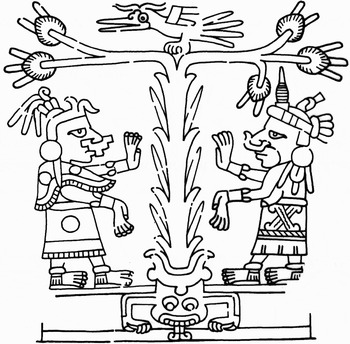
The cosmic diagram on page 1 of the Codex Féjerváry-Mayer shows the goddesses Tlazolteotl and Chalchiuhtlicue on the west, standing under a spiny tree (Figure 5). By no coincidence, the bird perched above them is a hummingbird. Arguably, the association of this bird with the female goddesses is derived from its role in hummingbird myths. Tlazolteotl, the Aztec goddess of cotton, spinning, and weaving, was closely related with love and sexual license (Sullivan Reference Sullivan, Benson and Boone1982). In this diagram, she wears on her head a spindle thick with thread—a frequent attribute shared with other female goddesses in Maya and Aztec religion (Taube Reference Taube and Kerr1994; Thompson Reference Thompson1970:246–247). The goddesses often wore unspun cotton on the head and sometimes carried weaving implements such as spindles and battens, interpreted by Sullivan (Reference Sullivan, Benson and Boone1982:18) as their weapons. A Trique myth from Oaxaca tells how the constellation of Taurus was formed when the irate old woman threw her weaving sticks at the twins who ascended to the sky and transformed into the sun and the moon (Hollenbach Reference Hollenbach1977:131).
The hummingbird perches on the tree of the west, above the goddesses Tlazolteotl and Chalchiuhtlicue. Detail from Codex Féjerváry-Mayer (page 1). Drawing by the author.

More than simple adornments or symbols of their daily labor, the spindles and cotton worn by the goddesses may be understood as magical utensils that protected them—and their human advocates—from the hummingbird's magic. Without them, they were exposed to the power of their foes, ending up dead as the grandmothers or falling into the arms of their suitors—the probable destiny of the seductive weavers represented in Jaina-style figurines.
THE MAIDEN AND THE BIRD
The magical qualities of weaving and spindling implements may explain their presence in high-ranking burials, noted especially in Mixtec tombs from Oaxaca (Hamann Reference Hamann, Claassen and Joyce1997; McCafferty and McCafferty Reference McCafferty and McCafferty1994). At the Late Classic site of Mirador, Chiapas, a woman was buried with twelve bone picks, one of them shaped as a quetzal (Agrinier Reference Agrinier1970:47–48). Avian imagery is also present in contemporary weaving picks from the Guatemalan highlands (Karl Taube, personal communication 2008). Recent research by Follensbee (Reference Follensbee2008) shows that hummingbird-shaped jade picks, traditionally identified as bloodletters, were most likely elite weaving tools. Unprovenanced examples attributed to the Middle Formative Olmec (Taube Reference Taube2004:122–125) may provide the earliest evidence of the bird's association with weaving, perhaps inspired by ancient versions of the hummingbird myth. Hummingbird-shaped jade picks have also been found in Classic Maya sites (Follensbee Reference Follensbee2008:101).
The Cordrys related the bird figures on weaving picks used by Cuicatec and Mixtec women with hummingbird myths. “When we asked what bird was represented, we were told with what seemed ribald laughter that it was the zanate (grackle)” (Cordry and Cordry Reference Cordry and Cordry1968:45–46). The cause of their amusement was their familiarity with the story, documented in Oaxaca among the Chatino and Mixe, although the published versions fail to identify the bird.
The avian suitor is a hummingbird in most Maya myths as well as in some Nahua versions from the Sierra de Puebla, but he becomes a zanate in a Nahua version from Hidalgo and among the Teenek. Elsewhere, the bird remains unidentified, and, in fact, it is sometimes replaced by another animal or object. In a Tzotzil version from Chenalhó, Chiapas, the hero disguised himself as a dog to approach the maiden while she washed by the river and conquered her by stealing her skirt—another way of attacking the woman's weaving, as she was likely to have woven her own clothing (Guiteras Holmes Reference Guiteras Holmes1986:153). López Austin shows that the hummingbird's participation falls in the realm of heroic subjects, whereas the underlying nodal subject is the hierogamy between the maiden and the disguised god.
Narratives from highland Mexico and the Gulf Coast share with the Tzotzil version the fact that the prodigy happened in the water, with or without the bird's intervention. In Totonac stories, the girl swallowed a brilliant trinket or an egg that she found in a spring. Her son planted maize and later became the sun, while according to one version his twin brother became the moon (Kelly Reference Kelly1966; Münch Galindo Reference Münch Galindo1992). In a Nahua story from Hidalgo, a maiden went to a spring and found a beautiful green stone. She placed it in her mouth and became pregnant, giving birth to the maize hero (Van 't Hooft and Cerda Zepeda Reference Van 't Hooft and Cerda Zepeda2003:41–55). Another story from the same region tells about a girl attracted to the song of a zanate while washing clothes in a river. In the hope of singing like the bird, she swallowed a grain of maize that the zanate dropped in the water (Greco Reference Greco1989). According to the Teenek, the girl that was bathing simply turned her head to see the bird, which dropped a grain in her open mouth. In some versions, the impolite zanate defecated in her mouth (Ochoa Peralta Reference Ochoa Peralta2000; Van 't Hooft and Cerda Zepeda Reference Van 't Hooft and Cerda Zepeda2003:34–39). Invariably, she became pregnant and gave birth to the maize hero.
The girl's impregnation is less important in the Maya area perhaps because in most versions, her only offspring were animals or insects. A majority of accounts tell that the bird retook his human shape at night, but sexual intercourse is seldom mentioned. A crucial prelude appears in some stories: To calm down the restless bird, or to revive it, the maiden sheltered it inside her blouse or skirt. By doing this, according to a Tz'utujil version, she became pregnant (Stanzione Reference Stanzione2003:79). The same episode appears in Chatino and Mixe stories from Oaxaca, some of which specify that once inside her blouse, the naughty bird bit the girl's nipples, thus impregnating her (De Cicco and Horcasitas Reference de Cicco and Horcasitas1962; Miller Reference Miller1956:76–79). While working in the Soconusco region of coastal Chiapas, Carlos Navarrete recorded a parallel story, told by Jesús Pérez (1966). God asked a beautiful girl in marriage but was rejected. Transformed into a bird, he came back while she washed clothes, but the girl hit it with a stick—a weaving stick in a parallel Mixe version. Compassionate, she revived the bird by placing it in her bosom. The bird bit her nipples, which made her pregnant, and flew away. Her twin offspring became the sun and the moon.
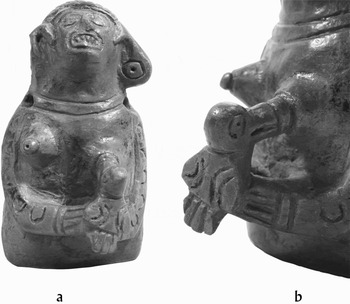
Navarrete cautioned about ancient and modern population movements that resulted in the incorporation of beliefs and traditions from many regions to the local repertoire. However, there is evidence that this mythical episode had great antiquity in Soconusco, going back at least to the Early Postclassic period. A candid representation of the hierogamy appears in a Tohil Plumbate effigy that shows the bird biting the girl's breast as she struggles to get rid of the painful aggressor (Figure 6). Analysis of clay sources by Hector Neff (Reference Neff, Love, Hatch and Escobedo2002) has shown that Tohil Plumbate pastes originated from the coastal plain of Soconusco, around the Cahuacan River. The potter that made this figurine in the Early Postclassic period lived and worked within a day's walk from the places where Jesús Pérez lived and worked in the twentieth century.
Tohil Plumbate ceramic effigy showing a bird biting a maiden's breast. Private collection, Guatemala City. Photographs by the author.

The interpretation of this figurine exemplifies the problems confronted in attempting to correlate mythical events with ancient imagery. Admittedly, other interpretations can be entertained. The bird's gender is not evident in the figurine, and there is a possibility that the bird is breast feeding, although the woman's stance is not obviously maternal. However, these alternatives find no explanation in the mythological sources. By contrast, the possibility that this Plumbate effigy alludes to a version of the hierogamy, known to the Early Postclassic peoples of the Pacific coast, is consistent with the contents of widespread narratives, including a version recorded near the figurine's place of manufacture, as indicated by archaeometric research.
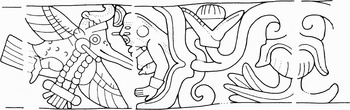
Elsewhere in the Maya area, a frieze from the Lower Temple of the Jaguars at Chichen Itza may also represent the hierogamy (Figure 7). In Eduard Seler's words: “The bird with the long, pointed bill that, here, apparently, is plunging into the opened breast of a human flower, could—perhaps—also be intended for this bird … the hummingbird” (1996:237). While his caution is justified, Seler's identification of the bird is most likely correct, as the scene finds parallel in the Katun 11 Ajaw prophecy from the Books of Chilam Balam. The prophecy recounts the descent among the flowers of Pizlimtec, a god that Cogolludo (Reference Cogolludo1971, Vol. 1:255) associated with music, singing, and poetry. According to the Códice Pérez, Pizlimtec disguised himself as a hummingbird to suck nectar from the flowers (Barrera Vásquez and Rendón Reference Barrera Vásquez and Rendón1974:88). In the Book of Chilam Balam of Chumayel, the hummingbird married a flower, an episode that led Thompson (Reference Thompson1970:313) to link these passages with the Guatemalan hummingbird myth. Arguably, the Chichen Itza frieze presents a version of the hierogamy in which the maiden became identified as a flower—an appropriate object of the hummingbird's desire.
A hummingbird bites the breast of a flower woman. Detail from sculptured frieze at the Lower Temple of the Jaguars, Chichen Itza. Drawing by the author, after a rubbing by Merle Greene Robertson.

THE MAIDEN AND THE INSECT
A Nahua tale from the Sierra Norte de Puebla adds an odd twist to the story. A hummingbird bit a cannibal girl (tzitzimitl), but instead of making her pregnant, it took some of her blood, mixed it with his own, and placed it close to a water spring. A plant grew on that spot and produced a fruit that had blood. An old couple of tsistimimej cut the fruit and threw it in the water, where they later found the baby Sintiopil, the maize hero (Pury-Toumi Reference Pury-Toumi1997:148; Segre Reference Segre1990:173–174). In consonance with the flower imagery featured in the Yucatec version of the hierogamy, sucking the girl's blood may refer to the hummingbird's feeding habits. However, sucking blood is, by and large, the habitual behavior of another class of creatures, namely insects.
In a parallel story, recorded among the Otomi of northern Veracruz, the suitor took the shape of a flea and bit the girl, but when she went to bathe and took her clothes off, all she found was a corn grain. She ground it and threw it in the water, where the shrimp took care of it. Nine months later, people found the child hero playing music by the stream (Oropeza Escobar Reference Oropeza Escobar and Huerta2007:186). The suitor's transformation into a flea reappears in Nahua and Totonac stories from Puebla, Hidalgo, and Veracruz (Ichon Reference Ichon1973:73–86; Olguín Reference Olguín and Alcalá1993:120–121; Sandstrom Reference Sandstrom, Brady and Prufer2005:47).
The choice of a flea is sometimes explained by the suitor's need to enter the coffin-like box or clay vessel where the jealous parents kept their daughter so that no one could approach her. However, its participation is not strange in hummingbird stories, where insects and other poisonous creatures play multiple roles. The Maya account of the origin of biting and stinging animals from the girl's spilled blood finds parallel in widespread versions where poisonous creatures originated from the ashes of the hero's grandparents, set free by an irresponsible envoy (Elson Reference Elson1947; Sandstrom Reference Sandstrom and Mercado1998:71; Van 't Hooft and Cerda Zepeda Reference Van 't Hooft and Cerda Zepeda2003:34–39, 41–55). Dragonflies collected the girl's blood from the water in Q’eqchi’ stories, while the Ixil tell that the suspicious father sent a louse, a flea, and a firefly to his daughter's room to investigate what was going on at night (Colby and Colby Reference Colby and Colby1986:196–198). In a Nahua version, several small animals tried to enter the box where the girl was caged, until the flea succeeded and made her pregnant (Olguín Reference Olguín and Alcalá1993:120).
Iconographic evidence suggests that an insect version of the hierogamy prevailed in the Maya Lowlands during the Classic period, in which the suitor took the shape of a mosquito. In Maya art, the insect's distinguishing features include a long, pointed muzzle, skeletal features, and ak'bal signs on the wings, which mark it as a nocturnal being (Coe Reference Coe1973:124). Noting the occasional representation of a flower pierced by the insect's muzzle, Taube (Reference Taube2004:123) suggested that mosquitoes may have been regarded as the hummingbird's insect versions. Mosquitoes are closely associated with water and need water to reproduce, a fact that may influence the hierogamy's frequent setting in springs or other bodies of water.
The plate with the enthroned lady is one of several depictions that show a mosquito biting a woman—not surprisingly, on her nipple (Figure 1). Another example is incised on vase K7433 (Figure 8). Far from rejecting it, the naked woman seems to offer her breast to the bite of a monstrous creature that thrusts its long, pointed mouthpiece into her nipple. Despite its humanlike body, the creature's oversized head adorned with eyeballs corresponds best to an insect. The same vase shows another scene in which the insect kisses a standing lady. The characters appear to be the same, but it is difficult to determine whether these are sequential episodes of a continuous story. A plausible alternative is that they depict two versions of the hierogamy, in which case it must be assumed that the artist recognized parallel passages from related narratives. In the first, the insect bites the maiden's breast, an episode that corresponds best with the bird's actions in contemporary tales from Oaxaca and Soconusco. In the second, the insect deposits its seed in the lady's mouth, just like the birds in modern Nahua and Teenek myths.
The maiden and the insect, incised on Classic Maya vase K7433. Drawing by the author, after a photograph by Justin Kerr (www.mayavase.com).

A Postclassic parallel from highland Mexico appears on page 30 of the Codex Laud (Figure 9), where a descending hummingbird kisses a pregnant woman in the presence of the death god. Corona Núñez (Reference Corona Núñez1964:376) saw this image as a depiction of a woman who died as a result of miscarriage and associated her with the heroic women who died in childbirth. Such an interpretation is not unrelated to hummingbird myths, which sometimes involve the death of the maiden. In Mixe narratives, she died and her children were born post-mortem, after a buzzard opened her stomach (Miller Reference Miller1956:76–87). Brotherston (Reference Brotherston1994) related this section of the Codex Laud with the birth almanacs of the Borgia Group codices (cf. Boone Reference Boone2007:140–141) and interpreted them as expressing the critical role of death for the gestation of human life. The presence of hummingbirds on pages 29, 30, and 31 suggests that the gestation and birth themes on these pages may relate with mythical narratives that involved the bird's participation.
A hummingbird kissing a pregnant woman. Detail from Codex Laud, page 30. Drawing by the author after Corona Núñez (Reference Corona Núñez1964).

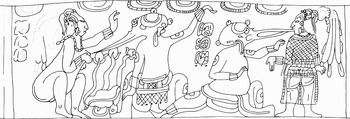
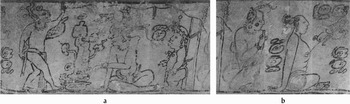
An insect appears behind the old god, Itzamnaaj, on a pottery fragment from Buenavista del Cayo, Belize (Houston et al. Reference Houston, Stuart, Taube and Kerr1992:Figure 10). The complete scene may have been close to an elaborate representation of the hierogamy that appears on a codex-style vase in the collection of the Museo de Arqueología y Vidrio Moderno, Antigua Guatemala (Figure 10). In a palatial setting, Itzamnaaj gestures over a plate that contains a crocodilian tree. An attendant dwarf watches behind his lord while a human-bodied insect with a skeletal head and dark wings enters the palace. The latter may be presenting the crocodilian tree to the old god, who seems unaware of the portent that unfolds in his own backyard. On the opposite side of the vase a flying mosquito bites the breast of a barely-dressed woman, while a jaguar-eared young man with a spot on the cheek turns his head to watch the hierogamy. Considering the usual interplay among the three main characters of Maya hummingbird myths—the young maiden, her suitor, and her father—the beautiful woman receiving the insect's bite may be the old god's daughter. The handsome aspect of the jaguar-eared man makes him a good candidate for the suitor's role. However, his relationship with the insects is far from clear. Is he the instigator of the mosquito's attack, that is, the rejected suitor, using a magical transformation to impregnate the lady? Is he conspiring with the insects to distract her father? Is he taking the shape of an insect to present the crocodile tree to his potential father-in-law? Is this gift one of the impossible tasks imposed by the old god in parallel with contemporary Ixil and Kaqchikel versions?
Mosquito biting a maiden's breast, behind an old god's palace. Classic Maya codex-style vase in the collection of the Museo de Arqueología y Vidrio Moderno, Antigua Guatemala. Composite photograph by the author.

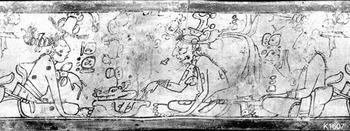
Because of the spot on his cheek, this young man appears to be God S, the Spotted Headband God of Classic Maya mythology (Taube Reference Taube1992:115–119). The jaguar ear is not a common attribute of this god, but it does appear on occasion (e.g., K1222). A role for God S in this version of the hierogamy is also suggested by his presence on vase K1607, where he presents the crocodile tree plate to Itzamnaaj (Figure 11). Very likely, this is the same plant that appears between the lovers on vase K7433, with three flowering branches growing from a monstrous head (Figure 8).
The spotted twin presenting a plate with a crocodile tree to the old god Itzamnaaj. Classic Maya codex-style vase K1607. Rollout photograph by Justin Kerr, Maya Vase Database (www.mayavase.com).

A tree or plant seems to play an important role in the mythical sequence of events that led to the maiden's impregnation by an insect, and indeed, such a plant appears in many versions of the myth. Q’eqchi’, Poqomchi', Mopan, and Lacandon stories specify that the hummingbird flew over a tobacco plant that grew in front of the old god's house and sucked nectar from its flowers. In some versions, the plant grew from the ashes that were spilled when the stuffed deerskin carried by the supposed hunter burst open. A Mixe version of the hummingbird myth identifies the hero as a tobacco merchant (Miller Reference Miller1956:75–76), while a Tzotzil text from Chamula asserts that the hummingbird was the Lord Sun's tobacco gourd (Gossen Reference Gossen2002:97–98). Benson (Reference Benson and Preuss1989:6) notes that hummingbirds are closely associated with tobacco throughout the New World; in myths from Guiana, they brought tobacco to the shamans and remain closely associated with them.
The precise identification of the tree is uncertain, but the suitor's transformation into a mosquito brings these Classic Maya representations close to modern Q’eqchi’ stories, which according to Braakhuis (Reference Braakhuis2005), are especially concerned with the origin of disease and curing—the trade of healers and sorcerers. Insects are widely held as agents of disease among the Maya, and Braakhuis highlights a Q’eqchi’ version from Senahú, where the biting and stinging creatures obtained their venom by soaking in an infusion made with tobacco leaves and water (De la Cruz Torres 1978:40–42).
The portentous intercourse of the maiden and the mosquito may relate with other instances of beastly love in Maya art. Examples include a fragmentary plate from Uaxactun that shows both an insect and a monkey fondling the breasts of young women (Smith Reference Smith1955, Figure 2g). On codex-style vase K1339 an old man with insect wings performs the same act while another woman presents her naked body to an approaching deer—a scene that finds parallel in the opening of the Moon's vagina by the deer hoof, told in some Q’eqchi’ versions of the hummingbird myth (Thompson Reference Thompson1930:129; cf. Braakhuis Reference Braakhuis2001). The old man with insect wings on K1339 is likely related with well-known Maya figurines that show old men in intimate contact with young women. In fact, some Q’eqchi’ and Poqomchi' versions of the hummingbird myth describe the suitor as an old man (Mayers Reference Mayers1958; Schumann Reference Schumann1988).
In the absence of literary sources, the precise unfolding of the story must remain uncertain. However, these objects hint at a Classic Maya version of the hierogamy, in which the hero took the shape of a mosquito to impregnate a young maiden. Like the birds in stories from Soconusco and Oaxaca, the insect achieved its goal by biting the maiden's breast. In a related episode, a crocodile tree was presented to the maiden's father. There are no hints about the fate of the girl or her offspring, but the images seem consistent with contemporary Q’eqchi’ versions in which the hierogamy eventually resulted in the birth of insects and other stinging creatures.
THE MAIDEN FROM THE LAND OF COTTON
Prodigious impregnations are recurrent in Aztec mythology. According to the Codex Chimalpopoca, “Quetzalcoatl was placed in his mother's belly when she swallowed a piece of jade” (Bierhorst 1998:28), an event that finds clear parallels in contemporary maize hero tales (Van 't Hooft and Cerda Zepeda Reference Van 't Hooft and Cerda Zepeda2003:41–55; Oropeza Escobar Reference Oropeza Escobar and Huerta2007:204). The tutelary god Huitzilopochtli was conceived when Coatlicue placed under her skirt a ball of feathers that fell from the sky. López Austin (Reference López Austin1996a:338–341) noted the shared features between this passage and twentieth-century versions of the hierogamy, not least among them the fact that Coatlicue's heroic son had hummingbird attributes.
Cecelia Klein (personal communication 2008) points out the hummingbird myth's parallels with the story of Mayahuel, the Aztec maguey goddess, as narrated in the Histoire du Méchique (Tena Reference Tena2002:151). The god Ehecatl abducted the virgin goddess Mayahuel, who was closely guarded by her grandmother, Cicimitl. The fleeing couple transformed into a tree, hoping to avoid the furious grandmother, who ran after them with other Cicimitl goddesses. They found them and killed the girl, but Ehecatl recovered her bones and planted them, thus creating maguey. While the myth stressed the origin of pulque, maguey was also an important source of fiber that was spun and woven into clothing. Sullivan (Reference Sullivan, Benson and Boone1982) and Mikulska (Reference Mikulska2001) highlight Mayahuel's close affiliation with Tlazolteotl, the patroness of spinning and weaving.
The Chinantec of Ozumacín, Oaxaca, tell a story about the theft of the Mother of Cotton, a goddess that ensured abundant crops in exchange for human victims, until she was stolen by the witches from a nearby town (Krotzer Reference Krotzer1970). López Austin (Reference López Austin1996a:406) noted the tale's parallel with a sixteenth-century story that recasts the hummingbird myth in quasi-historical terms. According to the Crónica Mexicayotl (Anderson and Schroeder Reference Anderson and Schroeder1997:118–123), the early Aztec king Huitzilihuitl—whose name means “hummingbird feather”—wanted to marry Miyahuaxihuitl, daughter of Ozomatzin Teuctli, the king of Quauhnahuac. This rich land was especially noted for its production of cotton at a time when, we are told, the Aztec only wore breechcloths made of marsh plants. Like every maiden in hummingbird myths, Miyahuaxihuitl was closely guarded and secluded from contact with men. A notorious sorcerer, her father summoned spiders, centipedes, snakes, bats, and scorpions—all sorts of stinging, poisonous creatures—to protect the palace doors from intruders. In a dream, the god Yoalli—a probable manifestation of Tezcatlipoca (cf. Olivier Reference Olivier2004:67–68)—told Huitzilihuitl to make a beautiful painted arrow and place a shiny jewel inside the cane. Following the god's instructions, the king went near the boundary of Ozomatzin Teuctli's kingdom and shot the arrow inside Miyahuaxiuitl's courtyard. Attracted by the beautiful arrow, the maiden picked it up, broke the cane, and found the shiny jewel inside. She placed it in her mouth and swallowed it and thus became pregnant. Her son was Moteuczoma Ilhuicamina, the great ruler who first turned the Aztec kingdom into a regional power.
As noted by López Austin, the identical names of the king of Quauhnahuac and the Chinantec town that lost the Mother of Cotton are unlikely accidental. Both stories probably derive from a very ancient myth that included similar motives. The same can be said about other elements in the story—the maiden's initial seclusion, the role of stinging animals and insects, and the hero's way of approaching her in disguise, through a beautiful flying object—that are highly reminiscent of hummingbird myths. In fact, the Aztec story finds a striking parallel with Mario de la Cruz Torres's Q’eqchi’ version from Senahú (1978:33). Looking for a wife, the sun hero shot an arrow that fell next to the maiden who was weaving and startled her. Like Huitzilihuitl's, the sun's sexual assault was mediated by a shooting arrow. These passages from widely distant sources bespeak a common origin.
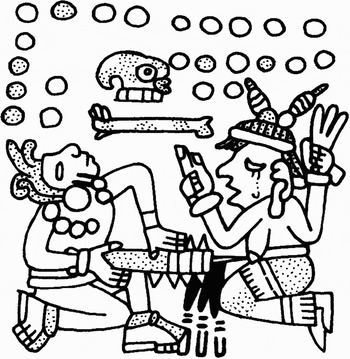
The arrow's sexual connotations reappear in the story of Mixcoatl and Chimalman, Quetzalcoatl's mother. The goddess surrendered only after Mixcoatl repeatedly shot arrows at her, without ever reaching the target (Bierhorst Reference Bierhorst1998:153). A related image appears among the marriage prediction tables in the Codex Laud and Codex Vaticanus B. In both, the twenty-third couple has the man piercing the woman's breast with a spear (Figure 12). This is a likely allusion to the prodigious impregnation of the maiden, here conflating sexual assault through a pointed weapon with another element found in hummingbird stories: the bird's or insect's bite on the woman's breast. According to Boone (Reference Boone2007:137), the characters in these prognostication tables are clad as specific supernaturals. Seler (Reference Seler1902:236) identified the protagonist gods in Codex Laud as Xochipilli and Xochiquetzal, and Xochipilli and Tlazolteotl in the Codex Vaticanus B.
Marriage prognostication, Codex Vaticanus B, page 33b. Drawing by the author.

Elsewhere, Chimalpahin (Reference Chimalpahin Cuauhtlehuanitzin1965:183) wrote that Moteuczoma Ilhuicamina was born at sunrise, which explained his prowess and intelligence, while his half-brother Tlacaelel was born at night, right before sunrise. As noted by Gillespie (Reference Gillespie1989:133) this passage associates both lords with the sun and the morning star. Indeed, the story of Moteuczoma's prodigious conception in the Crónica Mexicayotl casts him as an equal of the mythical heroes that were born as a result of a celestial god's deception of a tightly guarded young goddess, against the will of her father. As interpreted by Braakhuis (Reference Braakhuis2001, Reference Braakhuis2005), in hummingbird myths the latter is usually the owner of the earth's bounty. Sure enough, Ozomatzin Teuctli's kingdom of Quauhnahuac was a lush land, abundant in food, fruits, and especially cotton—the weavers' substance. Huitzilihuitl's conquest of the king's daughter carried together the Mexica's acquisition of the fruits of that bountiful place. His role also parallels that of Ehecatl stealing the goddess of maguey, the major source of clothing for highland Mexican people. As befits the story, Huitzilihuitl's triumph over the coveted woman went together with his conquest of cotton, the essential symbol of femininity.
Early sources link the region of Quauhnahuac—modern Cuernavaca—with Tamoanchan, a mythical place of abundance and the setting of major creational events in Aztec religion. According to the Histoire du Méchique, the first people were created there, “…en una cueva de Tamoanchan, en la provincia de Quauhnahuac, que los españoles llaman Cuernavaca…” (Tena Reference Tena2002:149). Mendieta (Reference Mendieta1973:60) situated in Cuernavaca the creation of the calendar, an event that took place in Tamoanchan, according to a mythical narrative recorded by Sahagún (López Austin Reference López Austin1994:233). Thus, the Aztec regarded Quauhnahuac as one of several earthly places that shared important features with the mythical Tamoanchan (López Austin Reference López Austin1994:46–47, 71). Not only were they similar in their bountiful nature, as expressed in the Crónica Mexicayotl, but the events that transpired in them were similar. Huitzilihuitl's impregnation of Miyahuaxihuitl may be regarded as a version of the hierogamy that took place in Tamoanchan, an episode that Graulich (Reference Graulich1997:56) compared with the Maya hummingbird myths.
According to Muñoz Camargo (Acuña Reference Acuña1984:202–203), the goddess Xochiquetzal was a talented weaver who lived in Tamoanchan, among the pleasures of a lush garden “where she was so guarded and secluded that men could not see her.” As the story goes, Tezcatlipoca stole her from Tlaloc, who was her husband. At the risk of amending the Tlaxcalan writer, I suggest that the earth and rain god was probably not her husband, but her father although it is equally plausible that the sixteenth-century Tlaxcalan version recorded by Muñoz Camargo varied in this important aspect. Both her weaving and her seclusion from suitors are highly suggestive of her identity with the virginal maidens of hummingbird myths. Consist with other versions of the hierogamy, her abduction amounted to an attempt to steal the earth's bounty, the gist of Maya hummingbird myths (cf. Braakhuis Reference Braakhuis2001, Reference Braakhuis2005). In the Postclassic codices, both Xochiquetzal and Tlazolteotl are sometimes associated with centipedes (Seler Reference Seler and Comparato1996:334), recalling both the Q’eqchi’ versions of the origin of poisonous creatures from the moon's ashes and a modern Cora myth recorded by Preuss, where scorpions, centipedes, spiders, and tarantulas came out of a maiden that had succeeded in seducing a hero, “taking all his flowers” (Gutiérrez del Angel Reference Gutiérrez del Angel and Huerta2007:78–79).
Codex Vaticanus 3738 tells that Tezcatlipoca disguised himself as a bird to deceive the goddess, here called Ixcuina (Corona Núñez Reference Corona Núñez1964:94–96; López Austin Reference López Austin1994:77). Muñoz Camargo mentioned no offspring, but other sources suggest that the product of this illicit union was the maize god, Cinteotl (Tena Reference Tena2002:155; Graulich Reference Graulich1997:52–59; López Austin Reference López Austin1994:79). In consonance with most versions recorded throughout Mexico, the impregnation of the goddess resulted in the birth of maize. Following Graulich's (1983; 1997) and López Austin's (1994) analysis of the Tamoanchan myth, the hierogamy was a transgression that marked a rupture in cosmic order, a portent that precipitated major creational events.
AZTEC AND MAYA HUMMINGBIRD DANCES
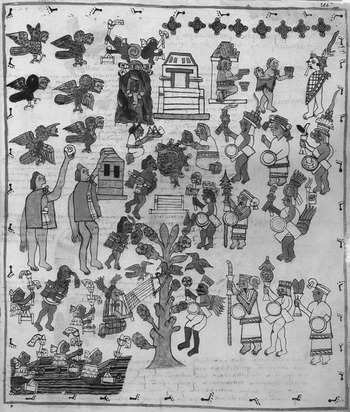
The parallel between the Tamoanchan myth and the hummingbird stories became tangible during the feast of Atamalcualiztli, celebrated every eight years in commemoration of the birth of Cinteotl. Michel Graulich (Reference Graulich2001) and Patrick Saurin (Reference Saurin2002) summarized the information available from scattered sources, showing that the feast was a reenactment of the hierogamy that resulted in the impregnation of Xochiquetzal and the birth of Cinteotl. As noted by both scholars, a drawing of Atamalcualiztli in Sahagún's Primeros Memoriales matches a description of a solemn dance provided by Diego Durán (Reference Durán1984:193) that describes the celebration's unfolding. A flowering house was built behind the temple of Huitzilopochtli with artificial trees full of flowers. There sat the goddess Xochiquetzal, while youths dressed as birds and butterflies climbed the trees and sucked nectar from the flowers. A group of gods approached, shooting down the birds with blowguns. Xochiquetzal came out of her house to receive the gods and let them sit by her side. The Primeros Memoriales drawing shows Xochiquetzal weaving, with her loom attached to a flowering tree full of birds, while the gods approach, with Tezcatlipoca first among them (Figure 13). The associated description mentions other participants, dressed not only as birds and butterflies, but also flies and scarabs, as well as lepers and other poor people, who danced around an effigy of Tlaloc (Graulich Reference Graulich2001:361).
Drawing of the Aztec feast of Atamalcualiztli. After Bernardino de Sahagún, Primeros Memoriales, fol. 254r. Copyright ©Patrimonio Nacional, Spain.

The young weaver, the youths disguised as birds, the presence of insects, and the rituals surrounding the earth god are compatible with hummingbird myths. In particular, the blowgun shooting of the birds is strongly reminiscent of highland Maya stories, where the young weaver's father shot down the beautiful bird with his blowgun. Similar images are evoked in the Song of Atamalcualiztli, recorded by Sahagún, which recalls the birth of Cinteotl in Tamoanchan Xochitlicacan, among flowers and birds. Relevant for the present argument is the song's mention of blowguns, alluding to the shooting of birds. The song also evokes Pilzintle, who covers himself with yellow parrot feathers and perches over a ballcourt. This verse recalls the Chilam Balam prophecy of the descent of Pizlimtec in a flowering place. Both refer to the mythical story of the god that cloaked himself as a bird to approach a reticent maiden that inhabited a flowering paradise. Both names are variations of Piltzinteuctli, the god that lay down with Xochiquetzal and fathered Cinteotl, according to the Histoire du Méchique (Tena Reference Tena2002:155). Graulich (Reference Graulich1997:56–57) and Olivier (Reference Olivier2004:255–257) consider Piltzinteuctli as a manifestation of Tezcatlipoca.
Saurin (Reference Saurin2002:160) suggested that the song's ballcourt references correspond with the Popol Vuh narrative, in which the heroes were defeated at the ballcourt but eventually succeeded through the magical impregnation of a maiden. Olivier (Reference Olivier2004:256) cites a relevant passage from Codex Tudela, which asserts that Piltzinteotl died while playing ball. Arguably, these passages allude to a ballcourt episode that probably played a role in ancient versions of the hierogamy, perhaps explaining the eventual death of the maiden's suitor. In fact, many contemporary stories share the fact that the suitor was killed one way or another, and his death in a ballgame is attested in a Tepehua version (Williams García Reference Williams García1972:87). Related ball-playing episodes are also present in Totonac and Mazateca-Popoluca sun and maize hero tales (Ichon Reference Ichon1973:78–79; Weitlaner Johnson and Basset Johnson Reference Weitlaner Johnson and Basset Johnson1939).
Like the Aztec, highland Maya peoples have performed the hummingbird story in traditional dances until the present. Henrietta Yurchenco (Reference Yurchenco2006) reported the Baile de Canastas, performed in the Ixil towns of Nebaj and Chajul until the mid-twentieth century. The dance was based on the story of Mariquita, the daughter of the sorcerer Matagtanic, who guarded the maize seed in her bosom. People commissioned the demigod Tz'unun (hummingbird), to abduct Mariquita and fertilize the seed. He could transform into a quetzal or a hummingbird. The hero organized the Baile de Canastas to distract the girl's father and had sexual intercourse with her. Her father killed her, but maize grew. A closely related Poqomchi' dance, the Baile de Ma'muun is based on the story of K'iche Achi, who abducted the maiden Guarchaj from her father, Ma'muun. With the help of macaws, the insulted father found them and killed K'iche Achi (García Escobar Reference García Escobar2005).
Ruud van Akkeren (Reference van Akkeren2000:410–431; cf. Breton Reference Breton1999:232–235, 265) has shown that the cosmogonic symbolism of the hummingbird myth is also embedded in the ancient dance-drama known as Rab'inal Achi. The drama culminates with the sacrifice of K'iche Achi, the invading warrior. Once he accepts his fate, K'iche Achi makes three petitions. The first is to drink the king's twelve intoxicating drinks or poisons, named ixtatz'unun, “hummingbird maiden”. Van Akkeren linked this passage with the hummingbird sipping tobacco flowers and with the jars that contained the maiden's blood in Q’eqchi’ hummingbird myths.
The warrior's second request is a piece of cloth: “the gleamy and soft fabric, the cloth of the double-threaded warp, the cloth that measures twenty lenghts, product of my mother/my lady” (van Akkeren Reference van Akkeren2000:416). A servant gives him the cloth—a small piece in contemporary performance—requesting that he should not tear it. However, when he returns it, he declares: “I have come to split it…I have come to tear it to pieces.” According to van Akkeren, this is a critical juncture in the drama, signaled by the warrior's request to the musicians to resound their trumpets and their drums, making the sky thunder and the earth tremble. K'iche Achi's final request is to dance with the king's daughter herself, whose role is performed by a young girl. Once again, he is allowed to dance with the maiden on condition that he should not tear her apart. Van Akkeren (2000:424) points out that the dances with the cloth and the maiden are identical in words and thus analogous to each other. Like Huitzilihuitil pursuing the princess from the land of cotton, K'iche Achi's dance with the maiden marks his attempt to steal the land and its bounty. While captured and eventually sacrificed, he achieves his goal by overtaking the king's daughter—her sexuality aptly represented by the gleamy cotton fabric, torn apart by her aggressor.
CONCLUDING REMARKS
The Classic Maya plate that began this inquiry was initially identified as a representation of the mythical union of a woman with an insect. A more nuanced interpretation may now be offered: this plate represents one of several variants of the hummingbird myth that were current in the Maya Lowlands during the Late Classic period. In this version, a hero took the shape of an insect to impregnate a maiden. Another variant, represented on vase K504, shows the suitor as a hummingbird, negotiating with his prospective father-in-law. Yet another variant shows the bird biting the maiden's breast—a flower maiden at Chichen Itza. These representations attest the rich variations of this mythical episode that coexisted, more or less contemporaneously, in a discreet region. We remain ignorant of the precise unfolding of the narratives that inspired these images, and yet we are able to understand their shared nodal subject through the comparative study of related narratives that are broadly distributed throughout Mesoamerica. This study highlights their rich diversity as well as the possibility of interpreting them by careful comparison of multiple variants from different times and regions. The search for synonymies that reveal the nodal subject of myths through a comparison of narrative and pictorial sources at a broad geographic level provides a methodological basis that can be applied productively to the study of Mesoamerican iconography.
The hummingbird myth's expressions in ancient Mesoamerican art, narrative, and performance are manifold. At first glance, the insect biting a maiden's breast seems only remotely related with K'iche Achi's heroic sacrificial dance or with Huitzilihuitl's arrow in Miyahuaxihuitl's courtyard. It seems equally distant from the serene Jaina weavers with their bird companions, despite their geographic and temporal proximity. Indeed, each version belongs to a specific time and place, and each conveys elements of the historical background, social organization, and world view of a specific community or social segment. Variables such as gender, class, and occupation may explain the peculiar features of each version. In López Austin's words, “…in the immense territory in which Mesoamerican peoples interacted for century upon century, the myth was produced, as all of the great cultural episodes are produced, by everyone and by no one, through additions, suppressions, and rearrangements, the transformations being confused with the origins” (Reference López Austin1996b:38). Yet, the exploration of synonymies in oral narratives and pictorial representations reveals the finely nuanced elements that recur throughout such diverse sources. The iterations of themes such as weaving magic, insects and poisonous creatures, the magical transformations of the suitor, and the in-laws' contempt toward him reinforce essential points of congruence that underline the nodal subject of the myth: the hierogamy that variously resulted in the birth of the sun, the moon, and human sustenance.
RESUMEN
Un episodio mitológico ampliamente difundido en Mesoamérica narra la historia de un héroe que toma el aspecto de un ave para seducir a una doncella, en contra de la voluntad de su padre o su madre. En numerosas historias, el héroe se transforma en colibrí, pero en ocasiones, toma la forma de otro animal, insecto, o incluso un objeto inanimado. Esta unión da lugar a una serie de conflictos entre el pretendiente y su suegro, o entre el hijo (o hijos gemelos) de esta pareja y su familia materna. Múltiples versiones del mito culminan con el origen del sol y la luna, y en muchos casos, el maíz y otros productos útiles para el ser humano. La amplia distribución geográfica del mito y sus múltiples variaciones sugieren gran antigüedad y, a la vez, plantean problemas de interpretación. ¿Cómo reconocer en el arte, la narrativa y el ritual, las versiones antiguas de mitos que debieron variar considerablemente a través del tiempo y el espacio geográfico?
Para enfocar este problema, en este trabajo se aplica el concepto de “sinonimias,” elaborado por Alfredo López Austin para el estudio de la mitología mesoamericana. Las sinonimias son episodios que recurren en formas variables, pero cuya similitud sugiere un significado común, más allá de los “asuntos hazañosos” que forman la secuencia narrativa de los mitos, los cuales pueden variar en cada versión. La comparación de múltiples versiones, en busca de sinonimias, permite detectar los “asuntos nodales,” los temas esenciales en las narraciones míticas, referentes a los procesos creativos básicos. Para López Austin, el asunto nodal del mito del colibrí es la hierogamia de los amantes que personifican el cielo y la tierra. Según H.E.M. Braakhuis las versiones mayas del mito representan la relación entre el ser humano y la tierra como análoga a la de un pretendiente en busca de esposa. El héroe intenta robar los productos de la tierra, personificados en la hija del dios, sin dar al padre la compensación adecuada. Por tanto, incurre en su furia, desencadenando los procesos creativos subsecuentes.
Un análisis comparativo de las versiones del mito en toda Mesoamérica provee una base para explorar las representaciones de este episodio en el arte prehispánico y sus paralelos con mitos y rituales del centro de México. Las representaciones se han identificado en objetos arqueológicos procedentes de la costa de Chiapas, las tierras bajas mayas y el norte de Yucatan. En el arte maya, el pretendiente puede transformarse en colibrí, pero en varios casos aparece como un mosquito que pica el pecho de una mujer. Esta identificación permite entrever el amplio rango de variación que debió existir en las versiones orales durante el periodo clásico.
De especial interés es la identificación de los aspectos mágicos del hilado y el tejido, que conforman un tema recurrente en el mito. En varias versiones, la agresión sexual del pretendiente se equipara con un asalto al tejido o hilado de la doncella, que suele ser una hábil tejedora. Para vencer su resistencia, el pretendiente debe alejarla de su labor, y solamente entonces consigue vencerla. De ese modo, la conquista del algodón, el telar o la tela se equipara con la conquista de la mujer.
Las sinonimias detectadas por medio del análisis comparativo permiten identificar elementos del mito en las fuentes aztecas, incluyendo los raptos de las diosas Mayahuel y Xochiquetzal—ambas relacionadas estrechamente con los textiles—y la concepción prodigiosa de Moteuczoma Ilhuicamina, narrada en la Crónica Mexicayotl. Finalmente, se exploran las representaciones escénicas que incluyen la representación del mito de Xochiquetzal en la fiesta azteca de Atamalcualiztli, y algunos bailes contemporáneos del altiplano guatemalteco, entre ellos el Rab'inal Achi.
ACKNOWLEDGEMENT
This paper was written with support from the Museo Popol Vuh, Universidad Francisco Marroquín, Guatemala. I owe an intellectual debt to H. E. M. Braakhuis, whose papers provided the initial inspiration for my research on the hummingbird myth, while the interpretations offered in this paper remain my sole responsibility. Valuable comments on an earlier version were provided by H. E. M. Braakhuis, Stephen Houston, Cecelia Klein, Guilhem Olivier, Karl Taube, and Ruud van Akkeren. For their generous help that allowed the identification and illustration of key objects, I thank Susana Campins, director of the Museo de Arqueología y Vidrio Moderno, Antigua Guatemala; Inés de Castro, curator of the Roemer- und Pelizaeus-Museum, Hildesheim; and the late Doña Bárbara de Nottebohm. For their amazing patience with listening to hummingbird stories, I thank Margarita Cossich and Víctor Castillo.