The Umbrella Movement took place in Hong Kong from September 28, 2014, when tear gas first mobilized masses of democracy supporters, until December 15, 2014, when the last occupation site was cleared at Causeway Bay. Coming at the end of a long process to reform the mechanism for Hong Kong's next chief executive election in 2017, it began in response to a decision issued by the National People's Congress Standing Committee (NPC-SC) on August 31, 2014, setting a restrictive legal framework. This decision confirmed the fears that had led to the formation of the group Occupy Central with Love and Peace (OCLP) in 2013: initiated by two academics and a Baptist minister, this group advocated civil disobedience and occupation of public space as a last resort against a decision by Beijing disallowing significant universal suffrage in Hong Kong. In the event, the occupation of public space took place more spontaneously, led by two student groups (Scholarism, which had established its credentials in the Anti-National Education campaign of 2012, and the Hong Kong Federation of Students or HKFS), and began in Admiralty (the site of Hong Kong's Central Government Offices) rather than Central (the business district), before spreading to Causeway Bay and Mongkok. It was fueled by the use of tear gas by the Hong Kong police on September 28, 2014, considered unusual, which mobilized several tens of thousands of people (possibly 100,000 or more at its peak). The government dug in its heels against the movement, which it called “illegal,” and encouraged transportation companies to take legal action; court injunctions were eventually used to clear the main occupation areas.Footnote 1
The Umbrella Movement has defied easy characterizations, sharing aspects of different movements, as well as encapsulating some of the contradictions of Hong Kong itself. As a territory in which a society that is in some respects post-materialistic is governed by a political system that is not (yet) democratic (Ma Reference Ma2011), Hong Kong presents an interesting theoretical paradox that had implications for the nature of the movement. The argument developed below suggests that, contrary to much of the rhetoric developed in the 1989 democracy movement, for example, in which many participants articulated their role as making personal sacrifices in the name of the future of the Chinese nation, the Umbrella Movement mobilized a great diversity of cultural references, constructing a far more heterogeneous notion of China. These diverse frames nurtured an open debate on the nature of the democratic community itself, in the occupying zones, and more broadly in Hong Kong. In this sense, the movement's particular significance lies in its ability to represent an alternative model to many of the democratic movements that developed in mainland China over the twentieth century.
The present essay is devoted to a specific aspect that has not yet been studied systematically: over the seventy-nine-day occupation, the three occupied areas (Causeway Bay, Admiralty, and Mongkok) were colonized not only by artwork,Footnote 2 but also by textual material in every size and form. Produced by diverse authors, some of them political groups, some of them unorganized participants, some of them just passersby, what do these texts express? How do they relate to the movement as a whole and help us to characterize it?
There has not been much theoretical engagement with movement slogans as such. A chapter devoted to slogans in a classic work on social movements (Stewart, Smith, and Denton Reference Stewart, Smith and Denton2001, 171–98) proposes a typology based mainly on their “persuasive” function.Footnote 3 Most discourse analysis on social movements, using the notions of strategic “framing” and discursive “repertoires,” focuses either on manifestos and press statements by movement leaders or on how the movement and its claims are portrayed in the media or in subsequent historiography.Footnote 4 More recent studies in the field of cultural sociology have revived interest in slogans as speech acts within “performances” that cannot be reduced to strategic framing.Footnote 5
The present article adopts an interdisciplinary approach, based on a close contextual reading of the texts themselves. In order to consider different aspects of the slogans, the argument is structured following J. L. Austin's (Reference Austin1973, 94–108) threefold analysis of speech acts. The first part discusses the illocutionary dimension of the slogans, or their “intended meaning.” The second part looks at the textuality of the slogans themselves (locutionary dimension), paying specific attention to the repertoire of cultural and historical references they mobilize. Finally, the third section discusses their communicational effect (perluctionary dimension) within a communicational framework inspired by Habermas's definition of the public sphere. The essay suggests that the movement represented an attempt to articulate a culturally hybrid democratic community, struggling to define deliberation as a political mechanism to regulate both its internal differences and its interaction with the broader polity of Hong Kong.
Corpus and Methodology
This study draws on over 1,000 slogans, texts, and other artifacts containing texts, which were photographed during several visits to the three sites of the Umbrella Movement between September 28 and December 11, 2014. Visits took place on twenty-one separate days to Admiralty, three separate days to Causeway Bay, and four separate days to Mongkok.
The sample is limited to text-based occurrences. However, exploiting this corpus of material raises some significant challenges, in particular quantification. The textual material can be classified into three main categories: (1) handwritten (unique) posters in various formats ranging from A4 to huge banners; (2) computer-printed or photocopied posters (potentially mass-produced) mainly in A4 or A3 format; and (3) textual parts on graphically designed and color-printed posters, usually in A3 format or above. To these can be added some artifacts or installations with textual components (e.g., the scale model of Lion's Rock with the slogan hanging on it). Material that is smaller than A4 format has been mainly excluded, with the exception of a few particularly significant objects. Documenting and exploiting the Post-it notes on which bystanders and participants alike left words of encouragement or random thoughts is a whole separate project, which is currently being carried out by others.
It should be noted that the length of the texts varies very significantly. In a classical definition, George Shankel describes a slogan as: “some pointed term, phrase or expression, fittingly worded, which suggests action, loyalty, or which causes people to decide upon and to fight for the realization of some principle or decisive issue.” It is thus usually assumed that slogans are “short and snappy” (Shankel Reference Shankel1941, 7; quoted in Stewart et al. Reference Stewart, Smith and Denton2001, 174). Generally speaking, the survey has been limited to texts of one or two lines. Some exceptions, such as short poems, are included. Anything lengthy (whole pages of text) has been excluded. On the other hand, no material has been excluded on the base of its content or type of speech act.
The language is mainly Chinese with some English. Chinese is mainly standard written Chinese, but significant parts of text are in written Cantonese, which is rarely used in formal settings.Footnote 6
Printed and photocopied materials raise the challenge of duplication. It is impossible to attribute authors and time of production to most texts. Although some slogans or posters contain references to political groups (parties or other groups, like Falungong), most are anonymous and undated, making it hard to know whether the time of documentation corresponds with the time of production. This also makes it difficult to establish a chronology of the movement. For similar reasons, it is difficult to differentiate between the three locales of Admiralty, Causeway Bay, and Mongkok: many of the slogans were mass-produced and migrated from one venue to another. For these reasons, quantitative analysis is impossible to carry out rigorously, as there are too many biases. Hence, the qualitative approach adopted here has consisted of attempting to maximize diversity in selecting a small number of slogans, and conducting a form of inductive analysis using these reduced samples to attempt a kind of thick description of the movement.
Asserting Agency: A Democratic Community with Varying Perimeters
The slogans and texts produced by the movement may firstly be seen as the expression of claims formulated by participants. In Austin's perspective, the preexisting claims expressed by the movement texts correspond with their semantic content, or “intended meaning.” All observers were struck by the extraordinary variety of slogans and claims that they encountered in the protest sites, ranging from local identity and language to environmentalism, gay rights, or anti-capitalism. They are all the harder to classify, as many are saturated with irony or cultural references that all but drown out the literal meaning of the words. It would be easy to dismiss this diversity of claims as the expression of a “post-modern carnival” in which different groups vie for recognition (Taylor Reference Taylor and Gutmann1994), typical of the “new social movements” that appeared in the 1970s. These movements, which opposed both liberal capitalism and repressive communism, distrusted bureaucracy and affirmed spontaneity, emphasized culture rather than class, and appealed to participants' identities, are generally seen as having given birth to identity politics.Footnote 7 Similarly, in Hong Kong, opponents of the Umbrella Movement were quick to dismiss its claims as the expression of an “identity politics” driven by the young generation's growing alienation from China (usually conjectured to be fueled by economic difficulties).
By contrast, a survey conducted on the protest sites in late October (Cheng and Yuen Reference Cheng and Yuen2014) showed surprising consistency: using “net percentages” (difference between rating as “important” and “unimportant”), it isolated seven main “reasons” given by participants for their implication: (1) struggle for democracy (87 percent); (2) dissatisfaction with the government's ignoring of demands (68 percent); (3) dissatisfaction with the police's response (51 percent); (4) identification with the ideal of civil disobedience (46 percent); (5) resistance to the central government's meddling in Hong Kong affairs (33 percent); (6) struggle for a space of discussion for public policy (22 percent); and (7) struggle to improve livelihood (3 percent). This survey—which is quite exhaustive, as interviewees were asked to supplement the available answers with their own—tends to show an overwhelming engagement with democracy, which in its most abstract formulation represents the most widely shared claim, but also, in its more concrete declinations, accounts for reasons 2 to 6. How can these findings be reconciled with the wide spectrum of textual claims?
Craig Calhoun criticizes the notion of “new social movements,” underlining that “identity politics is not new, or limited to ‘post-materialist’ ideologies of stages of development.” Rather, he highlights, “every collective identity is open to both internal subdivision and calls for incorporation into some larger category of primary identity” (Calhoun Reference Calhoun and Calhoun1994, 23, 27). In a similar perspective, this section argues that the variety of claims documented in the slogans can be understood as expansive or restrictive variations on an underlying theme that connects them. It attempts to show that notions of democracy, universal suffrage, or civil disobedience, as they are expressed in the slogans, are underpinned by an affirmation of moral and political agency, grounded in a community with variable boundaries.
Democracy
Firstly, the term democracy itself was massively quoted in movement texts, with a varying degree of abstraction. One of the iconic slogans was: “Don't forget the original intent: fight for democracy” (Wuwang chuzhong: zhengqu minzhu 勿忘初衷 ::爭取民主). As suggested by the ubiquitous notion of “struggle” (zhengqu), many slogans connected democracy to an affirmation of agency: “Democracy is fought for standing up, not begged for kneeling down” (Minzhu shi zhanqilai zheng, bushi guixialai qiu de 民主是站起來爭,不是跪下來求的). This variation contains a critical allusion to the student leaders of 1989 who famously knelt on the steps of the Great Hall of the People, asking leaders to receive their petition.
Other slogans denounce a lack of political participation in Hong Kong (deploring that citizens are “pawns” or “slaves” of the government). Democracy is connected to an understanding of “rights of citizens” or “natural rights” that are being denied by the government. This rights-awareness was expressed in either Western (“natural,” “human” rights) or Chinese references (Mencius's notion of minben or “people as foundation”). On the one hand, democracy was connected to the framework of the Basic Law and claimed in a minimal, self-limiting manner: “This is not a revolution. We only want universal suffrage. We only want civil nomination.”
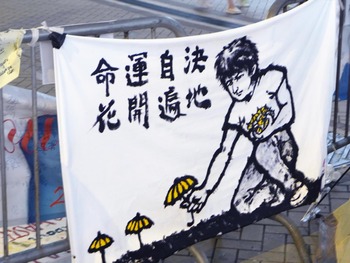
In other cases, democracy was endorsed for its utopian, not strictly political, dimension. In a frequently recurring image disseminated by pop culture, democracy is described as a “flowering”: “The flowers of democracy are blooming everywhere” (Minzhu biandi kaihua 民主遍地開花). Throughout the “occupied” areas, this text suggests, democratic practices of consultation, self-expression, and autonomy are developing.
Other slogans connected democracy to a moral imperative, like the following one borrowed from Taiwan's Sunflower Movement: “When dictatorship becomes a fact, revolution becomes a duty.”Footnote 8 Civil disobedience, as advocated by OCLP, is in this way justified as the affirmation of a higher form of justice, in the face of an unjust law. Similar slogans, affirming “love,” “dignity,” or “humanity” (“People driven by dignity will always stay longer than those driven by money”)Footnote 9 implicitly provide a simple moral frame for empirical events, ascribing to the government a set of negative values: violence, the use of force, and money (paying triads and patriotic or other groups to stir up trouble against protesters). The ideals embraced by the protesters are thus translated into a strong contentious claim of the moral high ground.
Most importantly, on a moral level, democracy was frequently presented as an assertion of agency and individual autonomy: “Masters of our own destiny” (Mingyun zizhu 命運自主); “Determine our own destiny, flowers blooming everywhere” (Mingyun zijue, hua kai biandi 命運自決,花開遍地; see figure 1).
Determine our own destiny, flowers blooming everywhere. Photograph by the author.

The idea of “destiny” or “fate” (mingyun) is closely linked to the central Chinese state and the traditional moral discourse of the unity of the nation. When the protesters affirm democracy as their “own destiny,” they reference a longstanding tension between traditional moral vocabulary and a modern political system, which goes back to May Fourth 1919, when students in Beijing first marched for “science and democracy,” affirming the power of human agency (“determine”) to change history, of individuals to change political systems. In a context in which Hong Kong's return to China has been portrayed as the expression both of its “rightful” return to the “motherland” and of a “law of history” (linking the traditional moral vocabulary of the unity of the nation with communist anti-colonial historicism), the protesters' call to challenge the laws of destiny implicitly questions the status of Hong Kong. Indeed, there is an interesting nuance between the two slogans: while zizhu (autonomy) arguably remains within the framework of Hong Kong's constitutional status, zijue (self-determination), possibly inspired by the much-discussed February 2014 issue of the Hong Kong University student union journal Undergrad,Footnote 10 marks a departure from the status quo, foreshadowing Joshua Wong's August 2015 call for a constitutional referendum on Hong Kong's status after 2047 (see J. Wong Reference Wong2015a, Reference Wong2015b).
Hong Kong Identity
Much ink has been spilt, especially in the pro-Beijing press, about the connection between the Umbrella Movement and the small group of Hong Kong pro-independence activists, a connection that remains largely unsubstantiated: while many slogans refer to Hong Kong itself and affirm its distinct local identity, almost none call for independence. (One such slogan was documented on-site.) Many do affirm a connection between the cultural community of Hong Kong and the political community of citizens claiming universal suffrage. Echoing Calhoun's critique of the new social movements paradigm and wariness of a reified notion of identity, it should be noted that slogans affirming Hong Kong are hard to divide neatly between an inclusive political notion of democracy and an exclusionary definition of identity. Many proclaim a personal, even intimate connection with the city that is neither directly political, nor culturally exclusive: “Hong Kong I love you” (Xianggang wo ai ni 香港我愛你); “The most beautiful thing in Hong Kong are its people” (Xianggang zui mei de shi ren 香港最美的是人). In some cases, slogans express “pride” and belonging to a “home,” or loyalty (implicitly criticizing politicians for not putting Hong Kong's interests first) but what lies outside the home, or what threatens it, is not defined, or only in vague moral terms: “Protect our home, resist dark forces” (Baowei jiayuan, jujue hei shili 保衛家園,拒絕黑勢力); “Protect our home from darkness”; “We support Hong Kong” (*Heung Gong, ngohdei chaang 香港,我地撐).
In some cases, the expression of cultural identity is indeed exclusive, when Chinese people are designated as others: “Refuse to be Chinese, nothing more than that” (Ju zuo Zhongguoren, meiyou dabuliao 拒做中國人,沒有大不了). This sense of cultural distance from China was shared by many of the participants in the movement: according to a survey, 81 percent of occupiers identified exclusively as Hongkongers, as opposed to 41 percent in the general population (Cheng and Yuen Reference Cheng and Yuen2015a).
However, at the same time, the expression of local identity presents itself as an affirmation of agency by a civic community: “Our Hong Kong, let's save it ourselves” (Ziji Xianggang ziji jiu 自己香港自己救); “Hong Kong history, written by Hongkongers” (Xianggang lishi you Xianggangren bianxie 香港歷史由香港人編寫). Borrowed from Taiwan's Sunflower Movement, the first slogan brings together several discursive strands. On one level, it grounds Hong Kong's subjectivity within the city's civic community, rather than within the Chinese nation as a whole. More broadly, it represents an affirmation of the end of a colonial mindset pervasive among Hong Kong elites, in which an ultra-efficient bureaucracy looks to the outside (London, Beijing, Washington) to determine ultimate political goals. It marked a growing awareness that Hongkongers would not be helped by the intervention of foreign powers (while leaders of the previous generation of democrats, like Anson Chan and Martin Lee, traveled to Washington), but had to organize on their own and take responsibility for their political community. The second slogan points to a similar aspiration to write Hong Kong's “own” history, not its history as a colony that has returned to the motherland to fulfill its “destiny.” Consequently, some critiques of China are framed in political terms, when mainland tourists are accused of “colonizing” Hong Kong (tourism has strongly reshaped urban geography over the last decade), sometimes using anti-colonial vocabulary (“becoming slaves”).
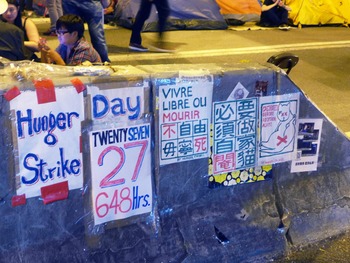
In one drawing, the curtailing or erosion of political freedoms after the handover is denounced as a form of “castration”: “Castrated before adoption as a pet” (accompanied by a drawing of a cat; see figure 2). The opposite of being a “pet” or a “slave” is an implicit affirmation of agency. Yet the political community in whose name universal suffrage is claimed could be elastic: “I want real universal suffrage. Hongkongers support Hongkongers” (*Ngoh yiu jan pousyun, Heung Gong yahn chaang Heung Gong yahn 我要真普選,香港人撐香港人); “Umbrella Revolution Hong Kong. Peace for our motherland.” While in the first slogan, democracy is linked to the affirmation of Hong Kong as a political community that does not immediately encompass China, the second one, while designating the movement as a “revolution,” also refers to an imprecise “motherland” (in English) which may refer to Hong Kong, but also to China. In this sense, the affirmation of Hong Kong identity as a central claim of the movement should not be opposed to democracy, but viewed as an expression of the political community claiming democracy. To what extent this community is open or closed to “outsiders” depends on individual slogans, but its central meaning is closely connected to democracy.
Castrated before adoption as a pet. Photograph by the author.

Anti-Capitalist and Post-Materialist Claims
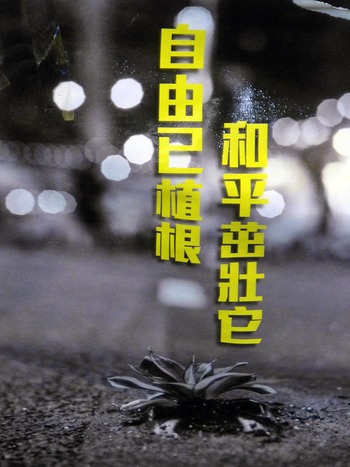
A third group of slogans can be summarized as “post-materialist,” mainly critiquing crony capitalism, affirming the need to preserve the environment, and supporting alternative lifestyles (gay pride, vegetarianism, organic farming). Ecological concerns were linked to a more inclusive and democratically accountable decision-making process, as echoed by the establishment of an organic garden in the midst of the Admiralty protest site, with a banner proclaiming: “Organic guerilla garden of plurality. Plentiful garden of organic disobedience” (Kangming youji fengfu zhi yuan 抗命有機豐富之園); “Freedom has taken root. Peace strengthens it” (Ziyou yi zhigen, heping zhuozhuang ta 自由已植根,和平茁壯它). The first slogan links civil disobedience with cultural plurality and organic farming, which some alternative communities advocated in the aftermath of the Choi Yuen Tsuen incident in 2010 (see also Cheung Reference Cheung and Cheng2014). Other slogans similarly connect democracy to a more accountable mode of town-planning. The second slogan features a photograph taken on one of the Admiralty flyovers, in which a hole has been drilled into the concrete highway to make room for a small cactus to take root in the soil below (see figure 3). Like in the “blooming flower” analogy, political freedom is incarnated by the image of a plant: by taking over the highways that serve as arteries of Hong Kong's capitalism, and planting flowers on them, the city may develop an ecosystem more conducive to the realization of political freedoms. It points out that democracy is impeded by crony capitalism and the widely shared endorsement of a productivist lifestyle—an obstacle generated not only in Beijing but within Hong Kong. The occupied zones served as a model: not only was refuse collection ensured, but a complex system of refuse sorting and recycling was organized, in contrast with the SAR government, which has been dragging its feet on the issue for many years, taking the position that recycling should be subcontracted to private companies that can make a profit on it.Footnote 11 Recyclable materials thus figured prominently in many of the emblematic productions of the occupied areas, like the Umbrella Man statue, made of recycled wood, and the canopy hung between footbridges over “Umbrella Square,” made of discarded umbrella tops. Ecological self-organization thus served as a kind of scale-model for the democratic process the occupiers were advocating.
Freedom has taken root. Peace strengthens it. Photograph by the author.

The critique of capitalism, productivity, and Hong Kong's economic model based on real estate also featured prominently. Many of the protesters' tents were ironically named in the style of Hong Kong's pretentious real estate developments, such as “Mount Harcourt 1” in Admiralty. A series of slogans directly targeted the real estate sector, denouncing “government-business collusion” and referencing a famous quote by C. Y. Leung (see Buckley and Bradsher Reference Buckley and Bradsher2014): “HK has too many poor people to allow direct elections (Carry Yourself Leung).”Footnote 12 The rule of law itself, a mantra in the pan-democrat camp, was questioned as skewed: “Rule of law? Wake up, Hong Kong people. The law? Skewed toward tycoons and finance!” (*Faatjih? Sing ha, Heung Gong yahn. Faatleuht? Heung fuhouh choihtyuhn kingcheh dik! 法治??醒吓,香港人.法律??向富豪財團傾斜的!). These pronouncements establish a clear link between political and economic issues. Contemplating a system that screens out candidates put forward by “poor people” and over-represents vested interests and pro-Beijing crony capitalists, this slogan again calls for an “awakening” that would empower citizens anew.
Two significant strands run through the entire range of slogans: democracy, the Hong Kong community that supports it, and the critique of capitalism are all presented as expressions of an affirmation of agency and justified in moral terms. They can simply be seen as different levels of generalization of the same core claim, which is made in a universalistic mode (“democracy”), in relation with a geographical community (“Hong Kong”), or by advancing more concrete policy agendas like opposing the hegemony of corporate productivism.
Performing Cultural Repertoires: An Expressive Movement
In a classic political science approach, social movements are often discussed through the lens of a cost-benefit calculation, against a larger background of the structure of political opportunities. In such a framework of strategic calculation and mobilization, movement slogans are generally understood as “frames” or “scripts,” that echo a “repertoire” of collective action (Tilly Reference Tilly1978). In an insightful commentary published just after the end of the movement, Law Wing-sang points out that the Umbrella Movement evolved from an “instrumental” model (implicit in the demands made by OCLP) to become an “expressive” social movement: while its instrumental demands (citizen nomination of candidates for the chief executive election) had already failed before the movement began (evidenced by the August 31 NPC-SC decision), the most important aspect was the movement's “spontaneity” (zifaxing 自發性) as expressed in the anti–tear gas protests on September 28 (An Tu Reference An2014). In this perspective, the slogans and other textual materials can be seen not simply as the expression of well-defined claims, but as part of a broader “performance” of the democratic or spontaneous nature of the movement itself. Similarly, cultural sociology studies social movements as “oppositional performances,” in which cultural references or frames are particularly significant in establishing meanings shared with larger groups of society (Johnston Reference Johnston and Johnston2009, 6). If we consider such texts as speech acts in Austin's perspective, this section deals with their locutionary content, or textuality.
In the Chinese context, Jeffrey Wasserstrom and Joseph Esherick use the categories of “ritual” and “theatre” to explain the mobilization of respectively traditional and modern historical repertoires of protest in the 1989 democracy movement. They argue that the three main traits of the movement are its address to the authorities as the implied audience, its public nature as street theatre that invites all citizens to join, and its symbolic self-definition of students within the tradition of selfless martyrs. This performed street theatre, they argue, is ultimately the result of China's lack of a structured civil society in 1989 (Esherick and Wasserstrom Reference Esherick and Wasserstrom1990). Protesters in Hong Kong similarly resorted to culturally specific practices of big-character and small-character posters (dazibao and xiaozibao). However, Hong Kong in 2014 had a well-developed civil society, in which the Umbrella Movement was strongly embedded. By contrast with the nationalist martyr imagery in 1989, the hybrid cultural identities performed in the Umbrella Movement reflect Hong Kong's complex position within the Chinese and global context. This section examines the cultural frames mobilized in texts.
Framing China
The Umbrella Movement was sparked by a decision made in Beijing, and it became apparent to many of the participants early on that a satisfactory answer to their claims could only be found if Beijing intervened. At the same time, the Chinese state media were continually castigating the movement as an illegal attempt to overthrow the local and central governments with the help of “foreign forces” (e.g., Guo Ping Reference Guo2014), and the Chinese government moved decisively to arrest scores of sympathizers in China. It is hence unsurprising that the movement's textual production would implicitly address both the central government and the Chinese population at large, attempting to correct the distorted image painted by state media. Furthermore, in Hong Kong's political culture, traditional Confucianism, encouraged both under British colonialism and after the handover (Law Reference Law2009), plays an important role as a widely shared frame.
A group of slogans thus establishes a strong connection with traditional China, using classical references to reaffirm a position of moral superiority and principle:
Both born of the same root [why torment each other so cruelly?] (Ben shi tonggen sheng 本是同根生) [Romance of the three kingdoms].
Choose virtue and persevere (Ze shan gu zhi 擇善固執) [Book of Rites].
Virtue is not left to stand alone. He who practices it will have neighbors (De bu gu, bi you ling 德不孤,必有鄰) [Analects].
The people do not fear death, why try to scare them with it? (Min bu wei si, naihe yi si shen zhi? 民不畏死,奈何以死慎之) [Laozi].
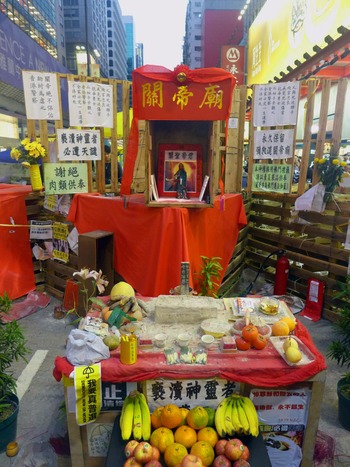
Each of these slogans references a classical text. The first one, which appeared as a rebuke to the Hong Kong police after the use of tear gas, took on a new meaning in the context of the rise of localist discourse, alluding to the fact that China and Hong Kong share the same cultural roots. The last slogan uses Laozi to criticize the use of force by the police. The other two use terms like shan or de to refer to the protesters, implicitly marking their claims as morally superior. In these texts, protesters are able to phrase their claims in the vocabulary of traditional political wisdom that enjoys wide acceptance in Hong Kong and China. Many of these explicitly reaffirmed the connection to the Chinese nation (some of them explicitly addressed to “our Chinese compatriots”), defined by Sun Yat-sen's both traditional and democratic concept of the “world belongs to all.” Traditional popular culture was also referenced in the Guandi shrine that appeared in the Mongkok area (see figure 4). The shrine was supposed to protect protesters from both triads and police because both of these groups worship him.Footnote 13 Here also, traditional culture, in its local variant, provides a frame that unites the protesters and their apparent opponents with the goal of “defending the country and protecting the people” (hu guo bao min 護國保民) that appeared in the parallel scrolls bearing Guandi's full name.
Guandi shrine in Mongkok. Photograph by the author.

Some famous literary quotes also appeared in the occupied zones, most prominent among them two lines respectively by Lu Xun (1881–1936) and Gu Cheng (1956–93):
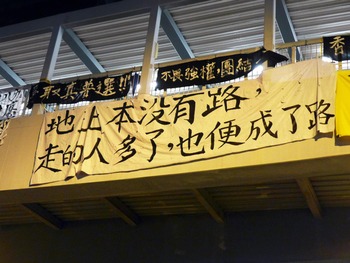
Although originally there was no path on the ground, as more and more people walked through, it became a path (Dishang ben meiyou lu, zou de ren duole, bian chengle lu 地上本沒有路,走的人多了,便成了路; see figure 5).
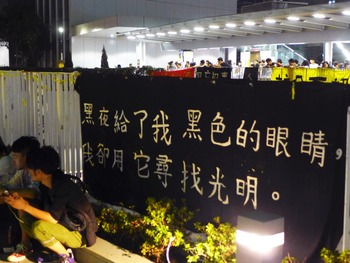
The black night has given me black eyes, but I use them to search for light (Heiye geile wo heise de yanjing, wo que yong ta xunzhao guangming 黑夜給了我黑色的眼睛,我卻用它尋找光明; see figure 6).
Lu Xun's quote, the last line of his short story “My hometown” (Guxiang, 1921), refers to the dialectics of hope and despair: although hope may not be visible at first, it can slowly form even in the midst of despair. Gu Cheng's quote, taken from the poem “A generation” (Yi dai ren, 1979), affirms a similar search for moral light in the midst of darkness, and encapsulated the quest of a whole generation to leave Maoism behind. Both slogans inscribe the movement within a century-long quest for democracy in China.
“Although originally there was no path on the ground, as more and more people walked through, it became a path” (Lu Xun). Photograph by the author.

“The black night has given me black eyes, but I use them to search for light” (Gu Cheng). Photograph by the author.

A third subgroup of slogans refers more directly to the contemporary PRC. In some cases, the occupiers strategically use quotes from CCP leaders (Mao's call to support student movements, and another to oppose unelected governments; Xi Zhongxun's endorsement of the people's power) to reaffirm their loyalty to the central government and at the same time highlight the CCP's nominal commitment to democracy. Enrolling Mao and Xi Zhongxun (father of Xi Jinping) under their banner, these slogans attempt to confront the CCP with its own contradictions: calling for democracy and universal suffrage, as well as a critical approach to patriotism before taking power, it then proceeded to do away with elections and demand blind obedience in the name of patriotism. A particularly ironic and graphically striking banner hanging from the footbridge in Admiralty demanded the resignation of C. Y. Leung using calligraphy executed in an imitation of Mao's style (see figure 7).
Leung Chun-ying, resign! (left-hand banner). Photograph by the author.

In other cases, the occupiers affirm their connection with a community of dissent in China. A series of texts explicitly or implicitly connected with Falungong stand out through their direct challenge to the CCP's legitimacy (e.g., “Only without the Communist Party will there be a new China,” parodying a famous song). Expressions of support appeared from groups like the Southern Street movement, a well-known rights-defense movement in Guangzhou in 2013–14. In several venues, occupiers drew attention to their supporters in China, with a regularly updated count of arrests: “How many people are still detained [in China] for supporting Occupy Central?” (Yinwei zhichi zhanzhong, you duoshao ren reng bei qiujin? 因為支持佔中有多少人仍被囚禁?). In another example, Hong Kong's historical role as a safe haven from communism was highlighted, asserting a generational continuity between members of the movement and their parents' generation. Altogether, the cultural references to “greater Chinese” identity are rich and varied. Drawing on different historical frames and political repertoires, the occupiers perform “China” through a mix of classical and modern references, with a strong moral-philosophical bend. Implicitly refusing the definition of patriotism advanced by Beijing, they establish a parallel tradition of Chineseness, which culminates in the strategic use of pronouncements by communist leaders to demonstrate their double standards and a direct critique of the CCP's legitimacy.
The World as Audience
While some texts highlight a Chinese connection, other slogans are firmly situated within a cosmopolitan tradition of worldwide protest. For a movement that relied strongly on the presence of the international media to resist skewed reporting by China's state organs, cosmopolitan framing had a definite strategic dimension. However, it also corresponds to Hong Kong's status as a hybrid cultural entity, where identification with cosmopolitan values is now higher than identification as Chinese.Footnote 14 Multilingual slogans appeared in various locations, with for example a long series of translations in several dozen languages of “Hong Kong democracy” on one of the flyovers leading from Admiralty to Central, underscoring that the Umbrella Movement was part of a more global struggle for democracy.Footnote 15
Slogans mainly quote pronouncements by worldwide protest leaders or thinkers, and international popular culture. While Gandhi is perhaps the most quoted leader (“First they ignore you, then they laugh at you, then they fight you, then you win”), Aung San Suu Kyi, Nelson Mandela (“It's always impossible until it's done”), and Martin Luther King (“Change does not roll in on the wheels of inevitability but comes through continuous struggle”) all made repeated appearances. Most of the individuals (many of them non-Western) represent moral authorities who fought for seemingly hopeless causes, against colonialism, military dictatorship, apartheid, Nazism (Dietrich Bonhoeffer), or racial discrimination. The slogans are generally abstract, reaffirming agency, and framing the necessary “continuous struggle” as a moral choice between good and evil, vindicated by history. Orwell's famous satire of communism in Animal Farm (“All animals are equal but some are more equal than others”) is used to make a comment on the equality of representation on the proposed Nomination Committee, skewed towards pro-Beijing forces.
Finally, a crucial component of the Umbrella Movement's international appeal was its performance of international pop culture. While some of it can be read in slogans, these quotations from popular songs were not only written down but also repeatedly performed, especially in Admiralty: “Do you hear the people sing?” (Les Misérables); “You may say I'm a dreamer, but I'm not the only one” (John Lennon); and “We don't need no thought control” (Pink Floyd). “Do you hear the people sing” became a core cultural reference of the movement, and was often sung in its Cantonese version (*Seuih waahn meih goksing 誰還未覺醒 “Who has not yet awoken?”) at the protest sites. It anchored the movement in a historical series of struggles against tyranny, while its Cantonese lyrics emphasized the defense of Hong Kong. John Lennon and Pink Floyd refer to the 1960s and 1970s, underscoring the continued appeal among the new generations of a protest culture that their predecessors (among the pan-democratic parties) may have taken part in but did not generally embrace politically.
The Hong Kong Story
The richest and most significant examples of performance can be associated with the expression of local identity. They were targeted both at reinforcing a sense of cultural community among the occupiers and more broadly at appealing to the Hong Kong population at large. The Cantonese language was central: to give only one example, an alternative name for the movement developed through a typical play on words: “Chater Revolution / Umbrella Revolution” (*Jeda gaakmihng 遮打革命). Part of the early occupation took place around Chater Road and Chater Garden in Central, a name transcribed on street signs as Jeda; by a particular coincidence je is also the Cantonese word for “umbrella” (rather than the standard word san 傘 or yusan 雨傘). In addition, this slogan uses “revolution” rather than “movement,” further highlighting its transgressive content. It is not clear, however, that Cantonese slogans are consistently more localist in content, though they may generally be more contentious in tone.
The performance of Hong Kong identity referenced the city's popular protest culture. Well-rehearsed song lines from the June Fourth vigil in Victoria Park include the following two, respectively affirming democracy and freedom: “Democracy will return victoriously from battle” (Minzhu hui zhansheng guilai 民主會戰勝歸來); and “No matter how hard the rain beats down, freedom will still blossom” (Wulun yu zenme da, Ziyou reng shi hui kaihua 無論雨怎麼打,自由仍是會開花). The first line is the title of a song composed in 2012 by the band VIIV, and the second is a line from the song “Flower of freedom,” which became popular at June Fourth vigils after it was given new lyrics in 1993. Several compositions by the 1980s and 1990s Cantopop band Beyond, known for its political commitment, were widely sung and referenced in the movement, in particular “Boundless ocean, vast skies” (Haikuo tiankong 海闊天空, 1993), which became one of the anthems of the Umbrella Movement, and “Glorious years” (Guanghui suiyue 光輝歲月,1990), originally devoted to Nelson Mandela. These references are significant in that the mainstream of the Umbrella Movement was quite critical with respect to the traditional pan-democratic political agenda, including the commemoration of June Fourth. They suggest, despite a growing distance from the mainland, that the June Fourth commemorations have become part of Hong Kong identity and as such are not rejected by the younger generation of protesters.Footnote 16
In a broader sense, Hong Kong pop culture was also performed through references to a number of songs by indie music composers like Denise Ho (strongly implicated in the movement), Fiona Fung, or Eason Chan. A line from a song by Denise Ho titled “Glamorous” (Yan guang si she 艷光四射), originally part of an album released in 2005, which she performed at the Gay Parade during the Umbrella Movement, became widely quoted during the movement, appearing on posters and t-shirts: “Being born in troubled times entails certain responsibilities” (Sheng yu luanshi you zhong zeren 生於亂世有種責任). It encapsulates the feeling of a generational cohesion among the participants, as well as expressing an analogy between “speaking out” both about gay rights and political rights, as Ho has done. Another indie band, My Little Airport, has risen in popularity in parallel with the political critiques of the new generation: lines from the song “Ngau Tau Kok youth” (Niutoujiao qingnian 牛頭角青年) were used to criticize youth apathy. Similarly, the song “Stubborn” (Juejiang 倔強) by Taiwanese rock band Mayday (Wuyuetian) was widely quoted for its line, “Although I may be disappointed I cannot despair” (Jiusuan shiwang bu neng juewang 就算失望不能絕望).Footnote 17
Most interestingly, several slogans attempted to redefine the political community of Hong Kong by reworking state and government symbols. The British wartime slogan “Keep calm and carry on” (going back to a 1944 propaganda effort, it was recently revived by designers) encapsulating the “British spirit” of stoic resistance, can be seen as an example of colonial heritage that has become part of Hong Kong. Lion's Rock became a symbol of the movement after a group of climbers hung a huge banner on it on October 23, 2014, inscribed with the slogan “I want real universal suffrage.” A symbol of the “Hong Kong spirit” of hard work and surviving in adversity, it was popularized by the 1970s television series and theme song “Below the Lion Rock” (sung by Cantopop icon Roman Tam) and referenced in many slogans: “Displaying the Hong Kong spirit under the Lion Rock—real universal suffrage” (Shizishan xia tixian Xianggang jingshen—zhen puxuan 獅子山下體現香港精神–真普選); “Hongkongers, undefeatable” (Xianggangren, da bu si 香港人,打不死); “Flowers blooming everywhere under Lion's Rock” (Shizishan xia biandi kaihua 獅子山下遍地開花). As part of the liberal discourse of the value of hard work, Lion Rock may sit uncomfortably with some of the more anti-capitalist pronouncements in the movement, but strongly resonates with the affirmation of identity and political agency.
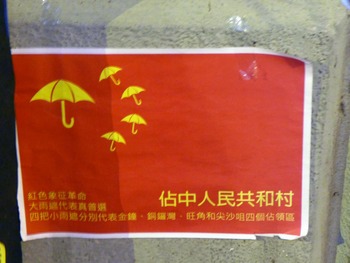
In some examples, Hong Kong identity was expressed by reappropriating political symbols. In one striking graphic creation, the PRC flag was redesigned, replacing the five yellow stars on a red background with five yellow umbrellas (see figure 8). The official name of the PRC and the symbolism of the flag were reinterpreted in the design, which read: “People's Village of Occupy Central” (Zhanzhong renmin gonghecun 佔中人民共和村). The explanation below reads: “The red color symbolizes revolution. The big umbrella represents universal suffrage. Four small umbrellas represent the four occupied areas of Admiralty, Causeway Bay, Mong Kok and Tsim Sha Tsui.” This graphic creation encapsulates many of the complexities of Hong Kong identity. Flags are a sensitive symbol in China: no local entities are allowed to have their own flag or emblem, and the Hong Kong SAR flag must, according to the Basic Law, always be flown in a smaller size than and together with the PRC flag. By reinterpreting the PRC flag, the occupiers avoid agitating for Hong Kong independence, but at the same time subvert it thoroughly. The idea of the “nation” is replaced by the notion of a “village,” the preferred term by which the occupiers referred to their camp (the term “gonghecun” also ironically alludes to the non-democratic nature of the PRC). An ironic commitment to the CCP's early ideals of revolution is suggested by the explanation of the red background, and connected with the four “revolutionary sites” in Hong Kong, replacing the four “revolutionary classes” in the original interpretation of the flag. By using the trivial symbol of the umbrella, and elevating it to ironically integrate it into the national flag, this design in fact subverts the whole notion of the nation-state. Rather than contesting Hong Kong's return to the PRC, it mocks the hollow pomp of national flags in general, proposing instead the organic community of the village. Other variants include a parody of the SAR flag, in which the five petals of the bauhinia are replaced by five black umbrellas on a yellow background.
People's Village of Occupy Central (PRC flag). Photograph by the author.

The diversity of cultural repertoires mobilized in the movement represents the complexity of identity issues in Hong Kong. Occupiers performed different cultural repertoires that both strategically played to different audiences and substantially expressed different aspects of a hybrid Hong Kong identity, bringing together traditional Chinese political vocabulary and modern Chinese culture, local and international pop icons, as well as colonial nostalgia and a preference for small, organic communities over large, aggressive nation-states. As pointed out by critics, at times the expressive dimension of the movement became overwhelming and drowned out other dimensions, such as the deliberative one that will be discussed below. Nonetheless, both aspects remain crucial to a full understanding of the movement.
Speech Acts and Public Space
“Performance” suggests strategic “framing” and a “playful” mode of interaction between an active group of performers and a more passive audience, which ultimately contributes to forming a group culture. There may, however, be another strand to the Umbrella Movement. As E. P. Thompson (Reference Thompson1971, 119) famously pointed out, popular protests do not only derive from a strategic calculation but also rely on implicit moral norms around which a community reaches a consensus. Similarly, Paul Lichterman (Reference Lichterman, Alexander, Jacobs and Smith2012, 214) notes that the mobilization of cultural frames can be part of a process of civic debate: “people use, enact, or rely on cultural forms to solve problems publicly so the forms they are using together in those instances are civic.” The moral undercurrent in many of the claims has already been highlighted above. Participants repeatedly expressed a strong commitment to creating spaces for deliberation and making decisions by consensus. In this sense, the movement's “spontaneism” may be seen as acting out contending public discourses, with as implicit model not only the dramatic stage, but also the deliberative forum (see, e.g., Della Porta Reference Della Porta and Johnston2009, 206). Sampson Wong (Reference Wong2015), in his analysis of the artistic production of the Umbrella Movement, moves from an “externalist reading” in which art is essentially a tool for protesters to communicate ideas to the outside, to a communicative framework in which artworks “reflect the desire of the occupiers to speak to other fellow participants of the movement.”
It should be remembered that the Umbrella Movement—like other “occupy” movements—was uniquely structured around the prolonged takeover of urban space, transformed into a forum of deliberative democracy. In a recent article, Craig Calhoun (Reference Calhoun2013) characterizes “occupy” movements by the following traits: (a) claiming the right to public space; (b) demonstrating the ability to maintain spontaneous order; (c) making the assembled group a demonstration of participatory democracy; (d) bringing together a group of like-minded people without a clear political program; and (e) being less a movement than a dramatic performance. The last two points have already been discussed above.Footnote 18 However, the three first points merit further attention. The Umbrella Movement began with a claim for public space (the storming of “civic square,” the public protest space in front of government headquarters that had been closed off); devoted tremendous resources and energy to maintaining spontaneous order (wardens organized security, supply stations provided food and drink, waste disposal and recycling were entirely self-organized); and, most importantly, repeatedly asserted its ideal of participatory democracy, expressed in the slogan, “Only the masses, no assembly” (Zhiyou qunzhong, meiyou dahui 只有群眾,沒有大會).
In this perspective, the texts produced and performed in the movement may also reflect an attempt to redraw the boundaries and rules of the public sphere. The exchange of slogans can be viewed as constitutive of a type of “communicative action” that for Habermas (Reference Habermas1984, 1:86)
refers to the interaction of at least two subjects capable of speech and action who establish interpersonal relations.… The actors seek to reach an understanding about the action situation and their plans of action in order to coordinate their actions by way of agreement. The central concept of interpretation refers in the first instance to negotiating definitions of the situation which admit of consensus.
Rather than the theatrical performance, referencing and subverting traditional political ritual, which played out on the stage of Tiananmen, it can be argued that the Hong Kong protests emphasized a deliberative exchange, grounded in a well-established tradition of civil society and civil discourse. As one of the student leaders underlined in an interview: “Democracy is about debate.”Footnote 19
Habermas's model has been criticized for its lack of attention to conflictuality, in particular to the process by which certain topics may be historically included or excluded from the public sphere (e.g., Fraser Reference Fraser, Nicholson and Seidman1995, 293). Craig Calhoun (Reference Calhoun1992, 24) points out that the public sphere became depoliticized and impoverished in the nineteenth century, as critical discussion bowed to cultural consumption, a tendency that the Umbrella Movement also experienced. One way of admitting conflictuality into Habermas's framework is to acknowledge a multiplicity of spheres: as Calhoun writes, “Social movements are among the several possible sorts of subsidiary public spheres we might conceptualize if we break with the idea that there must be one public sphere for each state” (37). Slogans can then be seen as the enactment of one of these alternative spheres where public debate takes place. In Austin's typology, this exchange derives from the perlocutionary dimension of the slogans, or their effect on and interaction with an intended audience.
Satire of Official Doublespeak
Caricatures and mocking slogans targeting politicians and members of the Hong Kong establishment, often in Cantonese, were ubiquitous. The main target was the chief executive, C. Y. Leung, and other members of the pro-Beijing camp. Leung was depicted as a CCP member, a wolf (a homophone of his surname), or a corrupt mafioso. One poster portrays him as Lei Feng, the communist model worker from the Cultural Revolution. Another uses characters homophonous with his English initials to highlight his “warped” thoughts: “Crooked thinking” (*si waai 思歪). Regina Ip, the former security secretary, was similarly mocked when her name, Ip née Lau (*Yip-Lau 葉劉), was glossed as “malignant tumor” (*yiht lauh 孽瘤). Several slogans mocked government phrases or catchwords. The one coined in support of the electoral reform package (“Pocket it first”), was reformulated to call for Leung's resignation: “CY resign: pocket it first” (*lohk jyuh toih sin 落住台先). Others denounced the undermining of the constitutional arrangements under the Basic Law and of the motto of the police: “One country, two systems: in name only. Hong Kong people rule Hong Kong: only idle talk” (Yiguo liangzhi, mingcun shiwang, Gangren zhi Gang, zhide koujiang 一國兩制,名存實亡,港人治港,只得口講); “Candid and upright” (Guangming leiluo 光明磊落). While the first asserts that the Basic Law has become meaningless, the second one contrasts the SAR police's motto with the alleged violence on September 28 (tear gas) and subsequent days (policemen were caught beating protester Ken Tsang on October 15), and the alleged police-triad collusion (police allegedly stood by as triad members beat protesters in Mongkok). We may note that, as contributions to a public debate, all these slogans highlight a gap between reality and speech.
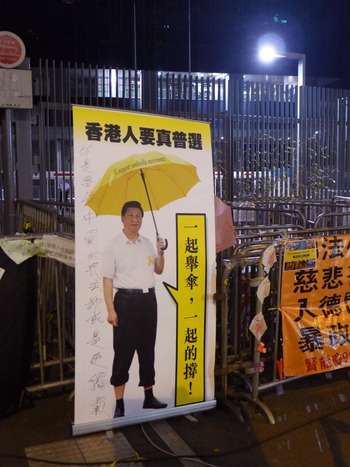
Interestingly, Chinese president Xi Jinping also became an icon of the satirical creations of the movement. Using a photo taken during flooding in Wuhan, where Xi Jinping appeared with rolled-up trousers and holding an umbrella (in keeping with his “down to earth” image), life-size cardboard figures of him holding a yellow umbrella blossomed throughout Admiralty (see figure 9). In this case, the visual power of the protest signs requires no slogan. On the one hand, this imagery alludes to Xi's anti-corruption campaign and grassroots image to communicate directly with the supreme leader and denounce corrupt local officials (highlighted in the HKFS's two open letters to the central government on October 11 and November 15), implicitly acknowledging the center's supreme authority over Hong Kong. At the same time, it mocked Xi's undignified appearance, which, in another poster, was unfavorably contrasted with the last British governor Chris Patten, under the slogan “Different tastes” (Pinwei bu yiyang 品味不一樣; see figure 10). This plays into the idea that British administration was superior, at least in style, to post-handover arrangements.
Hong Kong People want universal suffrage. “Raise the umbrella, support it together.” Photograph by the author.

Different tastes. Photograph by the author.

While some of these texts may not exactly suit the framework of civil discussion, they can be seen as conflictual interventions to extend the legitimate area of political debates in the face of the government's denial that the occupiers had a legitimate say in the discussion of public affairs. Critiques of Leung's ties to the Party and real estate promoters (and alleged ties to the mafia) and his preference for “rich people politics” point to this need to extend the public sphere. Similarly, referencing Xi Jinping's populist image, while at the same time mocking it, is also a way of highlighting how far removed the CCP has become from its original ideals.
Public Debate
Many of the movement's texts were explicitly designed to appear as interventions into an ongoing discussion, using personal pronouns (“we,” “you”). There was an ongoing internal debate on the strategy, goals, and nature of the movement. After the dialogue between the students and the government on October 21, some called to “step up” the action: “Without resistance, how can we have peace? Step up the movement!” (Meiyou kangzheng, na you heping? Xingdong shengji! 沒有抗爭哪有和平?行動升級!). Critiques of the “Occupy Trio” (Benny Tai, Chan Kin-man, and Chu Yiu-ming) targeted their moderation and their proposed exit strategy of handing themselves in to the police: “Self-surrender yourselves!” (Zishou ni ziji qu! 自首你自己去!); “Occupy Trio go home, the rest is our business. Umbrella Revolution: self-determination by the masses” (Sanzi tuichang, shengxia jiushi zanmen de shi le. Yusan geming minzhong zijue 三子退場,剩下就是咱們的事了.雨傘革命民眾自決).
One signboard in Mongkok—where slogans were often quite contentious—denounced the “Romantic losers in Admiralty” (Jinzhong de langman shibai zhuyi 金鐘的浪漫失敗主義). Critiques of the festive atmosphere in Admiralty, with singing, performing, and art creation, were also aired: “Not a carnival but a protest. We're serious” (documented in Admiralty, November 13). The three protest sites were usually considered as representative of different strands of the movement: Causeway Bay more academic and idealistic; Admiralty more middle class, “reasonable,” and dominated by HKFS; and Mong Kok more working class, with a stronger presence of anarchists and localists.Footnote 20 However, it is hard to substantiate these differences using the slogans alone, which appeared to migrate between the three venues. The only notable difference is the larger proportion of slogans dealing with issues of strategy and internal debate in Mongkok. The protestors most critical of traditional democrats often targeted “left plastic” (or “leftist pricks”), which refers to pan-democrats who supported “democratic reunification” and believe their struggle is linked to the fight for democracy in China: “If we don't get rid of leftist pricks, there is no end to Hong Kong's problems” (Zuojiao bu chu, Gang nan bu zhi 左膠不除,港難不止). Many posters criticized the projected referendum at Admiralty on October 26, which in the end had to be called off. These contentious claims highlight the growing politicization of Hong Kong society, which used to pride itself on its pragmatic and apolitical stance.
Others wanted to stick to the spirit of nonviolence and resisted calling the movement a revolution. They reasserted the value of peaceful resistance: “The dialogue has failed, why be angry? Sit tight and wait for arrest” (Duihua wu jieguo, fenhen you ruhe? Zuo ding deng ren suo 對話無結果,憤恨又如何?坐定等人鎖); “Retreat? Then we lose forever!” (Che? Jiu hui shu yi shi! 徹?就會輸一世!). Some proposed alternative strategies, like rotating occupation (“Be water, my friend,” an iconic quote from Bruce Lee referring to his unique martial arts style). Many texts highlighted the need for deliberative democracy inside the movement: “Debate our own HK. Umbrella is our common project, let the masses discuss it in common” (Ziji Xianggang, ziji jiang. Yusan gong ye, qunzhong gong yi 自己香港自己講.雨傘共業,群眾共議). This idea was of course both a strength and a vulnerability of the movement, which in the end prevented it from developing a consensual exit strategy, as various groups and individuals tried to leverage their own agenda and failed to develop consensus-building institutions or mechanisms.
Self-Reflexive Texts
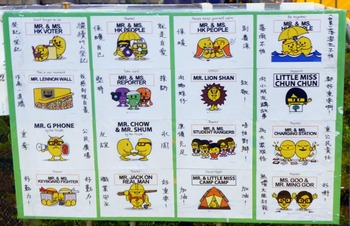
An original aspect of the movement was the continual production of self-portrayal, self-description, and self-commentary by its members. September 28 was commemorated as a foundational date almost as soon as it had passed: “We will not forget 9.28” (928 women bu hui wangji 928 我們不會忘記). Civil society, encompassing both the occupiers and the public at large, was represented in a series of “Mr Men” drawings that appeared around the occupation sites: “Little Mr and Mrs HK People” stood for all the citizens who at one time or another had visited the sites or spoken out against the political reform project (see figure 11). Many self-representations highlighted the generational aspect of the movement. The slogan “If not us, who? If not now, when?” (a quotation from John F. Kennedy) came to refer to the Occupy generation, the “us” fixing an in-group identity and generational sense of belonging. Echoing a ubiquitous subway announcement, a drawing states: “Please mind the generation gap” (see figure 12). It shows a young girl holding a yellow umbrella inside an MTR subway train and an older man standing outside on the platform, presumably hesitating to join her onboard.
Little Mr and Mrs Hong Kong People. Photograph by the author.

Please mind the generation gap. Photograph by the author.

A group of movement texts can be read as performative redefinitions of space. By renaming the occupied areas, they raise deeper questions about the nature of the occupying “community” and the political organization of Hong Kong. Predictably, the “occupation” of public space was an ongoing topic of public discussion: “Sorry, the congestion of the roads today is to ensure the smooth circulation of democracy in the future” (Duibuqi, malu jintian de tanhuan shi weile weilai de minzhu changtong 對不起,馬路今天的癱瘓是為了未來的民主暢通); “There will be a short battle because democracy is still in the next platform. Please accept our apologies.” Both of these poke fun at the Hong Kong nanny-state for its costly public works and paternalistic discourse justifying them in the name of the common good. They turn around this claim and assure the public that the outcome of democracy is worth enduring some hardship for. However, this argument ultimately failed to convince a large slice of public opinion, which grew increasingly impatient with the inconvenience.
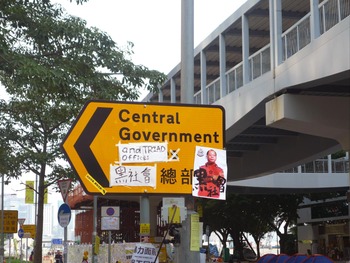
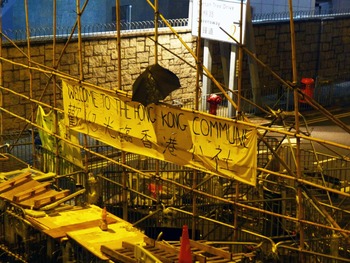
A culture of satirizing and redesigning signs developed in the occupied zones. One sign designated an area as a “Temporary Camp of Extraterrestrial forces” (waixing shili linshi zhuzhaying 外星勢力臨時駐紮營), mocking the chief executive's repeated assurance that the movement was due to manipulation by “foreign forces.” After the alleged collusion between police and triads, a sign pointing to the government building was relabeled “Central Government and Triad Offices” (see figure 13). More seriously, the central space in Admiralty where the stage was installed, under the umbrella canopy, was renamed Umbrella Square (Yusan Guangchang 雨傘廣場), affirming its role as a deliberative forum. A large banner appeared at the Western end of the Admiralty occupation zone, close to the PLA building, announcing: “Welcome to the Hong Kong Commune” (see figure 14). Highway signs were rewritten to indicate the “road” to democracy or universal suffrage. One street sign was covered with an inscription proclaiming the refusal of the NPC Standing Committee decision (“not a road”). These discussions point to a growing, substantive debate about the nature of the Hong Kong polity.
Central government and triad offices. Photograph by the author.

Welcome to the Hong Kong commune. Photograph by the author.

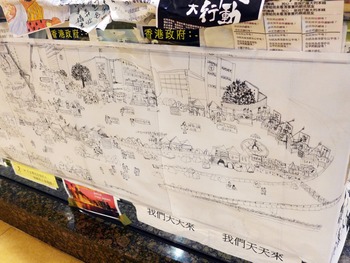
On one of the flyovers, a sign with a classical flavor explicitly referred to the “village,” the preferred term used by the occupiers to designate their settlement: “Here be the village entrance; good citizens dwell inside” (Ci nai cunkou, nei you liangmin 此乃村口,內有良民). It uses traditional political vocabulary to refer to the occupiers as liangmin (good, law-abiding subjects of the emperor). The traditional strand in defining the occupying community was also notable in the artwork, a full discussion of which is regrettably beyond the scope of this article. The famous Song dynasty scroll painting Along the River During the Qingming Festival or Qingming shang he tu 清明上河圖 (Zhang Zheduan, approx. twelfth century) inspired two carefully executed artworks displayed at Admiralty: a scroll-style drawing on several juxtaposed sheets of A3 paper exhibited at the Admiralty MTR station (Exit A), as well as a smaller version with an umbrella by Cuson Lo that circulated widely on the Internet. Both of them titled Along the river under the umbrella (Yusan shang he tu 雨傘上河圖), they depict daily life in the “Admiralty village” (see figure 15). They also attest the potential of traditional representations to contribute to the debate about redefining a community in the present.
Along the river, under the umbrella (detail, Admiralty station). Photograph by the author.

These self-representations all redesign the urban space, as other Occupy movements have also done, by highlighting different forms of political organization. Combining the “commune” from the leftist repertoire, the “village” from traditional Chinese representations, and the “square” or “forum” that may be associated with the origins of democracy, these representations all eschew the level of the state and of overly institutionalized politics. They highlight the search for an adequately representative political community (traditional or modern) and the difficulties the movement encountered in creating such a community.
Despite the challenges raised by the sheer number and diversity of the slogans documented, it is possible to draw some tentative conclusions from the analysis. The claim of democracy, with its declinations ranging from an abstract moral concept of human agency to a norm-based political system in a well-circumscribed community, is central to the movement texts. There is no contradiction between the claims of democracy and most of the assertions of localism, which often take the form of the geographical or cultural affirmation of a civic-based community. The affirmation of agency is situated on both a philosophical and a historical level: while democracy supposes individual agency (hence its moral appeal), Hong Kong's emergence as a democratic political community also entails the affirmation of agency against the legacy of colonization and post-handover recolonization. These claims are more largely framed within different sets of cultural references, ranging from the traditional Chinese to the cosmopolitan, and encompassing the specific “spirit” of Hong Kong and its own democratic dimension. A composite civic culture emerges from this synthesis, referencing elements of the colonial era, the moral appeal of traditional Chinese philosophy, cosmopolitan pop culture, and defense of human rights in mainland China.
The most original part of the movement, inseparable from its highly organized, nonviolent, rational principles, is undeniably the reappropriation of public space as an alternative democratic community. This essay makes the argument that a civil discourse developed in the slogans, which debated the nature of the democratic community itself: the occupying community and more largely the Hong Kong community. This sets the Umbrella Movement apart from many more contentious forms of social movements. The deliberative nature of the movement was admittedly sometimes overshadowed by the dramatic appeal of its performative dimension. As highlighted by one of the student leaders in an interview, it is possible that this civil discourse did not develop strongly or quickly enough to enable new mechanisms of democratic consultation and decision to guide the development of the movement. “We lacked trust within the occupied areas.… There was no possibility to persuade one another through debate.… Democracy is about debate.… We held consultation forums in certain areas, but we [the student leaders] were not on equal status, we were not self-aware enough. Even the [aborted] referendum was still decided by the organizers.”Footnote 21 Some of the slogans indeed attest the insufficiently democratic or civil nature of the deliberative exchanges among occupiers, which ultimately led to internal division and a disconnect between the occupiers and public opinion at large. However, Alex Chow's self-critical assessment is surely productive, and we may hence also choose to highlight the importance of the both radical and civil questioning of the nature of the Hong Kong community that took place in the slogans and artwork, with options ranging from the traditional village to the alternative commune. This long-overdue, self-reflexive questioning of the nature of the Hong Kong polity is probably the movement's most important legacy.
Acknowledgments
This article was first presented at the AAS in Asia at Academia Sinica, Taipei, in June 2015. I would particularly like to thank my three copanelists: Edmund Cheng and Samson Yuen offered critical comments, support, and inspiration, while Hung Ho-fung pointed out the significance of the notion of “self-determination.”