

Flexible Learning Programs in Australia
Alternative schools do not conform to any clear definition, apart from being an ‘alternative’ to regular or ‘mainstream’ schooling (Mills & McGregor, Reference Mills, McGregor and Noblit2017; te Riele, Reference te Riele2007). Broadly speaking, there are two branches of alternative schools in Australia. Those that follow an established philosophy of education, such as Steiner, Montessori, or democratic schools (see Korkmaz & Erden, Reference Korkmaz and Erden2014), and those that have arisen as a response to the needs of students who are considered to be disengaged, disenfranchised, or marginalised (Mills & McGregor, Reference Mills, McGregor and Noblit2017). This second category of alternative educational provision has loosely been labelled flexible learning programs (FLPs), or ‘flexis’, and focus on changing the education to fit the student, rather than changing the student to fit the education (te Riele, Reference te Riele2007).
FLPs exist in many forms in Australia. They include standalone schools, outreach programs, and separate spaces operating within a mainstream school setting. FLPs cater for students who have been ‘pushed out’ or have ‘dropped out’ of regular education (Bradley & Renzulli, Reference Bradley and Renzulli2011). Some programs are available for any student to attend, but in reality, many students attending FLPs are required to do so as part of a juvenile justice condition, have been referred due to emotional or behavioural difficulties, or have been expelled from other schools in their area. In other words, enrolment in many FLPs is available as a ‘choice’ for the young people, but that choice is often presented by schools as a threat (i.e., as a potential consequence for poor behaviour), as a way for the student to escape a mainstream setting (Thomas, Reference Thomas2016), or as their only chance at education (McGregor, Mills, te Riele, & Hayes, Reference McGregor, Mills, te Riele and Hayes2015).
Structurally, FLPs tend to be small scale, with high staff to student ratios (Gutherson, Davies, & Daszkiewicz, Reference Gutherson, Davies and Daszkiewicz2011). They often include a range of external support from the community to assist with housing, drug and alcohol support, legal aid, and food requirements because of the complexity of the students’ backgrounds and needs. The curriculum and assessment within FLPs tend to be personalised, and the delivery of the curriculum is flexible.
Students enrolled within FLPs are more likely to be from racial and ethnic minorities, low socioeconomic family backgrounds, and to have histories of abuse (Pennacchia, Thomson, Mills, & McGregor, Reference Pennacchia, Thomson, Mills and McGregor2016). Commonly, students who enrol in FLPs have experienced a long history of school failure and rejection. This breakdown of the relationship with schooling often defines this student population as being disengaged and the purpose of FLPs, therefore, as an opportunity to re-engage with education.
Engagement and Disengagement
McMahon and Portelli (Reference McMahon and Portelli2004) describe three definitions of engagement: conservative, liberal, and critical democratic. In their critical democratic model, the authors explain that
… As enacted, engagement is generated through the interactions of students and teachers, in a shared space, for the purpose of democratic reconstruction, through which personal transformation takes place. (p. 70)
This concept, that engagement is generated through the interactions of students and teachers, is central to the theoretical understanding of engagement in this paper. Coupled with the idea that student engagement is seen as a dynamic concept that changes over time (Callingham, Reference Callingham2013; Christenson, Reschly, & Wylie, Reference Christenson, Reschly and Wylie2012; Fredricks, Reference Fredricks2014), we understand student disengagement as being generated in the ‘shared space’ between students and their schooling. Like McMahon and Portelli (Reference McMahon and Portelli2004), we also see that ‘personal transformation’ can take place as a process of student disengagement.
Disengagement, like engagement, is multidimensional. It is generally accepted that there are at least three dimensions of engagement: (a) affective, (b) cognitive, and (c) behavioural (Archambault, Janosz, Fallu, & Pagani, Reference Archambault, Janosz, Fallu and Pagani2009; Christenson et al., Reference Christenson, Reschly and Wylie2012; Fredricks, Blumenfeld, & Paris, Reference Fredricks, Blumenfeld and Paris2004). Affective engagement refers to how a student feels about school, whereas cognitive engagement refers to how students see themselves as students, and behavioural engagement refers to how students act. Research suggests that there is a temporal order to disengagement; that is, a student will first disengage affectively or cognitively before they disengage behaviourally (Harris, Reference Harris2008; Thomas, Dyment, Moltow, & Hay, Reference Thomas, Dyment, Moltow and Hay2016). For example, a student does not feel like they belong (affective disengagement) so they skip class (behavioural disengagement). Behavioural disengagement appears in many forms, from the obvious poor conduct and truancy, to the less obvious withdrawn behaviours of the ‘quietly disengaged’ (Ross Reference Ross2019).
School Exclusion
Regardless of the fact that access to education is a human right (Universal Declaration of Human Rights; United Nations [UN], 1948), there are many formal and informal exclusionary practices in Australian schools. The most commonly known are those enshrined in behaviour management policies and consist of detentions, suspensions, expulsions, and prohibitions from schools for varying amounts of time. Informal or incidental exclusions possibly occur at higher rates than official exclusion but are not documented; these include ‘in-class’ exclusions such as the use of an isolation chair, reduction of privilege to attend certain school events such as sports days or excursions, or unspecified ‘alternative arrangements’ for some children while others undertake standard education (Pearce, Reference Pearce2019). Unofficial exclusion also exists in social situations when individual students are not invited to join groups in class or be involved in play.
From a perspective where engagement is created in the interactions between the student and education, school exclusions play a very important role in student disengagement. Every time a student is excluded from the school environment, formally, informally, by teachers and school administration, or by peers in the playground, student disengagement is created and a student’s ‘personal transformation’ takes place. Put succinctly, the theory of engagement would predict that the more exclusion a child experiences in the school environment, the more disengaged from education they will become. Unfortunately, this forms a positive feedback loop, where the more disengaged a student becomes, the more disengaged behaviour the child exhibits — and traditionally, the more exclusionary responses imposed by the school. This prediction is supported by empirical research from the United States (USA) where over 3.5 million students were suspended in 2011/2012 (Skiba & Losen, Reference Skiba and Losen2016). Skiba and Losen (Reference Skiba and Losen2016) found that suspensions were not only ineffective in producing more positive behaviour or safer schools but also associated with lower academic achievement and an ‘increased risk of negative behavior over time’ (p. 6).
The data that exist on the demographics of school suspension and school expulsion paint a troubling picture. According to research from the USA, ‘students of colour’, those from low socioeconomic backgrounds, boys, and those living with disability are the most likely to be excluded formally from schools (Skiba et al., Reference Skiba, Chung, Trachok, Baker, Sheya and Hughes2014). Although there is no national exclusionary data in Australia, Baker (Reference Baker2019) reported that in New South Wales (NSW) around 20% of students are reported to have a disability, although they constitute around 40% of suspended students; that is, in comparison with their peers without disability, students with disability are twice as likely to be suspended from school.
Students With Disability
The rights of students with disability to a quality education have been promoted internationally by United Nations’ declarations (such as the Universal Declaration of Human Rights; UN, 1948), statements (such as the Salamanca Statement and Framework for Action on Special Needs Education; United Nations Educational, Scientific, and Cultural Organization, 1994), and conventions (such as the Convention on the Rights of Persons With Disabilities; UN, 2006). In the USA, the No Child Left Behind Act 2001 (U.S. Department of Education, Office of Elementary and Secondary Education, 2002) and the Individuals With Disabilities Education Act 2004 (U.S. Department of Education, 2004) represent policy-level initiatives to enact these rights for students with disability. In Australia, the Disability Standards for Education 2005 (Australian Government Department of Education, Skills and Employment, 2020), which elaborates on and explains the application of the Disability Discrimination Act 1992 (Commonwealth of Australia, 2018) for the education sector, serves a similar purpose, requiring schools to make ‘reasonable adjustments’ for students with disability so that they can learn ‘on the same basis’ as their peers without disability. De Bruin (Reference de Bruin2019), however, argues that the outcomes of reforms for students with disability in these countries differ, with segregation increasing in Australia.
Despite acknowledging the important and positive role of the Disability Standards for Education 2005 (Australian Government Department of Education, Skills and Employment, 2020), Urbis (2015) found that the extent to which the ideals of the standards are achieved depends on local understanding, policy support, and funding to navigate the complexity and lack of clarity that sometimes hinders implementation for students with disability. In particular, a number of submissions to the Urbis (2015) review report on apparent breaches of the standards for students with learning disabilities whose needs may be less visible than for students with physical disabilities.
Approaches to support and funding for students with disability in Australia have historically varied across state and territories, although efforts such as the Nationally Consistent Collection of Data on School Students With Disability (NCCD) are seeking to promote equity across jurisdictions (Education Services Australia, 2020). At a local level, systems such as the Tasmanian Government’s Department of Education are seeking to reform their model of funding for students with disability in line with the level of adjustments of the NCCD (Tasmanian Government Department of Education, 2020). The report by Forlin, Chambers, Loreman, Deppeler, and Sharma (Reference Forlin, Chambers, Loreman, Deppeler and Sharma2013) for the Australian Research Alliance for Children and Youth described the range of approaches to accommodating the educational needs of students with disability, ranging from full inclusion in mainstream schools, ‘partial inclusion’ through participation in specialised classes, units, or centres, through to enrolment in separate special schools. The report emphasised the need for capacity building to enact inclusive education in schools. Similarly, in their editorial to mark 25 years since the Salamanca Statement, Ainscow, Slee, and Best (Reference Ainscow, Slee and Best2019) suggest that
… the promotion of inclusion is not simply a technical or organizational change – it is a movement in a clear philosophical direction. Moving to more inclusive ways of working therefore requires shifts in policy-makers’ values and ways of thinking, which enable them to provide a vision shaping a culture of inclusion, through to significant changes within schools and classrooms. And, of course, this has to involve the wider community. (pp. 675–676)
Notwithstanding the focus on reform for the education of students with disability, and although disability has previously been identified as an important variable influencing the likelihood of a student being disengaged from education, research has seldom been conducted on the relationship between disability and disengagement. In order to understand the relationship between disengagement and disability more deeply and to progress an understanding of the implications for the various systems of schooling, this study reports on an initial investigation into the prevalence of students with disability in Australian FLPs; that is, we aimed to answer the following research questions:
-
1. To what extent are students with disability overrepresented in FLPs?
-
2. What factors influence the overrepresentation of students with disability in FLPs?
Method
In order to explore the extent to which students with disability are represented within FLPs and the factors that influence their representation, an anonymous cross-sectional survey was used. The cross-sectional survey allowed us to make inferences about our population of interest (students with disability in FLPs, based on the perspectives of FLP leaders) at one point in time. We sent FLP administrators in Australia a link to the online survey asking about their students. As this was a preliminary study, a shorter survey was considered appropriate, because these few items would be needed to address our aims and research questions. We wanted to maximise survey completion and promote high response rates by making the survey as quick to complete as possible, as Roberts and Allen (Reference Roberts and Allen2015) note the connection between survey duration and response rates. Also, we wanted to respect the time of the participants.
Given that there was no current directory for FLPs in Australia, an internet-based environmental scan was conducted using a popular search engine (Google) and the following search terms: ‘flexible learning’, ‘alternative education’, and ‘reengagement’. The search terms were based on the first author’s knowledge of the sector developed over the previous decade. Through this process, major nongovernment organisations such as Youth Plus, Youth Off the Streets, Hands on Learning, Alta-1, and CARE were identified, and their websites were used to identify other programs and schools that met the following three criteria: (a) the educational provision was for school-aged children (i.e., primary and/or secondary levels of education); (b) the educational provision was not a mainstream school (i.e., not a school that promotes progressive flexible approaches to curriculum for the general population of students); and (c) the educational provision was not specifically or exclusively for students with disability. A total of 95 FLPs (with email contact details) were identified through this process (see Appendix A).
The survey was constructed through the Qualtrics online survey platform (Qualtrics, 2019) and consisted of three parts (see Appendix B). Part One was used to determine the type of school or program that was in the survey. We clarified that participants described their school or program as one that ‘responds to disengaged youth’, and that it was considered one of either flexible learning, alternative education/provision, reengagement program, or a second chance school. Part Two of the survey asked participants to number how many students they had enrolled who were living with one or more of the 10 most prevalent disabilities, and gave the option to add more categories if required. Finally, Part Three of the survey asked participants about whether they felt they had an overrepresentation of students with disability and whether they thought they had adequate resources to support them.
We chose to follow the broad definition of disability from the Disability Discrimination Act 1992 (Commonwealth of Australia, 2018) and to be inclusive of ‘imputed’ disabilities (Education Services Australia, 2020), rather than just clinically diagnosed disabilities, as the latter option may not have helped to understand the daily reality for educators in FLPs or the students they teach. In keeping with the broad categories of disability used in the NCCD, items in the survey were designed to encompass physical, cognitive, sensory, and social/emotional disabilities. For example, based on our experience across educational systems, we used the term ‘trauma’ so that participants could identify the proportion of students whose diagnosed or suspected disability (e.g., social/emotional disability) relates to the impact of traumatic events on the students’ behaviour and learning. Although the use of trauma as an umbrella term rather than focusing on a diagnosed disorder (such as post-traumatic stress disorder) may lead to variations in the way the item was interpreted, it allowed us to avoid the gap between diagnoses based on the Diagnostic and Statistical Manual of Mental Disorders (5th ed.; DSM-5; American Psychiatric Association, 2013) and educational provisions for students who have been affected by trauma (Watt, Reference Watt2017). Another question asked for the number of students enrolled who had ‘only one, two, three, or more than three conditions’ to determine rates of comorbidity.
It was not possible to retrieve the national prevalence rates from a single source; instead, we relied on the best available national data for each category of disability. Data for conduct disorders and attention-deficit/hyperactivity disorder (ADHD) were sourced from Lawrence et al. (Reference Lawrence, Johnson, Hafekost, Boterhoven de Haan, Sawyer, Ainley and Zubrick2015), as were rates for anxiety and depressive disorders. Autism spectrum disorder (ASD) rates were informed by Randall et al. (Reference Randall, Sciberras, Brignell, Ihsen, Efron, Dissanayake and Williams2016) and the Australian Institute of Health and Welfare (2017), and rates for learning difficulties were from the Australian Institute of Health and Welfare (2019). Rates for children affected by trauma were based on a report published by the Australian Institute of Child and Family Studies (Child Family Community Australia, 2017), noting that rates vary widely in the literature due to the fact that there is inadequacy in surveillance, varying methodological approaches, and differing definitions (May-Chahal & Cawson, Reference May-Chahal and Cawson2005; Radford, Corral, Bradley, & Fisher, Reference Radford, Corral, Bradley and Fisher2013; Saunders & Adams, Reference Saunders and Adams2014).
Having obtained approval to conduct the research from the University of Tasmania Social Sciences Human Research Ethics Committee, 95 survey invitations were sent via email, and 46 program leaders (48%) responded. Of those 46, 28 (29%) responses included some data and 22 (23%) were complete responses with reliable data. Incomplete answers were removed to create a more reliable dataset. Those 22 schools represented a total enrolment of 2,383 students in FLPs across Australia: Tasmania (n = 3), Victoria (n = 5), NSW (n = 5), Queensland (n = 4), Western Australia (n = 3), and South Australia (n = 2). To address the risk of the same participant completing the survey multiple times, the online survey platform (Qualtrics) recorded unique participant identifiers while still retaining participants’ anonymity. We were therefore able to discard any repeat survey completions and can confirm that the 22 participants were unique participants. By including only the 22 completed surveys for analysis and reporting, we ensured that the data were not distorted towards completion (or non-completion) of any particular item within the sample. Avoiding the use of ‘forced’ response items may have resulted in fewer completed surveys, but as Roberts and Allen (Reference Roberts and Allen2015) have noted, it also allowed us to avoid any ethical issues associated with compromising the extent to which the survey was completed by consent. There were no indications in the text-based response items that participants were unclear or not able to answer the survey in an informed and intended way.
Once collected, the data were exported to an Excel spreadsheet for analysis. In line with our research aim and as the participation of students with disability in FLPs is an underresearched area, we used descriptive statistics to represent the quantitative data, primarily in the form of percentages for the different disabilities reported and standard deviations, as well as aggregate percentages for the reported prevalence across the sample. Inductive thematic analysis of the qualitative data (written responses) was undertaken, and direct participant quotes are indicated by quotation marks in the presentation findings. This approach to the analysis and reporting of qualitative data followed studies such as Rayner and Allen (Reference Rayner and Allen2013) and Rayner and Swabey (Reference Rayner and Swabey2016), and involved the five main stages of qualitative data analysis described by Denscombe (Reference Denscombe2010): (a) data preparation (transferring raw data from Qualtrics to Excel), (b) initial exploration of the data (looking for key themes and issues), (c) analysis of the data (applying codes and grouping the data within categories), (d) presentation and display of the data (describing the themes in writing and illustrating themes through the use of verbatim quotes), and (e) validation of the data (comparing the qualitative data with the quantitative data and with alternative explanations).
Findings
Overrepresentation of Students With Disability
The vast majority (95%, n = 21) of the leaders who completed the survey believed that they enrolled an overrepresentation of students with a disability in their FLP. As a group, participants reported that 78% of students (n = 1,870) were living with a disability, which is more than four times higher than the estimated 18% of the general Australian population living with disability (Australian Institute of Health and Welfare, 2019). Also, a combined 61% of students (n = 1,473) were reported as having more than one disability, with more than one quarter of all students (n = 598) in the FLPs in this study having three or more disabilities.
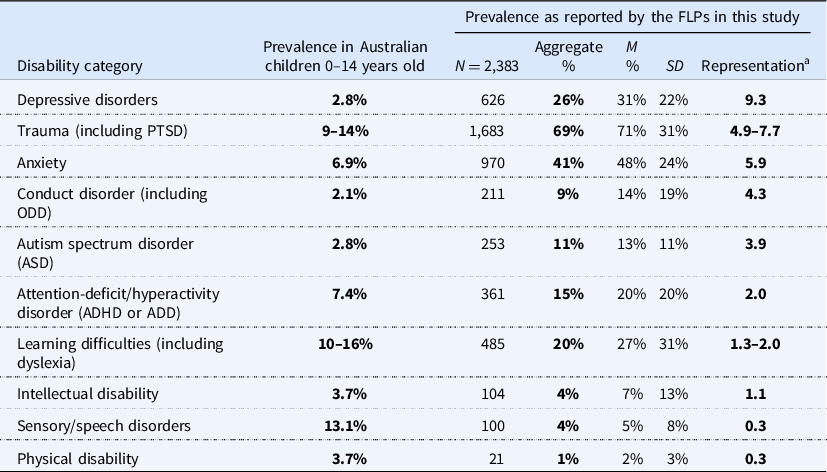
Responses from the survey indicated three groups of students with disabilities in FLPs in terms of their representation in comparison with the estimated national prevalence rates (see Table 1). The first group, students with depressive disorders, those affected by trauma, and those with anxiety, were clearly overrepresented in the FLPs, with aggregate proportions 5 to 9 times greater than the estimated national prevalence rates. The standard deviations within these groups were also relatively high, between 22 and 31%, indicating the diversity of prevalence of these conditions in the FLPs. Notably, when the estimated national prevalence rates are compared only with the lower end of the range, FLPs still recorded 4 to 7 times the proportion of students living with these disabilities.
Prevalence of Students Living With Specific Disabilities in Flexible Learning Programs (FLPs) Compared With the General Population

Note. PTSD = post-traumatic stress disorder; ODD = oppositional defiant disorder.
a Representation calculated by dividing the aggregate % number from the sample by the respective prevalence number reported for the general population of Australian children 0–14 years old. Thus, the higher the representation number, the more overrepresented the category of disability in the sample FLPs according to the respondents.
The second group also appeared overrepresented in FLPs, with aggregate proportions between 1 and 4 times the estimated national prevalence rates. This group included students with conduct disorder, ASD, ADHD, and learning difficulties including dyslexia. Like the first group, the means had standard deviations of between 11 and 31%, suggesting that, although some FLPs were less overrepresented than others, the majority were still more than twice that found in the general population.
Finally, students with intellectual disability, sensory and speech disorders, and physical disability did not appear to be overrepresented in FLPs compared with the national prevalence data. In the case of students with sensory and speech disorders and physical disability, the data from this study suggest that they were underrepresented in Australian FLPs. This group also recorded a much more consistent response than the other two, with a standard deviation of 3–13%, suggesting that students living with these disabilities were not overrepresented in most FLPs surveyed compared with the general population.
Participants reported seven students as having bipolar disorder and one student with gender dysphoria. These numbers appear to be under the estimated national prevalence rates for these conditions, but with such a small sample it is not possible for us to make a conclusive claim that they are under- or overrepresented.
Funding
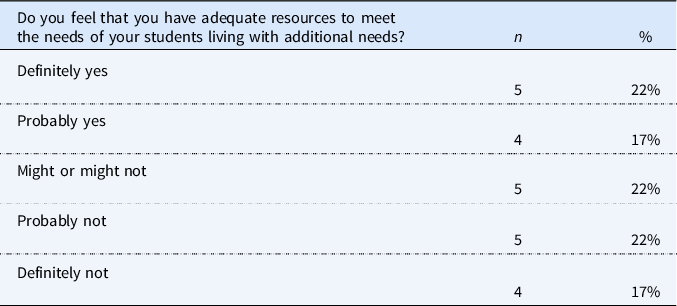
When asked whether they were adequately funded for their overrepresentation of students with a disability, there was an even spread of responses, as demonstrated in Table 2. Interestingly, when given the opportunity to add additional comments to the survey, the most common responses mentioned funding issues, and, like the quantitative results, participants were mixed in their answers, suggesting a diversity of opinion.
FLP Principals’ Perceptions of Adequacy of Funding to Support Students With Disability

All responses indicated the high level of funding required for FLPs to be able to provide for students with disability, and it appears that those that qualified as a ‘special assistance school’ under the federal funding scheme felt that they had adequate funding. This scheme allowed those schools ‘to appoint more staff and also to access specialist programs’. In addition to being qualified as a special assistance school, several participants mentioned accessing ‘additional funding’ in order to provide sufficient resources. As well as those participants who felt adequately funded, there were many comments explaining the need for more resourcing. Those who felt that funding was inadequate required more teaching staff, more teacher aides, and increased hours for intervention specialists such as psychologists, occupational therapists, and speech pathologists.
A major funding challenge for some participants was that many of their students’ disabilities were undiagnosed. According to one participant, ‘our biggest challenge is finding funding to support our youth as many of them aren’t diagnosed but are very much suspected of certain disorders’. This comment was supported by an estimation by another who stated that ‘10% have previously been funded under the Program for Students with Disabilities. Probably another 10% have gone through school with significant disability which have never been acknowledged, diagnosed or provided for’. In particular, a number of participants suggested that as students affected by trauma was a largely undiagnosed condition, it has proven difficult to attract support to address its effects on students.
Why Was There an Overrepresentation of Students With Depressive Disorders, Trauma, and Anxiety in FLPs?
When asked why they had an overrepresentation of students with a disability at their schools, three interrelated themes emerged. The first theme was that students with these conditions had needs that were very complex based on the individual students’ histories of trauma. Second, that the mainstream school environment itself was inherently too stressful for the students affected by trauma and those with anxiety, and failed to provide the specific skill set required to support these students. This led to the third theme that FLPs were seen as a specialist provision, which could create the environment where students with anxiety and those affected by trauma could feel safe.
The first theme emphasised that the students who came to FLPs from backgrounds where they have experienced high levels of anxiety and have been affected by trauma had very complex lives and required high levels of individual support. The complexity emerged from local factors such as ‘dysfunctional family lives’, ‘parental substance use, domestic violence, neglect and other forms of abuse, disrupted attachment styles, mental health conditions’, and ‘family transiency in early years’, as well as broader impacts of ‘social disadvantage’ and ‘intergenerational trauma’ for Indigenous students as a result of colonisation.
According to participants in this study, the impacts of trauma resulted in students having large gaps in their education, with some participants reporting that students were three to five academic grade levels below their same-age peers in mainstream settings. In addition, participants reported that students affected by trauma were ‘unable to develop positive relationships with school staff, peers, family members and the community’.
Alongside recognising that the needs of students affected by trauma were so high, participants reported that the very nature of mainstream schooling was inconsistent with the environment required by their students — especially those who suffer from anxiety and depression. The main factor identified was the sheer number of students in mainstream schools. The ‘pressures of socialising’ and finding it ‘difficult and often impossible to cope with the large numbers of students’ were believed by some participants to result in students being unable to ‘feel safe at schools with large numbers’. A second factor emerging from the environment of mainstream schools was the prevalence of bullying.
In addition to the large scale of a mainstream school, participants felt that the capacity required to support students affected by depression, trauma, and anxiety was lacking. This was a result of a lack of knowledge and training about trauma, and, in some cases, an apparent unwillingness to work with young people with complex needs resulting in them being unsupported. This perceived unwillingness could well be a result of the conduct of students, as one participant explained that
students frequently display symptoms of anxiety and depression in the school environment including hyper or hypo arousal, avoidance behaviours, negative self-image, low mood, irritability, and limited emotional regulation.
Increasing the difficulty to manage in the classroom was the common phenomenon of the multiple diagnoses of students interacting with their complex family backgrounds. According to one principal who completed the survey, ‘those with multiple diagnoses also have low social literacy/social and emotion learning levels that has an impact on peer to peer, professional and family relationships, particular conflict resolution’. Another participant claimed that these difficult behaviours resulting from trauma and anxiety may result in the transfer from mainstream settings to FLPs:
The effects of the trauma are displayed as behavioural issues and so they come into our program as disengaged and high risk, but really they have anxiety and stress due to the significant gaps in learning due to trauma and associated high absenteeism rates.
The claim that a lack in the capacity of mainstream schools to support students affected by trauma, anxiety, or depression was the main explanation for the overrepresentation of students with these conditions in FLPs was summarised by one participant who believed that ‘if the support and approach was adequate in mainstream school settings, schools like ours would not need to exist’.
The final theme related not to the deficits in the mainstream setting but to the expertise of staff working within the FLPs. Several participants described how their schools had been especially developed to meet the needs of students affected by trauma and those with anxiety. Participants talked about this in terms of their structures and pedagogy. Structurally, the FLPs in this study had smaller numbers and a higher ratio of staff to students than in mainstream settings. They also talked about having wraparound support with external agencies such as ‘counselling services’ and ‘mental health agencies’. Pedagogically, participants mentioned teaching through ‘co-regulation’ and ‘trauma-sensitive’ approaches and personalising the curriculum in a ‘project-based learning environment’. This approach was explained another way by a participant who claimed that ‘for all students, relationship comes before curriculum. For students with further complexities, this is even more so the case’.
Discussion
In this study, we explored the extent to which students with disability are overrepresented in FLPs. We found that, according to participants, overall, students with a disability were overrepresented in FLPs but only those from certain categories of disability. We propose two possible explanations for this trend: issues of funding and issues of behavioural presentation. To consider whether access to funding may have an impact on the overrepresentation of students with certain disabilities in FLPs, we turned to the information available on disability funding from each state’s and territory’s department of education websites as at November 2019 (see Appendix C).
The findings suggest that the type of disability influences the overrepresentation of students with disability in FLPs. When considering the types of disability that were found to be very overrepresented, somewhat overrepresented, and not overrepresented in this study (as per Table 2), it appears that students affected by trauma or those who have an anxiety or depressive disorder (those overrepresented in FLPs) may not meet eligibility criteria for funding in Queensland, NSW, or Victoria, the three most populated states. In contrast, students with physical disability, intellectual disability, and sensory and speech disorders (not overrepresented in FLPs) would more readily meet criteria for funding. In cases where students affected by trauma and those with anxiety and depression can qualify for individual funding support (e.g., in the approach taken by Western Australia and the Australian Capital Territory), students would need to have ongoing paediatric psychological or psychiatric assessments. In many places, access to these professionals is difficult, and this is especially the case for students with a complex set of factors impacting their lives, such as is often the case for those who enrol in FLPs (see Pennacchia et al., Reference Pennacchia, Thomson, Mills and McGregor2016).
Based on the apparent connection between students who are overrepresented in FLPs and the eligibility for individual disability funding, it is possible that current funding arrangements play a contributing factor to the exclusion of students from mainstream school settings. Although this research cannot draw definitive conclusions in this area, it seems possible that students who receive funding support are more likely to have their needs met and therefore stay engaged in school. Conversely, it makes sense that a student who does not receive funding support as a result of their disability will feel unsupported and be more likely to disengage. Direct consequences of being untreated (e.g., absenteeism due to anxiety) could also play a part in school exclusion. We are not presuming that no funding or support exists for students with overrepresented disabilities, just that, in some states, the funding is not allocated to/for the individual student (i.e., support may be provided from school- or system-level resources), and in others, there may be difficulty in meeting the diagnostic/eligibility criteria. We are also aware that some states (e.g., Tasmania, South Australia) have been moving towards a ‘needs-based’ funding model, which may help to address some of the issues previously identified. Notwithstanding, based on currently available information, it is possible that (a) some students’ category of disability is not considered sufficiently by the disability funding models; (b) access to diagnostic services makes it difficult for students to meet eligibility criteria to receive funding; and/or (c) despite adequate funding/support, there is a mismatch between student characteristics and the mainstream learning environment.
Behavioural Representation
When comparing the categories of students with disability who are overrepresented with those who are not, it appears that there is a pattern in how the two groups may present in a school environment. Students affected by trauma often present as hypervigilant and are more frequently in a fight or flight mode, or are dissociative (National Education Association, 2019; Oehlberg, Reference Oehlberg2006). In a classroom situation, this can be confronting for staff who may experience a student reacting violently, or withdrawing, at what seems to be very little provocation. Students who are living with anxiety may exhibit similar hypervigilance, and those with ADHD, ASD, and conduct disorders can exhibit inherently challenging behaviour. According to research conducted with teachers in South Australia, typical behavioural presentation for ADHD, ASD, and trauma are reportedly some of the ‘most difficult’ behaviours to manage (Sullivan, Johnson, Owens, & Conway, Reference Sullivan, Johnson, Owens and Conway2014). Thus, the very nature of a student having one of the disabilities in the ‘overrepresented’ group means that his or her behaviour may be more difficult to manage in a classroom. As discussed in the literature review, these behaviours, if addressed punitively in the classroom, can lead directly to the disengagement of students. This may especially be the case when it comes to students with disability. If they feel that they are being punished for behaviours that are associated with their disability, then the chances of them feeling a lower sense of belonging in the school is high. A reduction in affective engagement can result in a reduction of behavioural disengagement, which of course can exacerbate problematic behaviours in the classroom.
Many schools in Australia have a ‘stepped’ response to problematic behaviour (Sullivan et al., Reference Sullivan, Johnson, Owens and Conway2014). The ‘steps’ themselves may differ from school to school, but the idea is that the school will respond in increasing levels of punishments to repeated or more serious student behaviour. The inevitable end point of all stepped responses is the expulsion from the mainstream school. As school is compulsory for children in Australia until the age of 18, students with disabilities must find an alternative provision if they are expelled — and that, perhaps, is why these students with disabilities end up in FLPs in higher proportions.
Limitations of the Study
There are several limitations to bear in mind when considering the implications of the findings. For these reasons, the findings should be understood with some caution until further complementary research on the prevalence of students with disability in FLPs using different samples and methods has been conducted. First, as per Bartram (Reference Bartram and Lambert2019), we acknowledge the potential benefits of piloting surveys for research purposes and that the lack of a pilot represents a potential limitation in this study. Confidence with the phrasing and clarity of items was achieved by the two authors working on and critiquing iterations of the survey. Also, the items and structure of the survey were based on engagement with school staff in the FLP sector over the previous decade and interactions with postgraduate students undertaking subjects on the education of students with disability and student (re)engagement over a period of 2 years. Because of the small population under investigation, we did not want to limit the sample by having people who would otherwise be eligible to participate complete the survey as part of a pilot process. We consider that this preliminary study serves as a pilot for further research in this field.
Second, we acknowledge that the sample size of programs, and of the students they represent, is relatively small, which means that the findings here can only be considered indicative rather than representative of the total population of students in FLPs. Not all of those who received the survey chose to respond to it (23% completed surveys). That being said, given the geographical spread of the participants (all six states) and the diversity in enrolment numbers of the FLPs (ranging from 11 to 450), we are confident that the findings reported here are based on a broad representation of Australian FLPs.
Third, due to the anonymous nature of the survey, it was impossible to verify the accuracy of the responses. One participant, in fact, made it clear that ‘the numbers provided are estimates, not definitive numbers’, and others talked about the undiagnosed or suspected diagnosis of students. It is possible that with some conditions the description (e.g., ‘she has difficulty learning’) may not equal a diagnosable disability (i.e., ‘a learning difficulty’); this challenge is central to our study. Our use of the broad definition of disability from the Disability Discrimination Act 1992 (Commonwealth of Australia, 2018) and ‘imputed’ disabilities (Education Services Australia, 2020) was important to explore the extent to which students in FLPs are impacted by disability — whether clinically diagnosed or not.
Conclusions
In this preliminary study, we investigated the proportion and make-up of students living with disabilities in Australian FLPs as reported by the programs’ leaders. The two main findings were that, first, there appeared to be an overrepresentation of students with disability in FLPs compared with the general population. The second finding was that students with some types of disabilities appeared to be more overrepresented in FLPs than students with other types of disabilities.
If FLPs are going to continue to accommodate a high proportion of students with a disability, then the appropriate support needs to be directed to them to provide resources for specialist staff and other educational adjustments. This funding cannot be based on diagnosis alone, as students who attend FLPs may often be living with undiagnosed disability. If the apparent correlation between availability of funding and overrepresentation in FLPs is indeed indicative of the inequity between students with different diagnoses, there are direct implications for funding bodies. Funding approaches where students must achieve a specific diagnosis before receiving support disadvantage less visible disabilities such as mental health disorders. This approach also disadvantages students who cannot have regular access to medical professionals qualified to make these diagnoses, which often have to be consistently displayed over a period of time.
This was a small-scale study looking only at independent FLPs. We suggest that more comprehensive studies of students in all types of FLPs would be beneficial. For example, future research that compares the prevalence of initially ‘imputed’ disabilities with, through comprehensive clinical assessment of students, the prevalence of diagnosed disabilities among students at FLPs may help to extend this line of inquiry. As far as we are aware, this study is the first of its kind in Australia to explore the proportion of students with disability in FLPs. Also, we recommend that further research include qualitative studies through which young people with disability can tell their own stories about their pathway to an education in an FLP and their experiences in these settings.
Notwithstanding the limitations, the findings do seem consistent with previous research on the relationship between disability and exclusion (such as Baker, Reference Baker2019; Skiba et al., Reference Skiba, Chung, Trachok, Baker, Sheya and Hughes2014) and our anecdotal experiences across a range of educational systems. We hope that the findings and the listing of FLPs in Australia serve as a catalyst for discourse among researchers, educators, and policymakers in promoting educational opportunities for students with disability in all settings.
Supplementary material
To view supplementary material for this article, please visit https://doi.org/10.1017/jsi.2021.3
Acknowledgements
We wish to thank the FLP leaders who generously participated in this survey. We would also like to acknowledge the Australian Association of Special Education, who provided the opportunity for this research to be presented at their national conference in 2019.