

Introduction and Taxonomic History
While revising the genus Pedicularis L. for Flora of Pakistan, in which it will be placed in Scrophulariaceae (for discussion concerning alternative placements in Scrophulariaceae or Orobanchaceae see Mill, Reference Mill2011), it became necessary to consider the infrageneric classification of two NW Himalayan species, Pedicularis bicornuta Klotzsch and P. elephantoides Benth., whose taxonomic placements have not been critically evaluated for over a century.
Pedicularis elephantoides was described by Bentham (Reference Bentham1835), who in his Scrophularineae indicae grouped it and P. megalantha D.Don as the last two (nos. 13 and 12 respectively) of four species that comprised his P. sect. Siphonanthae Benth., the other two being P. siphonantha D.Don and P. hookeriana Wall. ex Benth. In Scrophularineae indicae, Bentham (Reference Bentham1835) only recognised one infrageneric rank – section – and Pedicularis sect. Siphonanthae was the third of five sections recognised by him in that work to encompass the 18 Pedicularis species he treated. Under Art. 22.6 of the International Code of Botanical Nomenclature (McNeill et al., Reference McNeill, Barrie, Burdet, Demoulin, Hawksworth and Marhold2006) Pedicularis sect. Siphonanthae is typified by P. siphonantha D.Don. Thus, Pedicularis sect. Siphonanthae Benth. has priority over P. sect. Schizocalyx H.L.Li (Li, Reference Li1949: 148), which also includes P. siphonantha within its circumscription.
In his account of Pedicularis for De Candolle’s Prodromus, Bentham (Reference Bentham and De Candolle1846) grouped P. elephantoides in P. series II Siphonanthae Benth. sect. Longirostres Benth. In Bentham’s Reference Bentham and De Candolle1846 classification, the ranks of series and section are misplaced and consequently the sectional name Longirostres is invalid under Arts. 4.2, 5.1 and 33.9 of the ICBN (McNeill et al., Reference McNeill, Barrie, Burdet, Demoulin, Hawksworth and Marhold2006). Moreover, Bentham used the sectional names Longirostres, Brevirostres and Erostres (all of them misplaced and not validly published) within more than one of his series (e.g. Longirostres is used as a subdivision within Pedicularis ser. Verticillatae, P. ser. Siphonanthae and P. ser. Faucidentes) and therefore, if they had been validly published, they would all have been simultaneously published homonyms of each other (Art. 53.4). In Bentham’s later work (Bentham, Reference Bentham and De Candolle1846), ‘series Siphonanthae’ [rank misplaced] had 10 species, arranged in two ‘sections’ [rank misplaced]. ‘Sect. Longirostres’ comprised nine species: Pedicularis elephantoides, P. elephas Boiss., P. hookeriana, P. labellata Jacquem., P. megalantha, P. punctata Decne., P. rhinanthoides Schrenk, P. siphonantha and P. tubiflora Fisch. Four of these (Pedicularis elephas, P. labellata, P. punctata and P. rhinanthoides) were described after publication of the Scrophularineae indicae (Bentham, Reference Bentham1835). A second ‘section’ of ‘series Siphonanthae’ was described in the Prodromus (Bentham, Reference Bentham and De Candolle1846); this was named ‘sect. 2 Erostris’ and was monospecific (Pedicularis perrottetii Benth. from south India). Limpricht (Reference Limpricht1924) classified Pedicularis perrottetii (which has white corollas lacking a beak: Maximowicz, Reference Maximowicz1877) in his unranked group equating to series Muscicolae Maxim. but Hurusawa (Reference Hurusawa1949) made it the type of the new monospecific series Pseudoerostres Hurus., a classification that was followed by Tsoong & Chang (Reference Tsoong and Chang1965a, Reference Tsoong and Chang1965b).
Between the publication of Bentham’s two works, Bunge (Reference Bunge1841) assigned Pedicularis elephantoides, P. hookeriana, P. megalantha, P. siphonantha and P. tubiflora to ‘sect. Tubiflorae Bunge’. This was also not validly published, because no description for it was provided under Art. 41.2(a) of the ICBN (McNeill et al., Reference McNeill, Barrie, Burdet, Demoulin, Hawksworth and Marhold2006). This ‘section’ corresponded largely to Bentham’s ‘sect. Longirostres’ and it was renamed ‘sect. Siphonantha Bunge’ in Bunge’s second classification (Bunge, Reference Bunge1843), again not validly published. The first validation of the name sect. Siphonantha with that spelling (rather than Bentham’s Reference Bentham1835 orthography Siphonanthae) was by Bunge (Reference Bunge and Ledebour1849: 276), three years after Bentham’s account in the Prodromus. The earliest name for this group of species is sect. Siphonanthae Benth. (Bentham, Reference Bentham1835: 53); although an adjectival epithet rather than the more preferable substantive form ‘Siphonantha’, Bentham’s name Siphonanthae is not correctable to ‘Siphonantha’ as the formation of names of sections and series is governed only by Recommendations (Recs. 21B.1, 2) rather than an Article in the ICBN (McNeill et al., Reference McNeill, Barrie, Burdet, Demoulin, Hawksworth and Marhold2006). In his protologue of Pedicularis sect. Siphonantha, Bunge (Reference Bunge and Ledebour1849: 276–277) gave formal treatments of two Russian species (P. longiflora Rudolph and P. rhinanthoides) and mentioned several other species from various parts of Asia (P. elephas, P. punctata, P. labellata, P. megalantha, P. siphonantha, P. hookeriana and lastly P. elephantoides). The last four of these constitute Bentham’s original, 1835, circumscription of the section.
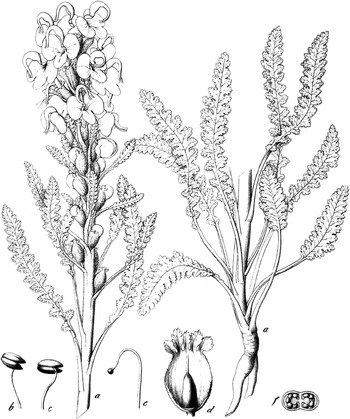
Pedicularis bicornuta (Fig. 1) was described and illustrated by Klotzsch (in Klotzsch & Garcke, Reference Klotzsch and Garcke1862), who did not assign it to any infrageneric category. The first person to do so seems to have been Maximowicz (Reference Maximowicz1877), who treated both it and Pedicularis elephantoides as members of P. ser. Siphonanthae, which was one of two series subordinate to a higher rank wrongly named ‘tribe I. Longirostres’ (Art. 5 of the ICBN [McNeill et al., Reference McNeill, Barrie, Burdet, Demoulin, Hawksworth and Marhold2006] applies). Besides eight of Bentham’s 10 species (Pedicularis punctata and P. tubiflora were removed), Maximowicz added seven others to P. ser. Siphonanthae in his 1877 paper. One of these was Pedicularis macrantha Klotzsch (nom. illegit., non Spreng.); this is now correctly named P. klotzschii Hurus. (Hurusawa, Reference Hurusawa1948). Another was Pedicularis longiflora, which Bentham (Reference Bentham and De Candolle1846: 565) synonymised with P. tubiflora. The remaining five were all new species first described from Gansu (China): Pedicularis armata Maxim., P. chinensis Maxim., P. cranolopha Maxim., P. muscicola Maxim. and P. przewalskii Maxim. Further species were added to ser. Siphonanthae by Maximowicz (Reference Maximowicz1888a; reprinted as Maximowicz, Reference Maximowicz1888b), who treated 23 species in ‘Siphonanthae typicae’ with Pedicularis muscicola being removed to P. ser. Muscicolae Maxim. Northwest Himalayan additions to ser. Siphonanthae in Maximowicz’s 1888 treatment were Pedicularis scullyana Prain ex Maxim. and P. eximia G.Watt. The latter species, originally described and illustrated by Watt (Reference Watt1881), was later synonymised with Pedicularis bicornuta by Hooker (Reference Hooker and Hooker1884), Prain (Reference Prain1890) and Limpricht (Reference Limpricht1924). Prain (Reference Prain1890) considered that it was ‘simply the ordinary eastern form of the species described by Klotzsch’ [i.e. Pedicularis bicornuta].
Pedicularis bicornuta var. bicornuta. Photograph of lectotype, the illustration in Klotzsch & Garcke, Die botanischen Ergebnisse der Reise seiner königl. Hoheit des Prinzen Waldemar von Preussen in den Jahren 1845 und 1846 t. 61 (1862).

In his monograph of the Indian species of Pedicularis, Prain (Reference Prain1890) made substantial changes to previous classifications. Although there is internal evidence on pp. 22, 58, 155 and 158 of Prain (Reference Prain1890) that Prain regarded his lowest hierarchical rank as series, as did Maximowicz (Reference Maximowicz1888a, Reference Maximowicz1888b), there is no formal indication that this is so and all Prain’s ‘series’ names should therefore be considered rankless; for a more detailed note see Husain et al. (Reference Husain, Garg, Agnihotri and Mill2006). Attribution of authorship at series rank is here ascribed to the next most recent author definitely using the name at series rank that has been traced in the literature. Prain divided Pedicularis sect. Siphonanthae, which had grown quite large by the addition of more and more species, into three large subordinate groups that have been incorrectly regarded as subsections by some previous authors. Each of these was further subdivided into smaller groups that have been frequently but incorrectly regarded as series by later authors. These groups were:
• Pedicularis A. Eusiphonanthae Prain containing five groups:
° group 1. Rhinanthoides Prain [= Pedicularis ser. Rhinanthoides (Prain) Bonati, Reference Bonati1910: 11]
° group 2. Longiflorae Prain [= Pedicularis ser. Longiflorae (Prain) Bonati, Reference Bonati1910: 12]
° group 3. Megalanthae Prain [= Pedicularis ser. Megalanthae (Prain) Bonati, Reference Bonati1910: 13]
° group 4. Muscicolae Prain [= Pedicularis ser. Muscicolae Maxim., Reference Maximowicz1888a, Reference Maximowicz1888b]
° group 5. Pumiliones Prain [= Pedicularis ser. Pumiliones (Prain) Bonati, Reference Bonati1910: 14]
• Pedicularis B. Brevitubae Prain containing two groups:
° group 6. Robustae Prain [= Pedicularis ser. Robustae (Prain) Hurus., 1948: 184]
° group 7. Macranthae Prain [= Pedicularis ser. Macranthae (Prain) Bonati, Reference Bonati1921: 110], and
• Pedicularis C. Oppositifoliae Prain with three groups:
° group 8. Integrifoliae Prain (‘Integrifolia’) [= Pedicularis ser. Integrifoliae (Prain) H.L.Li, Reference Li1948: 258 & 351; P. ser. Integrifolia (Prain) Hurus., 1949 (Feb.): 112]
° group 9. Gyrorrhynchae Prain (‘Gyrorrhyncha’) [= Pedicularis ser. Gyrorrhynchae (Prain) H.L.Li, Reference Li1948: 256 & 291; P. ser. Gyrrorhyncha (Prain) Hurus., 1949 (Feb.): 112]
° group 10. Franchetianae Prain (‘Franchetiana’) [= Pedicularis ser. Franchetiana (Prain) Hurus., 1949 (Feb.): 112; P. ser. Franchetianae (Prain) H.L.Li, Reference Li1949 (Dec.): 148].
Prain’s new group 7. Macranthae contained Pedicularis klotzschii (called by him P. macrantha), P. scullyana and P. elwesii Hook.f., the former two being previously in Maximowicz’s large concept of ser. Siphonanthae. Unfortunately, the name Pedicularis [unranked] 7. Macranthae Prain is a later homonym of a long-overlooked unranked name in Bunge’s treatment of Pedicularis for Ledebour’s Flora Rossica (Bunge, Reference Bunge and Ledebour1849). On p. 301 of vol. 3(2) of that work Bunge recognised Pedicularis [unranked] Macranthae Bunge with the description ‘corolla magna, galea obtusa edentula falcata’. This group contained only two species: Pedicularis capitata Adams and P. tristis L. By application of Art. 22.6 of the ICBN (McNeill et al., Reference McNeill, Barrie, Burdet, Demoulin, Hawksworth and Marhold2006), the former is the type of Pedicularis [unranked] Capitatae Prain (Prain, Reference Prain1890: 92) and the latter is the type of P. ser. Tristes Benth. (Bentham, Reference Bentham and De Candolle1846: 579). Neither of these species are at all closely related to the species of group Macranthae Prain; Pedicularis [unranked] Capitatae belongs to P. sect. Anodon Bunge and P. ser. Tristes to sect. Lasioglossa H.L.Li. Fortunately Bunge did not assign rank to his group Macranthae and therefore it does not displace either of these names (ICBN Art. 35.3: McNeill et al., Reference McNeill, Barrie, Burdet, Demoulin, Hawksworth and Marhold2006). However, the same Article (35.3) of the ICBN states that names of unranked taxa are to be included in considerations of homonymy, and Prain’s group Macranthae is clearly a later homonym of Bunge’s group Macranthae. Consequently Prain’s group Macranthae [= Pedicularis ser. Macranthae Bonati] was recently renamed as P. ser. Klotzschianae R.R.Mill (Mill, Reference Mill2010). The type of Prain’s group Macranthae was Pedicularis macrantha Klotzsch, itself an illegitimate later homonym of P. macrantha Spreng. and to which Hurusawa (Reference Hurusawa1948) gave the new name P. klotzschii Hurus. A later synonym of Pedicularis macrantha Klotzsch, P. ochroleuca Duthie ex Maxim. (Maximowicz, Reference Maximowicz1888a: 530), also cannot be used as it is a homonym of P. ochroleuca J.C.Schloss. from Croatia. The replacement name, Klotzschianae, chosen by Mill (Reference Mill2010) for group Macranthae, reflects this past nomenclatural and taxonomic history. It is formed by analogy with Pedicularis ser. Ikomanae Hurus. (type, P. ikomai Sasaki), P. ser. Keiskeanae T.Yamaz. (type, P. keiskei Franch. & Savat.) and P. ser. Semenowianae L.I.Ivanina & T.N.Popova (type, P. semenowii Regel).
Hooker (Reference Hooker and Hooker1884) used no formal infrageneric classification; instead he divided the genus Pedicularis as represented in ‘British India’ into two large unnamed series defined on phyllotaxy. In his numerical sequence he placed Pedicularis megalantha and P. bicornuta immediately after P. elwesii and immediately preceding P. bella Hook.f. and P. siphonantha. Inexplicably, he treated Pedicularis elephantoides as a synonym of P. rhinanthoides, despite major differences in leaf size (basal ones of P. elephantoides 80–115 × 20–35mm, of P. rhinanthoides 10–60 × 5–10mm), form of inflorescence (P. elephantoides a long raceme opening from top down, P. rhinanthoides short and capitate, the lower flowers opening first), corolla colour (P. elephantoides bicoloured yellow and purple, P. rhinanthoides wholly rose or magenta), galea beak (in P. elephantoides c.20mm long and turned upwards, in P. rhinanthoides c.6mm long and curved downwards and inwards) as well as other differences. His account of Pedicularis rhinanthoides, however, gave only features of that species.
Prain (Reference Prain1890: 68) classified both Pedicularis bicornuta and P. elephantoides within Pedicularis [unranked] 3. Megalanthae Prain. Apart from these two species, the only other species he included in that group was Pedicularis megalantha, which, under Art. 22.6 of the ICBN (McNeill et al., Reference McNeill, Barrie, Burdet, Demoulin, Hawksworth and Marhold2006), must be taken as type of the group. Prain diagnosed group Megalanthae on the basis of a suite of characters of habit, indumentum, leaf and leaf-segment morphology, calyx morphology and glabrous corolla lip with oblong middle lobe. None of these characters was uniquely diagnostic for the group, even when originally characterised. Prain, however, significantly keyed out Pedicularis megalantha as distinct from both P. bicornuta and P. elephantoides on the basis of its hairy anterior filaments (all four filaments being glabrous in the other two species), and the basal part of the galea (upper corolla lip) being somewhat reflexed (as opposed to erect in the other two). In addition, Pedicularis elephantoides and P. bicornuta were said to have the filament margins crenulate or undulate (Prain used ‘crenulate’ in his key, but ‘undulate’ in the respective species accounts); this character was not commented on for P. megalantha which is therefore assumed here to have been regarded by Prain as having non-crenulate filaments. The beaks of the galeas in the three species all differed: Pedicularis megalantha was described as having a circinnate beak shortly 2-lobed at the apex with the lobes obtuse; P. bicornuta, a galea twisted at the throat with its beak decurved and deeply 2-partite at the apex, with the segments acute; and P. elephantoides, a galea not twisted at the throat with its beak rather straight and very long, with a resupinate, entire apex. Clearly, Pedicularis [unranked] 3. Megalanthae as originally conceived by Prain was a group of three very disparate species that presumably did not ‘fit’ elsewhere in his system. Despite this, the circumscription of the group has remained more or less unchanged since then, other than the addition of extra species as they have been discovered. Tsoong (Reference Tsoong1956a) followed Prain (Reference Prain1890) in regarding Pedicularis megalantha, P. bicornuta and P. elephantoides as belonging to one series Megalanthae although in a later part of his paper (Tsoong, Reference Tsoong1956b) he did acknowledge that P. bicornuta and P. elephantoides did not match P. megalantha in corolla structure. The earliest author to have definitely assigned series rank to the group appears to have been Bonati (Reference Bonati1910: 13) who recognised five species (see below).
Since Prain’s original description of Pedicularis 3. Megalanthae, several taxa have been added to it. Species known to have been added are: Pedicularis hoffmeisteri Klotzsch (NW Himalaya: Klotzsch & Garcke, Reference Klotzsch and Garcke1862; classified by Prain, Reference Prain1890 as a synonym of P. megalantha D.Don but regarded either as a distinct species – by Yamazaki, Reference Yamazaki, Ohba and Malla1988 and other authors – or as a variety of P. megalantha, e.g. by Sealy, Reference Sealy1939); P. fastigiata Franch. (China: Franchet, Reference Franchet1900; Bonati, Reference Bonati1910)*, P. kialensis Franch. (China: Bonati, Reference Bonati1910)*; P. pauciflora (Prain ex Maxim.) Pennell (E Nepal, Sikkim, Chumbi: Pennell, Reference Pennell1943); P. megalochila H.L.Li (China, Burma and E Himalaya: Li, Reference Li1948, with several infraspecific taxa described later by Tsoong, Reference Tsoong1955a, Reference Tsoong1955b, and Yamazaki, Reference Yamazaki1980); P. cornigera T.Yamaz. (E Nepal: Yamazaki, Reference Yamazaki1980); P. zhongdianensis H.B.Yang (China: Yang, Reference Yang1994); and, most recently, P. woodii R.R.Mill (Bhutan: Mill, Reference Mill2001a, Reference Mill, Grierson and Long2001b). The two asterisked species have since been removed from the series. Pedicularis fastigiata was transferred first to Pedicularis [unranked] Robustae Prain (by Limpricht, Reference Limpricht1924) and then to ser. Longiflorae (Prain) Bonati (e.g. Yang et al., Reference Yang, Holmgren, Mill, Wu and Raven1998 who wrongly attributed series authorship to Prain). Pedicularis kialensis, which Bonati (Reference Bonati1910: 13) had included ‘à l’extrême limite’ of P. ser. Megalanthae because of similarities he perceived between it and P. elephantoides, was removed first to Pedicularis [unranked] Oxycarpae Prain (by Limpricht, Reference Limpricht1924) and finally to the monotypic P. ser. Kialenses H.L.Li (Li, Reference Li1949; Yang et al., Reference Yang, Holmgren, Mill, Wu and Raven1998). All the others are still currently regarded as members of Pedicularis ser. Megalanthae. Except for the transfers of Pedicularis fastigiata and P. kialensis as detailed above, no revision of the limits of this series appears to have been undertaken since Limpricht (Reference Limpricht1924), who restricted it to P. bicornuta, P. elephantoides, P. megalantha and P. megalantha var. pauciflora Prain ex Maxim. (now regarded as the species P. pauciflora; see above). Limpricht regarded Pedicularis hoffmeisteri as a mere synonym of P. megalantha and some authors (notably Macior & Sood, Reference Macior and Sood1991) have followed that view while others (e.g. Pennell, Reference Pennell1943; Yamazaki, Reference Yamazaki, Hara, Chater and Williams1982, Reference Yamazaki, Ohba and Malla1988) have retained the two as separate species.
Within the infrageneric taxonomy of Pedicularis, P. ser. Megalanthae was first grouped in P. sect. Siphonanthae (Prain, Reference Prain1890; Limpricht, Reference Limpricht1924). Hurusawa (Reference Hurusawa1949), unaware of Bentham’s earlier sectional name, placed the series in Pedicularis sect. Siphonantha Bunge subsect. Rhinanthoides Hurus., along with P. sers. Rhinanthoides (Prain) Bonati and Longiflorae (Prain) Bonati. Pedicularis ser. Megalanthae was not treated by Li in his revision of the Chinese species of Pedicularis (Li, Reference Li1948, Reference Li1949) although the name was mentioned a few times incidentally. In the very different treatment adopted in Flora Reipublicae Popularis Sinicae (Tsoong, Reference Tsoong1963) and by Tsoong & Chang (Reference Tsoong and Chang1965) it was placed as one of 10 series within Pedicularis grex Rhizophyllum subgrex Rhizophyllum. Yamazaki (Reference Yamazaki, Ohba and Malla1988) removed Pedicularis ser. Megalanthae from P. sect. Siphonanthae (which he called P. sect. Schizocalyx H.L.Li) and made it the only series within his new section Saccochilus T.Yamaz., although earlier (Yamazaki, Reference Yamazaki1980) he had regarded P. megalochila and his then newly described P. cornigera as members of P. ser. Rhinanthoides. Placement of Pedicularis ser. Megalanthae within P. sect. Saccochilus is the one accepted here, although very recently Garg (Reference Garg2009) has published a paper treating five Indian Himalayan members of P. sect. Siphonanthae, two of which (P. megalantha and P. hoffmeisteri) belong to ser. Megalanthae.
Li (Reference Li1949: 10 & 143) described the new section Pedicularis sect. Phanerantha H.L.Li to accommodate the above-mentioned P. ser. Klotzschianae (called by him ser. Macranthae). He was aware of about four or five species within the section and series, of which three occurred within the geographical limits of his revision. Yamazaki (Reference Yamazaki, Ohba and Malla1988) expanded the section considerably, to include Pedicularis sers. Robustae and Longiflorae as well as what he called P. ser. Macranthae (i.e. P. ser. Klotzschianae). Mill (Reference Mill, Grierson and Long2001b) also included Pedicularis ser. Robustae and Macranthae within P. sect. Phanerantha which also contained the new series P. ser. Garckeanae R.R.Mill (Mill, Reference Mill2001a; see below), but P. ser. Longiflorae was excluded following Yamazaki (Reference Yamazaki, Ohba and Malla1988) and placed in P. sect. Schizocalyx H.L.Li (for which the earlier name sect. Siphonanthae Benth. has since been traced; this paper).
Results and Discussion
In a recent study by Mill (Reference Mill2001a), Pedicularis garckeana Prain ex Maxim. was found to differ significantly from all the other members of P. ser. Robustae Prain, in which it had consistently been included for over a century. It was accordingly removed to the new monospecific series, Pedicularis ser. Garckeanae R.R.Mill (Mill, Reference Mill2001a, Reference Mill, Grierson and Long2001b). Similarly, it has become clear, as more species have been described, that the E Himalayan and Chinese members of the original Pedicularis ser. Megalanthae, including its type P. megalantha, form a natural group that has little or nothing in common with the NW Himalayan P. bicornuta and P. elephantoides. For these mostly eastern Sino-Himalayan species, Yamazaki (Reference Yamazaki, Ohba and Malla1988) described the new section Pedicularis sect. Saccochilus T.Yamaz., that had P. ser. Megalanthae as its only series. This section was diagnosed on the basis of its elongate corolla tube, 2–6 × longer than the calyx, the saccate lower corolla lip (hence the sectional name, Saccochilus) that covers the galea (see below), and the small, ligulate middle lobe of the lower lip. Yang et al. (Reference Yang, Holmgren, Mill, Wu and Raven1998) did not use a sectional classification, but they also diagnosed Pedicularis ser. Megalanthae by the very long corolla tube, large lower lip usually enveloping the galea, and curved, slender galea beak. In addition, they used the racemose, basipetal inflorescence, 5-lobed calyx, toothless galea, and other characters of less taxonomic significance.
In an extensive molecular phylogenetic study of Sino-Himalayan Pedicularis that included three species of P. ser. Megalanthae, Ree (Reference Ree2005) found that this series was one of only seven strictly monophyletic groups within the genus. Although he included Pedicularis cornigera, P. hoffmeisteri and P. megalantha in his analysis, unfortunately he did not include P. bicornuta or P. elephantoides. Therefore, although his results support the morphological distinctiveness of Pedicularis ser. Megalanthae sensu stricto, they do not help in elucidating the degree of relationship, if any, between the species included in it and the two NW Himalayan ones, which have so far not been studied phylogenetically.
The two NW Himalayan species, Pedicularis bicornuta (Fig. 1) and P. elephantoides, do have some characters in common with the eastern group. These include the basipetal inflorescence and (at least in Pedicularis bicornuta) the fact that the lower lip envelops the galea. However, the inflorescence arrangement is not the same in the two groups. The inflorescence of Pedicularis bicornuta (particularly its western, trans-Indus, form, as distinguished by Prain, Reference Prain1890) is dense, many-flowered and noticeably obovoid, and in its general arrangement closely resembles that of P. scullyana, which is now grouped in P. sect. Phanerantha H.L.Li ser. Klotzschianae R.R.Mill [= Pedicularis [unranked] 7. Macranthae Prain, nom. illegit.; P. ser. Macranthae (Prain) Bonati, nom. illegit.] along with P. klotzschii (= P. macrantha Klotzsch, non Spreng., type of ser. Klotzschianae) and P. insignis Bonati (Yamazaki, Reference Yamazaki, Ohba and Malla1988; Yang et al., Reference Yang, Holmgren, Mill, Wu and Raven1998). Pedicularis bicornuta also inhabits similar habitats to P. scullyana (glacial debris, screes and alpine meadows) although it has been noted that it grows in very exposed habitats subjected to high rainfall and very strong winds, including during the flowering season (Husain & Garg, Reference Husain and Garg2002; Garg & Husain, Reference Garg and Husain2003). It might, but for its unique floral morphology and other differences, be considered a western replacement taxon for Pedicularis scullyana. Pedicularis bicornuta differs from P. scullyana not only in its unique corollas but also in having all filaments glabrous (in P. scullyana, and all other species of P. ser. Klotzschianae, all four filaments are hairy). The inflorescence of Pedicularis elephantoides is similar to that of P. bicornuta but often somewhat looser; P. elephantoides apparently grows in more wooded places at lower altitudes than either P. scullyana or the ‘core group’ of P. ser. Megalanthae (i.e. the type and its E Himalayan relatives), the species of which have similar habitat preferences to P. ser. Klotzschianae but perhaps prefer damper sites such as stream-sides.
Three characters set apart Pedicularis megalantha and its other Sino-Himalayan relatives (hereafter referred to as ‘P. ser. Megalanthae sensu stricto’) from the two NW Himalayan species, P. bicornuta and P. elephantoides. These are (i) the very long corolla tube, (ii) the saccate ‘lower’ lip that is rotated in a very characteristic manner as described below, and (iii) the stamens with at least the anterior pair of filaments hirsute or villous (as first described for Pedicularis megalantha by Prain, Reference Prain1890), a character not previously noted in diagnoses as being common to ‘P. ser. Megalanthae sensu stricto’. These three characters are discussed in more detail below.
In all the species of Pedicularis ser. Megalanthae sensu stricto, the galea and lower lip of the corolla are carried well above the top of the calyx on a very long, slender, more or less straight and cylindrical corolla tube. Because of the form of the inflorescence, these long, erecto-patent corolla tubes are very prominent, carrying the lips of the corollas well above the top of the plant. Four of the species (Pedicularis cornigera, P. hoffmeisteri, P. megalantha and P. pauciflora) are illustrated side-by-side by Yamazaki (Reference Yamazaki, Ohba and Malla1988: fig. 21a–d). Pedicularis hoffmeisteri and P. cornigera (Yamazaki, Reference Yamazaki, Ohba and Malla1988: fig. 21b & c) show the least tube extension but the tube is still at least twice the length of the calyx. Pedicularis megalantha (Yamazaki, Reference Yamazaki, Ohba and Malla1988: fig. 21a) has a longer tube while that of P. pauciflora (Yamazaki, Reference Yamazaki, Ohba and Malla1988: fig. 21d) is by far the longest. These four taxa, incidentally, all deserve separate species rank. Pedicularis hoffmeisteri has previously been sunk into P. megalantha, either as a variety (Sealy, Reference Sealy1939) or as a synonym (including, importantly, in the pollination paper by Macior & Sood, Reference Macior and Sood1991; others taking this view have been Maximowicz, Reference Maximowicz1888a, Reference Maximowicz1888b and Prain, Reference Prain1890). However, it differs from true Pedicularis megalantha in several correlated characters. One of these is corolla colour, which in Pedicularis hoffmeisteri is primarily pale yellow, with or without some purple streaking on the ‘lateral’ lobes of the ‘lower’ lip, and a galea that is either yellow or (in the forms with purple streaks on the labellum) purple. In Pedicularis megalantha the corolla is entirely magenta. Maximowicz (Reference Maximowicz1888a, Reference Maximowicz1888b) commented that the illustration of ‘Pedicularis megalantha’ in Regel, Gartenflora 27: 195, t. 943 (1878) was of a plant with yellow corollas, whereas Don (Reference Don1825) had described the corollas of P. megalantha as having a purple galea and the labellum (with some doubt) as yellowish-red. Noting that according to Hooker (Reference Hooker and Hooker1884) collectors had described the corolla of ‘Pedicularis megalantha’ as sometimes yellow, sometimes purple, Maximowicz wondered whether either colour variation or confusion between two different species was involved. Prain (Reference Prain1890) mentioned that forms from the NW Himalaya differed in their wholly golden-yellow corollas but these were included by Pennell (Reference Pennell1943) in his concept of Pedicularis hoffmeisteri. Macior & Sood (Reference Macior and Sood1991) regarded Pedicularis hoffmeisteri and P. megalantha sensu stricto as colour morphs but their view is not accepted here because of the other correlated character differences. These include filament indumentum (both pairs of filaments villous in Pedicularis hoffmeisteri, only the anterior pair hairy in P. megalantha), and smaller anthers compared with P. megalantha. The two species are also disjunct, Pedicularis hoffmeisteri occurring in Himachal Pradesh and western Nepal, while P. megalantha is restricted to C and E Nepal, Sikkim, southernmost Tibet (Xizang: Chumbi) and Bhutan. The species with yellow corollas from the Himachal Himalaya whose pollination biology was studied by Macior & Sood (Reference Macior and Sood1991) was actually Pedicularis hoffmeisteri, not P. megalantha as stated by the paper’s authors. Pedicularis hoffmeisteri and P. megalantha have also been regarded as distinct species by Aswal & Mehrotra (Reference Aswal and Mehrotra1994) and most recently by Garg (Reference Garg2009). The variation within Pedicularis hoffmeisteri itself is not yet properly understood and it is possible that the forms with purple streaking (as found in Nepal) and those with pure yellow corollas (as found further west) might deserve taxonomic separation at some rank.
In all these species [and in the two not illustrated by Yamazaki (Reference Yamazaki, Ohba and Malla1988), i.e. Pedicularis woodii and P. zhongdianensis], the ‘lower’ lip of the corolla exhibits an unusual modification. Instead of being outspread and topographically below the topographical upper lip or galea as in most species of Pedicularis (e.g. P. longiflora, P. oederi Vahl and P. pyramidata Royle), it is rotated through about 90° so that one of the two lateral lobes is at the base and the other one is at the top of the corolla, where it forms an overhanging cowl-like hood that hides the galea; the middle lobe of the ‘lower’ lip projects downwards at an oblique angle to partly cover the front of the flower. This is clearly illustrated in the colour plate of Pedicularis hoffmeisteri in Yamazaki (Reference Yamazaki, Ohba and Malla1988: col. pl. 6d). This type of corolla rotation may be unique to Pedicularis sect. Saccochilus and is possibly an adaptation to shelter pollinators from cold and/or wet alpine conditions (Ree, Reference Ree2005). Macior & Sood (Reference Macior and Sood1991) maintained that this type of corolla rotation was also shared by Pedicularis elwesii (of uncertain position: best regarded as a member of P. ser. Klotzschianae R.R.Mill [= (unranked) 7. Macranthae Prain], though recently transferred to P. ser. Robustae by Husain & Agnihotri, Reference Husain and Agnihotri2007) and P. fletcheri P.C.Tsoong (P. ser. Pseudomacranthae P.C.Tsoong ex H.B.Yang) but it is clear from the photograph of P. elwesii in Yamazaki (Reference Yamazaki, Ohba and Malla1988: col. pl. 6a) that the end result, in that species at least, is different: the corolla in P. elwesii is much more open and less strongly hooded than in any species of ser. Megalanthae. Other Himalayan species exhibit different types of rotation, the most extreme so far discovered being in an as yet undescribed Nepalese species where the whole corolla is rotated on its axis by 180° to face inwards, and the lower lip is also rotated through 180° so that the middle lobe (not one of the laterals as in Pedicularis hoffmeisteri, P. megalantha, etc.) covers the top of the galea. The combination of long tube and the orientation of the galea and its beak in the members of sect. Saccochilus are adaptations to sternotribic pollination, as demonstrated for Pedicularis hoffmeisteri by Macior & Sood (Reference Macior and Sood1991, under the name P. megalantha) and by Macior et al. (Reference Macior, Ya and Zhang2001) for several unrelated species also having long-tubed corollas such as P. longiflora.
At least the anterior pair of anthers is hirsute or villous in all the species of ‘ser. Megalanthae sensu stricto’, while the posterior pair is also hairy in Pedicularis cornigera, P. hoffmeisteri, P. pauciflora and some forms of P. megalochila. By contrast, both pairs of filaments are glabrous in both Pedicularis bicornuta and P. elephantoides.
Thus, neither Pedicularis bicornuta nor P. elephantoides share any of these characters that are diagnostic for P. ser. Megalanthae sensu stricto. They also possess a suite of inflorescence and floral characters that unite them and are not shared by the species of Pedicularis ser. Megalanthae sensu stricto. These include:
• The corolla tubes in Pedicularis bicornuta and P. elephantoides are both about twice as long as the calyx. This is shorter than most members of Pedicularis ser. Megalanthae sensu stricto but both P. hoffmeisteri and P. cornigera have tubes of about the same relative proportionate length. However, in both Pedicularis bicornuta and P. elephantoides the tube is broader than in the members of P. ser. Megalanthae sensu stricto, being 2–3 mm wide. This, combined with the longer inflorescences with many more flowers, compared with those of Pedicularis ser. Megalanthae sensu stricto, means that the tubes of the two NW Himalayan species look relatively shorter; nor do they carry the corolla lips above the rest of the plant, as in all the species of P. ser. Megalanthae sensu stricto.
• The galea in both Pedicularis bicornuta and P. elephantoides is twisted at the base – a tight corkscrew in P. bicornuta, somewhat less pronounced in P. elephantoides. The anther case in both species is resupinate so that it points upwards rather than downwards as is usual in the genus.
• Both these species have a long slender galea beak which has a deeply bifid tip. In Pedicularis bicornuta the two lobes of the tip spread outwards like horns, hence the specific epithet. Although Pedicularis elephantoides also has a deeply bifid beak apex, the two lobes remain close together, so that its bifid nature is much less obvious than in P. bicornuta.
Pedicularis bicornuta and P. elephantoides thus both have a unique corolla morphology, neither being exactly similar to any member of P. ser. Megalanthae sensu stricto. The floral structure of Pedicularis bicornuta was first correctly described and illustrated by Wendelbo (Reference Wendelbo1965: 131–133, fig. 4A–D). As in Pedicularis hoffmeisteri, the galea is enclosed by the lower lip. However, the method of enclosure is totally different. Instead of the two lateral lobes being more or less parallel to each other at the topographical top and bottom of the flower, the left-lateral lobe is orientated almost vertically on the anterior side of the flower, while the right-lateral lobe is spread out horizontally at right-angles to the left-lateral lobe to form a porrect, canopy-like structure (described as ‘pale yellow balloons’ by Taylor & Taylor, Reference Taylor and Taylor1998; also see Husain & Garg, Reference Husain and Garg2002; Garg & Husain, Reference Garg and Husain2003). Below this, the broadly obovate middle lobe hangs downwards. The base of the galea beak is twisted like a corkscrew and the anthers are contained just below this corkscrew. Above the corkscrew, the galea is produced into a long, decurved, shallowly sinuous S-shaped beak. This projects downwards below the ‘canopy’ towards the middle lobe, which probably acts as a landing platform for pollinators. The whole flower is adapted for nototribic pollination, not sternotribic as in Pedicularis ser. Megalanthae sensu stricto, in which the pollination mechanism was described for P. hoffmeisteri by Macior & Sood (Reference Macior and Sood1991, under the name P. megalantha). In life, the galea (including the beak) of Pedicularis bicornuta is totally enclosed within the structure formed by the lobes of the lower lip, which, because of their orientation, do not gape like open jaws as do the two lateral lobes of P. hoffmeisteri and the other species of ser. Megalanthae sensu stricto. In Pedicularis bicornuta, the apex of the beak is deeply bifid with the two lobes tending (at least in herbarium material) to splay outwards, so that the bifid nature of the beak is immediately obvious even to the unaided eye.
Wendelbo (Reference Wendelbo1965) rightly pointed out that, in many instances (including Pedicularis bicornuta), it is impossible to determine the true, living appearance of the corolla of Pedicularis species by boiling flowers taken from herbarium material and then opening them out, which is how Prain (Reference Prain1890) and others (including, I suspect, Watt, Reference Watt1881 and Yamazaki, Reference Yamazaki, Ohba and Malla1988) prepared their drawings. This resulted in the drawings of the flowers of Pedicularis bicornuta in Prain’s monograph (Prain, Reference Prain1890: t. 3A & 3B) being grossly inaccurate, with the three lobes of the labellum (lower lip) being conventionally shown as spreading, rather than enveloping the galea, which is wrongly shown as projecting beyond them. Watt (Reference Watt1881) depicted the flowers of his Pedicularis eximia in a similar manner; the flowers in his drawing are strikingly similar to fig. 4A of Wendelbo (Reference Wendelbo1965) which shows an opened-out corolla, but bear no relation to the situation in vivo as illustrated by Wendelbo (Reference Wendelbo1965: fig. 4B–D).
Unlike Pedicularis bicornuta, there have been no studies of the corollas of P. elephantoides from living material. Prain’s illustration of Pedicularis elephantoides (Prain, Reference Prain1890: t. 3C) shows the three lobes of the corolla labellum orientated in exactly the same way as for P. bicornuta (op. cit., t. 3A), namely outspread. Therefore, there is no guarantee that this illustration is any more accurate (or, less inaccurate) in its depiction of the lateral lobes as they appear in vivo. Careful study of boiled herbarium material indicates that the labellum in Pedicularis elephantoides is in fact enfolded round the galea in a similar manner to P. bicornuta and that the galea is resupinate. Prain himself (1890: 117, and in key p. 68) described the galea apex as being resupinate but the resupination appears to affect the whole galea and its relation to the lower lip, which appears in herbarium material to be located behind and above the galea, as in Pedicularis bicornuta, rather than in front of and below it as would be the case if orientation were conventional. Thus the corolla structure of Pedicularis elephantoides is analogous to that of P. bicornuta and very different from the species of ser. Megalanthae sensu stricto. As in Pedicularis bicornuta, the beak of the galea is shallowly S-shaped. However, instead of the beak being enclosed within the rest of the corolla as in Pedicularis bicornuta, the longest part of the ‘S’ is turned upwards so that its tip, which abruptly becomes more horizontal, is carried well above, and forward from, the rest of the corolla. In shape, the whole beak and its relation to the rest of the galea resembles an elephant’s trunk when the animal is ‘trumpeting’ (hence the specific epithet). The labellum of Pedicularis elephantoides is noticeably smaller than in P. bicornuta and consequently does not form a balloon-like enclosure as in that species. Nevertheless, the balloon-like structure of Pedicularis bicornuta would appear to have evolved from the less highly developed form of the corolla morphology found in P. elephantoides, no doubt in response to the environmental conditions of its habitat.
Chromosome counts of W Himalayan Pedicularis are relatively few. However, it is noteworthy that Pedicularis megalantha agrees with the vast majority of species that have been counted worldwide in having 2n = 16 (Vaseduvan, 1975, reported as haploid n = 8). Two other, Nepalese, species of Pedicularis ser. Megalanthae, P. hoffmeisteri and P. pauciflora, have recently been cytologically examined; both also had 2n = 16, with tetraploid counts of 2n = 32 also recorded for both species (Amano, Reference Amano1999; Saggoo & Srivastava, Reference Saggoo and Srivastava2009). This suggests that 16 is the diploid number typical for ser. Megalanthae. However, Pedicularis bicornuta differs from these three species in having 2n = 14 (Vaseduvan, 1975, reported as haploid n = 7). Very few other Pedicularis species are so far known to have a base number of 7; indeed, Fischer (Reference Fischer, Kubitzki and Kadereit2004) does not give 7 as a base number within Pedicularis at all. This is incorrect; apart from Pedicularis bicornuta, species with x = 7 include P. ludwigii Regel of ser. Abrotanifoliae Limpr. (Zakharjeva, Reference Zakharjeva and Takhtajan1993), P. siphonantha D.Don var. delavayi (Franch.) P.C.Tsoong of ser. Longiflorae (Wang et al., Reference Wang, Cai, Gu and Mill2004), P. longiflora Rudolph var. tubiformis (Klotzsch) Pennell of ser. Longiflorae (Amano, Reference Amano1999, Nepal; but Wang et al., Reference Wang, Cai, Gu and Mill2004, have found x = 8 in Chinese material) and P. integrifolia Hook.f. subsp. integerrima (Pennell & H.L.Li) P.C.Tsoong of Pedicularis [unranked] Integrifoliae Prain [= P. ser. Integrifoliae (Prain) Hurus., 1949: 112], all of which are diploid (2n = 14) (Wang et al., Reference Wang, Cai, Gu and Mill2004), as well as P. anserantha T.Yamaz. var. elevatogaleata (T.Yamaz.) T.Yamaz of ser. Craspedotrichae Maxim., which is tetraploid (2n = 28; Amano, Reference Amano1999). This unusual base number in Pedicularis bicornuta lends further support for its separation from the remainder of P. ser. Megalanthae. Unfortunately, no chromosome count is yet known for Pedicularis elephantoides.
The main palynological study of Pedicularis to date has been the extensive light-microscopical survey by Tsoong & Chang (Reference Tsoong and Chang1965a, Reference Tsoong and Chang1965b). They examined, but did not illustrate, two species of Pedicularis ser. Megalanthae sensu stricto, namely P. megalochila and P. megalantha. These had prolate, 2-syncolpate pollen, that of Pedicularis megalantha being about 50% larger than that of P. megalochila. Neither Pedicularis bicornuta nor P. elephantoides was included in that study and neither has been palynologically studied in detail since. Although both were included in a recent light-microscopy (LM) survey of Scrophulariaceae pollen (Aman et al., Reference Aman, Naqshi and Dar2002), this paper did not give detailed palynological descriptions for each species, and, of the two species, only Pedicularis elephantoides was included in the poorly reproduced set of LM micrographs which show little detail and are without indications of scale or magnification. From the data available in the papers by Tsoong & Chang (Reference Tsoong and Chang1965a, Reference Tsoong and Chang1965b) and Aman et al. (Reference Aman, Naqshi and Dar2002), it is not possible to establish either whether Pedicularis bicornuta and P. elephantoides show any significant palynological differences from each other, or whether either or both of them differ from P. ser. Megalanthae sensu stricto. A more detailed examination of the pollen of Pedicularis bicornuta and P. elephantoides was deemed to be beyond the scope of this paper as these species should be studied as part of a more extensive survey of pollen of Himalayan Pedicularis in order that the palynological affinities between the various groups of species in the Himalaya can be properly understood.
On account of the distinctiveness of Pedicularis bicornuta and P. elephantoides from P. ser. Megalanthae sensu stricto, they are here assigned to P. ser. Bicornutae R.R.Mill, recently described but without discussion in Mill (Reference Mill2010). This series is assigned to Pedicularis sect. Phanerantha H.L.Li. For Pedicularis bicornuta this placement is not problematic since the superficial similarities between P. bicornuta and P. scullyana of P. ser. Klotzschianae of that section have been mentioned above. Pedicularis elephantoides also shares with the members of P. sect. Phanerantha the character of centrifugal inflorescence and thus keys out to that section using the key in Flora of Bhutan (Mill, Reference Mill, Grierson and Long2001b). It is clearly closely allied to Pedicularis bicornuta, of which it can be considered a less derived progenitor, and does not warrant series recognition of its own. With the addition of this recently described series Pedicularis sect. Phanerantha comprises the following four series: P. ser. Bicornutae R.R.Mill (this paper), P. ser. Garckeanae R.R.Mill (Mill, Reference Mill2001a), P. ser. Klotzschianae R.R.Mill (Mill, Reference Mill2010 and this paper) and P. ser. Robustae (Prain) Hurus., plus a fifth as yet undescribed series. Pedicularis ser. Longiflorae (Prain) Bonati, which has frequently also been included in P. sect. Phanerantha, differs from the other five series in numerous respects, including calyx lobes reduced in nearly all species to two or three. It seems better placed in Pedicularis sect. Siphonanthae Benth. (= Schizocalyx H.L.Li) following the placements of Li (Reference Li1948) and Mill (Reference Mill, Grierson and Long2001b) with necessary nomenclatural amendment.
Description of Pedicularis series Bicornutae
Pedicularis L. series Bicornutae R.R.Mill, Edinburgh J. Bot. 67: 185 (2010) (Sect. Phanerantha H.L.Li). – Type: Pedicularis bicornuta Klotzsch. For typification of this name see species account below.
Cauline leaves alternate, all petiolate or the uppermost ones subsessile. Inflorescence a long raceme opening from the top down, dense to lax, often interrupted at base, flowers spirally arranged. Calyx tubular, ± inflated, 10-ribbed, slightly narrowed and ± constricted at top of tube, deeply split anteriorly. Corolla tube hairy or glabrous, not more than twice as long as calyx. Lower lip of corolla with two large semicircular lateral lobes, rotated and with one of the lateral lobes wholly or partly hiding the galea; lower lip margin densely but minutely ciliate, or glabrous. Galea twisted at the base (like a corkscrew in Pedicularis bicornuta but less tightly in P. elephantoides), with resupinate anther case and shallowly sigmoid beak; distal part of beak deeply bifid, the two halves spreading outwards like horns or remaining close together. Stamens inserted at top of corolla tube; all filaments glabrous. Capsule obliquely lanceolate-ovoid to ovoid, the adaxial side curved distally or convex, the apex apiculate or abruptly acuminate. – Two species: Pedicularis elephantoides Benth. and P. bicornuta Klotzsch.
Distribution. E and NE Afghanistan (including Badakhshan), Pakistan (Gilgit-Baltistan, Khyber Pakhtunkhwa, Federally Administered Tribal Areas (FATA), Azad Kashmir), Kashmir, NW India (Himachal Pradesh and Uttarakhand). Absent from Nepal and further east; I have seen no material to substantiate the conjecture that Pedicularis bicornuta might occur in C Nepal, as stated in Appendix 1 to Press et al. (Reference Press, Shrestha and Sutton2002: 334).
Pedicularis ser. Bicornutae differs from P. ser. Megalanthae (Prain) Bonati by the thicker corolla tube, the labellum neither saccate nor gaping, with the middle lobe pendent, the laterals rotated in a different manner (one at the top and the other covering the side of the flower).
Pedicularis elephantoides is more or less constant in its characters but P. bicornuta is a variable taxon. Prain (Reference Prain1890) commented that, on the basis of the material he examined, there existed within it two forms, an eastern one from Garhwal and the Punjab Himalaya with ‘elongated looser racemes, with a longer corolla tube and with smaller calyx teeth’, which he considered typical, and a western, trans-Indus one with ‘more condensed racemes, a shorter corolla tube, larger calyx teeth and a more densely leafy stem’. However, he did not formally name these, stating that ‘the peculiarly contorted corolla throat which characterises this species and makes its confusion with any other Indian species impossible is the same in both districts, so that the forms are not separable even as varieties. Extreme conditions of the Eastern form (Duthie 237) from Rudaghera in Garhwal have very lax racemes and closely resemble P. megalantha’. Some aspects of Prain’s comments are difficult to understand, on the basis of the material examined. Many of the plants from Kashmir and northern Pakistan, which would presumably have been considered western or trans-Indus by Prain, have far longer corolla tubes and/or more extended inflorescences than many of the plants seen from the east of the range. The example seen of Duthie 237, which he specifically mentioned as having a particularly lax raceme, is a small plant with a condensed inflorescence! Nevertheless, I have come to the same conclusion as Prain: although some plants have larger and/or laxer inflorescences, longer corolla tubes, and larger more swollen calyces than others, there is too much intergradation for them to be divided into infraspecific taxa on the basis of those features.
Watt (Reference Watt1881) described Pedicularis eximia which appears to be a variant of P. bicornuta with a relatively long, dense inflorescence whose flowers all open more or less simultaneously, as claimed in an annotation on one of the original collections by Watt. The name was based on several syntypes, at least two of which (Watt 49A and 97B) have glandular calyces and are therefore referable to Pedicularis bicornuta var. adenocalyx (see below).
Among the material examined during the present study, several specimens could be easily distinguished from the others by their calyces covered with dense short glandular hairs. Prain (Reference Prain1890) apparently failed to notice this variant. This material has been distinguished as Pedicularis bicornuta var. adenocalyx R.R.Mill (Mill, Reference Mill2010). This is the only constant infraspecific variation that in my opinion deserves taxonomic recognition, and that only at varietal rank. The remainder of the material has calyces that are more or less long-pilose along the veins but otherwise glabrous. The degree of eglandular pilosity is very variable, with a continuum from nearly glabrous calyces, as in Bowes Lyon 1027 from Chitral, to densely pilose ones, as in Siddiqi et al. 4235 from Baltistan.
Key to species
1a. Corolla tube glabrous; labellum relatively small, not enclosing the galea, its margin glabrous; anther-bearing part of galea not corkscrew-like at base; beak of galea strongly turned upwards, red and contrasting with rest of corolla, the two halves of the bifid tip remaining close together; upper cauline leaves sessile P. elephantoides
1b. Corolla tube pilose; labellum large, ± enclosing galea like a balloon, its margin ciliate; anther-bearing part of galea tightly twisted at base like a corkscrew; beak of galea not turned upwards, yellow and same colour as rest of corolla, the two halves of the bifid tip spreading apart like horns; all cauline leaves petiolate 2
2a. Calyx ± eglandular-pilose but lacking glands or glandular hairs P. bicornuta var. bicornuta
2b. Calyx tube and teeth covered with ± dense short glandular hairs as well as longer eglandular-pilose indumentum P. bicornuta var. adenocalyx
Pedicularis bicornuta Klotzsch in Klotzsch & Garcke, Bot. Ergebn. Reise Waldemar 109, t. 61 (1862). –Type: Holotype of Pedicularis bicornuta collected in the Himalayas, probably between Kedarnath and upper Kunawar, collected by Hoffmeister in 1846: B, destroyed; no isotypes traced at C (database search, 26 Jan. 2001) or elsewhere. Lectotype: The illustration of Pedicularis bicornuta in Klotzsch & Garcke, op. cit., t. 61 (1862; fig. 1A), designated by Mill (Reference Mill2010: 186). Fig. 1.
Pedicularis bicornuta Klotzsch var. bicornuta
Pedicularis eximia G.Watt, J. Linn. Soc., Bot. 18: 381, t. 13, figs 1–6 (1881) p.p. excl. lectotype.
Calyx ± eglandular-pilose but lacking glands or glandular hairs.
A full account of this variety, with specimen citations, will appear in the Scrophulariaceae fascicle of Flora of Pakistan.
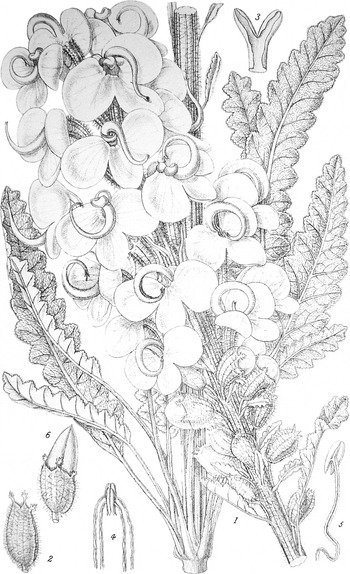
Pedicularis bicornuta Klotzsch var. adenocalyx R.R.Mill, Edinburgh J. Bot. 67: 186 (2010). – Type: Pakistan, B-8 Kashmir, Sonamarg, 34°20′N, 75°20′E, 10,500 ft, at edge of stream, flowers yellow, 5 viii 1965, Stainton 5031 (holo BM). Fig. 2.
Pedicularis eximia G.Watt, J. Linn. Soc., Bot. 18: 381 (1881) p.p. incl. lectotype. – Type: India, Himachal Pradesh, Pangi, Chumba State, Chenab River, southerly aspect, 8500–9000 ft, 25 vii 1878, J. Ellis snr. s.n. (hb. G. Watt 97B) (lecto E, designated by Mill, Reference Mill2010: 186; see discussion below).
Pedicularis bicornuta var. adenocalyx. Illustration from Watt (Reference Watt1881), forming part of the protologue of Pedicularis eximia G.Watt.

Differs from Pedicularis bicornuta var. bicornuta by the calyx tube and teeth covered with ± dense short glandular hairs as well as longer eglandular-pilose indumentum. Stems 12–42(–70) cm. Calyx 11–17 mm, ± densely glandular-pubescent, sometimes with dark blotches or spots on tube; tube 8–14.5 mm; teeth 1–4.5 mm. Corolla 15–35(–53) mm overall; tube 18.5–27(–42) mm; beak of galea 12–16 mm. Flowering from early June to mid-July; fruiting August onwards.
Distribution. Afghanistan, Pakistan (Khyber Pakhtunkhwa and Federally Administered Tribal Areas (FATA)), Kashmir.
Habitat and ecology. Wet meadows and marshes, 2600–3600 m.
Proposed IUCN conservation assessment. Least Concern (LC).
Additional specimens examined. Afghanistan. Parvan: Panjshir valley, between Shanez and Chimar, seen on both sides of the Anjuman Pass, 2600–3000 m, 22 vii 1962, I. Hedge & P. Wendelbo W. 5356 (E). Badakhshan: Oberes Anjuman, Umgebung des Ortes Anjuman, 3100 m, 15 viii 1965, D. Podlech 12389 (E, M n.v.). Baghlan: Oberstes Andarab-Tal, Darrah-i-Til südlich Doab-i-Til, 2800 m, 7 vi 1965, D. Podlech 11165 (E, M n.v.). Safrd Koh, 11,000 ft, vii 1879, Major H. Collett 114 (K). Pakistan. Khyber Pakhtunkhwa: d. Chitral, Chitral, Maj. S.M. Toppin 552 (K, 2 sheets). Hazara region, Sarul, Kagan, 13 viii 1897, Inayat 22043 (E). FATA: Kurram Agency, Kuriam and Hariab districts, 10,500–11,000 ft, 24 & 25 vi 1880, Aitchison 220 (K); Kurrum Valley, Shend Toi Hills, 10,000–11,000 ft, 9 vii 1879, Aitchison 779 (BM, K). Kashmir. Erin Valley, near Bandapur, 11,000 ft, 24 vii 1940, Ludlow & Sherriff 7817 (BM); above Gulmarg, 10–11,000 ft, 2 vi 1892, Duthie 11336 (BM, E); Tsurlat Pass (Salnai Sar), 13,500 ft, summer 1969, O. Polunin 9634 (BM); Gulmarg, 9000 ft, 9 viii 1933, J. Venning K 46 (K); Alibad, 11,000 ft, 6 vii 1876, C.B. Clarke 28985 (BM); Srinagar, Lashpathri, 10,000 ft, 3 vii 1978, C.R. Lancaster 34 (BM); Gangabal Lake, near Mt. Haramukh, 11,700 ft, 14 viii 1940, P.M. Pinfold 280 (BM; corolla much longer, and calyx less glandular, than typical for the variety); Upper Chenab, 10,000 ft, B.H. Baden-Powell 269 (K).
As mentioned above, the syntypes cited by Watt (Reference Watt1881) under his new species Pedicularis eximia are a mixture of P. bicornuta var. bicornuta and P. bicornuta var. adenocalyx as here defined. I have decided to lectotypify the name Pedicularis eximia G.Watt by one of the glandular specimens, so that Watt’s name can be revived if any later worker wishes to regard P. bicornuta var. adenocalyx as a full species. There are three Watt herbarium sheets in the type folder at E, where Watt’s original collection is now conserved, having been presented to the Royal Botanic Garden Edinburgh around 1900 (Vegter, Reference Vegter1988). Two of these are cited in the protologue (49A and 97B) and are Pedicularis bicornuta var. adenocalyx. The third sheet, collected at Pangi at 13,000 ft, is unnumbered; it is eglandular and consequently falls within Pedicularis bicornuta var. bicornuta. Pinned to this unnumbered sheet is the original drawing that formed the basis of the lithograph (plate 13; reproduced here as Fig. 2) that accompanied Watt’s paper and thus forms part of the protologue. However, the drawing shows numerous buds at the base of the inflorescence, which are absent on this sheet. Therefore it is concluded that either a different herbarium sheet must have been used by the artist, or that the drawing is a composite relying on information from more than one sheet.
Pedicularis elephantoides Benth., Scroph. Ind. 23 (1835). – Type: ‘Hab. ad Pyr Panjal, Royle’ (K).
A full account of this species will appear in the Scrophulariaceae fascicle of Flora of Pakistan.
Emendation of series Megalanthae
Pedicularis L. series Megalanthae (Prain) Bonati, Mém. Soc. Bot. France 18: 13 (1910), emend. R.R.Mill hoc loco (Sect. Saccochilus T.Yamaz.). – Pedicularis [unranked] 3. Megalanthae Prain, Ann. Roy. Bot. Gard. (Calcutta) 3: 68 (1890). – Type: Pedicularis megalantha D.Don (Art. 22.6 of the ICBN: McNeill et al., Reference McNeill, Barrie, Burdet, Demoulin, Hawksworth and Marhold2006).
Leaves mainly clustered near base, alternate, petiolate. Inflorescence basipetal, racemose. Calyx split to least 1/3, lobes 5. Corolla usually uniformly pink to purple (in Pedicularis hoffmeisteri lemon yellow, with or without purple streaks on the top lateral lobe of the labellum), with a long tube (usually at least twice as long as calyx) and large, saccate lower lip (which usually envelops the upper lip or galea), whose middle lobe is much smaller than the two laterals; the corolla rotated above the tube through c.90° so that the two larger lobes of the lower lip gape outwards like an open jaw, the upper of the two situated at the top of the flower and forming a hood over the galea and the lower, basal one a landing platform. Galea erect in centre of (and protected by) lower lip, its erect part very reduced or absent, not toothed, its anther-bearing part thus ± sessile on the lower lip, strongly twisted into a ring or arc and with a slender, coiled beak that is emarginate at the apex. Stamens with at least the anterior pair of filaments hirsute or villous. Capsule ovoid to lanceolate, apiculate. – Seven species: Pedicularis cornigera T.Yamaz., P. hoffmeisteri Klotzsch, P. megalantha D.Don, P. megalochila H.L.Li with three varieties, P. pauciflora (Prain ex Maxim.) Pennell, P. woodii R.R.Mill, P. zhongdianensis H.B.Yang. Excluded species: Pedicularis bicornuta Klotzsch (incl. P. eximia G.Watt; to ser. Bicornutae – Mill, Reference Mill2010 and this paper), P. elephantoides Benth. (to ser. Bicornutae – Mill, Reference Mill2010 and this paper), P. fastigiata Franch. (to ser. Longiflorae – Yang et al., Reference Yang, Holmgren, Mill, Wu and Raven1998) and P. kialensis Franch. (to ser. Kialenses – Li, Reference Li1949).
Distribution. NW India (Uttarakhand, Himachal Pradesh), Nepal, Sikkim, Bhutan, China (SW, S and SE Xizang, NW Yunnan), N Burma. Perhaps also in NE India (Arunachal Pradesh); this region is poorly known botanically but given the known distribution of Pedicularis megalochila and some of the others, it is likely that the series will be represented there although no species belonging to it was recorded in Flora of Assam (Kanjilal et al., Reference Kanjilal, Das, Kanjilal and De1939).
Key to species of Pedicularis series Megalanthae
1a. Corolla yellow, with the galea yellow, reddish, magenta or purple 2
1b. Corolla wholly magenta 6
2a. Whole corolla including galea yellow; calyx split to halfway on anterior side 3
2b. Galea of corolla not yellow; calyx split either to 1/4–1/3 or to more than halfway on anterior side 4
3a. Beak of galea c.15 mm; dorsal part of galea with a horn-like appendage; corolla tube 30–50 mm P. cornigera
3b. Beak of galea 5–6 mm; dorsal part of galea lacking a horn-like appendage; corolla tube 50–65 mm P. zhongdianensis
4a. Calyx split to 1/4–1/3 on anterior side (Nepal) P. hoffmeisteri
4b. Calyx split to 2/3 on anterior side (China: P. megalochila) 5
5a. Anterior pair of filaments villous, posterior pair glabrous; middle lobe of corolla labellum ligulate; corolla tube relatively short, c.15 mm P. megalochila var. ligulata
5b. All filaments pubescent; middle lobe of corolla labellum obcordate; corolla tube longer, up to 38 mm P. megalochila var. megalochila f. megalochila
6a. Corolla 27–31 mm with tube 14–20 mm; beak of galea with entire, truncate apex P. megalochila var. megalochila f. rhodantha
6b. Corolla 35–90 mm with tube 25–75 mm; beak of galea with emarginate apex 7
7a. Galea and throat white, rest of corolla reddish-purple; leaf petioles usually completely glabrous (sometimes sparsely pilose only at base); pedicels glabrous P. megalantha
7b. Galea and throat purple, like rest of corolla; leaf petioles and pedicels sparsely pubescent or pilose 8
8a. Corolla tube 35–75 mm, 4.5–6 × as long as tube; lobes of lower corolla lip pilose P. pauciflora
8b. Corolla tube 25–30 mm, c.2 × as long as tube; lobes of lower corolla lip glabrous or at most very sparsely pilosulous P. woodii
Pedicularis cornigera T.Yamaz., J. Jap. Bot. 55(10): 293 (1980). – Type: E Nepal, Lamni Nama, 4200–4900 m, 15 viii 1977, Ohashi, Kanai, Ohba & Tateishi 772407 (holo TI n.v.).
A full account of this species is given by Yamazaki (Reference Yamazaki, Ohba and Malla1988: 157, pl. 26c, fig. 21c). It was said (Yamazaki, Reference Yamazaki1980) to be allied to Pedicularis megalochila var. ligulata P.C.Tsoong from which it differed by the longer galea with a horn-like projection, and by the filaments all densely villous.
Pedicularis zhongdianensis H.P.Yang, Acta Bot. Yunnan. 6(3): 277, t. 1, figs 1–3 (1984). – Type: China, Yunnan, Zhongdian, 3300 m, 19 viii 1981, Zhao Kui-yi 762 (holo PE n.v.).
An account of this species is given by Yang et al. (1998: 208).
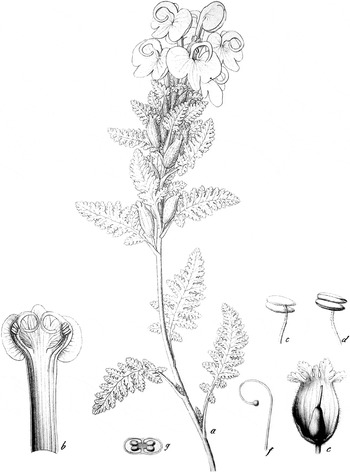
Pedicularis hoffmeisteri Klotzsch in Klotzsch & Garcke, Bot. Ergeb. Reise Waldemar 108, t. 60 (1862). – Pedicularis megalantha var. typica Prain ‘forma hoffmeisteri’ (Klotzsch) Prain, Ann. Bot. Gard. Calcutta 3(1): 119 (1890, perhaps not validly published [Art. 34.1(a) of the ICBN (McNeill et al., Reference McNeill, Barrie, Burdet, Demoulin, Hawksworth and Marhold2006) would seem to apply; see below]). – Pedicularis megalantha var. hoffmeisteri (Klotzsch) Sealy, Bot. Mag. 162: t. 9570 (1939). – Type: No type was designated beyond ‘Dr Hoffmeister fand diese Art im Himalaya’ and the original material collected (seemingly from Kunawar, fide Prain, Reference Prain1890: 118 who apparently saw it and cited it under Pedicularis megalantha var. typica), formerly at B, is now lost. Lectotype: The illustration in Klotzsch & Garcke, Bot. Ergeb. Reise Waldemar t. 60 (1862; illustrated here as Fig. 3, designated here). As this is a line illustration and Klotzsch did not describe the yellow corolla colour, which is diagnostic from Pedicularis megalantha (corollas purple), in either his Latin diagnosis or his fuller German description, I also simultaneously here designate the following epitype: India, Bashahr State, Kanaki, 7500 ft, lower lip very large, bright yellow, 4 vii 1890, J.H. Lace 350 (epi E; isoepi E with no field notes). Both epitype and isoepitype have preserved the yellow corolla colour well. Fig. 3.
Pedicularis hoffmeisteri. Photograph of lectotype, the illustration in Klotzsch & Garcke, Die botanischen Ergebnisse der Reise seiner königl. Hoheit des Prinzen Waldemar von Preussen in den Jahren 1845 und 1846 t. 60 (1862).

An account of this species as it occurs in Nepal is given by Yamazaki (Reference Yamazaki, Ohba and Malla1988: 156, col. pl. 6d, pl. 26a & fig. 21b). Garg (Reference Garg2009: 127 ff., fig. 7) has published a treatment of Pedicularis hoffmeisteri in NW India, with distribution map and illustration. Neither of these accounts, nor that of Sealy (Reference Sealy1939), discussed typification.
Prain (Reference Prain1890: 119), in a figure legend in his account of Pedicularis megalantha, wrote:
A—Specimen of VAR. typica (‘vera’) from Chumbi.
B— " " " " (forma ‘Hoffmeisteri’) from Kamaon.
When Prain (Reference Prain1890) recognised forms within other species, such as Pedicularis brevifolia D.Don (pp. 134–135) and P. gracilis (p. 140), he gave them Greek letters, provided short diagnostic descriptions and indicated at least one specimen. He did none of these things when mentioning the two forms of Pedicularis megalantha var. typica and I therefore conclude that Art. 34.1(a) of the ICBN (McNeill et al., Reference McNeill, Barrie, Burdet, Demoulin, Hawksworth and Marhold2006) can be applied to the mention of forma ‘hoffmeisteri’ to deem the name not validly published in the figure legend. His only comment about Pedicularis hoffmeisteri occurs in the final sentence of his account of P. megalantha, which reads: ‘Dr. Garcke of Berlin has very kindly sent to Calcutta authentic specimens of P. Hoffmeisteri Klotzsch, which is reduced in the Flora of British India to P. siphonantha; they show, as Mr. Maximowicz had already suggested (Mel. Biol. x, 82, footnote 8), that Klotzsch’s species is a form of P. megalantha VAR. typica.’
Pedicularis megalantha D.Don, Prodr. Fl. Nepal. 94 (1825). – Type: Hab. in Gosaingthan Nepaliae, Wallich 411/1 (lecto K, designated by Mill, Reference Mill2001a: 91).
Accounts of this species have been published by Yamazaki (Reference Yamazaki, Ohba and Malla1988: 157, col. pl. 6c, pl. 26b & fig. 21a) for Nepal, Mill (Reference Mill, Grierson and Long2001b: 1231–1232) for the area treated by Flora of Bhutan and by Garg (Reference Garg2009: 126–127) for NW India (only specimens from Sikkim are cited).
Pedicularis megalochila H.L.Li, Taiwania 1: 91 (1948); P. megalochila var. megalochila f. megalochila. – Type: Burma, Adung Valley, 6000–7000 ft, 11 vii 1931, F. Kingdon-Ward 9220 (holo F, photo seen).
P. megalochila var. megalochila f. rhodantha P.C.Tsoong, Acta Phytotax. Sin. 3: 279 (Jan. 1955); Bull. Brit. Mus. (Nat. Hist.), Bot. 2: 8 (Nov. 1955). – Type: Bhutan, Me La, 14,000 ft, 6 viii 1933, Ludlow & Sherriff 425 (lecto BM, designated by Mill, Reference Mill2001a: 92; isolecto E).
P. megalochila var. ligulata P.C.Tsoong, Acta Phytotax. Sin. 3: 279 (Jan. 1955). – Type: China, SE Xizang, Singo Samba, Lo La Chu near Molo, 28 vi 1936, Ludlow & Sherriff 1874 (holo BM; iso E).
A treatment of Pedicularis megalochila and all its subsidiary taxa appears in Yang et al. (Reference Yang, Holmgren, Mill, Wu and Raven1998: 208). Mill (Reference Mill, Grierson and Long2001b: 1232–1233) treated Pedicularis megalochila f. rhodantha for Flora of Bhutan.
Pedicularis pauciflora (Prain) Pennell, Monogr. Acad. Nat. Sci. Philadelphia 5: 149 (1943). – Pedicularis megalantha D.Don var. pauciflora Prain ex Maxim., Bull. Acad. Sci. Saint-Pétersbourg 32: col. 532 (1888). –Type: India, Sikkim, Bhoktan near Jongri, vii 1887, King’s collector s.n. [lecto CAL 327668, designated here, n.v. but colour illustration in Garg, Taiwania 54: 131, fig. 7 (2009), seen].
Pedicularis megalochila subsp. longituba T.Yamaz., J. Jap. Bot. 55: 294 (1980). – Type: Nepal, Thudam–Lamni Nama, 3500–4000 m, 14 viii 1977, Ohashi, Kanai, Ohba & Tateishi 770760 (holo TI n.v. but illustrated in Yamazaki, Revis. Pedic. Nepal pl. 26d, 1988).
A full account of this species was published by Yamazaki (Reference Yamazaki, Ohba and Malla1988: 158, pl. 26d & fig. 21d) for Nepal, synonymising his earlier Pedicularis megalochila subsp. longituba. Mill (Reference Mill, Grierson and Long2001b: 1233–1234) treated the species for the Flora of Bhutan area.
Pedicularis woodii R.R.Mill, Edinburgh J. Bot. 58: 82 (2001). – Type: Bhutan, Thimphu District, Dongshola, 4400 m, 19 viii 1990, J.R.I. Wood 7316 (holo E).
As well as the protologue cited above a treatment of this species appeared in Mill (Reference Mill, Grierson and Long2001b: 1234).
Acknowledgements
I am grateful to M. Amano for sending me a copy of his 1999 cytology paper and to T. Husain for sending copies of two papers on Pedicularis bicornuta. Wang Hong (Kunming Institute of Botany) greatly increased my knowledge of Chinese Pedicularis while she was on an extended study visit to the Royal Botanic Garden Edinburgh in 2001/02 and which resulted in two publications. I am grateful to Patrick Kuss and an anonymous reviewer for their constructive reviews that have helped to improve the paper. Patrick Kuss (Bern) and Rick Ree (Harvard University) are also warmly thanked for making available their unpublished draft large phylogenetic trees of Pedicularis. The Royal Botanic Garden Edinburgh is supported by the Scottish Government’s Rural and Environment Research and Analysis Directorate.