Introduction
Sudden sensorineural hearing loss (SSHL) is most commonly defined as sensorineural hearing loss of 20 dB1 or greater over at least two contiguous audiometric frequencies occurring within a 72-hr period caused by undefined factors. The incidence of SSHL is approximately 5 to 30 per 100,000 and is one of the most common emergencies in audiologic and otolaryngologic practice. Although there is a lack of epidemiological data on SSHL in China, recent clinical observations have shown an increasing incidence of the disease, with more and more young people being affected. The aetiology and pathophysiological mechanisms of SSHL are not yet fully expounded, but vascular damage is considered the most likely cause of full-frequency hearing loss.Reference Kim, Lim, Sim and Choi2 The 2015 guidelines classified1 SSHL into different types, indicating that the flat-type decline is often related to vascular stria dysfunction or vasospasm, while the profound deafness type is usually caused by inner ear vascular embolism or thrombosis. The guidelines also noted that the recovery rate of full-frequency hearing loss (profound deafness type and flat-type decline) is low, accompanied with persistent tinnitus and/or vertigo, ear fullness, auditory hypersensitivity, hearing difficulties or abnormal sensations around the ear.Reference Plontke, Löwenheim, Mertens, Engel, Meisner and Weidner3 Some patients may also experience psychological symptoms and disorders, such as anxiety, depression and sleep disturbances.Reference Roh, Chao, Kim, Yoon, Jung and Lee4 Unilateral deafness can severely reduce the ability of speech perception in noisy environments, significantly affecting the quality of life of patients.
It is well known that SSHLhas a certain self-healing rate, but the possibility of self-recovery is rare in patients with severe or profound SSHL.Reference Mattox and Simmons5 Most patients have a strong desire for treatment, but the therapeutic effect is generally poor, especially for idiopathic cases, where the prognosis is difficult to predict. Over the past few decades, numerous studies have attempted to establish correlations between SSHL prognosis and certain accompanying symptoms, duration or related blood test results. However, hearing improvement observed in audiological examinations after treatment often fails to meet the patients’ expected therapeutic effects, which exits great difference with existing studies.Reference You, You and Liu6–Reference Kaneva, Yanov, Bojko, Kudryavykh, Potolitsyna and Bojko11 Therefore, this study further explores the impact of clinical parameters and characteristics on hearing recovery after SSHL treatment, aiming to identify potential prognostic factors and is to construct a nomogram prediction model based on this, which will be calibrated and validated to better predict the prognosis of SSHL.
Materials and methods
Study subjects
A total of 194 patients with severe or profound SSHL admitted to the Department of Otorhinolaryngology-Head and Neck Surgery at Xi’an People’s Hospital (Xi’an Fourth Hospital) from January 2020 to January 2023 were selected. All patients underwent pure tone audiometry examination before admission and were re-examined on the 1st, 4th and 10th month after treatment. Data, including gender, age, affected ear, duration of hearing loss, accompanying symptoms and underlying diseases, were retrospectively collected. Pre-treatment blood routine and coagulation function test results were also collected. Inclusion criteria: (1) patients aged greater than 18 years, (2) bilateral or unilateral full-frequency hearing loss greater than 60 dB HL and (3) all patients were treated for the first time. Exclusion criteria: (1) patients with hearing loss caused by space-occupying lesions in the internal auditory canal and central nervous system lesions confirmed by MRI, (2) patients with congenital ear malformations or other congenital diseases, (3) patients in the decompensation phase of liver or kidney dysfunction and (4) patients unable to complete the standardized treatment plan due to individual reasons.
Treatment plan
All included patients were treated according to the latest SSHL guidelines, which included vasodilator drugs, corticosteroids and thrombolytic therapy. The vasodilator drug was Ginkgo biloba extract injection (produced by Yuekang Pharmaceutical Group Co., Ltd.). The hormone sequential therapy was conducted for patients, including intravenous injection of dexamethasone (produced by Sinopharm Group Rongsheng Pharmaceutical Co., Ltd.), local tympanic membrane injection of methylprednisolone sodium succinate (produced by Han Hui Pharmaceutical Co., Ltd.) as well as injection of batroxobin, the thrombolytic drug (produced by Beijing Tobisi Pharmaceutical Co., Ltd.). The treatment course lasted for 10 days, and coagulation function was monitored before intravenous infusion of batroxobin.
Efficacy evaluation
According to the latest SSHL guidelines, the condition of hearing recovery can be classified as follows. (1) Cured: The impaired-frequency hearing returns to normal or reaches the level of the healthy ear or reaches the level before the onset of the disease. (2) Significantly Effective: The average hearing threshold of the impaired frequency improves by more than 30 dB. (3) Effective: The average hearing threshold of the impaired frequency improves by 15–30 dB. (4) Ineffective: The average hearing threshold of the impaired frequency improves by less than 15 dB. Patients were divided into the effective treatment group (hearing improvement >15 dB) and the ineffective treatment group (hearing improvement ≤15 dB), and the therapeutic outcomes were stratified into four levels: ineffective, effective, significantly effective and cured.
Statistical analysis
The IBM SPSS (V19, IBM Corp., USA). statistical analysis software was used to perform normal distribution tests on gender, age and affected ear side. The χ² analysis and logistic regression analysis were performed for the following variables: gender, age, affected ear side, initial hearing threshold, duration of hearing loss, accompanying symptoms, platelet count (PLT), neutrophil-to-lymphocyte ratio (NLR), lymphocyte-to-platelet ratio (PLR), C-reactive protein (CRP), serum cholesterol, triglyceride, low-density lipoprotein (LDL) levels and the condition of the contralateral ear. The confidence interval was set at 95 per cent. For overall comparisons among multiple groups, the χ² test was used with a significance level of α equals 0.05 (two-sided). For pairwise comparisons among multiple groups, the Bonferroni correction method was applied, with the adjusted significance level αˊ equals α/m (where m represents the number of comparisons, for example, if m equals 3, then αˊ equals 0.017). A nomogram prediction model was constructed and calibrated using the R language.
Results
General information
In this study, a total of 194 patients were included, of which 84 were male and 110 were female, with an average age of 50.99 years. The patients were divided into three age groups: the youth group (20–40 years) including 56 patients, the middle-aged group (41–60 years) including 72 patients and the advanced group (over 60 years) including 66 patients, among whom 102 patients had hearing loss in the left ear and 92 patients had hearing loss in the right ear. A total of 120 cases were accompanied with tinnitus, 72 cases were accompanied with vertigo, 10 cases were accompanied with spontaneous nystagmus and 13 cases were accompanied with benign paroxysmal positional vertigo (BPPV). Additionally, 60 cases reported a sensation of ear fullness, and 37 cases had hearing loss in the contralateral ear. According to the initial hearing thresholds, 98 patients had severe hearing loss and 96 patients had profound hearing loss. The average duration of hearing loss was 5.96 days. After treatment, 80 patients showed no significant improvement in hearing, while 114 patients experienced improved hearing with an effective rate of 20.62 per cent, with the significant effective rate of 25.77 per cent and the cure rate of 12.37 per cent. Detailed data are shown in Table 1.
Basic information of patients

Effective group: effective + remarkably effective + cured.
Univariate analysis of related blood test results
The study showed no significant statistical difference between the effective and ineffective treatment groups in univariate regression analysis of blood examination, including NLR, PLR, CRP, serum cholesterol levels, triglyceride levels and LDL levels. However, there existed statistically significant differences in platelet count, fibrinogen levels before treatment (Fib1), 3rd (Fib2) and 5th (Fib3) days after treatment (see Table 2).
Univariate analysis of patients’ blood test results

CRP = C-reactive protein; FIB = fibrinogen; LDL = low density lipoprotein; NLR = neutrophil-to-lymphocyte ratio; PLR = platelet-to-lymphocyte ratio; PLT = platelet count; TC, total cholesterol; TG = triglyceride.
Effective group: effective + remarkably effective + cured.
Hearing recovery
There were no significant differences in the hearing thresholds of the affected ear between two groups before treatment. The average hearing thresholds of the healthy ear before treatment in the ineffective treatment group was poorer. The hearing thresholds of different frequencies in the ineffective treatment group showed no significant improvement, while the effective group showed an increase in the hearing thresholds. Specifically, low-frequency hearing loss at 250–500 Hz recovered earlier and increased greatly. On the 4th day after treatment, hearing recovered significantly in the effective treatment group.
Impact of age on prognosis
For patients in the group of 20–40 years old, 41–60 years old and older than 60 years old, the overall statistical results showed χ² equal to 41.77 and p less than 0.001, indicating a statistically significant difference in therapeutic effects. After pairwise comparisons, it was found that the cure rate (28.6 per cent) and the marked effectiveness rate (32.1 per cent) were the highest, respectively, in the groups of 20–40 and 41–60 years old, while the ineffectiveness rate (66.7 per cent) was the highest in the group older than 61 years old. There were significant statistical differences in the therapeutic effects between each two groups (p < 0.0125) (see Table 3).
Relationship between age and therapeutic effects

Multivariate analysis
Taking the therapeutic effect as the dependent variable and univariate factors with statistical differences as the independent variables, a multivariate analysis was conducted. There existed statistical significance in consultation time, dizziness, PLT and age stratification, with p < 0.05 (see Table 4).
Results of binary logistic regression on factors affecting the prognosis of severe full-frequency SSHL

CI, confidence interval; OR, odds ratio; PLT = platelet count; SSHL = sudden sensorineural hearing loss.
Construction of nomogram model
Based on the above univariate and multivariate logistic regression analyse, a nomogram model for predicting the prognosis of severe full-frequency SSHL was constructed using R language software, which was calibrated and showed good fitting and calibration curves (see Figures 1 and 2).
Nomogram model for factors affecting the prognosis of full-frequency SSHL.

Calibration curve.

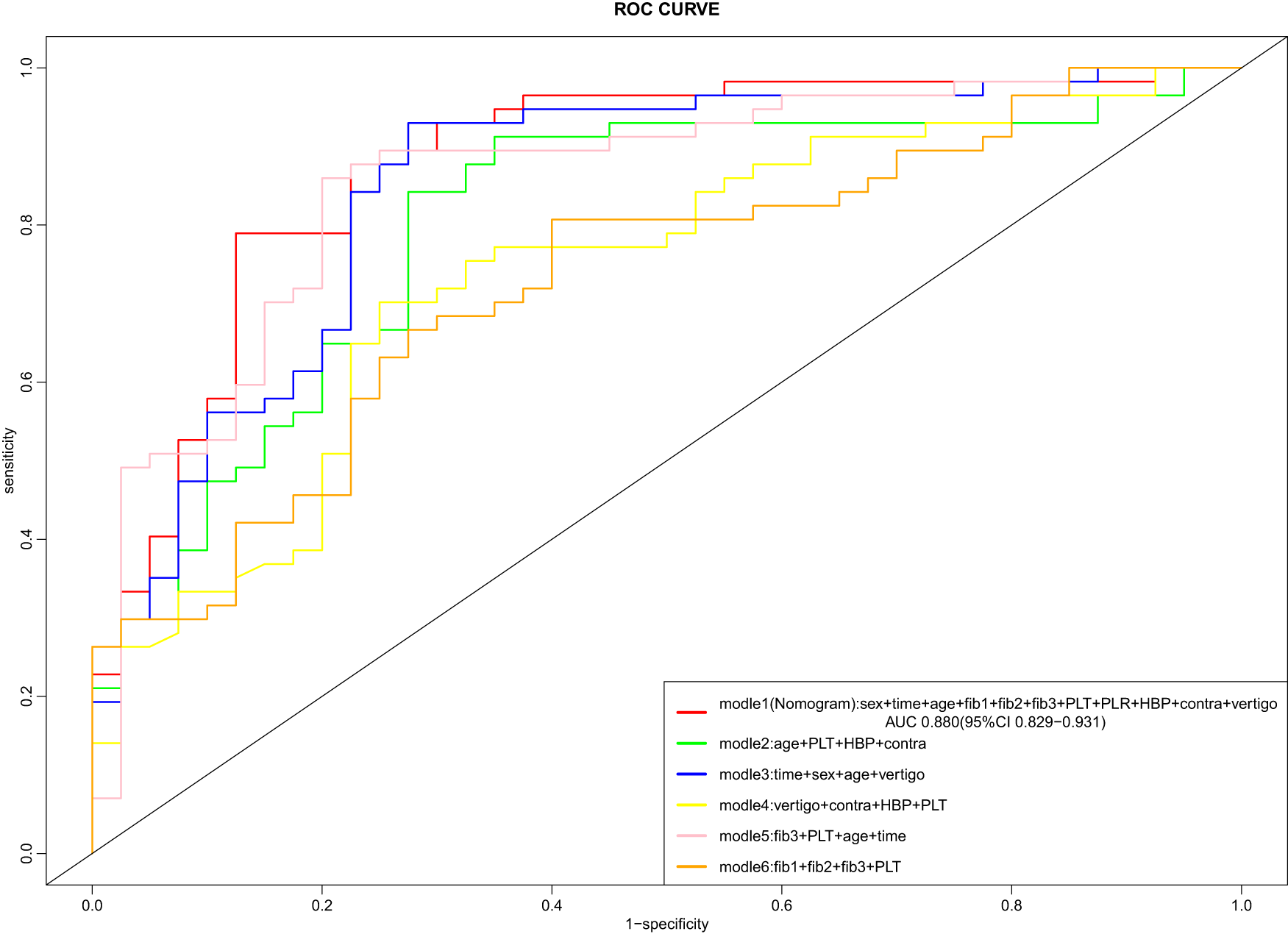
Receiver operating characteristics curve.
A model was constructed for different combinations of conditions that might affect the prognosis and compared with the best model. The analysis results of receiver operating characteristics (ROC) curve showed that the combined prediction model had the largest area under the curve (AUC) of 0.880 (95 per cent confidence interval [CI], 0.829–0.931). The highest sensitivity was 80.7 per cent and the highest specificity was 87.5 per cent.
Discussion
Although the specific aetiology and pathophysiological mechanisms of SSHL are not yet identified, most studies suggest that viral infections, autoimmune factors and abnormalities in the inner ear’s microcirculation may be closely related to the pathogenesis of SSHL. Among them, vascular damage is considered the most likely cause of SSHL in patients with full-frequency hearing loss. The 2015 guidelines in China proposed1 a classification of SSHL, where the flat-type decline is often associated with vascular dysfunction or vasospasm, and the profound deafness type is more likely related to inner ear vascular embolism or thrombosis. Over the past few decades, the most important therapeutic innovations in SSHL treatment have been the separation of fibrinogen and LDL, the intravenous injection of steroids through the tympanic membrane as well as hyperbaric oxygen therapy.Reference Plontke, Meisner, Agrawal, Cayé-Thomasen, Galbraith and Mikulec12 In clinical practice and other studies,Reference Chandrasekhar, Tsai, Schwartz, Bontempo, Faucett and Finestone13 it has been observed that the combination of steroids and hyperbaric oxygen therapy can improve therapeutic effect. However, most patients with full-frequency SSHL do not fully recover after medication treatment, and their understandings of prognostic factors is also very limited. Therefore, it is quite necessary to summarize the clinical parameters and characteristics of SSHL patients. Our analysis of 24 univariate factors that may affect the prognosis of SSHL revealed that patients, who were male, did not have dizziness or vertigo, had a short duration of hearing loss, had low hearing thresholds in the contralateral ear, were younger, did not have hypertension, had low platelet counts and had low levels of Fib1, Fib2 and Fib3, had better prognosis.
It is generally believed that SSHL occurs with equal incidence in males and females. However, Ceylan et al.Reference Ceylan, Celenk, Kemaloğlu, Bayazit, Göksu and Ozbilen14 in a retrospective study found that gender is a factor influencing the hearing prognosis of SSHL patients, and female patients’ prognosis is poorer than males’, which is consistent with our research results. On the other hand, the study by Samim et al. suggests that females have better hearing recovery than male,Reference Samim, Kilic, Ozdek, Gocmen, Eryilmaz and Unlu15 which may be related to our small sample size.
The onset of dizziness and/or vertigo in SSHL can occur before, during or after hearing loss. Some patients may accompanied with benign paroxysmal positional vertigo (BPPV), and in this study, 26 cases were combined with BPPV, with symptoms improved after repositioning. Spontaneous nystagmus was observed in 20 cases, and disappeared after treatment. The incidence of BPPV or spontaneous nystagmus in the effective group (17.85 per cent) was significantly lower than that in the ineffective group (30.00 per cent). Patients with full-frequency SSHL accompanied by dizziness and/or vertigo in the effective group needed longer time to recovery, very few of whom were cured completely. Most studies suggest that SSHL combined with dizziness has a poor therapeutic effect. Zhou et al.Reference Zhou, Yuan, Yang, Liu, Huang and Zhang16 observed that dizziness is an independent risk factor significantly associated with poor hearing prognosis, which is consistent with our multivariate analysis. The reason is that patients with SSHL and dizziness have a higher risk of labyrinthine vascular damage and vestibular organ lesions, which may be negatively correlated with hearing recovery.Reference Yu17
The time from onset to the initiation of treatment has long been considered an important factor affecting SSHL prognosis. The study by Attanasio et al.Reference Attanasio, Russo, Di, Cagnoni, Masci and Ralli18 indicates that delayed treatment is negatively correlated with hearing improvement, with the probability of hearing recovery decreased by 3 per cent for each day of delay. The study by Zhou et al.Reference Zhou, Yuan, Yang, Liu, Huang and Zhang16 suggests that patients who start treatment within 7 days have the best prognosis, and the treatment effect for patients starting treatment between 8 and 28 days is slightly better than for those who start treatment after 28 days. The results of this study show that the average duration in the ineffective group was 8.8 days, while in the effective group, it was 4.19 days. Univariate analysis revealed a significant difference between the two groups in duration. In multivariate analysis, this was identified as an independent prognostic factor for SSHL, suggesting that early treatment is more likely to lead to positive outcomes.
Previous studies have shown through multivariate analysis that the type of hearing loss is related to the prognosis of SSHL and is an independent prognostic factor.Reference Yuan, Liu, Ma, Chen, Wang and Gao8 In this study, patients with severe full-frequency SSHL (hearing loss > 60 dB) were selected. For the flat type, the efficacy evaluation showed 14 (14.3 per cent) cases were effective, 28 (28.6 per cent) cases were markedly effective and 20 (20.4 per cent) cases recovered. For the profound deafness type, 44 (27.1 per cent) cases were effective, 28 (22.9 per cent ) cases were markedly effective and 20 (4.2 per cent) cases recovered. A significant statistical difference was observed between the two groups, with a higher recovery rate in the flat type compared to the profound deafness type. This is consistent with the guidelines, which suggest that different types of SSHL patients have different hearing prognoses, and this phenomenon is believed to be related to different pathogenic mechanisms of SSHL classification.1 The flat decline type is often associated with vascular stria dysfunction or vasospasm, while the profound deafness type is frequently caused by inner ear vascular embolism or thrombosis.
In this study, the average hearing thresholds of the contralateral ear in the effective and ineffective groups were 22.95 dB HL and 36.78 dB HL, respectively. The ineffective group had a higher proportion of patients with elevated contralateral ear thresholds, indicating a worse prognosis. Similarly, Tsuzuki et al.Reference Tsuzuki, Wasano, Oishi, Hentona, Shimanuki and Nishiyama19 reported that atherosclerotic factors (i.e., older age, male and vascular diseases) were significantly associated with higher hearing thresholds in the healthy ear of SSHL patients, which indicates poor prognosis of SSHL.
Clinical data showed that SSHL can occur at any age, and multiple studies indicated that the older the age, the worse the prognosis. The results of the Japanese multicenter study by Kitoh et al. suggested that the highest proportion of patients was in the 60–69 age group.Reference Kitoh, Nishio, Ogawa, Kanzaki, Hato and Sone20 In this study (Table 3), the highest proportion of patients was in the 41–60 age group. The study by Xiong et al.Reference Xiong, Dai, Wang, Hou, Lu and Sun21 also found there was a significant difference in age after one month of treatment for hearing recovery of full-frequency SSHL, with the 18–30 age group showing better recovery rates than other age groups. Our study results show that the recovery rate in the 20–40 age group was significantly higher than that in the other two groups, and the recovery rate decreased significantly with increasing age. After multivariate analysis, age was also considered an independent prognostic factor for SSHL.
ROC curve.

In recent years, an increasing number of scholars have focused on the relationship between inflammation and SSH. Although the study by Yuan et al.Reference Yuan, Liu, Ma, Chen, Wang and Gao8 showed that the PLR can be used to predict hearing prognosis in SSHL patients, Sun et al.Reference Sun, Jiang and Wang7 demonstrated that parameters such as neutrophil, lymphocyte, platelet counts, NLR and PLR were not related to the prognosis of acute-phase full-frequency SSHL. His multivariate analysis showed that although there was a significant difference in CRP levels between the effective and ineffective groups, CRP levels were not correlated with the prognosis of full-frequency SSHL. This finding is consistent with the results of our study, which showed no statistical difference in neutrophil ratio, lymphocyte ratio, NLR, PLR and CRP parameters between the effective and ineffective groups in terms of the prognosis of full-frequency SSHL. However, univariate analysis in our study showed a significant difference in platelet count levels, and multivariate analysis indicated that platelet count could be an independent factor predicting the prognosis of full-frequency SSHL. Platelets are involved in the coagulation process, and the coagulation function of platelets may be abnormal in the elder patients. The latest study by Poscablo et al. published in the journal Cell Reference Poscablo, Worthington, Smith-Berdan, Rommel, Manso and Adili22 suggests that platelet enrichment associated with age exacerbates thrombosis after vascular damage. Therefore, it can be considered that platelet count can be used as a factor predicting the prognosis of SSHL.
The animal experiments by Ihler et al.Reference Ihler, Strieth, Pieri, Göhring and Canis23 found that hyperfibrinogenemia led to reduced cochlear blood flow and hearing damage in guinea pigs, while Kawakami et al.Reference Kawakami, Makimoto and Yamamoto24 found that, after defibrination (DF) treatment, the cochlear blood flow in guinea pigs increased, improving their hearing. Fibrinogen is a recognized risk factor in vascular diseases such as stroke and myocardial infarction.Reference Ernst25 The cause of full-frequency hearing loss is often attributed to cochlear artery occlusion, and reducing fibrinogen levels can significantly improve blood rheology and endothelial function, possibly related to cochlear circulation and auditory function.Reference Shiraishi, Kubo, Okumura, Naramura, Nishimura and Okusa26 The study by Ma et al.Reference Ma, Wu and Huang27 suggested that fibrinogen level was reduced in the hearing recovery group of SSHL patients, and Doo et al. Reference Doo, Kim, Kim, Yoo, Kim and Ryu28 also believed that fibrinogen is related to the prognosis of SSHL. Furthermore, domestic scholar Sun et al.Reference Sun, Jiang and Wang7 found there is a significant difference in pre-treatment fibrinogen levels between the effective and ineffective groups of SSHL patients, with a sensitivity of 85.4 per cent and a specificity of 60.0 per cent for predicting the prognosis of full-frequency SSHL, considered a useful predictive indicator. The results of this study show that there is a significant difference in pre-treatment fibrinogen (Fib1) and fibrinogen levels on the 3rd (Fib2) and 5th (Fib3) days after treatment between the effective and ineffective groups. However, multivariate analysis indicated that fibrinogen levels could not serve as an independent factor for predicting the prognosis of full-frequency SSHL. We also found that the ineffective group had higher pre-treatment fibrinogen (Fib1) levels, with a significant difference between the groups. After the first treatment with 1 ml of bivalirudin, significant differences were observed on the 3rd morning of fasting fibrinogen levels (Fib2), with the effective group having an average fibrinogen level of 1.10 ± 0.51 g/L. After the second treatment with 0.5 ml of bivalirudin, fibrinogen levels (Fib3) were significantly different, with an average level of 0.85 ± 0.27 g/L in the effective group. Although fibrinogen reduced to very low levels in the 4th and 5th treatments, there was no significant difference between the effective and ineffective groups. Therefore, we conclude that, if fibrinogen levels drop below 1.10 g/L after the first fibrinolysis treatment and to around 0.85 g/L after the second treatment, it suggests that the patients’ hearing prognosis may be favourable. For patients of different ages, with or without comorbidities such as hypertension or diabetes, or with a history of cerebral infarction or myocardial infarction, the target fibrinogen levels may differ. Further research is needed, including stratification and exclusion of confounding factors such as steroid treatment.
In this study, 194 patients were included, and the effective rate after one month of treatment was 58.76 per cent. Line charts 3 and 4 show that patients with low-frequency hearing loss recovered earlier in the effective group and their hearing improved a lot. Line chart 5 suggests that, on the 4th day after treatment, the hearing improvement in the effective group was more significant. Line chart 6 indicates that the improvement in hearing at 250 Hz was the greatest on the 4th day after treatment in the effective group. Sofer et al.Reference Sofer, Fisher, Tarnovsky, Vofo, Kaufmann and Stern Shavit29 found that over 80 per cent of patients with more than 30 per cent hearing improvement on the 2nd to 3rd day and 5th to 7th day after treatment had significant improvement or were cured during follow-up.
Previous studies have indicated that other chronic diseases, such as diabetes, hypertension, hyperlipidemia and cardiovascular diseases, can affect the recovery of SSHL. The study by Rinaldi et al. showed that patients with SSHL had significantly higher fasting blood glucose and blood pressure compared to the normal group, but other studies found no significant differences between cases and controls.Reference Rinaldi, Cavallaro, Cariello, Scialpi and Quaranta30 Kaneva et al.Reference Kaneva, Yanov, Bojko, Kudryavykh, Potolitsyna and Bojko11 found there was no significant differences in TG, TC and LDL-cholesterol (LDL-C) levels between the SSHL group and healthy controls. In our study, there were no significant differences in diabetes, TG, TC and LDL-C levels between the effective and ineffective groups. Univariate analysis showed a significant statistical difference in hypertension between the effective and ineffective groups, but hypertension was not an independent risk factor affecting the prognosis of SSHL patients.
This study used a nomogram model and multivariate ROC curve analysis to establish a prediction model. The results suggested that combining 11 factors, including gender, duration of hearing loss, age, hypertension, pre-treatment fibrinogen (Fib1), fibrinogen levels on the 3nd (Fib2) and 5th (Fib3) day after treatment, presence of dizziness or vertigo, platelet count, PLR and contralateral ear hearing threshold, can accurately predict the prognosis of SSHL, indicating that considering these factors comprehensively can significantly improve the sensitivity and specificity of predicting the effectiveness of SSHL treatment. The innovation of this study lies in the combined application of the above influencing factors for the assessment of SSHL treatment effectiveness and prognosis, and the validation of their predictive effectiveness through arefined statistical models. This provides scientific evidence for the treatment process of SSHL patients and helps to formulate and implement individualized preventive measures.
• The aetiology of sudden sensorineural hearing loss (SSHL) is unclear, and there are many factors that influence prognosis
• Age, onset time, coagulation function, and comorbidities were supposed affected treatment outcomes
• This paper identified 11 risk factors for sudden hearing loss and developed a nomogram prediction model and receiver operating characteristics (ROC) curve
• Our model precisely predicted treatment outcomes through the model, enabling personalized assessment of the condition
Conclusion
Our study suggests that a nomogram model incorporating 11 factors—gender, time from onset to treatment, age, hypertension status, fibrinogen levels (Fib1, Fib2 and Fib3), presence of vertigo/dizziness, platelet count, PLR and contralateral ear hearing threshold—can effectively predict the prognosis of severe (or greater) sudden sensorineural hearing loss (SSHL). Other potential confounding factors and comorbidities were not selected as influencing factors, which may be related to our limited sample size. Additionally, considering that the aetiology of SSHL in patients under 20 years old differs from that in older patients, we selected only patients over 20 years old for our study.