Introduction
Squamous cell carcinoma (SCC) of the oropharynx is a common head and neck malignancy. Despite the decrease in tobacco smoking and alcohol drinking, the incidence of oropharyngeal SCC has increased.Reference Mehanna, Beech, Nicholson, El-Hariry, McConkey and Paleri1–Reference Chaturvedi, Engels, Anderson and Gillison4 Human papillomavirus (HPV) has been implicated in the aetiopathogenesis of more than 50 per cent of oropharyngeal SCCs.Reference Mehanna, Beech, Nicholson, El-Hariry, McConkey and Paleri1–Reference El-Mofty and Patil7 Human papillomavirus positive oropharyngeal SCCs are generally advanced at presentation. In addition, they are more radiosensitive; thus, the oncological outcome is better compared to that of SCCs caused by traditional risk factors such as smoking and alcohol.Reference Mehanna, Beech, Nicholson, El-Hariry, McConkey and Paleri1–Reference Termine, Panzarella, Falaschini, Russo, Matranga and Lo Muzio9
The Scottish Intercollegiate Guidelines Network recommends treatment with chemotherapy, radiotherapy and surgery, depending on the disease stage and whether ablative or organ preservation approaches are adopted in patient management.10 Many patients undergo post-treatment neck dissection after completion of chemoradiotherapy to improve survival. However, as HPV positive oropharyngeal SCCs are more sensitive to radiotherapy, one may wonder whether interval neck dissection after completion of chemoradiotherapy is necessary in all cases.
Polymerase chain reaction and in situ hybridisation techniques are considered the most sensitive and specific accepted methods of HPV detection and genotyping in cancer and normal tissue specimens.Reference Evans, Matthews, Kandil, Adamson, Trotman and Cooper11, Reference Lewis12 Over-expression of p16 is consistent with a regulatory feedback mechanism to compensate for the HPV-derived E7-oncoprotein-induced loss of the tumour suppressor retinoblastoma protein.Reference Kim, Choi, Ko, Baek and Son13 Staining for p16 is simple, readily available and inexpensive compared to polymerase chain reaction and in situ hybridisation methods.Reference El-Naggar and Westra14 Recent studies have demonstrated that up to 90 per cent of HPV positive SCCs and less than 10 per cent of HPV negative SCCs stain positive for p16.Reference Smeets, Hesselink, Speel, Haesevoets, Snijders and Pawlita15, Reference Schache, Liloglou, Risk, Filia, Jones and Sheard16 Thus, positive staining for p16 is considered a ‘surrogate’ marker of oncogenic HPV presence.Reference Fischer, Kampmann, Zlobec, Green, Tornillo and Lugli17
This study aimed to evaluate the histopathological findings of neck dissection specimens from patients with p16 positive and p16 negative oropharyngeal SCC, after completion of chemoradiotherapy, and discuss the role of neck dissection after a ‘clinically complete response’ to chemoradiotherapy.
Materials and methods
Study design and data gathering
All patients with oropharyngeal SCC and neck node status of at least N1, who had been treated with chemoradiotherapy followed by neck dissection in the period January 2004–July 2012, were studied. The data, collected retrospectively, were extracted from medical case notes and pathology records.
The patients included in the study were selected using precise criteria. Specifically, all patients had oropharyngeal SCC with a neck node status of at least N1, they were all treated with curative intent, all completed chemoradiotherapy treatment and underwent neck dissection, and all demonstrated a clinically complete response to chemoradiotherapy. Patients with non-SCC or lymphoma, and those diagnosed and treated outside of NHS Tayside, were excluded from the study.
Clinical assessment of response to chemoradiotherapy was undertaken by the senior authors (REM, RC and SM). The absence of disease at the residual primary site (oropharyngeal region) and secondary site (neck) on clinical assessment after chemoradiotherapy was defined as a ‘clinically complete response’. For this cohort, no post-chemoradiotherapy imaging was performed to assess treatment response. Post-chemoradiotherapy imaging was not the routine practice during the study period, and we did not have access to positron emission tomography computed tomography (PET-CT) for this group of patients.
Laboratory analysis
Tumour specimens from the primary site were subjected to p16 immunohistochemistry as part of routine histopathological analysis. Uterine cervix tissue specimens with established HPV genomic status were used as controls.
There is some variation regarding the interpretation of p16 immunohistochemical staining.Reference Singhi and Westra18 In our institution, 70 per cent or more strong diffuse nuclear and cytoplasmic staining was considered positive for p16. Routine haematoxylin and eosin stained neck dissection specimen sections were examined for evidence of metastatic disease. Specimens were also subjected to cell viability tests to assess for the presence of viable and non-viable cancer cells. Immunohistochemistry for Ki-67, a marker which highlights cells other than those in the G0 cell cycle phase, was also performed. Viable tumour cells were those displaying obvious morphologically or cytologically malignant features, and were typically Ki-67 positive. Non-viable tumour cells were Ki-67 negative and showed necrotic or apoptotic debris with no obvious intact morphologically malignant appearing tumour cells, and they often demonstrated a surrounding tissue reaction with prominent macrophages.
Oncological treatment
Patients were managed with curative intent based on our experience and the Scottish Intercollegiate Guidelines. Specifically, standard treatment involved an induction chemotherapy regime starting within two to three weeks of the multidisciplinary head and neck clinic's decision to commence treatment. The standard induction regime was cisplatin 100 mg/m2 on day 1 followed by 5-fluorouracil 1000 mg/m2 on days 2–5 for two cycles.
Provided a response in the size of the tumour was observed, radiotherapy of 66 Gy in 33 fractions, with cisplatin 100 mg/m2, was usually administered in 2 phases, during weeks 1 and 4. The radiotherapy was three-dimensionally planned using either computed tomography (CT) planning or simulation, which was followed by CT for dosimetry; all CT scanning was performed using a two-part Perspex shell for immobilisation.
In all patients, ipsilateral selective neck dissection (levels II–IV) was performed once the radiation reaction had settled; this was usually between 8 and 12 weeks after the completion of treatment. This decision was made based on our previous experience that indicated this was an optimum time to conduct post-chemoradiotherapy surgery and operate in a field with limited fibrosis.
Outcome measures
The primary outcome measure was the presence of viable cancer cells on histopathology of neck dissection specimens. Secondary outcome measures included post-operative neck dissection complications, locoregional recurrence whilst the patient was under surveillance, tobacco smoking and alcohol history in relation to p16 status.
Statistical analysis
Data were stored using an Excel® spreadsheet. Statistical analyses were conducted using SPSS® software (version 15). The chi-square test for trend analysis was performed to identify any statistically significant associations between the p16 status of the primary tumour and histopathological findings on neck dissection specimens. A p value of less than 0.05 was considered significant.
Results
Between January 2004 and July 2012, 103 patients were commenced on chemoradiotherapy administered with curative intent. Sixteen patients demonstrated a poor response and three patients died during the course of treatment. A clinically complete response to chemoradiotherapy was evident in 84 patients. Of those 84 patients, 4 were unfit for surgery and 4 declined any further treatment after completion of chemoradiotherapy. The remaining 76 patients underwent planned post-chemoradiotherapy neck dissection.
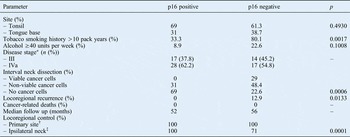
Forty-eight patients (63.2 per cent) were male and 28 (36.8 per cent) were female, with a median age of 57 years. Forty-five patients (59 per cent) had p16 positive disease and 31 (41 per cent) had p16 negative disease. Table I summarises the main clinical parameters.
Summary of main clinical parameters

*Based on the Union for International Cancer Control tumour–node–metastasis staging system. †Clinical evidence of disease control. ‡Clinical and pathological evidence of disease control
p16 positive disease
Thirty-one patients (69 per cent) had tonsillar SCC and 14 (31 per cent) had tongue base SCC. Fifteen patients (33.3 per cent) had a history of tobacco smoking and only four (8.9 per cent) had a history of alcohol abuse (Table I). None of the patients had viable cancer cells on histopathological assessment of neck dissection specimens; 31 per cent had non-viable cancer cells. Clinical control at the primary site, and clinical and histological control of the neck, was achieved in all patients (100 per cent), with no locoregional recurrence or cancer-related deaths whilst they were under follow up. All patients were alive (disease-free) after a median of 52 months' follow up.
p16 negative disease
Of the patients, 61.3 per cent had tonsillar SCC and 38.7 per cent had tongue base SCC. The majority had a history of tobacco smoking (80.1 per cent), and 22.6 per cent of patients had a history of alcohol abuse (Table I). Viable cancer cells were present on histopathological assessment of neck dissection specimens in 29 per cent of patients; 48.4 per cent of patients had non-viable cancer cells. Locoregional recurrence occurred in 12.9 per cent of patients whilst they were under follow up, but there were no cancer-related deaths. Specifically, local recurrence occurred in one patient (3.2 per cent) and regional recurrence occurred in three patients (9.7 per cent). Eighty-seven per cent of patients were still alive (disease-free) after a median of 56 months' follow up.
Complications
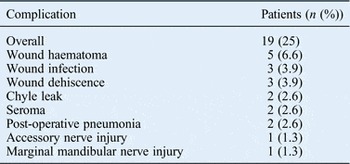
Table II shows the post-operative complications associated with post-treatment neck dissection. Nineteen patients (25 per cent) developed post-operative complications. Eight patients (10.5 per cent) required a return to the operating theatre, five for wound haematoma and three for wound dehiscence. Complication rates were not significantly associated with p16 status (p > 0.05).
Post-operative complications related to post-treatment neck dissection

Discussion
Principal results
Overall, 45 patients (59 per cent) in the present study had p16 positive oropharyngeal SCC, with a low rate of tobacco smoking and alcohol abuse. The association between p16 positive oropharyngeal SCC and negative neck dissection findings was statistically significant. Few studies have investigated the control of disease by chemoradiotherapy and neck dissection in terms of its association with p16 and HPV status.
In a recent study by Tan et al., comprising 64 similar patients, viable cancer cells were found in the neck dissection specimens of 28.3 per cent of HPV positive patients and 27.8 per cent of HPV negative patients.Reference Tan, Fakhry, Fan, Zaboli, Neuner and Zinreich19 The apparent discrepancies between the findings of that study and those of the current study may be explained by two points. First, the clinical response to the chemoradiotherapy regime used in the study by Tan et al. was not reported; thus, those patients with an incomplete clinical response may have been included in the neck dissection reports, yielding a higher proportion of positive specimens. Second, HPV status was defined using in situ hybridisation rather than p16 immunohistochemistry.Reference Tan, Fakhry, Fan, Zaboli, Neuner and Zinreich19
A retrospective study by Shoustari et al. reported overall pathological control of neck disease (n = 112) in 89 per cent of p16 positive cases and 43 per cent of p16 negative cases.Reference Shoushtari, Meeneghan, Sheng, Moskaluk, Thomas and Reibel20 Locoregional control was achieved in 93 and 71 per cent of cases respectively (of note, only 62.2 per cent of p16 positive cases and 33 per cent of p16 negative cases received concurrent chemotherapy with radiotherapy). The disease-free survival rate was 91 per cent for the p16 positive patients (median follow up of 29 months) and 63 per cent for the p16 negative patients (median follow up of 22 months).Reference Shoushtari, Meeneghan, Sheng, Moskaluk, Thomas and Reibel20
p16 status
Clinically and in terms of responses to treatment, p16 positive and p16 negative oropharyngeal SCCs appear to be very different. It is clear from the present study that p16 status plays an important role in terms of the clinical outcome of patients with oropharyngeal SCC. Based on the study findings, we believe that p16 status should be determined in all cases of oropharyngeal SCC and used in staging the disease. This may enable more informed treatment decisions.
Post-treatment neck dissection
Post-treatment (interval) neck dissection plays an important role in the management of oropharyngeal SCC. However, considering the findings of this study, one may question the role of neck dissection for p16 positive cases treated with the chemoradiotherapy regime defined previously. This study has also demonstrated important post-operative complications associated with neck dissection, which must be taken into account when treatment decisions are made. Our post-operative complication rate (25 per cent) is similar to other reports in the current literature.Reference Pellini, Mercante, Marchese, Terenzi, Sperduti and Manciocco21–Reference Hillel, Fakhry, Pai, Williams, Blanco and Zinreich23 Chemoradiotherapy is a risk factor for major wound complications given the fibrotic tissue reaction that occurs.Reference Pellini, Mercante, Marchese, Terenzi, Sperduti and Manciocco21 One might envisage a future in which we simply monitor p16 positive oropharyngeal SCC cases after a complete response to chemoradiotherapy, and reserve neck dissection for later depending on clinical demand and the patient's wishes.
Role of surveillance
In recent years, integrated PET-CT has become an extremely useful tool in the management of head and neck carcinoma for disease staging, treatment planning, early detection of recurrence and more accurate differentiation of therapeutic changes associated with residual disease compared to other imaging modalities.Reference Kim, Kim, Han, Yoo, Song and Lee24–Reference Beswick, Gooding, Johnson and Branstetter27 However, controversy exists with regards to deferring neck dissection after a complete response to chemoradiotherapy based on PET-CT evidence.Reference Agarwal, Branstetter and Johnson25 Studies have shown that PET-CT is superior to contrast-enhanced CT or magnetic resonance imaging; it has an overall accuracy of 86–91 per cent for the detection of residual disease, with a quoted sensitivity of 77 per cent, specificity ranging from 92 to 97 per cent and a negative predictive value of 92–100 per cent.Reference Agarwal, Branstetter and Johnson25, Reference Kim, Kim, Yi, Lee, Choi and Nam28 Studies have also demonstrated a greater than 90 per cent sensitivity of PET-CT for the detection and localisation of asymptomatic recurrences.Reference Agarwal, Branstetter and Johnson25, Reference Beswick, Gooding, Johnson and Branstetter27 There is also controversy regarding the timing of the first PET-CT after the completion of treatment; however, it is now generally accepted that this should be conducted between 8 and 16 weeks after treatment.Reference Kim, Kim, Han, Yoo, Song and Lee24, Reference Agarwal, Branstetter and Johnson25, Reference Beswick, Gooding, Johnson and Branstetter27
In the current study, the timing of surgery post-chemoradiotherapy (i.e. 8–12 weeks) was critical in terms of defining tissue planes and tissue fibrosis. For optimal accuracy, the PET-CT assessment should be performed three months post-chemoradiotherapy; hence, conducting PET-CT may delay surgery and make the neck dissection more difficult. Based on the senior surgeon's experience at our institution, neck dissection should be carried out within three months of chemoradiotherapy completion, in light of the fibrosis that develops. This coincides with the recommended interval for PET-CT, but should not delay a neck dissection in cases of increased uptake. Where there is clinical suspicion, a PET-CT and/or neck dissection should ideally be conducted within three months.
Our data would support no further investigation or intervention for p16 positive oropharyngeal SCC cases with the criteria and treatment regime described above; however, our numbers are limited. Thus, we recommend that cases are treated on the basis of clinical merit until more data are available. A disadvantage of PET-CT is that it can highlight other areas (e.g. in chest) which may not be representative of neoplastic disease. This can cause unnecessary anxiety for the patient and family, and the need for further investigation. For the p16 negative cases, PET-CT and/or interval neck dissection remain important. Nevertheless, according to one recent study, PET-CT surveillance appeared to be more economically favourable compared with neck dissection, and it reduced the number of unnecessary neck dissections.Reference Pryor, Porceddu, Scuffham, Whitty, Thomas and Burmeister29
Study limitations
No imaging was performed after chemoradiotherapy to determine the presence or absence of residual local or regional disease. Furthermore, assessment of the effectiveness of oncological treatment by clinical examination is often considered inadequate.Reference Agarwal, Branstetter and Johnson25 However, the objective of our study was not to evaluate the effectiveness of clinical examination or imaging methods in the assessment of residual disease. Follow-up data are currently incomplete for many patients; hence, survival analysis and disease control rates are not presented. Differentiating between viable and non-viable tumour cells on histology and with Ki67 is frequently not straightforward. Moreover, it is somewhat subjective and not a 100 per cent reliable indicator of viability. Lastly, matching the cohorts in terms of age and cancer stage might have given more validity to the results.
• p16 positive and negative oropharyngeal carcinomas appear to be oncologically distinct
• This study suggests that p16 status plays an important role in the clinical outcome of patients with oropharyngeal carcinoma
• p16 status appeared to be an independent marker of the disease control achieved by the chemoradiotherapy regime
• The findings raise questions regarding the role of post-treatment neck dissection in p16 positive cases with a ‘clinically complete response’ to chemoradiotherapy
The objective of this study was purely to evaluate the relationship between p16 status and the histopathological findings of neck dissection specimens. No HPV DNA testing (the ‘gold standard’ test) was carried out; p16 staining is much more cost effective and was readily available in our department during the study period. Given that up to 90 per cent of HPV positive SCC case specimens and less than 10 per cent of HPV negative SCC case specimens stain positive for p16,Reference Smeets, Hesselink, Speel, Haesevoets, Snijders and Pawlita15, Reference Schache, Liloglou, Risk, Filia, Jones and Sheard16 if HPV DNA sequencing was performed, some of the p16 negative cases may well have been HPV positive and therefore the result obtained could have been slightly different. However, we doubt that this would have made a significant difference. The results of this study should therefore be taken in the context of p16 immunohistochemistry findings.