Introduction
In the summer of 1916, the young Chinese scholar Hu Shi 胡適 (Hu Shih, 1891–1962), who was completing his doctoral studies at Columbia University under John Dewey and would soon become one of the leading intellectuals of China's New Culture movement, received a letter from his friend Mei Guangdi 梅光迪 (K. T. Mei, 1890–1945), who was also pursuing a PhD in literature at Harvard University. Mei disapproved of Hu's experiment with writing poems in vernacular Chinese, cautioning him against the ‘inappropriate influence’ of ‘ominous new tides of thought’ popular in Europe and America. He listed ‘Bahaism’ as one of the six religious tides (the others being Billy Sunday, Shakerism, Christian Science, Free Thought, and the Church of Social Revolution).Footnote 1 In his reply, Hu refuted Mei's concerns, stressing that those movements deserved serious investigation, as they enshrined many truths. A diligent diarist, he recorded portions of Mei's letter as well as his reply, in which he reordered Mei's list, placing the English term ‘Bahaism’ at the top, which he rendered into Chinese as ‘Persian Pantheism’ (波斯泛神教).Footnote 2
‘Bahaism’, now known as the Bahá’í Faith, enjoyed widespread publicity in the United States around the time Hu was studying there. During a tour of North America in 1912, the movement's leader ‘Abdu'l-Bahá (1844–1921) was described by the American press as a ‘Persian prophet’ who advocated world citizenship and the unity of religions, women's rights, and racial equality during widely reported lectures and talks hosted by Theosophists, socialists, Unitarians, suffragettes, black colleges, liberal Christians, and Jews.Footnote 3 Born in Tehran, ‘Abdu'l-Bahá was the eldest son of and successor to Bahá’u'lláh (1817–1892), the founder of the Bahá’í Faith, which emerged out of the Bábi millenarian movement. This movement had convulsed Iran in the mid-nineteenth century by challenging the authority of the country's Shi'a orthodoxy and proclaiming the inauguration of an independent religious dispensation. As elaborated in Bahá’u'lláh's writings and explicated by his son during his overseas travels, the new teachings included the common origin and purpose of all religions; the oneness of humanity; the abolition of religious, racial, and ethnic prejudice and violence; the equality of women and men; harmony between science and religion; the independent search for truth; the abolition of ecclesiastical authority; and advancing towards a new civilization that would lead to a world commonwealth and the ‘Most Great Peace’.Footnote 4
Although Hu Shi did not discuss ‘Bahaism’ in detail, he may have found resonance between his own beliefs and the pivotal Bahá'í principle of the ‘oneness of mankind’. As president of the Cornell Cosmopolitan Club (1914) and a leading member of Association of Cosmopolitan Clubs in the United States, he was a strong advocate of the clubs’ shared ideal that ‘above all nations is humanity’.Footnote 5 In his writings, he translated ‘cosmopolitanism’ into datong zhuyi 大同主義, using the term datong—the ‘Great Oneness’ or ‘Great Unity’ evoked in the ancient Book of Rites (禮記). From the late nineteenth century, for Chinese intellectuals and reformers, this concept had symbolized ideals of world peace and unity, and a cosmopolitanism rooted in the deep values of ancient Chinese civilization.Footnote 6
Although it is likely that it was in the United States that Hu Shi heard of the Bahá’í Faith, during the same period the movement was also becoming known among intellectuals and society leaders in China itself. Over the next two decades, many leading thinkers, politicians, and military leaders in Republican China learned about and sympathized with the Bahá’í teachings. These came to be known as Datong jiao, the ‘teachings of the Great Oneness’—or, to reverse Hu Shi's translation, the ‘teachings of Cosmopolitanism’. In fact, with the possible exception of Iran, in no other country of the world was the Bahá’í Faith as well-known among a nation's elite—but, while the new faith was viewed as a heresy in the country of its birth,Footnote 7 its reception in China was, on the whole, quite positive.
By tracing the individuals, connections, and events through which knowledge of the Bahá’í Faith spread in China in the early decades of the twentieth century, our study reveals an interconnected web of networks—intellectual reformers, liberal Christians, Esperantists, Confucian modernizers, redemptive society activists, and socialists—that shared overlapping cosmopolitan ideals. The Bahá’í connections thus serve as a thread that reveals the influence of cosmopolitan thought and networks in Republican China, hitherto largely ignored in the scholarly literature on this period, which has focused primarily on the growth of modern Chinese nationalism.Footnote 8 While some recent edited collections have examined cosmopolitan ideas during this period from the perspectives of Chinese intellectual and literary history,Footnote 9 we focus here on the spread and overlapping of social networks, forming what we call a ‘cosmopolitan nexus’. Prasenjit Duara's work has previously discussed some of these networks, but, while his research has led him to focus primarily on those intellectuals and movements that were pan-Asian in orientation,Footnote 10 our case sheds light on the cosmopolitan affinities and connections between those groups and movements that began in the West such as liberal Christianity and Esperantism, as well as the Bahá’í Faith as a movement originating in the Middle East.
A cosmopolitan moment in colonial modernity
Cosmopolitanism as a normative ideal, as an intellectual tradition, as a theoretical framework, and as a subjective condition has been the subject of renewed intellectual and academic debates over the past two decades.Footnote 11 In the context of these discussions, sociologists and anthropologists have advocated looking beyond cosmopolitanism as an abstract political philosophy to examine empirically existing forms of cosmopolitanism; to break out of a Eurocentric genealogy and conceptualization of the cosmopolitan; and to follow the transformations of cosmopolitan thought and social forms within specific historical periods and contexts.Footnote 12 The case presented here is one of the cosmopolitanismsFootnote 13 that were transnational, Asian-focused, often religious, and grounded in non-state social organizations and networks.
Conventional accounts of the history of cosmopolitanism place its origins in the thought of the Greek Cynics and Stoics; its modern development in European Enlightenment thought, exemplified by Kant; its decline with the rise of nationalism in the late nineteenth century; and its renewed relevance following the Second World War, the establishment of the United Nations, and the emergence of institutions of global governance.Footnote 14 Challenging this narrative of the ups and downs of a political cosmopolitanism closely tied to Western universalism, recent contributions have explored non-Western traditions of cosmopolitan thought, as well as the social reality of cosmopolitan subjectivities fostered by transnational networks and migratory flows in the contemporary period.Footnote 15
This literature has stressed the distinction between ‘philosophical cosmopolitanism’ and ‘empirical-analytical cosmopolitanism’. The latter is typically described as unintentional and even passive; in so doing, however, this approach has ignored social movements and organizations that consciously advocate, propagate, and attempt to realize a cosmopolitan utopia.Footnote 16 Here, in contrast, we focus on such groups and on their overlaps and interconnections. We refer to this interlinked network of groups as a ‘cosmopolitan nexus’, alluding not only to the fact that they were made up of often well-travelled people with a cosmopolitan outlook on the world, but to their conscious pursuit of an explicitly cosmopolitan social and even religious ideal. This article focuses on China, but it reveals that the cosmopolitan nexus was a transnational one, with the same networks of Bahá’ís, liberal Christians, Theosophists, Esperantists, socialists, colonial intellectuals, and modernizers of tradition criss-crossing and overlapping in places as varied as Shanghai, Tokyo, Calcutta, London, Paris, Budapest, and New York.
Many authors have stressed how modern cosmopolitanism is in many ways a product of the colonial experience, in which the formation of colonial empires led to sustained cross-cultural encounters that facilitated the emergence of a global consciousness among both the colonizers and the colonized, and to the rise of elites, both European and colonial, whose world travels fostered a cosmopolitan subjectivity. The ideological and social structuring of this consciousness and subjectivity thus bore the imprint of the colonial or imperial frame. Nonetheless, as argued by van der Veer, transnational religious movements in colonial contexts can be cosmopolitan in a different way to the secularism of Western colonialism.Footnote 17
While many of the Chinese intellectuals who appear in this study, such as Hu Shi, Lu Xun, and Cai Yuanpei, are known today as Westernizing modernizers and secularists, our case, nonetheless, challenges conventional narratives of cosmopolitanism: what we find here, with the Bahá’ís, is a religious cosmopolitanism that originated in Iran and whose spread to China can be traced to links with the Ottoman empire, British Palestine, the United States, and Japan. Emerging in an Islamic context, it had as many affinities with Confucianism as with Western modernism.Footnote 18 It connected with exponents of a strand of Chinese thinking that could claim a cosmopolitan pedigree at least as ancient as the Greek origins of its Western counterpart, and which was actively discussed and pursued among intellectuals and political reformers.Footnote 19 Rather than an abstract philosophy of peace, the Bahá’í cosmopolitanism studied here was a belief system grounded in theological concepts, a community with emerging forms of practice, and an international organization that linked up with other organized cosmopolitan networks.Footnote 20
This article thus sheds light on cosmopolitanism in China during a crucial period in the early decades of the twentieth century. Contrary to the perception that ‘from the end of the nineteenth century to the middle of the twentieth century the national imagination for the greater part prevailed over the cosmopolitan imagination’,Footnote 21 we show how pervasive the cosmopolitan imagination was among Chinese elites during this period. Many of those who appear in our narrative are also among the founding figures of Chinese nationalism. During this ‘cosmopolitan moment’ in China's modern history,Footnote 22 constructing the Chinese nation was imagined as a necessary stepping stone towards establishing an ideal cosmopolitan community; conversely, cosmopolitan ideals framed the mental space within which the nation could be imagined.Footnote 23
Reformist intellectuals, Gilbert Reid, and ‘spiritual Esperanto’
The political disorder that ensued after the fall of the Qing dynasty in 1911 gave rise to the New Culture Movement, an intellectual campaign advocating the rejection of traditional Confucian values and the embrace of Western modernism.Footnote 24 One of its key leaders was the aforementioned Hu Shi, who returned to China in early 1917.Footnote 25 It was against this background that the first reports on the Bahá'í movement appeared in newspapers, journals, and public talks.Footnote 26 As early as 1911, the Hong Kong-based South China Morning Post reported on ‘Abdu'l-Bahá’s imminent visit to Europe. It highlighted the rapidity of the spread of the Bahá’í Faith, stating ‘now a third of the Persian people are converts’ and ‘there are many believers in Egypt, India, the United States, France, and England’.Footnote 27 Quoting Rev. R. J. Campbell (1867–1956), the editor of the London weekly Christian Commonwealth—the radical Christian mouthpiece of the ‘New Theology’, which published frequent articles on the Bahá’í Faith, Theosophy, Oriental religions, and progressive social movements—the report likened the Bahá’í Faith to a ‘spiritual Esperanto’ that seeks ‘to demonstrate the fundamental unity of all religions’.Footnote 28
It was the American Presbyterian missionary Gilbert Reid (known in Chinese as Li Jiabai 李佳白, 1857–1927), however, who played a pivotal role in introducing the Bahá’í Faith to Chinese intellectuals in the 1910s. Reid had started his four-decade-long career in China in 1882. Although he started his mission among the rural poor in Shandong, he observed that the root of opposition to Christianity came from the elite and, during a furlough back to the United States in 1892, he sought support for the establishment of a Mission among the Higher Classes in China (MHCC), which would aim not to proselytize, but to build friendships. The proposal was rejected by his leaders, and he resigned from the Presbyterian Church, continuing his work as an independent.Footnote 29 Reid also attended the World's Parliament of Religions in Chicago in 1893, returning to Beijing imbued with the spirit of this interfaith congress.
Reid established the International Institute of China (Shangxian tang 尚賢堂), which was officially incorporated in 1897.Footnote 30 Its aim was to ‘advance the cause of international harmony and good-will, and the cause of truth and righteousness, with special reference to the welfare of China’.Footnote 31 Reid and the Institute played an important role in promoting modernizing reforms as a means to strengthen China against foreign encroachment.Footnote 32 They received recognition and support from many Chinese officials and intellectuals, including the leading reformers Liang Qichao 梁啟超 (1872–1929) and his teacher Kang Youwei 康有為 (1858–1927). The former wrote an introductory account of the Institute, praising its lofty, fraternal aspirations,Footnote 33 while the latter, a daring utopian thinker, developed his own vision of the future unification of ‘nations, races and religions’ and eventually wrote his celebrated Datong shu 大同書 or Book of Great Unity.Footnote 34
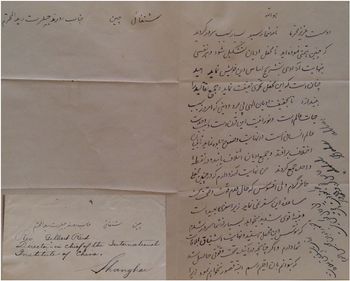
Due to the unstable situation in Beijing following the Boxer Rebellion, Reid moved his Institute to Shanghai, where in 1914 he secured official recognition from the new Republic.Footnote 35 One of the Institute's core activities was to organize seminars, at which lectures were delivered on various faiths. In 1914, Reid gave a talk in English on the ‘Benefits of the Bahá'í Movement’, the transcript of which appeared in the Shanghai Times.Footnote 36 He concluded his talk by reading out the English translation of a letter from ‘Abdu'l-Bahá (see Figure 1), to whom he had written inviting him to attend a ‘Congress of Religions’, modelled on the Parliament of Religions, that he proposed to hold in Shanghai.Footnote 37 ‘Abdu'l-Bahá showed great appreciation of Reid's ‘lofty exertion’, but regretted that he did not have the strength to make the long journey.Footnote 38
‘Abdu'l-Bahá’s original letter in Persian to Gilbert Reid. Source: Courtesy of Hamilton College Archives, United States.

The Chinese version of Reid's talk was also published in the popular Dongfang zazhi 東方雜誌 (Eastern Miscellany).Footnote 39 Included in the same issue of the journal was another article on the Bahá'í movement by Reid's friend Du Yaquan 杜亞泉 (1873–1933), the journal's chief editor. An important thinker, Du was one of the protagonists of the far-reaching debate on Eastern-Western cultures in the late 1910s, arguing for the complementarity of Western science and Chinese tradition. His chief opponent was Chen Duxiu 陳獨秀 (1879–1942), future co-founder of the Chinese Communist Party.Footnote 40 While appreciating the value of Western science, Du lamented the fact that the primacy of religion in Western culture had been dethroned by the rise of materialism, social Darwinism, and militarism.Footnote 41 Du spoke highly of the Bahá'í vision to ‘trace all religions to […] one single Divine source’. He commented that the Bahá'í teachings on unity and peace met both the needs of the times and the tradition of the Chinese people, who, unlike peoples in other lands, carried no religious ‘burden’ from history. He predicted that it would be only a matter of time before the movement became widely promulgated and established in the world.Footnote 42 Three years later, as the First World War drew to an end, Du again cited the Bahá’í Faith as an exemplar of unity in his discussion on the conciliation of various conflicting ‘isms’.Footnote 43
This first phase of Bahá’í connections in China exemplifies the rise of a trans-religious, cosmopolitan spirituality in the context of imperial and colonial modernity. Religious circulations between the Christian West and the domains of the ‘Orient’ led many to a search for a common essence between different traditions and to a distancing from or rupture with orthodox religious institutions. For liberal Christians such as Gilbert Reid, this approach had begun with the purpose of smoothing the way to the conversion of the Chinese to Christianity; however, his enthusiasm for promoting interfaith harmony led his original American patrons to suspect his commitment to his own faith. On the other hand, as in India, some Chinese intellectuals such as Du Yaquan sought an alternative modernity to Western imperialism and materialism. But, as has been shown by Peter van der Veer, this universalizing modern spirituality could also serve to underpin notions of national essence in the context of anti-colonial nationalism.Footnote 44
The Pan-Asiatic League and the first Chinese Bahá’í
The first recorded Chinese Bahá'í was Chen Hai An (Harold A. Chen), who embraced the Faith in mid-1916 while still a student at the University of Chicago. The introduction came through Zia Bagdadi, then associate editor of the Bahá'í journal Star of the West.Footnote 45 Chen was so enthusiastic about his ‘newly-gained gospel’ that he desired to spread it ‘among three thousand students’ at his university.Footnote 46 Inspired by Pan-Germanism, Pan-Slavism, Pan-Latinism, and Pan-Americanism as well as by Bahá’í ideals, Chen played a key role in the creation of the Pan-Asiatic League based at the University of Chicago. Possessed of the belief that ‘Asia is One’, the League aimed ‘to study the several civilizations represented in the League [India, China, Japan, the Philippines, Persia, and Turkey] … to bring about a unity among the peoples in Asia’.Footnote 47 Chen was elected its president, and his Bahá’í teacher Zia Bagdadi, the treasurer.Footnote 48 Like Hu Shi at Cornell, Chen was also involved in the University's Cosmopolitan Club.Footnote 49 After he completed his Master's degree at Chicago in June 1916,Footnote 50 Chen went on to study law at Columbia University (where Hu Shi was now studying). Meanwhile, he developed a strong desire to travel to Palestine and visit ‘Abdu'l-Bahá ‘for spiritual food’.Footnote 51 Records show that he had received a letter from ‘Abdu'l-Bahá, but there is no evidence that he made the trip.Footnote 52
Chen was eager to carry his ‘Gospel’ back to China. On the eve of his return at the end of 1916, he wrote to his American friends that he would meet ‘Mr. Bahi’, a Persian Bahá'í in Shanghai, and they would ‘try to establish a Chinese Bahá’í assembly there’.Footnote 53 Chen, who worked at the Chinese-American News Agency based in Shanghai,Footnote 54 was very likely to have helped with the production of what was probably the first Bahá'í publication in Chinese in 1917.Footnote 55 The pamphlet, entitled Baha zhi jianyi 巴哈之建議 or ‘The Bahá’í Proposal’, gave a brief account of Bahá’u'lláh and his teachings, highlighting that his aim was ‘to unite all religions in oneness of God, and all nations as one family’. It added that Bahá’u'lláh's teachings embrace the doctrines of Judaism, Islam, Zoroastrianism, Protestantism, Catholicism, Hinduism, and Confucianism, and shared the ideas expressed in ethics, philosophy, mysticism, and even socialism. It stated that the Bahá’í goal was to achieve the ‘economic, social and spiritual unity of the world of humanity’. It quoted extensively from the writings of Bahá’u'lláh and ‘Abdu'l-Bahá, thus marking the beginning of Chinese translation of Bahá’í scriptures.Footnote 56
Hai An Chen's letter to ‘My dear Earnest’ dated 4 May 1916, penned on a pre-printed letterheaded paper of his newly established Pan-Asiatic League. Source: Courtesy of the US National Bahá’í Archives.

In 1919, ‘Abdu'l-Bahá addressed a letter from Haifa to a certain Chen Ting Mo in Shanghai, who was probably the same person as the aforementioned Chen Hai An.Footnote 57 As there was no postal arrangement between China and Palestine, the letter was sent via the prominent early American Bahá’í Roy Wilhelm (1875–1951). Based in New York, Chen had become acquainted with him while studying in the United States. In the letter ‘Abdu'l-Bahá praised Chen's teaching efforts in China, exhorted him to ‘consolidate the assembly thou hast established at Shanghai’, and to make efforts to institute another one at Peking; he also asked Chen to convey his love and kindness to two new Chinese believers.Footnote 58 Clearly Chen was a very active Bahá'í in China, and he would continue to carry out activities well into the early 1920s, as can be inferred from the fact that the police of the Shanghai International Settlement investigated his ‘Bahá'í Movement Esperanto’.Footnote 59
The Japanese connection and the Esperanto movement
There were, indeed, deep affinities and connections between Bahá’ís and Esperantists.Footnote 60 After its invention in 1887 by the Polish-Jewish ophthalmologist Ludwik Zamenhof (1859–1917), Esperanto soon spread beyond Russia and Eastern Europe to many countries in Western Europe, the Americas, and Asia.Footnote 61 Its ideal chimed well with the Bahá’í teaching on the necessity of an international auxiliary language. Although he did not endorse Esperanto as the future lingua franca envisioned in the Bahá’í scriptures, ‘Abdu'l-Bahá encouraged Bahá’ís to study and spread it.Footnote 62 Similarly, Zamenhof expressed his admiration for the Bahá’í cause, and his daughter, Lidia, would become an active Bahá'í herself, translating Bahá’í literature into Esperanto and Polish.Footnote 63 The interactions between the Bahá’ís and Esperantists, as we show below, were also strong in China and Japan, where Esperanto had been most widely disseminated (outside Europe and the Americas).Footnote 64
Chen Hai An's adoption of the Bahá’í Faith had occurred simultaneously with his involvement in the aforementioned Pan-Asiatic League, which evokes the doctrine of Pan-Asianism. This Japanese-led cosmopolitan movement advocated Asian unity in the face of Western imperialism and would eventually be co-opted by Japanese imperialism.Footnote 65 But in Japan itself, it was the Esperanto movement that provided the soil for the spread of the Bahá’í Faith—and from there into China. The key catalyst was the Bahá’í teacher Agnes Alexander (1875–1971), an American born into a Hawaiian Christian missionary family, who moved to Japan in 1914 and helped establish the Japanese Bahá’í community. A self-taught Esperantist, she became an advocate of the language in Japan and used it to spread the Bahá’í message.Footnote 66
Indeed, at that time the Esperanto Movement enjoyed favour in Japan, where it had attracted an increasing number of followers.Footnote 67 Among those drawn to the Bahá’í teachings was the Russian Esperantist and story-writer Vasili Eroshenko (1890–1952), who taught Esperanto to the blind in Tokyo.Footnote 68 He helped Alexander with her teaching and with the translation into Esperanto of Hidden Words, a popular collection of short moral exhortations by Bahá’u'lláh. ‘It was through his [Eroshenko's] effort,’ Alexander wrote, ‘that I had the joy of sharing the Bahá’í Message with the blind of Japan.’Footnote 69 After the 1917 Russian Revolution, however, Eroshenko became pro-communist. Not only did he begin to distance himself from the Bahá’í movement, but he also urged the Esperanto movement in Japan to move away from its Bahá’í leanings.Footnote 70 He was arrested as a result of his active participation in socialist protests in Japan and was eventually deported in 1921 after charges were brought of a Soviet conspiracy allegedly in connection with the Bahá’í movement.Footnote 71 He then made his way to China, where he was warmly received by his fellow Chinese Esperantists. While in Beijing, he was befriended and accommodated by Lu Xun 鲁迅 (1881–1936) and his brother Zhou Zuoren 周作人 (1885–1967), both renowned writers and supporters of Esperanto who had also studied in Japan. Zhou Zuoren seems to have known about the Bahá’í Faith: in his 1919 discussion of the Japanese ‘New Village’ (Atarashiki-mura 新村), he quoted Bahá’u'lláh as saying that ‘Association is always conducive to union and harmony.’Footnote 72 The New Village was a quasi-socialistic utopian commune established by the Japanese novelist and philosopher Saneatsu Mushanokoji (武者小路実篤, 1885–1976), whose humanitarian philosophy was inspired by Leo Tolstoy (1828–1910), who himself showed deep appreciation of the Bahá’í Faith in his later years.Footnote 73 On the recommendation of the Zhou brothers, Eroshenko was invited to teach Esperanto at Peking University. A collection of his children's stories was translated into Chinese by Lu Xun, and Eroshenko became famous in China as ‘the blind poet and writer from Russia’.Footnote 74
Martha Root and the Chinese Esperantists
In October 1923 Agnes Alexander was joined by Martha Root, another American woman, who played a pivotal role in proclaiming the Faith in China. A journalist based in Pittsburgh, Root had become a Bahá’í in 1909 after being introduced to the Faith by the aforementioned Roy Wilhelm. Eventually, she made it her life's work to undertake lengthy tours around the world to promote the Bahá’í Faith, giving talks, writing articles, distributing Bahá’í literature, and contacting educators, scholars, government officials, and other groups such as Theosophists, Esperantists, and followers of various spiritual traditions.Footnote 75
Root had longed to visit China ever since she read what later came to be known as the ‘China Tablet’, a famous passage on China by ‘Abdu'l-Bahá published in 1917. Although at that time China was considered by Westerners to be among the feeblest and most helpless nations, ‘Abdu'l-Bahá affirmed the great potential of the Chinese people and praised their spiritual qualities and traditions. ‘China, China, China, China-ward the Cause of Bahá’u'lláh must march!’ he wrote, calling for the ‘right kind’ of Bahá’í teachers to go China, characterizing it as ‘the country of the future’. He stressed that the Bahá’í teacher of the Chinese people ‘must first be imbued with their spirit, know their sacred literature, study their national customs and speak to them from their own stand-point, and their own terminologies’.Footnote 76
Root eventually arrived in Beijing in April 1923, following a brief visit to Japan where she had been suspected by the Tokyo police of spreading some ‘communist-like’ doctrine.Footnote 77 At that time, the Republic of China (ROC) was still dominated by regional warlords, with its presidency changing hands frequently. Working as a journalist in this complex political context, Root nevertheless adhered to the Bahá’í principle of non-involvement in politics and declined the request of her new employer, the Asiatic News Agency, to write political commentaries.Footnote 78 During her stay in Beijing, her schedule was filled with Chinese lessons, making new contacts, giving talks, and writing articles.Footnote 79 She called on people of rank to speak about the Faith, among them the head of the largest local mosque, an adviser to President Li Yuanhong 黎元洪, and the president of Tsinghua University, Cao Yunxiang 曹雲祥 (1881–1937), as discussed below.Footnote 80
Similarly to her visits to many other countries, Martha Root reached out to Chinese Esperantists. Her proficiency in Esperanto had proved to be very helpful during her time in Brazil (1919), Panama (1919), Canada (1920), and Japan (1923).Footnote 81 Esperanto was first introduced into China in the late nineteenth and early twentieth centuries, and by the 1910s, it had spread widely. Not only was it made an optional course for teachers’ colleges, but Esperanto groups, schools, and clubs mushroomed in many cities. By the time Root arrived in China, Esperanto-related associations or societies had been established in dozens of cities, including Shanghai, Beijing, Guangzhou, and Hankou. A large number of literary and intellectual leaders, such as Ba Jin 巴金 (1904–2005), Qian Xuantong 錢玄同 (1887–1939), and Hu Yuzhi 胡愈之 (1896–1986), were its enthusiastic advocates.Footnote 82 The cosmopolitan ideal underlying the language was inspirational to Chinese Esperantists, who regarded it as a means of fostering equality and amity among nations.Footnote 83 Esperanto was more than a language in China: it was also a movement strongly linked to Chinese anarchism and later to communism.Footnote 84
Root did not arrive early enough to meet Alexander's old friend Eroshenko, who had just left Beijing for the Soviet Union; nevertheless, she found another way to associate with the Esperantists in the capital. In Autumn 1923, she obtained a teaching job at the newly established Peking Esperanto College (Pekina Esperanta Kolegio). Its founding president was Cai Yuanpei 蔡元培 (1898–1940), then president of Peking University. Among her colleagues was Lu Xun; his brother Zhou Zuoren had been elected president of the Beijing Esperanto Society the previous year. Given such connections, Root undoubtedly associated with them. She also spoke of the Bahá’í cause to the students, some of whom corresponded with ‘Abdu'l-Bahá’s grandson, Shoghi Effendi Rabbani (1897–1957), known as the Guardian of the Bahá’í Faith, then residing in Palestine.Footnote 85 It was customary for Root to promote Esperanto and the Bahá’í movement simultaneously. This was shown in the title of one of her later talks ‘Esperanto and the Bahá’í Movement’, in which she presented Bahá’í principles for the ‘bringing together of all peoples [and] of all religions’.Footnote 86 As will be seen later, she would continue to make contact with Esperantists in other Chinese cities she visited.
The Christian general and the communists
One of Alexander's Chinese friends was Bao Shijie 包世傑 (1891–1938), whom she had introduced to the new faith in 1920. Bao was an important figure in Shanghai's political, religious, cultural, and even commercial circles. He had played a role in the merging of five parties into the Nationalist Party (國民黨) to contest the first national elections at the outset of the ROC in 1912. A Christian, he was a key member of the Beijing Society for Religious Freedom (北京信教自由會) and a leading member of the Shanghai Christian Association for National Salvation (上海基督教救國會).Footnote 87 After his return to Shanghai, he had an article on the Bahá’í Faith translated for a local newspaper, which, in all likelihood, was a 1922 article entitled ‘The Great Movement to Unite all Religions’ published in the time-honoured Shen Bao 申報 or Shanghai News.Footnote 88
By 1923, Bao was working as secretary and diplomatic representative of Feng Yuxiang 馮玉祥 (1882–1948), the famous ‘Christian general’. It was reported that most of the general's officers professed to be Christians and almost half of his soldiers were baptized.Footnote 89 Feng paid great attention to the education of his men's children through a school for the sons of military officers. With Bao's permission, Root and Alexander spoke at the school and gave every student a copy of a Chinese Bahá’í booklet (which Alexander and Root had arranged to be translated into Chinese by a Chinese student studying in Japan) in the hope that they would become ‘torch bearers of the Message of Bahá'u'lláh to General Feng's army of 10,000 men’.Footnote 90 Lieutenant K. Tsiang, who had learned about the Faith from Alexander during his visit to Japan, also invited the two Bahá’í teachers to speak to the pilots at his aviation training school.Footnote 91 Prior to their departure from the capital, Root and Alexander also held the first Bahá’í Feast in Beijing on 4 November 1923, which represented a small but significant step towards achieving Root's dream of developing the nucleus of a Bahá’í community in Beijing.Footnote 92
Root and Alexander also met and conversed with Gilbert Reid.Footnote 93 As a strong pacifist, Reid had been forced to leave China in 1917 for expressing his opposition to the United States’ and China's entry into the First World War. After his return to China three years later, he revived the activities of the International Institute and started a weekly newsletter, the International Journal (國際公報). He published a report on Root and the Bahá’í movement in his journal,Footnote 94 which was followed by another article on the need to use the spirit of religion to renew the corrupted world, warning that failure to do so would result in a second world war.Footnote 95 His efforts to promote religious harmony were widely recognized, as was demonstrated by his election as honorary president of the short-lived Association for the Unity of World Religions (世界宗教大同會), which included Confucianism, Daoism, Buddhism, Judaism, Christianity, and Islam, established and officially approved in Beijing in early 1923.Footnote 96
The educator Deng Jiemin 鄧潔民 (1890–1926) was also deeply attracted to the Bahá’í Faith through Root and Alexander and made sincere efforts to grasp its import.Footnote 97 Pro-communist, Deng was a close friend of such founding members of the Communist Party of China as Li Dazhao 李大釗 (1888–1927) and Zhou Enlai 周恩來 (1898–1976);Footnote 98 he was also a convert to Christianity who had established his own church that advocated independence from foreign missionary organizations.Footnote 99 Root believed that Deng had converted to the Bahá’í Faith, for she reported in March 1924 that he continued holding Bahá’í feasts after she left Beijing.Footnote 100 English sources reported that he had established a ‘Bahá’í College’ in Beijing in early 1924.Footnote 101 There are no Chinese records of such a ‘Bahá’í College’—however, Deng did establish the Guoji daxue 國際大學 (International University) in early 1924, with the sponsorship of General Feng.Footnote 102 The name conveyed the intention to model it on Rabindranath Tagore's International University, which was widely reported on in China.Footnote 103 Its charter stated its aim to ‘promote inter-cultural communication and advance international fellowship’, with ‘unity of mankind’ and ‘peace of the world’ as its highest ideals.Footnote 104 The university only functioned for about a year before it was forced to close by General Feng's political opponents, on the pretext that it was promoting communism (赤化). Soon afterwards Deng joined the indigenous and nationalist True Jesus Church (真耶稣教会), to which he handed over his own church; he died of cancer in 1926.Footnote 105
Confucians, Theosophists, and redemptive societies
The case of Deng Jiemin and the International University exemplifies Bahá’í sympathies and connections among nationalist Christians with pro-communist sympathies, as well as communists themselves. Indeed, during those times, Bahá’ís were often suspected by the authorities of being communists, as shown by the police investigations in Shanghai and Japan mentioned above (and as would be the case in the 1960s in Taiwan).Footnote 106
At the same time, Root and Alexander actively sought out advocates of Asian spiritualities, be they Confucians, redemptive societies, or Theosophists. During their journey from Beijing to Shanghai, they stopped at Tianjin, Jinan, Qufu, Xuzhou, Nanjing, and Suzhou, giving talks at schools and distributing the Chinese Bahá’í booklet. In Jinan, for example, they spoke at Shandong Christian College and made a special visit to Qufu, the birthplace of Confucius, where they met ‘the little descendent of Confucius, a boy of five years’.Footnote 107 This is very likely to have been Kong Decheng 孔德成 (1920–2008), the seventy-seventh generation descendant of Confucius in the direct line. Shortly after his birth, he was appointed Duke Yansheng 衍聖公 by the Beijing government in accordance with the imperial tradition, a title bestowed on the eldest male in the main line of descent in each generation.Footnote 108 They also visited and spoke at the Third Women's Normal College in Xuzhou, at the invitation of its principal, Miss Qian Yonghe 錢用和 (1897–1990), whom Alexander had befriended in Japan.Footnote 109 Miss Qian later studied at Columbia University and, after her return to China, served as the long-term English secretary to Soong Mei-ling 宋美龄 (Madame Chiang Kai-shek, 1898–2003).
When they finally reached Shanghai, Alexander sailed for Japan, while Root remained there for over two months. Never at rest, she continued to search for opportunities as a journalist and a public speaker.Footnote 110 Her articles on the Bahá’í Faith in turn brought her opportunities to give talks to different audiences. She was invited to speak at the Shanghai College of Commerce (上海商科大學) by its president, Guo Bingwen 郭秉文 (Kuo Ping-Wen, 1880–1969), a prominent Chinese educator who had studied at Columbia University under John Dewey.Footnote 111 Esperantists in Shanghai were among the first to hold a gathering to welcome Root—‘the instructor from Peking Esperanto College who came to Shanghai to promote the Bahá’í Religion’.Footnote 112
Root also befriended the Theosophists in Shanghai. ‘The head of the Theosophical Society invited me to dinner on Thursday evening,’ Root wrote to her American friends on 11 January 1924, ‘and we talked for three hours.’Footnote 113 Outside of Shanghai, there was also a branch of the Theosophical Society in inland Hankou, which Root would soon visit.
Initially founded in New York in 1875, the Theosophical Society had established its international headquarters at Adyar, India, and within half a century, branches had appeared in many countries in the Americas, Europe, and Asia.Footnote 114 Before coming to China, Root had already shared the Bahá’í principles with Theosophists in countries such as Burma (1915), Brazil (1915), Argentina (1915), Chile (1915), Canada (1920), and Japan (1923).Footnote 115 At that time, there were already two branches of the Theosophical Society in Shanghai. The Saturn Lodge was set up in 1920 by Western residents. Spurgeon Medhurst, a Baptist missionary, translator of the Daodejing 道德經 and pioneer of Theosophy in China, observed in 1921 that China had ‘turned her back on her saints’ and that Theosophy was the ‘only disinfectant’ that could check the ‘spreading virus’ of materialism and irreligion in China.Footnote 116 The Sun Lodge was established in 1922 by Chinese Theosophists, with the prominent diplomat Wu Tingfang 伍廷芳 (1842–1922) posthumously elected honorary president. Wu and his fellow Theosophists held the opinion that only Theosophy could unite the ‘three religions’ of China, and the propagation of its teachings and ideals would help China to take its rightful place among the nations.Footnote 117 In the late 1910s, while serving as minister of foreign affairs and briefly as acting premier of the Republic of China, Wu started to promote Theosophy in China through giving talks (including at Gilbert Reid's International Institute of China in 1916) and translating theosophical texts by Annie Besant.Footnote 118 During two trips to China in 1914 and 1922, the French lawyer and Orientalist Hippolyte Dreyfus-Barney (1873–1928), who was the first French Bahá’í, and his wife, the American philanthropist Laura Clifford Dreyfus-Barney (1879–1974)—both of whom had played instrumental roles in organizing ‘Abdu'l-Bahá’s visits to Europe and North America—met with Wu Tingfang. She wrote in her memoir that ‘we found him as always a fervent Theosophist and interested in Bahaism’.Footnote 119
Root's newspaper articles also drew interest from several members of the Confucian Association (孔教會), who called upon her and tried to arrange for her to meet their leader, saying he had read the Chinese Bahá’í booklet.Footnote 120 The Confucian Association was founded in 1912 chiefly through the efforts of the American-educated Chen Huanzhang 陳煥章 (1881–1933) under the guidance of his teacher Kang Youwei. It was based on Kang's reinterpretation of Confucianism as a religion of Confucius or Kongjiao 孔教. To Kang, Kongjiao was a lost religion originally founded by Confucius; now restored by him, it would, with the assistance of Buddhism, lead the Chinese people and all humanity to achieve the Utopian Commonwealth of the Great Oneness (datong).Footnote 121
In addition to Confucians, Root corresponded with Hou Sushuang 侯素爽 (1871–1942), a former official of the Qing court and later a key member of the Daoyuan (道院), a major redemptive society that flourished in the 1920s and which established a nationwide charity organization, the Red Swastika Society (紅卍字會).Footnote 122 Hou was undoubtedly a friend of Gilbert Reid, who had played an important role in facilitating the formal registration of the Daoyuan in Beijing; Reid was also the honorary president of a similar redemptive society, the Wanguo daodehui 萬國道德會, which was closely aligned with the Confucian Association and presented itself in English as the World Ethical Society.Footnote 123 Redemptive societies, which grew out of the Chinese salvationist and spirit-writing traditions, used modern associational forms to promote a Chinese-centred ethical culture and spiritual universalism, combining the Five Teachings of Confucianism, Daoism, Buddhism, Christianity, and Islam to usher in the datong era of the Great Commonwealth. Root reported that Hou studied the Bahá’í teachings most passionately and had passages from the Bahá’í writings published in Zhebao 哲報, one of the two major journals run by the Daoyuan.Footnote 124
In March 1924 Root left for Hong Kong, where she met Rabindranath Tagore (1861–1941), who had stopped there on his way to Beijing. Tagore had met ‘Abdu'l-Bahá in America in 1912 and was deeply impressed by the Bahá’í teachings.Footnote 125 One of the questions he asked Root on the first day of his arrival was: ‘How is the Bahá’í Cause progressing?’Footnote 126 In a few weeks, he would journey northwards and visit Tsinghua University, whose president, Cao Yunxiang, had been confirmed in the Bahá’í Faith through Root.
Cao Yunxiang, Tsinghua University, and the YMCA
Cao Yunxiang was born into a prominent Christian family. After graduating from St John's College in Shanghai, he went to Yale University for graduate studies and then to Harvard Business School, where he earned an MBA in 1914, the first Chinese to do so. In fact, Cao had already met Hu Shi and Gilbert Reid in 1911, when all three attended and spoke on China's religious question at a Christian summer school.Footnote 127 After his return to China, he acted as a diplomat to the United Kingdom and Denmark for the Beijing government, during which time he married Elin Halling, a Swedish American who was a member of the Theosophical Society.Footnote 128 In 1922, Cao was appointed president of Tsinghua (the American Indemnity College); during his six-year tenure, he upgraded the college into the fully fledged university which would go on to become China's most prestigious institution of higher education.Footnote 129
Cao may have learned about the Bahá’í Faith while studying or working abroad. It was through Martha Root, however, that he and his wife became ‘confirmed’ in the Faith in late 1923.Footnote 130 From that time on, he seemed to ally himself with the Bahá’í Faith both in his writing and in speeches. According to one of his Yale classmates who knew him very well, Cao ‘writes that politically he is a free lance and in regard to church affiliation he is a member of the Bahá’í movement’.Footnote 131 His latest biographer, Cai Degui, has pointed out that Bahá’í principles were manifested in Cao's talks and work at the university.Footnote 132 One of his acclaimed reforms was setting up the Academy of Sinology (國學院) at Tsinghua, for which he had, on the recommendation of Hu Shi, invited four leading scholars to be mentors (Liang Qichao, Wang Guowei 王國維, Chen Yinke 陳寅恪, and Zhao Yuanren 趙元任). Cao's advocacy of his new faith went beyond the campus. To a liberal Christian congregation, for example, he gave a well-received speech on ‘The Unity of Civilization and the Universality of Religion’, concluding it with reference to the 12 Bahá’í principles.Footnote 133 In his talk, he argued that not only had most great religions always claimed to be universal, but the first two decades of the twentieth century also witnessed religious and philosophical thinkers who supported universality in religious life as well as an up-to-date, all-inclusive conception of world-movements striving for the unification of religions and the unity of mankind.Footnote 134
Cao stressed that the Bahá’í Faith not only met the needs of modern times and the exigencies of China, but was also consonant with Chinese spiritual traditions. It had been, he wrote, the age-old political ideal of China to redeem the world. This followed the Confucian process, from the cultivating of oneself, to the regulating of the family, the ruling of the country, and eventually the governing of the world. He asserted that the universalism upheld in the Bahá’í cause was a logical successor to ancient Chinese ideals. To him, the very fact that unity of family, of tribe, of city-state, and nation had been successively established could only point to the next step—the unification of the whole of mankind.Footnote 135 Based on these considerations, he decided to find a more appropriate Chinese name for the Bahá’í cause. He used the Chinese term datong or ‘Great Oneness’—which Hu Shi had used as the Chinese equivalent of ‘cosmopolitan’—to name the Bahá’í Faith as Datong jiao 大同教 (literally, the ‘Teachings of Great Oneness’).Footnote 136 This name would be used by Chinese Bahá’ís, especially in Taiwan, until the early 1990s.Footnote 137 Cao went on to translate several of the key Bahá’í scriptures, some of which were published by the Chinese Bahá’í Press (大同社), which he helped to establish in Shanghai.Footnote 138
After he left Tsinghua in 1928, Cao moved to Shanghai where he took up various posts, including as chairman of the board of the Shanghai Young Men's Christian Association (YMCA). He and his wife joined the local Bahá’ís and became active members of the community.Footnote 139 He reported that he had ‘ample opportunities’ to discuss the Bahá’í teachings with a variety of friends, including generals, Christians, businessmen, Buddhists, and Muslim clerics, some of whose appreciative testimonies he collected and published in both English and Chinese.Footnote 140 It should be noted, however, that although he became increasingly engaged with the Bahá’í Faith, Cao did not withdraw from his Christian activities with the YMCA. In his view, the two faiths were unified in the concept of ‘oneness of religion’ and a true Bahá’í would necessarily uphold the teachings of Jesus Christ.Footnote 141
Sun Yat-sen and China's political elite
During her sojourn in Hong Kong in early 1924, Martha Root made a special trip to Guangzhou, where she had an audience with Sun Yat-sen 孫中山 (1866–1925). The meeting was arranged through Sun's family friend Liao Chongzhen 廖崇真 (1898–1971), a newly returned Cornell University graduate who had been introduced to the Bahá’í Faith through Roy Wilhelm in the United States. He would later become a leading agricultural reformer and translator of Bahá’í writings.Footnote 142 At that time, Sun had just regrouped his followers into the Nationalist Party (commonly known as the Kuomintang or KMT) with assistance from the communists and the Soviet Union, and established a government of his own in Guangzhou as an alternative to the warlord-dominated government in Beijing.Footnote 143 A Chinese newspaper reported that Sun ‘showed [the] greatest appreciation’ of their discussion on world peace.Footnote 144 Root ended her teaching journey in China in May 1924 when she left for Australia. She cherished the hope that she could come back to China and spend the rest of her life there.Footnote 145
Root paid another two-month visit to China in late 1930. While in Shanghai, she had her articles on the Bahá’í Faith published in several newspapers.Footnote 146 Equally responsive was the city of Guangzhou, where Root was invited to give three broadcasts on the Bahá’í movement and Esperanto, the texts of which appeared in a special supplement to the Guangzhou Municipal Daily News (廣州市政日報) on 22 September 1930. She was invited by the chancellor of the National Central University in Nanjing, Zhang Naiyan 張乃燕 (1894–1958), to give a speech to 2,000 students, probably the largest audience she had ever had in China.Footnote 147 She also visited a number of governors and ministers (including General Chen Mingshu 陳銘樞 (1889–1965), then governor of Guangdong; former minister, Ye Gongchao 葉恭綽 (1881–1968); Wang Zhengting 王正廷 (1882–1961), minister of foreign affairs, whom Bao Shijie once served as secretary; and Jiang Menglin 蔣夢麟 (1886–1964), minister of education) and shared with them Bahá’u'lláh's message.Footnote 148
Towards the 1930s and 1940s
Through these numerous contacts with political, educational, and cultural leaders, talks at colleges, schools, societies, and on the radio, and articles in newspapers and magazines, Bahá’u'lláh's message reached numerous Chinese and generated unprecedented publicity for the Faith in China in the 1920s. These favourable conditions contributed to the growth of the Chinese Bahá’í community. By 1928, a Bahá’í Spiritual Assembly had been formed in Shanghai, with the Persian Bahá’í Ouskouli as secretary. Ouskouli had settled in the city with his family and functioned as the main communication channel with Shoghi Effendi in Haifa.Footnote 149
At the same time, the Bahá’í movement was increasingly recognized as an important advocate of world peace. In August 1929, for example, it was reported in the Islamic Monthly of Yunnan (雲南清真鐸報) that the Bahá’í religion would take part in the Universal Religious Peace Conference to be convened at Geneva, Switzerland, in 1930, along with other great religious systems including Buddhism, Hinduism, Confucianism, Islam, Judaism, Christianity, Zoroastrianism, Ethical Culture, Shintoism, and Theosophy. The report highlighted that although it was an emerging, lesser known religion, the Bahá’í movement was a universal one, whose teachings resembled, yet predated, those of socialism and that it already had quite a few followers in Shanghai.Footnote 150
In the 1930s and 1940s, the Chinese Bahá’í community experienced modest growth. However, as China came under the unified control of the Nationalist Party in the early 1930s, the project of nation-building shifted from the realm of intellectual ideas to (often violent) social engineering by the KMT party-state, communist revolution, and Japanese imperialism. Cosmopolitan ideals were marginalized, incorporated, or co-opted in the ideological struggle between the rival forces. The intellectual avant-garde, many of whom were Esperantists in their youth, were now divided into the different camps. As the older generation of Confucian cosmopolitans passed away, the redemptive societies devoted themselves to the day-to-day demands of charity and religious salvation. The politicians and generals deferred their internationalist sympathies to a distant future. With the Anti-Japanese war and the civil war between the Nationalist and Communist parties, the ‘cosmopolitan moment’ of the early twentieth century came to an end.
Hilda Yen, the United Nations, and the post-war cosmopolitan moment
The final episode in this study links our Chinese story to another cosmopolitan moment, with the founding of the United Nations (UN) organization in the aftermath of the Second World War. In 1944, Yan Yaqing 顏雅清 (Hilda Ya-tsing Yen, 1906–1970), a prominent Chinese diplomat in New York, declared herself to be a Bahá’í. As a niece of Cao Yunxiang, she came from a high-profile Chinese family. Her uncle Yan Huiqing 顏惠慶 (W. W. Yen, 1877–1950) had several times held the post of premier of the ROC in the 1920s, and later became China's ambassador to the Soviet Union, in which role he invited her to act as the Embassy hostess. This paved the way for her to become a diplomat herself, serving as a Chinese representative to the League of Nations. After the Sino-Japanese War broke out, she trained as a pilot and made widely reported solo flying trips across the United States in 1938–39, sometimes in her own plane (named ‘The Spirit of New China’), when she spoke eloquently about the need for assistance for China to fight against Japan's invasion.Footnote 151
An Episcopal Christian, Yan may have first heard about the Bahá’í Faith from her maternal uncle, Cao Yunxiang, but it was through her contact with the American Bahá’ís that she finally became confirmed.Footnote 152 Invigorated by her new faith and acting as the Chinese representative, Yan attended such momentous meetings as the 1944 Dumbarton Oaks Conference that laid the foundations for the United Nations.Footnote 153 She worked as the public liaison officer at the UN Office of Public Information and was one of the founding members of the UN representative office of the Bahá’í International Community (BIC), one of the first non-governmental organizations (NGOs) to be accredited at the UN in 1948. In the next year, Yan served as a member of the Bahá’í delegation to the UN International Conference of NGOs held at Lake Success, New York.Footnote 154 In addition, she served as one of the secretaries to Eleanor Roosevelt, the first chairperson of the preliminary UN Commission on Human Rights, during the drafting of the Universal Declaration of Human Rights.Footnote 155 In this role, she undoubtedly had many interactions with the vice-chairman of the Commission, the Chinese representative P. C. Chang 張彭春 (1892–1957), who was her former colleague in the Chinese diplomatic service and who had also, two decades earlier, been employed by Cao Yunxiang as professor and director of teaching affairs at Tsinghua University.Footnote 156 Chang is widely recognized for his seminal contributions, representing a Confucian perspective, to the deliberations on the wording of the Declaration.Footnote 157 These personal connections show how the cosmopolitan nexus had stayed alive through the decades, tracing a direct link between the two ‘cosmopolitan moments’ of early Republican China and of post-war internationalism.
Conceptualizing cosmopolitan moments
Cosmopolitanism as a normative ideal has been defined by Prasenjit Duara as the notion that ‘all humans belong non-exclusively to a single community’.Footnote 158 The sociological challenge is to understand ‘how a normative idea emerges and becomes embodied in social forms’.Footnote 159 As outlined by Holton, a research programme on cosmopolitanism needs to address the question ‘What varieties of cosmopolitanism have emerged, and how do these relate to both the temporal and spatial development of globalization?’Footnote 160
This article has used the history of the Bahá’í Faith in Republican China to document the appearance of a ‘cosmopolitan nexus’ of interconnected and transnational networks in the early decades of the twentieth century. These groups, which, in China, included Bahá’ís, Esperantists, Theosophists, liberal Christians, Confucians, redemptive societies, reformist intellectuals, and socialists, all had different social, cultural, philosophical, and ideological starting points. They all aspired to some form of cosmopolitan ideal by which they would transcend their original civilizational or religious matrix—be it Islamic, Christian, Chinese, or Western—and build an all-encompassing human community that could both respect and transcend difference. This common aspiration facilitated connections and exchanges between these networks; indeed, the same individuals were often active in more than one of the groups. But these networks were not only based on these specific cosmopolitan movements, they largely overlapped with elite intellectual and political networks. The story of the dissemination of the Bahá’í teachings in China during this period is a mapping of many of China's leading cultural, intellectual, and political figures of the time, all of whom were directly or indirectly connected to each other.
The wide-ranging sympathy of China's elite for the ideas prevalent in the cosmopolitan nexus seems to indicate that there was something ‘in the air’ that drew them to those ideals, particularly during the first three decades of the twentieth century. This was a specific ‘cosmopolitan moment’, defined by Delanty as a time when the encounter between cultures as well as between the local and the global leads to transformation and self-problematization.Footnote 161
Our account raises the question of the conditions leading to the beginning and end of specific cosmopolitan moments. These include imperial and colonial expansion, the development of trade networks, migratory and religious circulations, and technological changes that integrate territories through infrastructures. The rapid conjunction and intensification of these factors provoke the weakening or breakdown of orthodoxy and a flourishing of cultural experimentation, eclecticism, and innovation, as well as a new subjectivity and reflexivity. Such a moment reveals unique dynamics of interaction and distinctive cosmopolitan subjectivities, aesthetics, networks, ideals, and imaginations. The moment ends when some of the ideas and networks congeal into competing and mutually exclusive ideological and political formations, marginalizing or co-opting the less exclusivist strands.
Different moments have generated different cosmopolitan dynamics. Our study points to the Asian colonial modernity of the late nineteenth and early twentieth centuries as a key cosmopolitan moment.Footnote 162 The worldwide dissemination through colonial empires and spheres of influence, of modern infrastructures of transport, administration, education, hygiene and religion, and networks of transcontinental circulation and imperial political integration led to the formation of a specific type of imagination of a universal human community. The new generation of elites who were trained in Western-style educational institutions worked in modern-style political or economic organizations, but lived in societies in which traditional forms of thought and society were still pervasive. New horizons of knowledge and progress, and experiences of intercontinental travel served to give them a more cosmopolitan outlook, transcending, without losing, their position in local cultures, while the universalism of the Western imperial imagination and civilization held a strong attraction. At the same time, they strove to redress the insufficient universality of the Western-dominated order, by embracing cosmopolitan visions that were either more radical or that more fully encompassed non-Western cultures and civilizations. New forms of religious or spiritual universalism were one solution—promising to maintain the material and scientific progress of the West while legitimizing, rejuvenating, and universalizing the spirituality of the Orient, thus forming a complete union of spiritual and material civilization that would incorporate the wisdom of all peoples. Another solution was nationalism, which, in this period, saw nation-building as the foundation of a true cosmopolitanism, replacing the lopsided Western domination of the colonial empires with a world community of diverse, independent, and equal cultures and nations. Socialism, which promised a new, universal commonwealth of the people of the world, rid of capitalist and imperialist oppression, was a third solution. In the period covered by this study, these different options had not yet fully crystallized into what, today, may appear to be radically incompatible visions of the world order. This was a time of heated debates and controversies, far from any consensus. At the same time, the actors knew each other, experimented with different ideas, moved between networks, and often changed their own positions.Footnote 163
Cultural reflexivity and self-problematization, necessary conditions for the cosmopolitan position, were not limited to colonized intellectuals—they also occurred in the colonial metropoles. The impact of the colonial encounter on Western intellectual and artistic reflexivity has been well documented.Footnote 164 Here, we can see how a cosmopolitan self-problematization became apparent in the religious field, even if it never became dominant. Many liberal Christians questioned the exclusivist claims of their faith and were moved to engage in interfaith encounters and to recognize the possibility of truth in other traditions. Theosophists and others rejected the forms of Western religiosity and sought wisdom in the traditions of the Orient. Both movements were advocates of social reform. During this period, under the ministry of ‘Abdul’-Bahá, the Bahá’í Faith in the West combined both sensibilities, alternatively or simultaneously perceived by Westerners as a universalistic Oriental wisdom or as a modern religious movement that affirmed Jesus Christ and the Christian spirit but without sectarianism and exclusivity.Footnote 165
The consensus in much of the academic literature has been to portray most of these trends, whether in the West or among colonial elites, as expressions of Westernization or ‘Protestantization’.Footnote 166 To be sure, Max Müller's Sacred Books of the East, the World's Parliament of Religions, and other interfaith initiatives were dominated by Christians who continued to believe in the supremacy of their own faith and promoted a form of religiosity that conformed to liberal Protestant norms. Western seekers of the wisdom of the Orient, similarly, projected their own fantasies and tropes, derived from Western expectations, onto Asian spiritual traditions. And the elite cosmopolitans of Asia, especially in China, were often at the forefront of Westernizing cultural trends and of movements to destroy traditional culture and religion.Footnote 167 Such were the structural conditions of the cosmopolitan moment under colonial modernity that it was virtually impossible to imagine alternative forms of global community without borrowing from, partly mirroring, or inverting the very imagination of Western political, cultural, and religious hegemony.
However, following recent sociological conceptualizations, cosmopolitanism (or ‘cosmopolitanization’Footnote 168) can be conceived of not as a state that is either present or absent,Footnote 169 but as a process of transformations in self-understanding caused by increasing interactions between societies and between the local and the global. The path to a greater openness to difference is coupled with the quest to find shared norms of coexistence and to build the foundations of a global community.Footnote 170 This is not a linear process, however. Within such a framework, the cosmopolitanism of colonial modernity at the turn of the twentieth century can be seen as one of a succession of cosmopolitan moments in time and space. It was preceded by other moments in pre-colonial and colonial contexts,Footnote 171 and was followed by other moments, in the post-war, post-colonial, and contemporary contexts.
Diverging trajectories
In our case, during the cosmopolitan moment of early twentieth-century China, we see a range of cosmopolitan ideals distributed in a wide array of networks and organizations, with sufficient overlap to facilitate links, conversations, and circulations between and among them. Being largely confined to intellectual, religious, and political elites, however, they did not penetrate into the grassroots of society. Ultimately, the cosmopolitan dreams were insufficient to transcend the identities that crystallized around each network. The cosmopolitan ideals were, in each network, combined with specific cultural or religious traditions, ideological inclinations, and geo-political affinities. As the decades advanced and China was put on a war footing, cosmopolitan utopianism was relegated to a distant future and put at the service of nationalist or imperialist goals: the liberal Christian strand became associated with the American ties of the Kuomintang; the socialist strand becoming solidified as part of the ideology of the Communist Party; and the pan-Asiatic, traditionalist strand becoming the target of Japanese strategies of co-optation. But the Bahá’í connections show that, in the early decades of the century, cosmopolitan ideals facilitated the circulation of ideas and people, in networks of communication that had not yet become fixed into the three camps that shaped the rise of Chinese nationalism during and after the Second World War.
As for the Bahá’í Faith itself, while it acted as a connector between the different networks, it was also an outlier within the cosmopolitan nexus. Liberal Christianity, modernizing Oriental spiritualities, and secular universalism and socialism all had deep roots and influence in the cultural, religious, or political worlds in which Chinese cosmopolitans circulated, whether in Shanghai, Peking, London, New York, Moscow, or Tokyo. The Bahá’í Faith could connect and show affinities with all of these movements, but it remained independent of them all. Its cosmopolitanism was more radical. It had emerged out of a different cultural matrix—Iranian Islam—from which it was cut off through its affirmation of a new divine revelation and its persecution as a heresy; it had parted ways from the nationalist and Islamist movements that were led by many of its leading interlocutors in the Middle East.Footnote 172 Unlike the latter, or its friends among Christians, Confucians and redemptive societies, it did not represent a modernizing, liberalizing, or universalizing trend that still situated itself within an existing tradition; rather, it claimed to be a new and independent religious revelation with the oneness of humanity at the very core of its theology and eschatology. Unlike the socialists, communists, and militant pan-Asianists, it banned the pursuit of political power and involvement in partisan struggles. It was thus not incorporated or co-opted into any of the ideologies or geo-political camps associated with the competing forces during the war period.
In some ways, the Bahá’í affinities were strongest with the Theosophists and the Esperantists, which may explain why these two networks were so often intertwined with those of the Bahá’í Faith. Like the Theosophists, the Bahá’ís formed a highly transnational movement that claimed to unify and transcend every specific religious tradition. Like the Esperantists, the Bahá’ís shared a radical utopian ideal of human community. But, unlike the former's aspiration to form an esoteric spiritual elite and the latter's focus on language alone as a vehicle for world solidarity, the Bahá’í Faith saw itself as a fully fledged world religion and way of life, a mass movement, and a set of principles for the organization of a world commonwealth.
This distinction was still aspirational in early twentieth century-China, however; it would take decades for the diverging trajectories of the different movements to open a wide gulf between them, loosening the deep affinities that formed the cosmopolitan nexus of the period on which we have focused here. The Theosophical Society, based in India but with a network of chapters throughout the Americas, Europe, and Asia, reached its peak in the late 1920s, with a membership of 45,000. Its leaders Henry Steel Olcott (1832–1907) and Annie Besant (1847–1933) had played significant roles in promoting the modernization of Theravada Buddhism and Hinduism, as well as the Indian home rule movement. While the Society suffered from divisions and schisms after the 1930s, Theosophy had a profound influence on the reinvention and spread of Asian spiritualities in the West.Footnote 173 The Esperanto movement also peaked in the 1920s, when Iranian, Chinese, and Japanese delegates to the League of Nations proposed the adoption of the language in international relations.Footnote 174 As for the Bahá’í Faith, at the time, its nucleus as an organized religion was constituted by its Iranian community. Hardened by persecution and numbering around 100,000, including merchants, clerics, peasants and nomads, there was a flourishing exile community in Ishqabad in Russian Turkmenistan; a leadership based in Haifa in British Palestine; a network of intellectual interlocutors in Cairo, Beirut, and Istanbul;Footnote 175 and fledgling communities throughout the United States, Canada, Britain, France, Germany, India, Burma, Japan, and Australia. In China, while organized Spiritual Assemblies are reported to have been formed in Shanghai and Beijing, the Bahá’í influence seems to have manifested primarily through the promotion and circulation of its ideas via personal networks, intellectual conversations, speeches, and news reports, as we have described in this article.
The Bahá’í community in mainland China withered away after the establishment of the Peoples’ Republic in 1949. The Bahá'ís from abroad, like other foreigners, had to evacuate the country. Only Ouskouli managed to stay in Shanghai, where he passed away in 1956 and was buried.Footnote 176 The rest of the foreign believers, together with some of the native ones, moved to Taiwan and Malaysia. It was there, and in Hong Kong, Macau, and Singapore, that Chinese Bahá’í communities were established and grew from the mid-twentieth century onwards.Footnote 177 During that period, the Bahá’í Faith also underwent massive expansion in rural regions of the global South, in regions such as South Asia, Central Africa, Latin America, and Oceania. A worldwide institutional structure of elected councils at the local, national, and international levels was established. While the cosmopolitan vision of the oneness of humanity and a future world commonwealth remained at the core of the Bahá’í teachings, the network of Bahá’í interlocutors expanded far beyond the early circles of liberal Christians, Theosophists, or Esperantists. Efforts became more focused on engaging with families and youth at the grassroots level, and in community groups, local authorities, and development organizations.
It was only in the late 1980s that the Bahá’í Faith resumed its spread in mainland China—a process that began through overseas educational and business connections, which had no direct links to the earlier history that we have narrated here. It accelerated through local Chinese groups in the early twenty-first century.Footnote 178 In China, as elsewhere, Bahá’í cosmopolitanism can now be characterized by the dynamic tension inherent in its goal of creating a single global movement that is rooted in self-sustaining grassroots communities in tens of thousands of localities on all continents. Meanwhile, the rise of nationalist populism on all continents seems to signal the end of the post-Cold War cosmopolitan moment. Only time will tell us when, and under what configuration, we may witness the signs of a new cosmopolitan moment.