INTRODUCTION
The family Himantolophidae comprises five species groups totalling 18 species, all of which are found in tropical or sub-tropical waters and only one of which, Himantolophus groenlandicus, is found in polar waters (Bertelsen & Krefft, Reference Bertelsen and Krefft1988). The species Himantolophus appelii (Clarke, Reference Clarke1878) is a meso- and bathy-pelagic species distributed circum-globally in the southern hemisphere, except in the eastern Pacific, between 27° and 48° at depths of 338 to 1300 m. In the Atlantic the southern-most capture previously recorded was at 38°S (Froese & Pauly, Reference Froese and Pauly2008). It was thought to be a sub-tropical to cool temperate species (Anderson & Leslie, Reference Anderson and Leslie2001) and has not previously been recorded outside this climatic zone.
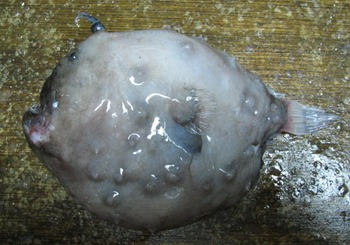
On 14 November 2007 a specimen of female Himantolophus appelii was collected as by-catch on a commercial trawler between 51°19.5′–51°12.2′S and 57°01.8′–56°53.2′W on the continental slope to the east of the Falkland Islands at a depth of 292–318 m (Figure 1). The specimen was initially frozen then preserved in 10% buffered formalin/saline solution for four months before finally being stored in 70% ethanol. The specimen is now in the British Natural History Museum, registration number BMNH 2008.6.20.1, Himantolophus appelii.
Freshly caught Himantolophus appelii. (BMNH registration no. BMNH 2008.6.20.1, Himantolophus appelii, 21 cm total length.) (Photograph: Sarah Hearne.)

DIAGNOSIS
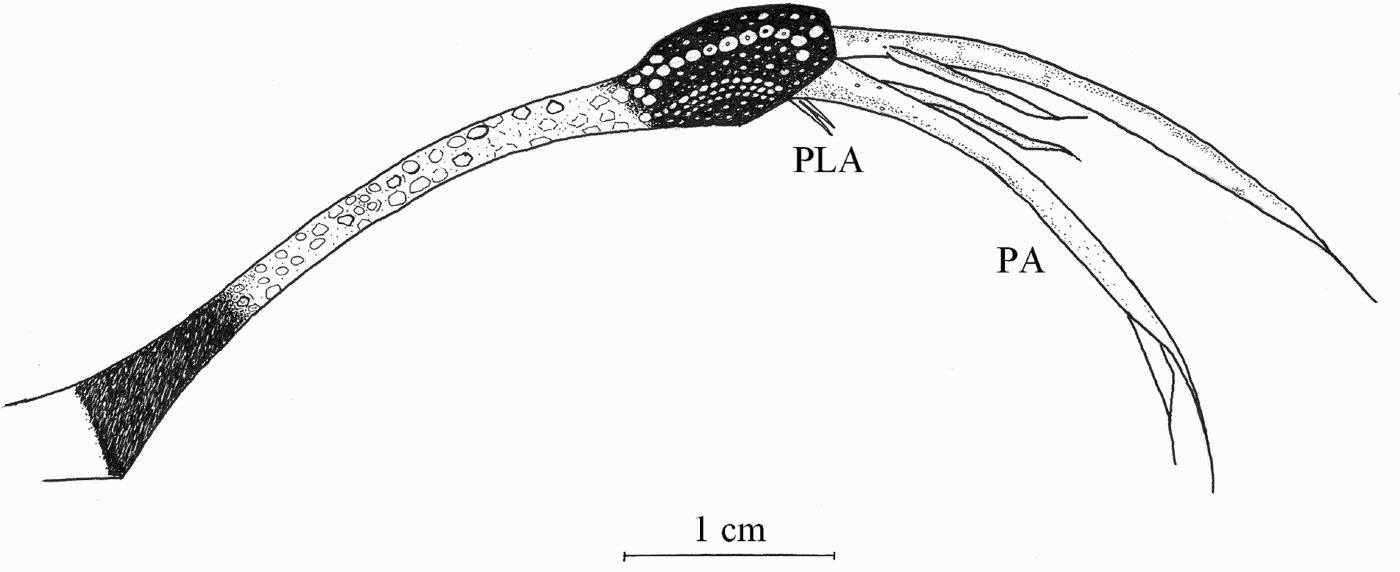
The specimen was identified to species-group level using the keys developed by Pietch & Kenaley (2007a,b). The illicium (Figure 2) had a bulbous distal light organ and emerged from behind the tip of the snout. It lacked an external second cephalic ray. The esca lacked bony denticles. The posterior appendage was present. Close examination did not reveal any indication of a distal appendage and it was concluded that it was absent. The posterior appendage was bifurcated at the base and each primary branch had a side branch near the base. One primary branch also had a side branch near the tip. These side branches are unique to H. appelii (Bertelsen & Krefft, Reference Bertelsen and Krefft1988).
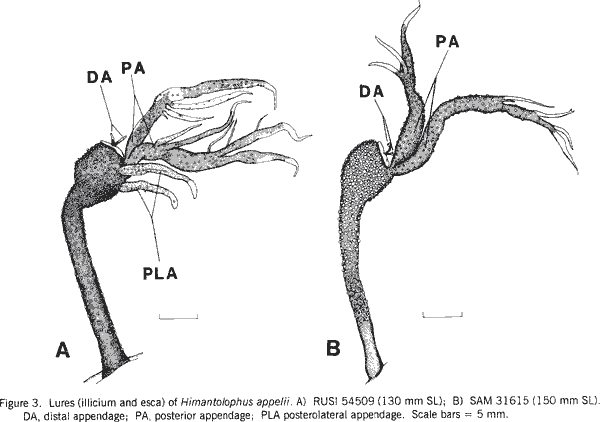
Illicium and esca of Himantolophus appelii caught in Falkland Islands' waters. PA, posterior appendage; PLA, posterolateral appendage. Scale bar: 1 cm. Comparable pictures of illicii and escae of two South African specimens from the paper by Anderson & Leslie (Reference Anderson and Leslie2001) are available on-line (http://www.bioline.org.br/showimage?fb/line/fb01002c.gif)

DESCRIPTION
The specimen measured 21 cm total length and weighed 616 g. The fin ray counts were as follows: D5, P17, A4, C8. This is consistent with diagnoses of all Himanolophids including H. appelii (Stewart & Pietsch, Reference Stewart and Pietsch1998; Anderson & Leslie, Reference Anderson and Leslie2001).
The following measurements (after Pietsch, 1974) were taken following transfer to ethanol and are given as a percentage of the standard length: head length 64.5; head width 50.4; upper jaw length 23.6; lower jaw length 23.9; eye diameter 37; interorbital width 24.4; illicium length 24.0; esca length 4.5; esca width 4.0. These measurements were outside the range given by Anderson & Leslie (Reference Anderson and Leslie2001) with the head length, head width and interorbital width being larger than that previously recorded and the other measurements being smaller.
DISCUSSION
The finding of this specimen extends the range of Himantolophus appelii to the south and reveals that it is not confined to sub-tropical waters as previously thought. The southern limit of the species most likely set by the presence of the South Atlantic Current (Campos et al., Reference Campos, Miller, Müller and Peterson1995) but eddies in this may bring some eggs further south, accounting for the occurrence of this specimen in the waters of the Falkland Islands.
ACKNOWLEDGEMENTS
Many thanks to P. Reyes, Z. Shcherbich, Dr P. Brickle, Professor T. Peitsch and particularly Dr V. Laptikhovsky for all their help and support. Thanks also to two anonymous referees for their helpful comments.