Introduction
Acanthocephalans of the class Eoacanthocephala mainly parasitize fishes and contain two orders, Gyracanthocephala (including only one family Quadrigyridae) and Neoechinorhynchida (including three families: Dendronucleatidae, Tenuisentidae, and Neoechinorhynchidae) (Amin Reference Amin2013). However, the monophyly and phylogenetic relationships of the two orders and their included families/subfamilies remain unclear due to the scarcity and inaccessibility of genetic data for some taxa. The family Quadrigyridae contains two subfamilies Quadrigyrinae and Pallisentinae (Amin Reference Amin2013). However, some previous molecular phylogenetic studies suggested that the family Quadrigyridae and the subfamily Pallisentinae are both non-monophyletic (Song et al. Reference Song, Zhang, Deng, Ding, Liao and Liu2016; Muhammad et al. Reference Muhammad, Ma, Khan, Li, Zhao, Ahmad and Zhu2019a, Reference Muhammad, Li, Zhao, Bannai, Mohammad, Khan and Ma2020a, Reference Muhammad, Khan, Li, Zhao, Ullah, Zhu and Mab; Ru et al. Reference Ru, Rehman, Chen, Khan, Muhammad and Li2022).
Although approximately 250 species belonging to over 30 genera have been described in the class Eoacanthocephala, the mitogenomes of the Eoacanthocephala are currently available for only four species, namely, Acanthogyrus cheni Amin, 2005; Neoechinorhynchus violentum Van Cleave, 1928; Paratenuisentis ambiguus Van Cleave, 1921; and Pallisentis celatusi Van Cleave, 1928 (Song et al. Reference Song, Zhang, Deng, Ding, Liao and Liu2016; Gazi et al. Reference Gazi, Kim, García-Varela, Park, Littlewood and Park2016; Pan and Nie Reference Pan and Nie2013; Weber et al. Reference Weber, Wey-Fabrizius, Podsiadlowski, Witek, Schill, Sugár and Hankeln2013; Pan and Jiang Reference Pan and Jiang2018). Our current knowledge of the mitochondrial genomes of acanthocephalans, especially the class Eoacanthocephala, remains very limited.
The poorly known species A. bilaspurensis Chowhan, Gupta & Khera, Reference Chowhan, Gupta and Khera1987 was originally reported from the reba carp Cirrhinus reba (Hamilton) in India (Chowhan et al. Reference Chowhan, Gupta and Khera1987; Naidu Reference Naidu2012). Recently, this species was redescribed based on specimens collected from Cyprinus carpio (Linnaeus) in Pakistan (Ru et al. Reference Ru, Rehman, Chen, Khan, Muhammad and Li2022). In the present study, the complete mitochondrial genome of A. bilaspurensis (Gyracanthocephala: Quadrigyridae) was sequenced and annotated for the first time. In addition, in order to assess the phylogenetic relationships of some families or subfamilies in Acanthocephala, phylogenetic analyses were performed using maximum likelihood and Bayesian inference (BI) based on concatenating the amino acid sequences of 12 protein-coding genes (PCGs) of mitogenomes.
Materials and methods
Parasites collection and species identification
Acanthocephalans were collected from the intestine of C. carpio in the Indus River, district Swabi (34°07′07.23″N, 72°36′32.38″E), Khyber Pakhtunkhwa, Pakistan. The acanthocephalans were identified as A. bilaspurensis according to some previous studies (Ru et al. Reference Ru, Rehman, Chen, Khan, Muhammad and Li2022; Chowhan et al. Reference Chowhan, Gupta and Khera1987).
Molecular procedures
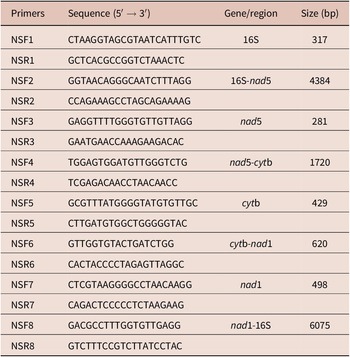
The genomic DNA was extracted for molecular studies using Wizard_SV Genomic DNA Purification System (Promega, Madison, USA) following the manufacturer’s protocol. The extracted DNA was preserved at −20°C for further molecular studies. The overall mitochondrial DNA of A. bilaspurensis was amplified by PCR using the primers shown in Table 1. PCR reactions were conducted in a 50 μl reaction mixture, containing 22.5 μl dd H2O, 22.5 μl PrimeSTAR Max DNA polymerase, 2 μl DNA template, and 1.5 μl of each primer. Long PCR amplification was conducted with 2 min denaturation at 96°C, then 15 cycles of denaturation at 98°C for 20 s, annealing at 50–65°C for 30 s, and extension at 68°C for 3 to 5 min, followed by 96°C denaturation for 2 min, plus 30 cycles of 96°C for 20s (denaturation), 52–65 °C for 30 s (annealing) and 65°C for 3 to 5 min, and a final extension at 72°C for 10 min. The positive amplified fragments, size up to 2 kb, were cloned in pMD18-T vector, and size above 2 kb were sequenced directly using primer walking strategy.
Primers used for amplification and sequencing of the complete mitochondrial genome of Acanthogyrus bilaspurensis in the present study

The mitogenome of A. bilaspurensis was assembled manually in a stepwise manner using DNAstar v7.1 program (Burland Reference Burland2000). The MEGA v7.0 (Kumar et al. Reference Kumar, Stecher and Tamura2016) was used for analyzing the nucleotides composition and codons usage. Protein-coding genes (PCGs) were identified using BLAST and ORF Finder tools by choosing the invertebrate mitochondrial code. The nucleotide alignment was checked against the genomes A. cheni and P. ambiguus. Most of the tRNAs were identified using MITOS web server (Bernt et al. Reference Bernt, Donath, Juhling, Externbrink, Florentz, Fritzsch, Putz, Middendorf and Stadler2013) and ARWEN (Laslett and Canback Reference Laslett and Canback2008). Ribosomal RNA genes (rrnL and rrnS) were identified by alignment comparison with other acanthocephalan species. The amino acid sequences of 12 PCGs were obtained using MEGA7, for which invertebrate mitochondrial code was chosen. Codons usage and relative synonymous codons usage (RSCU) for 12 PCGs were sorted out using PhyloSuite v1.1.15 (Zhang et al. Reference Zhang, Gao, Jakovlić, Zou, Zhang, Li and and Wang2020). The circular drawing of the mt genome of A. bilaspurensis was drawn out with MTVIZ, an online tool of mitochondrial visualization (available at http://pacosy.informatik.uni-leipzig.de/mtviz/). The RSCU figure was drawn using plugin ggplot2 (Wickham Reference Wickham2016).
Phylogenetic analyses
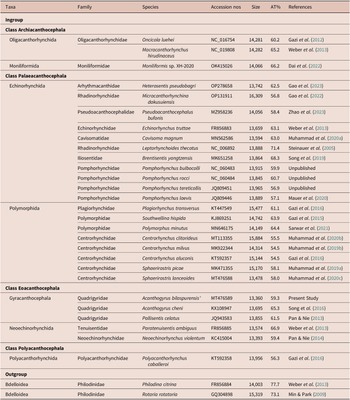
Phylogenetic analyses were performed based on concatenating the amino acid sequences of 12 PCGs of mitogenomes. Rotaria rotatoria Pallas, 1766 and Philodina citrina Ehrenberg, 1832 (Rotifera: Bdelloidea) were chosen as the out-group. Detailed information of representatives included in the phylogenetic analyses is provided in Table 2. Fasta files of the amino acid sequences of 12 PCGs were extracted from the GenBank, using PhyloSuite. Genes were aligned with MAFFT (Katoh et al. 2002) and integrated in PhyloSuite using normal-alignment mode. PhyloSuite was used to concatenate the generated alignments into a single alignment and then generate nexus and phylip format files for the phylogenetic analyses. The selection of best-fit models and partition strategy was done using PartitionFinder2 (Lanfear et al. Reference Lanfear, Frandsen, Wright, Senfeld and Calcott2017). Maximum likelihood analysis was carried out using IQ-TREE (Nguyen et al. Reference Nguyen, Schmidt, Von Haeseler and Minh2015) with 50,000 ultrafast bootstraps (Minh et al. Reference Minh, Nguyen and Von Haeseler2013). Bayesian inference analysis was generated using MrBayes v3.2, (Ronquist et al. Reference Ronquist, Teslenko, Van der Mark, Ayres, Darling, Höhna, Larget, Liu, Suchard and Huelsenbeck2012) by running two independent MC3 runs of four chains each for 5,000,000 generations and sampling tree topologies with every 1000 generations. ‘Burn-in’ periods were adjusted to one million generations following the standard deviation of split frequency value lower than (0.01). The phylograms were observed Using FigTree v.1.43 (Chen et al. Reference Chen, Chen, Kang, Fang, Dao, Guo, Lai, Lai, Fan, Fu, Andrieu and Lu2014) and annotated in Adobe Illustrator®. Phylogenetic analyses ranked nodes with Bayesian posterior probabilities (BPP) and bootstrap support values (BS) ≥0.90/90 as strongly supported and ≥0.80/80 and < 0.90/90 as moderately supported.
Detailed information of representatives included in the present phylogenetic analyses

* The mitogenome labeled as Neoechinorhynchus sp. (MT476589) in the GenBank actually corresponds to Acanthogyrus (Acanthosentis) bilaspurensis.
Results and discussion
Organization of the mitochondrial genome of Acanthogyrus (Acanthosentis) bilaspurensis
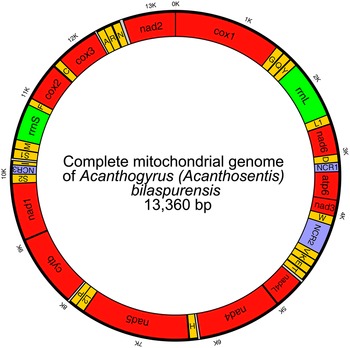
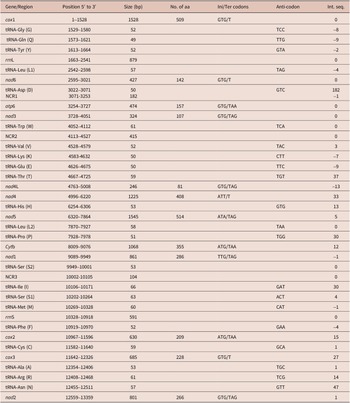
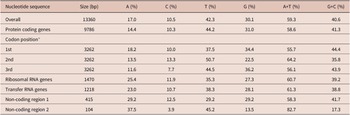
The complete mitogenome of A. bilaspurensis is 13,360 bp in size and contains 36 genes, including 12 protein-coding genes (PCGs) (cox1–3, atp6, nad1–6, nad4L, and cytb, lacking atp8), 22 tRNAs and two rRNAs genes (rrnL and rrnS), plus three non-coding regions (NCR1, NCR2, and NCR3) (Figure 1) (Table 3), which represent the smallest mitogenome of acanthocephalans reported so far (Table 2). All genes are encoded on the heavy strand and transcribed in the same direction. According to the previous studies, most of the acanthocephalan species lack atp8 gene in their mitogenomes, except for Leptorhynchoides thecatus Linton, 1891 (Steinauer et al. Reference Steinauer, Nickol, Broughton and and Ortí2005). The nucleotide contents in the complete mitogenome of A. bilaspurensis were 17.0% A (2276 bp), 30.1% G (4027 bp), 42.3% T (5652 bp), and 10.5% C (1405 bp) (Table 4). The level of overall A+T contents (59.3%) is lower than that in the mitogenomes of the other Eoacanthocephala species (59.4–66.9%) (Song et al. Reference Song, Zhang, Deng, Ding, Liao and Liu2016; Pan and Nie Reference Pan and Nie2013, Reference Pan and Nie2014; Weber et al. Reference Weber, Wey-Fabrizius, Podsiadlowski, Witek, Schill, Sugár and Hankeln2013). The low level of overall A+T contents in the mitogenome of A. bilaspurensis is due to the low use of A-rich codons in the PCGs, especially in the second and third codon positions, which were only 13.5% and 11.6%, respectively (Table 4).
Organization of the complete mitogenome of Acanthogyrus (Acanthosentis) bilaspurensis. The 12 protein-coding genes (PCGs) (red), 22 tRNA genes (yellowish-brown), 2 rRNA genes (green), and three non-coding regions (NCR) (purple) shown in different colors. All genes are transcribed in the clockwise direction on the same strand.

Organization of the mitochondrial genome of Acanthogyrus (Acanthosentis) bilaspurensis

NCR: non-coding region, bp: base pair, aa: amino acid, Ini/Ter: initial/terminal codons, Int. seq.: intergenic sequences
Nucleotide composition of the mitochondrial genome of Acanthogyrus (Acanthosentis) bilaspurensis

* Termination codons were excluded.
Protein-coding genes and codon usage
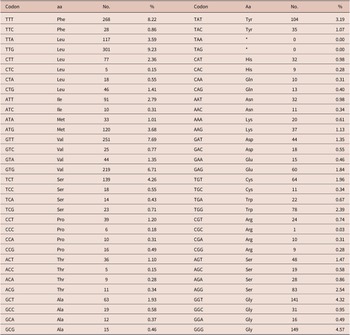
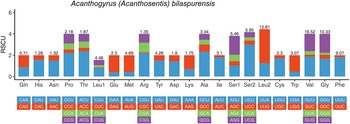
The size of 12 PCGs of A. bilaspurensis is 9,786 bp, containing 3,262 codons excluding termination codons, with average A+T content of 58.6% (Table 4). The size of 12 PCGs varied from 246 bp (nad4L) to 1545 bp (nad5) (Table 3). In the 12 PCGs of the mitogenome of A. bilaspurensis, the high level of T contents (44.2%) is consistent with high frequency of T-rich codons, which has been reported in the other acanthocephalans (Gazi et al. Reference Gazi, Kim, García-Varela, Park, Littlewood and Park2016; Muhammad et al. Reference Muhammad, Li, Zhao, Bannai, Mohammad, Khan and Ma2020a). TTG for lecine (9.23%) is the most frequently used codon, followed by TTT for phenylalanine (8.22%) and GTT for valine (7.69%), while CGC is the most unfrequently used codon (only 0.03%) (Table 5). Leucine (17.3%) is the most persistent amino acid in the PCGs of A. bilaspurensis (Table 5). The overall codon usage and RSCU for the construction of 12 PCGs are displayed in Figure 2. The highly frequent usage of leucine has also been reported in Cavisoma magnum Southwell, 1927 [16.7%], Sphaerirostris picae Rudolphi, 1819 [14.0%], and Plagiorhynchus transversus Rudolphi, 1819 [15.0%] (Muhammad et al. Reference Muhammad, Ma, Khan, Li, Zhao, Ahmad and Zhu2019a, Reference Muhammad, Li, Zhao, Bannai, Mohammad, Khan and Ma2020a; Gazi et al. Reference Gazi, Kim, García-Varela, Park, Littlewood and Park2016). The most frequent start codon is GTG, used for seven PCGs (cox1, nad6, atp6, nad3, nad4L, cox3, and nad2), whereas cytb and cox2 used ATG as start codon. The remaining PCGs (nad4, nad5, and nad1) used ATT, ATA, and TTG as start codons, respectively (Table 3). The most frequently used complete stop codons are TAG and TAA. The stop codon TAG was used for five PCGs (nad3, nad4L, nad5, nad1, and nad2), while the codon TAA was used for three PCGs (atp6, cytb, and cox2). The remaining four PCGs (cox1, nad6, nad4, and cox3) were inferred to terminate with incomplete stop codon T. The incomplete stop codon T was also reported in the mitogenomes of some other acanthocephalan species (Muhammad et al. Reference Muhammad, Ma, Khan, Li, Zhao, Ahmad and Zhu2019a, b, Reference Muhammad, Li, Zhao, Bannai, Mohammad, Khan and Ma2020a). The detailed information of codons of 12 PCGs of A. bilaspurensis is provided in Table 3.
Genetic code and codon usage for 12 PCGs in the mitochondrial genome of Acanthogyrus (Acanthosentis) bilaspurensis

No.: number of copies; *: Stop (termination) codon; aa: amino acid; Average# codons: 3262
Relative synonymous codon usage (RSCU) of the 12 protein-coding genes (PCGs) of Acanthogyrus (Acanthosentis) bilaspurensis. The codon families are labelled on the x-axis. Values on the top of each bar represent amino acid usage in percentage.

Ribosomal and transfer RNA genes
Two ribosomal RNAs, rrnL and rrnS, are 879 bp and 591 bp in size, with A+T (61.1%) and (60.2%), respectively. The rrnL lies between trnY and trnL1, which is the same as most of the acanthocephalan species reported so far, except for Macracanthorhynchus hirudinaceus (Pallas, 1781) (rrnL lies between trnY and trnL2) (Weber et al. Reference Weber, Wey-Fabrizius, Podsiadlowski, Witek, Schill, Sugár and Hankeln2013). The rrnS is located between trnM and trnF, which is also the same as most of acanthocephalan species reported so far, except for P. celatus and L. thecatus (rrnS located between trnS1 and trnF) (Muhammad et al. Reference Muhammad, Ma, Khan, Li, Zhao, Ahmad and Zhu2019a, Reference Muhammad, Ma, Khan, Wu, Zhu and Lib, Reference Muhammad, Li, Zhao, Bannai, Mohammad, Khan and Ma2020a; Pan and Nie Reference Pan and Nie2013; Steinauer et al. Reference Steinauer, Nickol, Broughton and and Ortí2005). In the complete mitogenome of A. bilaspurensis, the size of 22 transfer RNAs ranges from 49 bp (trnQ) to 66 bp (trnI), lacking TΨC arm but having TV-replacement loop. The two tRNAs, trnS1 and trnS2, both lack (DHU) arm, and the other tRNAs are predicted to fold into a ‘cloverleaf-like’ secondary structure (Muhammad et al. Reference Muhammad, Ma, Khan, Li, Zhao, Ahmad and Zhu2019a, Reference Muhammad, Ma, Khan, Wu, Zhu and Lib, Reference Muhammad, Li, Zhao, Bannai, Mohammad, Khan and Ma2020a; Gazi et al. Reference Gazi, Kim, García-Varela, Park, Littlewood and Park2016). The size, location, and anticodons of all the 22 tRNAs are presented in Table 3.
Non-coding regions
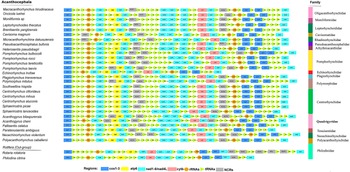
There are usually two non-coding regions (NCR) in the mitogenomes of acanthocephalans, but A. cheni, Pomphorhynchus laevis (Zoega in Müller, 1776), Polymorphus minutus (Zeder, 1800) and Pomphorhynchus bulbocolli have three non-coding regions in their mitogenomes (Song et al. Reference Song, Zhang, Deng, Ding, Liao and Liu2016; Mauer et al. Reference Mauer, Hellmann, Groth, Fröbius, Zischler, Hankeln and Herlyn2020; Sarwar et al. Reference Sarwar, Zhao, Kibet, Sitko and Nie2021). Paratenuisentis ambiguus and Heterosentis pseudobagri Wang & Zhang, 1987 have only one non-coding region (NCR) (Weber et al. Reference Weber, Wey-Fabrizius, Podsiadlowski, Witek, Schill, Sugár and Hankeln2013; Gao et al. Reference Gao, Yuan, Jakovlić, Wu, Xiang, Xie and and Ou2023). Only Neoechinorhynchus violentum Van Cleave, 1928 has been reported with four non-coding regions (Pan and Nie Reference Pan and Nie2014). Present study revealed A. bilaspurensis also has three non-coding regions, the total size of which is 974 bp. The NCR1 is 182 bp in length, located between trnD and atp6. The NCR2 is 415 bp in length, located between trnW and trnV, while the NCR3 is 104 bp, located between trnS2 and trnI. The position of NCR3 of the present species is different from all of the acanthocephalan species reported so far. Details of position and size of NCRs are provided in Figures 1 and 3 and Table 3.
Linearized comparison of the mitochondrial gene arrangement for 28 acanthocephalan species and two rotifer species. All genes are encoded from left to right in the same direction. The tRNAs are labelled by single-letter code for the corresponding amino acid.

Gene order
The gene arrangement of the mitogenomes can provide useful information for the phylogenetic relationships of metazoans (Song et al. Reference Song, Zhang, Gao, Cheng, Xie, Li and Wu2019; Muhammad et al. Reference Muhammad, Li, Zhao, Bannai, Mohammad, Khan and Ma2020a). The tRNAs in the mitogenomes of acanthocephalans seem to have more variability in translocation (Song et al. Reference Song, Zhang, Gao, Cheng, Xie, Li and Wu2019; Muhammad et al. Reference Muhammad, Li, Zhao, Bannai, Mohammad, Khan and Ma2020a). In the mitogenome of A. bilaspurensis, gene order of 12 PCGs and 2 rRNAs is in the following pattern: cox1, rrnL, nad6, atp6, nad3, nad4L, nad4, nad5, ctyb, nad1, rrnS, cox2, cox3, nad2, which is the same as the other acanthocephalans reported so far (Muhammad et al. Reference Muhammad, Ma, Khan, Li, Zhao, Ahmad and Zhu2019a, Reference Muhammad, Ma, Khan, Wu, Zhu and Lib, Reference Muhammad, Li, Zhao, Bannai, Mohammad, Khan and Ma2020a, Reference Muhammad, Khan, Li, Zhao, Ullah, Zhu and Mab, Reference Muhammad, Ahmad, Li, Zhao, Ullah, Zhu and Mac; Zhao et al. Reference Zhao, Yang, Lü, Ru, Wayland, Chen and Li2023). However, several tRNAs of the mitogenome of A. bilaspurensis (i.e., trnM, trnV, trnS1, trnS2, trnK, trnC, and trnR) exhibit variability in translocation (Figure 3).
Phylogeny
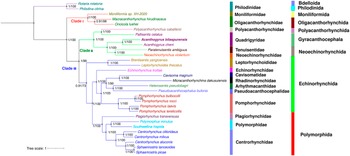
Phylogenetic trees using ML and BI methods have almost identical topologies, which supported the division of the phylum Acanthocephala into three large monophyletic clades (clades I, II, and III), representing the classes Palaeacanthocephala, Archiacanthocephala, and Eoacanthocephala, respectively (Figure 4). The clade I consists of M. hirudinaceus, O. luehei, and Moniliformis sp., all belonging to the class Archiacanthocephala, which further confirmed the Archiacanthocephala as a sister to the remaining Acanthocephala. The results are consistent with the previous phylogenetic studies (Gao et al. Reference Gao, Yuan, Wu, Xiang, Xie, Song and Ou2022).
Phylogenetic relationships of acanthocephalans based on concatenating the amino acid sequences of 12 protein-coding genes (PCGs) of mitogenomes using Bayesian inference (BI) and maximum likelihood (ML) analyses. Philodina citrina and Rotaria rotatoria (Bdelloidea: Rotifera) were used as outgroups. Bootstrap values≥90 and Bayesian posterior probabilities values≥0.90 are shown in the phylogenetic trees.

The clade II contains representatives of the classes Eoacanthocephala and Polyacanthocephala. Species of the class Polyacanthocephala (including only Polyacanthorhynchus caballeroi Diaz-Ungria & Rodrigo, 1960) nested in representatives of the class Eoacanthocephala, which is accordant with the previous mitogenomic phylogenies (Muhammad et al. Reference Muhammad, Ma, Khan, Li, Zhao, Ahmad and Zhu2019a, Reference Muhammad, Ma, Khan, Wu, Zhu and Lib, Reference Muhammad, Li, Zhao, Bannai, Mohammad, Khan and Ma2020a, Reference Muhammad, Khan, Li, Zhao, Ullah, Zhu and Mab; Gazi et al. Reference Gazi, Kim, García-Varela, Park, Littlewood and Park2016; Song et al. Reference Song, Zhang, Gao, Cheng, Xie, Li and Wu2019; Zhao et al. Reference Zhao, Yang, Lü, Ru, Wayland, Chen and Li2023; Dai et al. Reference Dai, Yan, Li, Zhang, Liu, Gao and Jia2022). However, some phylogenetic analyses based on 18S, 18S+28S, and 18S+28S+cox1 sequence data supported that Polyacanthocephala is an independent class (Garey et al. Reference Garey, Near, Nonnemacher and Nadler1996; García-Varela et al. Reference García-Varela, Cummings, de León, Gardner and Laclette2002; García-Varela and Nadler Reference García-Varela and Nadler2006; Verweyen et al. Reference Verweyen, Klimpel and Palm2011). Our phylogenetic analyses showed A. bilaspurensis clustered together with A. cheni, which displayed distant relationship to P. celatus in the family Quadrigyridae (Figure 4). The present phylogeny further confirmed the order Gyracanthocephala, the Quadrigyridae, and its subfamily Pallisentinae are not monophyletic, which is coincident with the previous phylogenetic studies based on mitogenomics and nuclear DNA data (Gazi et al. Reference Gazi, Kim, García-Varela, Park, Littlewood and Park2016; Song et al. Reference Song, Zhang, Gao, Cheng, Xie, Li and Wu2019; Muhammad et al. Reference Muhammad, Ma, Khan, Li, Zhao, Ahmad and Zhu2019a, Reference Muhammad, Ma, Khan, Wu, Zhu and Lib, Reference Muhammad, Li, Zhao, Bannai, Mohammad, Khan and Ma2020a, Reference Muhammad, Khan, Li, Zhao, Ullah, Zhu and Mab, Reference Muhammad, Ahmad, Li, Zhao, Ullah, Zhu and Mac; Dai et al. Reference Dai, Yan, Li, Zhang, Liu, Gao and Jia2022; Zhao et al. Reference Zhao, Yang, Lü, Ru, Wayland, Chen and Li2023).
The clade III includes species of the class Palaeacanthocephala. Phylogenetic results showed that the order Polymorphida is a monophyletic group, and the families Polymorphidae (including Southwellina hispida (Van Cleave, 1925) and P. minutus) and Centrorhynchidae (including Centrorhynchus milvus Ward, 1956, Centrorhynchus clitorideus Meyer, 1931, C. aluconis Müller, 1780, Sphaerirostris lanceoides Petrochenko, 1949, and S. picae) have a more close relationship than the family Plagiorhynchidae (including P. transversus) (Figure 4), which agreed well with some previous phylogenetic studies based on the mitogenomic data (Gazi et al. Reference Gazi, Kim, García-Varela, Park, Littlewood and Park2016; Song et al. Reference Song, Zhang, Gao, Cheng, Xie, Li and Wu2019; Muhammad et al. Reference Muhammad, Ma, Khan, Li, Zhao, Ahmad and Zhu2019a, Reference Muhammad, Ma, Khan, Wu, Zhu and Lib, Reference Muhammad, Li, Zhao, Bannai, Mohammad, Khan and Ma2020a, Reference Muhammad, Khan, Li, Zhao, Ullah, Zhu and Mab, Reference Muhammad, Ahmad, Li, Zhao, Ullah, Zhu and Mac; Dai et al. Reference Dai, Yan, Li, Zhang, Liu, Gao and Jia2022; Zhao et al. Reference Zhao, Yang, Lü, Ru, Wayland, Chen and Li2023) but conflicted with these phylogenies using 18S + 28S + cox1 data (García-Varela et al. Reference García-Varela, Pérez-Ponce de León, Aznar and Nadler2013; Gazi et al. Reference Gazi, Kim and Park2015) or some phylogenies based on the mitogenomic data (Muhammad et al. Reference Muhammad, Li, Zhao, Bannai, Mohammad, Khan and Ma2020a, Reference Muhammad, Khan, Li, Zhao, Ullah, Zhu and Mab, Reference Muhammad, Ahmad, Li, Zhao, Ullah, Zhu and Mac). Phylogenetic analyses also indicated the order Echinorhynchida is a paraphyletic group. However, the families Pseudoacanthocephalidae (including only Pseudoacanthocephalus bufonis Shipley, 1903) and Arhythmacanthidae (including only H. pseudobagri) displayed sister relationships, which is inconsistent with the previous phylogeny (Zhao et al. Reference Zhao, Yang, Lü, Ru, Wayland, Chen and Li2023).
Authors’ contribution
NM and LL designed the study and analyzed mitogenomic data. NM performed the experiment, sequenced data, and wrote the manuscript. LL and RSS identified acanthocephalan specimens. NM and DXL performed the phylogeny. Suleman, DS, and MAA collected specimens. All authors read and approved the final manuscript.
Financial support
This study was supported by the National Natural Science Foundation of China (Grant No. 31872197).
Competing interest
The authors declare that they have no competing interests.