Introduction
People are living longer such that there will be two billion older people aged 65 and above by 2050 (United Nations, 2016). Gerontological research has investigated a wide range of domains, components and factors in shaping people's ageing experiences. While healthy and successful ageing previously referred to the absence of physical and mental illness, older people's spiritual needs and practice have gained more attention from gerontological scholars over recent years (Sadler and Biggs, Reference Sadler and Biggs2006; Mowat and O'Neill, Reference Mowat and O'Neill2013; Schuurmans-Stekhoven, Reference Schuurmans-Stekhoven2019).
Many theorists consider religiosity to be an important factor of successful ageing (Crowther et al., Reference Crowther, Parker, Achenbaum, Larimore and Koenig2002; Sadler and Biggs, Reference Sadler and Biggs2006). Relative to other age groups, the aged population demonstrated the highest level of religiosity (McFadden, Reference McFadden, Paloutzian and Park2005; Dalby, Reference Dalby2006; Bengston et al., Reference Bengtson, Silverstein, Putney and Harris2015). Gerontologists and health researchers have thus examined the role of religiosity in shaping people's later-life health and wellness, but the evidence is far from conclusive. Moreover, most previous research in this field has utilised Western samples, with relatively little attention paid to Eastern countries experiencing rapidly ageing populations. This study aims to explore the relationship between religion and health in an Eastern setting by comparing health conditions between religious and non-religious Chinese older populations via a meta-analytical approach.
Religion and health
Numerous previous studies have examined the relationship between religion and people's health and wellbeing. However, the link is not conclusive. Religion could theoretically have an impact on people's physical health by promoting healthy behaviours, increasing positive psychological states, encouraging positive coping with stressful life events (Schuurmans-Stekhoven, Reference Schuurmans-Stekhoven2018), providing social support, and acting as supernatural energies and subtle energies (Oman and Thoresen, Reference Oman, Thoresen, Paloutzian and Park2005). A growing body of empirical research (over 1,200 studies and 400 reviews; Yeager et al., Reference Yeager, Glei, Au, Lin, Sloan and Weinstein2006) offered evidence for positive associations between religiosity and better states of health, such as physical health (e.g. Oman and Riley, Reference Oman, Riley and Oman2018), depression and anxiety (e.g. Howell et al., Reference Howell, Carleton, Horswill, Parkerson, Weeks and Asmundson2019; Moons, Reference Moons, Luyckx, Dezutter, Kovacs, Thomet, Budts, Enomoto, Sluman, Yang, Jackson, Khairy, Subramanyan, Alday, Eriksen, Dellborg, Berghammer, Johansson, Mackie, Menahem, Caruana, Veldtman, Soufi, Fernandes, White, Callus, Kutty and Apers2019), social support (e.g. Schuurmans-Stekhoven, Reference Schuurmans-Stekhoven2017; Bailly et al., Reference Bailly, Martinent, Ferrand, Agli, Giraudeau, Gana and Roussiau2018), suicide ideation and attempts (e.g. Florez et al., Reference Florez, Allbaugh, Harris, Schwartz and Kaslow2018; Svob et al., Reference Svob, Wickramaratne, Reich, Zhao, Talati, Gameroff, Saeed and Weissman2018) and health behaviours (e.g. Padela et al., Reference Padela, Malik, Vu, Quinn and Peek2018).
However, religiosity may also be negatively associated with people's health and wellbeing (e.g. Willits and Crider, Reference Willits and Crider1988; Oman, Reference Oman2018). For instance, religion may trigger patients’ feelings of abandonment from God and thus lead to a higher risk of mortality (Pargament et al., Reference Pargament, Koenig, Tarakeshwar and Hahn2001). There are also studies suggesting a non-linear relationship between religion and health. For instance, some studies show that those who are marginally religious may be more depressed than the non-religious, and only those who are highly religious gain any benefit (Galen and Kloet, Reference Galen and Kloet2011). There are also studies showing that the moderately religious benefit most because they do not have to pay the social cost of high religious involvement (McFarland, Reference McFarland2010).
Religion and health among older adults
With the rapidly ageing population, researchers have a good reason to investigate the relationship between religion and health among older adults. According to Erikson's lifestage theory of psycho-social development (Munley, Reference Munley1975), people at different lifestages may experience different psycho-social development and tensions, and thus may need different coping styles and mechanisms. Religion deals with questions such as birth, death, marriage and loss. As older adults feel closer to death than younger people, according to Malinowski's ‘crisis of life’ theory, older people are more likely to turn to religion for support and comfort (Murat, Reference Murat2017). Arguably then, religion may help to shed light on older adults’ understanding of the meaning of life when facing the existential questions of ageing and death (McFadden, Reference McFadden, Paloutzian and Park2005). Older adults are also more likely to experience loss related to ageing. Religion and spirituality may offer a socio-cultural means for coping with the transitions and tribulations of ageing, such as loss of physical function, disability and loss of partners (McFadden and Kozberg, Reference McFadden and Kozberg2008; Cheesman et al., Reference Cheesman, Cox, Smith and Parmelee2019). In this case, it is of critical importance to investigate specifically the relationship between religiosity and health of older adults, instead of merely translating the evidence found for all age groups.
Many researchers investigated the relationship between religion and health in people's late life (McFadden, Reference McFadden, Paloutzian and Park2005; Koenig et al., Reference Koenig, King and Carson2012; Schuurmans-Stekhoven, Reference Schuurmans-Stekhoven2019). For instance, religious older people tend to have better cognitive function (Sun et al., Reference Sun, Ma, Wu, Koenig and Wang2018), decreased depression, improved optimism, self-esteem (McFarland, Reference McFarland2010) and report engaging in more health behaviours (Bakhtiari et al., Reference Bakhtiari, Yadollahpur, Omidvar, Ghorbannejad and Bakouei2018) relative to older adults who are not religious. However, religion may also have a negative influence on older adults’ health. For instance, a study among Chinese older immigrants in the USA found that the religious belief that the body can heal spontaneously can result in a delay in seeking medical advice and treatment (Zhan et al., Reference Zhan, Luo and Zhang2013).
Previous meta-analysis on religion and health
In the field of psychology of religion, researchers have already conducted several meta-analysis and systematic reviews to examine the relationship between religiosity and people's health and wellbeing. For example, Hackney and Sanders (Reference Hackney and Sanders2003) conducted a meta-analysis of 34 studies and found a small but very significant positive relationship between religiosity and mental health (r = 0.10, p < 0.0001). A recent meta-analysis reviewed studies published in English and found religiosity and spirituality (R/S) is positively related to cognitive function among middle-aged and older adults (Hosseini et al., Reference Hosseini, Chaurasia and Oremus2017). Two other meta-analyses show that people with higher religious engagement experience an 18 per cent lower risk of death (Chida et al., Reference Chida, Steptoe and Powell2009) and this variable also accounts for 2–6 per cent of the variation in adult subjective wellbeing (Witter et al., Reference Witter, Stock, Okun and Haring1985). Jim et al. (Reference Jim, Pustejovsky, Park, Danhauer, Sherman, Fitchett, Merluzzi, Munoz, George, Snyder and Salsman2015) conducted meta-analysis specifically among cancer patients. They found that religiosity is significantly associated with better patient-reported physical health, including physical wellbeing, and functional wellbeing.
Despite these positive results in aggregate, there were also systematic reviews or meta-analyses showing negative or mixed findings (Payne et al., Reference Payne, Bergin, Bielema and Jenkins1991; Larson et al., Reference Larson, Sherrill, Lyons, Craigie, Thielman, Greenwold and Larson1992). For example, two meta-analyses found that negative religious coping can be closely related to negative psychological adjustment to stress (Seybold and Hill, Reference Seybold and Hill2001; Ano and Vasconcelles, Reference Ano and Vasconcelles2005). Abu et al. (Reference Abu, Ulbricht, Ding, Allison, Salmoirago-Blotcher, Goldberg and Kiefe2018) reviewed studies – mostly conducted in the United States of America (USA) – on the relationship between R/S and quality of life among cardiovascular patients. They found that even though some studies showed positive relationships, half of them showed null or negative relationships.
The present study
The Chinese population currently displays the fastest rate of ageing in the world. At the same time, religion has become increasingly prevalent in China. Especially after the Chinese economic reform and open-door policy (Song and Sung, Reference Song and Sung1991), mainland China experienced a rapidly progressing process towards modernisation. During this period, people turned to religion at an increasing rate as they lost confidence in Marxism–Maoism (Potter, Reference Potter2003; Liu, Reference Liu and Blasi2011). According to the most recent national survey, Chinese older adults consist of the largest proportion (24%) of religious believers (Lu, Reference Lu2014). Yet only a relatively small number of gerontological studies have specifically examined the impact of religion on Chinese older adults’ health and wellbeing.
It is questionable to translate Western evidence to Chinese culture because religion in China is quite different from Western society so that its relationship with health may differ. First, there has been a long-contested relationship between religion and State power (e.g. Travagnin, Reference Travagnin2016; Sun, Reference Sun2017; Xie, Reference Xie2017). In contemporary China, religion has been under ‘the persistent interference and systematic control from the new faith [i.e. Marxism–Maoism]’ (Yang, Reference Yang1967: 141). Such politicisation has resulted in stigmatisation of the traditional religious schools including Buddhism, Taoism, Islam, Catholicism and Protestantism. Such social rejection could influence the effect of religion on ageing experiences and wellbeing (Yang, Reference Yang2013; Shiah et al., Reference Shiah, Chang, Chiang and Tam2016). In addition, it is more common in China that people do not identify with a particular religion. Many Chinese believers are syncretic, e.g. many adopt aspects of both Taoism and Buddhism rituals (Zhan et al., Reference Zhan, Luo and Zhang2013). Moreover, ‘folk religion’, such as customary beliefs and practices, is more common in China than in Western countries (Yang and Hu, Reference Yang and Hu2012; Boyle and Sheen, Reference Boyle and Sheen2013). The relationship between health and such ‘folk’ religious belief may be different from the traditional religion–health relationship uncovered by psychologists in Western settings.
Although the role of Christianity has decreased in countries such as the USA and the United Kingdom (UK), Eastern religion, such as Taoism and Buddhism, has started to grow in Western society due to the process of globalisation (Palmer and Siegler, Reference Palmer and Siegler2017). Other new forms of R/S have also been developed. Therefore, perhaps China can be considered ‘the great laboratory-like research site’ – an especially useful source of information for understanding the complexity of religion (Chao and Yang, Reference Chao and Yang2018: 188). With China having the largest ageing population in the world, exploring the relationship between religion and health among Chinese older adults could potentially provide fruitful guidance to social gerontologists and elderly care practitioners in China and the international society.
As reviewed in the preceding section, previous meta-analysis studies have been mostly conducted in Western countries and without a specific focus on older adults (Loewenthal, Reference Loewenthal2006). Therefore, this research examines whether the generally positive relationship between religiosity and health also holds for Chinese older adults. The purpose of this study was to synthesise the available empirical research on older adults’ religiosity and health and to examine the health differences between non-religious and religious older Chinese people. Specifically, we were interested in whether people with a religious affiliation or deeply held religious beliefs would report better physical, mental and social health than those who are secular or less religious.
We also examined whether the association would differ across different moderators. There are some potential moderators in the relationship between religion and older people's health. These include race (Musick et al., Reference Musick, Koenig, Hays and Cohen1998; Tabak and Mickelson, Reference Tabak and Mickelson2009), stressful life events (Jahn et al., Reference Jahn, Poindexter, Graham and Cukrowicz2012) and measures of religiousness (Smith et al., Reference Smith, McCullough and Poll2003; Jahn et al., Reference Jahn, Poindexter, Graham and Cukrowicz2012). For instance, studies have found that the religion–health relationship is stronger among African Americans and Hispanics than non-Hispanic Whites (Musick et al., Reference Musick, Koenig, Hays and Cohen1998; Tabak and Mickelson, Reference Tabak and Mickelson2009). The relationship is stronger among those who have recently experienced stressful life events, and those with a higher level of frailty (Kirby et al., Reference Kirby, Coleman and Daley2004). Gender could be another moderator; for instance, a two-wave longitudinal study suggested that older men obtained more mental health benefits from organisational religious involvement than older women (McFarland, Reference McFarland2010). As religion may play different roles in people from the abovementioned sub-groups, in the present meta-analysis, we also conducted moderator analysis.
Method
Search strategy
We searched eight major English databases (PsycINFO, PsycARTICLES, PubMed, Web of Science, EMBASE, MEDLINE, ScienceDirect and Scopus), three major databases in simplified Chinese (Wanfang Database, Weipu Database and China Academic Journals Full-text Database) and one database in traditional Chinese (PerioPath Index to Taiwan Periodical Literature System) for studies published prior to May 2018. The keywords include four sets: older adults (e.g. ‘old*’ OR ‘elder*’), religiosity (e.g. religion* OR Budd* OR Christian*), health-related outcomes (e.g. mental* OR psychological OR health OR ‘social support’) and China (China OR Chinese). The details of keywords used in each database are shown in the online supplementary material.
Inclusion criteria
Studies were included in the meta-analysis if they: (a) were published in either English or Chinese; (b) included a sample of Chinese adults older than 55 years and residing in mainland China, Hong Kong, Macau and Taiwan; (c) were quantitative studies with a cross-sectional, case-control or panel study data sample with a size of equal to or larger than 30; (d) measured variables related to religiosity, including religious beliefs, involvement and practices; (e) evaluated health-related outcomes; (f) reported an effect size representing the bivariate association between religiosity and health-related outcomes; and (g) were published in a peer-reviewed journal.
We construct R/S as beliefs, practices and rituals that related to the sacred or a transcendent divine being (Hassed, Reference Hassed2000; McSherry, Reference McSherry2000; Koenig et al., Reference Koenig, King and Carson2012). The health-related outcomes of older adults include physical health, mental health, health-related behaviours, coping, lifestyle and wellbeing. We excluded studies with only data about older Chinese adults residing in countries other than mainland China, Hong Kong, Macau and Taiwan, such as Chinese immigrants in other countries. We also excluded studies that examined the relationship between health and spiritual wellbeing as the latter can also be a dimension of ‘health’ per se.
Screening procedures
Two raters who have advanced degrees and experience in this field reviewed the papers generated from the search. Titles and abstracts were independently reviewed by both to decide which articles warranted a full review. Articles were excluded only if there was a clear violation of the selection criteria such as utilising a qualitative study design, targeted population other than older adults, and topic unrelated to health and wellbeing. If it could not be decided from titles and abstracts whether the articles met the criteria, we retained them for full-text screening. Discrepancies were identified and resolved after discussions between two raters. When the full text could not be found or provided insufficient data, we contacted the original authors for the full text.
Quality assessment and data extraction
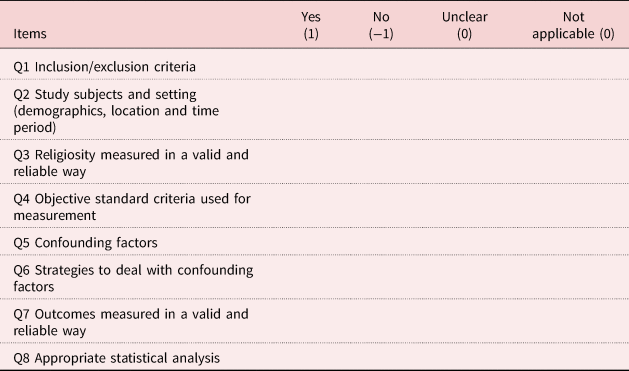
Two raters independently evaluated the quality of the selected articles based on the critical appraisal tools developed by the Joanna Briggs Institute containing eight items concerning reporting and methodological quality (Table 1). The total score ranged from −8 to 8. Inter-rater reliability was examined via Cohen's kappa, and the result was 0.61, which is between 0.40 and 0.75, indicating a good agreement (Landis and Koch, Reference Landis and Koch1977).
Items of the quality assessment tool

Data synthesis
Effect size measures
Effect size statistics used in the meta-analysis were bivariate associations between religiosity and health. These effect size statistics included Pearson or Spearman correlation, standardised mean differences between groups (e.g. religious versus non-religious; Buddhist versus Christian) and odds ratios. If studies did not report such statistics but other indexes that can be transformed to a bivariate effect size, these scores were converted and included in our analysis. If there was insufficient information provided in the paper to generate an effect size, we contacted the authors to acquire them. Statistics such as the unstandardised coefficient (B), the standardised coefficient (β) and others from multivariable regression were not used as effect sizes, because the confounding factors may be different across studies and may not be able to be combined in the meta-analysis (Hunter and Schmidt, Reference Hunter and Schmidt1990). To make the individual effect size from each study able to be combined, all the effect sizes were converted to Hedge's g that represents a standardised mean difference (Cohen, Reference Cohen1988). A Hedge's g smaller than 0.2 indicates a small effect size, 0.5 indicates a medium effect size and 0.8 indicates a large effect size (Cohen, Reference Cohen1988).
Meta-analytic procedures
Data extraction was performed by two raters independently. Random effects models were employed since the included studies were heterogeneous to some extent. Forest plots were used to display the effect size of each study and the overall meta-analysis. Statistical heterogeneity was assessed by the Q statistics with p < 0.1 indicating heterogeneity between studies, and the I 2 test that describes the percentage of variability among the effect sizes beyond that expected by chance (Higgins et al., Reference Higgins, Thompson, Deeks and Altman2003). The Comprehensive Meta-Analysis Version 2 (CMA2, a software package that can be used to conduct a meta-analysis) was used for calculating each study's Hedge's g, and the metafor package (Viechtbauer, Reference Viechtbauer2010) in RStudio was used for conducting the following meta-analytic procedures. The metafor package has an advantage over CMA2 because it adopts the Knapp-Hartung adjustment (KNHA) to improve the nominal coverage of confidence intervals (CIs). The CMA2, like most meta-analysis tools, provides the overall effect based on a normal distribution, which leads to biased CIs, especially with small sample sizes (N) or a small number of studies (k) (Suurmond et al., Reference Suurmond, van Rhee and Hak2017).
Moderator analysis
Associations between older adults’ religiosity and health may vary by demographic characteristics of older adults. Moderators tested in this study included (a) categorical variables: household residential type (rural versus urban), population (general older adults versus at-risk older adults (e.g. left behind, living alone, empty-nest, patients living in health facilities and those at the end-of-life stage), the region of the study (Mainland China versus Hong Kong/Taiwan), measurement of R/S (religious beliefs versus religious affiliation/involvement/activities) and language of the study (English versus Chinese); and (b) continuous moderators: mean age, percentage of females in the sample and quality score. The choice of moderators, on the one hand, was exploratory, and on the other, was based on evidence showing the differentiating religiosity among different sub-groups of the Chinese population. For instance, according to the 2009 Gallup Poll, 45 per cent of people in Taiwan view religion as an important aspect in their life (Crabtree and Pelham, Reference Crabtree and Pelham2009), while only 26 per cent of people in China consider religion plays an essential role in their life (Angus Reid, 2006). Religion plays a relatively more important role in people's social life in rural China than in urban China. According to a 2003 survey in China, 14.1 per cent of rural dwellers indicated that they are religious while the value was only 8.3 per cent among urbanites (Lu et al., Reference Lu, O'Leary, Li and Day2016). There are also studies showing gender differences in religiosity and its health implications (McFarland, 2009). Given such differences, this moderator analysis aimed to explore whether the religion–health relationships will be different in different Chinese communities.
Sub-group analyses were performed to test the categorical moderators, and meta-regression was performed to test the continuous moderators. To avoid the risk of false-positive effects, we followed the guidelines about the minimum number of studies required for moderator analysis. We only performed sub-group analysis when there are at least four studies in each sub-group (Fu et al., Reference Fu, Gartlehner, Grant, Shamliyan, Sedrakyan, Wilt, Griffith, Oremus, Raina, Ismaila, Santaguida, Lau and Trikalinos2011) and meta-regression when the number of studies (k) is greater than ten (Baker et al., Reference Baker, Michael White, Cappelleri, Kluger and Coleman2009).
Publication bias refers to the possibility that published papers are not representative of all the research because studies with insignificant results are usually less likely to be published. We also used Egger's test to examine whether there is publication bias (Rosenthal, Reference Rosenthal1991). A p < 0.1 indicates potential publication bias (Egger et al., Reference Egger, Smith, Schneider and Minder1997; Deeks et al., Reference Deeks, Macaskill and Irwig2005). If Egger's test detected publication bias and the effect size was significant, as a form of sensitivity analysis, we adopted the recommended trim-and-fill method, a non-parametric method to estimate the number of missing studies, to adjust for publication bias and to compute an actual effect size without publication bias (Lin et al., Reference Lin, Chu, Murad, Hong, Qu, Cole and Chen2018).
Results
Characteristics of included studies
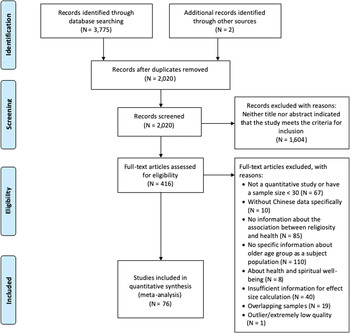
We identified 2,142 papers from the English database, 1,633 papers from the Chinese database and two from grey literature (i.e. literature that has not been formally published, including conference proceedings, institutional repositories or studies published outside widely available journals searching; Conn et al., Reference Conn, Valentine, Cooper and Rantz2003), resulting in 3,777 studies in total. After removing duplicates, 2,020 studies remained for screening. The two raters had a large agreement on the results of titles and abstracts (Cohen's kappa = 0.90) (Landis and Koch, Reference Landis and Koch1977). Eventually, 416 studies were included after the titles and abstracts screening. Independent screening of the 416 full texts resulted in a final sample of 76 studies. The flowchart of the screening process is shown in Figure 1.
PRISMA diagram of article screening.

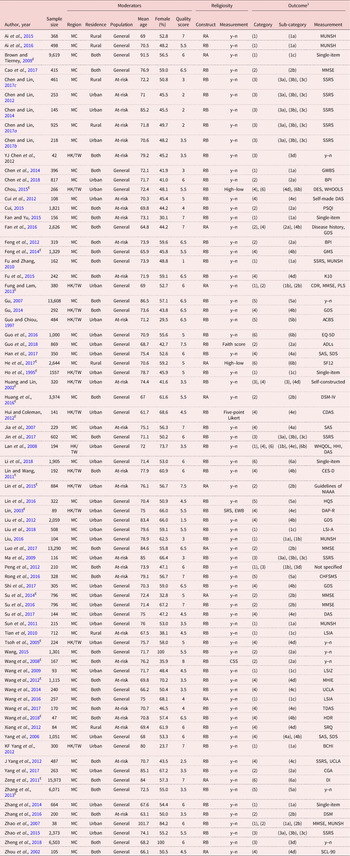
The characteristics of each included study are shown in Table 2. Of all the 76 studies included, the sample size ranges from 38 to 15,973. The total sample size is 110,875. The mean age ranges from 61.7 to 101.7 years old. Most of the studies aimed to examine the factors influencing the physical, mental and psycho-social health and wellbeing of Chinese older adults. Religiosity in these studies was included as one of the factors or covariates. Ten of the 76 studies focused on the health consequences of older adults’ religiosity specifically. One study treated older adults’ religious beliefs as the dependent variable that can be influenced by the intergenerational relationships.
Characteristics of studies included

Notes: N = 76. Papers written in English are marked E. 1. For details of the categories and sub-categories, see the Results section. MC: Mainland China. HK/TW: Hong Kong/Taiwan. RB: religious belief. RA: religious activity. y–n: yes–no. SRS: Springfield Religiosity Schedule. EWB: Existential Well-Being. CSS: Chinese Spirituality Scale. MUNSH: Memorial University of Newfoundland Scale of Happiness. MMSE: Mini-Mental State Examination. SSRS: Social Support Rating Scale. GWBS: General Well-Being Schedule. BPI: Brief Pain Inventory. DES: Dissociative Experiences Scale. WHOQOLS: WHO Quality of Life Scale. DAS: Death Attitude Scale. PSQI: Pittsburgh Sleep Quality Index. GDS: Geriatric Depression Scale. GMS: Geriatric Mental State Schedule. K10: Kessler Psychological Distress Scale. CDR: Clinical Dementia Rating. PLS: Purpose in Life Scale. ACBS: Adjusted Coping Behaviour Scale. ADL: activities of daily living. SAS: Zung Self-Rating Anxiety Scale. SDS: Zung Self-Rating Depression Scale. SF12: Short Form-12. DSM-IV: Diagnostic and Statistical Manual of Mental Disorders, 4th Edn. CDAS: Chinese Death Anxiety Scale. HHI: Herth Hope Index. CESD: Center for Epidemiological Studies–Depression. NIAAA: National Institute on Ageing and the Alzheimer Association. HQS: Health Quotient Scale. DAP-R: Death Attitude Profile–Revised. LSI-A: Life Satisfaction Index A. CHFSMS: Congestive Heart Failure Self-Management Scale. MHIE: Mental Health Inventory for the Elderly. UCLA: UCLA Loneliness Scale. TDAS: Templer Death Anxiety Scale. HDR: Hamilton Depression Rating Scale. SRQ: self-reporting questionnaire. BCHI: Brief Chinese Happiness Inventory. CGA: Comprehensive Geriatric Assessment. DI: Deficits Index. SCL-90: Symptom Checklist-90.
Among the total studies, 62 were conducted in Mainland China, ten in Taiwan and four in Hong Kong. In total, 18 studies were published in English and 58 were published in Chinese. Twenty-three of the 76 studies were rated as lower quality (score of 1–4) and 53 had a relatively high score for quality (>4). To be more specific, seven studies were conducted in rural Mainland China and 31 were conducted in urban mainland China. We also coded the Hong Kong and Taiwan studies as ‘urban’. Studies that did not specify whether the participants were rural or urban residents were coded as ‘both’. Samples from 27 studies were recoded as ‘at-risk’, including empty-nest, living alone or left-behind (k = 10), patients (k = 13), in poverty (k = 1), disaster survivors (k = 2) and at the end-of-life stage (k = 1). Only 12 studies measured the behavioural attendance or involvement with religious organisations, while 64 studies measured respondents’ self-reported strength of religious beliefs or faithfulness. The vast majority of studies adopted the binary ‘yes–no’ or ‘high–low’ metric to capture participants’ religiosity. Only four studies used continuous scores to measure the respondents’ religiosity.
There are a variety of health outcomes measured across different studies, including both positive wellbeing and negative outcomes such as negative affect and physical illness. We classified all the outcomes into six categories, including (1) subjective wellbeing; (2) physical illness; (3) social support; (4) negative affect; (5) health behaviours and lifestyles; and (6) general health and quality of life. There are multiple sub-categories under each category. Subjective wellbeing included three sub-categories according to the three dimensions categorised by previous studies (Kapteyn et al., Reference Kapteyn, Lee, Tassot, Vonkova and Zamarro2015), including (1a) hedonic wellbeing (e.g. emotions) namely happiness; (1b) eudemonic wellbeing (e.g. autonomy, purpose in life) including self-esteem, self-efficacy, confidence, hope and perceived purpose in life; and (1c) evaluative wellbeing (e.g. evaluation of life) namely life satisfaction. Physical illness included: (2a) chronic diseases such as chronic pain, functional limitation, diabetes, and so forth, and (2b) cognitive function. Social support included four sub-categories: (3a) objective social support; (3b) subjective social support; (3c) utilisation of social support; and (3d) family support. Negative affect included: (4a) anxiety; (4b) depression; (4c) loneliness; (4d) general negative affect; and (4e) death-related fear and anxiety. Health behaviours and lifestyles included: (5a) health knowledge/behaviours and (5b) positive coping behaviours. General health and quality of life included: (6a) general health status and (6b) quality of life.
Health outcomes
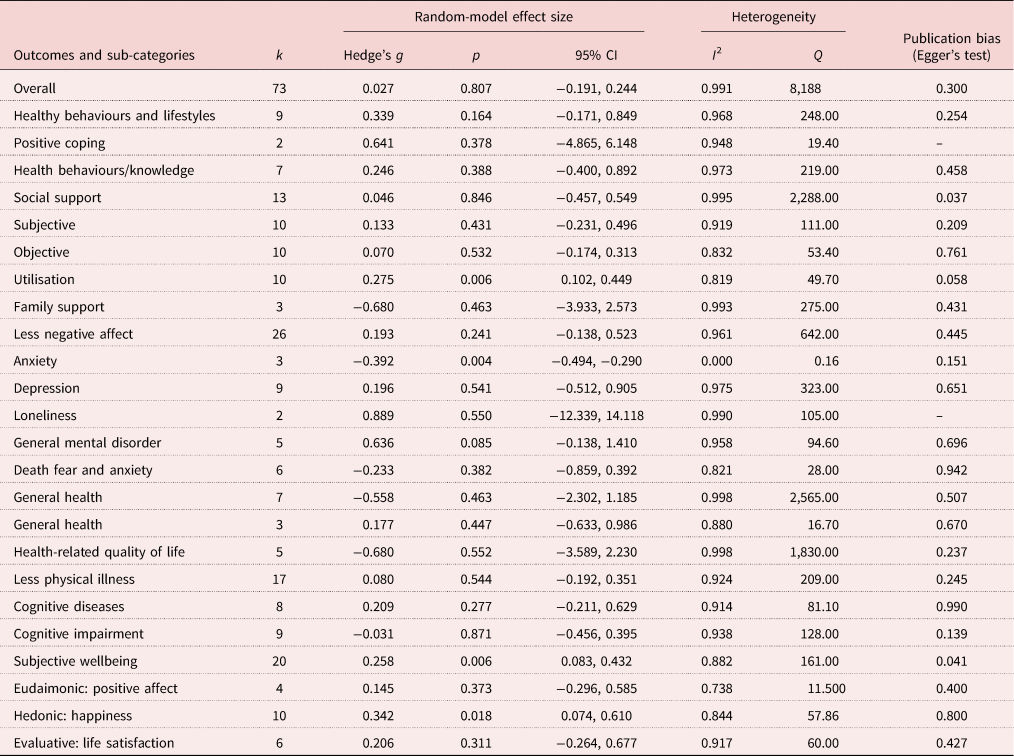
For easy interpretation, we recoded all the effect sizes in the same direction, meaning that a positive effect size indicates better health and wellbeing, and a negative effect size indicates worse health and wellbeing. We first computed a pooled effect size of all the included studies. Of the 76 studies, four studies used the same secondary data-set. We chose the one with the largest sample size for the pooled effect size calculation, resulting in 73 studies in total included in the calculation of effect sizes. As shown in Table 3, the pooled effect size is not significant (Hedge's g = 0.027, 95% CI = −0.191, 0.244; p = 0.807). The I 2 indicates a large heterogeneity among the included studies (I 2 = 99.1%, p < 0.0001).
Effect sizes, heterogeneity and publication bias of health-related outcomes

Note: CI: confidence interval.
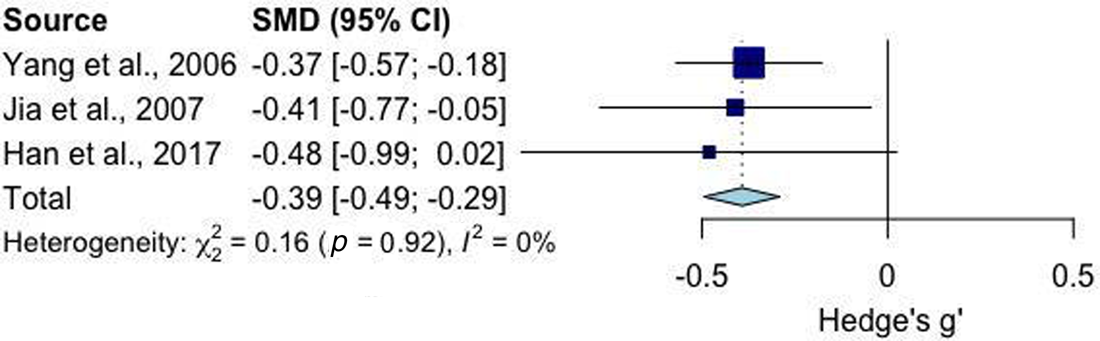
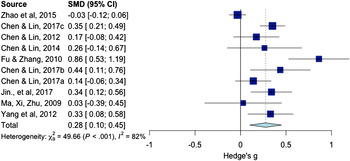
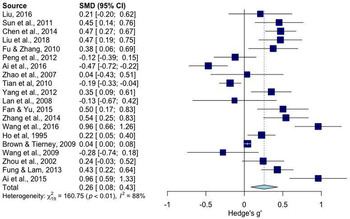
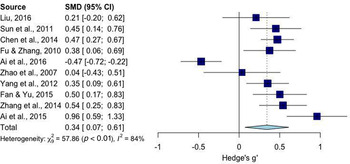
Table 3 also shows the effect size and heterogeneity information about studies under each category and sub-category. Most of the effect sizes are positive but among the six outcome categories, only the effect size of subjective wellbeing was significant (k = 20, g = 0.258, p = 0.006, 95% CI = 0.083, 0.432). Among the sub-categories, the religious group was significantly higher in (a) utilisation of social support (k = 10, g = 0.275, p = 0.006, 95% CI = 0.102, 0.449); (b) anxiety (k = 3, g = −0.392, p = 0.004, 95% CI = −0.494, −0.290); (c) happiness (k = 10, g = 0.342, 95% CI = 0.074, 0.612; p = 0.018). The significant relationships are shown in Figures 2–5.
Religiosity and anxiety (k = 3).

Religiosity and utilisation of social support (k = 10).

Religiosity and subjective wellbeing (k = 20).

Religiosity and happiness (hedonic wellbeing) (k = 10).

Moderators
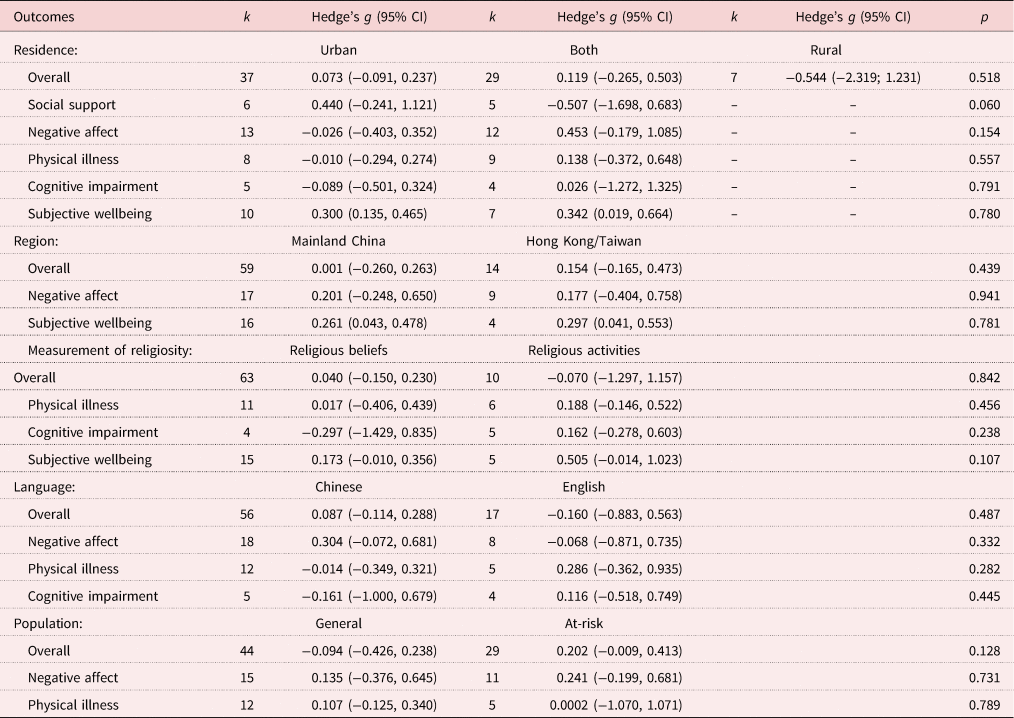
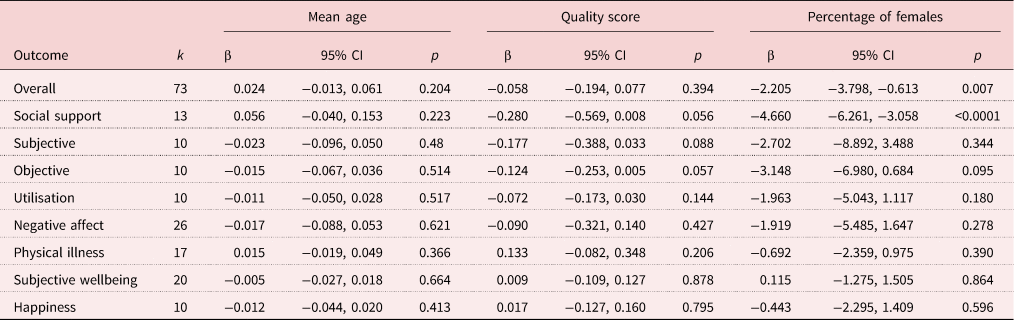
The results of sub-group analysis and meta-regression are shown in Tables 4 and 5. The percentage of females was the only significant moderator in the relationship between religiosity and the pooled health outcomes (k = 73) and social support (k = 13). A higher percentage of females is related to lower effect size (β = −2.205, 95% CI = −3.797, −0.613; p = 0.007) in the pooled sample. The percentage of females accounted for 9.31 per cent of the heterogeneity of the relationship between religiosity and the pooled health outcomes (R2 = 9.31%). A higher percentage of females is also related to lower effect size in the social support (β = −4.660, 95% CI = −6.261, −3.058; p < 0.0001). The percentage of females accounted for 79.25 per cent of the heterogeneity of the relationship between religiosity and social support (R 2 = 79.25%).
Results of sub-group analysis

Note: CI: confidence interval.
Results of meta-regression

Note: CI: confidence interval.
Publication bias
Table 3 shows the results of Egger's test, indicating the publication bias related to each significant outcome. The p-values smaller than 0.1 indicate that the relationship between religiosity and social support, utilisation of social support and subjective wellbeing are subject to potential risks of publication bias.
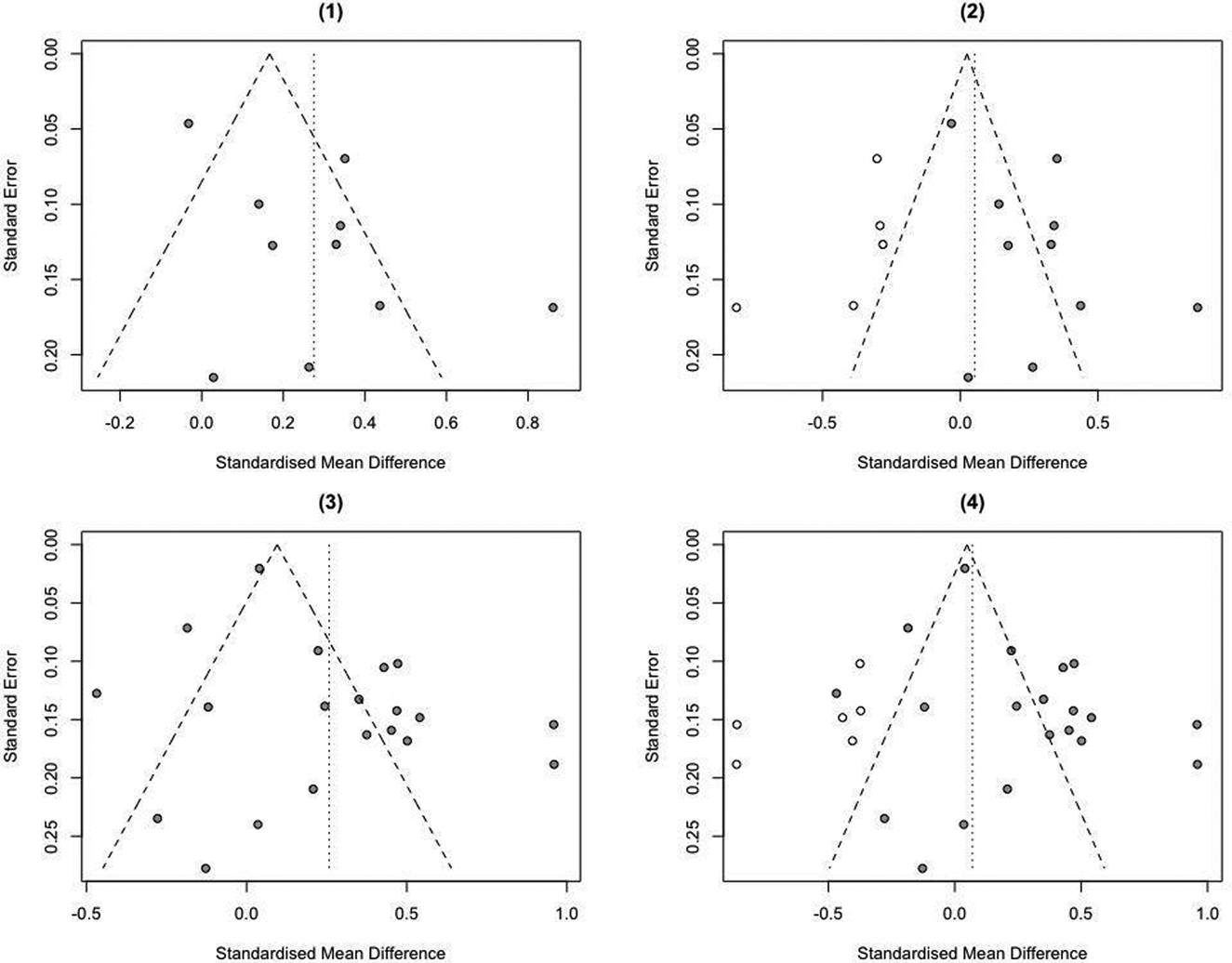
We used the trim and fill method to calculate the bias-corrected effect sizes between (a) religiosity and utilisation of social support and (b) religiosity and subjective wellbeing. As shown by the funnel plots, it is apparent that there are publication biases that studies with positive effect sizes are over-represented. After performing the trim and fill method by filling in the missing studies, the difference between religious and non-religious groups in utilisation of social support became statistically non-significant (g = 0.053, 95% CI = −0.174, 0.280; p = 0.627) after adding five studies by the trim and fill method. The difference between two groups in subjective wellbeing also became statistically non-significant (g = 0.070, 95% CI = −0.127, 0.267; p = 0.472) after adding six studies via the trim and fill method. Figure 6 visualises the trim and fill method to adjust for the publication bias.
Publication bias adjusted by the trim and fill method: (1) utilisation of social support (before trim and fill); (2) utilisation of social support (after); (3) subjective wellbeing (before trim and fill); and (4) subjective wellbeing (after).

Discussion
This meta-analysis aimed to explore the religion–health relationship by comparing the health disparities between non-religious and religious older Chinese people. Bonelli and Koenig's (Reference Bonelli and Koenig2013) review of Western studies before 2010 found a generally positive relationship between religiosity and a wide range of health outcomes, including depression, stress-related disorders, suicide and dementia. However, in the present study, even though the effect sizes were mostly in a positive direction, among all the health outcomes examined, there were significant differences in anxiety and happiness only between non-religious and religious older Chinese people. The effect sizes ranged from small to moderate. The non-significant statistical differences in other health outcomes reviewed in this study echo some recent studies showing that religious people do not necessarily have better health conditions after considering the complex nature of religiosity, such as the certainty of the belief (Galen and Kloet, Reference Galen and Kloet2011), and controlling other confounding factors such as personality traits and virtues (Schuurmans-Stekhoven, Reference Schuurmans-Stekhoven2011, Reference Schuurmans-Stekhoven2017, Reference Schuurmans-Stekhoven2018).
On the one hand, we found that Chinese older adults who have religious beliefs or participate in religious activities have a higher level of happiness than their peers who have no religious beliefs or involvement. Previous research has provided evidence to demonstrate the theoretical mechanisms of the relationship between religiosity and happiness among older adults. For example, as argued by Lim and Putnam (Reference Lim and Putnam2010), religious settings can provide social capital that can contribute to an individual's happiness better than the social network in general. Other mechanisms include the social control over one's lifestyle, the patterned engagement the individuals get from regularly attending religious activities (Ellison and George, Reference Ellison and George1994) and the meanings individuals attached to the ritualistic events when attending churches (Ellison, Reference Ellison1995). Krause et al. (Reference Krause, Ironson and Hill2018) proposed that religiously involved people are more likely to be compassionate, and these compassionate individuals would be willing to provide emotional support to significant others, which made them tend to be happier. There is also a possibility of reverse causation that positive moods may make people less sceptical and make it easier to believe in a religion (Forgas and East, Reference Forgas and East2008).
On the other hand, there were no significant differences between the religious and the non-religious groups in the other two types of subjective wellbeing: evaluative or eudaimonic wellbeing. This may be because different components of subjective wellbeing reflect different types of life experiences, and therefore have different correlates. According to a multi-national study conducted by Deaton and Stone (Reference Deaton and Stone2013), evaluative subjective wellbeing is more strongly and stably influenced by factors such as income and education, while happiness is more influenced by religiosity. The null finding for religiosity and eudaimonic wellbeing is probably because Chinese people lean more towards extrinsic religious orientation, instead of intrinsic religiosity (Allport and Ross, Reference Allport and Ross1967). It is common in China that people only visit temples or pray when bad things happen. Intrinsic religious orientation mainly refers to ‘a meaning-endowing framework in terms of which all of life is understood’ (Donahue, Reference Donahue1985: 400) in which an individual ‘lives his [sic.] religion’ (Allport and Ross, Reference Allport and Ross1967: 434), while extrinsic religious orientation usually means that people ‘use his [sic.] religion’ (Allport and Ross, Reference Allport and Ross1967: 434) to try to achieve external rewards, including social support. According to empirical studies (e.g. Ardelt, Reference Ardelt2003; Mahmoodabad et al., Reference Mahmoodabad, Ehrampoush, Tabei, Nami, Fallahzadeh, NamavarJahromi, Shayan and Forouhari2016), an intrinsic religious orientation is significantly positively correlated with positive meaning and purpose of life, while extrinsic religious orientation was negatively or non-significantly related with these outcomes. These patterns were also found in the Chinese population (Liu and Koenig, Reference Liu and Koenig2013).
Chinese older people having a religious belief or attending religious activities reported a significantly higher level of anxiety. One tentative explanation is that while religion can be a resource, it is also entangled with neurotic and psychotic disorders due to guilt, self-blame or frustration when trying to live up to the high standards ruled by the religious doctrines (Koenig, Reference Koenig2009). Another tentative explanation is the reverse causal relationship between religiosity and health. People may appeal to religion when they face health problems. For instance, people are more likely to seek meaning or calmness from religion when they are anxious (Y Chen et al., Reference Chen, Wang, Weng and Wang2012).
Studies with a higher percentage of female participants tend to report a smaller effect size in the overall outcomes and social support, specifically, indicating that there is a smaller gap among female religion believers and non-believers. It is a bit surprising because it is commonly considered that females are more likely than males to be religious and attend religious activities more frequently so that they may benefit more from religion, as found by Jung (Reference Jung2014). Despite this, this study is consistent with a previous study conducted among older Americans showing that older men received more benefits from religious involvement than older females. The underlying explanation for this may be that religion may provide more exclusive support for older males rather than females. Females can gain emotional and social support from a broader range of sources than males (McFarland, 2009). Another tentative explanation is that even though older women tend to be more religious than men, they participated in different types of religious activities. Older women in China tend to have a lower educational level than men, so they are more likely to be involved in ritual activities such as temple visiting or praying at home. On the other hand, men who are better educated are more likely to be involved in more complicated activities such as organising events and being involved in scriptural discussion that may have larger effects on their mental health (Zhang, Reference Zhang2010). As this study is cross-sectional, the gender differences in the effect size may not be due to the differentiating benefits of religions on females and males, there is a possibility of inverse causality that females’ and males’ health status may influence their religiosity differently. Such uncertainty calls for future longitudinal or experimental studies.
Limitations and strengths
This study carries some limitations. First and foremost, most of the studies included in this study are cross-sectional and bi-variate, so we could not examine any mechanisms shaping the health disparities between the religious and non-religious groups. It is worth emphasising that the effect sizes computed in this study only demonstrated the health differences between religious and non-religious Chinese older people, instead of how religion can influence people's health. The positive relationship between religion and happiness found in this study should not be interpreted simply as a belief-as-benefit effect because we did not control for other confounding factors. Some scholars note that the apparent role of religion in improving health might be over-estimated or even illusory without taking into consideration other covariates. For instance, some multivariate analyses have shown that the pro-social personality traits or virtues common among religious people, such as kindness, conscientiousness and agreeableness, can contribute to people's health and wellbeing to a larger extent than believing in religion itself (Schuurmans-Stekhoven, Reference Schuurmans-Stekhoven2011, Reference Schuurmans-Stekhoven2017, Reference Schuurmans-Stekhoven2019). A study among Japanese older people found that the religiosity–health impacts are significantly weakened after controlling for agreeableness and conscientiousness (Schuurmans-Stekhoven, Reference Schuurmans-Stekhoven2019). Given these non-confirmatory findings, future studies should adopt more robust research designs, such as longitudinal and experimental, and a multivariate data analysis approach to avoid any exogeneity issues when estimating the real role of religion in shaping older people's health (Schuurmans-Stekhoven, Reference Schuurmans-Stekhoven2011).
Second, religion is a complex concept, but most studies reviewed in this meta-analytic investigation examined the yes/no status of the participants’ religious belief or participation. The simple measures of yes/no may not accurately capture the truthful religious involvement of Chinese older people, and therefore the health differences between religious believers and non-believers found in this study should be interpreted with caution. This simplified measurement of religiosity overlooked the extent to which individuals adhere to religion. Previous studies have shown an inverse U-shaped religion–health connection (Galen and Kloet, Reference Galen and Kloet2011; Brammli-Greenberg et al., Reference Brammli-Greenberg, Glazer and Shapiro2018). Galen and Kloet (Reference Galen and Kloet2011) have found there is a curvilinear relationship between religiosity and mental health; specifically, non-religious people with a high certainty have a more advantageous health status than those religious believers with a low level of certainty. Moreover, due to the relatively strict national policies on religion regulation in China and the stigmatisation among the public towards religion, which is often considered as superstitious (Yang, Reference Yang2013), the prevalence of religious people may be underestimated in these studies. In addition, while some people do not report having a religious belief, it is relatively common in China that a large percentage of people attend folk religious activities (Yang and Hu, Reference Yang and Hu2012). Scholars have proposed that ‘as much as 80 percent of China's population may be termed “religious” if customary beliefs and practices in the countryside are included’ (Boyle and Sheen, Reference Boyle and Sheen2013: 177). However, the information about Chinese people's folk religion beliefs and practices are difficult to obtain, not only because ‘folk religion’ is hard to define, but also because religion is a private issue and at most times politically sensitive in China. Therefore, social surveys usually do not include such questions and people are reluctant to disclose such information to others, especially strangers, such as the social survey interviewers. To address these limitations, future studies should develop more culturally appropriate and acceptable tools to explore more details about Chinese people's religiosity and its implications for their health and wellbeing (Liu and Koenig, Reference Liu and Koenig2013). In addition, future studies should also investigate whether different measurements and constructs of health and wellbeing can modify the religion–health connection.
Third, this study only reviews quantitative evidence, and therefore it could not reflect the qualitative evidence regarding Chinese older adults’ perspectives about their religiosity, ageing and health. Such qualitative studies could be helpful to make sense of the underlying mechanisms of the health (in)differences found between non-religious and religious older people found in this study. Future studies should try to synthesise qualitative evidence to capture a more complex picture of the interaction between Chinese older adults’ ageing, religiosity and health.
Despite the limitations, this study has some strengths. First, to the authors’ knowledge, the study is among the first meta-analytical studies to quantify the health disparities between older religion believers and non-believers in China. This study represents a preliminary effort to synthesise existing evidence on the relationship between Chinese older people's religiosity and health. The health-related gap between religious and non-religious older people proven in this study warrants future research to investigate the mechanisms underlying this phenomenon. Second, it identifies research gaps in Chinese gerontological research regarding the role of religiosity in shaping older people's health and well-being. Western studies have shown that religion plays an increasingly important role in people's lives as they age, but gerontological studies in China have paid minimal attention to it. According to our review, in existing gerontological studies in China, religion has been mostly adopted as a covariate alongside other factors and receives little specific attention. This is problematic as religious coping could be an important resource for older adults to cope with adversities in life, and it deserves closer investigation. Moreover, even though multi-domain measures of religiosity are needed (Levin and Chatters, Reference Levin and Chatters1998), the Chinese gerontological literature predominantly adopted a single item. As suggested by Chao and Yang (Reference Chao and Yang2018), such dichotomous measures are only applicable to monotheistic believers of Western religions, and may not be valid to capture the syncretic religiosity of Buddhists, Hindus, folk religions and other new spirituality.
In conclusion, R/S has become increasingly prevalent in China, especially among the older population, and constitutes an important dimension of their ageing experiences. Religion can be an essential source of life meaning, emotional support and coping resources for older people facing late-life adversities. However, there is ongoing uncertainty about the influence of religion on older people's health and wellbeing. Different from most reviews of Western evidence, religious Chinese older adults were revealed to experience both health advantages and disadvantages in this study. However, due to the nature of a cross-sectional and bi-variate review, this study could not capture the underlying mechanisms. Future research desperately needs to be conducted to explore the complex relationship between religiosity and health.
Supplementary material
The supplementary material for this article can be found at https://doi.org/10.1017/S0144686X20000835.
Financial support
This research received no specific grant from any funding agency, commercial or not-for-profit sectors.
Conflict of interest
The authors declare no conflicts of interest.
Ethical standards
There were no first-hand data collected and thus an ethical application was not required.