Several decades of research have relied on the Adult Attachment Interview (AAI) as the gold standard assessment of adolescent attachment security (Allen & Land, Reference Allen, Land, Cassidy and Shaver1999; Allen, Porter, McFarland, McElhaney, & Marsh, Reference Allen, Porter, McFarland, McElhaney and Marsh2007). These studies have repeatedly found associations between secure or autonomous state of mind and a variety of adaptive outcomes, including social competence, emotion regulation, ego resilience, and problem solving (Allen, Reference Allen, Cassidy and Shaver2008; Kobak & Sceery, Reference Kobak and Sceery1988; Zimmerman & Becker-Stoll, Reference Zimmermann and Becker-Stoll2002). Although the AAI assesses important self-regulatory aspects of adolescent and adult personality (Allen & Miga, Reference Allen and Miga2010; Hesse, Reference Hesse2008; Kobak & Zajac, Reference Kobak, Zajac, Cicchetti and Roisman2011; Warmuth & Cummings, Reference Warmuth and Cummings2015), less is known about how caregiver–adolescent communication maintains secure, insecure, and disorganized patterns of adolescent attachment. In this paper, we examine the Goal-Corrected Partnership Adolescent Coding System (GPACS), an observational system designed to rate secure and atypical dimensions of interaction in adolescence (Obsuth, Hennighausen, Brumariu, & Lyons-Ruth, Reference Obsuth, Hennighausen, Brumariu and Lyons-Ruth2014). The goals of this study are twofold. First, we will evaluate whether the degree of security in caregiver–teen interaction at age 13 has concurrent and predictive validity in accounting for adolescents’ psychosocial adaptation with measures that include functional emotion regulation, AAI classification, and teachers’ ratings of social competence. Second, we will examine how three atypical GPACS patterns, namely, punitive, role confused, and disoriented, account for increased risk for internalizing, externalizing, and risk behaviors, including unprotected sexual activity and substance use problems from early to middle adolescence.
Caregiver–Adolescent Attachment as a Goal-Corrected Partnership
As attachment studies have moved beyond infancy and early childhood, investigators have begun to account for how the child's growing capacities for autonomy and self-regulation alter the processes for maintaining a secure attachment bond. Bowlby (Reference Bowlby1982/1969) described this later developmental phase in the attachment relationship as a goal-corrected partnership in which language and perspective-taking abilities allow the child to become an active partner in negotiating goal conflicts and arriving at joint plans (Marvin & Britner, Reference Marvin, Britner, Cassidy and Shaver1999). During the goal-corrected partnership stage, the child's security (i.e., their confidence in the caregiver's availability) is maintained by open communication (Bowlby, Reference Bowlby1988) and cooperative discussions of goal conflicts that communicate each person's goals while respectively acknowledging their partners’ point of view (Kobak & Duemmler, Reference Kobak, Duemmler, Bartholomew and Perlman1994). By early childhood, the cooperative and shared positive emotion reported in mutually responsive dyads (Kochanska, Reference Kochanska1997, Reference Kochanska2002) typify secure caregiver–child relationships that, in turn, have been associated with the child's developing psychosocial competencies such as effortful control (Kochanska, Coy, & Murray, Reference Kochanska, Coy and Murray2001; Kochanska, Forman, Aksan, & Dunbar, Reference Kochanska, Forman, Aksan and Dunbar2005) and empathy (Sroufe, Reference Sroufe and Perlmutter1983).
Studies of early school-age children illustrate how the move to a goal-corrected partnership results in new dyadic patterns for maintaining the attachment bond. Main and Cassidy (Reference Main and Cassidy1988) identified individual differences in dyads among 5- to 7-year-old children and their caregivers. Secure dyads were generally characterized by cooperative engagement in which the child initiated conversation with the parent or was highly responsive to the parent's initiatives. In addition, striking transformations in relationships were noted among children who had been coded as disorganized as infants in the Strange Situation. These children tended to display controlling behavior toward the parent during the laboratory reunion at age 6 years. These controlling patterns took both a hostile form in which the child actively devalued the parent and a caregiving form in which the child assumed an overly bright or entertaining role in relation to the parent. Subsequent studies of early elementary age children indicate that these controlling patterns are relatively stable (r = .47; Moss, Cyr, Bureau, Tarabulsy, & Dubois-Comtois, Reference Moss, Cyr, Bureau, Tarabulsy and Dubois-Comtois2005) and that children who display these behaviors are at increased risk for both internalizing and externalizing behaviors (Moss et al., Reference Moss, Smolla, Cyr, Dubois-Comtois, Mazzarello and Berthiaume2006), as well as poor academic achievement (Moss & St.-Laurent, Reference Moss and St.-Laurent2001). Subsequent follow-up of this sample suggested that the subtype controlling/punitive pattern assessed at school age accounted for externalizing behaviors at age 13 as reported by adolescents but not their caregivers (Lecompte & Moss, Reference Lecompte and Moss2014).
By early adolescence, children's ability to maintain a cooperative goal-corrected partnership is tested by their growing need for autonomy (Allen, Reference Allen, Cassidy and Shaver2008; Smetana, Reference Smetana, Cicchetti and Toth1996; Sroufe, Reference Sroufe1991). Studies of parent–adolescent discussions of goal conflicts generally indicate that balanced or cooperative exchanges in early adolescence promote the emergence of a secure state of mind in the AAI at age 19 years (Roisman, Padrón, Sroufe, & Egeland, Reference Roisman, Padrón, Sroufe and Egeland2002; Sroufe, Egeland, Carlson, & Collins, Reference Sroufe, Egeland, Carlson and Collins2005). Further, maternal behaviors that supported both autonomy and relatedness at age 14 were associated with adolescents’ coherence ratings in the AAI at age 26 (Allen & Hauser, Reference Allen and Hauser1996). Although there was only modest continuity between infant attachment security and AAI states of mind 26 years later, some of the discontinuity in attachment organization was accounted for by age 13 parent–adolescent interactions (Sroufe et al., Reference Sroufe, Egeland, Carlson and Collins2005). Insofar as developing autonomy and individual identity is a central task of adolescence, these studies suggest that a cooperative caregiver–adolescent partnership plays a unique role in supporting the adolescents’ security in exploring thoughts and ideas that may differ from those of their parents.
Less is known about patterns of parent–adolescent interactions that clearly deviate from secure and cooperative exchanges. Although a number of studies have investigated the relation between hostility in parent–adolescent interactions and maladaptive outcomes (Conger, Ge, Elder, Lorenz, & Simons, Reference Conger, Ge, Elder, Lorenz and Simons1994; Kobak, Cole, Ferenz-Gillies, Fleming, & Gamble, Reference Kobak, Cole, Ferenz-Gillies, Fleming and Gamble1993; Patterson, Reference Patterson1982), very few studies have identified other atypical or disorganized patterns of parent–adolescent interaction. In one notable exception, Sroufe et al. (Reference Sroufe, Egeland, Carlson and Collins2005) used an age 13 measure of parent–adolescent “boundary dissolution” to account for increases in adolescent risk behaviors from early adolescence to age 16. They noted that, whereas their measures of boundary dissolution were keyed to parental behavior during infancy and toddlerhood, boundary problems were also evident in the child's behavior by the age 13 assessment. These boundary problems share some structural similarity to the controlling patterns identified by Main and Cassidy (Reference Main and Cassidy1988), insofar as both indicate a role-reversed pattern in which the parent abdicates the caregiving role in the interaction. Other types of nonoptimal patterns in adolescent–caregiver interaction have yet to be described. Yet there is the possibility that certain types of nonoptimal caregiver–adolescent relationships create particular profiles of maladaptive behavior over the course of adolescence.
The GPACS
The GPACS was designed to address the need for an observational coding system that can distinguish between secure and atypical patterns of parent–adolescent interaction (Obsuth et al., Reference Obsuth, Hennighausen, Brumariu and Lyons-Ruth2014). Beginning with the notion that a secure caregiver–adolescent relationship can be conceptualized as a cooperative goal-corrected partnership, the system was developed to assess interactions that occurred during a discussion of a goal conflict. In addition to coding a secure cooperative pattern, GPACS scales were also developed to assess three atypical dyadic patterns. Building on Main and Cassidy's (Reference Main and Cassidy1988) observations of 6-year-old children, GPACS scales were developed to capture the presentation in adolescence of both a punitive/hostile pattern and a caregiving/controlling pattern. Additional scales were developed to assess disorientation in interaction, as revealed through odd, out of context, or inexplicable behavioral sequences, such as freezing in the middle of an ongoing dialogue. In contrast to coding systems that focus exclusively on the child's behavior, the GPACS scales rated both the adolescent's and the caregivers’ behavior during discussion of a goal conflict.
Obsuth et al. (Reference Obsuth, Hennighausen, Brumariu and Lyons-Ruth2014) took an important step toward validating the GPACS coding system in their longitudinal study of late adolescents from economically disadvantaged families. Confirmatory factor analyses yielded four dyadic constructs: a secure/cooperative pattern along with three atypical patterns: punitive/control, role confused, and disoriented. The three disorganized or atypical patterns were associated with a range of maladaptive antecedent and concurrent outcomes that included disorganized attachment, partner abuse, and psychopathology. Assessment of atypical patterns of interaction may be particularly important in samples of high-risk or economically disadvantaged families that have higher rates exposure to trauma, family instability, and attachment disruptions (Ackerman, Brown, & Izard, Reference Ackerman, Brown and Izard2004; Adam & Chase-Lansdale, Reference Adam and Chase-Lansdale2002). These poverty cofactors also likely contribute to the increased prevalence of disorganized attachment that has been observed in high-risk samples (van IJzendoorn, Schuengel, & Bakermans-Kranenburg, Reference van IJzendoorn, Schuengel and Bakermans-Kranenburg1999).
The current study will test two major sets of hypotheses. The first set focuses on whether GPACS secure/cooperative interactions promote adaptation in a high-risk sample. These hypotheses test a central theoretical claim that has guided much of attachment research, namely, that a secure attachment relationship will promote the child's developing autonomy and capacities for successfully coping with challenge. This hypothesis will be tested in three domains of adolescent functioning: (a) emotion regulation during the conflict discussion; (b) states of mind in the AAI; and (c) teacher ratings of social skills, empathy, and internalizing and externalizing problems. With respect to emotion regulation, we expect that adolescents who engage in more secure/cooperative interactions will demonstrate more capacity for emotional engagement without accompanying anger, distress, or sadness. With regard to the AAI, based on prior studies (Allen & Manning, Reference Allen and Manning2007; Sroufe et al., Reference Sroufe, Egeland, Carlson and Collins2005), we expect that dyadic security at age 13 years will increase the likelihood that the adolescent will show a secure or autonomous state of mind in the AAI at age 15. Finally, with respect to internalizing and externalizing problems, we expect that dyadic security will promote empathy and social competence and reduce risk for problems between early and middle adolescence.
The second set of hypotheses address the incremental validity of atypical patterns of caregiver–adolescent attachment. First, we examine whether the atypical GPACS scales account for behavioral or adjustment problems after controlling for the secure/cooperative scale. Second, concurrent and prospective analyses test for differential patterns of risk in relation to internalizing symptoms, externalizing symptoms, or risk behaviors, including unprotected sexual activity and substance use problems. Third, we consider whether different atypical patterns of interaction represent a continuum of risk for problems in adaptation. This continuum model has emerged from the infant and child attachment literatures in which disorganized attachment is often associated with increased risk for adjustment difficulties when compared with organized patterns of attachment (Kobak, Cassidy, Lyons-Ruth, & Ziv, Reference Kobak, Cassidy, Lyons-Ruth, Ziv, Cicchetti and Cohen2006). Therefore, it was proposed that disoriented patterns of interaction in early adolescence might predict the most maladaptive outcomes.
Method
Participants
Data were collected from 186 economically disadvantaged adolescents (92 female, 88 male) and their caregivers, who were recruited to take part in a longitudinal investigation of risk for adolescent psychopathology. Twenty families were lost to attrition between the age 13 and age 15 year data collection, leaving a final sample of 166 families with complete data at both times. At the age 13 year assessment, adolescents ranged in age from 12 to 14 (M = 13.2). Of the participants, 77% were African American, 21% were European American, and 2% were Hispanic. Families had an average household income of $27,250 (SD = $22,829), and 27% of the families received welfare payments. A majority (56.7%) of the families had a single caregiver, 21% of the families included two biological parents, and 20.7% included a primary caregiver and a live-in boyfriend. In terms of their relationships with the adolescents, caregivers were 87% biological mothers, 7% grandmothers, 3% biological fathers, and 3% aunts or foster mothers.
Procedure
Dyads were recruited from two sources of economically disadvantaged families. Ninety-five families were recruited from an earlier longitudinal study of children who had participated in Head Start (Ackerman, Kogos, Youngstrom, Schoff, & Izard, Reference Ackerman, Kogos, Youngstrom, Schoff and Izard1999), and 91 families were recruited from families of 13-year-old children who met federal income guidelines for free and reduced-priced lunch. Initial interviews were conducted with families during a home visit that lasted between 1 and 2 hr and were followed within a 2- to 4-week period by a laboratory visit. Lab visits lasted between 2.5 and 3 hr and included a videotaped reunion and parent–teen conflict discussion. Within 6 months of the lab visit, teens were interviewed at their school and both self-reports and teacher reports of adjustment and behavior problems were collected. When teens’ reached their 15th birthday, families participated in a second wave of assessments that included home and lab visits and teacher ratings of adolescents’ behavior problems. Adolescents were interviewed with the AAI during the laboratory visit at age 15 years, and teachers provided ratings of student adjustment within 6 months of the lab visit. The measures reported within the context of this study are a subset of the measures collected as part of the larger study.
Reunion and parent–adolescent conflict discussion
Laboratory visits at age 13 years began with a brief 5-min introduction to the lab protocol. Caregivers and teens were then taken to separate rooms to complete interviews and questionnaires. At the end of the interview session, the caregivers and adolescents separately completed an Issues Checklist on which they rated topics that they viewed as sources of disagreement in their relationship with the other person. After both interviews were complete, the caregiver and teen were reunited. The 5-min reunion was followed by two counterbalanced 5-min conflict discussions (one discussion of the caregiver's topic and a second discussion of the teen's topic), a 10-min coconstruction of memory task, and a 10-min joint puzzle-solving exercise. All interactions were videotaped, and copies of the reunion and conflict discussions were sent to Dr. Karlen Lyons-Ruth's laboratory where they were coded by GPACS raters who were blind to all other measures in the study.
Measures
Demographic interview
During the initial home visit, a demographic interview was administered to caregivers to assess household income, number of children in the household, caregiver's relation to child, child's ethnicity, and level of education.
GPACS rating scales
The GPACS (Lyons-Ruth, Hennighausen, & Holmes, Reference Lyons-Ruth, Hennighausen and Holmes2005) is designed to code videotapes of a 10-min discussion of a topic of conflict between adolescent and parent. The GPACS includes 12 scales. Brief scale descriptions, descriptive statistics and interrater reliabilities follow. Collaborative communication measures balanced and reciprocal interactions that lead to a steady and developing exchange of ideas. A rating of 1 is assigned when one party dominates the entire discussion and the other never clearly expresses feelings. Ratings of 5 are assigned to dyads in which both caregivers and adolescents elaborate their positions in a comfortable, constructive, and spontaneous manner (M = 2.48, SD = 0.86, intraclass correlation [ICC] = 0.88). Warmth/valuing assesses the expression of warmth, care, valuing statements, and positive regard shared between the parent and adolescent. A rating of 1 is assigned to dyads that lack any warm or valuing behaviors. A rating of 5 is assigned when there is considerable warmth and positive regard, giving the sense that this might be a natural mode of interaction for the pair (M = 2.53, SD = 0.84, ICC = 0.77). Caregiver validation of adolescent's voice rates caregiver openness and responsiveness to the adolescent's statements, opinions, and initiatives. A rating of 1 is assigned when a caregiver actively invalidates or overrides the adolescents’ initiatives. A rating of 5 is assigned to a caregiver who actively and appropriately elicits the adolescent's feelings and opinions (M = 2.44, SD = 0.93, ICC = 0.76). Caregiver's hostile/punitive/devaluing behavior assesses the extent to which the caregiver behaves in a hostile, punitive, and/or devaluing way toward the adolescent. A low score on this scale is assigned in the absence of hostile comments while a high score is assigned to caregivers who exhibit a preponderance of overt or indirect hostile, punitive, or devaluing behaviors (M = 2.47, SD = 1.02, ICC = 0.96). Caregiver's role confused behavior measures the extent to which the parent does not assume or abdicates a parental stance toward the adolescent. A low score is assigned to caregivers who show no signs of role confused behavior and a high score is assigned to caregivers who are clearly and consistently role confused in relation to the adolescent and may at times respond to the adolescent as a parental figure (M = 2.06, SD = 0.98, ICC = 0.77). Caregivers’ odd or out-of-context/contradictory behavior assesses the extent to which the caregiver makes odd, out-of-context, or contradictory remarks and/or engages in odd, out-of-context, or contradictory behavior. Low scores are assigned when such behavior is absent from the interaction while high scores are assigned to caregivers to display frequent and pervasive odd, out-of-context behavior (M = 1.47, SD = 0.81, ICC = 0.82). Caregiver's distracted, disoriented, or inwardly absorbed behavior measures the extent of the parent's distracted, disoriented, and/or inwardly absorbed behavior that may indicate a momentary shift in or collapse of the caregiver's strategy during the interaction. Low scores are assigned in the absence of such behavior while high scores are assigned to caregivers who are pervasively distracted or inwardly absorbed and are rarely able to participate productively in the interaction (M = 1.55, SD = 0.89, ICC = 0.76). Adolescent advances own view assesses the adolescent's ability to maintain balanced contributions in the dialogue demonstrated by the adolescent's ability to contribute, advance, and support his/her view clearly, directly, and respectfully. Low scores are assigned to adolescents who appear completely unable to contribute, advance, or support any position in the dialogue. High scores are assigned to adolescents who demonstrate notable ease and comfort in consistently contributing, advancing, and supporting his/her view (M = 2.81, SD = 0.85, ICC = 0.84). Adolescent's hostile, punitive, or devaluing behavior assesses the extent to which the adolescent behaves in a hostile, punitive, and/or devaluing way toward the parent. A rating of 5 is assigned when adolescents’ hostile behavior is a pervasive feature of the interaction while low scores are assigned to adolescents who display no hostile behavior (M = 2.03, SD = 0.92, ICC = 0.74). Adolescent's caregiving, organizing, or entertaining behavior measures the extent to which the adolescent tries to manage, take care of, and/or appease the caregiver by assuming responsibility for structuring or managing the interaction. Scores of 5 are assigned to adolescents who actively and consistently manage, take care of, and/or try to appease the parent (M = 1.84, SD = 0.92, ICC = 0.71). Adolescent's odd, out-of-context, or contradictory behavior assesses the extent to which the adolescent makes odd, out-of-context, or contradictory remarks and/or engages in odd, out-of-context, or contradictory behavior. Such behavior and/or remarks may seem disjointed, startling, possibly inexplicable, and difficult for an observer to understand (M = 1.77, SD = 1.00, ICC = 0.93). Adolescent's distracted, disoriented, or inwardly absorbed behavior measures the amount of distracted, disoriented, or inwardly absorbed behavior that may indicate a momentary shift in or collapse of the adolescent's strategy (M = 1.76, SD = 0.82, ICC = 0.78).
Affect coding
A portion of the Family and Peer Process Coding System (Stubbs, Crosby, Forgatch, & Capaldi, Reference Stubbs, Crosby, Forgatch and Capaldi1998) was utilized to code adolescent affect during the 5 min of the conflict discussion about the area of disagreement chosen by the caregiver. One of seven possible affect codes (happy, caring, neutral, aversive, distress, sad, or disengaged) was assigned to 10-s intervals, generating 30 affect codes per adolescent. Happy affect was coded when the adolescent smiled, evidenced an excited voice tone, and exaggerated, expansive, or animated gestures. Caring affect was marked by a soft, warm, soothing voice tone, affectionate and tender movements, and facial expressions of understanding. Adolescents with neutral affect spoke in a flat, monotone voice, showed body language that was not expressive, and facial expressions that were bland. Sad affect was coded when the adolescent demonstrated a low or slow-paced voice tone, facial expressions such as pouting or frowning, and withdrawn or listless body language. Aversive affect was evidenced by a loud, gruff voice tone, forceful and threatening gestures, and facial expressions such as narrowed eyes, pursed lips, rolling eyes, or a clenched jaw. Distressed affect involved whining, stuttering, or a trembling voice, cowering or tense body posture, shaking or trembling body language, and raised eyebrows, grimacing, wincing, or expressions of pain. The disengaged code was added by the researchers of this project to capture adolescents who were inattentive, uninvolved, and avoided both eye contact and conversation with the caregiver. Two raters coded each 5-min conflict discussion and κs on individual codes ranged from 0.41 for sad affect to 0.72 for disengaged. Counts of the seven affects across the 30 intervals were created to index the extent to which each of the affects occurred during the 5-min interaction. Intercorrelation coefficients between raters’ counts were happy (0.78), caring (0.48), neutral (0.72), distress (0.48), aversive (0.70), sad (0.49), and disengaged (0.81). Affect counts were aggregated across raters and used in subsequent analyses.
AAI
The AAI (George, Kaplan, & Main, Reference George, Kaplan and Main1996) was administered to adolescents during the laboratory visit during the age 15 assessment. The AAI is a semistructured 60- to 90-min interview that focuses on memories of childhood experiences with attachment figures. Reliability and validity of the AAI are well established (Bakersman-Kranenburg & van IJzendoorn, Reference Bakermans-Kranenburg and van IJzendoorn1993; Crowell, Treboux, & Waters, Reference Crowell, Treboux and Waters2002). All AAIs were recorded and transcribed, and transcripts were coded using the AAI Q-sort (Kobak et al., Reference Kobak, Cole, Ferenz-Gillies, Fleming and Gamble1993) based on the Main and Goldwyn (Reference Main and Goldwyn1998) experience and state of mind scales. Two blind raters sorted 100 Q-sort items to describe each transcript. At least one of the two raters coding each transcript had attended a 2-week training workshop and passed reliability testing on the Main and Goldwyn (Reference Main and Goldwyn1998) coding method. If interrater reliability fell below 0.60 (Spearman–Brown formula), a third rater sorted the transcript and the highest two-rater correlation was used to form a composite description. A third rater was required on 45 (23%) transcripts. The average reliability for the composite Q-sorts across all transcripts was 0.82 (Spearman–Brown formula). Composited Q-sorts were correlated with prototype sorts for secure, dismissing, and preoccupied derived from the Main and Goldwyn (Reference Main and Goldwyn1998) system, resulting in continuous scores for each adolescent on all three dimensions.
Teacher ratings of internalizing and externalizing problems
Ratings of adolescents’ internalizing and externalizing behaviors were collected from teachers using the Child Behavior Checklist Teacher Report Form (Achenbach & Rescorla, Reference Achenbach and Rescorla2001). Two teachers (English and math) independently reported on each adolescent's behaviors by completing the Teacher Report Form within 6 months of the lab visits at the ages 13 and 15 waves of the study. A teacher's rating was obtained from 100% of the sample, and two teachers’ ratings were obtained for 73% of the sample at age 13 and for 53% of the sample at age 15. Cronbach αs for the current samples are presented for ages 13 and 15, respectively, aggression (0.95, 0.95), rule breaking (0.78, 0.84), anxiety/depression (0.80, 0.83), somatic complaints (0.61, 0.77), and withdrawal (0.88, 0.84). An externalizing composite score was computed by averaging the aggression and rule breaking scales. An internalizing composite score was computed by averaging the anxiety/depression, withdrawal, and somatic complaint scores. Using a composite of two teachers’ ratings would result in regression to the mean for that subset of our sample. As a result, we examined patterns of missing data for students with one versus two teacher ratings by coding “missing” (0) or “not missing” (1). The t tests with each predictor and outcome variable yielded no significant tests. As a result, data can be assumed to be missing at random. Based on the missing at random assumption, we imputed the second teacher rating using expectation maximization from SPSS at the subscale level based on the first teacher's scores. Teachers’ scores were then aggregated in order to increase reliability of the teacher ratings.
Teacher ratings of social competence
The peer relationships and empathy scales from the adolescent version of the Walker–McConnell Scale of Social Competence were used to assess adolescent social competence (Walker, Stieber, & Eisert, Reference Walker, Stieber and Eisert1991). The peer relations scale consisted of 15 items such as “makes friends easily,” “keeps conversations going with peers,” and “is socially perceptive.” Internal consistency of this scale was 0.91 at age 13 and 0.93 at age 15. The empathy scale consisted of 4 items such as “is considerate,” “shows sympathy,” and “listens while others are speaking.” Internal consistency on this scale was 0.81 at age 13 and 0.82 at age 15.
Adolescent risk behaviors: Substance use problems and sexual risk taking
Risk behaviors were assessed at age 13 and age 15 years with the Drug and Alcohol Use Questionnaire (Dishion & Loeber, Reference Dishion and Loeber1985) a 22-item self-report measure of the frequency and severity of the adolescent's cigarette, drug, and alcohol use, exposure to peers’ drug and alcohol use, and perceptions of interpersonal difficulties related to the use of drugs and alcohol (αs for the 22 items = 0.79 at age 13 and 0.83 at age 15). In addition, the Scale of Sexual Risk-Taking (Metzler, Noell, & Biglan, Reference Metzler, Noell and Biglan1992) is a 13-item measure of the frequency of engagement in unprotected sexual intercourse and sexual behaviors (αs = 0.56 at age 13 and 0.64 at age 15). Factor analyses of the four subscales from the Drug and Alcohol Use Questionnaire and the Scale of Sexual Risk-Taking produced a single factor solution with factor loadings ranging from 0.68 to 0.82 at age 13 and 0.71 to 0.84 at age 15. The factor score was used to index overall risk behaviors at both assessments.
Results
Preliminary analysis
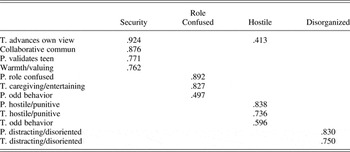
A factor analysis was conducted to reduce the 12 GPACS scales to a smaller set of discrete dimensions of dyadic interaction that replicated Osbuth et al.’s (2014) confirmatory factor analysis in their sample of late adolescents. The exploratory factor analysis with an oblique rotation yielded four factors with eigenvalues greater than 1, accounting for 70% of the variance in the 12 scales. Scale factor loadings greater than 0.40 are presented in Table 1. Only one scale (teen advances view) cross-loaded on more than one factor. Overall, the loadings replicated the dyadic patterns of interaction reported by Osbuth et al. (Reference Obsuth, Hennighausen, Brumariu and Lyons-Ruth2014). Collaborative communication, warmth and valuing, caregiver validation, and adolescent advances own view formed the first factor indexing a secure/cooperative dimension. The second factor replicated the punitive/hostile pattern with positive loadings for both caregivers’ and adolescents’ hostile/devaluing behavior along with teen's odd behavior. The third factor replicated the role confused pattern in which the adolescent displayed caregiving/entertaining behavior and the caregiver demonstrated role confused and odd behavior. The final factor replicated the disorientation dimension with both caregivers and adolescents displaying distracted or disoriented behavior during the interaction. Dyadic scores were computed to index each of these four dimensions: secure/collaborative, punitive, role confused, and disoriented using standardized scores from the individual scales.
Factor loadings for Goal-Corrected Partnership Adolescent Coding System scales

Note: T, Teen; P, parent.
Preliminary analyses examined the association of demographic variables, including gender, household income, and racial/minority status on the four GPACS dimensions and the measures of teen adaptation. Household income was associated with secure/collaborative caregiver–teen interactions (r = .23, p < .01) and negatively associated with role confusion and the disoriented dimensions (rs = –.16 and –.18, respectively, both ps < .05). Race also produced a significant correlation with GPACS dimensions indicating that African American families received lower role confused ratings (r = –.22, p < .01) than did families of other racial/ethnic groups. Gender produced two correlations with outcome measures, indicating that girls received higher ratings of empathy at both age 13 and 15 assessments compared to boys. As a result, gender, race/ethnicity, and household income were used as covariates in subsequent analyses.
Primary analyses
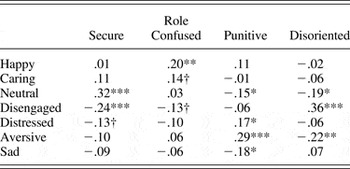
The concurrent and predictive validity of GPACS dimensions was examined across several domains of adolescent adaptation. These domains included emotion regulation during the conflict discussion, states of mind in the AAI at age 15, social competence (empathy and peer relationships), and adjustment difficulties (internalizing, externalizing, and risk-taking behaviors). We initially examined how the GPACS dimensions differentiated between adolescents’ emotion expressions during the conflict discussion. Correlations presented in Table 2 indicate unique patterns of emotion expression associated with each of the attachment dimensions. Adolescents who engaged in more secure/collaborative interactions showed markedly less disengagement and more neutral emotions during the conflict discussion. Adolescents in more role confused interactions displayed more positive (happy and caring) emotions while adolescents in punitive/hostile interactions showed substantially more negative emotions (aversive and distressed) but less sadness. Adolescents in more disoriented interactions were more disengaged, but displayed less aversive emotions.
Correlations between attachment dimensions and adolescent emotions during the conflict discussion (N =188)

†p < .10. *p < .05. **p < .01. ***p < .001.
Predictive analysis of AAI states of mind
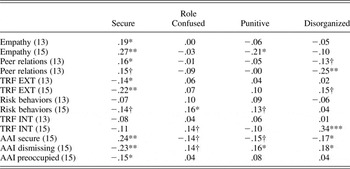
We anticipated that age 13 secure/cooperative interactions would predict adolescents’ secure or autonomous states of mind in the AAI at age 15. The correlations in Table 3 indicate support for this hypothesis. The GPACS secure/cooperative dimension was positively associated with AAI security after controlling for household income, gender, and race/ethnicity. In addition, all three of the atypical GPACS dimensions showed positive associations with the AAI dismissing pattern at age 13, showing no clear pattern of differentiation. AAI preoccupation at age 15 was generally not associated with the GPACS dimensions.
Partial correlation between attachment dimensions and adjustment variables (household income, ethnicity, and gender as covariates)

Note: TRF, Teacher's Report Form; EXT, externalizing; INT, internalizing; AAI, Adult Attachment Interview.
†p < .10. *p < .05. **p < .01. ***p < .001.
Concurrent and predictive analyses of social competence
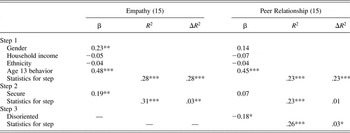
Concurrent associations between GPACS dimensions and teacher ratings of social competence (empathy and peer relations) were examined with partial correlations in Table 3, followed by prospective analyses in Table 4 that examine whether GPACS dimensions predicted social competence at age 15 years after accounting for social competence at age 13 and the contemporaneous GPACS scores. To test the incremental validity of the three atypical GPACS dimensions, age 13 behaviors along with demographic covariates were entered in the first step of hierarchical regression models (see Table 4), followed by the GPACS secure/cooperative dimension, followed by stepwise entry of GPACS role confused, punitive, and disoriented dimensions. The final step included stepwise entry of interaction terms between gender and each of the GPACS dimensions.
Prediction of age 15 empathy and peer relations covarying age 13 behavior

Note: The beta weights are from the variable's first entry into the model.
*p < .05. **p < .01. ***p < .001.
The semipartial correlations in Table 3 indicate the secure/cooperative GPACS dimension was concurrently associated with adolescents’ peer relationships and empathy. Prospective analyses in Table 4 indicate that the GPACS secure/cooperative dimension predicted adolescents’ empathy at age 15 years after controlling for empathy at age 13 years. However, none of the three atypical attachment dimensions made significant additions to the model. Although the GPACS secure/cooperative dimension did not account for residual change in peer relationships, the GPACS disoriented dimension added significantly to the model, indicating that adolescents with more disoriented interactions were more likely to show lower levels of peer relationship quality at age 15 years even after controlling for levels of relationship quality at age 13 years.
Concurrent and predictive analyses of maladaptive behaviors
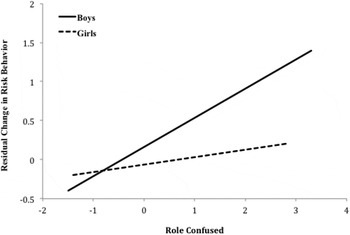
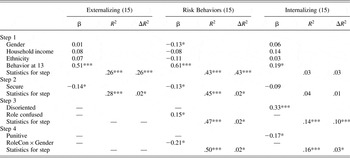
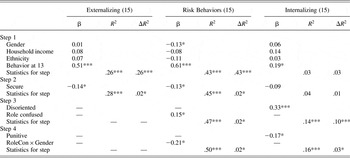
We expected that the GPACS secure/cooperative dimension would protect adolescents from psychopathology indexed by externalizing, internalizing, and risk behaviors, while the atypical GPACS dimensions would increase risk for these maladaptive behaviors. However, examination of the partial correlations in Table 3 revealed only one significant association, indicating that adolescents with more secure/cooperative interactions received lower ratings of externalizing behaviors. Yet the regressions in Table 5 indicate that GPACS dimensions predicted maladaptive behavior at age 15 years after controlling for variation in these maladaptive behaviors ate age 13 years. In the first model regressing age 15 externalizing on age 13 predictors, the GPACS secure/cooperative dimension was related to reduced risk for externalizing behavior. In the second model, regressing age 15 problem behaviors on age 13 predictors, the secure/cooperative dimension was related to reduced risk for risk behaviors while the role confused dimension was related to increased risk for risk behaviors. The relationship between the role confused dimension and risk behaviors was moderated by gender. The interaction in Figure 1 indicates that boys in role confused interactions were more vulnerable to increased risk behaviors at age 15 than girls. The final regression in Table 5 regresses age 15 internalizing behavior on age 13 predictors. Although the secure/cooperative dimension did not contribute to the model, the disorientation dimension did increase risk for age 15 internalizing symptoms. The GPACS punitive dimension added significantly to the model, reducing some of the risk associated with disoriented dyads.
Gender moderates the relationship between the role confused dimension and prediction of risk behaviors (sexual risk behavior and substance use problems) from age 13 to 15.

Prediction of age 15 externalizing, internalizing and risk behaviors (risky sexual behaviors and substance use problems) covarying age 13 behavior
Note: The beta weights are from the variable's first entry into the model.
*p < .05. **p < .01. ***p < .001.
Discussion
The findings support the view that secure/cooperative caregiver–adolescent negotiations of goal conflicts promote social adaptation in early adolescence. The security/cooperation dimension incorporated two components of a secure attachment bond: a cooperative partnership (warmth and collaboration) and the caregiver serving as a secure base for the developing child (adolescent engagement and caregiver validation). Independent emotion ratings indicated that secure interactions were characterized by better regulated negative affect and sustained engagement in the conflict discussion. Prospective analyses indicated that secure/cooperative interactions contributed to the emergence of autonomous states of mind in the AAI at age 15 years. In addition, this aspect of the parent–adolescent interaction was associated with more capacity to empathize with others by middle adolescence and was associated with lower levels of teacher-reported externalizing behaviors and self-reported risky behaviors, such as substance use and sexual risk-taking behavior. Overall, secure/cooperative caregiver–adolescent interactions at age 13 years was associated with adolescents’ competence while protecting them from the externalizing and risky behaviors that tend to increase from early to middle adolescence.
Beyond establishing the adaptive value of secure/cooperative caregiver–adolescent relationships, a second study goal was to evaluate atypical patterns of caregiver–adolescent interaction. The role confused dimension was characterized by parents who abdicated the caregiving role and by adolescents who took on a caregiving, structuring, or entertaining role with their parents. Adolescent emotion expression in these caregiving/role confused dyads included higher rates of positive affect (happy and caring). The presence of positive affect in the context of a conflict discussion may serve to reassure a parent who has difficulty acting as an older and wiser caregiver and supports the notion that the adolescent may be diverting attention from more challenging conflict topics in order maintain the discussion. Although at age 13 there were few concurrent associations between this dimension and measures of maladaptive behavior, longitudinal analyses indicated that male adolescents in caregiving/role confused dyads showed higher levels of risky behaviors by age 15. It may be that boys seek autonomy from a role confused relationship by engaging in deviant behavior; alternatively, the lack of clear parental structure and support may leave these boys with less adult guidance and monitoring of deviant and risky behavior.
Although adolescents whom engaged in punitive/hostile interactions showed a pattern of negative emotion expression (increased aversive and distressed emotions) and less sadness, these adolescents did not demonstrate a clearly delineated pattern of maladaptation. Teachers viewed these adolescents as less empathetic at age 15 and as showing a marginal tendency toward riskier behaviors. Longitudinal analyses indicated that these adolescents showed lower levels in teacher rated internalizing symptoms at age 15 years. Together, these findings suggest that caregiver–adolescent punitive/hostile interactions at age 13 are related to fewer adolescent expressions of sadness or internalizing symptoms.
Adolescents who engaged in disoriented interactions demonstrated a unique pattern of emotion expression and risk for maladaptive behavior. During the conflict discussion, they were more likely to display a combination of high levels of disengagement along with lower levels of aversive or hostile emotions. This pattern may suggest that disengagement was effective in reducing direct expression of angry emotions, or alternatively that these adolescents may have adopted a passive strategy in which angry emotions were noticeably absent. Support for the disorientation pattern as a more passive strategy may be evident in the tendency of these adolescents to show lower teacher ratings of the quality of their peer relationships at age 15 years. These adolescents also displayed higher levels of teachers’ ratings of internalizing symptoms (depression, somatic, and withdrawn) in middle adolescence.
The role confused and punitive dimensions of the GPACS bear some resemblance to the controlling/caregiving and controlling/punitive strategies observed by Main and Cassidy (Reference Main and Cassidy1988) among early school-age children. Because Main and Cassidy's controlling patterns were much more common among children who had been classified as disorganized in the Strange Situation, the caregiving and hostile patterns in our adolescent sample might be viewed as markers of disorganized attachment. We are hesitant to draw such a conclusion from the current findings. First, we have no evidence that the role confused or punitive patterns identified in this study have their origins in infant disorganization or in the frightened, frightening, or atypical caregiver behaviors that have been linked to disorganized behavior in the Strange Situation (Hesse & Main, Reference Hesse and Main2006; Lyons-Ruth, Bronfman, & Parsons, Reference Lyons-Ruth, Bronfman and Parsons1999; Madigan et al., Reference Madigan, Bakermans-Kranenburg, van IJzendoorn, Moran, Pederson and Benoit2006). Second, the disoriented behavior exhibited by caregivers and adolescents would seem to be much closer to the original criteria that have been used to code disorganization in the Strange Situation and subsequently to code unresolved states of mind in the AAI. In both assessments, disorganized behavior in the Strange Situation or lapses in meta-cognitive monitoring in the AAI represent breakdowns in organized attachment strategies. Third, after accounting for secure/cooperative caregiver–adolescent interactions, adolescents who engaged in more disoriented interactions were at greater risk both for problems in their peer relationships and for internalizing symptoms than were adolescents who engaged in punitive or role confused interactions. Disoriented interactions would thus seem to index processes associated with the most extreme risk for adjustment problems.
The association between the observations of secure/cooperative interaction and the emergence of adolescents’ security in the AAI at age 15 years replicates previous studies that have linked balanced or cooperative parent–adolescent interactions to subsequent autonomous states of mind in the AAI (Allen & Hauser, Reference Allen and Hauser1996; Roisman et al., Reference Roisman, Padrón, Sroufe and Egeland2002). However, it is also important to note the moderate effect size of the association between GPACS and AAI security. This suggests that, although these two measures are related, they assess somewhat different constructs. The developmental history that contributes to the emergence of AAI security remains to be explored (see Allen & Manning, Reference Allen and Manning2007). It seems likely that an autonomous state of mind in the AAI derives from a wide range of experiences that extend beyond the adolescent's relationship with a primary caregiver. Viewed from this perspective, secure/cooperative interactions with the primary caregiver at age 13 would only be expected to partially account for adolescents’ AAI security at age 15.
The current high-risk sample included an unusually large number of dismissing adolescents (Kobak & Zajac, Reference Kobak, Zajac, Cicchetti and Roisman2011). This is consistent with the high prevalence of dismissing classifications reported in adolescent samples (Sroufe et al., Reference Sroufe, Egeland, Carlson and Collins2005; Warmuth & Cummings, Reference Warmuth and Cummings2015). This high prevalence of dismissing strategies may indicate that these strategies have some adaptive value but may also be observed among those formerly disorganized as infants. As a result, it may not necessarily reflect the states of mind that will occur in adulthood or during the transition to becoming a parent. As a result, conclusions about the relationship between dismissing and preoccupied strategies and dyadic patterns observed in the GPACS may be more appropriate in middle-class or low-risk families, in which the construct validity of such strategies on the AAI has been more clearly established.
Limitations and future directions
Because this sample was predominately low income and African American, the generalizability of findings is limited in several ways. First, in our sample, the caregiving/role confused pattern was less prevalent in African American than in European American families. Thus, investigation of this pattern might be enhanced by studies that include a larger proportion of economically disadvantaged European American or Hispanic families. Second, the low-income nature of our sample may have contributed to unusually low levels of security in the AAI compared to levels observed in middle-class samples. This is consistent with the low prevalence of secure adolescents reported in the high-risk Minnesota Longitudinal Study of Risk and Adaptation (Sroufe et al., Reference Sroufe, Egeland, Carlson and Collins2005). Third, the current study did not include codes for unresolved loss or trauma on the adolescents’ AAI. As a result, conclusions about differential relations between dismissing and preoccupied strategies and dyadic patterns observed in the GPACS would require studies of lower risk families, with higher expected rates of organized attachments that also included the unresolved classification.
Although the GPACS coding system fills an important gap in studies of adolescent attachment, a number of questions remain unanswered. There is a need to initially determine short-term stability of the measure with repeated observational assessments. Assuming short-term stability, further consideration should be given to factors linking GPACS dimensions to childhood measures of caregiver–child attachment. Further, longitudinal studies are also needed to examine links between childhood controlling patterns and GPACS dimensions and to provide a basis for modeling sources of discontinuity in the parent–child attachment relationship (Verhage et al., Reference Verhage, Schuengel, Madigan, Fearon, Oosterman, Cassibba and van IJzendoorn2015). Both caregiver and child factors that contribute to dyadic security need to be investigated. Of particular interest are caregiver qualities that may increase the likelihood of the frightened, frightening, or atypical behavior that has been linked to disorganized attachment in infancy (Hesse & Main, Reference Hesse and Main2006; Lyons-Ruth et al., Reference Lyons-Ruth, Bronfman and Parsons1999). These questions of continuity and discontinuity in attachment relationships are at the heart of Bowlby's (Reference Bowlby1973) developmental pathways model of attachment and personality. Tests of this model depend on the continued validation of observational measures of parent–child attachment in middle childhood as well as in adolescence.