Introduction
Extreme environments are described as places where one or more environmental parameters are close to the lower or upper limits known to support life. Despite being considered lifeless for a long time, today these environments are recognized as rich habitats with highly adapted species. The first report of these organisms – an extremophile – dates back to 1880 when an US botanist Farlow isolated halophilic species from salted fishes, followed later by Eleazari Volcani in 1936, who isolated microbial strains from high salt-concentrated water in the Dead Sea. Later in 1969, the US microbiologist Thomas Brock discovered Thermus aquaticus, a thermophilic bacterium living at 80 °C from a hot spring in the Yellowstone National Park, and one year later he found Sulfolobus acidocaldarius, a hyperthermophilic Archaea growing at 85 °C and low pH (1–5). These and other reports altered forever the concept of life, because since Louis Pasteur biologists had the idea that no living being could stay alive above 80 °C. After these discoveries, a wide range of environments were successfully explored in search for life, including volcanoes, glacier ice, acidic and alkaline waters, hypersaline lagoons, deep sea sediments, radioactive impacted areas and others (López-García Reference López-García, Gargaud, Barbier, Martin and Reisse2005). The studies on extremophilic micro-organisms are extremely important to extend the limits of life and to understand the possibility and detectability of extraterrestrial life, thus being a main research subject in astrobiology.
Brazil is a tropical country with a very mesophilic climate, without the occurrence of traditional extreme environments. However, the country has some permanent or seasonal extreme environments that could be used for a better comprehension of the limits of life on Earth and as analogues of extraterrestrial locations. This article is a brief overview of the subject and cannot be seen as exhaustive, but the purpose is to stimulate the curiosity of the reader to explore this interesting branch of microbiology and its relationship with the emerging field of astrobiology. Contrary to the common sense, extremophiles can be found in a variety of environments, and the rich Brazilian biodiversity represents a great potential still to be explored. The following points are discussed: (i) what are extremophiles and how important they are for astrobiology; (ii) a brief description of some Brazilian biomes and how extremophiles could be found in these environments; (iii) a summary of past, current and future Brazilian research projects on extremophilic micro-organisms and how the results are linked to astrobiology.
Extremophilic micro-organisms
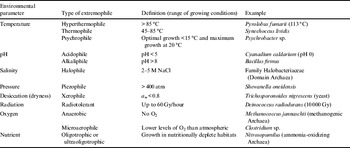
Extremophiles are organisms that are adapted to survive or grow optimally at extreme ranges of environmental variables, for example high and low temperatures (thermophiles and psychrophiles), acid and alkaline pH (acidophiles and alkaliphiles), high salt content (halophiles), high pressures (piezophiles), high doses of radiation (radiotolerant) and others (Table 1). Although the extremophiles are found within the three domains of life, most of them belong to the Archaea and Bacteria (Seckbach & Oren Reference Seckbach, Oren and Seckbach2007).
Summary of the physical and chemical parameters important for defining an extremophile organism. Adapted from Rothschild & Mancinelli (Reference Rothschild and Mancinelli2001). Radiation range and D. radiodurans tolerance were based on Cox & Battista (Reference Cox and Battista2005)

Some bacterial and archaeal phylogenetic lineages are particularly well adapted to specific extreme conditions. For example, many archaea and a few bacteria are hyperthermophiles (Stetter Reference Stetter1996). On the other hand, many extremophiles that are adapted to the same condition are found broadly scattered in the tree of life (e.g. psychrophiles and piezophiles). There are even some cases in which different species within a specific phylogenetic group are adapted to different extreme conditions. For example, many species of cyanobacteria have been isolated from Yellowstone hot springs at 70 °C, Antarctic ice and snow, deserts, hypersaline lakes, alkaline lakes and regions with high metal concentration. However, they are not found in acid environments and rarely grow on pH below 5–6 (Paerl et al. Reference Paerl, Pinckney and Steppe2000).
The diversity of life in extreme environments is often related to astrobiology for several reasons. Firstly, it is a general consent that the early Earth had extreme conditions when life originated (Horneck & Rettberg Reference Horneck and Rettberg2007), and thus studying extremophiles could help understand how life on Earth first appeared and evolved. Secondly, if life beyond Earth exists, it will most likely have to deal with harsh environmental conditions, and therefore it is important to establish the physical and chemical limits of life (Rothschild & Mancinelli Reference Rothschild and Mancinelli2001). In this context, Earth has a series of environments that are considered analogues to some locations in extraterrestrial bodies, for example the polar regions, geothermal sites, arid regions, places with low and high pH, sites with high salinity and high pressures, low or absent oxygen areas and so on. Extremophiles living in these locations are being explored for astrobiological purposes and are contributing to extend the limits of life as we know it and considerably expanding the number of extraterrestrial sites where life could exist. Moreover, many extremophiles have been reported living in non-extreme environments over the last decade, mainly due to significant and recent advances in microbiological methods (Cardoso et al. Reference Cardoso, Vieira, Paranhos, Clementino, Albano and Martins2011).
The research on life in extreme environments represents a major challenge for microbiologists. To successfully cultivate an extremophile, for example, one must simulate its natural extreme environment in laboratory conditions. These micro-organisms often require particular growth conditions that are either difficult to achieve or could be completely unknown. Moreover, it is estimated that less than 1% of all environmental micro-organisms are cultivable in laboratory conditions (Tiedje Reference Tiedje1999). Therefore, the success to study extremophiles depends on the advances in both technology for accessing extreme environments (e.g. in situ instrumentation, sampling equipments and transport logistics) and cultivation-dependent and -independent approaches (molecular methods). Recent advances in the ’-omics’ technologies (genomics, proteomics, transcriptomics, metabolomics, etc.), allowed us to identify previously unknown organisms and reveal new metabolic capabilities of life in extreme environments (Hollister et al. Reference Hollister, Engledow, Hammett, Provin, Wilkinson and Gentry2010; Mardanov et al. Reference Mardanov, Gumerov, Beletsky, Perevalova, Karpov, Bonch-Osmolovskaya and Ravin2011; Mykytczuk et al. Reference Mykytczuk, Trevors, Foote, Leduc, Ferroni and Twine2011; Xie et al. Reference Xie2011). As an example of these improvements, pyrosequencing technology (454 Life Sciences) permitted the construction of DNA sequence libraries that are orders of magnitude larger than conventional cloning libraries by Sanger technology. Consequently, using the 454 pyrosequencing method, it is now possible to detect even the ‘rare’ biosphere – microbial populations that exist in very low abundances in the environment. For example, in the context of extreme environments, 454 pyrosequencing was used to study deep sea sediments and hydrothermal vents, and revealed these communities are up to two orders of magnitude more complex than previously reported using traditional microbiological methods (Sogin et al. Reference Sogin, Morrison, Huber, Welch, Huse, Neal, Arrieta and Herndl2006). Although no method is bias-free, it is clear that these recent advances in DNA sequencing technology are providing new insights into the microbial world and their interactions with the environment.
Extreme environments in Brazil
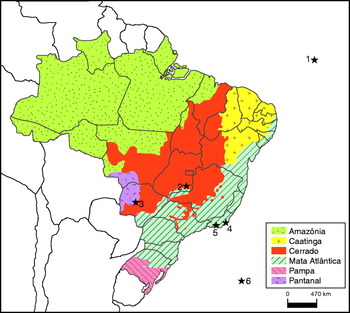
The great biodiversity of the Brazilian fauna and flora is well-known worldwide. There are innumerous studies describing the ecology and biological diversity of the six great biomes found in Brazil: Amazonian Rain Forest, Cerrado (tropical savanna), Caatinga (dry forest), Mata Atlantica (tropical Atlantic forest), Pampa (South American lowlands) and Pantanal (tropical wetland) (Fig. 1). Comparing the number of articles published on Brazilian plants and animals, however, the microbial diversity in these ecosystems has received attention by only a few studies (Borneman & Triplett Reference Borneman and Triplett1997). In the context of extremophilic micro-organisms, the number of studies is even lower, being restricted mostly by projects focused on biotechnological and industrial applications (Cruz et al. Reference Cruz, Terenzi, Jorge and Terenzi1988; Almeida & Franca Reference Almeida and Franca1999). However, this is not a result of low biodiversity of extremophiles or rare extreme environments in Brazil. Cardoso et al. (Reference Cardoso, Vieira, Paranhos, Clementino, Albano and Martins2011) elegantly asked in their article: ‘Why then should people be inspired to come to this part of the world [Brazil] to study extremophiles while there are many other interesting environments around the globe in which the archaeal diversity is well known, such as the Yellowstone National Park in the United States?’. The answer to this question lies around several factors that shape the Brazilian ecosystems. At first, it should be considered that Brazil is a hotspot of biodiversity (Mittermeier et al. Reference Mittermeier, Myers and Mittermeier2000). Secondly, the combination of different physico-chemical, geological and climatic factors in Brazil, creates distinctive ecosystems that may exhibit extremes of these parameters through short and long periods of time. For example, mangrove sediments in the coastline is typically known as an anaerobic environment with high salt concentrations (up to 30–37% NaCl), the soil in the northeastern Caatinga is very hot and dry for most part of the year (soil temperature around 50–60 °C), and the central Brazilian savanna ‘Cerrado’ presents an extreme acid soil (pH < 5) with high aluminium concentration (Ratter et al. Reference Ratter, Ribeiro and Bridgewater1997). In addition, there are also smaller ecosystems with extreme characteristics such as the hypersaline lagoons, areas impacted by heavy metal pollution, hot water springs, caves (ultra oligotrophic ecosystems), deep sea sediments in the Brazilian coast and others. Moreover, an important factor that should be considered on discovering extremophilic species in Brazil is the recent improvement made by novel culture-independent methods. These methods are based on the direct analysis of extracted DNA from environmental samples without the need of cultivating micro-organisms in specific conditions.
Distribution of Brazilian biomes. Stars indicate specific locations, which could be considered extreme environments. 1, São Pedro & São Paulo Archipelago; 2, Caldas Novas hot springs; 3, Nhecolândia alkaline and hyposaline lakes; 4, Araruama hypersaline lagoon; 5, Sepetiba Bay impacted by heavy metal; 6, Rio Grande Rise deep sea area.

Cerrado
The Cerrado – or Brazilian tropical savannah – is one of the most diverse biomes in Brazil and accounts for about 21% of the country land area, being the second largest habitat after Amazonia. The weather is characterized by a semi-humid tropical climate similar to other savannah regions of the world. Two distinguishing seasons occur through the year: a rainy season during southern summer, followed by a strong dry season during southern winter (Ratter et al. Reference Ratter, Ribeiro and Bridgewater1997). The average annual precipitation is between 800 and 2000 mm for 90% of the area and the medium annual temperature is 25 °C, ranging from 40 °C in summer to around 10 °C in the winter season. Cerrado is also a species rich habitat, harbouring about 33% of total biodiversity in Brazil (Aguiar et al. Reference Aguiar, Machado, Marinho-Filho, Aguiar and Camargo2004).
The soil in Cerrado is characterized by acidic pH and high concentrations of aluminium, which represents a major problem for both micro- and macro-organisms. Toxic forms of aluminium (e.g. Al+3) become soluble in the soil as the pH drops below 5 and therefore may react with many chemical and cellular processes (Kochian Reference Kochian1995). As expected, many soil bacteria were reported to be tolerant to aluminium (Appanna et al. Reference Appanna, Kepes and Rochon1994; Wakao et al. Reference Wakao, Yasuda, Jojima, Yamanaka and Hiraishi2002). For example, an acidophilic strain of Flavobacterium sp. was resistant to 74 mM aluminium while growing at pH 3.5 (Konishi et al. Reference Konishi, Souta, Takahashi, Ohmoto and Kaneko1994). Moreover, strains of Actinobacteria (e.g. Streptomyces sp.) were successfully isolated from acid (pH 4.5) Cerrado soils for biotechnological applications (Gomes et al. Reference Gomes, Semedo, Linhares, Guimarães, Alviano, Linhares and Coelho1999, Reference Gomes, Semedo, Soares, Linhares, Ulhoa, Alviano and Coelho2001).
Mangrove
The mangrove ecosystem is saline woodland located at the transition between the coast land and the sea, and represents approximately 75% of the world's tropical and subtropical coastlines (Holguin et al. Reference Holguin, Vazquez and Bashan2001). Brazil has one of the longest mangrove areas of the world, covering about 25000 km2 from north to south coastline. The high productivity in this habitat is associated with a high biodiversity of fishes, insects, crustaceans, reptiles, birds and mammals. Despite the mangroves having high amounts of organic matter, they are also characterized by low concentration of other nutrients, especially nitrogen (N) and phosphorous (P), which are almost not available to the organisms since the mangrove is usually an anaerobic and reducing environment. In addition, species living in this habitat have to cope with high salinity (up to 30%).
Micro-organisms play an important role in the nutrient cycling of a mangrove ecosystem. Different species of Bacteria and Archaea are involved with litter decomposition, nitrogen fixation, sulphate reduction and phosphate solubilization to the whole ecosystem (Holguin et al. Reference Holguin, Vazquez and Bashan2001). Several authors reported the successful isolation of halophilic and halotolerant bacteria from mangroves (Vazquez et al. Reference Vazquez, Holguin, Puente, Lopez-Cortes and Bashan2000; Soto-Ramírez et al. Reference Soto-Ramírez, Sánchez-Porro, Rosas-Padilla, Almodóvar, Jiménez, Machado-Rodríguez, Zapata, Ventosa and Montalvo-Rodríguez2008; Sahoo & Dhal Reference Sahoo and Dhal2009). Recently a set of well-preserved and human impacted Brazilian mangroves were studied for the presence and diversity of local microbial communities, including studies within the Archaea (Dias et al. Reference Dias, Dini-Andreote, Taketani, Tsai, Azevedo, Melo and Andreote2011) and Bacteria domains (Dias et al. Reference Dias, Andreote, Dini-Andreote, Lacava, Sá, Melo, Azevedo and Araújo2009, Reference Dias, Andreote, Rigonato, Fiore, Melo and Araújo2010), and more specifically on the Phylum Cyanobacteria (Rigonato et al. Reference Rigonato, Alvarenga, Andreote, Dias, Melo, Kent and Fiore2012).
Caatinga
The Caatinga is a tropical dry forest of about 800000 km2 and extends over several Brazilian states in the north-eastern area (Castelletti et al. Reference Castelletti, Santos, Tabarelli, Silva, Leal, Tabarelli and Silva2003). This biome exhibits semi-arid vegetation characterized by a deciduous forest, with shrubs and thorn trees which endure severe water shortage that lasts from March to October. The precipitation is low all over the year, with annual rainfall distribution of 500–750 mm occurring irregularly throughout the summer season. The climate is always hot with air temperatures varying from 23 to 27 °C, while the soil can reach temperatures around 60 °C (Prado Reference Prado, Leal, Tabarelli and Silva2003). For several years, the Caatinga was considered a biome with low biodiversity, but recent studies have confirmed that it supports a rich number of species and a high endemism of both plants and animals (Leal et al. Reference Leal, Silva, Tabarelli and Lacher2005). The Caatinga soil parameters that micro-organisms are exposed include hydric stress, high temperatures and high doses of ultraviolet radiation. Therefore, these distinct characteristics make Caatinga a unique ecosystem of Brazil, with no similar counterpart in the world. Although, this ecosystem is of biological importance, only a few studies focused on its microbial diversity (Da Silva et al. Reference Da Silva, Trufem, Saggin Júnior and Maia2005; Gorlach-Lira & Coutinho Reference Gorlach-Lira and Coutinho2007).
Other relevant areas
Besides the extreme parameters found in the Brazilian biomes described above, there are also smaller extreme environments across the country. Some examples are the Caldas Novas geothermal sites, the hypersaline lagoon Araruama, mine drainage waters in Sepetiba Bay, and alkaline and hyposaline lakes in Pantanal.
Caldas Novas is a hot spring area located in the central region of Brazil. This area is formed by 86 springs and the surface water temperature is around 60 °C. This area has been studied by only a few geochemical and geophysical methods, so the exact cause for the presence of thermal waters in Caldas Novas is still unknown (Lugão et al. Reference Lugão, LaTerra, Kriegshäuser and Fontes2002). The microbial community of these Brazilian hot springs was explored for fungi with biotechnological applications (Rezende et al. Reference Rezende, Guimarães, Rodrigues and Felix2005).
Araruama lagoon is one of the largest permanently hypersaline lagoons in the world with about 220 km2 located in Rio de Janeiro State (Moreira-Turcq Reference Moreira-Turcq2000). It is characterized by high salt content (average of 5.2% total salts), high evaporation and low rainfall rates, which favoured the development of many salty ponds around the lagoon. The climate is typically hot and dry, with a mean precipitation rate varying between 750 and 900 mm annually. The lagoon is around 3 m deep and the water renewal is very low (50% every 84 days). The microbial community in the Araruama lagoon is composed typically of halophiles, which includes various lineages of Archaea (haloarchaea). Interestingly, the lagoon water and the surrounding saline pond water harbour different Archaea and Bacteria groups. Moreover, culture-independent methods revealed a significant number of clones related to uncultured Archaea and Bacteria suggesting that the Araruama lagoon contain novel micro-organisms, distinct from those observed in other similar hypersaline environments (Clementino et al. Reference Clementino2008).
Sepetiba Bay is a 520 km2 water body in Rio de Janeiro State, which is separated from the Atlantic Ocean by a natural sand barrier. It has been polluted by industrialization activities around the area over the past 40 years. High loads of acid and heavy metal contaminated waters discharged into the bay are considered the main source of pollution, mostly by acid mine drainage waters contaminated with Zn (24 t year−1) and Cd (3660 t year−1) (Molisani et al. Reference Molisani, Martins, Machado, Paraquetti, Bidone and Lacerda2004). The microbial community in the Sepetiba Bay was studied by culture-independent methods revealing the presence of many acidophilic bacteria such as Acidocella, Acidosphaera and Acidiphilium (Almeida et al. Reference Almeida2009). The Archaea was also studied and the most abundant clones were affiliated to uncultivated Crenarchaeota also found in other extreme environments, such as radioactive thermal springs, subsurface geothermal water and sulphidic marsh water (Almeida et al. Reference Almeida2009).
The Pantanal of Nhecolândia is the world's largest field of tropical lakes, compromising approximately 10000 lakes on an area of 24000 km2 that vary greatly in pH, salinity, colour and biological parameters. The hyposaline lakes, for example, have variable pH, low-to-very-low salinity, and always lack beaches. On the other hand, saline lakes have high pH (9–10), and they are often surrounded by sand beaches and rarely become dry across the year. The origin of these differences is not completely understood, but the dominant idea is the presence of a climate with significant hydrous deficit along with scarcity of Ca2+ in surface and ground water. The combined effect of these two factors may unbalance the Ca2+ geochemical cycle and results in increased pH (Almeida et al. Reference Almeida, Calijuri, Falco, Casali, Kupriyanova, Paranhos-Filho, Sigolo and Bertolo2011). During the dry season, cyanobacterial blooms and an increase in salinity were frequently detected (Medina-Júnior & Rietzeler Reference Medina-Júnior and Rietzeler2005). The saline–alkaline lakes of Nhecolândia are considered similar to the soda lakes of the East African Rift Valley (Jones et al. Reference Jones, Grant, Duckworth and Owenson1998).
Brazilian research projects on extremophiles related to astrobiology
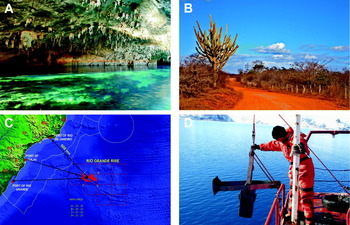
Microbiologists in Brazil have been studying extremophiles for ecological, biotechnological and bioprospection applications (Cruz et al. Reference Cruz, Terenzi, Jorge and Terenzi1988; Tosi et al. Reference Tosi, Terenzi and Jorge1993; Almeida & Franca Reference Almeida and Franca1999). Since the middle of the 2000 decade, when the interest for astrobiology increased within the Brazilian scientific community, a few researchers began to develop experiments directly or indirectly related to astrobiology. Nevertheless, Brazilian biomes have been poorly explored in search for extremophilic micro-organisms (Fig. 2) and, in fact, most of the astrobiological-related experiments outcome from Brazilian projects in Antarctica.
Extreme environments that could be explored for extremophiles. A, cave at Chapada Diamantina (NE Brazil); B, typical Caatinga landscape; C, topographic map of the southern part of the Brazilian coast showing the Rio Grande Rise; D, sampling marine sediments in Antarctica. Photos (A, B) by Tadeu Fessel and (D) by Cristina Rossi Nakayama; Rio Grande Rise map (C) by Kaiser Gonçalves de Souza, Geological Survey of Brazil.

The Brazilian Antarctic Program (PROANTAR) is a National Research Plan since 1984 and deal out with all scientific activities in the Antarctic continent and sub-Antarctic regions. Within PROANTAR Brazilian microbiologists have been investigating the microbial diversity in different cold environments, including glacial ice, snow, mineral soils, permafrost, lake water, seawater and marine sediments. Most of these studies aimed at exploring the potential of indigenous Antarctic bacteria to degrade petroleum-derived hydrocarbons (Whyte et al. Reference Whyte, Schultz, Beilen, Luz, Pellizari, Labbé and Greer2002; Luz et al. Reference Luz, Pellizari, Whyte and Greer2004, Reference Luz, Ciapina, Gamba, Lauretto, Farias, Bicego, Taniguchi, Montone and Pellizari2006), as biological indicators of pollution (Martins et al. Reference Martins, Montone, Gamba and Pellizari2005), screening for cold-active enzymes (Araújo et al. Reference Araújo, Kagohara, Garcia, Pellizari and Andrade2011; Vaz et al. Reference Vaz, Rosa, Vieira, Garcia, Brandão, Teixeira, Moliné, Libkind, Van Broock and Rosa2011) and molecules with anti-tumoural activity (Santiago et al. Reference Santiago, Alves, Rabello, Sales Junior, Romanha, Zani, Rosa and Rosa2012), or to describe the local microbial diversity (Kuhn et al. Reference Kuhn, Bellicanta and Pellizari2009; Rodrigues et al. Reference Rodrigues, Jesus, Ayala-Del-Río, Pellizari, Gilichinsky, Sepulveda-Torres and Tiedje2009; Rosa et al. Reference Rosa, Vaz, Caligiorne, Campolina and Rosa2009, Reference Rosa, Vieira, Santiago and Rosa2010; Loque et al. Reference Loque, Medeiros, Pellizzari, Oliveira, Rosa and Rosa2010; Teixeira et al. Reference Teixeira, Peixoto, Cury, Sul, Pellizari, Tiedje and Rosado2010). Some other studies, however, revealed interesting results that have direct implications to astrobiology. These studies and their results were achieved after the International Polar Year (2007–2008) and therefore are about to be published. For example, a project focusing on the microbial diversity in Antarctic glaciers with molecular biology approaches (454 Pyrosequencing) revealed a relatively high abundance of sequences (9.6% of ∼2500 total reads) similar to the genera Brevundimonas sp. (e.g. GenBank accession code JF516277) (R.T.D. Duarte, unpublished data). This bacterium is a psychrotolerant and facultative anaerobe commonly found living in cold environments as alpine and polar soils, permafrost, snow, glacier ice and marine water (Sheridan et al. Reference Sheridan, Miteva and Brenchley2003; Gonzáles-Toril et al. Reference Gonzáles-Toril, Amils, Delmas, Petit, Komarek and Elster2009; Abraham et al. Reference Abraham, Estrela, Nikitin, Smit and Vancanneyt2010). Moreover, living cells of Brevundimonas were isolated from the Russian Space Station ‘Mir’ (Li et al. Reference Li, Kawamura, Fujiwara, Naka, Liu, Huang, Kobayashi and Ezaki2004) and also detected in the sterilization chamber used by NASA laboratories for the Phoenix Project (La Duc et al. Reference La Duc, Dekas, Osman, Moissl, Newcombe and Venkateswaran2007). As a second example, the same study has successfully detected microbial DNA in permafrost dated from ∼5000 years (Antarctic samples) to several millions of years (1.8 and 3 millions of years in Arctic samples) (R.T.D. Duarte, unpublished data). These results are in agreement with other studies that detected microbial DNA preserved within permafrost across geological times, and provide an important method for determining time scales for evolution (Johnson et al. Reference Johnson2007). Cold-adapted micro-organisms in such terrestrial permafrost may also be considered models for studying the persistence of potential life in extraterrestrial cryogenic bodies (Gilichinsky et al. Reference Gilichinsky2007). More recently the ‘polyextremophile’ bacteria Exiguobacterium antarcticum strain B7 was isolated from Antarctic microbial biofilms nearby the Brazilian Antarctic Station ‘Comandante Ferraz’. This Gram-positive bacterium is able to grow at temperatures ranging from 3 to 42 °C and preliminary results of its recently sequenced genome show a versatile genetic repertoire (Vishnivetskaya et al. Reference Vishnivetskaya, Kathariou and Tiedje2009). Currently, this bacterial strain is under proteomic analysis to compare its protein expression at 0 and 37 °C. Preliminary analysis revealed 68 proteins that were differentially expressed depending on the temperature, with some being around 20 times more abundant at 0 °C (F. Nóbrega, unpublished data). Moreover, in order to investigate the potential for survival and mechanisms of adaptation, the E. antarcticum strain B7 will be soon submitted to simulated Mars and Europe (Jupiter's Moon) environmental conditions. The simulated extraterrestrial environments experiments are planned to be conducted in a simulation chamber, in its final stage of development within the Brazilian Astrobiology Laboratory (AstroLab) of the Institute of Astronomy, Geophysics and Atmospheric Sciences at the University of São Paulo. This simulation chamber will be capable of recreating the composition of different atmospheres, work on a variety of pressures, ranging from less than 10−7 to 800 Pa, temperatures ranging from 10 to 450 K and the use of radiation from varied sources, including ultraviolet and ionizing sources from nuclear and synchrotron accelerators (see Rodrigues et al. in this issue for more information about the AstroLab and the simulation chamber).
In the context of Archaea, studies are also being carried out in our laboratory with methanogens isolated from Antarctic marine deep sediments down to 300 m below sea level. Methanogens are strictly anaerobic and autotrophic micro-organisms that thrive on C1 compounds (e.g. CO2, methanol and acetate) as unique source of carbon. They are responsible for the last step of organic matter mineralisation in anaerobic environments and produce around 70% of total methane on Earth (Conrad Reference Conrad2009). Furthermore, methanogens are believed to be among the earliest emerging life forms and are used as a model micro-organism for astrobiology. The interest in this group of micro-organism has recently increased with the detection of methane being produced on Mars (Mumma et al. Reference Mumma, Villanueva, Novak, Hewagama, Bonev, DiSanti, Mandell and Smith2005), by some biotic or abiotic source. Previous results of a Brazilian project revealed that Antarctic archaeal community on sea sediments, dominated mainly by Crenarchaeota groups, may act as either a sink or source of methane to the atmosphere (Nakayama et al. Reference Nakayama, Kuhn, Araújo, Alvalá, Ferreira, Vazoller and Pellizari2011). These authors also reported high archeal diversity in Antarctic shallow water using molecular approaches. At this moment, methanogens of these Antarctic samples are being isolated for astrobiological experiments on the Brazilian astrobiology laboratory – AstroLab.
The most recent microbiology project undergoing in PROANTAR is particularly focused on astrobiology. The project entitled ‘The Antarctic Microbial Environment as a Model for Studies on Astrobiology’ (CNPq #557063/2009-4) began in 2009 and is in its last year of development. Briefly, the project goal is to isolate and identify extremophilic micro-organisms from a wide range of Antarctic samples (permafrost, glacial ice, soils, sediments, biofilms, etc.), screening and characterization of cold-adapted and UV-resistant strains, and finally submitting the selected extremophilic strains to extra-terrestrial simulated environments. So far, 163 bacterial strains have been isolated from different Antarctic samples, which are being subjected to an ultraviolet tolerance test.
Despite the microbiological research on Antarctica described above, no Brazilian biome has been explored for extremophilic micro-organisms in the context of astrobiology. Presently, there are a few projects that aim to study extremophiles in Brazil with ecological and biotechnological purposes. Nevertheless, these projects are revealing the yet unknown microbial diversity in Brazilian biomes, and they also could produce interesting results for astrobiology. For example, since 2009, the Archaea community is being studied for the first time in the Brazilian Caatinga under the project named ‘Biodiversity and Bioprospection of Native Plants and Microorganisms of Caatinga’, coordinated by Dr Itamar Soares de Melo from the Federal Research Institute EMBRAPA–Meio Ambiente. Similar studies in other arid regions of the world revealed a high diversity of archaeal division Crenarchaeota (Kvist et al. Reference Kvist, Mengewein, Manzei, Ahring and Westermann2005; Chanal et al. Reference Chanal, Chapon, Benzerara, Barakat, Christen, Achouak, Barras and Heulin2006). Only a few strains of this group have been successfully isolated and all of them are thermophilic or hyperthermophilic (Siebers et al. Reference Siebers2011). Using culture-independent approaches, however, DNA sequences of Crenarchaeota were found in marine sediments and terrestrial ecosystems (Nicol et al. Reference Nicol, Tscherko, Embley and Prosser2005; Park et al. Reference Park, Park and Rhee2008). Crenarchaeota isolated from arid soils of the Brazilian Caatinga will help understand their physiology and adaptations to extreme dehydrated habitats on Earth.
Additionally, in Brazil, a series of projects began to investigate the Brazilian coast and Atlantic deep sea sediments. Exploring the deep sea is logistically complex and expensive, and for that reason these projects are usually performed in cooperation with other countries. For instance, hydrothermal vents and cold seeps (chemosynthetic ecosystems) have been described for a long time on many regions of Earth, but only in the last decade the geological surveys suggested the presence of seeps in the Brazilian coast (Llodra et al. Reference Llodra, Tyler and German2003; Sumida et al. Reference Sumida, Yoshinaga, Madureira and Hovland2004). A project called ‘ColMEIA’ (Cold Mantle Exhumation and Intra-transform Accretion), which is a cooperation between Brazil and France and starts in 2012, will search for hydrothermal vents and cold seeps in a transect between the Northeastern coast of Brazil (nearby the Rio Grande do Norte State) and the São Pedro and São Paulo archipelago. Brazil is also cooperating with Japan in order to collect samples from active cold seep sites on the Southeastern Brazilian continental slope (Santos basin). This expedition will take place in 2013 and will use the Japanese manned research submersible Shinkai6500. A third example is the Brazilian project entitled ‘Environmental Characterization and Evaluation of Biogenic Ocean Resources from Brazilian Continental Shelf and Adjacent Oceanic Zone’ (INCT-CARBOM), which will cover not only São Pedro and São Paulo archipelago sites but also the Rio Grande Rise, where samples will be collected from 4000 to 6000 m deep in a transect that extends from São Paulo coast to the Rio Grande Rise. The projects described above will provide important environmental samples for Brazilian researchers. The microbial diversity of the deep sea sediments is still poorly described and the samples could also provide a wide range of extremophiles for astrobiological studies.
Conclusions
Extremophile micro-organisms in Brazil are highly unreported. Nevertheless, the experience acquired by studying micro-organisms in Antarctica provided a major step forward in our ability to characterize microbial communities in extreme environments. In addition, current projects led by Brazilian Research Institutes and its International Collaborators will offer the opportunity to access new environmental samples that are poorly studied by microbiology, such as deep sea sediments, hydrothermal vents, saline pools, alkaline lakes, caves, mangroves, arid and acidic soils, and others. Furthermore, the recent advances in culture-independent technologies offer new opportunities to study the dynamics of microbial communities in samples from such extreme environments. In summary, Brazil holds numerous extreme and interesting ecological niches that may be explored for different subjects, from the description of endemic microbial diversity, the application in biotechnological companies, and has important biological models for astrobiology.
Acknowledgements
The authors are grateful to the ‘São Paulo School of Astrobiology’ (SPASA 2011) organizing committee and to the São Paulo Research Foundation (FAPESP) for the School financial support. We thank Dr Douglas Galante, Dr Fabio Rodrigues and Felipe Dutra for their assistance with the figures and reviewing the text. We also thank the anonymous referee for his/her critical analysis of this manuscript.