Allan Pred, a pioneer in geographical research on people's spatial behaviour, remarked in 1990 that the studies in the field undertaken in the preceding decades had produced surprisingly few insights into ‘the communication of popular geographies and other forms of linguistically conveyed knowledge necessary to spatial orientation and getting around in urban environments’.Footnote 1 Thereafter, however, the so-called cultural (or, indeed, linguistic) turn across social sciences and humanities has been accompanied by new research directions into the linguistic aspects of urban processes. One such research front has been the burgeoning literature on urban toponymic landscapes. With respect to cities both past and present, scholars have explored the relationship of language, power and identities, be it European traditions of commercial and commemorative naming, or hegemonic and counter-hegemonic practices of naming in colonial, post-colonial and post-socialist urban settings.Footnote 2 Whether or not influenced by Walter Benjamin's classic ruminations on the industrialized metropolis as a ‘linguistic cosmos’ (providing, in Benjamin's thought, ‘all words’ with the revolutionary possibility ‘to be elevated to the noble status of name’),Footnote 3 this new work has opened intriguing perspectives into the material embeddedness of language in the processes of urban transformation.
So far, nonetheless, empirical treatments of how toponymies are actually lived and contested – how ‘the diversity of place names [is] utilized for different purposes by various players’Footnote 4 – in and through everyday urban practices, have been relatively few. In fact, besides previous sociolinguistic, lexicographic and onomastic work conducted in the Finnish context,Footnote 5 the closest path-setter for the present article remains Pred's detailed study of blue-collar workers’ colloquial working-class sociolects in the face of capitalist modernization in late nineteenth-century Stockholm.Footnote 6 Provocatively, in his Marxist-inspired analysis, Pred states that working-class people's (predominantly men's) ways of discussing the places of their daily life evaded ideological domination: in ‘Stockholm's folk geography . . . folk humour of irony, irreverence, social inversion, and bawdiness’ prevailed to such a degree that official place names were only seldom employed.Footnote 7 In some respects reminiscent of Pred's excavation, our interview-based study focuses on the early twentieth-century uses of slang toponyms (proper nouns) and other place-bound verbalizations (such as common nouns referring to urban space) among the young male population of Sörnäinen, Helsinki's most prominent working-class district.
Unlike previous microhistories of Helsinki and SörnäinenFootnote 8 – dubbed respectively StadiS00 (literally, the ‘City’) and SörkkaSF1890 in slangFootnote 9 – we thus read the everyday realities of industrial urbanization through onomastics, by analysing informal place names coined and used in the early industrial era. In more precise terms, we argue that toponymic slang vocabulary used between 1900 and 1939, when interpreted as a whole, reflected the everyday life of the local working class and especially that of male children and adolescents of Sörkka. As will be seen, not only prevailing language relations, but also specific spare-time interests, money-making activities and even some aspects of urban built form are readable in the semantic focuses (‘attraction centres’),Footnote 10 contexts of use and other characteristics of the known slang place names. In exploring Sörkka lads’ (young men not yet settled into ‘skilled’ occupations) informal naming practices, the article unfolds as a reconstruction of how typical slang toponyms were put to use at sequential phases of their ageing. Our primary research material consists of interviews carried out between the 1920s and the 1980s.Footnote 11 Based on commonalities in childhood and adolescence recollections of men who lived in Sörkka's working-class neighbourhoods either permanently or periodically during the first four decades of the twentieth century, we aimed to find answers to the following research questions:
• To what extent did Sörkka lads use slang place names to communicate about everyday urban spaces?
• With what type of age-, gender- and class- specific social activities and urban phenomena were their slang-based naming practices associated?
• What types of identity-related symbolic meanings did slang toponyms bear among Sörkka lads, and how did these contribute to the delineation and contestation of territorial and social boundaries in urban space?
• To what measure did slang place names comprise a counter-hegemonic lexicon (in terms of class struggle à la Pred, or otherwise) in the face of official nomenclature and societally hegemonic conceptualizations of urban space?
Before addressing these questions, however, it is necessary to contextualize our analysis through a brief examination of Helsinki's early industrialization and the city's changing language relations during this process.
Industrial urbanization and the early development of Helsinki slang
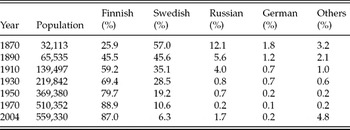
King Gustav Vasa of Sweden founded Helsinki (Helsingfors in Swedish) on the coast of the predominantly Swedish-speaking province of Nylandia in 1550. Its economic and demographic development was slow, experiencing a boost only after Russia supplanted Sweden as the rulers of Finland in 1809, and Helsinki was nominated capital of a Grand Duchy of the Russian Empire in 1812. From the 1860s onwards, industrialization began to remould the local socio-economic landscape and living conditions at an increasingly fast tempo. In a couple of decades, the city's population grew exponentially (Table 1). Prior to the actual industrial boom, the habitations of the poor had been scattered along the coastal rim around the governmental and business quarters of the city. The effects of the first industrial migration wave, by contrast, were felt most tangibly in the northern parts of Helsinki, former hinterlands separated from the central areas by an inlet of sea (Figure 1). A new railway connection (1863) to Sörnäinen timber harbour, in particular, fuelled the development of these rocky areas into an urban working-class district hitherto unparalleled in the Finnish context. Suddenly, Helsinki became split into two residential halves. In the south, there was the ‘stone city’ of the gentry and of the burgeoning middle classes (with relatively minor concentrations of the poor), whereas the fin-de-siècle landscape on the northern side of Pitkäsilta (‘Long Bridge’), or Longis S00 (a bridge only few dozens metres in length, but all the more important as a mental and social barrier in subsequent decades), was characterized by rapidly spreading, intensively built wooden settlements of the working class around the area's factories.Footnote 12
Helsinki's population growth and its residents by mother tongue, 1870–2004

Sources: Åström, Samhällsplanering, 31; Waris, Työläisyhteiskunnan, 14; L. Nyholm, Svenskt Stadsmål i Helsingfors (Helsinki, 1984), 8–9; S. Ranto, Ulkomaalaiset Helsingissä (Helsinki, 2005), 5.
Working-class quarters of Sörkka in 1900. The index map designates Helsinki's other substantial concentrations of the working class at the turn of century. Sources: Åström, Samhällsplanering; Waris, Työläisyhteiskunnan, 54.

During the last quarter of the nineteenth century, a consequent lack of affordable housing prompted efficient actions from the city of Helsinki, which was the main landowner around Sörkka's industrial cluster. Initially, the municipal authorities’ position in the face of these claims was somewhat unwieldy, as Helsinki had leased its estates on the northern side of Pitkäsilta for agricultural production and recreational villas. Ironically, these fixed-term leaseholds delayed the city's earnest involvement in planning, construction and solving acute housing problems in the rapidly urbanizing area. Only when these decades-long leases ceased, estate by estate, were the first cohesively organized (even if half-planned) residential neighbourhoods constructed in Sörkka. The building of Harju (1883–) was soon followed by that of Kallio (1888–); both were constructed without ratified plans mainly by private real estate speculators. In Kallio (dubbed Bärgga S00, Bärtsi S10 or Kaltsi F20 in slang), for instance, 157 new two- or three-storey wooden tenements were erected by the end of the century, each housing 100 residents on average. In both Kallio and Harju, the infrastructure of sewerage and water system, as well as permanent school facilities, long remained below the standards of the time. Even more rudimentary were the living conditions in Hermanni (nicknamed Heruli SF00 or Svinstad S1890 ‘Swine Town’ due to small-scale animal husbandry practised by its residents), a neighbourhood that was thrown up in frenetic fashion in the mid-1890s prior to its annexation to Helsinki. By contrast, the building projects in the early twentieth century, such as those of Vallila (the 1900s–) with its detached houses and municipal tenements, or the ‘garden city’ of Torkkelinmäki (mid-1920s–) within the Surutoin estate, were much more meticulously regulated from the beginning.Footnote 13
Meanwhile, the dawn of the industrial era led to substantial upheavals in local language relations (see Table 1). Previously, upper-class Swedish-speakers had held sway over Helsinki's linguistic landscape, irrespective of the presence of the Russian army in the city and the rising Finnish nationalism committed to the upgrading of the status of the Finnish language. In the tense politico-linguistic context around the turn of the century, caused in part by the influx of newcomers, the population in the bourgeois parts of the city was increasingly divided into supporters of Swedish or Finnish. In Fennomanic circles, for instance, the use of ‘pure’ Finnish in daily communication was often a deliberate choice. By contrast, in the rapidly growing working-class neighbourhoods it was an integral part of life to hear various lay versions of both languages.Footnote 14 Settled by either Finnish- or Swedish-speaking newcomers from Nylandia, Tavastia, Ostrobothnia and other provinces, Sörkka in particular was quite literally – to draw an analogy from Simmel's definition of the class of the poorFootnote 15 – a ‘common end of the most diverse destinies’ in sociolinguistic terms. Obviously, its population initially lacked uniting symbols based on shared experiences of the urban environment.Footnote 16 Yet, as far as its second-generation kids (who grew up in heteroglossic urban conditions) were concerned, the situation was already radically different. Given that the everyday practices and language-uses of young females were typically disciplined in working-class families much more rigorously than those of juvenile lads, the latter group's bilingual companionships became pioneering in linguistic mixing, forming a basis for the development of Helsinki working-class slang.
What spoken form did this ‘street language’ actually take? Roughly put, in its initial stage, Helsinki working-class slang remained more a linguistically relatively stable pidgin, a creole or a mixed language, than a slang conventionally defined. Instead of churning out obfuscating inversions (e.g. ‘tackwards balking’) or pejorative and ironic metaphors (much more common features of the Helsinki slang in later days), early juvenile slang-speakers in Sörkka mainly used slang to facilitate bilingual communication. While slang-speaking varied grammatically along with the speakers’ mother tongue, its main characteristics were derived from both Swedish and Finnish. In terms of phonological kinship, the old Helsinki slang was closer to the former – apparently mirroring stylistic choices in favour of a traditional ‘language of the cities’ in Finland. Thus, stadi, meaning city (noted above), gained popularity at least partly because it was difficult to pronounce by rural-born Finnish-speakers due to its initiative double consonant /st/ and the phoneme /d/ (both common features in Germanic languages like Swedish but missing from dialects of Finnish). Above all, however, the mixed slang vocabulary was based on modified borrowings from both Swedish and Finnish (although the proportion of borrowings from the latter gradually increased at the expense of the former), and to a lesser degree Russian, as well as more minor ‘locally spoken’ languages (e.g. Romani, Yiddish, German and even English). In the case of place names and nouns more generally, borrowed words were typically truncated by the aid of non-sensical slang-endings, as with ‘-kka’ in Sörkka.Footnote 17
Although phonetic variations in the once adopted slang terms were very common in the early Helsinki slang, its major grammatical characteristics, basic vocabulary and semantic focuses remained relatively unchanged between 1900 and 1939. Even more crucially from the viewpoint of our analysis, as the working-class slang spoken in Helsinki was primarily a lingua franca of Sörkka's Finnish- or Swedish-speaking youth groups, its vocabulary concentrated on the domains of urban life with a special interest for them. Equally importantly, slang-uses by Sörkka lads cannot be disjoined from the wider societal, cultural and language political nuances of Helsinki's industrial growth. Indeed, as much as slang evolved through immersing itself in influences from different standard languages, folk dialects, earlier slangs and urban popular culture, the existence of this (to quote a historical novel) ‘weird mingled language in which words of Finnish, Swedish and Russian collided and dashed against each other’Footnote 18 was simultaneously jeopardized by often hostile reactions towards it. Unorthodox mixing of linguistic elements, in particular, made it a despised ‘mongrel’ in the ears of the upper-class linguistic purists; consequently it was condemned even by many ‘respectable’ representatives of the working class itself.
Early childhood recollections
In the light of our interviews, Sörkka lads started to speak slang language even as toddlers. As soon as the boys were old enough to participate in the puerile activities occurring in the enclosed yards of the large working-class tenements, they began to embrace slang words that eased bilingual communication between them. One obvious reason why the social space of pitsku F00 (‘yard’) – and not so much that of the hima S1890 (‘home’) – had such a crucial role in the socialization of pre-school boys into slang-users was simply that slang-speaking was forbidden in very many families, especially in the mother's presence. A clear indication of this ‘centrifugalism’ in early childhood slang-uses is provided by slang noun mutsi S00, a semi-clandestine word for mother. From the very beginning, the social context of speech made a difference: ‘in those days the word mutsi was in common use but there was no chance to utter it at home, it was an absolute taboo, no one was allowed to say mutsi. If you did, you got instantly a clip round your ear’ (a man born in 1905). An important informal boundary between hima and the young boys’ shared social space was delineated: out of immediate earshot of the providers, bilingual peer-companionships had more liberties to do (and name) things at their own will.
As our informants recall, the initial adoption of slang names took place hand-in-hand with an imaginative conquering of the tenement milieu in playful uses with the boys next door, whether these spoke Finnish or Swedish. Designations originating from Swedish common nouns dominated ‘yard-tied’ slang coinages, especially in the beginning decades of the twentieth century: a yard's communal laundry was re-dubbed tvettis S00, cellar keltsu SF00 (cf. Swedish ‘källare’ and its Finnish loan ‘kellari’) and woodshed (or firewood cellar) klitsu SF00, whereas skinderi S00 for an outhouse was apparently derived from informal ‘skithus’ (‘shit house’). Quite a few new Finnish-based slangifications, such as roskis F00 for a litter bin, also found their way into common usage.
Later, the lads’ ventures outside the familiar yard (typically without adult guidance) made them increasingly aware of the adjoining yards and juveniles, which in turn reinforced their identification with ‘our yard's kids’. It took some time for a lad to acknowledge that virtually all himabyggas (bygga S00 = ‘building’), pitskus, porttarisSF00 (‘gateway’), buidusS00 (‘store’), lafkasR00 (‘eating place’, ‘store’), putkasR00 (‘coffee stand’, ‘kiosk’), kulmasF20 (‘street corner’) and kartsasSF00 (‘alley’, ‘street’) across the local townscape were in many respects very much alike. Accordingly, an array of early childhood slang toponyms began gradually to designate both specific places (as proper nouns) and certain types of places (as common nouns) across the district. Undoubtedly, the varying uses of a more or less clandestine, subcultural toponymy facilitated the etching of slang-speaking into an elemental part of young lads’ evolving social identities.
The foremost precondition for slang's dispersion among young male children of Sörkka was, of course, that they were ‘thrown’ into the mixed, bilingual circumstances of the district. In addition, there were two interlinked dimensions that had to do with the specificity of their home district that need to be emphasized. First, not only was the use of slang forbidden in many homes (as will be seen, at least partly an outcome of ‘morally uplifting’ campaigns by local schools), but also the confined nature of living conditions,Footnote 19 biased slang's expressive focus away from domestic circles. In stark contrast to coeval bourgeois kids in Töölö district in southern Helsinki, for instance, working-class kids rarely, if ever, had chances to play with their mates at home.Footnote 20 At the turn of the twentieth century, an average working-class dwelling in Kallio comprised one room only (occasionally with a kitchenette) and was inhabited by more than four persons, which quite simply left no room for visiting children.Footnote 21 In consequence, young Sörkka lads learnt from the very beginning to live a sort of linguistic ‘double life’. In tandem with everyday socio-spatial boundary-delineations, vigilant code-switching Footnote 22 between using unmixed Finnish or Swedish at home and other ‘civilized’ settings but unrestricted language with their peers became a guiding rule in their everyday life. Second, prerequisites for slang's dispersion in early twentieth-century Sörkka were consistently favourable: not only did tenant families change abode frequently,Footnote 23 but independently wandering groups of young males of different ages – the youngest of them well below school-age – were a salient element of its everyday landscapes (Figure 2). Importantly, the common adoption of informal expressions also eroded social boundaries: intense linguistic exchanges between slang-users from different houses, quarters and neighbourhoods formed a basis for its dissemination into an increasingly wide male juvenile (and later on, transgenerational) usage.
A group of pre-teen working-class boys in Siltasaari (Siltis). In the background, the Long Bridge (Longis) and the bourgeois Kruununhaka neighbourhood (Krunika). Photograph: unknown photographer 1905, by courtesy of Helsinki City Museum.

Towards unconstructed outskirts and nearby town corners
If the cramped living conditions pushed working-class lads away from home circles, there also existed plentiful exciting attractions that encouraged them to move about in the vicinity. A peculiarity of Sörkka's pre-teen lad culture was that the lads’ itineraries bifurcated both to urbanized areas and unbuilt flanks of the residential and industrial townscape. In many respects, their youthful activities were more reminiscent of rural kids’ attachment to self-discovered playing grounds than the tendency of urbanized upper-class kids to play on predetermined sites.Footnote 24
Indeed, the outskirts of urban space and relics of non-urbanized landscape between the neighbourhoods (such as the rocky hills between Kallio and Harju, remaining largely unbuilt until the 1920s) were among young Sörkka lads’ favourite settings for climbing, wrestling, sledging, as well as building koitsusS00 (‘huts’) and lumikoitsusFS00 (‘snow castles’). In there, they also played fantasy role games such as pirates, fasttaagarit S1890ja röövarit S1890 (‘cops and robbers’) and skoobarit E10ja indarit E10 (‘cowboys and Indians’), obviously learnt from the popular culture of the time. The majority of the slang appellations given in the course of these activities followed in most respects naming practices already set forth in earlier childhood. It is symptomatic, for instance, that there were nearly a dozen slang variants for woodland, all of them eponymous to Swedish ‘skog’ (e.g. skuge S00, skutsi S00).Footnote 25Skuge, bärtsi S00 (‘rocky hill’, ‘cliff’), branttis S00 (‘steep hill’), skvettamäki SF00 (‘sledging hill’), rantsu SF00 (‘shore’, ‘beach’), plotti S10 (‘pond’), plantsku S10 (any suitably open area for sports etc.), and many more slang terms designated certain types of topographic features. These same terms could also pinpoint specific locations. In addition, a common practice was to compound slang names for specific unbuilt sites through referring to adjacent areas, streets or other urban constructions, as was the case with Kinapori'sSF00 (‘Quarrel Castle’, a metaphoric slang name for an area in Harju) and Kägäri'sF10 (from ‘Käenkuja’, ‘Cuckoo's Alley’) bärtsis and Vartsi’sS00skutsi (‘Dockyard's forest’).
It is necessary to stress that local bärtsis, skutsis and rantsus were in a social sense neither extra-urban nor borderless places. Rather, they were gathering places for companionships of various sorts and ages from all over the district, even to the degree that among local temperance movements Sörkka's cliffs, for instance, were often discredited as places where tippling and the associated vices of prostitution, card-playing and ‘apache’ knife-games ran rife.Footnote 26 From the vantage point of young lads, nonetheless, the most significant ‘social others’ encountered in these marginal spaces were the rival groups of age-mates.Footnote 27 For them, wandering on vacant areas was essentially a learning process, an entry into a subcultural world of territorial gangs measuring their prowess against each other through battling, stone-hurling ‘wars’ (stenusota SF10) and slang blasphemies. The most enduring turf-based juvenile crews from different houses, quarters, streets or neighbourhoods − Trettika's kundisS10 ‘the lads of the Thirty’ (referring to a house number), Kinapori's jengi S10 and many more − were commonly known by their slang names. Interestingly, as the social historian Koskela has remarked, the biggest gang-fights in the early twentieth-century Sörkka were actually waged between territorial groups of young boys on unbuilt sites, whereas the older ‘hooligans’ were more taken to obtrusive conduct in public places.Footnote 28 In a seemingly paradoxical vein, slang united juvenile gang-members through the socio-spatial subdivisions it made, in a distinctive way, communicable: as the linguistic basis of a thrilling local subculture it was part and parcel of Sörkka lads’ evolving territorial and masculine identities.
At the same time, however, abstaining from the topicalities of urban life was an unthinkable option for young working-class lads. As with the outskirts which were still untouched by tangible urbanization, the familiar streetscape mutated, literally step by step alongside growing up, from a playing ground into a territorialized space where bunches of lads guarded their areas, played team games, intimidated occasional passers-by, contrived wind-ups or just hung around. Whether coined by themselves or learned from older lads, a plethora of slang toponyms gave clues to the spatializations enmeshed with their activities (e.g. Flemari SF10 < ‘Fleminginkatu’, ‘Fleming's Street’; Herulin Espis FS10 < ‘Hermanni's Esplanade’, ironic loan name for a section of Eastern Chaussé; Sadika F00 < house-owning company ‘Sadan Markan Villat’, ‘Hundred Marks’ Villas’; Ryssäntalo RF00 < ‘the Russki's building’; Kusila F10 < ‘Piss-place’, a metaphorically nicknamed tenement; kani R00 < ‘pawn shop’; kuntsi F20 < appellation for any municipal tenement). In addition, young pre-teen lads also explored more hazardous adult territories. An especially magnetic stage of the industrial era was the local harbour area. With its exciting berths, timber yards, dishevelled estates, gutters (skeidakanaalisSF10 ‘shite canals’) and gasworks area (Koiranperse F00 ‘Dog's Arse’), Vartsi was a place to be socialized into the masculine world of work, gape at arriving ships and loading projects, and hawk with skönemannisS00 (‘seamen’). On the other hand, it was simultaneously one of the arenas where many juveniles circled around in order to assist their down-and-out families by pilfering wood for warming and cooking, scraping together money for rent, and so forth.
Last but not least, one of the hubs of Sörkka's pre-teen lads’ everyday life was inevitably the school. Even prior to the Compulsory Education Act of 1921, the majority of providers in Sörkka sent their kids to elementary school.Footnote 29 Schoolmasters and teachers in Sörkka's overcrowded schools, for their part, typically viewed themselves as moral and cultural ‘missionaries’, disseminating civilized and nationalistic values to the backstreets.Footnote 30 As one of the ‘measures of civilization’ fostered in contemporary teacher education was the correctness of language, slang-speaking was seen by them as an ‘impure’ phenomenon to be weeded out from the pupils’ parlance in class, in the ground, as well in spare time. Special blame was put on the local street culture and homes:
The main causes of the deterioration and brutalization of pupils’ language-uses have been unfavourable models given by the homes and the environment . . . The mother tongue and the street language should be always juxtaposed in the schools and make them [the pupils] admire the beauty of the former and the ugliness of the latter . . .[A]bove all, the language of homes should be ameliorated.Footnote 31
The school was thus one topos where Sörkka lads had to avoid speaking their ‘gang-tongue’: ‘if someone answered the teacher using slang, the teacher corrected it at once’ (born in 1908), or ‘put fingers into their ears’ as a sign of abhorrence.Footnote 32 Yet despite these efforts, Sörkka's pre-teen lads continued to code-switch between standard language and their own sociolect − a fact that is mirrored in dozens of more or less sacrilegious slang idioms for school-related things. Out of the teachers’ earshot, the school itself was simply skole S00 or kansis F10, without frills of linguistic refinement.
Spare-time and earning opportunities
Even before teenage years, the everyday lived space of Sörkka lads reached well beyond their linguistic home-turf, the neighbourhoods on the northern side of Pitkäsilta. Youth camps and collective activities organized by local workers’ associations introduced them, willingly or not, to the coastal areas and colonies around the ‘summer pasturage of the proletariat’, the Old Town Bay (Vanhankaupunginlahti).Footnote 33 However, Sörkka's adolescent males’ toponymic slang coinages mirrored again their own, largely unattended pedestrian itineraries.Footnote 34 Did this mean that they simply acted out on a wider scale specific spatial and linguistic practices − the use of slang as a practical means of bilingual communication, spontaneous code-switching, adventuring in non-predetermined (urban and non-urban) sites, gang-related territorial spatializations, the embeddedness of slangifications in the necessity to get by − they had already learnt in childhood? To a great measure, yes − yet essentially in more socially intricate, often class-antagonistic settings than during their rather enclosed childhood on the backstreets of Sörkka.
For one thing, the occasional fights between the gangs of Sörkka and other (working-class or bourgeois) districts, and the legends circulating about these among the local youth, certainly played a role in their increasing awareness of the territorial divisions within the city and consequent identifications of themselves as ‘lads of Sörkka’. Even so, for the majority, the fervour to attend the violent turf-wars dissipated as they grew older.Footnote 35 Instead, competitive sports grew into one of the most favoured fields into which the rivalry amongst the youngsters was funnelled. Undoubtedly, the popularity of athletics reflected its rise as a pervasive form of internationalizing mass culture in the early twentieth century. Like most other Finns and Helsinkians, Sörkka lads observed the success stories of national sports heroes (and heroines) in the Olympic Games and other events through newspapers, telegrams, cinema newsreels and radio (mid-1920s−).Footnote 36 Nonetheless, the whereabouts of their own competitions were substantially affected by the splitting-up of the organizational field of sports in Finland into right- and left-wing societies, both practising intensive recruitment of youngsters on their respective territories.Footnote 37 Sörkka, in particular, became known for its ‘red’ sport clubs (e.g. Jyry ‘Rumble’, Tarmo ‘Vigour’, Toverit ‘Comrades’) and as a breeding ground of ‘flaxen-haired national team boxers’.Footnote 38 A good proportion of Sörkka youngsters’ life was spent wrestling, boxing, skating, racing or playing team sports (above all futis S10 ‘football’ and jääboltsi FS20 ‘bandy on ice’). These activities took place either on purpose-built venues like Bygga S00 (‘Building’, the workers’ main community hall), Klubba S10 (a skating ground on Eläintarhanlahti Bay), Haapis F10, Bragu SF20 (also nicknamed Sörkka's Bislet O30 after Oslo's sports stadium), or their self-appointed sports sites. Fredika’sS00skutsi woodland north from Sörkka, hid a meadow (nitsku F00) which youngsters from Sörkka had cleared and christened their own Narva O20 arena (apparently a borrowed name from a historical battleground in Estonia, used to hoax parents and smaller kids).Footnote 39 Due to its entanglement with the bipolarized institutional politics of class, sports represented an everyday sphere in which Sörkka lads’ activities concentrated on the northern, working-class side of Pitkäsilta (Figure 3).
A sample of sites that Sörkka lads frequented for recreation or chances to earn money.

In contrast, there were other attractions that were, if not always less competitive, much less starkly spatially segregated. A sample of early slang names of Sörkka lads’ favourite fishing, swimming, trash collecting and other money-earning sites, as illustrated in Figure 3, shows that their routes stretched over an area of several kilometres in radius. Slang names used for some swimming sites, for instance, indicate that Sörkka lads’ spatial practices transgressed ideological antagonisms inscribed in the local landscape.Footnote 40 Dotted across Sörkka and Helsinki, their swimming destinations entailed both natural waterfronts (rantsus) and gender-compartmentalized open-air sea water pools (simmisesS00) managed by local swimming clubs of different class and language political persuasions.Footnote 41 While the nearby working-class pools in Haapis F00, Blobika S00 and Kylis F10 were among the favourites, a recollection of a right-wing swimming club westwards from Sörkka testifies that the ideological boundaries were not allowed to constrain the summertime activities: ‘a host of lads from a whole house always went swimming at the same time . . . tarmac just crunched beneath our toes as we ran all the way to Bjella S00’ (born in 1905). When heading to Urssa’sS00simmis (a pool hosted by a club of Swedish-speaking swimmers), their routes even traversed the central commercial and governmental quarters of the city.
In practice, Sörkka lads’ trips further away from their home district were very often mingled with economic interests. In Edisa S1890, for instance, their activities could involve scavenging for bones and blood from the city's only slaughterhouse, or taking the Cossacks’ horses to swim in the sea. This ‘transitional tract between the city and the countryside’Footnote 42 was quite literally a scrap metal mine for the lads. ‘Oh goddammit, Edisa was a groovy place . . . where Hiekkis F30 [Helsinki's first publicly sanctioned beach for both middle- and working-class townspeople, opened in the 1930s] is located now, there was that kaatoplaani FS10 [‘dumping place’]’ (born in 1910). Symptomatically, they ransacked garbage dumps in search of items which they sold in one of the romisesF00 or barkufasR00 (scrap stores, the latter after Barkoff's establishments) in Sörkka or central Helsinki. But for what ultimate purposes did Sörkka adolescents scavenge skrodu S10 discarded by the urban system? In most cases, it appears that the leitmotif was to scrape together money for pastime activities such as going to the cinema or for mass-manufactured commodities like skrinnarisS00 (‘skates’). For one thing, a bicycle became a realizable dream for a growing number of Helsinki's working-class adolescents, especially from the 1920s onwards. A velo OS10 – a ‘great leveller’ under the conditions of early industrialization – was not just an exciting vehicle for moving ‘four times faster’ than on foot,Footnote 43 but it also represented enviable symbolic capital among peers, and a means to improve one's competitiveness in several paying jobs available to working-class youngsters. In essence, the industriousness of Sörkka lads – including the transgressions of class-dividing territorial boundaries it required – mirrored both economic and cultural survival tactics.
For a young lad, crossing Pitkäsilta and heading southward to the central areas and public spaces of Helsinki could at first ‘feel like entering a foreign territory’. In upper-class residential areas, at least when moving in groups, they were often treated as unwanted intruders: ‘if you went on the side of Kaivari F00 (‘Kaivopuisto’, ‘Well Park’; a premier park and residential area), people there recognized immediately that you were from the other side of Pitkäsilta . . . they used to say that those are Sörkka vagabonds, using that turn of phrase’ (born in 1911). In central public spaces, however, their continuing presence as service-sector menial workers was a case in point of how actual urban development ‘threatened the clarity of segregation’ between the affluent and poor parts of the city.Footnote 44 The young working-class tsuffarisS10 (‘errand-boys’), steissarisS10 (‘telegram sellers/deliverers’), dilkkaajasS10 (‘newspaper deliverers/hawkers’) and jynssärisF10 (‘shoe-polishers’) laboured in public spaces where their potential paying patrons lived and worked (Figure 4). ‘Kapla SF10 [a restaurant ‘Chapel’ at the eastern end of Esplanade Park] was a sort of place where a shoe-cleaner made a lot . . . one always desired to get there, or at Statsa S00 (‘Railway Station’), those were the best mestasR00 (‘places’)’ (born in 1911). Along with the accumulation of fleeting encounters with customers from radically different social backgrounds and streetwise knowledge of the most profitable ways of addressing them, the practice of code-switching gained novel nuances on the southern side of the class-dividing boundary of Pitkäsilta.
A group of barefooted shoe-polishers sitting about in the middle of Esplanade's arterial pedestrian corridor, in the background restaurant Oopris S1890 (‘Operakällaren’, ‘Opera Cellar’). The presence of young working-class labourers in the city centre caused anxiety among many contemporaries. In fact, the City of Helsinki consulted both the Salvation Army (1915–) and the YMCA (1919–) to stabilize shoe-cleaners’ working conditions and dictate their domains. Or as a man born in 1911 recalled it: ‘before Marssi [the YMCA's ‘Express Office Mars’] was founded, kundis [‘lads’] swarmed everywhere around kartsas, wherever there were lots of gimmas [‘women’] and bisses [‘hubbies’] present’. Photograph: I. Timiriasew, 1912, by courtesy of Helsinki City Museum. See Koskela, Huligaanit; 166; S. Ojanne, ‘Katuammattikunta. Helsingin kengänkiillottajapojat’, Suomen Kuvalehti, 3, 37 (1919), 804–5.

Indeed, Sörkka lads’ criss-crossing of southern Helsinki was accompanied by a number of more or less clandestine re-codifications of the city centre's official nomenclature. It is important to stress that these toponymic adoptions – such as Bulla S00 (‘Boulevard’), Aleksi SF00 (‘Aleksanterinkatu’, ‘Alexander's Street’), Brunssa S00 (also dubbed Kaivari), Rööperi S00 and Gresa S00 (Punavuori and Ruoholahti, both working-class neighbourhoods in south-western Helsinki), Buli Tirra SF00 (‘Big Theatre’, actually the National Theatre), Järkku's tortsi SF10 (‘Railway Station Square’), Stokis OS10 (‘Stockmann’ department store) and Roiskis OE20 (restaurant ‘Royal’) − were in part based on earlier student or working-class slang names, and were very likely also underpinned by linguistic exchanges with adolescents from southern Helsinki. In any case, the strengthening overtones that Sörkka lads’ tongue began to take as an alternative, symbolically anti-elitist but emphatically urban sociolect − as epitomized in its latter-day appellation Stadi's slangi − were at least partly conditioned by their foothold within the socially mingled hubs of urban life.
In fact, Sörkka lads did not move around socially central mestas of southern Helsinki solely in the search of money-earning chances. In the context of rapid urbanization, there were no means to keep them mentally detached from the allures of modernizing city life. Here, Esplanade Park (Espis OSF1880, Espa OSF00) serves as an apt synecdoche for how Sörkka lads’ naming practices and experiences of the city centre departed from those of upper-class Helsinkians. Originally, Esplanade Park was designed (1830s−) as a refined leisure ground of the Swedish-, Finnish- or Russian-speaking gentry of the Duchy's new capital. In the early twentieth century, the area was still used by many southern Helsinkians after a formal, politically delineated ‘spatial economy’Footnote 45 (‘the Swedish-minded ambled along the North Esplanade’).Footnote 46 Yet, industrial urban growth had already brought notable changes in its social uses: on Sundays, for instance, ‘younger working folk’ could swarm around the park to the extent that that ‘chap Runeberg [a photographer-ethnologist's jocular reference to a sculpture of the national poet J.L. Runeberg] got shrouded by a dust-cloud up to his nose’.Footnote 47
Interestingly, although Espa was one of the pivotal places where many of Sörkka adolescents both worked and hung around, there are very few known slang names for its architectural ‘monuments of the industrial age’, seen by many of their upper-class contemporaries as evocative of Helsinki's ‘novel’, ‘international’, ‘continental’, ‘Parisian’ and ‘metropolis-like’ atmosphere.Footnote 48 The probable reason for this curious absence is that Espa's glories of the city − its luxurious facades and interiors − were in themselves quite simply economically and socially irrelevant to Sörkka lads. By contrast, the adolescents had numerous informal names for popular gathering sites, meeting-spots and restaurants (apparently haunts of their favoured clientele) in and around the promenade park, as witnessed by Bulitortsi SF00 (from colloquial ‘Isotori’, officially ‘Kauppatori’, ‘Market Square’), restaurants Socis OS1890 (‘Seurahuone’) and Bronda S00 (‘Brondin's Café’), as well as symbolically ‘lowering’ statue nicknames Kaivo-Manta OF00 (‘Well-Amanda’, after the fountain of Havis Amanda) and Ryynegreeni S00 (the aforementioned sculpture of Runeberg). In the light of this anti-snobbish vocabulary, Espa was for Sörkka lads a lucrative domain in which to earn money as well as a place where they could satisfy their appetite for urban experiences − a socially mingled venue to blather with youngsters from other neighbourhoods, leer at bypassing piikaparaatisF1890 (‘maid parades’) and ‘Espis-butterflies’OSF00 (an euphemism for prostitutes), and poke fun at unaccustomed landesS20 (‘country people’) with their rough street language.
Back to Sörkka: slang uses and urban identities
Even though working-class lads from the northern side of Pitkäsilta eddied through Helsinki and its surroundings, Sörkka stayed a nodal area for the majority during their adolescent years. Here, however, we must acknowledge that their home district neither remained untouched by ‘the grip of modernization’, fostered inter alia by time-and-space-transgressing communication technologies and the rise of mass consumption.Footnote 49 True, some characteristics in the district's history – like strikes and political unrest, a short ascendancy of the Reds during the Civil War of 1918, or the effects of Prohibition between 1919 and 1932 – followed more marginal trajectories of urban development. A rampant trade on spirits (spitta OSF00) on the backstreets of Sörkka, in particular, brought along pejorative or ironic sub-discourse into Helsinki slang that surfaced as metaphoric names given to the district's ill-reputed quarters or hovels (e.g. Pirunlinna F20 ‘Devil's Castle’, Kankkunen F20 ‘Canistery’): ‘folks speculated that in the wooden houses of Vaasis SF10 (‘Vaasa Street’), there was bootlegging’.Footnote 50 Overall, nevertheless, Sörkka's modernization (as we know it) continued throughout the whole of the period. More and more wooden tenements were demolished to make way for burgeoning, high-rise stone edifices; completely new neighbourhoods were erected on previously vacant estates.Footnote 51 In retailing and mass entertainment sectors, a growing number of large modern establishments opened their doors in Siltasaari (Siltis F00) and along Sörkka's major arteries. In short, ‘a battle over the souls of the inhabitants of the working-class district’Footnote 52 was intensified and complicated, as urban modernization and commercial mass culture gained an increasingly tight hold of people's daily lives.
In what ways did slang toponymy reflect these changes and their incarnations in the local landscape? As with architectural spectacles in the city centre, few of the new kolossisOS10 (‘colossal buildings’) built in Sörkka were christened with alternative slang names. While some landmarks – most notably the aforementioned Bygga community hall, Hagis’ Eltsu F20 (Elanto's co-operative emporium) and Bärgga's tsyrkka S10 or Kallio's kirtsi F20 (‘the Kallio Church’) – were exceptions to this rule, it is somewhat surprising that even a building such as Arenan talo (‘the Arena Building’, housing most notably the city's first radio broadcasting studio) in Siltasaari remained apparently anonymous in slang vocabulary. ‘Distant’ (aesthetic or otherwise) evaluations of the urban built form were largely beyond the scope of the spontaneous verbalizations of working-class juveniles. Instead, the distinctive foci of their informal language-uses mirrored the immediately lived social topicalities of the time. Indeed, when read through three illustrative street-level nuances of urban development − through cultural internationalization (cinema-going), territorializations of leisure space (dance-going areas) and the definitions of identity against the backdrop of rurality (encounters with newcomers) − their naming practices evoked the Lefebvrian definition of ‘city-ness’ as the gathering of diverse things, ideas and people in the concrete places of everyday life.Footnote 53
First, urban transformation brought with it popular cultural forms to do with technological change and internationalizing mass entertainment − some of them striking the right excitement-seeking chord among adolescent and even younger slang-speakers. The cases in point included movie theatres, transmitters of a ‘uniquely democratic art form’ which not only ‘enabled all of its viewers to see anywhere that a camera could see’, but which also was relatively affordable for working-class audiences.Footnote 54 Cinema culture was on everybody's lips in early twentieth-century Helsinki. While Sörkka's first cinema Fennia (Fenkku O00) opened in 1905, twelve leevandesS00 (levarisS00, leffasS00; cf. Swedish ‘lefvande bilder’, ‘living pictures’) already existed in the area in the mid-1910s, ‘six or seven of them in Hagis SF00 (Hakaniemi Square area), standing in row one after the other’.Footnote 55 For Sörkka lads, the means to acquire money for this favourite recreation were many, varying from ‘scavenging scrap metal a whole day’ to leaflet delivering prior to the shows. In Western movies and other adventure films, ‘seats were bursting with boys of all ages’.Footnote 56 Accordingly, the thriving celluloid culture left numerous time-and-space-transgressing traces on their everyday parlance: while younger boys role played inkkarisE10 and goobarisE10 on the rocky hills of Sörkka, pre-teen and adolescent gangs were given Indian tribe names (Kinapori's apaches, Sörkka's apasOSF10) after the model of movies (and probably also similarly named Parisian gangs).Footnote 57
The dance hall culture, living its heyday during the period of the present study, bears witness to the enhancing significance of consciously urban (yet territorially multi-layered) identities behind Sörkka adolescents’ slang-uses. In the first place, the confirmed youngsters’ and older lads’ regular places for dance-going concentrated on Sörkka-based dance halls. A great majority of attendees in Sörkka's evening parties were ‘from this side of Pitkäsilta’. Often, the command of Furula F1890, Bygga, Sörkan Vennu S00, Valkan Työsi F20 (Vallila's workers’ association's community hall) and other local haunts were defended by adolescents in a way reminiscent of younger kids’ turf-based gang wars. Conversely, Sörkka lads did not ‘often frequent, and even less so in bunches, Tölikan Vennu’sS00 hops’ (a man from Töölö, year of birth unknown), nor dances organized at Annan Vennu S00, Vidari S20 or other halls in central Helsinki. Even so, on occasions they transgressed the social territorializations of the local dance hall culture. This was the case, for instance, when the lads of Stadi headed to the more peripheral dance halls (often by taking a toge S00, or train) such as työsi F10 in Hupika SF10. Here, their shared urban background and the slang as its stylistic expression became symbolic glue that cemented them against a common enemy. Again, slang united its speakers, articulating social (sub)divisions in a distinctive way: ‘If we went dancing at a hop outside Helsinki and got there into a tangle with lads from landis S00 (‘countryside’), all of the stadi-guys . . . whether they were from Tölika SF00 (‘Töölö’), Röba S00 (‘Punavuori’) or wherever, they were in the same gang’ (born in 1899).
Finally, Sörkka lads faced the changing urban circumstances on the central squares, street corners and thoroughfares of their home district. In their favourite gathering places by Hagis Square or Hesari SF10 (‘Helsinginkatu’, ‘Helsinki Street’), for instance, Sörkka lads encountered increasing numbers of upper-class townspeople and businessmen, brought along to the working-class area by the spreading of the stone city. Even more significant social others in terms of the reinforcement of their urban consciousness were, however, people from the provinces. Cramming into the growing district in pursuit of work and affordable housing, the ‘country yokels'’ (landelaiset S10, landet S10) perpetual presence transformed, in identity terms, the lads’ slang-uses towards underscoring their own rootedness in urban conditions. Indeed, abusing rural newcomers was often based on their vain efforts to speak slang as if they were already urbanites. Difficulties that Finnish-speaking landes, in particular, had with the slang's ‘urban’ phonemes − as with ‘incorrectly’ pronounced expressions Stati S00, Tati S20 (cf. Stadi) and tatilaiset S20 (cf. stadilaiset S10 ‘Helsinkians’) − sounded strikingly comic or irritating in the ears of true-born slang-speakers. Tellingly, slang-speaking ‘asphalt toes’ (asfalttivarvas F20) had nearly two dozen known mock names for the country people, ranging from ridiculing metaphors of their beet-like stupidity (lanttu F20 ‘Swedish turnip’) to calling them ameebasO20 ‘hankering after earth back home’ (born in 1924).Footnote 58 Once again, slang was an elemental part of the delineation of social boundaries: vis-à-vis the newcomers from lande (‘countryside’), proficiency in it represented street-originated social capital that could be adopted neither quickly nor by book-learning.Footnote 59
Conclusions
Since at least the 1910s, journalists and laymen have meditated upon the likely origins of the suddenly proliferated street language, spoken above all by juvenile males from Helsinki's new working-class neighbourhoods. According to one line of reasoning, put forward by a pseudonym ‘Professor of Gang-Tongue’ in a sardonic left-wing magazine in 1915, the city's own ‘gang-language’ was initially born among newspaper boys at the turn of the century; due to the subsequent limitations on alcohol trade on the northern side of Pitkäsilta, the rampant speakeasies in the area spawned ‘apaches or gang-members’ who currently used it.Footnote 60 While such an explanation seems partially correct, we have attempted to show in this article that the early development of Helsinki slang − its toponymic vocabulary in particular − was much more thoroughly immersed in the social practices of Sörkka's bilingual lad cultures. Both its predominant linguistic (etymological, phonetic, semantic) characteristics and its main contexts of use point towards the conclusion that slang was a street-level formation soaked in influences not only from standard languages (mainly Swedish and Finnish), dialects and earlier slangs, but also from various spheres of urban life, the only precondition being that these were considered worthy of (re-)adoption by slang-speakers.
Taken together, the typical childhood and adolescent ways of adopting informal place names have produced a multi-angled picture of Sörkka's working-class lads’ everyday life in early twentieth-century Helsinki. Our main findings in this respect are: (1) the very development of slang as a practical means of communication between lads of either Finnish- or Swedish- language background was conditioned by their social mixing, growing up in and around the heteroglossic quarters of Sörkka; (2) the cramped housing conditions, along with the demands for ‘pure’ language(s) by the nationalistic school system, directed young lads’ naming patterns away from the home, teaching them customarily to ‘code-switch’ between using slang with peer companions but unmixed talk within the earshot of ‘civilized’ listeners; (3) stark territorializations of certain spare-time realms (gang-fights, dance-going) through subdividing slang name systems were utilized by young slang-speakers to construct their mutually competitive, masculine subcultures; (4) specific focuses of slang toponymy were interwoven with the necessity to scrape together money opportunistically in both marginal and central urban spaces.
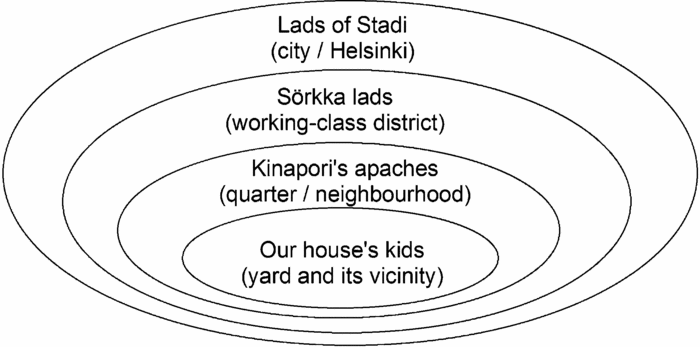
As they grew older the lads’ sprawling spatial practices in search of earning and spare-time opportunities brought them into contact with a wider spectrum of social classes and urban phenomena which, in turn, made the identity politics of slang-speaking a much more territorially multi-layered and contextually varying matter of ‘where one is from’ (Figure 5). A quintessential aspect of slang-speaking was that (5) it was utilized both to erode (in uniting symbolically above all bilingual working-class male juvenile groups) and strengthen (as with providers, working-class girls, teachers, upper-class urbanites and above all people from the countryside) existing socio-spatial boundaries. Meanwhile, (6) the meanings of slang toponymy became interlinked with the speakers’ affective ties with urban life and their anti-elitist conceptions of it. In slang-speakers’ alternative spatial register of the city, the highbrow marvels of modernization (architectural spectacles, luxurious shopping establishments) were considered unworthy of naming; what instead counted were street-level topicalities and recreations, public gathering sites and chances to earn well in service-sector menial jobs.
A schematic presentation of Sörkka lads’ overlapping territory-based identities.

Finally, can the early Helsinki slang toponymy be regarded as a counter-hegemonic lexicon at odds with the hegemonic conceptualizations of space in industrializing, modernizing Helsinki? The most probable conclusion is that in some respects it remained devoid of subversive meanings, yet in others bore them. On the one hand, in a sense of Marxian class struggle a great majority of slang-uses remained ideologically innocent. Unlike in the late nineteenth-century Stockholmska slang analysed by Pred,Footnote 61 expressions based on open irreverence, social inversions or bawdiness were rather few in early Helsinki slang. If Sörkka lads said ‘no to the language of honour and heroes’Footnote 62 through their rough slang toponymy, this took place obliquely, by leaving strangely anonymous most of the highbrow glories of the city. However, the wide societal condemnation of this ‘linguistic mongrel’ was a clear indication of its anti-hegemonic potential. Using alternative, in-group toponyms and other informal expressions provided slang-speakers with socially bordered spaces of their own; it gave them a sense of holding the power of (re-)defining the meanings of urbanity in their own terms. Simultaneously, however, (7) the routinized practice of code-switching left room for both internalizing slang as part of one's identity and socialization into the mainstream society. In a sense, it is telling that during the decades of rapid economic development, (sub)urban growth and the levelling of class differences in post-World War II Finnish society, the majority of the informants referred to in this study came off well in their adult occupations. Although many of Sörkka lads sooner or later left their home district, its bygone places – or rather, mestas – left lifelong marks in their memories.