Introduction
Tea, Camellia sinensis (L.) O. Kuntze (Theaceae), is an economically important, perennial and intensively managed monoculture plantation crop which provides the congenial microclimate as well as a continuous supply of food to a number of arthropods. According to recent estimates, more than a 1000 (n = 1034) arthropods are associated with tea plantations around the globe (Chen and Chen, Reference Chen and Chen1989; Muraleedharan, Reference Muraleedharan and Pimentel2007). Insect and mite pests are the most damaging. Among the insect pests, Lepidoptera is the largest order, containing 32% of the pest species, followed by Hemiptera with 27%. The dynamic adaptations of insects have enabled them to attack every part of a tea plant with a maximum number of pests occurring on the foliage, resulting in 11–55% loss in yield if left unmanaged (Hazarika et al., Reference Hazarika, Bhuyan and Hazarika2009).
Among the sucking pests of tea, Helopeltis theivora Waterhouse (Heteroptera: Miridae) is the most important pest, which sucks the sap from tender leaves, buds and young shoots, the most economic parts of the tea plant for the tea industry (Das, Reference Das1965), causing crop yield losses of up to 55% in Africa (Rattan, Reference Rattan, Wilson and Clifford1992), 11–100% in Asia (Muraleedharan, Reference Muraleedharan, Wilson and Clifford1992; Sundaraju and Sundara Babu, Reference Sundaraju and Sundara Babu1999; Muraleedharan, Reference Muraleedharan and Pimentel2007) and 10–50% in north-east India (Roy et al., Reference Roy, Gurusubramanian and Mukhopadhyay2010a).
In conventionally managed (synthetic insecticide-treated) tea plantations, different organo-synthetic insecticides of different functional groups (organochlorines, organophosphates, synthetic pyrethroids and, very recently, neonicotinoids) are routinely applied round the year to keep pest insect and mite populations under control (Sannigrahi and Talukdar, Reference Sannigrahi and Talukdar2003; Gurusubramanian et al., Reference Gurusubramanian, Rahman, Sarmah, Roy and Bora2008). This is a burden to planters as well as to the environment and can result in the resurgence of primary pests (Sivapalan, Reference Sivapalan and Jain1999), secondary pest outbreaks (Cranham, Reference Cranham1966), resistance development (Georghiou, Reference Georghiou1972; Kawai, Reference Kawai1997; Hsu, Reference Hsu, Feng and Wu2004; Roy et al., Reference Roy, Mukhopadhyay and Gurusubramanian2010b) and environmental contamination including undesirable insecticide residues in tea (Chaudhuri, Reference Chaudhuri and Jain1999). Continuous use of synthetic insecticides leads to the development of higher tolerance or resistance in many insects (Scharf et al., 1998; Martin et al., Reference Martin, Chandre, Ochou, Vaissayre and Fournier2002; Yu et al., Reference Yu, Nguyen and Abo-Elghar2003; Yang et al., Reference Yang, Wu, Chen, Devine, Denholm, Jewess and Moores2004; Markussaen and Kristensen, Reference Markussaen and Kristensen2010; Komagata et al., Reference Komagata, Kasai and Tomita2010). Variations in relative toxicity to commonly used insecticides have been observed in H. theivora populations from Jorhat, Assam (Gurusubramanian and Bora, Reference Gurusubramanian and Bora2007), Darjeeling (Bora et al., Reference Bora, Sarmah, Rahaman and Gurusubramanian2007), and from the sub-Himalayan Dooars region of north-east India (Roy et al., Reference Roy, Gurusubramanian and Mukhopadhyay2008a). In tea plantations of Terai, Dooars and Darjeeling foothill regions, for instance, endosulphan, quinalphos, monocrotophos, deltamethrin and cypermethrin are extensively used (Roy et al., Reference Roy, Mukhopadhyay and Gurusubramanian2008b).
Detoxification of insecticides is an important mechanism for insect pests to tolerate regularly applied insecticides (Brown and Brogdon, Reference Brown and Brogdon1987; Soderlund and Bloomquist, Reference Soderlund, Bloomquist, Roush and Tabashnik1990; Yu, Reference Yu1996; Scharf et al., 1998; Yu et al., Reference Yu, Nguyen and Abo-Elghar2003; Nehare et al., Reference Nehare, Moharil, Ghodki, Lande, Bisane, Thakre and Barkhade2010; Wu et al., Reference Wu, Yang, Yuan, Cambell and Teese2011). Despite the continuous use of insecticides, there are repeated failures in controlling the pest species in recent years (Gurusubramanian et al., Reference Gurusubramanian, Rahman, Sarmah, Roy and Bora2008; Roy et al., Reference Roy, Gurusubramanian and Mukhopadhyay2008a) in different conventional tea plantations of Terai, Dooars and Darjeeling foothill regions. Such failures occur due to change in the susceptibility level of the pest to the applied insecticides. Changes in susceptibility level are mainly due to metabolic detoxification of insecticides through a higher level of activity of some detoxifying enzymes under the stress of different management practices (Maymo et al., 2002; Sarker and Mukhopadhyay, Reference Sarker and Mukhopadhyay2003, Reference Sarker and Mukhopadhyay2006; Buès et al., Reference Buès, Bouvier and Boudinhon2005; Limoee et al., Reference Limoee, Enayati, Ladonni, Vatandoost, Baseri and Oshaghi2007; Cao et al., Reference Cao, Zhang, Gao, Liang and Guo2008; Wu et al., Reference Wu, Yang, Yuan, Cambell and Teese2011).
Generally, three principal enzymes (general esterases (GEs), glutathione S-transferases (GSTs) and cytochrome P450-mediated mono-oxygenases (CYPs)) are involved in the process of metabolic detoxification of insecticides (Soderlund and Bloomquist, Reference Soderlund, Bloomquist, Roush and Tabashnik1990). Estimation of the activities of these metabolic defence-related detoxifying enzymes may give information on the degree of tolerance/resistance of the insect pest population to insecticides and may be useful tools in monitoring the tolerance/resistance levels to insecticides in the pest population. Early detection of pest specimens representing metabolic threats related to tolerance/resistance levels to insecticides is important for devising control measures that can minimize the risk of subsequent build-up of the pest population and reduce environmental toxicity and wastage of insecticides.
In the present study, the susceptibility levels of the female H. theivora populations collected from conventional (synthetic insecticide treated: Terai and Dooars regions) and organic (synthetic insecticide untreated: Darjeeling foothill region) tea plantations to the insecticides quinalphos and cypermethrin were determined and were related to the activity of the detoxifying enzymes to obtain a better understanding of the biochemical basis of the susceptibility or tolerance level of the pest and to develop integrated resistance management strategies that can help in the effective control of this major tea pest.
Materials and methods
Collection and rearing of H. theivora
Helopeltis theivora were collected periodically from different conventional and organic tea plantations. These landscapes having unique phytogeographic climate and soil harbour tea plantations often dissected by river courses, interspersed patches of forests, low hills, highways and agricultural lands.
A laboratory culture of H. theivora was set up (at 25 ± 2 °C and 70–80% relative humidity) on the TV1 clone, collected from organically maintained tea plantations of the Makaibari Tea Estate of the Darjeeling foothills and was maintained in the laboratory for five generations following the procedure of Roy et al. (Reference Roy, Gurusubramanian and Mukhopadhyay2010a). These were used as a control (synthetic insecticide unexposed). Synthetic insecticide-exposed specimens were collected from different synthetic insecticide-managed plantations of Terai, Dooars and Darjeeling foothill regions. Both the laboratory-reared (control) and field-collected populations were subjected to relative toxicity and biochemical assays.
Insecticides and chemicals
The two insecticides quinalphos 25 EC (organophosphate: Flash®; Indofil India Ltd) and cypermethrin 25 EC (synthetic pyrethroid: Cymbush®; Syngenta India Ltd) were used for enzyme studies.
Bovine serum albumin (BSA), α-naphthyl acetate (α-NA), α-naphthol, 1-chloro-2,4-dinitrobenzene (CDNB), reduced glutathione (GSH), 3,3′,5,5′-tetramethyl benzidine (TMBZ), Fast Blue BB salt, acrylamide, bis-acrylamide (Sisco Research Laboratory, Mumbai) and cytochrome C (Sigma-Aldrich, Mumbai) were used for enzyme studies. Solutions of α-NA (30 mm), CDNB (50 mm) and TMBZ (6.3 mm) and the staining solutions were prepared fresh just before use.
Relative toxicity bioassay
The insecticides were diluted with demineralized water in five selected concentrations for use and were expressed in parts per million. Adult (female) H. theivora were exposed initially to a wide range of concentrations and on the basis of the resultant mortality, a series of concentrations within a narrow range were further tested. The second series was determined on the basis of the concentrations causing insect mortality above 20% and below 100%.
Toxicity assays were conducted using the standard ‘leaf dipped method’ recommended by the Insecticide Resistance Action Committee of the International Group of National Associations of Manufacturers of Agrochemical Products (Anonymous, 1990). Thirty adult females of H. theivora were released using a camel-hair brush separately into each glass chimney containing insecticide treated tea shoots. For each concentration, there were three replications and a control. Five doses from the second series were tested for each of the insecticides and the demineralized water was used for the control. The entire experiment was replicated three times. Final assessment of the lethal effects of the insecticides was done after 48 h of insecticide exposure, and was expressed as per cent mortality of the insect at each dose, in relation to control mortalities using Abbott's formula (Abbott, Reference Abbott1925) as needed (mortality above 10%).
Lethal concentrations for 50% (LC50) were calculated using SPSS version 15.0 (SPSS Inc., USA), based on Finney's probit analysis method (Finney, Reference Finney1973) and expressed in parts per million.
Homogenization of insects
Single adult (female) H. theivora was homogenized in 500 μl of ice-cold 0.1 m sodium phosphate buffer (pH 7.0) and centrifuged at 12,000 g for 20 min at 4 °C in a high-speed refrigerated centrifuge (SIGMA 3K30). The resultant post-mitochondrial supernatant was aliquoted (100 μl each) into a 0.5 ml centrifuge tube and was stored at − 80 °C as an enzyme source for GE, GST and CYP activity assays and to estimate the amount of total protein. For the GST assay, the pH of the homogenization buffer was 6.5. For both the control and field-exposed specimens, 60 adult females were assayed for enzyme activities.
GE activity
GE activity was measured using α-NA as a substrate according to the method of van Asperen (Reference van Asperen1962), with minor modifications, using a microplate reader. Twenty microlitres of the supernatant were taken in each well of the microplate reader (Opsys MR, DYNEX Technologies) in duplicate. Two hundred microlitres of freshly prepared 30 mm α-NA were added to each well for the reaction to occur. The reaction was stopped after 15 min by adding 50 μl of staining solution prepared fresh by mixing two parts 0.1% Fast Blue BB salt with five parts of 5% sodium dodecyl sulphate (SDS). The plate was left for 5 min for equilibration and absorbance was recorded at 590 nm. The change in absorbance was converted to an end product (α-naphthol) using the standard curve of α-naphthol (0.05–1.00 μM). Blanks were set at the same time using a reaction mixture without protein extracts.
GST activity
GST activity was estimated using the method of Kao et al. (Reference Kao, Hung and Sun1989) with minor modifications. Fifty microlitres of 50 mm CDNB and 150 μl of 50 mm GSH were added to 2.78 ml of sodium phosphate buffer (100 mm, pH 6.5). Twenty microlitres of the enzyme stock were then added. The contents were shaken gently, incubated for 2–3 min at 20 °C and then transferred to a cuvette in the sample cuvette slot of a UV–visual spectrophotometer (Rayleigh UV-2601). The reaction was carried out in duplicate. The reaction mixture (3 ml) without the enzyme was placed in the reference slot for setting zero. Absorbance at 340 nm was recorded for 10–12 min employing a kinetics (time-scan) menu. A unit of enzyme activity is defined as the amount of enzyme that catalyses the formation of 1 μmol 2,4-dinitrophenylglutathione/min at 30 °C using 1 mm concentrations of GSH and CDNB. Specific activity is defined as units of activity per mg protein. At 340 nm, the difference in millimolar extinction coefficient between the CDNB–GSH conjugate and CDNB was 9.6. Changes in absorbance/min were converted to μmol CDNB conjugated/min per mg protein using the formula (Habig et al., Reference Habig, Pabst and Jakoby1974; Nehare et al., Reference Nehare, Moharil, Ghodki, Lande, Bisane, Thakre and Barkhade2010):
CDNB–GSH conjugate (μmol/min per mg protein) = absorbance increase (in 5 min) × 3 × 1000/9.6 × 5 × protein (in mg),
where 9.6 mm/cm is the extinction coefficient for the CDNB–GSH conjugate at 340 nm.
Cytochrome P450 activity
Most of the classic methods to evaluate oxidase activity with chromogenic substrates require the purification of microsomal fractions. However, these methods cannot be used to estimate the differences in oxidase activity in single small insects (Martin et al., Reference Martin, Chandre, Ochou, Vaissayre and Fournier2002). The alternative method was to measure the level of haem-containing enzymes, including the cytochrome oxidase enzymes (Brogdon et al., Reference Brogdon, McAllister and Vulule1997). Peroxidation of TMBZ was catalysed by microsomal proteins with hydrogen peroxide as a co-substrate. The amount of oxidase enzymes was correlated with the peroxidase activity of the haem groups. Cytochrome P450 activity was estimated by measuring haem peroxidase activity (Penilla et al., Reference Penilla, Rodriguez, Hemingway, Trezo, Lopez and Rodriguez2007; Tiwari et al., Reference Tiwari, Pelz-Stelinski, Mann and Stelinski2011). As haem constitutes the majority of cytochrome P450 in non-blood-fed (herbivorous) insects, quantification of haem activity can be expressed as cytochrome P450 (Brogdon et al., Reference Brogdon, McAllister and Vulule1997). For cytochrome P450 activity, 20 μl of the supernatant was taken in the well of the microplate containing 200 μl of 6.3 mm TMBZ solution (10 mg TMBZ dissolved in 5 ml absolute methanol mixed with 15 ml of 0.25 m sodium acetate buffer (NaC2H3O2), pH 5.0, prepared fresh daily). Then, to each well of the microplate, 80 μl of 0.0625 m potassium phosphate buffer, pH 7.2, and 25 μl of 3% hydrogen peroxide were added. Two controls per plate were prepared each with 20 μl of homogenizing buffer and with all the ingredients except the enzyme source. Absorbance was recorded at 630 nm after 30 min of incubation using a microplate reader (Opsys MR; DYNEX Technologies) against blanks at 25 °C. A standard curve for haem peroxidase activity was prepared using different concentrations of cytochrome C (0.0025–0.02 nmol) from horse heart type VI (Sigma Aldrich). Total cytochrome P450 activity was expressed as nmol of cytochrome P450 equivalent units mg protein/min.
Electrophoretic analysis of GEs
Electrophoresis of different H. theivora populations (conventional field-collected populations from Terai and the Dooars, and susceptible populations from the Dooars (Samsing tea plantation) and Darjeeling foothill regions (Mokaibari tea plantation)) was carried out in 8% polyacrylamide gels using an equal amount of protein in Tris-glycine (pH 8.3) at 200 V for 6–7 h at 4 °C. The gels were stained for esterase isozymes according to Georghiou and Pasteur (Reference Georghiou and Pasteur1978) with slight modifications. Esterase isozymes were designated as EST I, II, III, IV, V and VI based on mobility from anodal to cathodal. The R m (relative mobility) values of esterase isozyme bands were determined following the standard method. Densitometric analysis of the isozyme bands was performed using Image Aide Analysis software. The increase in esterase isozymes (Est I–VI) was quantified as the relative pixel density of the bands for the specimens.
Total protein
Enzyme activities were corrected for protein concentration. Total protein content of the homogenate was determined by Lowry's method (Lowry et al., Reference Lowry, Rosebrough, Farr and Randall1951) as modified for microplate reader using BSA as the standard.
Correlation between enzymatic activities and LC50 concentrations in different populations of H. theivora against these two insecticides was determined by a correlation test (α = 0.05; SPSS 15.0) following the method of Cai et al. (Reference Cai, Han, Cao, Hu, Zhao and Bi2009).
Results
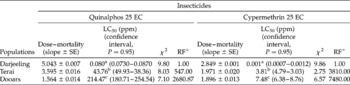
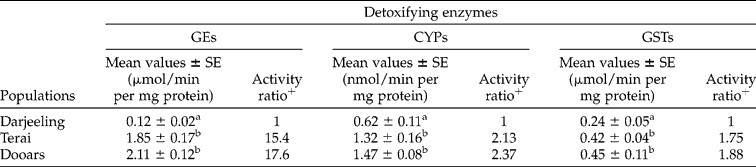
The Dooars population was almost 29-fold and the Terai population 11-fold more susceptible to cypermethrin than to quinalphos (Table 1). The GE activity of H. theivora populations collected from the conventional tea plantation of Terai and the Dooars was 15.4- and 17.6-fold, respectively, than the susceptible populations from the Darjeeling foothills (Table 2). The most resistant Dooars population had the shallowest slope, suggesting a greater amount of heterogeneity in population response to insecticide exposure, which also makes sense by looking at the wider confidence intervals. Mono-oxygenase and GST activity was 2.1- and 2.4-fold, and 1.8- and 1.9-fold, respectively, for the H. theivora populations of conventional tea plantations of the Terai and the Dooars when compared with the susceptible population of the Darjeeling foothill (Table 2).
Relative toxicity of quinalphos 25 EC and cypermethrin 10 EC against Helopeltis theivora in sub-Himalayan tea plantations of West Bengal, India

Lc50, lethal concentrations for 50%; χ2, chi square value; RF, resistance factor;.
a,b,cLC50 values with different letters within a column were significantly different (P = 0.05; Tukey's multiple comparison test (honestly significant differencea)).
+ RF = LC50 of the conventional field-collected population/LC50 of the susceptible population.
Detoxifying enzyme activity of Helopeltis theivora in sub-Himalayan tea plantations of West Bengal, India
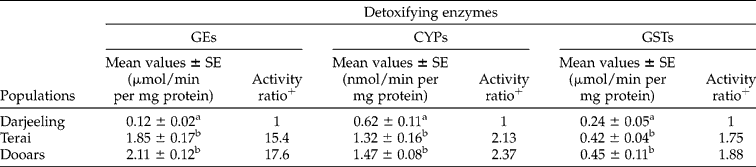
GEs, general esterases; CYPs, mono-oxygenases; GSTs, glutathione S-transferases.
a,bMean values with different letters within a column were significantly different (P = 0.05; Tukey's multiple comparison test (honestly significant differencea)).
+ Activity ratio = enzyme activity of the conventional field-collected population/enzyme activity of the susceptible population.
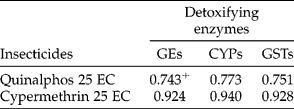
A high degree of correlation between the activities of detoxifying enzymes and insecticidal toxicities of the various H. theivora populations in question was evident (Table 3). There was a strong correlation between the toxicities of cypermethrin and the activities of CYPs (r 2 = 0.94). Similarly, GEs and GSTs also showed good correlations with the toxicity of the two insecticides.
Correlation between detoxifying enzyme activity and lethal concentrations for 50% in different populations of Helopeltis theivora in sub-Himalayan tea plantations of West Bengal, India
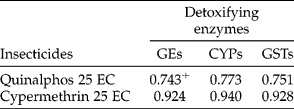
GEs, general esterases; CYPs, mono-oxygenases; GSTs, glutathione S-transferases.
+ r 2 value.
Electrophoretic analysis for GEs revealed the six isozyme bands (Est I–VI). The R m values of the esterase bands (Est I–VI) were 0.15, 0.23, 0.30, 0.38, 0.43 and 0.51, respectively. Staining intensity (level of expression) was found to be higher, which is evident from the densitometric study of the populations of H. theivora in specimens from the conventional tea plantations of Terai and the Dooars when compared with the susceptible specimens from the organic tea plantations from the Dooars and Darjeeling foothill regions. Staining intensity also varied between the populations from the insecticide-treated conventional plantations of Terai and the Dooars. The susceptible specimens showed a very low level of expression for all the esterases (Est I–VI) from the organic tea plantations of the Dooars (Samsing tea plantation) and Darjeeling foothill regions (Mokaibari tea plantation).
Discussion
This is the first study on the level of susceptibility of H. theivora populations in reference to two common insecticides (quinalphos and cypermethrin) from the sub-Himalayan tea plantations of North Bengal, India. Compared with the susceptible populations of H. theivora (from the organic tea plantations), the conventional field populations (from the Dooars and Terai) varied considerably in susceptibility to insecticides as well as in the level of detoxifying enzyme activity (Roy et al., Reference Roy, Gurusubramanian and Mukhopadhyay2008a). The conventional field-collected strain was expected to have developed resistance to the tested insecticides. The development of resistance may be related to the history of the commonly sprayed insecticides or other pesticides of similar groups (Zhu et al., Reference Zhu, West, Snodgrass and Luttrell2011). The resistance ratio can be closely related to the number of applications with pesticides of the same mechanism of action (Campos et al., Reference Campos, Dybas and Kruba1995).
The kind and quality of pesticide applications for the tea cultivation areas can be assessed from the marketing statistics of the local chemical companies and the survey report on the use pattern of insecticides in tea estates of North Bengal (Sannigrahi and Talukdar, Reference Sannigrahi and Talukdar2003; Roy et al., Reference Roy, Mukhopadhyay and Gurusubramanian2008b). The literature reveals that in conventional tea plantations, different insecticides of the same or different functional groups or mode of actions are routinely used to control insect and mite tea pests. The target site and the mode of action are different for each group of insecticides: organophosphates and carbamates block acetylcholinesterase; pyrethroids and DDT (dichlorodiphenyl trichloroethane) interfere with sodium channels; chlorinated cyclodienes interfere with Cl channels in GABA (gamma-aminobutyric acid) receptors; and nicotinyl insecticides interfere with nicotinic acetylcholine receptors (Yu, Reference Yu2008). At the same time, GE and cytochrome P450s are phase I (primary) detoxifying enzymes which detoxify insecticides mainly by oxidation, hydrolysis and reduction, and GSTs are phase II detoxifying enzymes which conjugate polar products with various endogenous compounds such as sugars, sulphate, phosphate, amino acids or glutathione (Yu, Reference Yu2008). Quinalphos and cypermethrin insecticides have been extensively used in the last few decades in the Dooars and Terai regions of North Bengal, the highest consumption being in the Dooars region.
Metabolic detoxification of insecticides is an important mechanism in insects to reduce the toxic effects of insecticides. Esterases have great versatility and are generally involved in the metabolism of organophosphorus insecticides. There was a significant enhancement in the activity of different detoxifying enzymes in H. theivora from the conventional tea plantations. In resistant pest species, a higher level of GE activity (Ferrari et al., Reference Ferrari, Morse, Georghiou and Sun1993; Hemingway et al., Reference Hemingway, Hawkes, McCarroll and Ranson2004; Nehare et al., Reference Nehare, Moharil, Ghodki, Lande, Bisane, Thakre and Barkhade2010; Wu et al., Reference Wu, Yang, Yuan, Cambell and Teese2011) has been observed. Oxidation mediated by cytochrome P450 mono-oxygenases is considered to be the major pathway for cypermethrin detoxification, though, to a limited extent, esterase hydrolysis is also possible (Shono et al., Reference Shono, Ohsawa and Casida1979). The activity of cytochrome P450 mono-oxygenase in female H. theivora showed a good correlation (r 2 = 0.94) with the toxicity of cypermethrin. When piperonyl butoxide was synergized with the insecticides, there was an increase in the susceptibility level of H. theivora, indicating the involvement of cytochrome P450-mediated metabolism of the insecticides (Roy et al., Reference Roy, Mukhopadhyay and Gurusubramanian2009). A strong correlation between fenvalerate toxicity and cytochrome P450 activity in Helicoverpa armigera Hübner (Lepidoptera: Noctuidae) has also been reported by Chen et al. (Reference Chen, Yang and Wu2005). Such correlation involving cytochrome P450 indicates its important role as a detoxifying enzyme for both the insecticides in H. theivora. GST activity also increases with insecticide resistance (Wu et al., Reference Wu, Jiang and Miyata2004; Nehare et al., Reference Nehare, Moharil, Ghodki, Lande, Bisane, Thakre and Barkhade2010). Increased GST activity was associated with organophosphate resistance, as reported by Cheng et al. (Reference Cheng, Kao, Lin and Trai1983) and Yu and Nguyen (Reference Yu and Nguyen1992), indicating its role in detoxifying. GE and GST also showed a good correlation with the two insecticides, indicating that these two enzymes also play a role in the metabolism of the insecticides in H. theivora. Similarly, an increase in GE and GST activity in relation to the more resistant populations to the two insecticides indicates that these two enzymes also play a substantial role in the metabolism of the insecticides in H. theivora. Similarly, Perera et al. (Reference Perera, Hemingway and Karunaratne2008), Sarker et al. (Reference Sarker, Bhattacharyya, Borkotoki, Goswami, Rabha, Baruah and Srivastava2009) and Zhu et al. (Reference Zhu, West, Snodgrass and Luttrell2011) have shown that in field populations of insects, the activity of all the three principal detoxifying enzymes (GE, GSTs and cytochrome P450) may be enhanced.
Qualitative changes of esterases may also give rise to resistance (van Asperen and Oppenoorth, 1959; Devonshire, Reference Devonshire1977; Devonshire and Field, Reference Devonshire and Field1991; Wu et al., Reference Wu, Yang, Yuan, Cambell and Teese2011). The increase in the activity of detoxifying enzyme levels strongly correlates with the level of toxicity of the two insecticides. Detoxification by cytochrome P450 mono-oxygenases is generally considered to be an important mechanism in conferring resistance to insects (Hodgson and Kulkarni, Reference Hodgson, Kulkarni, Georghiou and Saito1983; Feyereisen, Reference Feyereisen1995, Reference Feyereisen1999). Esterase-based resistance due to qualitative changes in esterases has been recorded in Myzus persicae (Sulzer) (Hemiptera: Aphididae) (Devonshire, Reference Devonshire1977) and Musca domestica L. (Diptera: Muscidae) (van Asperen and Oppenoorth, Reference van Asperen and Oppenoorth1959, Reference van Asperen and Oppenoorth1960). Electrophoretic analysis for GEs revealed six isozyme bands (Est I–VI). The R m values of the esterase bands (Est I–VI) were 0.15, 0.23, 0.30, 0.38, 0.43 and 0.51, respectively. The expression level (band colour intensity) was higher in specimens from the conventional tea plantations when compared with the susceptible specimens from the organic tea plantations. The susceptible specimens showed a very low level of expression for all the esterase isozymes (Est I–VI), which was also found to be true in quantitative estimation. These differential expressions of GEs indicate their relationship with insecticide tolerance levels in H. theivora. It appears that continuous exposure of different insecticides has enabled selected populations of H. theivora over several decades to become more tolerant to commonly used insecticides such as quinalphos and cypermethrin.
In pest management programmes, treatment decisions are based on economic thresholds or aesthetic injury levels. However, insecticide resistance reduces the efficacy of insecticide treatments (Kawai, Reference Kawai1997), thereby influencing the decision process by reducing the number of viable treatment options. An enzyme-based early detection of resistant or more tolerant populations of H. theivora may help in making decisions on insecticide selection and spray operations. Similarly, their susceptibility levels to insecticides can be helpful in understanding the development of insecticide-tolerant strains of pest populations, hence leading to better planning of their management.
In recent years, use of synthetic insecticides has become a major concern for the tea industry, as importing countries are imposing stringent restrictions on the acceptability of processed tea having insecticide residues. These conditions warrant a review of the levels and use patterns of insecticides, which would restrict application to only effective insecticides, on the one hand, and reduce insecticide load on tea and the environment, on the other hand.
Acknowledgements
The authors would like to thank the Head of DST-FIST and UGC-SAP Assisted Department of Zoology, University of North Bengal for providing laboratory facility. The authors also thank the planters and managers of the organic and conventional tea estates of Terai and the Dooars for their kind co-operation in collecting specimens from their plantations, especially those of Kalchini, Bhatkhawa Samsing (organic), Nagrakata, Hildebrand, Grassmore Tea Estates of the Dooars, Morhargong Gulma Atal, Kamalpur, Longview (organic), Simulbarie, Hansqua, Gungaram, Gayaganga, Sonachandi, Maruti, Matigara Tea Estates of Terai and Makaibari (organic), Singel (organic), and Castleton (organic), and Ambootia Rohini Tea Estates of the Darjeeling foothill. The authors would further like to thank the Tea Research Association, Nagrakata for its co-operation.