INTRODUCTION
Precious coral fishery management in the Mediterranean faces the challenge of studying the baseline species' distribution and population structure some centuries after fishing actually began (Tsounis et al., in press). Although the biology of the precious red coral (Corallium rubrum) has been the focus of a series of studies since the 1970s, our knowledge on the distribution of the species originates mainly from information gleaned from fishermen, rather than from ad hoc scientific studies. The scientific literature considers C. rubrum to be an eurybathic species, extending from the shallow subtidal to over 700 m (Costantini et al., Reference Costantini, Taviani, Remia, Pintus, Schembri and Abbiati2009). In contrast, little is known about the distribution of other precious and deep corals in the Mediterranean.
A review of related literature suggests that C. rubrum is the only precious coral species that has been fished to date in the Mediterranean, overlooking the fact that other precious coral species, such as Gerardia spp. in Turkey (Bayram Öztürk, personal communicaton) and antipatharian species in Malta, have also been fished, albeit on a minor scale. It appears that precious coral fisheries in Malta might never have been monitored or managed on the basis of scientific surveys, and were rather based on sporadic short-term permits.
Historical records show that coral fishing has occurred around the Maltese Islands for centuries, probably ever since the first century BC (Busuttil, Reference Busuttil1971). The importance of corals to the Maltese culture is underlined by the presence of unworked white and pale red coral (Dendrophyllia ramea, mainly) at the temple site at Tas-Silg in Malta, dating back to approximately the same period (Quercia, Reference Quercia2002). With the EU-wide ban on coral dredging coming into force in 1994, black coral populations are no longer exploited in Maltese nearshore waters, but it is likely that the population structure of these long-lived, slow-growing organisms has not yet returned to pre-fishing levels. Therefore, describing past precious coral fisheries gives some clues on the present status of affected species' populations.
The increasing interest in Mediterranean coral habitats (e.g. study by Cerrano et al., Reference Cerrano, Danovaro, Gambi, Pusceddu, Riva and Schiaparelli2010, on the effects of the presence of gold coral Savalia Savaglia on ecosystem functioning and marine biodiversity at a site in the Ligurian Sea) has contributed to advancing our knowledge on the distribution of these species, pursuant to improving their conservation. For example, deep-water coral populations have been recently recorded from Maltese waters, including reefs of Dendrophyllia cornigera, Desmophyllum cristagalli and white coral (Lophelia pertusa and Madrepora oculata) at depths of 390–617 m (Schembri et al., Reference Schembri, Dimech, Camilleri and Page2007), and colonies of Corallium rubrum at depths of 585–819 m (Costantini et al., Reference Costantini, Taviani, Remia, Pintus, Schembri and Abbiati2009). Conversely, very little is known about the distribution of coral at intermediate depths (i.e. the continental shelf below SCUBA diving limit—Pyle, Reference Pyle1996). There are only a few records of Antipatharia in the Mediterranean: in the Adriatic, off Genova, and Marseille, Corsica, Sardinia, and North Africa (Gravier, Reference Gravier1921; Lacaze-Duthiers, Reference Lacaze-Duthiers1864; Brook, Reference Brook1889; Koch, Reference Koch1889). More recently, black coral populations have been studied in the Strait of Messina (Bo et al., Reference Bo, Tazioli, Spanò and Bavestrello2008, Reference Bo, Bavestrello, Canese, Guisi, Salvati, Angiolillo and Greco2009), and have been documented off Nice (Ballesta, Reference Ballesta2008). Another precious coral family, Gerardiidae, has been recorded from similar habitats in Sicily, off Naples, off Croatia, and southern France at 40–70 m depth (Schmidt, Reference Schmidt1972) and along North African coasts (Lacaze-Duthiers, Reference Lacaze-Duthiers1864). However, little is known about this group of corals in the Mediterranean, and about anthropogenic impacts on their populations.
Given the scarcity of precious corals, the lack of data on their distribution, and the presumed ongoing unregulated fishing activities, this study presents a first record of black coral (Antipatharia) from Maltese waters, as well as historical information and data on the Maltese coral fisheries. The reported data improve our understanding of the ecological history of the populations and, in this way, contribute to the long term establishment of a population baseline, which is in turn useful for environmental management.
MATERIALS AND METHODS
All available information concerning past fishery of precious coral species in Maltese territorial waters was collected. In order to glean this information, grey literature had to be relied upon, including archives within different Maltese government entities, such as those of the Ministry for Resources and Rural Affairs (MRRA), the Malta Enterprise and the Fisheries Department, besides the National Archives. Interviews with fishermen were conducted in order to reconstruct a realistic rendition of the previous coral fishing activities in Maltese nearshore waters. A specimen in a private collection and another one at the Natural History Musuem in Mdina, Malta were inspected for identification.
RESULTS
The presence of red (and white) coral in Maltese waters, particularly near Xlendi, Gozo has been documented in the 18th Century (Agius de Soldanis & Mercieca, Reference Agius de Soldanis and Mercieca1999). One of the earliest records of coral fishing from Maltese waters dates back to 1647, stating that red coral fishermen from Trapani in Sicily fished coral from Maltese waters (Abela, Reference Abela1984). In the mid-18th Century, twenty-five ‘corallari’ from Trapani, who owned boats, petitioned the Order of the Knights of St John to harvest coral in Maltese waters since a quantity of red coral had been spotted towards the north-east of the island and records show that in 1747 a large amount of Sicilian boats crossed to Malta to fish for coral.
The first systematic attempt at mapping the distribution of Corallium rubrum in Maltese waters was made in 1862 by Captain T.A.B. Spratt aboard HMS ‘Medina’ (Figure 1). The official cruise report states that C. rubrum was fished in Maltese nearshore waters by means of the St Andrew's Cross, or ingegno. The same cruise provides us with the first distribution map of C. rubrum in Maltese nearshore waters (incorporated in Figure 1).
Distribution map of historical red and black coral records from Maltese nearshore waters. Legend: (1–9) coral records cited in maps from HMS Medina (1862) expedition and not fished during the 1984–1987 period; (A, B) coral records cited in maps from the HMS ‘Medina’ expedition and fished for Corallium rubrum during the 1984–1987 period; (I–II) coral records cited in maps from the HMS ‘Medina’ expedition and fished for black coral during the 1984–1987 period. GB, the bay of Gnejna; RW, Ras in-Newwiela. Bathymetry data collected by the British Admiralty and the US Navy between 1955 and 1957, and digitized by Professor Aldo Drago, Physical Oceanography Unit, University of Malta.

According to an Oil Exploration Progress report compiled by R. Scotto in 1983, the first coral fishing license was issued by the British authorities that same year, on an exclusive basis, to Michele Crescuolo, a Neapolitan hailing from a coral-fashioning family, for the harvesting of a coral bank located ~200 – 300 m off Ras in-Newwiela in Gozo (Figure 1). A tender was awarded in 1863, for the duration of one year, for coral fishing on an exclusive basis for the entire coast of Malta and Gozo to Giosue Cafiero, in association with Settimio Caramia (Balzan & Deidun, in press). Subsequently, individual fishermen or companies, mainly hailing from Sicily or the Torre del Greco area, periodically requested permits for coral-fishing purposes, up to recent times.
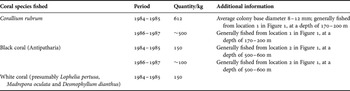
In 1983, a license was granted by Maltese authorities to an Italian company (Coralma) to extensively survey Maltese waters for the presence of C. rubrum. Twenty different locations, extending throughout the 12 nautical mile territorial waters of the Maltese Islands, were sampled by dividing the same marine area in to ten different zones. The enterprise was largely unsuccessful, since just 3 kilos of ‘low-quality’ Corallium rubrum was officially recorded. In 1984, a government-owned company, the Mediterranean Coral Fishing Company, was instituted with the sole objective of identifying and harvesting precious coral populations in Maltese waters, which yielded the only quantitative information about shallow-water precious coral populations in these waters (Table 1). The company was initially set up with an investment of 250,000 euros and had at its disposal two Italian boats. Maltese fishermen were commissioned at an attractive rate of 165 euros/week.
The historical catch data from Malta, which are not available through annual catch statistics of the FAO (Matthew Camilleri, GFCM–FAO, personal communication).

An analysis of this data indicates that the C. rubrum catch landed from Maltese nearshore waters during 1984–1985 and 1986–1987 amounted to almost 1.5% of the total biomass of the 44.3 tons and 40.4 tons recorded for the whole Mediterranean for these two periods, respectively (http://www.fao.org/fishery/statistics/software/fishstat/en).
During the operating period of the coral-harvesting company (1984–1987), Maltese nearshore waters were surveyed primarily by means of SCUBA divers using helium-based breathing gas mixtures, an ROV (operating from a modified French navy vessel) and a manned submersible (<10 m in length, manned by three individuals, and fitted with hydraulic arms for collection of coral specimens) which was occasionally hired for 150,000 euros per week from offshore oil companies.
Underwater footage of C. rubrum colonies filmed during this period has deteriorated in quality, making it impossible to estimate population descriptors, such as abundance of colonies or colony height. The footage suggests, however, that C. rubrum colonies are distributed at the base of submarine vertical walls and along the lower fringes of overhangs. Attempts made by the submarine operators to harvest C. rubrum through the use of the robotic arms proved largely unfruitful.
In addition to surveying exercises through the deployment of the midget submarine, fishermen generally used conventional nets or a device akin to the barra italiana, a heavy metal bar with nets attached at intervals along its length and which was dredged along the seabed to collect Corallium rubrum. The pipe in question was generally less than 20 cm in diameter and about 20 feet long.
This fishery also landed 100 kg of black coral (Antipatharia), which was recorded at that time as Antipathes spp. (Table 1). To date, very few black coral specimens and fragments retrieved from the company's operations can be located, and it is not clear if the fishery exploited one or several species. One such erect, branching specimen, identified as Leiopathes glaberrima and having a height of 40 cm, is housed at the Natural History Musuem in Mdina, Malta (Figure 2). Other smaller black coral fragments were also available for this study, having base diameters ranging from 6 to 12 mm, suggesting colony sizes slightly smaller than that of the museum specimen. Unfortunately, the state of the specimens makes definite identification difficult. However, the irregular sympodial branching pattern and the absence of spines on the larger branches further indicate that this specimen probably belongs to the species Leiopathes glaberrima.
The antipatharian specimen housed at the Natural History Museum, Mdina, identified as Leiopathes glaberrima.

Most of the recorded fishing locations for the precious coral species coincide with the locations indicated by Captain Spratt's survey in 1862 (Figure 1). One other record refers to C. rubrum documented by a SCUBA diver at a depth of ~20 m, in a partially submerged cavern, located a few hundred metres to the north of Ras in-Newwiela in Gozo. If confirmed, this would constitute the shallowest record of C. rubrum in Maltese nearshore waters. The restriction of C. rubrum populations to waters off the western coasts of the Maltese Islands might be attributed to a number of factors, including the seabed typology, which is largely rocky with frequent pockets of coralligenous biocoenosis, the prevailing sea currents (mainly of a north-western provenance in the Maltese Islands) and the abrupt increases in sea depth experienced along the western flanks of the islands, in the form of submarine cliffs and vertical walls.
While raw red coral fished from Maltese nearshore waters was mainly bought by the industry in Torre del Greco (Tescione, Reference Tescione1973), official Mediterranean Fishing Coral Company documents state that black coral jewellery derived from Maltese stocks was mainly sold to the German market, whilst the largest demand for local red coral artefacts came from Britain. The former fetched lower prices and was more time-consuming to sculpt. In addition, whilst 75% of the biomass of precious red coral was wasted during the sculpting phase, this statistic was even higher for the black coral species, due to its softer skeleton that made it less malleable to mechanical manipulation. The company purchased a single coral-fashioning machine from Germany, worth 10,000 euros, and even developed a protocol for the polishing of precious red coral through the adaptation of equipment normally used in the manufacture of spectacles and through the use of tumblers and mud.
DISCUSSION
Information gathered from historical sources and interviews has to be analysed cautiously, considering its questionable reliability. However, in the case of the reconstruction of past coral fisheries scenarios presented in this study, only a few minor discrepancies were encountered.
One of them was the fact that the coral distribution documented in Captain T.A.B. Spratt's survey had to be interpreted with caution, in view of the lack of sophisticated remote surveying techniques at that time. Borg et al. (Reference Borg, Howege, Lanfranco, Micallef, Mifsud and Schembri1998) also allude to the fact that benthic habitats off the north-eastern coast of the island of Malta identified originally as ‘coral’ in British Admiralty charts turned out be to maerl.
The Maltese fishery seems to have been an exception to the general practice of the centralized precious coral jewellery manufacture in Italy, whereby most Mediterranean fisheries supplied the raw material to the specialized industry in Torre del Greco (Tescione, Reference Tescione1973).
Certainly the most remarkable aspect of this analysis is the discovery of the only known past black coral fishery in the Mediterranean. This is even more surprising given the fact that the presence of this group had not been previously described from Maltese waters. Unfortunately, the specimens available had lost their soft tissue by natural abrasion, with such tissue being helpful for reliable identification (Opresko, Reference Opresko2001). However, the branching pattern (Opresko & Försterra, Reference Opresko, Försterra and Hofrichter2004) of the larger black coral specimen in the Mdina Natural History Museum suggests that it might be a specimen of Leiopathes glaberrima, whose taxonomic identity was further confirmed through an analysis of microscopic spines from smaller fragments of the species. If future surveys confirm the presence of L. gaberrima in Maltese waters, it would have considerable implications for conservation, as this species is supposed to reach a lifespan of several decades or centuries (Williams et al., Reference Williams, Risk, Ross and Sulak2009), maybe even more than 2000 years (Roark et al., Reference Roark, Guilderson, Dunbar and Ingram2006), and is thus very vulnerable to anthropogenic disturbance.
The impact of the fishery on the populations is still unknown, but it is possible that they are currently recovering, as fishing for black coral in Maltese nearshore waters ceased, for two main reasons: the great depths involved, making the use of coral dredging or netting necessary in order to access the coral populations, and the fact that coral dredges have been prohibited in the EU since 1994. The only alternative is cost-intensive harvesting by manned submersible, but the low price of black coral, coupled with its availability from the tropics, makes this option non-profitable. Harvesting large Antipatharian colonies, with their relatively tough and flexible proteinaceous skeleton (as opposed to the brittle, calcium carbonate skeleton of Corallium spp.), would require hydraulic arms, further raising the cost of deployed ROVs as well.
Furthermore, Antipatharia species have been listed in Annex II of the CITES Convention since 1981, which regulated its international trade, by only allowing export of corals from sustainably managed stocks, coupled with scientific monitoring. Consequently, the black coral fishery in the Maltese Islands eventually came to the attention of the International Union for the Conservation of Nature (IUCN) which, in 1987, solicited the Maltese government to sustainably manage and regulate these slow-growing species based on scientific studies, highlighting the fact that this was the only known black coral fishery in the Mediterranean. To date, there is still a dearth of knowledge about the biology of the species in question, and even the fact that it was previously fished was never published.
The need for a stock assessment of red coral populations in Maltese waters was raised in 1990, when Maltese environmental authorities sought advice on the matter from the Conservation Monitoring Centre of the IUCN. Malta has been invited since the late 1980s to participate in the FAO pan-Mediterranean stock assessment of Corallium rubrum populations, with no data being submitted by the Maltese authorities (Matthew Camilleri, GFCM–FAO, personal communication).
Corallium rubrum and antipatharian species (as Antipathes spp.) fall under strict protection regimes in the Maltese Islands, being listed under Schedule VI of LN 311 of 2006 (Maltese legislation), which includes all species of plants and animals of national importance in need of strict protection. The listing of these precious coral species has been conducted on precautionary grounds, in view of the complete lack of abundance data for the same species (with Leiopathes glaberrima not being included in such a listing). The listing seems justified when considering the small to medium size of the red coral landed (8 mm; see Table 1), the limited distribution of precious coral species in Maltese nearshore waters (being restricted to isolated pockets off the north-western coastal fringe of the Maltese Islands; Figure 1), and the small quantities of coral landed (Table 1), in contrast to the intense fishing effort involving submersibles, robots and dredges. Even if not all the coral landed was officially reported, the quantities cited are still considerably less than in other regions (Tsounis et al., in press). In addition to this protection, Act No. XII of 1953 (Fish Industry Act) of the Maltese Islands regulates the harvesting of coral species, stating that ‘Fishing means the art of catching every description of fish, of shellfish or corals or plants found in the sea’.
Nevertheless, interest in fishing for Corallium rubrum continues to be high, as confirmed by official correspondence between the Director of Agriculture and Fisheries of Malta and a prospective coral fishing licencee, dated 10 July 1990, and numerous applications for coral-fishery by Maltese fisheries authorities in successive years. Another indication of the sustained high demand for precious red coral is a recent application by a Maltese company for a license to initiate a coral-culturing enterprise on roof space and in a marine area in close proximity to existing aquaculture operations.
In conclusion, it can be stated that the harvesting of precious coral populations in Maltese nearshore waters has, to date, been conducted without any provisions for stock assessment, and may thus not have been sustainable. The distribution of Antipatharia in Malta is unknown to date, while the distribution of Corallium rubrum is only known thanks to records of fishermen, at least above ~120–150 m depth. Similar findings in other parts of the Mediterranean (e.g. see Tsouris et al., in press) and the isolated record at 20 m indicate that C. rubrum could have been more widely present at this depth before industrial harvesting commenced.
Future research may provide a precise stock assessment of precious coral populations through the deployment of ROV technology during ad hoc scientific surveys at reported locations. In addition, the taxonomic identity of black coral species occurring in Maltese nearshore waters should be conclusively established. This kind of data are invaluable for the sustainable management and conservation of the precious coral species in question.
It is likely that, whilst exploitation of black coral in Maltese waters has ceased, red coral fishing in the same waters is still ongoing, albeit on an unofficial and at scaled-down levels (when compared with the 1980s fishing efforts). Concerns exist over the complete lack of management protocols and regulation governing such fishing, for which no licenses are currently operational; it is thus recommended that, for Maltese nearshore waters, baseline data concerning the coral species of interest are collected and environmental monitoring of the same populations is embarked upon.
ACKNOWLEDGEMENTS
The authors are grateful to the Ministry of Resources and Rural Affairs (MRRA) and Malta Enterprise for allowing access to their archives in order to glean information on previous records of fishing for precious coral species in Maltese nearshore waters. In addition, the authors are grateful to Professor Noel Zarb Adami, Dr Roger Scotto, Dr Dennis Opresko, and Mr Frank Abela, formerly involved in the directorship of the Mediterranean Coral Fishing Company, for the wealth of useful information furnished.