Introduction
In advance care planning (ACP), people inform family members or healthcare providers either verbally or in writing about treatments they may or may not want and about who should be involved in surrogate decision-making for them — about how decisions should be made when they cannot make those decisions themselves (Sudore et al., Reference Sudore, Lum and You2017). ACP is associated with improved outcomes at the end of life (EOL) for both patients and surrogate decision-makers — with more received care concordant with stated care goals, more and earlier use of hospice care, greater satisfaction with care among patients (Wright et al., Reference Wright, Zhang and Ray2008; Detering et al., Reference Detering, Hancock and Reade2010; Mack et al., Reference Mack, Weeks and Wright2010), and reduced stress and decisional conflicts within bereaved families (Detering et al., Reference Detering, Hancock and Reade2010; Chiarchiaro et al., Reference Chiarchiaro, Buddadhumaruk and Arnold2015).
Research also shows that older African Americans are less likely to discuss EOL treatment preferences (i.e., informal ACP) or complete advance directives (ADs) for EOL preferences (i.e., formal ACP) than their White counterparts (Carr and Luth, Reference Carr and Luth2017). Rates may vary, but most research, including a recent analysis of ACP in a nationally representative sample of older Americans, shows that African Americans are at least twice as likely as Whites to not complete ADs (Koss and Baker, Reference Koss and Baker2017). Suggested factors for African Americans' lower ACP rates include historically rooted distrust of physicians and medical institutions, adherence to religious beliefs that emphasize God's authority and control rather than the individual patient's, deciding when it is time for a patient to die (Carr, Reference Carr2011, Reference Carr2012a; West and Hollis, Reference West and Hollis2012), and preferences for curative treatments at the EOL (Carr, Reference Carr2011; Sanders et al., Reference Sanders, Robinson and Block2016). Lower levels of education, income, and assets among African Americans may also contribute to lower rates of formal ACP participation (Koss and Baker, Reference Koss and Baker2017, Reference Koss and Baker2018). Carr (Reference Carr2012b) has hypothesized that older adults with assets to protect are more likely to engage in estate planning than their less wealthy counterparts and that estate planning is likely to trigger the completion of ADs. Thus, lower rates of AD completion among African Americans may also reflect racial disparities in wealth and home ownership.
Because ACP is linked with high-quality clinical outcomes at the EOL, there is an increasing effort to improve ACP participation rates among African Americans. In the present study, we therefore explore rates and correlates of ACP among older African American women (N = 116, aged ≤50 years) with multiple chronic health conditions. We examine ACP in older African American women, because this population group has higher rates of chronic diseases (e.g., diabetes, hypertension, and heart disease) at younger ages than do White women (Institute of Medicine [IOM], 2012). More chronic conditions lead to higher risks for serious illnesses, more intensive treatments, more interactions with healthcare providers and the healthcare system, and circumstances that may require substitutes' decision-making. It is therefore reasonable to encourage ACP in this particular group.
The examination of variations within any racial or cultural group is important, because within-group variations may be equal to or greater than between-group variations, and within-group differences are influenced by a variety of personal and social factors, such as education, income, experiences of illness, healthcare access, and, in the present instance, knowledge about ACP (Kwak and Haley, Reference Kwak and Haley2005). Examining correlates of ACP among African American women can help us identify important characteristics to inform ACP outreach and interventions for this group. Sociodemographics, such as age, gender, and education, can help identify groups of individuals who may be more or less likely to engage in ACP, and these groups may be more likely to respond to interventions tailored to their characteristics than to those that are not. Economic or social resources, such as income and social support as well as health status and needs, may influence whether one has access to information and support to engage in ACP as well as interest and willingness to do so.
Methods
Design
Data for the present study are drawn from a cross-sectional in-person survey for a study of factors influencing medication self-management behaviors in older African American women. In this study, we report the findings for ACP. The design of the parent study and its conclusions related to medication self-management behaviors are reported elsewhere (see Ellis et al., Reference Ellis, Kovach, Fendrich, Olukotun, Baldwin, Ke and Nichols2019). The study approval was obtained from the Institutional Review Board at IRB# 17.063.
Data collection
Potential participants were recruited from churches, a fitness club, and a nurse-managed health center located in central Milwaukee, Wisconsin. Research staff distributed study flyers and interacted with staff or pastors and potential participants at the recruitment sites. All participants voluntarily agreed to participate and signed an informed consent form. Two registered nurses (RNs) conducted the survey interviews with participants; both RNs were African American, skilled in community nursing, and trained by the two authors (a social work researcher with expertise on aging and a nurse researcher) for data collection. The RNs met with participants individually to conduct in-person structured interviews, which were held in private rooms at mutually agreed-upon community locations (e.g., a library or church). The interviews lasted from 30 to 60 min.
Participants
Participants for this study were recruited from the central area of a mid-western city as part of a larger study on medication self-management (Ellis et al., Reference Ellis, Kovach, Fendrich, Olukotun, Baldwin, Ke and Nichols2019). Eligibility criteria included being African American, female, and ≥50 years old, having diagnoses of two or more chronic diseases, and taking prescription medication. Individuals were excluded if they screened positively for high levels of depressive symptoms or were on hemodialysis (two women screened positively for depression; for those women, the RNs followed a specific protocol for follow-up). We excluded those who screened for possible depression, because depression is a known factor that affects medication self-management, which was the focus of the larger study.
Measures
Sociodemographic characteristics
Previous studies with older adults have reported that age and educational level are associated with ACP (Carr and Luth, Reference Carr and Luth2017). For the present study, participants provided information on their age, marital status, educational attainment, home ownership status, and income level.
Overall health needs and insurance
Serious chronic conditions are associated with ACP (Rao et al., Reference Rao, Anderson and Lin2014; IOM, 2015). Participants in the present study reported whether they had any of 10 specific diseases (e.g., arthritis, stroke, heart problems, diabetes, and cancer) and drawn from the Older Americans Resources and Services Questionnaire. Numbers of yes responses to the list of 10 conditions were summed for a total score (range, 0–10). Participants also reported how many times they were hospitalized or visited the emergency department (ED) in the past year. The prescription medication information was gathered by having the participants bring a current report from the pharmacy or pharmacies they use. An additional item addressed a health insurance coverage type (e.g., Medicare, Medicaid, other private insurance, and no insurance).
Self-efficacy and distrust in the medical system
The higher a person's self-efficacy, the more likely a person is to engage in ACP. The Self-Efficacy for Managing Chronic Disease Scale was used as a proxy for self-efficacy (Cella et al., Reference Cella, Choi and Condon2019). This instrument includes six questions with responses on a 10-point Likert scale (1 = not at all confident and 10 = totally confident); total scores range from 6 to 60, with higher scores representing greater self-efficacy for managing chronic disease (Cronbach's α = 0.85).
Although inconclusive, past studies have discussed trust in the medical system as an important cultural factor in African Americans' views on ACP (Kwak and Haley, Reference Kwak and Haley2005; Sanders et al., Reference Sanders, Robinson and Block2016). In this study, participants were assessed on medical mistrust with the 12-item Group-Based Medical Mistrust Scale (Thompson et al., Reference Thompson, Valdimarsdottir and Winkel2004). The scale measures provided healthcare within the social context of racism and discrimination; it captures factors including suspicion, discrimination, lack of support, and beliefs related to mistrust based on one's racial group. Items are rated on a 5-point Likert scale; total scores range from 12 to 60, with higher scores indicating greater mistrust (Cronbach's α = 0.77).
ACP knowledge and practice
Participants were assessed for their knowledge about ADs with seven true/false statements (Gao et al., Reference Gao, Sun and Ko2015). Examples include the following: “An advance directive can manage your financial affairs” and “You need a lawyer to complete an advance directive.” Total correct scores range from 0 to 7, with higher scores indicating more accurate knowledge of ADs (Cronbach's α = 0.79).
We also asked participants three questions about ACP behavior that were used in the 2011 and 2012 National Health and Aging Trends Study (NHATS), a longitudinal study of a nationally representative sample of community-dwelling Medicare beneficiaries aged ≥65 years (Harrison et al., Reference Harrison, Adrion and Ritchie2016). These items included (1) whether participants had made plans about the types of medical treatment they would or would not want if they should become seriously ill in the future; (2) whether they had a durable power of attorney for healthcare (DPOHC), defined as having made any legal arrangements for someone to make decisions about their medical care if they should become unable to make those decisions themselves; and (3) whether they had a living will or AD, defined as written instructions about the type of medical treatment they would want to receive if they were unable to make decisions themselves. Response options were yes = 1 or no = 0.
Data analysis
Data were evaluated for missingness and multicollinearity and inspected for variability and correlations to identify the best predictors using a descriptive analysis. Using the logistic regression, adjusted odds ratios for participants' engagement in ACP were estimated, controlling for the study variables described above. Statistical analyses were conducted using SPSS, Version 23.
Results
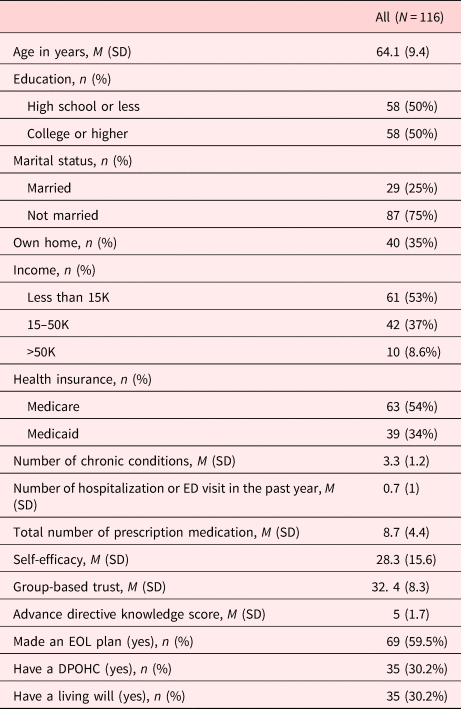
The final sample consisted of 116 African American women (see Table 1). On average, these participants were 64 years old (SD = 9.42; range, 50–98). A large majority (78%) of participants were not married; 54% had an annual income of $15,000; and 50% had less than a college education. A majority (54%) had Medicare and 34% had Medicaid. Participants' overall chronic health status and use of medications and the healthcare system reflected the high morbidity and mortality of the African American urban population. The mean numbers of chronic conditions, prescribed medications, and hospitalizations or ED visits in the past year were 3.31 (SD = 1.25), 8.75 (SD = 4.42), and 0.7 (SD = 1), respectively.
Participant background characteristics

DPOHC, durable power of attorney for healthcare.
On average, participants answered five out of seven items correctly on the AD knowledge scale (SD = 1.7). The most frequent incorrect response was to the statement that “advance directive deals with financial issues” (56% of participants thought this statement true). Although 59% had talked to someone about their future healthcare preferences, only 30% had completed a living will or a power of attorney for healthcare.
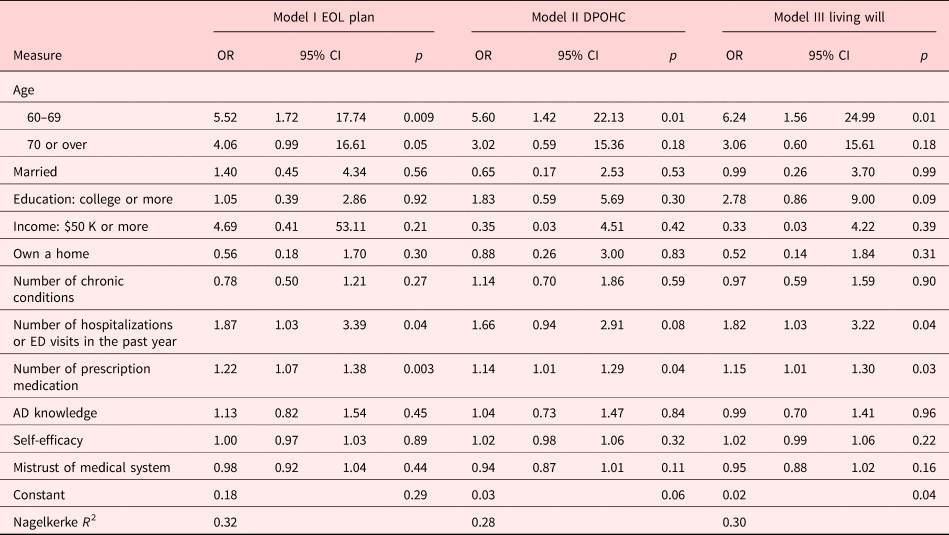
A summary of the logistic regression results is presented in Table 2. Age, the number of prescription medications, and the number of hospitalizations or ED visits were significantly correlated with both informal ACP (i.e., having talked to someone about one's preferences only and without completing ADs) and formal ACP (i.e., having completed ADs) while controlling for other sociodemographics, health status, the knowledge of AD, self-efficacy, and trust in the medical system. Compared with those who were younger than 60, those who were 60–69 years old had significantly higher odds of having an EOL plan (OR = 5.52, p < 0.01), a DPOHC (OR = 5.6, p < 0.05), or a living will (OR = 6.24, p < 0.05). The higher the number of the prescription medications that participants had, the higher the odds of having an EOL plan (OR = 1.22, p < 0.01), a DPOHC (OR = 1.14, p < 0.05), or a living will (OR = 1.15, p < 0.05). The number of hospitalizations or ED visits was also significantly associated with having an EOL plan (OR = 1.87, p < 0.05) or a living will (OR = 1.82, p < 0.05). No other characteristics, including the knowledge of ADs, self-efficacy, or trust in the medical system, were statistically associated with informal or formal ACP.
Logistic regression models predicting ACP

EOL, end of life; DPOHC, durable power of attorney for healthcare; OI, odds ratio; CI, confidence interval; ED, emergency department.
Discussion
This study has examined rates and correlates of ACP in 116 older African American women with multiple chronic health conditions. In these participants, overall chronic health status (e.g., an average of 3.3 chronic conditions) and use of medications (i.e., an average of 8.7 prescription medication) reflected the high morbidity of the African American urban population. For example, according to a recent study of the nationally representative sample of middle-aged adults in the USA, African American women have 28% higher rates of chronic disease than White women; on average, White respondents had 2.8 chronic diseases while African American respondents had 3.3 chronic diseases (Quiñones et al., Reference Quiñones, Botoseneanu, Markwardt, Nagel, Newsom, Dorr and Allore2019).
Many of these African American women, 59%, had engaged in informal ACP by talking with someone about their future healthcare preferences, but only 30% had engaged in formal ACP by completing either a living will or a power of attorney for healthcare. The rate of formal ACP among the study participants is consistent with the findings from the study examining ACP rates in a nationally representative sample of White and African American decedents aged 65–99 years which reported ACP rates of 38% and 74%, respectively, for African American and White decedents (Koss and Baker, Reference Koss and Baker2017). The difference between informal and formal ACP participation rates among African American women with chronic conditions may be due in part to social and cultural factors, such as mistrust in the healthcare system, to which lower ADs among African Americans have been attributed. In past studies, African Americans have preferred an informal discussion with family members or clergy as opposed to the formal completion of ADs, due to the perception that ADs may lead to receiving too little or a lower quality of care (Wicher and Meeker, Reference Wicher and Meeker2012; Rhodes et al., Reference Rhodes, Batchelor and Lee2015; Robinson, Reference Robinson2016). However, the present study did not include or compare the ACP participation of a White group with that of an African American group, nor did it directly assess participants' preferences for treatments at the EOL. Future studies should compare treatment preferences across multiple racial/ethnic groups and examine whether their ACP behaviors are directly affected by their perceptions that their treatment preferences will or will not be respected (or honored) by providers.
Only a small proportion of this group of African American women with a high number of chronic conditions and healthcare needs engaged in formal ACP. Age, the number of prescription medications, and the number of hospitalizations or ED visits were significantly correlated with both informal and formal ACP, whereas psychosocial characteristics, such as education and financial resources, the knowledge of ADs, self-efficacy, and trust in the medical system, were not. These findings are not surprising, given that age and illness severity are two of the most consistent factors associated with ACP participation reported in the ACP literature. In fact, available guidelines for ACP recommend that ACP should occur iteratively as patient's health status changes. Important triggers for the ACP discussion include aging (which prompts the “welcome to Medicare” wellness visit), the diagnosis of a serious illness (e.g., advanced cancer, dementia, or organ failure), and progressing illness severity (e.g., treatment nonresponse and declines in cognitive and functional status) (Barnato, Reference Barnato2017). The number of prescription medications and hospitalizations or emergency visits may indicate not only the severity of health needs but also the frequency of encounters with the healthcare system, which can trigger providers to initiate conversations about ACP. ACP engagement has often been viewed and studied as an individual health behavior that may be changed through psychosocial educational interventions targeting the individual's knowledge, self-efficacy, perceptions of ACP's benefits, or motivations (Scherrens et al., Reference Scherrens, Beernaert and Robijn2018). At the same time, ACP requires interactions between the patient and the provider, and often with family members. Studies show that most patients with a serious illness become aware that a treatment decision must be made only when a provider perceives that a decision is necessary (Davison and Simpson, Reference Davison and Simpson2006; de Kort et al., Reference de Kort, Pols and Richel2010). As Barnato (Reference Barnato2017) has observed, physicians' attention to ACP increases when they perceive that a patient has a life-threatening illness or is nearing the EOL. In comparison with individual psychosocial characteristics, such as self-efficacy or the knowledge of ADs, whether a provider initiates the conversation with the patient and facilitates that the ACP process may have an equal, if not more important, impact on the likelihood of engaging in not only informal but also formal ACP behaviors.
The literature highlights the impact on ACP of a number of cultural and systematic factors, such as mistrust or disparities in access. However, the present findings as well as others (e.g., those of Sanders et al., Reference Sanders, Robinson and Block2016; Koss and Baker, Reference Koss and Baker2017) suggest variability among African Americans as a group, and we must acknowledge and pay attention to this variability as we engage in efforts to facilitate culturally sensitive ACP interventions. ACP requires more than a single visit to a doctor's office or a single formal discussion for completing the paperwork. For African American women with multiple chronic conditions, who have frequent interactions with the healthcare system, community-based outpatient settings, such as outpatient clinics or pharmacies, may be more optimal for meaningful and effective ACP, because these settings may provide care more consistent with patients' preferences than acute care settings where interactions and time spent between patients and providers are limited. Focusing on outpatient settings, such as primary care providers' offices to promote ACP among African American patients, is complicated by the fact that African Americans seek primary care through a private physician's office at significantly less rate than Whites (224.3 vs. 302.3 out of every 100 persons, respectively) due to barriers, such as a lack of health insurance, geographic and transportation-related barriers, and a shortage of primary care providers, just to name a few (Arnett et al., Reference Arnett, Thorpe and Gaskin2016; Rui and Okeyode, Reference Rui and Okeyode2016). The disparities in access to primary care providers may, in part, explain the lower rates of ACP among African Americans. Nevertheless, primary care sites may be an effective place of care to start ACP conversations with African Americans with chronic conditions. Community-based settings allow patients and providers to develop history and trust and to engage in deeper exchanges of patients' preferences and values, with providers' information and recommendations communicated more clearly among patients, family members, and providers themselves. Knowledge gained and lessons learned from promoting ACP in community-based settings may be applied to improve ACP in acute care settings as well in the future.
Our findings should be considered in the context of several limitations. For this study, we used a convenience sample, limiting generalization. The study was descriptive, cross-sectional, and correlational, so that causal claims cannot be made. The participants all lived in a mid-western city, so findings might be different in other geographic areas. Subsequent research with more representative samples of African Americans with multiple chronic conditions will provide a fuller picture of ACP practices. Finally, the use of a self-report survey might have led participants to provide socially desirable responses with regard to ACP; this might have resulted in an overestimation of ACP prevalence, because the actual completion of ADs was not verified.
In conclusion, the difference between informal and formal ACP participation rates among African American women with chronic conditions may reflect both social and cultural factors as well as other individual needs, such as the severity and complexity of healthcare needs and encounters with the healthcare system. One must acknowledge both between- and within-group differences in cultural and individual factors in order to inform future efforts to develop and provide culturally sensitive interventions for ACP in increasingly diverse groups of patients with multiple chronic conditions.
Acknowledgments
The content is solely the responsibility of the authors and does not necessarily represent the official views of the NIH. Editorial support with manuscript development was provided by the Cain Center for Nursing Research and the Center for Transdisciplinary Collaborative Research in Self-Management Science (P30, NR015335) at the University of Texas at the Austin School of Nursing.
Funding
Research reported in this publication is funded by the National Institute of Nursing Research of the National Institutes of Health (NIH) under award number P20NR015339. Additional support was provided by the University of Wisconsin-Milwaukee (UWM) Office of Research and the UWM College of Nursing.