INTRODUCTION
Zoysia grass (Zoysia japonica Steud.) is a sod-forming, warm-season perennial that is native to Japan and forms a major component of semi-natural grasslands in the country (Gotoh et al. Reference Gotoh, Kaneko, Kurokawa, Tanaka, Suzuki and Kanda2011). Zoysia grass is widely distributed from the Kyushu region to Hokkaido (Nishimura et al. Reference Nishimura, Sasaki and Nishimura2001) and is suitable as a low-cost food for breeding beef cattle without fertilizer application, as this grass is used for grazing mainly in hilly or mountainous areas (Kano et al. Reference Kano, Meguro, Murasato, Imura and Ito1984; Mitamura et al. Reference Mitamura, Ogawa, Okamoto, Teshima, Agata and Kamata1985; Ishida Reference Ishida1990; Nishimura et al. Reference Nishimura, Sasaki and Nishimura2001; Gotoh et al. Reference Gotoh, Kaneko, Kurokawa, Tanaka, Suzuki and Kanda2011). Zoysia grass is relatively inexpensive to maintain because of its excellent tolerance to heat, drought, pests and wear tolerance compared with that of cool-season grasses (Biran et al. Reference Biran, Bravdo, Bushkin-Harav and Rawitz1981; Reinert & Engelke Reference Reinert and Engelke2001; White et al. Reference White, Engelke, Anderson, Ruemmele, Marcum and Taylor2001; Patton et al. Reference Patton, Volenec and Reicher2007). There are various ecotypes of native zoysia grass, with different morphological characteristics and productivity (Fukuoka Reference Fukuoka2000; Hashiguchi et al. Reference Hashiguchi, Tsuruta, Matsuo, Akamine and Akashi2006). One option for establishing a low-input forage production system with zoysia grass is to substitute organic fertilizer for mineral fertilizer.
Organic matter application is reported to have several effects on the soil. It is an essential component of soil that not only provides nutrients for plants, but also improves soil aggregation, facilitating the maintenance of soil structure, drainage and aeration, all of which are necessary for good crop and forage yields (Arthurson Reference Arthurson2009). Soil acquires increased resistance to crusting and compaction, improving the growth of crop roots and stimulating microbial activity (Marinari et al. Reference Marinari, Masciandaro, Ceccanti and Grego2000; Debosz et al. Reference Debosz, Petersen, Kure and Ambus2002), indirectly improving crop and forage yield (Arthurson Reference Arthurson2009). On livestock farms, large-scale livestock operations are focused on intensive production, and the management of animal manure and waste water on such farms is an important environmental issue (Nakai Reference Nakai2001; Sasaki et al. Reference Sasaki, Kitazume, Nonaka, Hikosaka, Otawa, Itoh and Nakai2006). Animal manure and waste water are processed using compost and sewage purification by aerobic fermentation, methane use by anaerobic fermentation, carbonization and destruction by fire (Nakai Reference Nakai2001). Anaerobically digested slurry (DS) is produced by a process in which organic compounds, such as animal slurry, are broken down by bacteria, including methanogenic microorganisms, under oxygen-free conditions, transforming organic matter into biogas (a mixture of methane and carbon dioxide but containing trace amounts of water vapour, ammonia and hydrogen sulphide) (Saunders et al. Reference Saunders, Harrison, Fortuna, Whitefield and Bary2012). The end products of this process include biogas, a renewable energy source, and treated manure containing plant nutrients that can be used to replace agricultural fertilizers (Arthurson Reference Arthurson2009; Saunders et al. Reference Saunders, Harrison, Fortuna, Whitefield and Bary2012). The utilization of DS as crop and forage fertilizer should enhance yields and soil fertility, which would promote the closure of global energy and nutrient cycles (Arthurson Reference Arthurson2009). The quality of DS depends on the origin of the organic waste used as feedstock (Arthurson Reference Arthurson2009), and moisture content, pH and ammonia nitrogen (NH4-N) content become higher than in the original materials (Matsunaka et al. Reference Matsunaka, Kumai and Sentoku2003; Möller et al. Reference Möller, Stinner, Deuker and Leithold2008). The total nitrogen (T-N) content of the DS has the same value as that of the original materials, while the total carbon (T-C) content decreases due to the production of methane. Therefore, the C/N ratio of the DS is lower than that of the original materials (Matsunaka et al. Reference Matsunaka, Kumai and Sentoku2003; Möller et al. Reference Möller, Stinner, Deuker and Leithold2008). These changes suggest that the effects of the application of DS fertilizer are greater and that nitrogen (N) fertilization happens particularly rapidly. In general, DS is an efficient N source for plants with the potential to improve crop and forage yields and soil properties (Arthurson Reference Arthurson2009). It has been reported that the effect of DS fertilizer is similar to that of mineral fertilizer in maize (Chantigny et al. Reference Chantigny, Angers, Bélanger, Rochette, Eriksen-Hamel, Bittman, Buckley, Massé and Gasser2008), a maize–Italian ryegrass cropping system (Idota et al. Reference Idota, Asano, Kirimura, Sugimoto and Ishii2013), dwarf Napier grass (Hasyim et al. Reference Hasyim, Ishii, Wadi, Idota and Sugimoto2010, Reference Hasyim, Ishii, Wadi and Idota2014, Reference Hasyim, Ishii, Wadi and Idota2016) and orchardgrass (Matsunaka et al. Reference Matsunaka, Kumai and Sentoku2003). However, the effect of DS application on zoysia grass has not been studied. It is important to clarify the effect of DS in order to develop low-input and sustainable agriculture using zoysia grass grasslands.
Arbuscular mycorrhizal (AM) fungi (AMF) form a symbiotic association with >0·80 of land plant families and benefit their host principally by increasing the uptake of relatively immobile phosphate ions, owing to the ability of the fungal extraradical mycelium to grow beyond the phosphate depletion zone that quickly develops around the root (Smith et al. Reference Smith, Smith, Timonen, de Kroon and Visser2003; Gosling et al. Reference Gosling, Hodge, Goodlass and Bending2006; Briske Reference Briske, Barnes, Nelson, Moore and Collins2007; Smith & Read Reference Smith and Read2008; Watts-Williams & Cavagnaro Reference Watts-Williams and Cavagnaro2014). Other benefits to the host that have been identified include increased resistance to foliar-feeding insects, improved drought resistance, increased resistance to soil pathogens, increased tolerance of salinity and heavy metals, and increased uptake of macronutrients and micronutrients (Smith et al. Reference Smith, Smith, Timonen, de Kroon and Visser2003; Gosling et al. Reference Gosling, Hodge, Goodlass and Bending2006; Briske Reference Briske, Barnes, Nelson, Moore and Collins2007; Smith & Read Reference Smith and Read2008; Watts-Williams & Cavagnaro Reference Watts-Williams and Cavagnaro2014). Due to their ability to increase plant nutrient acquisition, AM are increasingly recognized as having an important role in sustainable agricultural production systems (Gianinazzi et al. Reference Gianinazzi, Gollotte, Binet, van Tuinen, Redecker and Wipf2010; Watts-Williams & Cavagnaro Reference Watts-Williams and Cavagnaro2014). Previous studies have reported that AMF communities are affected by a range of factors such as soil characteristics, plant species and climate (Kanno et al. Reference Kanno, Saito, Ando, Macedo, Nakamura and Miranda2006; An et al. Reference An, Miyakawa, Kawahara, Osaki and Ezawa2008; Posada et al. Reference Posada, Franco, Ramos, Plazas, Suárez and Álvarez2008; Smith & Read Reference Smith and Read2008). However, the relationships between AMF and soil chemical properties are not sufficiently understood. In addition, the effects of DS on zoysia grass, soil and AMF have also not been clarified. The effect of DS application on productivity and AM formation is thought to vary according to the genotype of the zoysia grass; hence, the development of a low-input forage production system should clarify the differences between genotypes.
The present study investigated the effects of DS, fertilizer application rates and zoysia grass genotypes on dry matter production, AM colonization of zoysia grass and soil chemical properties. Furthermore, it also examined the relationships between AM structural organ colonization, DMY of zoysia grass and soil chemical properties, in order to explore the possibility of utilizing AMF for the sustainable production of zoysia grass under the application of DS. It was hypothesized that the DMY of zoysia grass and the colonization of AMF would not be influenced by the type of fertilizer (DS v. chemical fertilizer) used, but it would be influenced by the rate of fertilizer application, and the effect would depend on zoysia grass genotype. Furthermore, continuous application would lead to changes in soil properties, and would have an influence on the DMY of zoysia grass and AMF colonization.
MATERIALS AND METHODS
Research site and observations
The study was conducted from 2007 to 2009 in a site in Miyazaki Prefecture, southwestern Japan (31°49′N, 131°24′E; 28 m a.s.l.). The experimental treatments were the combinations of two genotypes of zoysia grass (strain Aso and cv. Asagake) × two types of fertilizer (DS and mineral fertilizer) × three rates of fertilizer application (10, 20 and 40 g N/m2/year; low (L), medium (M) and high (H), respectively). The treatments were allotted to 36 field plots (2 × 2 m2 each) following a randomized block design with three replications. The plots were established in April 2006 and received fertilizer applications (equal fractions of the annual rate) and cuttings monthly between August and October in 2006 and between May and October in 2007–2009. The DS, generated by a biogas plant located on the University of Miyazaki campus, was derived from swine slurry containing on average 3750 mg N/l, 687 mg phosphorus (P)/l, 1933 mg potassium (K)/l and 1200 mg calcium (Ca)/l for 3 years from 2007 to 2009. The amount of DS applied to the DS plots was determined by the level of N in the treatment and the N concentration of the DS. In the DS, 870 mg/g of the total N was NH4-N: the remainder was organic N. The chemical fertilizer treatments applied inorganic fertilizer prepared to have the same nutrient composition (N, P, K and Ca) as the DS. In 2006, fertilizer was applied after cutting in August and growth analysis in September. In 2007 and 2008, fertilization was carried out during spring emergence (April) and after growth analysis, from May to September (fertilization was divided into six applications). In 2009, fertilization was carried out during spring emergence (March) and after growth analysis, from April to August (fertilization was divided into six applications).
Sampling and measuring
The plants in a quadrat (0·5 × 0·5 m2) were cut at a height of c. 30 mm above the ground surface. The collected samples were separated into zoysia grass and weeds and were dried at 70 °C for a minimum of 72 h for the measurement of dry weight.
Sod samples (vegetation and soil) were collected to a depth of 100 mm using an iron tube (75 mm internal diameter) in May and October 2007 and in June, August and October 2009. The samples were passed through a sieve with 2-mm mesh, and the soil attached to the residual roots on the sieve was carefully removed under running water to collect the plant roots. Only above-ground, connected roots were chosen from sampled zoysia grass plants, to prevent contamination with the roots of weeds. These parts were sub-sampled for determination of AM colonization (internal hyphae, vesicles and arbuscules), following the methods used by Giovannetti & Mosse (Reference Giovannetti and Mosse1980). Briefly, plant roots were cleaned using 10% KOH (w/v), bleached using 1–2% HCl (v/v), dyed using 0·05% trypan blue (w/v), then scored for the presence or absence of AM colonization under a microscope at × 400 magnification. The AM colonization level was calculated as number of intersections colonized (internal hyphae, vesicles and arbuscules) divided by total number of intersections examined.
Soil samples that passed through a sieve with a 2-mm mesh were analysed for their available P concentration (Bray II method, Bray & Kurtz Reference Bray and Kurtz1945), pH (in water, glass electrode method, D-54, Horiba Ltd, Kyoto, Japan), and electrical conductivity (EC, platinum–titanium electrode method, D-54, Horiba Ltd, Kyoto, Japan).
Meteorological data
Meteorological data were obtained from the observation records at the Miyazaki Meteorological Office (31°56′N, 131°25′E; approximately 10 km from the study site) (Japan Meteorological Agency 2017).
Statistical analyses
Arbuscular mycorrhizal colonization (internal hyphae, vesicles and arbuscules) data were converted into arcsine values, and data for these and soil chemical properties were analysed using repeated-measure analysis of variance (ANOVA) taking into account the block effects. The least significant difference between mean values was used to identify statistical differences at P < 0·05. Correlation analysis was used to evaluate the relationships between DMY and AM structural organ colonization, between DMY and soil chemical properties, and between AM structural organ colonization and soil chemical properties. Correlation coefficients (r) were deemed statistically significant at P < 0·05. All statistical analyses were performed using STATISTICA (version 10.0; StatSoft Inc., USA).
RESULTS
Climatic conditions
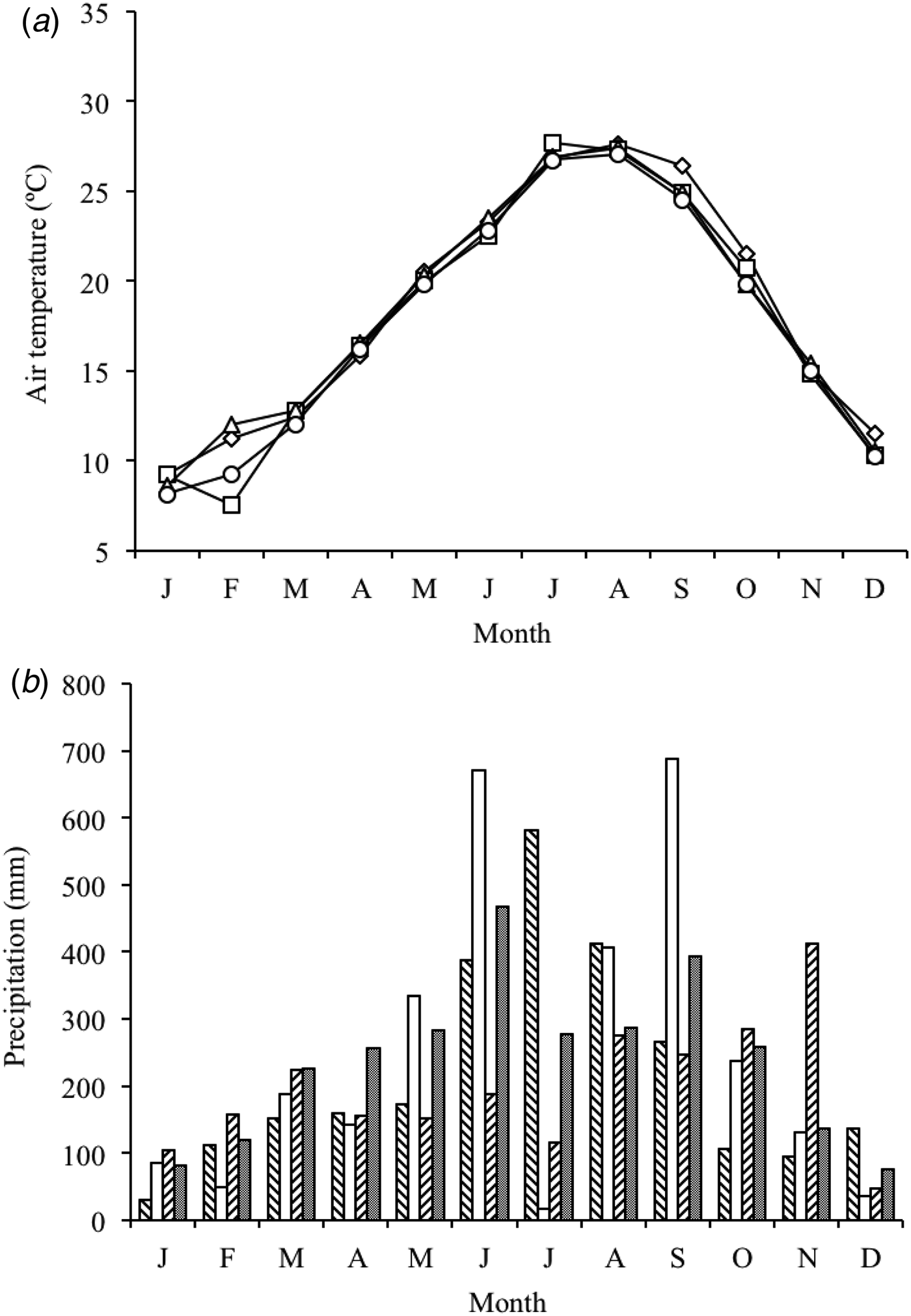
Precipitation and daily mean air temperature from 2007 to 2009 are shown in Fig. 1. In 2007, precipitation in July and August was higher than average and that in May, September and October was lower; temperatures in September and October were higher than average. In 2008, precipitation was above average in June, August and September and lower in July, while temperatures were higher than average in July. In 2009, precipitation was below average in May, June, July and September.
(a) Temperature and (b) rainfall during the experimental period. 2007 (◇,  ), 2008 (□,
 ), 2009 (△,
 ) and normal year (○,
 ).

Dry matter yield
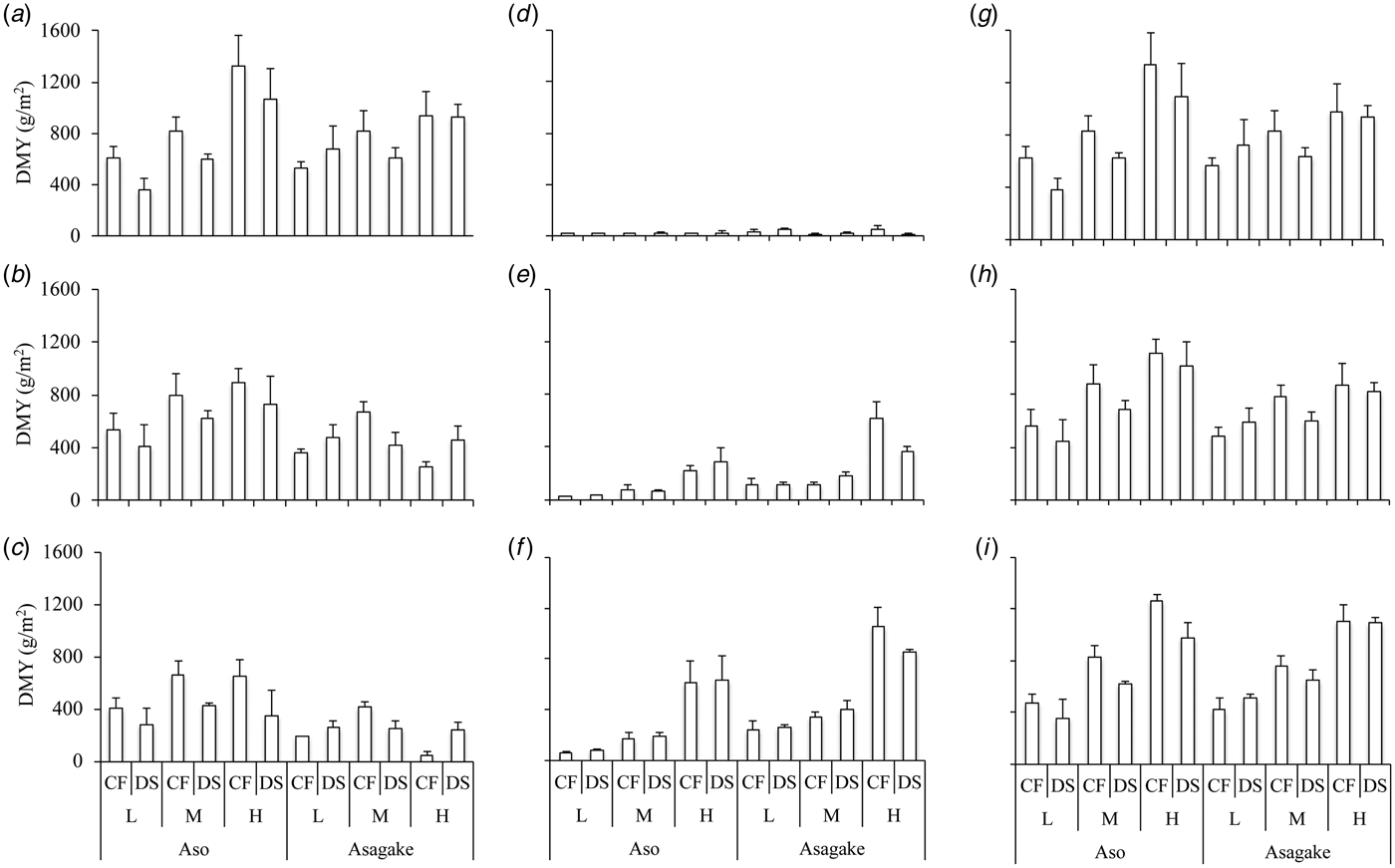
The annual total dry matter yields (DMYs) for zoysia grass decreased with the passage of time (2007 > 2008 > 2009, P < 0·001, Figs 2(a)–(c)). Between the fertilizer types, mineral fertilizer was higher than DS (P < 0·01). Among fertilizer rates, H and M were higher than L (P < 0·001). Dry matter yields for the zoysia grass variety Aso were higher than in Asagake (P < 0·001). The interactions fertilizer rate × genotype (P < 0·001), fertilizer type × genotype (P < 0·01), year × fertilizer rate (P < 0·001) and year × genotype (P < 0·01) were significant. In Aso, DMY decreased with the rate of fertilizer in the order H > M > L, and it was higher in mineral fertilizer than in DS. However, in Asagake, there were no differences among types and rate of fertilizer. In 2007, among fertilizer rates, H was higher than M and L (P < 0·001, Fig. 2(a)). Meanwhile, in 2008 and 2009, the DMY for Aso was higher than for Asagake (P < 0·01, Figs 2(b ) and (c)).
Dry matter yield (DMY) (+s.e.) in 2007 (a, d, g), 2008 (b, e, h), and 2009 (c, f, i) in swards of two genotypes of zoysia grass (a–c), weed (d–f) and combination of zoysia grass and weed (g–i) subjected to six fertilizer treatments (DS and chemical fertilizer (CF) as fertilizer types; L, M and H as fertilizer rates).

The DMY of weeds increased over time (2009 > 2008 > 2007, P < 0·001, Figs 2(d )–(f)). There were no differences between the types of fertilizer. Among fertilizer rates, DMY of weeds for H was higher than that for M and L (P < 0·001). The DMY of weeds for Asagake was higher than that for Aso (P < 0·001). The interactions year × fertilizer rate (P < 0·001) and year × genotype (P < 0·01) were significant. In 2007, there were no differences among rate and types of fertilizer. In 2008 and 2009, there was no difference between DS and chemical fertilizer, but H was higher than M and L (P < 0·001), and Asagake was higher than Aso (P < 0·001). The main weeds in April 2009 were Rumex acetosa L. (average coverage: Aso/H, 0·375; Asagake/H, 0·667; Aso/L, 0·055; Asagake/L, 0·107), Cerastium glomeratum Thuill. (Aso/H, 0·102; Asagake/H, 0·105; Aso/L, 0·013; Asagake/L, 0·043), and Hydrocotyle maritima Honda (Aso/H, 0·125; Asagake/H, 0·040; Aso/L, 0·042; Asagake/L, 0·043).
The annual combined DMY of zoysia grass and weeds was in the order of 2008 < 2009 < 2007, and that of 2008 was significantly lower than that of 2007 (P < 0·05, Figs 2(g )–(i)). Among fertilizer types, it was higher for mineral fertilizer than that for DS (P < 0·01). The annual combined DMY of zoysia grass and weeds decreased with the rate of fertilizer in the order H > M > L (P < 0·001). There was no significant difference between genotypes. The interactions fertilizer rate × genotype (P < 0·01), fertilizer type × genotype (P < 0·05), and year × fertilizer rate × genotype (P < 0·05) were significant. In Aso, the annual combined DMY of zoysia grass and weeds decreased with the rate of fertilizer in the order H > M > L in all three years, and mineral fertilizer had a higher annual combined DMY of zoysia grass and weeds than did DS in 2007 and 2009. However, in Asagake, the annual combined DMY of zoysia grass and weeds in H was higher than in M and L in 2009, there were no differences among types of fertilizer in all 3 years. There were no significant differences between the genotypes in any year.
Arbuscular mycorrhizal colonization
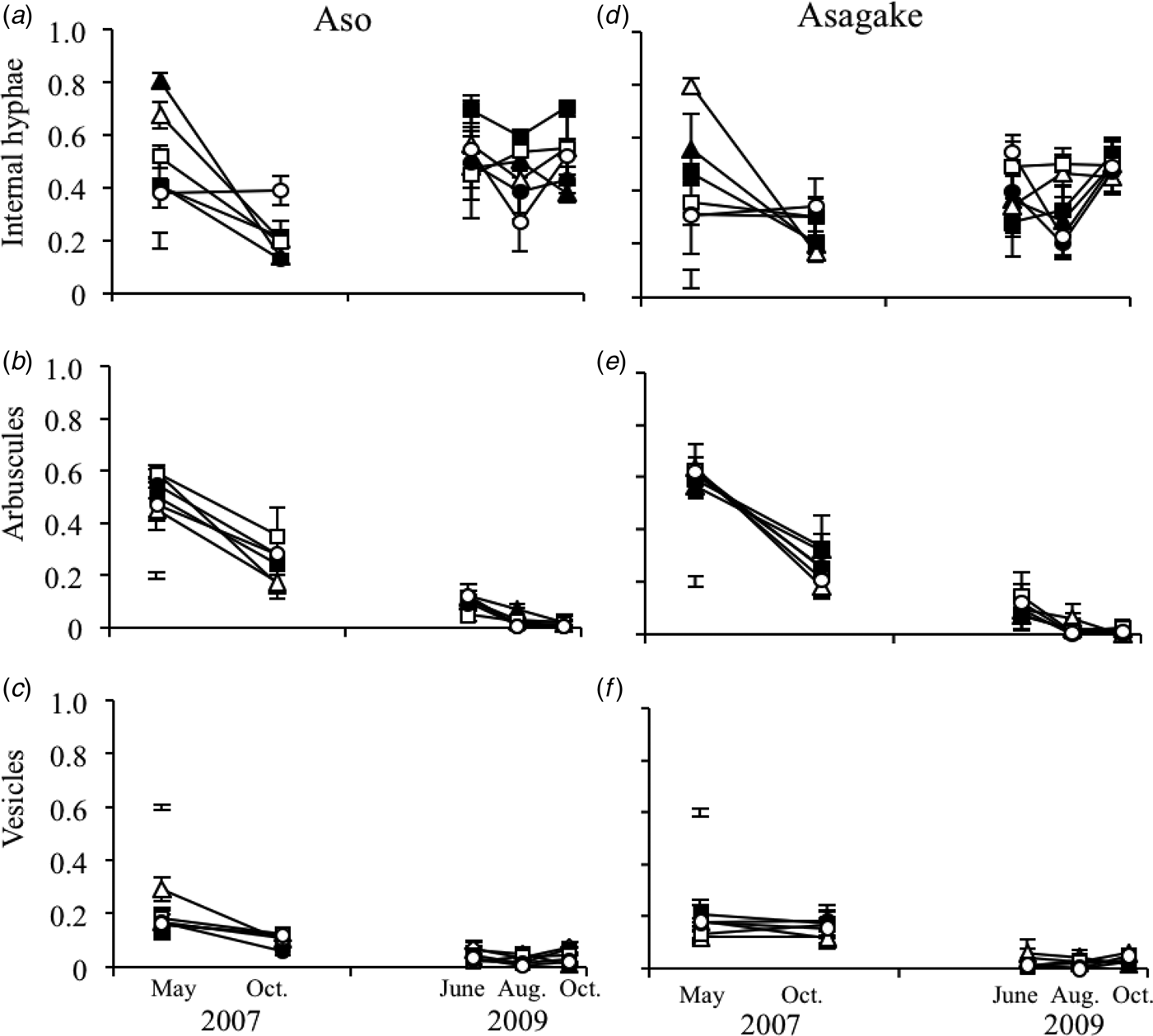
There were no differences in internal hypha colonization between DS and chemical fertilizer (Fig. 3(a)). Internal hypha colonization was in the order L & M > H for the fertilizer application rates (P < 0·05), and Aso > Asagake (P < 0·01) for the genotypes. Arbuscule colonization decreased over time (P < 0·001, Fig. 3(b)). There were no differences in arbuscule colonization level between DS and mineral fertilizer, between Aso and Asagake, or among L, M and H. Vesicle colonization decreased over time (P < 0·001, Fig. 3(c)). There were no differences for the fertilizer type or plant genotype. However, vesicle colonization among fertilization types was in the order L > M > H, and there was a significant difference between L and H (P < 0·05). There was no difference between the blocks regarding AM colonization.
Arbuscular mycorrhizal colonization ((a, d) internal hyphae, (b, e) arbuscules, and (c, f) vesicles) (±s.e.) in swards of two genotypes of zoysia grass ((a–c) Aso and (d–f) Asagake) subjected to six fertilizer treatments (DS and chemical fertilizer as fertilizer types; L, M and H as fertilizer rates; L/chemical fertilizer (▲), L/DS (△), M/chemical fertilizer (■), M/DS (□), H/chemical fertilizer (●), H/DS (○)). Vertical bars shown above or below the values for May 2007 indicate the least significant difference (P = 0·05) among all plots.

Soil chemical properties
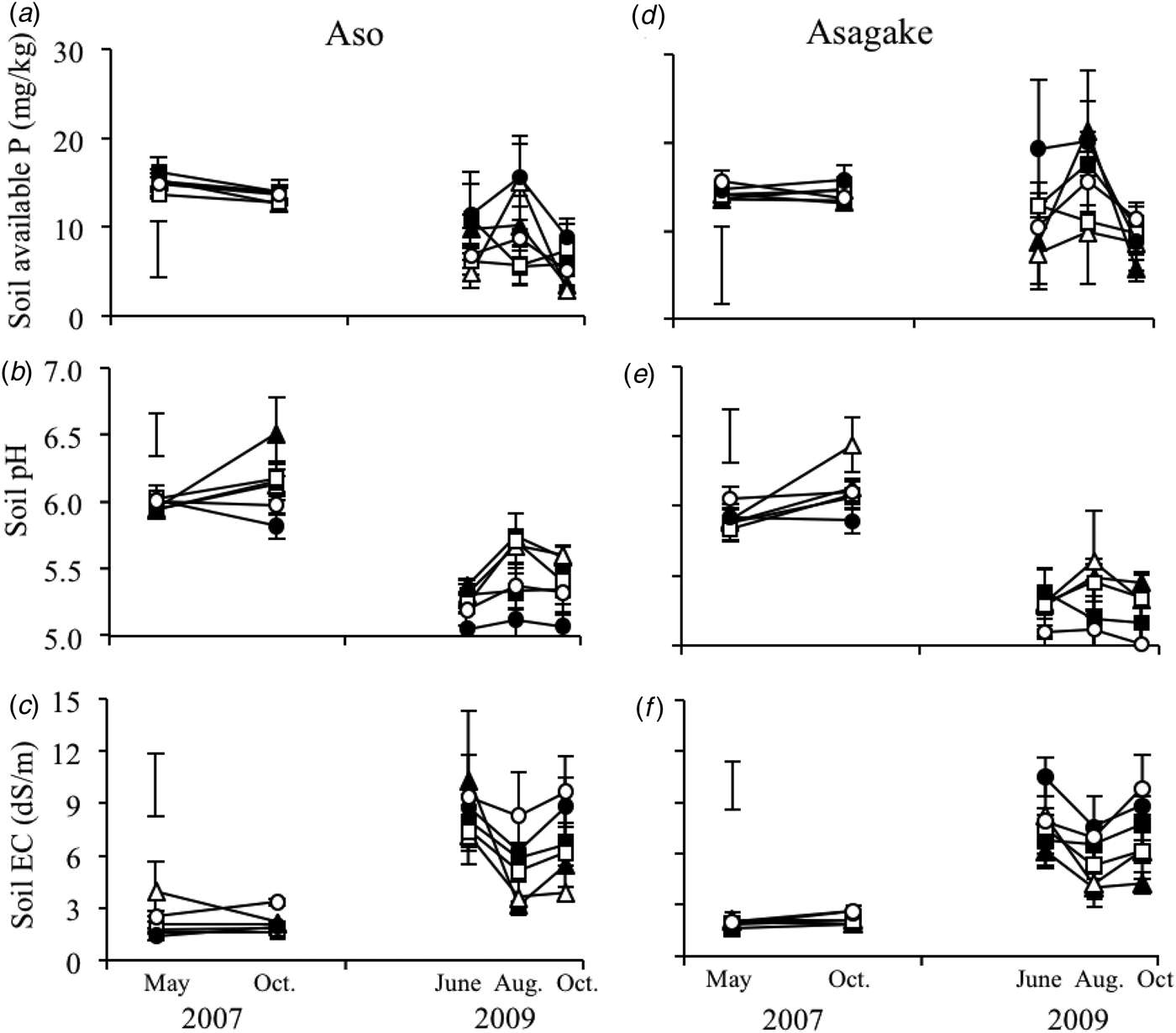
There were no differences in soil available P concentration among the rates and types of fertilization; however, Asagake was higher than Aso in June and August 2009 (P < 0·05, Fig. 4(a)). The soil pH was highest in October 2007 and decreased in 2009 (P < 0·001, Fig. 4(b)). There were no differences among fertilizer type and genotype, but the effect of rate of fertilizer application was in the order L & M > H in October 2007 and August and October 2009 (P < 0·001). Soil EC in 2009 was higher than in 2007 (P < 0·001, Fig. 4(c)). There were no differences among fertilizer type and genotype, but the effect of rate of fertilizer application was in the order H > M, L in August and October 2009 (P < 0·01). There was no difference between the blocks with respect to soil chemical properties.
Soil chemical properties ((a, d) soil available P concentration, (b, e) pH and (c, f) EC) (±s.e.) in swards of two genotypes of zoysia grass ((a–c) Aso and (d–f) Asagake) subjected to six fertilizer treatments (DS and mineral fertilizer as fertilizer types; L, M and H as fertilizer rates; L/mineral fertilizer (▲), L/DS (△), M/mineral fertilizer (■), M/DS (□), H/mineral fertilizer (●), H/DS (○)). Vertical bars shown above or below the values for May 2007 indicate the least significant difference (P = 0·05) among all plots.

Relationships between the dry matter yield of zoysia grass, arbuscular mycorrhizal colonization and soil chemical properties
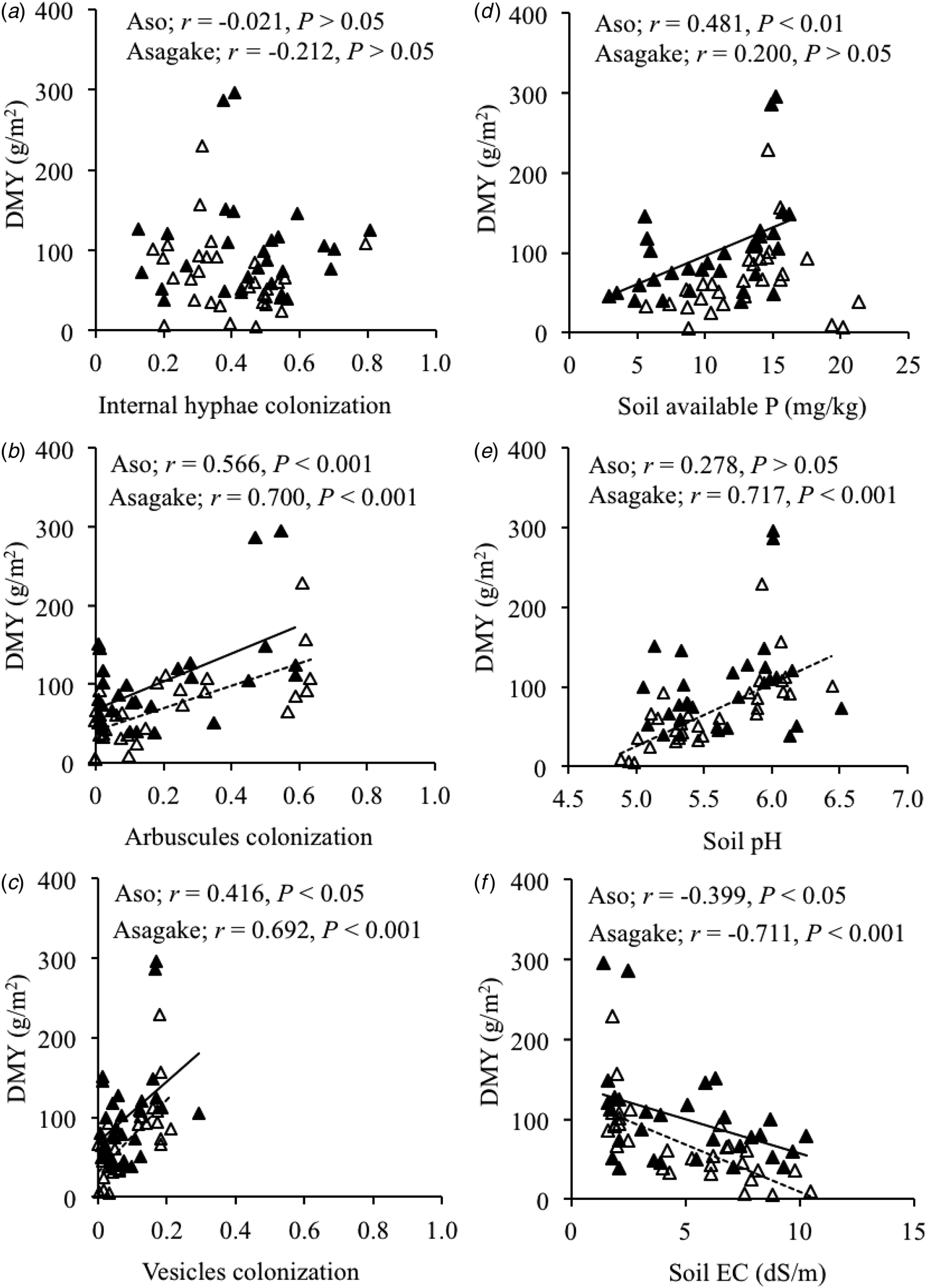
In Aso (n = 30), the DMY of zoysia grass had a positive correlation with the colonization of arbuscules (P < 0·001, Fig. 5(b)), colonization of vesicles (P < 0·05, Fig. 5(c)), and soil available P (P < 0·01, Fig. 5(d)), and a negative correlation with the soil EC (P < 0·05, Fig. 5(f)). In Asagake (n = 30), the DMY of zoysia grass had positive correlations with colonization of arbuscules, colonization of vesicles, and soil pH (P < 0·001, Figs 5(b ), (c) and (e)), and a negative correlation with soil EC (P < 0·001, Fig. 5(f)).
Relationship between dry matter yield (DMY), arbuscular mycorrhizal colonization ((a) internal hyphae, (b) arbuscules and (c) vesicles), and soil chemical properties ((d) soil available P concentration, (e) pH and (f) EC) in swards of two genotypes of zoysia grass (Aso (▲, ——) and Asagake (△,  )).

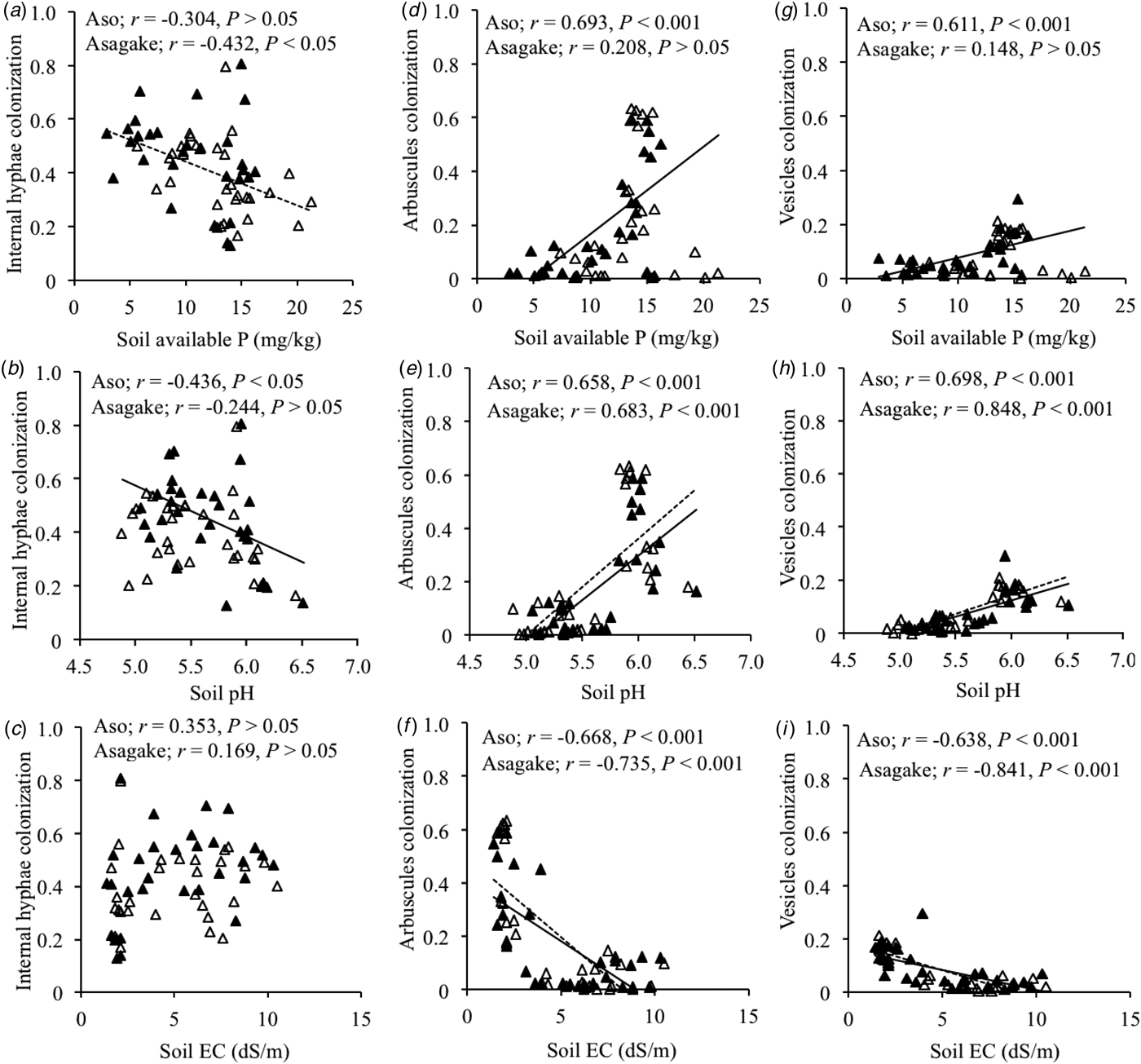
In Aso, internal hyphal colonization was negatively correlated with soil pH (P < 0·05, Fig. 6(b)). Arbuscule colonization showed positive correlations with vesicle colonization (r = 0·873, P < 0·001), soil available P concentration (Fig. 6(d)) and soil pH (Fig. 6(e)) (P < 0·001), but a negative correlation with soil EC (P < 0·001, Fig. 6(f)). Vesicle colonization had positive correlations with soil available P concentration (Fig. 6(g)) and soil pH (Fig. 6(h)) (P < 0·001), and a negative correlation with soil EC (P < 0·001, Fig. 6(i)).
Relationships between arbuscular mycorrhizal colonization (internal hyphae, arbuscules and vesicles) and soil chemical properties (soil available P concentration, pH and EC) in swards of two genotypes of zoysia grass (Aso (▲, ——) and Asagake (△,  )).

In Asagake, the internal hyphal colonization was negatively correlated with soil available P concentration (P < 0·05, Fig. 6(a)). The arbuscule colonization had positive correlations with vesicle colonization (r = 0·830, P < 0·001) and soil pH (Fig. 6(e)) (P < 0·001), and a negative correlation with soil EC (P < 0·001, Fig. 6(f)). The vesicle colonization had a positive correlation with soil pH (P < 0·001, Fig. 6(h)), and a negative correlation with soil EC (P < 0·001, Fig. 6(i)).
In Aso (n = 30), the soil available P concentration had a positive correlation with soil pH (r = 0·566, P < 0·001) and a negative correlation with soil EC (r = −0·601, P < 0·001). The soil pH was negatively correlated with soil EC (r = −0·885, P < 0·001). In Asagake (n = 30), the soil pH was negatively correlated with soil EC (r = −0·934, P < 0·001).
DISCUSSION
Effects of type and rate of fertilizer, and continuous fertilizer application on dry matter yield of zoysia grass
The annual total DMY of zoysia grass decreased over time. In 2008 and 2009, Aso had a higher annual total DMY than Asagake. In Aso, the annual total DMY of zoysia grass decreased with rate of fertilizer in the order H > M > L, and the value with chemical fertilizer was higher than that with DS. However, the annual total DMY of weeds increased over time, and, in 2008 and 2009, there was no difference between mineral fertilizer and DS, and that of the fertilizer application rates differed in the order H > M, L, Asagake was higher than Aso. From these, it was revealed that the response to fertilizer application varied according to zoysia grass genotype. It seemed that the response to fertilizer application was more sensitive in Aso than in Asagake. Regarding the total annual DMY of Aso, the mineral fertilizer treatment showed higher values than DS. The main nutrient composition of DS was the same as that of the chemical fertilizer; however, inorganic N (mainly NH4 +) in DS constituted 0·80 of the T-N. In Aso, the annual total zoysia grass DMY of DS was approximately 0·80 of that of mineral fertilizer. When DS is used as fertilizer in grassland, considering the ratio of inorganic N, it results in the same level of DMY as that of mineral fertilizer. Generally, zoysia grass has been found to have only a small response to fertilization (Gotoh et al. Reference Gotoh, Kaneko, Kurokawa, Tanaka, Suzuki and Kanda2011), and repeated fertilization promoted the growth of weeds that had greater responses to fertilizer. Thus, the vigorous growth of weeds in early spring suppressed the growth of zoysia grass, and restrained its later growth. This was particularly evident in Asagake, and, in 2009, zoysia grass comprised 0·04 of the combined annual total DMY in the H/mineral fertilizer treatment and 0·22 in the H/DS treatment.
The combined annual total DMY of zoysia grass and weeds was of the order of 2008 < 2009 < 2007, and 2008 was significantly lower than 2007. The DMY was lower in August and September 2008, when precipitation was high, and it was inferred that the total DMY was lower in 2008. Asagake has superior stolon elongation and vigour in spring (Kobayashi et al. Reference Kobayashi, Ebina, Kasuga, Okumura, Takai, Araya, Tsurumi and Nakagawa2013). However, because Asagake grows at a low density on lawns (Kobayashi et al. Reference Kobayashi, Ebina, Kasuga, Okumura, Takai, Araya, Tsurumi and Nakagawa2013), weeds invaded easily, and coverage by large perennial weeds such as the Rumex acetosa increased.
Effects of the type and rate of fertilizer on the colonization of arbuscular mycorrhizal fungi and soil chemical properties
The phosphorus content in DS has been reported to be lower than N and K contents (Matsunaka et al. Reference Matsunaka, Kumai and Sentoku2003; Muranaka et al. Reference Muranaka, Nishiwaki, Udathu and Sugimoto2009), and this was true for the DS in the present study. When the soil P content is low because of a low rate of P application, growth is limited by the plant's ability to absorb P. It has been reported that colonization with AMF leads to increased yields because the AMF makes more of the P available to the plant (Lin et al. Reference Lin, Zhang, Wong, Ye, Lou, Wang and Zhu2007). The colonization of arbuscules and vesicles was positively correlated with DMY in both zoysia grass genotypes, and the decline in DMY was closely related to the decline in colonization of arbuscules and vesicles.
Arbuscular mycorrhiza internal hypha colonization was in the range of 0·30–0·80 in June 2009, the same values as for AM colonization in Pleioblastus chino and Miscanthus sinensis, which dominate Japanese semi-natural grasslands (Kojima et al. Reference Kojima, Hayashi and Saito2007). Mycorrhizal root colonization was higher in wheat plants grown in soil to which organic matter was added than in plants grown in un-supplemented soil (Saia et al. Reference Saia, Benítez, García-Garrido, Settanni, Amato and Giambalvo2014); in the low fertility soil, particularly with very low mineral N availability, the addition of organic matter may have caused a temporary sequestration of nutrients, thus reducing their availability and increasing plant dependence on AM symbiosis. In the present experiment, the fact that the fertilizer type (DS v. mineral fertilizer) had little or no effect on AM colonization in both zoysia grass genotypes and soil properties indicates that DS can be used as a substitute for mineral fertilizer at the same fertilization rate. Furthermore, approximately 0·80 of the T-N in DS was inorganic nitrogen (NH4-N). However, heavy fertilizer application decreased colonization by internal hyphae and vesicles. Furthermore, even at the lowest rate, the continuous application of DS and chemical fertilizer decreased colonization by arbuscules and vesicles in both zoysia grass genotypes, which have been associated with decreased soil pH and increased EC (Posada et al. Reference Posada, Franco, Ramos, Plazas, Suárez and Álvarez2008; Han et al. Reference Han, Luo, Yang, Liu, Wu and Xu2014; Wang et al. Reference Wang, Zhang, Bai and Guo2015).
Relationships among the DMY of zoysia grass, arbuscular mycorrhiza colonization and soil chemical properties
Continuous fertilizer application would lead to change in soil properties (Posada et al. Reference Posada, Franco, Ramos, Plazas, Suárez and Álvarez2008; Han et al. Reference Han, Luo, Yang, Liu, Wu and Xu2014; Wang et al. Reference Wang, Zhang, Bai and Guo2015). In the current experiment, continuous application resulted in a decrease in soil pH and an increase in EC. This suggests that soil pH and soil EC are negatively correlated (Aso, r = −0·885; Asagake, r = −0·934). Soil EC is useful as a relative measure of the total quantity of ions in the soil solution (Zhang & Wienhold Reference Zhang and Wienhold2002). Soil EC has no direct effect on plant growth or yield, but close relationships are frequently observed between EC and a variety of other soil properties that are highly related to plant growth and yield (Zhang & Wienhold Reference Zhang and Wienhold2002). Soil pH has a direct effect on plant growth, yield and AM colonization (Kanno et al. Reference Kanno, Saito, Ando, Macedo, Nakamura and Miranda2006; Posada et al. Reference Posada, Franco, Ramos, Plazas, Suárez and Álvarez2008); AM colonization and yield are high when soil pH is near neutral.
It was assumed that the arbuscule is a key unifying structure and that it is the sole site of C acquisition by fungi (Smith & Read Reference Smith and Read2008). Vesicles have a function as an important storage organ (Smith & Read Reference Smith and Read2008). Environmental conditions strongly affect vesicle development; at high P or low irradiance, vesicles are reduced in the same way as arbuscules (Smith & Read Reference Smith and Read2008). Nevertheless, little is known about their biology, particularly with respect to either the germination or mobilization of reserves (Smith & Read Reference Smith and Read2008).
Arbuscular mycorrhiza colonization was clearly decreased by the continuous application of mineral fertilizer and DS. A negative correlation was shown between soil EC and DMY, and a positive correlation between colonization by arbuscules and vesicles, soil pH and DMY. Therefore, continuous fertilizer application increased the inorganic nutritional content of the soil and EC, and reduced soil pH and colonization by arbuscules and vesicles, reducing the DMY of zoysia grass. In contrast to the results of the present study, Posada et al. (Reference Posada, Franco, Ramos, Plazas, Suárez and Álvarez2008) reported that, in hilly terrain, there were highly positive correlations between EC and colonization by arbuscules and between colonization by hyphae and colonization by vesicles. In contrast, in a valley, there were highly positive correlations between colonization by hyphae and colonization by vesicles, between colonization by hyphae and colonization by arbuscules, and between colonization by vesicles and colonization by arbuscules (Posada et al. Reference Posada, Franco, Ramos, Plazas, Suárez and Álvarez2008). Among the AM structural organs of the present study, a positive correlation was shown only between colonization by arbuscules and colonization by vesicles. There have been few studies that have examined relationships between the formation of mycorrhizal structural organs and soil pH or EC; however, these relationships are mostly not identified. However, in the present study, correlations between these factors were sometimes found. Generally, a high concentration of available soil P suppresses colonization by AMF (Gosling et al. Reference Gosling, Hodge, Goodlass and Bending2006). In Asagake, a negative correlation was found between soil-available P and internal hypha colonization, but the present study found a positive correlation between soil available P and arbuscule colonization and vesicle colonization in Aso. This is because soil pH decreased with repeated fertilizer application in Aso, and soil available P also decreased. The present study did not determine the quantity of plant phosphorus derived from AMF by symbiosis, and the existing species and density of AMF in the soil were not examined. It is necessary to clarify these issues in further studies.
The results suggest that the decrease in DMY of the zoysia grass depend on the zoysia grass genotypes rather than the application of DS over chemical fertilizer. When DS derived from animal manure and wasted water was used as a substitute for chemical fertilizer, it acts as a fertilizer in the grassland; however, it is necessary to apply it, taking into account the ratio of inorganic N. The colonization of internal hyphae, arbuscules and vesicles were not affected by the type of fertilizer (DS v. mineral fertilizer). Increasing fertilizer application reduced soil pH, raised soil EC, promoted the growth of weeds that had a stronger growth reaction to fertilization, reduced zoysia grass productivity, especially for Asagake, and reduced AMF symbiosis. Furthermore, continuous fertilizer application reduced soil pH and raised soil EC, and as a result, reduced AMF symbiosis. Management of zoysia grass grassland to maintain its productivity and AMF functioning, in other words to establish a low-input forage production system, it is necessary to fertilize at a rate that is lower than that used in the present study (<10 g N/m2/year). This range of N application will be sub-optimal for weed production, and thus will create a trade-off between AMF utilization and plant productivity in zoysia grass grasslands. Further investigation regarding long-term fertilization application at a rate lower than that used in the present study will be necessary in the future.
The authors thank Professor Masahiko Hirata, University of Miyazaki, for experimental advice. A part of this study was supported by the research fund (organized by Yasuhiro Sugimoto) of the Ministry of Education, Culture, Sports, Science and Technology in Japan.