Introduction
Benzodiazepines (BZDs) are the most frequently prescribed psychotropic drugs to older persons (Gleason, Schulz, Smith, Newsom, Kroboth, & Kroboth, Reference Gleason, Schulz, Smith, Newsom, Kroboth and Kroboth1998). Seniors often report symptoms of anxiety and insomnia, for which short-term use of BZDs is clearly effective, yet seniors typically use BZDs for more than 30 days (Bartlett, Abrahamowicz, Tamblyn, Grad, & du Berger, Reference Bartlett, Abrahamowicz, Tamblyn, Grad, Capek and du Berger2004; Isacson, Carsjö, Bergman, & Blackburn, Reference Isacson, Carsjö, Bergman and Blackburn1992; Jorm, Grayson, Creasey, Waite, & Broe, Reference Jorm, Grayson, Creasey, Waite and Broe2000). Moreover, the effectiveness of treating insomnia (Ashton, Reference Ashton2005; Holbrook, Crowther, Lotter, Cheng, & King, Reference Holbrook, Crowther, Lotter, Cheng and King2000) and anxiety (Baker & Shaw, Reference Baker and Shaw2001; Rickels, Schweizer, Csanalosi, Case, & Chung, Reference Rickels, Schweizer, Csanalosi, Case and Chung1988) with BZDs used continuously over 30 days does not exceed that of a placebo (Ashton, Reference Ashton2005; Silber, Reference Silber2005). Adverse effects of longer-term use of BZDs in older persons include cognitive impairment, psychomotor slowing, reduced functional autonomy, falls, delirium, and car accidents (Ashton, Reference Ashton2005; Barbone, McMahon, Davey, Morris, Reid, McDevitt et al., Reference Barbone, McMahon, Davey, Morris, Reid and McDevitt1998; Blazer, Steffens, & Busse, Reference Blazer, Steffens and Busse2004; Verster, Veldhuijzen, & Volkerts, Reference Verster, Veldhuijzen and Volkerts2004; Voyer, Landreville, Moisan, Tousignant, & Preville, Reference Voyer, Landreville, Moisan, Tousignant and Preville2005). Use of BZDs can also lead to substance dependence, which clinicians may fail to notice or appreciate in the elderly (Mort & Aparasu, Reference Mort and Aparasu2002; Voyer, Cohen, Lauzon, & Collin, Reference Voyer, Cohen, Lauzon and Collin2004). In this article, we discuss the problem of substance dependence among older users of BZDs, which was the subject of our study.
According to the Diagnostic and Statistical Manual of Mental Disorders, Fourth Edition, Text Revision (DSM-IV-TR; American Psychiatric Association, 2000) the diagnosis of Substance Dependence, Sedative or Anxiolytic Type can be made when, over a one-year period, the individual using BZDs meets at least three of seven criteria leading to “clinically significant impairment or distress.” The DSM-IV-TR’s criteria include (1) tolerance to the substance; (2) withdrawal symptoms upon ceasing its use; (3) increases in quantity or duration of use; (4) wishing to reduce or stop it; (5) spending much time obtaining the substance or recovering from its effects; (6) reducing or abandoning important activities; and (7) continuing to use the substance despite its harmfulness.
Some authors have questioned the relevance of some of these criteria to capture the phenomenon of substance dependence in older persons adhering to a socially acceptable, physician-prescribed, and pharmacy-purchased BZD medication regimen (Aparasu, Mort, & Sitzman, Reference Aparasu, Mort and Sitzman1998; Ashton, Reference Ashton2005; Damestoy, Collin, & Lalande, Reference Damestoy, Collin and Lalande1999; Kan, Breteler, Timmermans, van der Ven, & Zitman, Reference Kan, Breteler, Timmermans, van der Ven and Zitman1999). For instance, DSM-IV-TR’s criterion 5 requires the individual to spend much time obtaining the substance or recovering from its effects, which seems weighted to the use of illicit drugs. Also, changes in the occupational and leisure status of many older people make it difficult to observe the drug-induced disruptions of social roles implied by DSM-IV-TR’s criterion 6. Criterion 7 specifies persistence of drug use despite harmful effects. Given the difficulty to establish cause-effect relations between BZD use and gradually appearing adverse consequences in older persons who may have co-occurring physical and cognitive deterioration, criterion 7 might similarly be difficult to assess in many older users of BZDs. No study has tried to determine the prevalence of DSM-IV-TR BZD dependence (and the distribution of its criteria) among a random sample of community-dwelling seniors. Similarly, while some authors have suggested that questions besides those derived from DSM-IV-TR criteria might better elicit the phenomenon of BZD dependence in the elderly population, none of these items have been compared against DSM-IV-TR criteria for substance dependence among community-dwelling seniors (Baillie & Mattick, Reference Baillie and Mattick1996; de las Cuevas, Sanz, de la Fuente, Padilla, & Berenguer, Reference de las Cuevas, Sanz, de la Fuente, Padilla and Berenguer2000; Kan et al., Reference Kan, Breteler, Timmermans, van der Ven and Zitman1999; Voyer et al., Reference Voyer, Cohen, Lauzon and Collin2004).
This study had two objectives: (a) to determine the prevalence of BZD dependence according to DSM-IV-TR criteria among elderly BZD users, and (b) to explore the frequency of other, atypical, suggested potential signs of BZD dependence using a large, probability sample of community-dwelling older persons.
Methods
Sampling
Data used in this study came from the Quebec Survey on the Health of Older Persons (Enquête sur la Santé des Aînés, ESA; Preville, Boyer, Grenier, Dube, Voyer, Punti et al., Reference Preville, Boyer, Grenier, Dube, Voyer and Punti2008), a large-scale-population-based survey funded by the Canadian Institute of Health Research. During the survey, which took place from 18 January 2005 to 26 September 2006, all respondents were aged 65 years or older and able to speak and understand French (this last-mentioned attribute applies to 94.6% of the population in Quebec province; Canadian Heritage, 2008). The ESA sampling plan involved stratification by metropolitan (≥ 500,001 inhabitants), urban (5,001–500,000 inhabitants), and rural (≤ 5,000 inhabitants) areas, in order to consider regional variations in the organization of health services in Quebec. Respondents living in the far northern regions of the province were excluded on feasibility grounds. Within each of the three geographical strata, a proportional sample of households was constituted by means of a random telephone number generation method, in accordance with the known populations of Quebec’s 16 administrative regions. Finally, within each household, a simple random sampling method was used to select a single adult 65 years of age or older as respondent. These sampling procedures yielded a target sample of 3,989 individuals.
Participant Recruitment and Interview Procedures
To recruit and interview participants, a research nurse first contacted each potential respondent by telephone to describe the survey aims and procedures and ask them to participate in an interview at their home. Next, a letter describing the study was sent to reassure potential participants of the legitimacy of the survey and of the interviewer assigned to them. Third, a phone call was made to ascertain their interest in participating, and, in the affirmative, an appointment was made. All interviews were in-home, face to face, took place within two weeks following the potential participant’s agreement, and lasted 90 minutes on average.
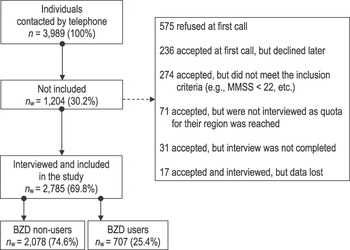
At the beginning of the interview, respondents were rated on the Mini Mental State Examination (MMSE; Tombaugh & McIntyre, Reference Tombaugh and McIntyre1992). Individuals with an MMSE score < 22, indicating cognitive problems, were excluded from the study. All others were invited to respond to the ESA questionnaire. All participants gave written informed consent, and received CAN$15.00 in compensation for their participation. The research protocol was approved by the ethics committee of the University of Sherbrooke Geriatric Institute (see Figure 1).
Recruitment of the sample, reasons for exclusion, and completion of interviews.

Instruments
Mental health status was assessed using the computer-assisted ESA Diagnostic Questionnaire (ESA-Q), developed by the research team and based on DSM-IV-TR criteria. The ESA-Q was then pre-tested among a sample of 216 seniors (Béland, Préville, Tournier, Voyer, Moride, Bouharaoui et al., Reference Béland, Préville, Tournier, Voyer, Moride and Bouharaoui2008; Voyer, Cappeliez, Perodeau, & Preville, Reference Voyer, Cappeliez, Perodeau and Preville2005; Voyer et al., Reference Voyer, Cappeliez, Perodeau and Preville2005). The nurses conducting the interviews received both individual and group training in its use as a general assessment of mental health and cognitive status (American Psychiatric Association, 2000). The ESA-Q is similar to the Diagnostic Interview Schedule and the Composite International Diagnostic Interview, both of which have demonstrated satisfactory reliability and validity (Bucholz, Marion, Shayka, Marcus, & Robins, Reference Bucholz, Marion, Shayka, Marcus and Robins1996; Erdman, Klein, Greist, Bass, Bires, & Machtinger, Reference Erdman, Klein, Greist, Bass, Bires and Machtinger1987; Erdman, Klein, Greist, Skare, Husted, Robins et al., Reference Erdman, Klein, Greist, Skare, Husted and Robins1992; Levitan, Blouin, Navarro, & Hill, Reference Levitan, Blouin, Navarro and Hill1991; Robins & Cottler, Reference Robins and Cottler2004; Robins, Slobodyan, & Marcus, Reference Robins, Slobodyan and Marcus1999).
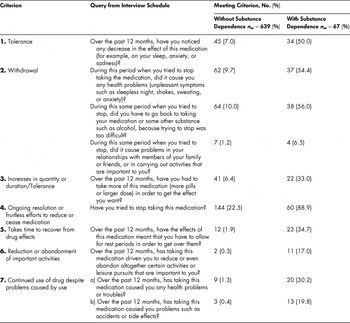
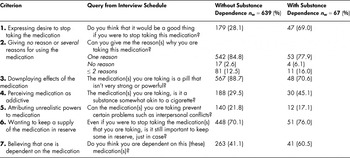
For each major mental disorder assessed by this questionnaire, questions were derived directly from the relevant DSM-IV-TR diagnostic criteria. Questions regarding BZD dependence are presented in Table 1. The seven atypical signs of BZD dependence in older persons examined in this study (see Table 2) were selected from five previous investigations by four research teams (Baillie & Mattick, Reference Baillie and Mattick1996; Cook, Biyanova, Masci, & Coyne, Reference Cook, Biyanova, Masci and Coyne2007; de las Cuevas et al., Reference de las Cuevas, Sanz, de la Fuente, Padilla and Berenguer2000; Kan et al., Reference Kan, Breteler, Timmermans, van der Ven and Zitman1999; Voyer, McCubbin, Cohen, Lauzon, Collin, & Boivin, Reference Voyer, McCubbin, Cohen, Lauzon, Collin and Boivin2004), based on both their empirical support and on the expert opinions of the ESA researchers (content validity). During the researchers meetings, every question was examined and the experts made sure that the questions reflected well the themes or questions from the previous published studies or tools. Total agreement was required to include the questions into the questionnaire.
Proportion of BZD-dependent respondents who answered positively to the questions addressing DSM-IV-TR criteria

Benzodiazepine users meeting “atypical” criteria suggestive of benzodiazepine dependence

Use of BZDs was assessed by first asking all respondents whether they had taken one of several benzodiazepines (presented to respondents as a list of brand and generic names) during the past year. Respondents who answered in the affirmative were then asked to show their BZD container(s) and to confirm that they still used the medication. To be considered a BZD user, a respondent had to answer yes to all three questions. No blood or urine samples were collected.
Data Analysis
Data were weighted to ensure that the results reflected the true proportions of older adults in each of the geographical areas and administrative regions (Cox & Cohen, Reference Cox and Cohen1985; Trudel, Courtemanche, & Tarte, Reference Trudel, Courtemanche and Tarte1992). Weights were determined on the basis of (1) probability of selection of the administrative region within the geographic area; (2) conditional probability of selection of the household within the administrative region; and (3) conditional probability of selection of the respondent within the household. The weight attributed to each respondent represented the inverse of his or her probability of selection. In text and tables, all weighted figures have been rounded to the nearest whole number.
In addition to frequencies and percentages to describe participant characteristics and prevalence rates, chi-square was used to test the significance of relationships between socio-demographic variables and BZD dependence. All analyses were carried out using SAS Statistical Analysis System software, version 8.0.
Results
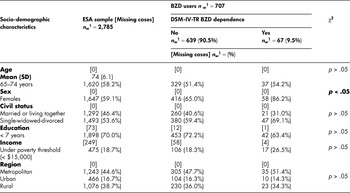
A total of 2,785 completed interviews of older adults were included in this study, representing a 69.8 per cent response rate (Figure 1). The average age of respondents was 74.0 years. Almost 60 per cent were women and more than half lived without a spouse. More than 80 per cent reported an annual income above the poverty threshold of $15,000 (81%), and 70 per cent reported less than seven years of education (see Table 3).
Demographic characteristics of the ESA sample and the sub-group of BZD users

1 The frequencies are weighted according to the geographical areas and the administrative regions in Quebec.
A weighted total of 707 (25.4%) respondents reported using at least one of 10 BZDs. About 82 per cent of BZD users reported using one of four drugs (lorazepam, 42.3%; oxazepam, 21.3%; clonazepam, 9.9%; and temazepam, 8.3%). Remaining BZD drugs used were bromazepam (6.2%), alprazolam (5.5%), flurazepam (4.6%), nitrazepam (1.3%), triazolam (0.5%), and estazolam (0.1%). Among BZD users, a weighted total of 67 participants (9.5%) met the DSM-IV-TR criteria for substance dependence. These respondents’ socio-demographic characteristics did not differ significantly from those of other BZD users, except that they were more likely to be women (Table 3).
Table 1 shows the proportion of BZD-dependent respondents who answered positively to the questions addressing DSM-IV-TR criteria. Criteria 6 (reducing important activities) and 7b (continuing medication use despite side effects or accidents) were least frequently met (< 20%) while criterion 4 (ongoing resolve or fruitless efforts to reduce medication) was ubiquitous (88.9%). About half of these individuals reported signs of tolerance (criterion 1), unpleasant withdrawal symptoms, and using other drugs or alcohol to reduce withdrawal distress (criterion 2). The remaining criteria were reported by between 30 and 35 per cent of respondents. We observed that the percentage of respondents reporting that taking a BZD caused a health problem (criterion 7a) was markedly different between non-dependent (1.3%) and DSM-IV-TR dependent users (30.2%). Finally, 27 (39.4%) users who met the DSM-IV-TR criteria for substance dependence disagreed that they were dependent (Table 2).
In the same group of DSM-IV-TR dependent users, three of the seven atypical criteria of BZD dependence were more frequently answered positively: (a) agreeing that it would be a good thing to stop using BZDs (69.0%), (b) believing that one is dependent (60.5%), and perceiving BZDs to be as addictive as cigarettes (45.1%).
Although only a single DSM-IV-TR criterion was met by more than 10 per cent of the non-dependent group of BZD users (criterion 4, “ongoing resolve or fruitless efforts to reduce or cease medication,” 144 of 639 [22.5%]), several of the atypical criteria were reported by substantial numbers of these respondents. Thus, 179 of 639 (28.1%) non-dependent users agreed that it would be a good thing to stop taking BZDs, and 263 (41.1%) defined themselves as dependent. Also, more non-dependent persons than dependent persons reported two of these atypical criteria: downplaying effects of BZDs (567 of 639 [88.7%]), and attributing unrealistic powers to BZDs (140 of 639 [21.8%]).
Discussion
The present study provided new findings regarding BZD dependence among seniors in Quebec. According to our data, 9.5 per cent of community-dwelling senior users of BZDs met the DSM-IV-TR criteria for substance dependence, whereas more than 40 per cent of them considered themselves dependent. The present study added to our knowledge of drug dependence among seniors. No previous study had been conducted in Canada on the prevalence of BZD dependence among a large sample of seniors randomly selected from the general population. Moreover, despite the sample size, the assessment of BZD dependence was based on a face-to-face interview by fully trained nurses applying the DSM-IV-TR criteria.
Most prevalence studies are conducted with smaller samples and use scales that have not been validated or compared against DSM, which cannot be generalized to the population at large. Finally, estimates of the prevalence of “atypical” signs of BZD dependence are the first to be derived from such a large random sample, allowing us to be more confident of their relevance. In summary, this study provides unique and reasonably accurate data about a phenomenon that remains difficult to investigate. Ordinary individuals do not readily participate in research studies that disclose their usage of psychotropic drugs. That this assessment of BZD dependence was an integral part of a larger study on health made it possible. In the field of geriatric drug dependence, experts have continuously asked for data to document its prevalence. In our view, the present study provides the most accurate and rigorous data so far.
Study Limitations
This study’s limitations include the possibility that dependence on other substances (e.g., coffee, tobacco, alcohol) may have influenced responses to queries about both DSM-IV-TR and atypical BZD dependence symptoms. Unfortunately, questions on uses of these and other substances were not part of our questionnaire. Second, counting a respondent as a BZD user rested on respondents’ willingness to disclose and confirm such use. Some users with marked dependence might not have revealed this information due to suspiciousness about the study or embarrassment. Third, not all BZD drugs on the market in Quebec were included in this study (Zopiclone, a non-benzodiazepine hypnotic was not included in this study). If any of these three factors were present, they would probably have resulted in an underestimate of the prevalence of BZD dependence in this population. Fourth, our sampling frame of respondents accessed via randomly generated telephone numbers excluded institutionalized persons, and thus our findings cannot be generalized to this segment of the population, which makes up approximately 3 per cent of persons aged 65 years and older in Quebec. Fifth, the lack of data allowing fine determinations of the actual frequency or level of BZD use limits the strength of the association that may be observed between reported BZD use and dependence. Sixth, the study was conducted in a single Canadian province, thus its findings cannot be generalized to other provinces.
Prevalence of Substance Dependence
The first objective of this study was to estimate the prevalence rate of BZD dependence among senior users of BZDs. One quarter of the sample (25.4%) used a BZD, a finding in line with the prevalence rate found in recent analyses of an administrative database from the province of Quebec (Institut-de-la-Statistique-du-Québec, 2009) and with rates observed in the rest of the world (Voyer et al., Reference Voyer, Cohen, Lauzon and Collin2004). To our knowledge, the finding that 9.5 per cent of older non-institutionalized persons using BZDs met DSM-IV-TR criteria for substance dependence was the first estimate published on BZD dependence among a randomly selected sample of community-dwelling older persons (Brymer & Rusnell, Reference Brymer and Rusnell2000). In a smaller clinical sample of 140 psychogeriatric outpatients, a retrospective medical chart review (Holroyd & Duryee, Reference Holroyd and Duryee1997) found a similar prevalence of 16 patients (11.4%) meeting DSM-III-R criteria for BZD dependence (chart reviews are more likely to yield underestimations of many phenomena because of faulty documentation by clinicians; Laurila, Pitkala, Strandberg, & Tilvis, Reference Laurila, Pitkala, Strandberg and Tilvis2004; Voyer et al., Reference Voyer, Cohen, Lauzon and Collin2004).
Using the self-rated Severity of Dependence Scale made up of five items (loss of control, worry about use, worry about missing a dose, wishing one could stop, and difficulty to stop) with 1,048 adults (248 over 65 years) who attended primary care health centres in the Canary Islands, researchers (de las Cuevas, Sanz, & de la Fuente, Reference de las Cuevas, Sanz and de la Fuente2003) reported that 493 (47%) were dependent on BZDs. The higher rate probably resulted from a selection bias (the sample included many patients attending clinics for their drug problems) and a scale using signs less difficult to meet than the DSM-IV-TR criteria. The rate reported in the present study can be considered a robust estimate of DSM-IV-TR BZD substance dependence because it was based on face-to-face interviews by trained nurse research assistants with randomly selected individuals.
Self-Labelling as Dependent on Benzodiazepines
Although the DSM-IV-TR criteria have been conceived as a unified set for symptom-based psychiatric diagnosis, the atypical criteria are presented in this article only as a list of possibly relevant items from different sources – not as a scale or globally coherent measure of substance dependence. In the present study, 41.1 per cent of all BZD users reported that they were dependent on these medications on the basis of the following question: “Do you think you are dependent on this (these) medication(s)?”, and in the aforementioned study (de las Cuevas et al., Reference de las Cuevas, Sanz and de la Fuente2003) of primary health care patients, 49 per cent positively responded to a similar query. A common meaning of dependence is that one has difficulty in stopping use of a given substance because of the craving associated with the absence of consumption. In the study, 22.5 per cent of BZD users indicated that they experienced such difficulty. In the absence of a gold standard for the diagnosis of substance dependence, using a consensus-derived measure such as the DSM-IV-TR led to a prevalence of approximately 10 per cent among BZD users, while using self-labelling appeared to lead to a rate four times higher.
The results provide mixed support for the relevance of both the DSM-IV-TR and the atypical criteria among seniors. Indeed, although over half of dependent users according to the DSM-IV-TR reported experiencing withdrawal symptoms, only 6.5 per cent in our study reported that these symptoms had an adverse impact on their activities. Conversely, the percentage of respondents reporting that taking this medication caused any health problems (criterion 7a) climbed from 1.3 per cent among non-dependent users to 30.2 per cent among DSM-IV-TR dependent seniors. In the set of atypical criteria, the most noticeable percentage increase concerned criterion 1, where more than twice as many seniors who could be categorized as DSM-IV-TR dependent expressed the desire to stop taking BZDs than did non-dependent respondents. Conversely, downplaying effects of medication, attributing unrealistic powers to it, and wanting to keep a supply in reserve did not distinguish dependent from non-dependent users. The finding that almost 90 per cent of users downplayed adverse effects of BZDs suggests that much of the use of benzodiazepines among older persons is experienced as controlled and self-directed.
Despite the study’s focus on the problem of dependence, we do not overlook the observation that more than 70 per cent of BZD users expressed no wish to stop their use, suggesting that they are satisfied with this medication. As noted, previous research has shown that the therapeutic effects of BZDs for anxiety and insomnia do not exceed those of placebo after 30 days of use. Future research should therefore explore what specific benefits BZD users are deriving from ongoing BZD consumption.
Overall, it appears clear that broadening criteria to include the user’s desire to stop taking medication and the user’s self-labelling as dependent greatly increases the prevalence of BZD substance dependence compared to the conventional DSM-IV-TR diagnosis. Although the DSM criteria include social and behavioural dimensions, these were less present among dependent users. On the other hand, besides the most frequently met DSM criterion of having tried to stop taking the medication (criterion 4), tolerance (criterion 1) and withdrawal (criterion 2) were frequently met (50% of the cases) and clearly distinguished dependent from non-dependent users. It has been suggested that focusing solely on physiological symptoms of dependence (criteria 1 and 2) can lead clinicians to under-detect older people dependent on BZD, whose need for support might go unnoticed (de las Cuevas et al., Reference de las Cuevas, Sanz and de la Fuente2003). According to our results, this latter assertion has merit given that 50 per cent of the respondents recognized as dependent according to the DSM-IV-TR did not meet either of these criteria (1 or 2).
The present results highlight the importance of increasing knowledge on the clinical and functional impact of BZD dependence among seniors. Debate might persist about the precise meaning of the concept of dependence, but future research should examine health and well-being outcomes in persons who self-label as dependent as well as those who meet traditional psychiatric criteria of substance dependence. It remains to be determined whether the nearly one third of BZD users who wish to stop using this medication do so because they have been exposed to negative messages about the risks of long-term consumption, or because they genuinely experience and recognize unpleasant cognitive or other states of dependence. Whether or not users of BZDs experience the classic physical symptoms of tolerance or withdrawal, we believe that clinicians should be willing to help and programs should be available to assist those who wish to discontinue their usage of BZDs. Yet, this reasonable expectation is not always met (Damestoy et al., Reference Damestoy, Collin and Lalande1999; Pimplott, Hux, Wilson, Kahan, Li, & Rosser, Reference Pimplott, Hux, Wilson, Kahan, Li and Rosser2003; Sleath, Svarstad, & Roter, Reference Sleath, Svarstad and Roter1997), despite the existence of effective withdrawal programs (Ashton, Reference Ashton2005; Baillargeon, Landreville, Verreault, Beauchemin, Grégoire, & Morin, Reference Baillargeon, Landreville, Verreault, Beauchemin, Grégoire and Morin2003).