


Introduction
‘I don’t treat clients with autism.’
Many clinicians who are well-trained in evidence-based practices (EBPs) are careful to delineate which diagnostic presentations are outside the scope of their training, an approach that is both reasonable and ethically appropriate (Maddox et al., Reference Maddox, Crabbe, Beidas, Brookman-Frazee, Cannuscio, Miller, Nicolaidis and Mandell2020). That said, a number of clients struggle to access mental health services as a result of not fitting neatly within the guidelines of a typical target population or even within the population parameters of an EBP due to symptom severity or psychological co-morbidities (e.g. Camm-Crosbie et al., Reference Camm-Crosbie, Bradley, Shaw, Baron-Cohen and Cassidy2019; Dickson et al., Reference Dickson, Lind, Jobin, Kinnear, Lok and Brookman-Frazee2021; Tint and Weiss, Reference Tint and Weiss2018). This is particularly true of adults with autism spectrum disorder (ASD), an area in which many mental health clinicians receive little to no training and, as a result, are less likely to accept adults on the spectrum as therapy clients (Crane et al., Reference Crane, Adams, Harper, Welch and Pellicano2019; Maddox et al., Reference Maddox, Crabbe, Fishman, Beidas, Brookman-Frazee, Miller, Nicolaidis and Mandell2019; Maddox et al., Reference Maddox, Crabbe, Beidas, Brookman-Frazee, Cannuscio, Miller, Nicolaidis and Mandell2020).Footnote 1 Conversely, many clinicians who complete specialized training in ASD do not complete as much training in EBPs for other psychological presentations (Maddox and Gaus, Reference Maddox and Gaus2019) and co-occurring mental health problems such as depression, anxiety, trauma and suicidality (Cantor et al., Reference Cantor, McBain, Kofner, Stein and Yu2020).
According to the most recent estimates provided by the Centers for Disease Control and Prevention (CDC), ASD affects approximately 1.85% of the population in the USA (Maenner et al., Reference Maenner, Shaw, Baio, Washington, Patrick, DiRienzo, Christensen, Wiggins, Pettygrove, Andrews, Lopez, Hudson, Baroud, Schwenk, White, Rosenberg, Lee, Harrington, Huston and Dietz2020), and prevalence rates are on the rise. In 2004, one in 166 children were diagnosed with ASD; in 2014, that rate increased to one in 59 (Baio et al., Reference Baio, Wiggins, Christensen, Maenner, Daniels, Warren, Kurzius-Spencer, Zahorodny, Robinson, White, Durkin, Imm, Nikolaou, Yeargin-Allsopp, Lee, Harrington, Lopez, Fitzgerald, Hewitt and Dowling2018). The increased prevalence is largely explained by a broadening of the diagnostic criteria and improved awareness and identification of autism symptoms (Fombonne, Reference Fombonne2020). ASD includes two core features – impairments in social-communication skills and the presence of stereotyped and repetitive patterns of behaviour – that are present across the lifespan, beginning in early childhood and extending through adulthood (American Psychiatric Association, 2013). Behaviourally, these characteristics may manifest in a multitude of ways and across a wide range of functional impairment, including difficulties in maintaining reciprocal social conversations, limited use of eye contact in interpersonal interactions, limited use of non-verbal gestures to accompany speech, deficits in developing and maintaining friendships, the presence of repetitive motor movements, the use of overly formal or pedantic language, an unusually narrow range of interests, cognitive and behavioural rigidity and insistence on sameness, and the presence of unusual sensory interests and responses (for a review of the clinical correlates and behavioural features of ASD, see Fakhoury, Reference Fakhoury2015).
Many mental health professionals have a misconception that all autistic individuals present with significant and obvious functional, behavioural, and cognitive impairments (Maddox et al., Reference Maddox, Crabbe, Beidas, Brookman-Frazee, Cannuscio, Miller, Nicolaidis and Mandell2020). On the contrary, recent prevalence data from the CDC indicate that approximately 42% of 8-year-olds diagnosed with ASD had average or higher than average intellectual functioning (IQ>85), whereas only 33% met criteria for intellectual disability (ID; IQ≤70) (Maenner et al., Reference Maenner, Shaw, Baio, Washington, Patrick, DiRienzo, Christensen, Wiggins, Pettygrove, Andrews, Lopez, Hudson, Baroud, Schwenk, White, Rosenberg, Lee, Harrington, Huston and Dietz2020). In addition, many autistic individuals have less distinctive behavioural presentations in that they do not engage in repetitive or socially deficient behaviours that are obvious to others (de Marchena and Miller, Reference de Marchena and Miller2017). This is due in part to the fact that some autistic individuals engage in ‘camouflaging’ behaviours – such as appearing to make eye contact, reducing the tendency to fidget, or pretending to like the same things other members of a group like – in order to fit into social situations and prevent others from picking up on their differences (Hull et al., Reference Hull, Petrides, Allison, Smith, Baron-Cohen, Lai and Mandy2017). Thus, ASD is a heterogeneous condition that affects people over a wide range of intellectual, language and adaptive behaviour skills and may not be apparent to clinicians who are not well trained to assess for ASD.
Co-occurring psychiatric conditions are present at a significantly higher rate in ASD than in the general population, are evident across the entire lifespan of adults with ASD, and contribute to long-term negative effects on health and quality of life (Lai et al., Reference Lai, Kassee, Besney, Bonato, Hull, Mandy, Szatmari and Amels2019; Lever and Geurts, Reference Lever and Guerts2016). Autistic individuals are at increased risk for mental health problems because of both the genetic overlap between ASD and other psychiatric disorders as well as the psychosocial stressors associated with living with ASD (Carter Leno and Simonoff, Reference Carter Leno, Simonoff, White, Maddox and Mazefsky2020). Common co-occurring disorders include anxiety, depression, attention-deficit/hyperactivity disorder (ADHD), obsessive-compulsive disorder (OCD), bipolar disorders, sleep-wake disorders, and psychotic-spectrum disorders (Buck et al., Reference Buck, Viskochil, Farley, Coon, McMahon, Morgan and Bilder2014; Fombonne, Reference Fombonne2012; Greenlee et al., Reference Greenlee, Mosley, Shui, Veenstra-VanderWeele and Gotham2016; Lai et al., Reference Lai, Kassee, Besney, Bonato, Hull, Mandy, Szatmari and Amels2019; Simonoff et al., Reference Simonoff, Jones, Baird, Pickles, Happe and Charman2013). In addition, many individuals with ASD experience suicidal ideation or engage in non-suicidal self-injury (Maddox et al., Reference Maddox, Trubanova and White2017; Mayes et al., Reference Mayes, Gorman, Hillwig-Garcia and Syed2013; Storch et al., Reference Storch, Sulkowski, Nadeau, Lewin, Arnold, Mutch, Jones and Murphy2013). Psychological difficulties are particularly common for autistic adults without ID (Buck et al., Reference Buck, Viskochil, Farley, Coon, McMahon, Morgan and Bilder2014); Lever and Geurts (Reference Lever and Guerts2016) found that 79% of the sample of autistic adults without ID met criteria for at least one psychiatric condition in their lifetime, with mood disorders and anxiety being the most common. In fact, for this subgroup of autistic adults, the psychiatric symptoms may be the primary impairment rather than the ASD characteristics (Maddox and Gaus, Reference Maddox and Gaus2019).
Given the relatively high (and rising) prevalence rate of ASD, the frequent psychiatric co-occurring conditions experienced by autistic individuals, and the fact that many autistic individuals have more subtle ASD symptom presentations, mental health practitioners are likely to encounter an autistic adult in their practices, whether they intend to or not. Some autistic adults may withhold their diagnosis at intake out of concern that they will be turned away because clinicians may not feel knowledgeable or confident enough to treat them (Maddox et al., Reference Maddox, Crabbe, Beidas, Brookman-Frazee, Cannuscio, Miller, Nicolaidis and Mandell2020), even though these same clinicians possess the necessary training and expertise to treat co-occurring conditions. Alternatively, clients may be unaware that they meet criteria for ASD. In either of these scenarios, the ASD diagnosis may elude the clinician entirely, or may only become apparent when the client is having difficulty benefiting from EBPs that are presented in standard fashion (i.e. without adaptation for individuals with ASD).
Even if clinicians are willing to learn about autism, a limited number of EBPs have been adapted for individuals with ASD (Maddox and Gaus, Reference Maddox and Gaus2019; Maddox et al., Reference Maddox, Crabbe, Beidas, Brookman-Frazee, Cannuscio, Miller, Nicolaidis and Mandell2020), and even fewer adapted EBPs have been studied in autistic adults. For example, while modified cognitive behavioural therapies (CBT) have been shown to be effective in treating anxiety and affective disorders in autistic children, there are very few studies examining the effectiveness of CBT for co-occurring conditions in autistic adults (Kerns et al., Reference Kerns, Roux, Connell and Shattuck2016; Spain et al., Reference Spain, Sin, Chalder, Murphy and Happé2015; Weston et al., Reference Weston, Hodgekins and Langdon2016; White et al., Reference White, Simmons, Gotham, Conner, Smith, Beck and Mazefsky2018). Clearly, more evidence-based interventions are needed for this under-served population (Fombonne, Reference Fombonne2012; Murphy et al., Reference Murphy, Wilson, Robertson, Ecker, Daly, Hammond, Galanopoulos, Dud, Murphy and McAlonan2016; Shattuck et al., Reference Shattuck, Roux, Hudson, Taylor, Maenner and Trani2012).
Over the past decade, an increasing amount of attention has been paid to the concept of emotion dysregulation as one of the central problems that underpins a number of psychiatric difficulties (Sheppes et al., Reference Sheppes, Suri and Gross2015). New treatments have emerged that focus less on discrete diagnostic classes and more on wide-ranging transdiagnostic applicability (e.g. the Unified Protocol; Barlow et al., Reference Barlow, Farchione, Sauer-Zavala, Latin, Ellard, Bullis, Bentley, Boettcher and Cassiello-Robbins2017). In addition, interventions that target putative underlying psychological processes (e.g. cognitive flexibility in acceptance and commitment therapy; Hayes et al., Reference Hayes, Strosahl and Wilson2009) are being studied across a range of psychiatric populations. One treatment in particular – dialectical behaviour therapy (DBT; Linehan, Reference Linehan1993; Linehan, Reference Linehan2014) – is based on the hypothesis that emotion dysregulation is the core deficit for individuals with a multidiagnostic symptom presentation and that skills can be taught to improve an individual’s ability to recognize, modulate and tolerate emotions more effectively.
DBT is a comprehensive intervention that was designed to treat individuals with chronic suicidality and co-morbid psychiatric conditions and is best known as the gold standard treatment for borderline personality disorder (BPD; APA Division 12: https://div12.org/psychologicaltreatments/disorders/borderline-personality-disorder/; Stoffers-Winterling et al., Reference Stoffers-Winterling, Völlm, Rücker, Timmer, Huband and Lieb2012). Linehan (Reference Linehan1993) theorizes that emotion dysregulation is the core feature of BPD; in addition, she posits that the problematic behaviours seen in individuals with BPD are either the result of dysregulated emotion (e.g. lashing out) or serve as a way of downregulating negative emotion (e.g. self-harm). DBT assumes that many of the difficulties that clients experience are attributable to skills deficits; thus, the treatment is designed to improve emotion regulation capacity so that clients can more easily manage their interpersonal, intrapersonal, and behavioural difficulties. Data support this hypothesis: in one study of DBT with women with BPD, skills usage fully mediated decreases in suicidal behaviour, depression and anger control over time, and partially mediated decreases in non-suicidal self-injury over time (Neacsiu et al., Reference Neacsiu, Rizvi and Linehan2010).
Standard DBT consists of weekly individual therapy, weekly group skills training, as needed between-session coaching calls, and weekly consultation team meetings for therapists. Skills training in DBT includes four modules: mindfulness, distress tolerance, emotion regulation, and interpersonal effectiveness (see Table 1). Skills are taught in a classroom format, and participants are expected to engage in skills practice and homework each week. Individual DBT sessions utilize a standard framework in which treatment targets are addressed hierarchically according to three categories: life threatening behaviour (e.g. suicide and self-harm), therapy interfering behaviour (e.g. any behaviour by the client or therapist that threatens the integrity of the therapeutic relationship, including non-compliance, dishonesty, lateness, etc.), and quality of life interfering behaviour (e.g. anything that interferes with the client’s well-being, including depression, anxiety, substance use, job or housing instability, relationship difficulties, etc.). Coaching calls are utilized to generalize new behaviour into the client’s natural environment; clients are able to call their therapists between sessions to learn a new skill if needed, or to get help applying a skill to a specific situation (for a thorough description of telephone coaching in DBT, see Chapman, Reference Chapman2018).
DBT skills modules

With the increasing focus on emotion dyregulation as a core symptom of a number of disorders, DBT has been utilized with an ever-growing list of groups and target populations. The treatment has been studied with clients across a variety of age ranges, including children (Perepletchikova et al., Reference Perepletchikova, Nathanson, Axelrod, Merrill, Walker, Grossman, Rebeta, Scahill, Kaufman, Flye, Mauer and Walkup2017), adolescents (McCauley et al., Reference McCauley, Berk, Asarnow, Adrian, Cohen, Korslund, Avina, Hughes, Harned, Gallop and Linehan2018; Mehlum et al., Reference Mehlum, Tørmoen, Ramberg, Haga, Diep, Laberg, Larsson, Stanley, Miller, Sund and Grøholt2014; Mehlum et al., Reference Mehlum, Ramberg, Tørmoen, Haga, Diep, Stanley, Miller, Sund and Grøholt2016), adults (for a review, see Stoffers-Winterling et al., Reference Stoffers-Winterling, Völlm, Rücker, Timmer, Huband and Lieb2012), and geriatric clients (Lynch et al., Reference Lynch, Cheavens, Cukrowicz, Thorp, Bronner and Beyer2007), as well as in a variety of treatment settings (Ritschel et al., Reference Ritschel, Miller, Taylor, Ehrenreich-May and Chu2013), including inpatient, outpatient, residential and forensic settings. Beyond BPD, DBT has been studied as a treatment for treatment-resistant depression, eating disorders, post-traumatic stress disorder, and substance use disorders (Ritschel et al., Reference Ritschel, Lim and Stewart2015). Of particular relevance to the current project, an ongoing study is testing the efficacy of DBT for autistic adults with suicidal ideation and/or self-harm behaviours (Huntjens et al., Reference Huntjens, Wies van den Bosch, Sizoo, Kerkhof, Huibers and van der Gaag2020).
Recent studies have examined the utility and importance of skills training to outcomes in DBT. Linehan and colleagues (Reference Linehan, Korslund, Harned, Gallop, Lungu, Neacsiu, McDavid, Comtois and Murray-Gregory2015) conducted a component analysis in which they compared three conditions: standard DBT, individual DBT without skills training, and skills training plus case management only. While participants in all three conditions showed improvement, the two conditions that included skills training were more effective than individual therapy alone. Lyng and colleagues (Reference Lyng, Swales, Hastings, Millar, Duffy and Booth2020) conducted a quasi-experimental study comparing standard DBT to skills training only for individuals with BPD. Although attrition rates were higher in the skills group only condition, there were no other statistically significant differences on outcome measures between the two groups. In addition, DBT skills training has been evaluated as a stand-alone or adjunctive intervention across a wide range of clinical populations, including eating disorders, mood disorders and ADHD (Harned and Botanov, Reference Harned and Botanov2016). Valentine and colleagues (Reference Valentine, Bankoff, Poulin, Reidler and Pantalone2015) summarized outcomes from 17 studies evaluating DBT skills training as a stand-alone intervention and concluded that skills training appears to be effective in reducing symptoms in more straightforward clinical presentations such as depression, ADHD, and binge eating disorder, but may not be sufficient for cases involving high-risk behaviours such as non-suicidal self-injury and suicidality. They noted that there have been a wide range of methodological differences in DBT skills training only studies published to date and, therefore, it is difficult to draw firm conclusions about DBT skills training as a stand-alone intervention at this point. Although more research is needed, outcomes from these studies suggest that the skills training component of DBT is (1) a critical component for high-risk, multi-diagnostic patients, and (2) an effective intervention for lower risk, less complex patients in need of skills.
Emotion dysregulation is also often cited as a core problem for many individuals with ASD (Cai et al., Reference Cai, Richdael, Uljarevic, Dissanayake and Samson2018; Mazefsky and White, Reference Mazefsky and White2014; Mazefsky et al., Reference Mazefsky, Herrington, Siegel, Scarpa, Maddox, Scahill and White2013). Given the heterogeneity of symptom presentations in autistic individuals, it may be more parsimonious to develop or adapt multi-diagnostic treatments for autistic adults to target emotion dysregulation more generally rather than specific and narrow symptoms. A broad-based treatment could then be utilized with individuals presenting with a wide range of emotional and behavioural concerns, with the idea that improving emotion regulation capacity mediates improvements in behavioural outcomes. However, a limited number of studies have targeted emotion dysregulation in ASD (Beck et al., Reference Beck, Conner, Breitenfeldt, Northrup, White and Mazefsky2020a; Conner and White, Reference Conner and White2018), and most have focused on children (e.g. Scarpa and Reyes, Reference Scarpa and Reyes2011; Thomson et al., Reference Thomson, Riosa and Weiss2015; Weiss et al., Reference Weiss, Thomson, Riosa, Albaum, Chan, Maughan, Tablon and Black2018) or adolescents (Conner et al., Reference Conner, White, Beck, Golt, Smith and Mazefsky2019). To our knowledge, no published studies have evaluated DBT (standard DBT or skills training alone) for individuals with ASD. Thus, the purpose of the current study was to evaluate the feasibility and acceptability of a DBT skills training group (DBT-ST) with autistic adults without intellectual impairment and who experience symptoms of anxiety, depression, and/or emotional or behavioural dysregulation.
Method
Participants
Study participants were recruited from the treatment waiting list of the the University of North Carolina TEACCH Autism Program. TEACCH is a state-wide program that has a strong community focus, and the clinics are embedded in communities that serve diverse populations, including urban and rural areas. Study participants represented a wide age range (19–68 years), included both males and females (approximately 23% female), had a primary diagnosis of ASD, did not have a co-occurring diagnosis of ID, had verbal abilities in the low average range or above, and successfully completed a general education high school curriculum. The educational level and intellectual abilities criteria were used to ensure participants had the ability to read and comprehend the teaching materials used in the intervention. The diagnosis of ASD for study participants was made by community providers and confirmed by expert clinical judgment of the group leaders. In addition to ASD, some participants had co-occurring diagnoses, including generalized anxiety disorder (69%), major depressive disorder (23%), ADHD (15%), bipolar disorder (8%) and OCD (8%). Individuals with active suicidal ideation were excluded from the study. Participants were not restricted from seeking additional treatment (e.g. individual therapy, medication management) while they were enrolled in the DBT-ST group.
Procedures
An initial interview was conducted with each study participant to provide information about the DBT-ST intervention and to determine eligibility. The confirmation of the diagnosis of ASD and screening for ID were also accomplished at the time of the initial interview either through chart review of previous psychological testing or administration of a standardized measure of verbal ability [i.e. Peabody Picture Vocabulary Test – fourth edition (PPVT-4; Dunn and Dunn, Reference Dunn and Dunn2007) or the Vocabulary subtest of the Wechsler Abbreviated Scale of Intelligence – second edition (WASI-II; Wechsler, Reference Wechsler2011)]. All participants had verbal standard scores of 80 or above. Participants were provided copies of the standard adult DBT-ST handouts for the skills taught and worksheets for the between-session practice assignments (Linehan, Reference Linehan2014).
Training of TEACCH Autism Program Staff
An expert DBT trainer (L.R.) began providing consultation to the TEACCH Autism Program in 2017. This consultation was sought because the ASD experts at TEACCH (1) were having trouble getting treatment for psychiatric co-occurring conditions with community clinicians for their clients with ASD, and (2) hypothesized that improving clients’ emotion regulation capabilities would be helpful for improving their overall well-being. The TEACCH Autism Program operates seven community clinics statewide, and TEACCH clinicians provide a range of clinical services for autistic individuals across the lifespan. Consistent with the DBT model, the decision was made to implement the standard DBT-ST agenda, with attention towards whether any skills would need to be adapted for an ASD population (i.e. ‘adopt, then adapt’; Koerner et al., Reference Koerner, Dimeff, Swenson, Dimeff and Koerner2007). Prior to the launch of skills training groups, a 2-day training was conducted in which TEACCH staff were given an overview of comprehensive DBT as well as specific training on DBT skills and skills group implementation in March 2017. Refresher trainings were held in February 2018 (1 day) and January 2020 (2 days).
Monthly consultation calls led by the DBT trainer were initiated in July 2017 and have been held continuously since that time. Agendas are set at the beginning of these calls and include updates about group attendance and recruitment at each TEACCH site as well as training on specific skills, questions about assessments or research questionnaires, or possible adaptations to skills needed for an ASD population. TEACCH therapists have provided the trainer with feedback on questions that have arisen during skills training as well as their observations of any difficulties that participants seemed to have learning particular skills. Reciprocally, the trainer has provided feedback on which difficulties that are occurring in TEACCH groups are normative for DBT groups (e.g. therapy interfering behaviours such as homework non-completion or telling off-topic stories; participants dropping out of group due to difficulties with transportation or because they started a new job and their work schedule precluded ability to attend). In addition, consultation calls have focused on translating DBT skills into formats and exercises that are more amenable for autistic learners. More detail on specific adaptations to DBT skills is included in the Discussion section.
Implementation of DBT group skills training
Between July 2017 and January 2018, DBT skills groups were launched at four TEACCH clinics across the state. All groups were run with a leader and a co-leader who had participated in the training described above. The therapists conducting the groups had considerable expertise in treating autistic individuals, with a mean of 23.7 years (range 12–41 years) of experience, but no experience with DBT skills. The groups were capped at five participants and met weekly for 1.5 hours for 24 weeks using the standard adult DBT skills handouts and worksheets. Groups met in a traditional outpatient physical environment (i.e. a conference room at the clinic) with no special modifications for sensory sensitivities. The room was set up in a way that is typical in DBT outpatient groups, which tend to look more like a classroom setting (e.g. tables so participants could easily take notes on the handouts provided, white board for enhanced teaching). Each group began with a mindfulness practice, followed by review of the previous week’s homework, a short break, and teaching of that week’s skill. As is standard practice in DBT, all clients were expected to participate in homework review, and non-participation was addressed with the client as therapy interfering behaviour. The DBT skills modules and durations are illustrated in Fig. 1.
DBT skills group modules and duration.

Feasibility and acceptability measures
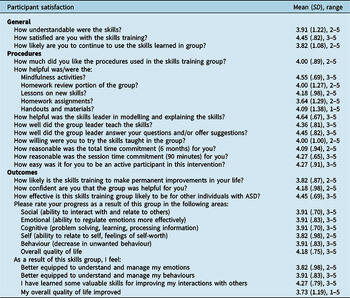
Feasibility was assessed by participant attendance and retention rates across the 24 sessions. Acceptability of the intervention was assessed with the Participant Satisfaction Questionnaire, which was developed for the purposes of the present study (see Table 2). Participants completed this questionnaire at the conclusion of treatment. The Participant Satisfaction Questionnaire used in this study was a modified version of one that was developed at the TEACCH Autism Program and used to evaluate a separate intervention (Boyd et al., Reference Boyd, Turner-Brown and Hume2013). The original questions were adapted to address the specific elements of the DBT-ST group intervention.
Participant Satisfaction Questionnaire

Ratings were on a Likert scale: 1 = not at all, 3 = neutral, and 5 = very much.
Results
Sixteen participants enrolled in the intervention, and 13 (81.25%) completed the full 24 sessions (mean age 36.62 years, range 19–68 years; 77% male). Reasons for dropping out of the group were as follows: one participant found employment that conflicted with the group time; one dropped out for financial reasons; and one decided that the time commitment for the group was too much to manage. The mean session attendance rate was 87.54% (range 80–96%). Completion rate of the Participant Satisfaction Questionnaire was 85%. Satisfaction ratings ranged from 1 (lowest) to 5 (highest) and are reported in Table 2. Overall satisfaction with DBT-ST was high (mean = 4.45, SD = .82), as was the confidence rating that the intervention was helpful (mean = 4.18, SD = .98). Study participants viewed DBT-ST as an intervention that would probably be effective for others with ASD (mean = 4.45, SD = 69). Participants found the DBT skills group intervention acceptable and helpful.
Discussion
The findings of the current study provide preliminary support for the feasibility and acceptability of using DBT-ST with autistic adults without ID who experience co-occurring mental health conditions. The excellent retention and attendance rates showed that participants were sufficiently engaged with the intervention to attend weekly 90-minute sessions and remain in treatment for the duration of the 24 sessions. Of note, these rates are excellent in comparison with other studies of DBT-ST as a stand-alone intervention; in their summary of DBT-ST studies, Valentine and colleagues (Reference Valentine, Bankoff, Poulin, Reidler and Pantalone2015) found completion rates ranging from 48 to 100%, with an average completion rate of 73.5%. Furthermore, the attendance and retention rates in this study were achieved without the typical contingencies operating in a comprehensive DBT program; in standard DBT, poor group attendance would be addressed by the individual therapist as therapy interfering behaviour, and none of the participants in this study had individual DBT therapists (i.e. who were following the DBT individual session hierarchy, were providing coaching calls, and were participating on a weekly consultation team). Study participants endorsed high satisfaction ratings at the completion of treatment and viewed the intervention to be beneficial. In addition, participants rated DBT-ST as likely to be helpful in improving emotion regulation capacity for other autistic individuals. The group procedures, such as the time commitment of 6 months, 90-minute weekly sessions, requirement of active participation in session, and interactions with the group leader, also received high satisfaction ratings.
These study results are promising in the effort to develop more mental health interventions for this under-served population. Due to the limited number of trained providers with expertise in adult ASD, expanding services to meet the needs of this population will involve both autism experts learning new mental health interventions, as well as mental health practitioners learning about ASD. While the study group therapists had significant experience in treating autistic individuals, it is notable that they had no prior experience with DBT, suggesting that therapists with no prior exposure to DBT can learn and implement DBT skills effectively. It is also notable that TEACCH therapists had ongoing access to an expert consultant in DBT and that this would not necessarily be available to all therapists in the community. Moreover, ASD experts tend to be well trained in behavioural interventions more broadly, and thus learning and implementing a behaviourally based skills training intervention may not have been a particularly difficult task for them.
Building on the existing literature on the effectiveness of DBT-ST as a stand-alone intervention, we hypothesized that DBT-ST would be a useful intervention for autistic adults for five reasons. First, DBT places a strong emphasis on teaching emotion regulation skills, which includes both the up-regulation of positive emotions and the down-regulation of negative emotions. Emotion dysregulation is a common and significant problem in autistic adults and is associated with a wide range of mental and physical health difficulties (Cai et al., Reference Cai, Richdael, Uljarevic, Dissanayake and Samson2018). Second, modifications to therapeutic interventions that take into account the unique learning style of autistic individuals are often recommended for this population (Kerns et al., Reference Kerns, Roux, Connell and Shattuck2016; Spain et al., Reference Spain, Sin, Chalder, Murphy and Happé2015), many of which are relatively easily addressed in DBT-ST. This learning style includes both a strength in visual processing of information as well as difficulties in executive function, processing of social cues, and reciprocal communication (Van Bourgondien and Coonrod, Reference Van Bourgondien, Coonrod, Goldstein and Naglieri2013). Given these relative strengths and weaknesses, a frequent recommendation is for therapists to adopt a didactic style that relies more heavily on the use of visual supports to maximize engagement with autistic clients and to ensure depth of processing. DBT-ST has a strong psychoeducational approach that lends itself easily to increased use of visual aids; for example, participants are given structured handouts and homework assignments to practise each week, both of which naturally align with recommended modifications for autistic clients. In addition, DBT skills are easily translatable into a number of more visually based teaching techniques (see recommendations below).
Third, recommended modifications for ASD interventions typically include an increased focus on improving emotional literacy. Alexithymia (i.e. difficulty identifying, distinguishing and describing emotions) is a common problem in ASD (Mazefsky and White, Reference Mazefsky and White2014) and may interfere with more traditional CBT strategies that require self-monitoring of emotions (Beck et al., Reference Beck, Greco, Terhorst, Skidmore, Kulzer and McCue2020b). The DBT Emotion Regulation module provides explicit and practical instruction for understanding the cognitive and physical aspects of emotions using a visual diagram. It also includes handouts for 10 common emotions (anger, disgust, envy, fear, happiness, jealousy, love, sadness, shame, and guilt) that provide different labels for each emotion, explain prompting events for each emotion, and give examples of the physiological and behavioural responses to each emotion. Fourth, sufficient time for learning new skills is often recommended (Spain et al., Reference Spain, Sin, Chalder, Murphy and Happé2015). The number of sessions included in DBT-ST is higher than that in most CBT programs described in the literature, and participants reported that the required commitment to treatment was acceptable.
Finally, DBT-ST was also thought to be a good fit for autistic adults because a core component to the DBT model is a balance between acceptance skills and change skills. This may be particularly important for autistic adults, who are often told they need to change or be different to fit in more easily. As noted earlier, social masking or camouflaging (a change strategy) is frequently endorsed by autistic clients, who report that this practice is incredibly effortful and can lead to feelings of exhaustion as well as threats to a person’s sense of self (Hull et al., Reference Hull, Petrides, Allison, Smith, Baron-Cohen, Lai and Mandy2017). From a treatment standpoint, a unilateral focus on change can be invalidating for clients and may lead to treatment drop-out. This is entirely consistent with Linehan’s (Reference Linehan1993) original rationale for including acceptance-based strategies in the treatment of BPD; she noted that change-focused technologies (e.g. second-wave CBT) resulted in significant difficulties in the therapeutic alliance and contributed to treatment attrition, which led her to include acceptance-based and dialectical strategies when she developed DBT. One study conducted with autistic adults found preliminary support that mindfulness-based therapy may be preferred over CBT (Sizoo and Kuiper, Reference Sizoo and Kuiper2017), suggesting that acceptance strategies may indeed be an important component of treatment.
Lessons learned: potential modifications to DBT skills for autistic adults
DBT-ST was judged to be a good fit for autistic adults as evidenced by the strong satisfaction ratings of the participants, high participant retention and group attendance rates, and the clinical impressions of the therapists. However, based on their extensive experience with ASD, the group leaders who participated in this study (and who have continued to run DBT-ST groups since data collection for this study was completed) noted several recommended modifications to tailor group instruction to better fit the learning style of autistic individuals (Van Bourgondien and Coonrod, Reference Van Bourgondien, Coonrod, Goldstein and Naglieri2013). It is important to note that these suggestions are not empirically derived; rather, they emerged from the clinical experience of the group leaders based on their knowledge of best practices for teaching autistic adults, informal feedback from group members, and collaborative discussion and problem solving among the team members during monthly consultation calls in which common difficulties in teaching and reviewing homework across sites were discussed at length.
First, we recommend using visual supports and hands-on activities to make the teaching of abstract concepts more concrete. For example, when teaching states of mind, rather than asking group members to verbally generate examples of each state of mind on their own, they were asked to select a card with a written behavioural example that illustrated Wise Mind, Emotion Mind, or Reasonable Mind. The group member read the description aloud, discussed with the group, and then sorted the card into one of three piles representing each of the three states of mind. This activity reduced the executive function demand of the task and facilitated group participation and mastery of the concept. A similar modification was made when teaching the Model of Emotions; group leaders created a large version of the model with ‘pockets’ for each of the elements of the model and put it on the wall, and they created index cards to represent different elements of the model (e.g. ‘I forgot to take my medicine that morning’ as an example of a vulnerability factor; ‘yelling, screaming’ as an example of an action urge). Group members were then asked to sort the index cards into the correct pockets as a way to learn the skill. They could then use blank index cards to write down one of their own experiences and to demonstrate skills usage the following week in homework review. As another example, when teaching the concept of chain analysis, group leaders provided group members with different coloured strips of paper, with each colour representing a different element of the chain (e.g. green for vulnerability factors, yellow for prompting events, blue for links on the chain, red for problem behaviours, purple for consequences). Group members were asked to write the specific elements of their own chains on the paper links and to then put the links together into an actual chain so that they could better understand the sequence of events that led to the problem behaviour.
Second, we recommend incorporating activities and visual images that are consistent with the special interests often seen with autistic clients into the teaching materials. For example, when the first author initially taught self-soothe skills to the TEACCH therapists, the ASD experts noted that many of the visual and auditory images used involved nature scenes or other ‘typical’ soothing images or sounds. They noted, however, that autistic adults tend to find more idiosyncratic images to be soothing, such as images of machines or scientific equipment.
Third, we recommend using handouts that are streamlined and simplified, as many autistic individuals can be overwhelmed with too many words on a page. At times, we found the adult skills training handouts to be overly complicated for autistic clients and, where possible, we utilized the corresponding handout from the adolescent skills training manual (DBT-A; Rathus and Miller, Reference Rathus and Miller2014). For example, therapists tended to rely more heavily on the DBT-A versions of the handouts when teaching the skills of Mindfulness and Opposite Action. Of course, using the DBT-A handouts with adults can be problematic as well, in that they are clearly marked ‘adolescent’ at the bottom of the page, and they include images that are more suitable for younger clients. As such, we also created PowerPoint templates to summarize the skills in ways that retained the principle of the skill being taught but utilized fewer words and more images.
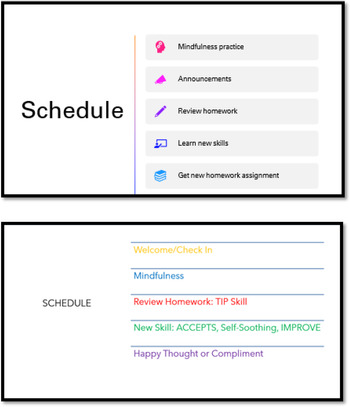
Fourth, we recommend structuring groups in systematic ways to maximize in-group learning and between-group skills generalization. We start each of our groups with a written schedule of activities to leverage the utility of visual cues to guide participants through each group (see Fig. 2). We return to this visual schedule throughout the group to remind participants where we are in the agenda and what is left to come. In addition, we provide ‘Post-it’ notes or other stickers to help clients clearly mark the pages that are to be completed for homework over the course of the week. Lastly, we often have participants start the homework assignment in the group if feasible (e.g. writing out the elements of the DEAR MAN that they plan to practise that week), or we ask participants to get out a calendar or planner and to mark off the specific days and times when they will practise skills that week. Although these may generally be considered best practices in many DBT groups, we have found them to be particularly helpful with autistic clients.
Sample session schedules.

Limitations
A strength of this study is that the DBT-ST groups were conducted in outpatient university-affiliated, community-based clinics, which enhances generalization of results to routine clinical practice. Additionally, all genders were included in the sample, and the sample had a wide age range. Results are limited based on a number of factors, including the small sample size, no comparison condition, the fact that other interventions were uncontrolled (e.g. individual therapy, medications), and adherence ratings were not obtained. It is also notable that the clinicians who participated in the study have a considerable amount of experience working with autistic clients, which is clearly not representative of the average community mental health practitioner and may not even be reflective of most clinics that specialize in ASD.
Conclusions and future directions
The current study provides preliminary evidence of the feasibility and acceptability of DBT-ST groups for autistic adults without ID in community-based clinics. Retention and attendance rates were excellent, and participants reported being highly satisfied with the group procedures and teaching. The standard DBT skills group materials appear to be feasible for use with this population, although therapists with expertise in ASD recommended modifications to tailor group instruction to enhance learning. Future studies should include larger sample sizes and more rigorous study methodology, should explicitly measure symptom change and the impact of skills acquisition on functional outcomes, and should gather qualitative data from autistic individuals who participate in the group regarding suggested changes and modifications for an ASD population. In addition, the role of caregivers in treatment may need to be considered, as a number of autistic adults still live at home. Of note, the current study required a minimum IQ level to be included, and further research should be undertaken to explore modifications for individuals with ASD and co-occurring intellectual disability. One possibility would be to utilize handouts from the I Can Feel Good program (Ingamells et al., Reference Ingamells, Morrissey, Brotherton and Ashworth2018), which is a DBT-informed curriculum for individuals with intellectual disabilities and difficulties managing emotions.
Another adaptation of DBT that may be helpful for autistic adults is called Radically Open DBT (RO-DBT; Lynch, Reference Lynch2018). This adaptation more closely mirrors standard DBT in that it includes individual therapy and group skills training conducted over the course of 30 weeks. Preliminary findings suggest that RO-DBT may be helpful for improving general distress in individuals with ASD (Cornwall et al., Reference Cornwall, Simpson, Gibbs and Morfee2020), although it should be noted that this study was quasi-experimental (uncontrolled) and attrition rates were quite high (>50%). In addition, and in contrast to standard DBT, RO-DBT was designed to address disorders of overcontrol (e.g. treatment-resistant depression, anorexia nervosa). As such, future studies should be designed to take into account the aforementioned heterogeneity of the ASD population; that is, while some autistic adults may have greater difficulties with emotional overcontrol and inhibition, others may need a treatment that addresses problems with emotional dysregulation.
Going forward, it will be important to provide mental health practitioners with accurate information about ASD and the unique learning style of these individuals, and also to encourage them to look beyond the ASD differences to provide treatment for the common mental health issues with which the providers have expertise (Murphy et al., 2016). Importantly, these preliminary results suggest that there are two viable pathways to increasing the availability of DBT-ST for autistic clients. Clinicians with expertise in ASD can learn to teach DBT skills; alternatively, perhaps these results will serve as encouragement to clinicians with DBT training that, with some willingness to learn more about ASD and how it might be presenting in their clients, they can continue providing DBT with relatively minimal adaptations in order to more effectively reach this under-served population.
Acknowledgements
We thank all of the participants and their families who participated in this project, and also the UNC TEACCH Autism Program team for their tremendous contributions.
Financial support
This research received no specific grant from any funding agency, commercial or not-for-profit sectors.
Conflicts of interest
Dr Ritschel is a consultant for Behavioral Tech, LLC (B-Tech), for whom she conducts training and consultations in DBT. Consultation for this project was provided through Dr Ritschel’s private practice (Triangle Area Psychology Clinic) in Durham, NC, USA. B-Tech was not involved in this research or consultation at any point. Dr Guy and Dr Maddox have no conflicts to report.
Ethics statement
The authors and study team abided by the Ethical Principles of Psychologists and Code of Conduct, and this study was approved by the University of North Carolina School of Medicine Institutional Review Board. Informed consent was obtained prior to data collection.
Data availability statement
The data that support the findings of this study are available from the corresponding author (L.R.) upon reasonable request.
Author contributions
L.G. conceived of the presented idea. L.G. and L.R. collaborated to develop the study methodology and assessments. L.R. provided training and consultation in DBT. L.G. oversaw data collection and analyses. B.M. assisted with theoretical framework of DBT for ASD. All authors discussed the results and contributed to the final manuscript.





Comments
No Comments have been published for this article.