Introduction
Cropping systems focusing more on crop diversity and ecological processes than on chemical inputs are gaining in interest for sustaining productivity and to control pests (Liebman and Dyck Reference Liebman and Dyck1993). More commonly, food and pharmaceutical companies increasingly prefer plant materials from organic cropping systems to avoid the negative effects of pesticides and synthetic fertilizers on the composition of active ingredients in the plants they use (Fonseca-Santos et al. Reference Fonseca-Santos, Antonio Corrêa and Chorill2015; Jamshidi Kia et al. Reference Jamshidi Kia, Lorigooini and Amini-Khoei2018). Thus adopting an eco-friendly cropping system could be an efficient strategy in overcoming these challenges.
Intercropping is known as an eco-friendly strategy to decrease weed problems via nonchemical methods (Mesgaran et al. Reference Mesgaran, Mashhadi, Khosravi, Zand and Mohammad-Alizadeh2008). The enhanced competitiveness against weeds makes intercropping systems suitable for application in low-input and organic farming systems, where options for chemical weed control are limited (Szumigalski and Van Acker Reference Szumigalski and Van Acker2005). Intercropping per se in cassava-based systems has generally reduced weed biomass 30% to 60% compared to cassava alone (Weerarathne et al. Reference Weerarathne, Marambe and Chauhan2017). In studying warm-season, annual grass–legume intercrops, greater weed biomass was observed in the intercrops containing two legumes compared with the intercrops with two grasses (Bybee-Finley et al. Reference Bybee-Finley, Mirsky and Ryan2017).
The global demand for both fresh and processed sweet corn has increased worldwide over the past decade (Williams Reference Williams2014), and the global cultivation area has increased by approximately 1 million hectares since 1994 (Tang et al. Reference Tang, Yu, Guan, Zhou, Wang, Gou and Wang2017). Its production in the Fars Province of Iran has also experienced an increase due to the elevated market price since 2011. This crop has multiple uses, such as marketable ears, fresh kernel, and forage, as well as processed baby corn.
Summer savory is a medicinal and spice plant distributed mostly in the Mediterranean region. Fourteen species in the genus of Satureja have been reported to exist in Iran, of which eight are endemic (Taban et al. Reference Taban, Saharkhiz and Hadian2013). Most of the Satureja species have aromatic and medicinal properties (Skubij and Dzida Reference Skubij and Dzida2019), and their essential oils are reported to have pesticide properties (Taban et al. Reference Taban, Saharkhiz and Hadian2013). Furthermore, their volatile oils have been shown to exert inhibitory impact on initial growth of several weed species (Ðikic´ 2005). Taban et al. (Reference Taban, Saharkhiz and Hadian2013) reported strong allelopathic and phytotoxic impacts of summer savory on seed germination and seedling growth of some weed species. Therefore, if used in an intercropping system, it may effectively reduce weed biomass and thus translate to higher crop yield, but it remains unclear whether the allelopathic and phytotoxic impacts will negatively impact the other crop plant. Therefore the objective of the present study was to determine whether intercropping sweet corn with summer savory can suppress weed growth without reducing sweet corn yield.
Materials and Methods
Field Site Description
A field experiment was conducted in 2019 and 2021 at the research field of the School of Agriculture, Shiraz University, Iran (35°52′E, 40°29′N, 1,810 m above sea level). The soil is a silty loam (fine, mixed mesic, Typic Calcixerpets) with pH 8, EC of 0.65 dS m−1, 0.06% total N, 50 mg kg−1 available P, 100 mg kg−1 available K, and 0.7% organic matter.
Plant Material and Cultivation
Both experiments were conducted as a randomized complete block design with three replications. Seedbed preparation consisted of moldboard plowing, disk harrowing, and leveling. The experimental field was fallow in the previous year. One block consisted of five randomly arranged cropping patterns (plot size 3 × 3 m) of sweet corn and summer savory seeds (sweet corn alone, savory alone, and three intercropping sweet corn:summer savory ratios as a percentage of plant densities used in respective monocultures: 75:25, 50:50, and 25:75). Basin’s sweet corn seeds (Seed and Plant Improvement Institutes, Karaj, Iran) and summer savory seeds (Pakan Bazr Company, Isfahan, Iran) were sown on May 14, 2019, and May 24, 2021. The between-row and within-row spacing for sweet corn was 75 cm and 17 cm, respectively. Summer savory was broadcasted in the furrows in intercropping treatments and both on the ridge and in the furrows in its monoculture. Each plot consisted of four rows and was 3 m long. The seed density in monocultures was 16 plants m−2 for sweet corn and 40 plants m−2 for savory. The intercropping ratios of sweet corn:savory of 75:25, 50:50, and 25:75 were 12:30, 8:20, and 4:10 seeds m−2, respectively. Furrow irrigation was applied immediately after seeding both plants. For 2 wk, the seedlings were irrigated in 6-d intervals, and the irrigation intervals were adjusted as required thereafter. No chemical herbicides were used during the experiment.
Harvesting of Sweet Corn, Summer Savory, and Weeds
From each plot, 1 m−2 from the center of two middle rows were harvested to determine sweet corn and savory yields on August 27, 2019, and on August 24, 2021, respectively. For sweet corn, the ears were separated from the plants and fresh weight was recorded. For savory, the harvested plants were dried at room temperature under shade for 2 wk. All weeds were also harvested from the same 1-m2 area in each plot and then oven-dried at 72 C for 48 h to assess total biomass.
Identification of Essential Oil Compounds
Essential oil of savory was measured using a Clevenger-type apparatus (IROST, Tehran, Iran), based on the method of British Pharmacopoeia (HMSO 1998). The essential oils were dried over anhydrous sodium sulfate, collected in specific glasses, and stored at 4 C in dark conditions until gas chromatography–mass spectrometry analysis and identification of essential oil compounds could be done.
Statistical Analysis
Data were subjected to analysis of variance (ANOVA), and means were compared with Duncan’s multiple range test (P < 0.05) using SAS (version 9.1, SAS Institute, Cary, NC, USA) software. Intercropping ratios were considered as fixed effects and years as random effects. As the ANOVA indicated no significant (P > 0.05) differences between years for the effect of the cropping pattern on weed biomass, data from both years were combined. However, a significant difference (P < 0.05) was found for year by cropping pattern for sweet corn and summer savory biomass. Therefore data from each year are reported.
Results and Discussion
Weed biomass decreased as summer savory density increased (F = 4.93, P = 0.02) (Figure 1). Compared to sweet corn alone (1661 ± 299 g m−2), weed dry biomass was reduced 48%, 61%, and 70% in sweet corn:summer savory intercropping ratios of 75:25, 50:50, and 25:75, respectively, and 84% in summer savory alone. A possible explanation for the significant reduction in weed biomass could be the allelopathic properties of summer savory as shown by Taban et al. (Reference Taban, Saharkhiz and Hadian2013). Abbes et al. (Reference Abbes, Trabelsi, Kharrat and Amri2019) reported that intercropping of faba bean (Vicia faba L.) with fenugreek (Trigonella foenum-graecum L.) caused a notable decrease in broomrape (Orobanche foetida Poir.) infestation, likely due to allelopathic interactions. Although allelopathy has been shown to be an effective weed control strategy, it relies on the weed species being more susceptible to allelopathic toxins than the component crops (Liebman and Dyck Reference Liebman and Dyck1993), that is, sweet corn in the current study. Another contributing factor for the notable weed biomass reduction might be increased resource preemption by the intercrop, resulting in greater quantities of resources captured by crops and smaller quantities captured by weeds, reducing the weeds’ competitive advantage. Stoltz and Nadeau (Reference Stoltz and Nadeau2014) also reported that intercropping of forage maize and faba bean slightly decreased the incidence of weeds compared to monocropped maize. Studying the effects of baby corn–legume intercropping on weed dynamics and community structure, Sharma and Banik (Reference Sharma and Banik2014) reported that intercropping systems possessed lower weed density and biomass over their respective sole crops.
Weed biomass as affected by cropping pattern; C100, C75:S25, C50:S50, C25:S75, and S100 refer to sweet corn alone, intercropping ratio for sweet corn:summer savory (of plant densities used in respective monocultures), and summer savory alone, respectively. Data were pooled across both years. Means within the same graph with the same letter are not significantly different (P > 0.05).

Summer savory contained essential oil with high monoterpene contents, such as carvacrol, thymol, and caryophyllene oxide. The chemical compositions of the essential oils of the summer savory were analyzed, and a total of 43 compounds were identified (data not shown). The major components were carvacrol (33.11% to 34.99%), γ-terpinene (19.35% to 20.66%), p-cymene (11.28% to 13.10%), and α-terpinene (4.12% to 4.98%). These monoterpenes are declared to be the cause of inhibitory effect of essential oils of summer savory on plants (Taban et al. Reference Taban, Saharkhiz and Hadian2013).
Zhou et al. (Reference Zhou, Han, Zhang, Kuchkarova, Wei, Zhang and Shao2021), investigating the phytotoxic effects of monoterpenes to suppress Amaranthus retroflexus L. and Poa annua L., reported that carvacrol possesses much stronger biological activity compared with p-cymene and γ-terpinene, although they are similar aromatic monoterpenoids. They declared that carvacrol was the main active compound responsible for weed-suppressing effects. This herbicidal activity of carvacrol could be attributed to its ability to incite membrane leakage (Chaimovitsh et al. Reference Chaimovitsh, Shachter, Abu-Abied, Rubin, Sadot and Dudai2017).
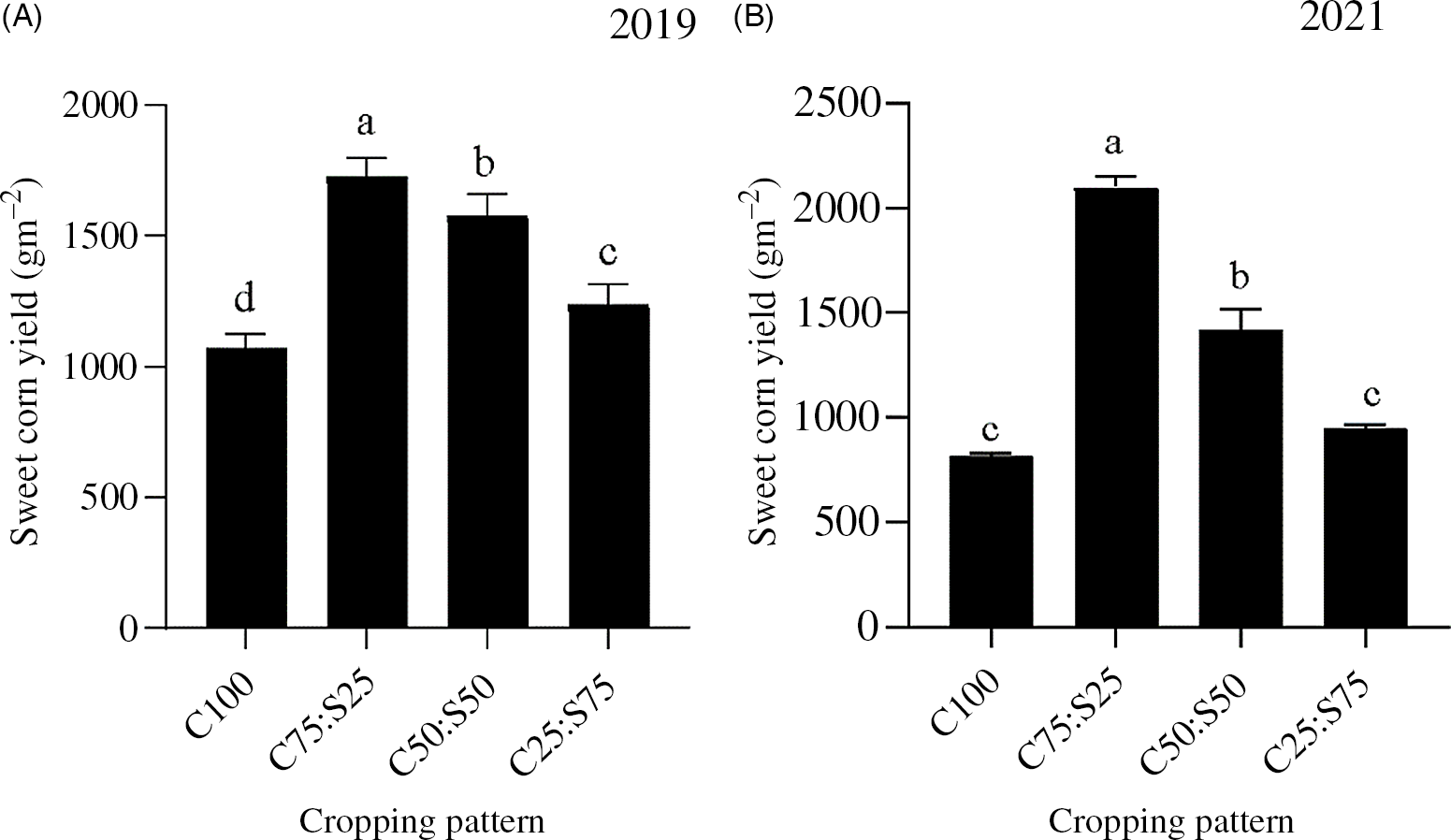
Sweet corn yield was significantly affected by cropping patterns in both 2019 (F = 60.53, P = 0.001) and 2021 (F = 31.27, P = 0.001), with the highest sweet corn yield obtained in a sweet corn:summer savory ratio of 75:25 (1,733 g m−2 and 2,035 g m−2), followed by 50:50 and 25:75 in 2019 and 2021, respectively. The lowest yield of 1,077 g m−2 was obtained in the sweet corn alone in 2019 (Figure 2A). In 2021, the lowest yield was obtained in a sweet corn:summer savory ratio of 25:75, but it was not significantly different from sweet corn alone (Figure 2B). The higher yield obtained in the intercropping systems could be attributed to the reduced weed competition coupled with the crop components using growth resources in a complementary manner and not competing for resources like water, nutrients, and light (Lithourgidis et al. Reference Lithourgidis, Vlachostergios, Dordas and Damalas2011). Other studies found that intercropping of field crops with medicinal plants like dragonhead (Dracocephalum moldavica L.) (Fallah et al. Reference Fallah, Rostaei, Lorigooini and Abbasi Surki2018) and fennel (Foeniculum vulgare Mill.) (Rezaei-Chiyaneh et al. Reference Rezaei-Chiyaneh, Amirni, Amani Machiani, Javanmard, Maggi and Morshedloo2020) was superior to their monocultures with regard to yield production.
Effects of intercropping pattern on sweet corn yield in 2019 (A) and 2021 (B). C100, C75:S25, C50:S50, and C25:S75 refer to sweet corn alone and intercropping ratio for sweet corn:summer savory (of plant densities used in respective monocultures). Means within the same graph with the same letter are not significantly different (P > 0.05).

Weed competition in sweet corn alone resulted in yield reductions of nearly 40% in 2019 and 47% in 2021, compared to having only 25% summer savory in the 75:25 intercropping ratio. Commercial hybrids of sweet corn differ in competitive ability, complicating weed management with this crop (Williams et al. Reference Williams, Rick, Boydston, Peachey and Robinson2011). Although 25% summer savory was beneficial to sweet corn yield, as the proportion of summer savory increased, the proportion of yield increase in sweet corn decreased from 38% and 47%, 32% and 23%, and 15% and 14% in the sweet corn:savory ratios of 75:25, 50:50, and 25:75 in 2019 and 2021, respectively. This suggests that initially, the inhibitory effects of savory against weeds were beneficial to sweet corn yield. However, as summer savory increases, the benefits are outweighed by the greater abundance of summer savory. This aspect deserves further research, because it is unclear from the current study whether this is due to the allelopathic properties or to competition for resources from summer savory affecting sweet corn yield.
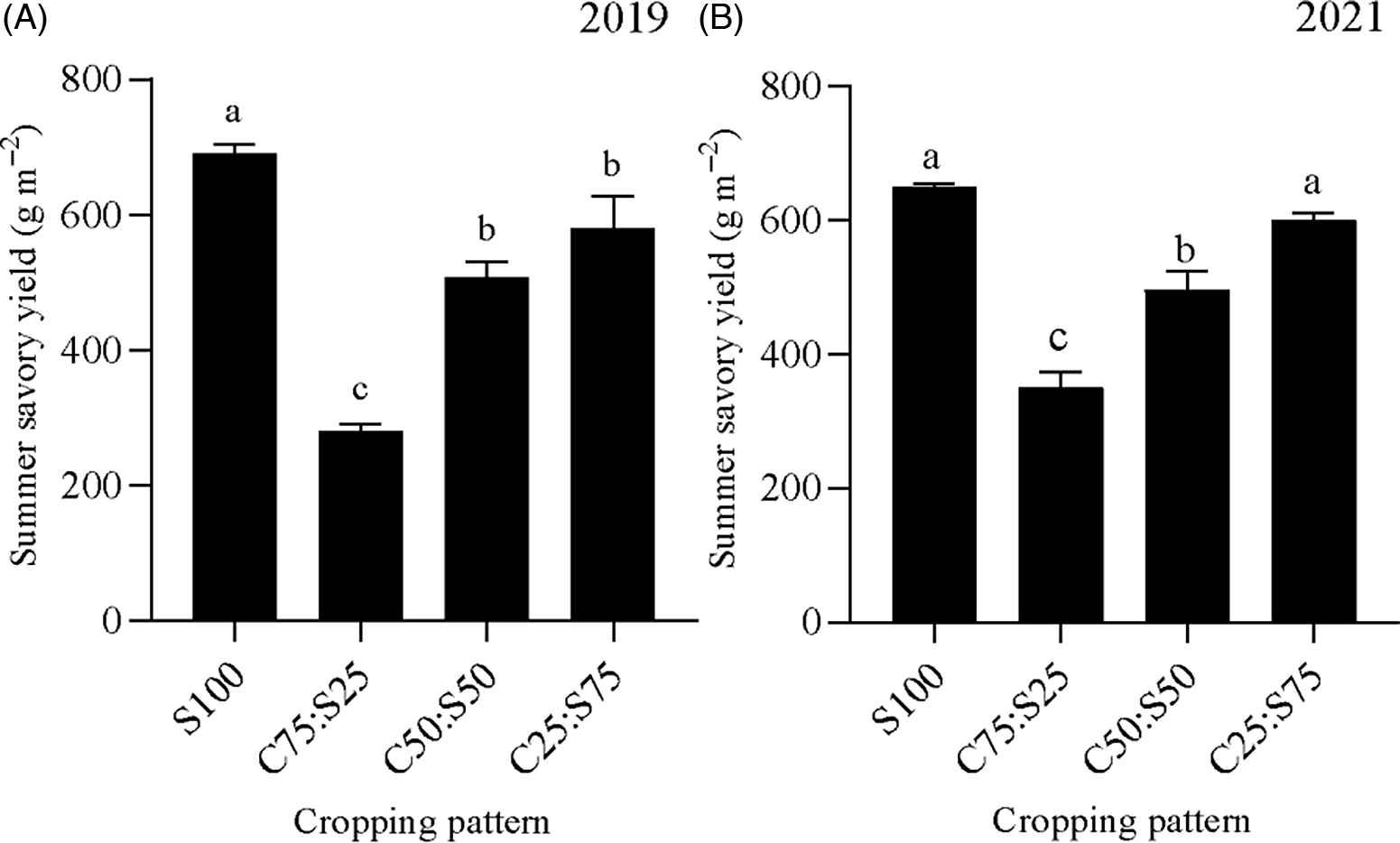
The intercropping pattern had the opposite effect on summer savory yield, with a significant reduction in yield with an increasing ratio of sweet corn (F = 26.37, P = 0.0005; F = 42.50, P = 0.001) (Figure 3 A and B). This suggests that although there is a weed-inhibitory effect of sowing summer savory, there is also a competition effect with sweet corn resulting in reduced yield. This is an important finding and will allow farmers to prioritize the intercropping pattern based on target crop species. For example, if the target crop species is sweet corn, then an intercropping ratio of 75:25 sweet corn:summer savory will significantly add to the yield of sweet corn; however, the yields of summer savory will be suboptimal. Despite this, the potential benefits of reduced weeds in the field allowing a reduction in labor or herbicide applications may offset the loss in yield of summer savory. In addition to this, Williams (Reference Williams2008) found that despite employing a large amount of herbicides for controlling weeds in the American Midwest, still 57% of sweet corn fields encountered yield loss due to weeds. Because economic and environmental concerns ask for diminishing herbicide applications and at the same time maintaining or enhancing crop productivity (Swanton and Weise Reference Swanton and Weise1991), employing a sustainable weed management strategy by harnessing the allelopathic properties of plants in intercropping systems is of great importance.
Effects of cropping pattern on savory yield in 2019 (A) and 2021 (B). S100, C75+S25, C50:S50, and C25:S75 refer to summer savory alone and intercropping ratio for sweet corn:summer savory (of plant densities used in respective monocultures). Means within the same graph with the same letter are not significantly different (P > 0.05).

Acknowledgments
The authors thank Shiraz University for financial support. The contribution of PW was supported by CABI, with core financial support from its member countries (for details, see https://www.cabi.org/what-we-do/how-we-work/cabi-donors-and-partners/). The authors declare no conflicts of interest.