An early diagnosis of autism spectrum disorder (ASD) is a critical need in psychology due to the significant role it plays in early intervention of ASD. Although the prevalence of ASD is currently estimated at around 1.5% of the general population, the average age of diagnosis in Europe is not until 3.5 years old (Developmental Disabilities Monitoring Network Surveillance Year 2010 Principal Investigators, & Centers for Disease Control and Prevention, 2014; Salomone, Charman, McConachie, & Warreyn, Reference Salomone, Charman, McConachie and Warreyn2016). Given that an early diagnosis allows for early intervention and therefore, may lead to better outcome, there are continual efforts to provide earlier diagnosis. Diagnosing ASD is challenging and the current diagnostic criteria are related to impairments in social interaction and communication, and restricted interests and repetitive behaviors (American Psychiatric Association, APA, 2013). These symptoms are usually not detected until the first two years of life. The purpose of this study was to examine the association between parents’ early concerns related to ASD’s criteria and age at diagnosis and to estimate to what extent socio-demographic variables could predict and/or mediate the time lag between early concerns and diagnosis.
In the absence of early biological markers for ASD, the early diagnosis of ASD is closely related to the recognition of the behavioral signs and symptoms of ASD. These signs and symptoms are present early in life and usually are detected by parents (Barbaro & Dissanayake, Reference Barbaro and Dissanayake2009; Guinchat et al., Reference Guinchat, Chamak, Bonniau, Bodeau, Perisse, Cohen and Danion2012). In Spain, parents are the first to see signs in up to 79 % of children with ASD at 18 months (Fortea-Sevilla, Escandell-Bermúdez, & Castro-Sánchez, Reference Fortea-Sevilla, Escandell-Bermúdez and Castro-Sánchez2013), but these early concerns are not specific to ASD.
The first signs of ASD generally become visible prior to 36 months of life (Guinchat et al., Reference Guinchat, Chamak, Bonniau, Bodeau, Perisse, Cohen and Danion2012); furthermore, some studies found that between 30–50% of early concerns related to ASD are expressed around 12 months of life, and 80–90% by 24 months (Volkmar, Chawarska, & Klin, Reference Volkmar, Chawarska, Klin, Chawarska, Klin and Volkmar2008). In Spain, although parents may be aware of some signs early, often their child does not receive a diagnosis until 37 months of life (Díaz-Atienza, García-Pablos, & Martín-Romera, Reference Díaz-Atienza, García-Pablos and Martín-Romera2004; Salomone et al., Reference Salomone, Charman, McConachie and Warreyn2016), and the time lag between early concerns and a formal ASD diagnosis is close to 13 months (Fortea-Sevilla et al., Reference Fortea-Sevilla, Escandell-Bermúdez and Castro-Sánchez2013).
The time that it takes for children to receive a diagnosis after initial concerns are expressed by parents can be influenced by the manner in which pediatricians elicit and answer parents’ developmental concerns (Zuckerman, Lindly, & Sinche, Reference Zuckerman, Lindly and Sinche2015). Parents and pediatricians may find it difficult to differentiate ASD from other developmental disorders at an early stage (Monteiro et al., Reference Monteiro, Spinks-Franklin, Treadwell-Deering, Berry, Sellers-Vinson, Smith and Voigt2015). This is due to the similarity of symptoms of ASD to symptoms of other developmental disorders (e.g., speech and language disorders or general developmental delay). The wide heterogeneity of ASD and the similarity of symptoms between different disorders could generate a delay in diagnosis of ASD because pediatricians have a wait-and-see attitude (Daniels & Mandell, Reference Daniels and Mandell2014; Klin, Klaiman, & Jones, Reference Klin, Klaiman and Jones2015).
Language delay and communication difficulties are two of the initial ASD-related concerns frequently reported by parents (Meek, Robinson, & Jahromi, Reference Meek, Robinson and Jahromi2012). These symptoms have been associated with early detection, but also with a later diagnosis (Volkmar et al., Reference Volkmar, Chawarska, Klin, Chawarska, Klin and Volkmar2008; Zwaigenbaum, Bryson, Rogers, Roberts, Brian, & Szatmari, Reference Zwaigenbaum, Bryson, Rogers, Roberts, Brian and Szatmari2005). Other features directly related to ASD diagnosis have been delays in reaching developmental milestones (e.g. speech and language delay), slower rate of development, loss of previously acquired skills (e.g. speech regression) (Kishore & Basu, Reference Kishore and Basu2011; Mishaal, Ben-Itzchak, & Zachor, Reference Mishaal, Ben-Itzchak and Zachor2014), less frequent instances of smiling, orienting, and vocalizing to people (Maestro et al., Reference Maestro, Muratori, Cesari, Cavallaro, Paziente, Pecini and Sommario2005), lack of joint attention (Kishore & Basu, Reference Kishore and Basu2011), poor eye contact, lack of play and interaction, and hand flapping and toe walking (Mandell, Novak, & Zubritsky, Reference Mandell, Novak and Zubritsky2005). Concerns related to repetitive behaviors often emerge later, and are often reported for children with other developmental disorders too (Mooney, Gray, & Tonge, Reference Mooney, Gray and Tonge2006).
Beside these early difficulties, several factors have been shown to influence age of early concerns specifically related to ASD. For instance, having another child without ASD has been associated with an early detection and diagnosis, as parents could compare the development of the child at risk of ASD with their child with typical development (TD) (Fountain, King, & Bearman, Reference Fountain, King and Bearman2011; Herlihy, Knoch, Vibert, & Fein Reference Herlihy, Knoch, Vibert and Fein2015; Mishaal et al. Reference Mishaal, Ben-Itzchak and Zachor2014; Rosenberg, Landa, Law, Stuart, & Law (Reference Rosenberg, Landa, Law, Stuart and Law2011). In general, higher maternal education would be associated with more knowledge of child development. Shattuck et al. (Reference Shattuck, Durkin, Maenner, Newschaffer, Mandell, Wiggins and Cuniff2009) showed that a lower level of maternal education and younger maternal age were associated with older children’s ages for early concerns related to ASD. However, Mishaal et al. (Reference Mishaal, Ben-Itzchak and Zachor2014) did not find significant correlations between parental age and educational attainment and age of ASD diagnosis. Furthermore, the gender of children with ASD has been another variable of scientific interest that might have an impact on the age in which children are diagnosed. Some studies have found no differences between gender and the age of diagnosis (Begeer et al., Reference Begeer, Mandell, Wijnker-Holmes, Venderbosch, Rem, Stekelenburg and Koot2013; Fountain et al., Reference Fountain, King and Bearman2011). Nevertheless, parents may expect more social behavior from girls, and encourage them to act more socially, which could delay detection.
There is no clear consensus about which features are more important in the earlier detection of ASD and which variables have a significant impact on the time lag between type of parents’ early concerns and the diagnosis of ASD. It is important to consider features that improve clinical practice in eliciting these concerns and as a result, help to improve the early diagnosis of ASD. In addition, an early and accurate diagnosis helps parents cope with the stress related to the disorder (Pozo & Sarria, Reference Pozo and Sarria2014). Thus, this retrospective study investigates the association between parents’ early concerns related to ASD symptom criteria and age at diagnosis. In particular, we investigated to what extent socio-demographic variables (i.e., type of parents’ early concerns, parental level of education, parental age, child’s age, sibling status, and child’s gender) predict the time lag between early concerns and diagnosis.
Method
Participants
A total of 48 families from Granada (Spain) of a child with ASD (range: 4.1–10.1 years old) were enrolled in this study. All parents signed the informed written consent before participation, and The Ethics Committee of the University of Granada approved the methodology of the study. Inclusion criterion for each child was having an ASD diagnosis based on Diagnostic and statistical manual-text revision (DSM-TR-IV; APA, 2000) and the Autism Diagnostic Interview-Revised (ADI-R; Le Couteur, Lord, & Rutter, Reference Le Couteur, Lord and Rutter2003) or Autism Diagnostic Observation Schedule-WPS (ADOS-G; Lord, Rutter, DiLavore, & Risi; Reference Lord, Rutter, DiLavore and Risi2002). The diagnosis was confirmed by an independent tester with the Guilliam Autism Rating Scales (GARS; Guilliam, Reference Guilliam2004). In addition, one of our purposes was to investigate whether having an older sibling with typical development could have delayed or accelerated parents’ doubts. As a result, an additional inclusion criterion was that for the children with older siblings, the older siblings must be deemed typically developing in order to be included in this analysis.
Parents were interviewed and they completed an open-ended questionnaire measuring several aspects related to detection of ASD and diagnosis. This kind of questionnaire enabled us to obtain more spontaneous information and to run both qualitative and quantitative analyses (Chamak, Bonniau, Oudaya, & Ehrenberg, Reference Chamak, Bonniau, Oudaya and Ehrenberg2011; Guinchat et al., Reference Guinchat, Chamak, Bonniau, Bodeau, Perisse, Cohen and Danion2012). Families were asked (1) about early concerns that made them think that their child could have ASD, (2) what was their child’s age when these signs were detected, and (3) when the child received the diagnosis of ASD.
Coding procedure and analysis
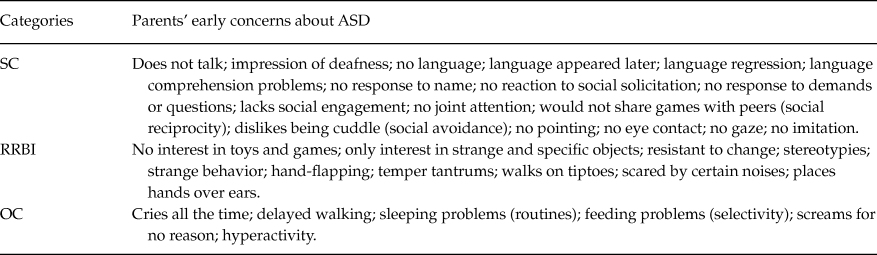
We focused on parents’ early concerns about ASD. The coding procedure consisted of breaking down early concerns into 2 fields related to two domains from DSM–5 (APA, 2013): (1) Social communication (SC), and (2) restrictive and repetitive behaviors and interests (RRBI). Moreover, because many parents usually reported concerns that were not specific to autism criteria (Guinchat et al., Reference Guinchat, Chamak, Bonniau, Bodeau, Perisse, Cohen and Danion2012), we included a third category (3) other concerns non-specific to ASD (OC). The operational definitions of what variables were considered as SC, RRBI, or OC are mentioned in Table 1. Two independent coders identified the three different types of concerns. Mean percentage agreement (based on Cohen’s Kappa inter-rater agreement measurement) was over 95% for all symptoms. Disagreements were resolved through discussion.
First Signs related to ASD Reported by Parents

Note: SC = Social communication signs; RRBI = Restrictive and repetitive behaviors and interest signs; OC = Other developmental concerns non-specific to ASD.
Data analyses
All statistical analyses were performed using Statistica 13 software. To evaluate relationships between the two outcome variables (i.e., child’s age at suspicion, and time lag between suspicion and diagnosis) and four predictor variables (i.e., sibling status, SC, RRBI, and OC) bivariate Pearson correlations were conducted. To determine the influence of each predictor, we run several multiple regression analyses. Furthermore, to examine potential meditational effects, path analyses were computed. Parental age, education, and child’s gender were entered as covariates. We consulted the bootstrapping method with bias-corrected confidence estimates to test our results. The 95% confidence interval of the indirect effect was obtained with 5000 bootstrap samples.
Results
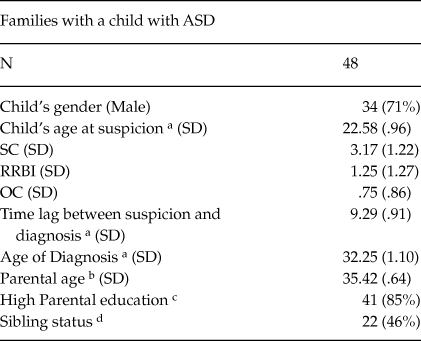
Forty-eight families were enrolled in this study. Descriptive statistics for all study variables are presented in Table 2. From the whole sample, 12.5% (n = 6) reported child’s age at diagnosis less or equal to 24 months; 54.2% (n = 26) reported child’s age at diagnosis between 25 and 35 months; the remain 33.3% (n = 16) reported child’s age at diagnosis longer than 36 months.
Socio-demographic Variables from Families with a Child with ASD

Note: SC = Social communication signs; RRBI = Restrictive and repetitive behaviors and interest signs; OC = Other developmental concerns non-specific to ASD.
a Months. b Years. c Post-secondary and university education. d Having an older sibling with typical development.
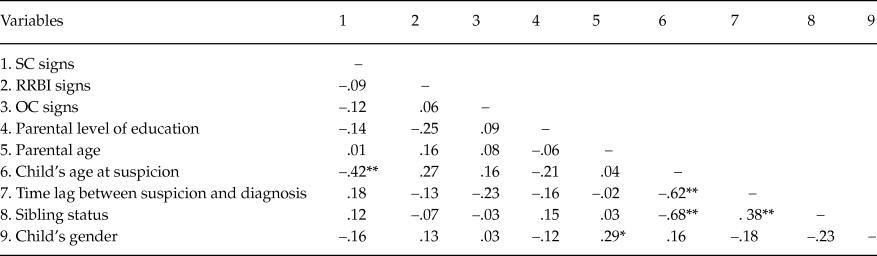
Bivariate Pearson correlations are presented in Table 3. Correlations between parents’ early concerns (i.e., SC, RRBI, and OC), parental level of education, parental age, child’s age at suspicion, time lag between suspicion and diagnosis, sibling status, and child’s gender were computed. We focused on two of these variables: Child’s age at suspicion and time lag between suspicion and diagnosis. Younger child’s age at suspicion was related to more number of SC reported by parents (p < .05), longer time lag between suspicion and diagnosis (p < .001), and having an older sibling with typical development (p < .001). Additionally, longer time lag between suspicion and diagnosis was positively related to having an older sibling with typical development (p < .05).
Correlations Coefficients Values between Symptoms related to ASD, and Variables related to Parents and Children

Note: SC = Number of social communication signs; RRBI = Number of restrictive and repetitive behaviors and interests signs; OC = Other developmental concerns non-specific to ASD.
*p < 0.05; **p < 0.01
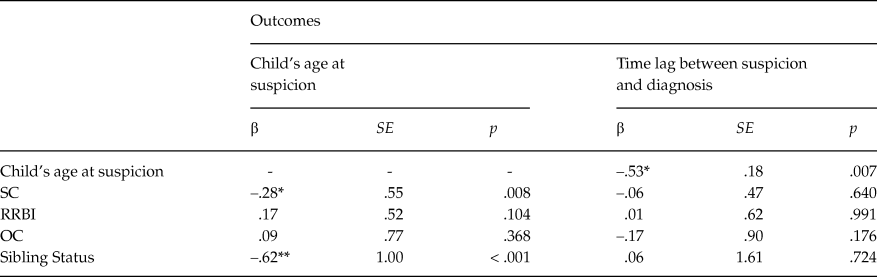
We then conducted two multiple linear regression analyses with outcomes child’s age at suspicion, and time lag between suspicion and diagnosis respectively. The results of these regressions are presented in Table 4, including standardized regression coefficients for each predictor.
Regression Analyses to Determine the Influence of Each Predictor on Child’s Age at Suspicion and Time Lag between Suspicion and Diagnosis

Note: SC = Number of social communication signs; RRBI = Number of restrictive and repetitive behaviors and interests signs; OC= Other developmental concerns non-specific to ASD.
*p < .01, **p < .001
Child’s age at suspicion. This model accounted for 56% of the total variance, F(4, 42) = 15.612, p < .001. From all potential predictors, the number of SC and having an older sibling with typical development were the statistically significant variables (p < .005, and p < .001 respectively).
Time lag between suspicion and diagnosis. This model accounted for 35% of the total variance, F(5, 41) = 5.896, p < .001. In this model, from all potential predictors, child’s age at suspicion was the only statistically significant variable (p < .05).
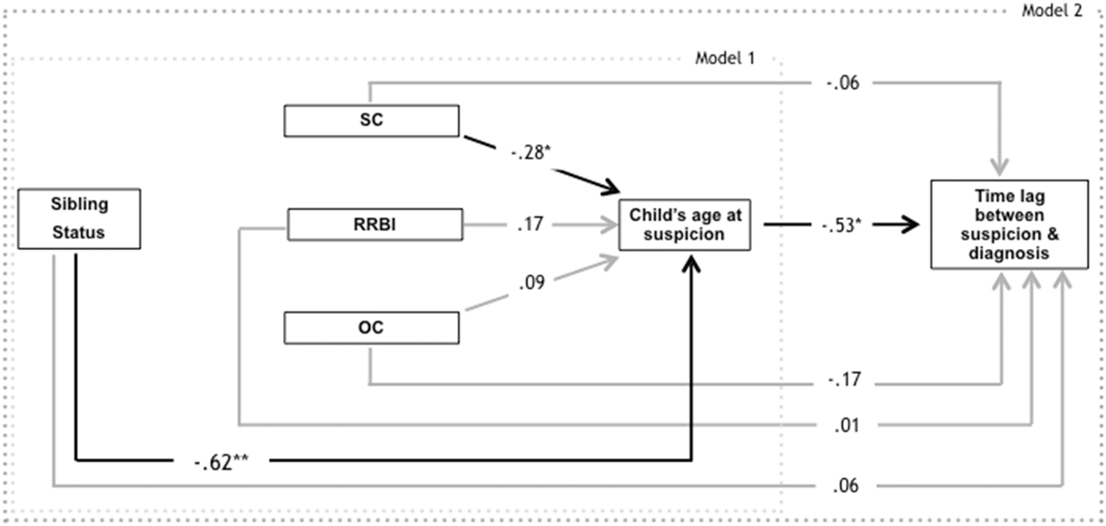
Path analysis. To describe a comprehensive model, we carried out path analyses. We tested a path model that was based on the regression analyses and was consistent with the actual timeline of events (i.e., that having an older sibling with typical development influences the potential signs noticed by parents, which can in turn influence their suspicions of ASD, and finally the diagnosis).
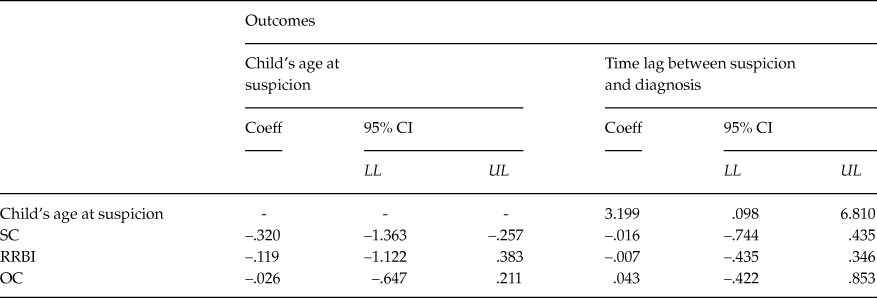
The number of SC was related to child’s age at suspicion, suggesting that it could be a potential mediator of the relationship between sibling status and the child’s age at suspicion (see Figure 1). To test this possibility, we estimated indirect effect on number of SC via child’s age at suspicion (see Table 5). The results showed that there was a significant indirect effect of number of SC on child’s age at suspicion via sibling status (95% confidence interval excluding 0).
Results from mediation analyses.
Note: Coefficients are standardized β; SC= Number or social communication signs; RRBI= Number of restrictive and repetitive behaviors and interest signs; OC= Other developmental concerns non-specific to ASD * p<.01; ** p<.001

Estimated Indirect Effects from Sibling Status Via Path Analysis

Note: SC = Number of social communication signs; RRBI = Number of restrictive and repetitive behaviors and interests signs; OC = Other developmental concerns non-specific to ASD.
Regarding the second model, child’s age at suspicion was related to time lag between suspicion and diagnosis, suggesting that it could be a potential mediator of the relationship between sibling status and the time lag between suspicion and diagnosis. To test this possibility, we estimated indirect effect on child’s age at suspicion via time lag between suspicion and diagnosis. The results showed that there was a significant indirect effect of child’s age at suspicion on time lag between suspicion and diagnosis through sibling status (95% confidence interval excluding 0). Moreover, results showed another significant indirect effect of SC on child’s age at suspicion through sibling status.
Discussion
To our knowledge, this is the first study that includes several variables to develop a mediation model between parents’ early concerns, sibling status, child’s age, and time lag between suspicion and diagnosis. Our study suggests that some variables are mediating over others that could explain the period of time between the suspicion and the diagnosis of ASD.
First, our results indicated that if the child with ASD has an older sibling with typical development, this precipitates parents’ detection, as other authors have found (see for example, Herlihy et al., Reference Herlihy, Knoch, Vibert and Fein2015; Mishaal et al., Reference Mishaal, Ben-Itzchak and Zachor2014). This can be explained by the fact that those parents who have another child, can compare the development of their child with ASD with a typical development, and can detect these signs earlier. This relationship is partially mediated by the type of concerns noted by parents. If we include SC, RRBI, and OC concerns in our model as predictors, the strength of the association between sibling status and child’s age at suspicion decreases. Moreover, as previously has been found by Volkmar et al. (Reference Volkmar, Chawarska, Klin, Chawarska, Klin and Volkmar2008) and Zwaigenbaum et al. (Reference Zwaigenbaum, Bryson, Rogers, Roberts, Brian and Szatmari2005), concerns related to SC and language hasten the suspicion of ASD. This can be explained by the fact that SC concerns such as smiling and orienting to others or speaking are detected earlier by parents because they appear before than those symptoms related to RRBI, such as interest in toys, resistance to change, stereotypic behaviors, or motor delay (Herlihy et al., Reference Herlihy, Knoch, Vibert and Fein2015). On the other hand, our results did not find statistically significant other concerns such as RRBI, OC, or socio-demographic variables that were included in the model (e.g. parental level of education, parental age, and child’s gender). One possible explanation might be that our sample showed similar levels of education and parental age.
Second, we found that the child’s age at suspicion is a mediator between parents’ early concerns and time lag between suspicion and diagnosis. This mediation can be explained by the fact that the age of suspicion is crucial in the ASD diagnosis. We need to keep in mind that these children have been diagnosed through DSM–IV–TR (APA, 2000), in which it was stated that the onset of ASD must be prior to 3 years of age, but the diagnosis was not usually made until 3 years of age (Díaz-Atienza et al., Reference Díaz-Atienza, García-Pablos and Martín-Romera2004). This further explains why pediatricians decided to wait until children were 3 years old. Pediatricians may have understood that every child had their own pace of development and some of the early concerns could be related to other disorders (such as specific language disorder). So, it seems that parents may help their child receive a diagnosis earlier by relaying their concerns to their pediatricians but because every child has his/her own rate of development, pediatricians chose to wait and see (Klin et al., Reference Klin, Klaiman and Jones2015).
Finally, we found a relationship between sibling status and time lag between suspicion and diagnosis. Our results are partially consistent with those obtained by Fountain et al. (Reference Fountain, King and Bearman2011), Herlihy et al. (Reference Herlihy, Knoch, Vibert and Fein2015), and Rosenberg et al. (Reference Rosenberg, Landa, Law, Stuart and Law2011), because having another child without ASD was associated with an early detection. Surprisingly, our results showed that having another child make longer the time lag between suspicion and diagnosis. However, this relationship was totally mediated by the time when ASD was suspected and parental concerns (i.e., SC, RRBI, and OC). We found that the earlier the age of suspicion, the more time lag between the suspicion and the diagnosis of ASD they have to wait. This explanation sheds light on the previous association. This would explain why children who have older siblings have to endure longer wait times in order to receive an ASD diagnosis.
This study has several limitations. First, by using an open-ended questionnaire there is a possibility of parental recall bias and parents’ limited knowledge about ASD. Nevertheless, this approach is an efficient way to collect the most spontaneous concerns and retrospective parental information has been widely used as a source of information about ASD (Barbaro & Dissanayake, Reference Barbaro and Dissanayake2009). In that sense, we encourage future research to observe if parents report the same kind of concerns by comparing different procedures, such as a checklist and an open-ended questionnaire. Second, our sample consists of families with a high level of parental education, so we have not been able to assess whether educational level affects their ability to detect ASD signs. Third, due the fact that our parental sample belonged to the same age cohort, we could not evaluate this variable. It would be interesting to study possible differences between the signs detected by parents from different age cohorts. Maybe younger parents would detect more signs because of the huge amount of information about ASD available nowadays.
We conclude that there are some variables related to the time lag between parents’ early concerns and diagnosis of ASD. These relationships are not linear, but mediating variables are included. Parents who detected signs earlier reported more concerns related to SC than those who detected ASD later. Moreover, parents earlier detected ASD signs if their child had an older sibling with typical development. However, when they shared their concerns with the pediatrician, they often received the advice of wait and see. This could mean that pediatricians should give more attention to these signs and this also underscores the importance of promoting awareness about early signs of ASD.
Our study and others (Daniels & Mandell, Reference Daniels and Mandell2014; Guinchat et al., Reference Guinchat, Chamak, Bonniau, Bodeau, Perisse, Cohen and Danion2012) have shown that a significant delay exists between the moment when parents first become concerned about their child’s development and the moment when their child receive a formal ASD diagnosis. We consider that training pediatricians on how to respond to parents’ questions or concerns might enhance their response to parents’ concerns and consequently, decrease the time until diagnosis of children with ASD. One potential response includes promoting parents’ informed decisions and advising them to contact a specialist as soon as concerns arise.