1. Introduction
Households in developing countries face a wide variety of risks arising from natural disasters. For instance, in July–August 2010 Pakistan experienced the worst floods in its history, which affected 84 out of a total of 121 districts, killing more than 1,700 persons (United Nations, 2010). Disasters such as this could disable the entire household or local economy. To compound issues, the number of natural disasters reported appears to be increasing globally – it was less than 100 per year in the mid-1970s while it was approximately 400 per year during the 2000s, according to the emergency events database (EM-DAT).Footnote 1 Households in low-income developing countries are particularly vulnerable to such disasters for several reasons. First, their initial welfare levels are already close to the poverty line. Second, institutional arrangements to cope with disasters are lacking. Third, early warning systems are absent.
As an example of such developing countries, this paper investigates the case of Pakistan. Pakistan is a low-income country with a population of 174 million people in 2010, where the share of agriculture in GDP continues to be high at over 20 per cent (Government of Pakistan, various issues). Agricultural production fluctuates substantially depending on the rainfall, because the availability of canal irrigation water depends on fluctuating rainfall in the Himalaya, and the delivery of irrigation water at farm level is frequently disrupted by administration problems in the irrigation system (Kurosaki, Reference Kurosaki1998). The non-agricultural sector also depends on agriculture, including agro-industries (such as cotton-based textiles) and agro-services (such as trade of agricultural produce). The performance of Pakistan's economy, therefore, largely depends on agricultural output, which substantially fluctuates with weather conditions. According to the EM-DAT database that lists the top 10 natural disasters in Pakistan for the period 1900–2013, more than half of them occurred during the 1990s and 2000s. Floods and earthquakes are major disasters in these lists. This database thus appears to indicate more frequent occurrences of natural disasters in more recent years in Pakistan. On the other hand, colonial reports published by the British Government of India before Pakistan's independence in 1947 are full of statements about droughts, hailstorms and floods.Footnote 2 These reports suggest that policy makers during the colonial period were highly sensitive to droughts that could result in a famine.
What were the impacts of these disasters on developing economies? As summarized by Cavallo and Noy (Reference Cavallo and Noy2009) and Sawada (Reference Sawada2007) in their review papers covering the whole world, the economic research on natural disasters and their consequences is fairly limited and the majority of such studies focus on macroeconomic impacts. For instance, using cross-country panel data, Noy (Reference Noy2009) shows that developing countries face much larger output declines following a disaster of similar relative magnitude than do developed countries or bigger economies, suggesting the importance of an increased ability to mobilize resources for reconstruction. Using similar cross-country panel data, Sawada et al. (Reference Sawada, Bhattacharyay and Kotera2011) demonstrate that natural disasters have positive impacts on per capita GDP in the long run, despite the fact that they generate large negative impacts in the short run. Coffman and Noy (Reference Coffman and Noy2012) use a synthetic control methodology to estimate the long-term impacts of a 1992 hurricane on the island economy of Kauai, Hawaii, showing that Kauai's economy was yet to recover 18 years after the event.
The macroeconomic studies mentioned above tend to treat the disaster as an economy-wide covariant shock and ignore within-country or within-village heterogeneity. However, it is likely that the damage and consequent welfare loss of a covariant shock differ from village to village within a region and from household to household within a village. This calls for research on the microeconomic impacts of natural disasters.
In development economics, there is an accumulation of theoretical and empirical studies focusing on households' ability to cope with risk. These studies have shown that poor households are likely to suffer not only from low levels of welfare on average but also from fluctuations in their welfare due to their limited coping ability (Fafchamps, Reference Fafchamps2003; Dercon, Reference Dercon2005). The inability to avoid welfare declines when hit by exogenous shocks can be called vulnerability, for which we have now a substantial literature on its measurement (Ligon and Schechter, Reference Ligon and Schechter2003; Dercon, Reference Dercon2005; Kurosaki, Reference Kurosaki2006; Dutta et al., Reference Dutta, Foster and Mishra2010). These studies tend to focus on the welfare impacts of idiosyncratic shocks. This focus has led to econometric specifications in which all village-level (or higher level) shocks are often controlled through fixed effects. The use of village fixed effects implies that the magnitude and direction of the impact of each type of village-level shock on household welfare are not identified separately but put into a black box. This is unsatisfactory, particularly when considering the growing influence of aggregate shocks on the welfare of villagers in the process of globalization and global warming. Furthermore, Ligon and Schechter (Reference Ligon and Schechter2003) demonstrate that aggregate risk is much more important than idiosyncratic sources of risk. Nevertheless, there has been less effort in microeconometric studies to explain the sources and impacts of aggregate shocks than idiosyncratic shocks. Research on the heterogeneity of the impact of natural disasters on household welfare and the economic mechanism underlying the heterogeneity is thus lacking in the existing literature.
As the majority of poor households living in developing countries are self-employed in agriculture, the literature on agricultural household models is relevant in exploring the economic mechanism underlying the heterogeneity. The classic studies by Singh et al. (Reference Singh, Squire and Strauss1986) and de Janvry et al. (Reference de Janvry, Fafchamps and Sadoulet1991) demonstrate that production decisions by rural households are affected by their consumption preferences when markets are incomplete. In the context of this paper, such households may attempt to smooth income in the expectation of natural disasters. As these measures are taken before the occurrence of a disaster, we can call them ex ante measures. For instance, farmers can choose crop portfolios to reduce exposure to risk (Kurosaki and Fafchamps, Reference Kurosaki and Fafchamps2002) or allocate more of their labor to non-agricultural activities when weather risk in agricultural production is high (Ito and Kurosaki, Reference Ito and Kurosaki2009). At the same time, self-employed households can also use measures to smooth consumption after they are hit by shocks. Such ex post measures include savings, assets, credits and transfers (Fafchamps, Reference Fafchamps2003; Dercon, Reference Dercon2005). The effectiveness of these ex post and ex ante measures against village-level shocks is not well investigated in the literature.
This paper attempts to fill these gaps in the literature by investigating the following questions: which type of households in rural Pakistan are more vulnerable to natural disasters such as floods and droughts in terms of a decline in their consumption during such disasters, and if we find heterogeneity across households in the vulnerability thus defined, what kind of microeconomic mechanism is likely to underlie the heterogeneity? In addressing these questions, we compare consumption response to village-level and idiosyncratic shocks and investigate how the two differ across different types of households, because this comparison is useful in inferring the microeconomic mechanisms underlying the heterogeneity in vulnerability. The employment of this comparison is unique to this paper and motivated by the possibility that risk sharing among villagers co-exists with intertemporal resource allocation using credit markets outside the village. The approach and findings of this paper thus contribute to our understanding of resilience against natural disasters in the context of economic development (Perrings, Reference Perrings2006).
The remainder of the paper is organized as follows. The empirical strategy is presented in section 2. The data used in this study are described in section 3, while the econometric results are discussed in section 4. Section 5 concludes the paper.
2. Empirical strategy and theoretical background
2.1 Empirical model
As two-period panel data sets of households are more readily available than panel data sets covering three or more periods, this paper proposes an empirical model for a two-period panel data set. Let c it be the real consumption expenditure per capita for household i in period t, aggregating expenditures on consumption items in the standardized list, including the imputed values of unpaid consumption (Deaton and Zaidi, Reference Deaton and Zaidi2002). Household i belongs to village v, which is also a primary sampling unit in the panel survey. The first difference in log consumption (dlnc i = ln c it − ln c i, t−1) is a measure used in the literature on consumption dynamics as the most representative proxy for a welfare change experienced by household i (Deaton, Reference Deaton1991). Therefore, we use dlnc i as the dependent variable in regression analysis. In this way, we can also cleanly control the unobservable and time-invariant characteristics of a household that affect the consumption level.
The welfare change occurs as a result of structural reasons (e.g., life-cycle factors and accumulation of wealth) as well as exogenous shocks that occur between t − 1 and t. To describe this relation, we first regress the consumption change on initial household characteristics and variables that capture shocks. Since there are only two periods, the empirical model is given by the following cross-section regression model for household i:
 $$dlnc_{i}=X_{1i}b_{0}+b_{1\comma 0}Z_{1v}+b_{2\comma 0}Z_{2v} + b_{3\comma 0}Z_{3i}+\varepsilon_{i}\comma \;$$
where X 1i is a vector of household characteristics at t–1 such as physical assets owned by the household, income sources, credit access, education level of the household head and demographic composition; Z 1v is a measure of village-level drought shocks that occurred between t–1 and t in village v; Z 2v is a similar measure of village-level flood shocks; Z 3i is an idiosyncratic health shock that hit household i between t–1 and t; b 0 is a vector of parameters to be estimated; b 1, 0, b 2, 0 and b 3, 0 are parameters to be estimated; and ε is a zero mean error term. X 1i also includes the intercept term and region dummies.
The main concern of this paper is not parameters b 0 but parameters b 1, 0, b 2, 0 and b 3, 0 because the latter show the average impact of village-level and idiosyncratic shocks on household consumption growth. As we define shocks in the usual sense (i.e., the larger Z is, the larger is the damage), we expect these parameters to be negative. By investigating parameters included in b 0, we can infer which households were more able to grow faster than other households, irrespective of disasters. The term X 1i b 0 is thus included in the model mainly as a control to precisely identify our main parameters of interest: b 1, 0, b 2, 0 and b 3, 0.
We then extend the model in equation (1), allowing the impact of shocks on consumption growth to differ depending on household characteristics:
 $$dlnc_{i}=X_{1i}b_{0}+Z_{1v}X_{2i}b_{1} + Z_{2v}X_{2i}b_{2}+Z_{3i}X_{2i}b_{3}+\varepsilon_{i}\comma \;$$
where X 2i is a subset of X 1i used for interaction terms,Footnote 3 while b 1, b 2 and b 3 are vectors of parameters to be estimated. When region dummies are included in X 2i , the difference in vulnerability across regions can be examined. Moreover, when households' initial attributes are included in X 2i , vector b 1 indicates which household attributes are associated with a larger or smaller decline in consumption if the village is hit by droughts. Similarly, vector b 2 identifies the households that are more likely to reduce consumption when the village is hit by floods. Thus, parameters in b 1 and b 2 are of main interest to this paper. Furthermore, parameters in b 3 in equation (2) show which households have to cut their consumption substantially when they are hit by negative idiosyncratic health shocks.
2.2. Theoretical inference on the economic mechanisms underlying the heterogeneity
Since equation (1) is a restricted version of equation (2), we can test whether the heterogeneity is statistically significant using an F-test for the null hypothesis that all coefficients in b 1, b 2 and b 3 are zero except for b 1, 0, b 2, 0 and b 3, 0, which are associated with the constant in vector X 2i . If this null is rejected in favor of heterogeneity in consumption response to shocks, we examine the coefficients b 1, k , b 2, k and b 3, k , which are associated with variable X 2ki in vector X 2i . Depending on the nature of X 2ki , several patterns (noted as ‘case’ or ‘subcase’ below) of their signs are predicted by the standard theory of household behavior under uncertainty. We briefly discuss them in two parts: ex ante mechanisms and ex post mechanisms.
First, if variable X 2ki is associated with ex ante measures of income diversification (the first case), its coefficients are likely to be positive, since the variable mitigates the ill effect of shocks. We can list three theoretical subcases that have mutually exclusive predictions. As the first subcase, if higher X 2ki implies that households can more easily diversify the drought risk, say through a deliberate choice of crop portfolio (Kurosaki and Fafchamps, Reference Kurosaki and Fafchamps2002), we expect b 1, k > 0, b 2, k = 0 and b 3, k = 0, because such farmers' crop income loss due to droughts is mitigated.Footnote 4 As another subcase, if higher X 2ki implies that households can more easily diversify income sources, say through non-agricultural labor supply (Ito and Kurosaki, Reference Ito and Kurosaki2009) and the health shock occurs on working members of the household, we expect b 1, k > 0, b 2, k > 0 and b 3, k < 0, because such households' income is more resilient against agricultural shocks while more vulnerable to health shocks. Although not strictly an ex ante measure, any factor that reduces the transmission of the shocks to income reduction is analyzed in a similar way. As the third subcase, regarding floods, if X 2ki is associated with higher political connections to affect the control on dykes and waterworks, the income loss due to floods for households with higher X 2ki may be smaller. Then we expect b 1, k = 0, b 2, k > 0 and b 3, k = 0.Footnote 5
Second, if variable X 2ki is associated with ex post measures of higher ability to smooth consumption, its coefficients are likely to be positive (the second case). We can list three subcases that have mutually exclusive predictions here as well. If households smooth consumption only through credit markets whose lending conditions are not affected by village-level shocks and X 2ki enhances the household ability to borrow, we expect b 1, k > 0, b 2, k > 0 and b 3, k > 0. On the other hand, if households smooth consumption only through village-level risk sharing, all households in the risk-sharing network have homogeneous risk preference, the extent of risk sharing is partial and X 2ki enhances the household ability to share risk with others, we expect b 1, k = b 2, k = 0 and b 3, k > 0. This is because village-level shocks (which cannot be insured through village-level risk sharing) affect consumption of risk-sharing network members by the same proportion regardless of the efficiency level in sharing idiosyncratic shocks. Finally, if households do not use outside credit markets but belong to a full risk-sharing network at the village level to smooth consumption, households in the network have heterogeneous risk preferences and X 2ki reduces the household capacity to bear risk, we expect b 1, k > 0, b 2, k > 0 and b 3, k = 0. This is because under full risk sharing among heterogeneously risk-averse households, households with higher ability to bear risk take more of the burden of village-level shocks than other households do.Footnote 6
These six subcases of theoretical predictions, however, do not cover all parameter combinations and are valid only when several assumptions are satisfied (they are only necessary conditions). Therefore, the main empirical strategy to infer the economic mechanisms underlying the heterogeneity is to carefully examine the signs of b 1, k , b 2, k and b 3, k , considering the nature of variable X 2ki and the possibility of both ex ante and ex post mechanisms. Since the six subcases suggest that it is informative to compare the consumption response to village-level and idiosyncratic shocks, we include the term involving Z 3i in our empirical models. As the main interest of this paper is on the impact of village-level shocks, we will discuss coefficients on idiosyncratic shocks only to the extent that the discussion is useful in distinguishing the underlying mechanisms. Econometrically speaking, if Z 3i is orthogonal to Z 1v and Z 2v , the entire expression Z 3i X 2i b 2 in equation (2) can be excluded and merged into ε without affecting our ability to obtain unbiased estimates for b 1 and b 2. Whether the orthogonality condition is satisfied in our case will be examined empirically.
3. Data
3.1. Panel data from the Pakistan Rural Household Survey
In this paper, we employ micro data from the Pakistan Rural Household Survey (PRHS), which provides a unique panel data set from Pakistan with a relatively large sample size. The survey was conducted jointly by the Pakistan Institute of Development Economics and the World Bank. The first round of the survey (PRHS-I) was conducted in the period from September 2001 to January 2002; information was collected on agriculture-related activities for the crop seasons of Kharif 2000 and Rabi 2000/2001,Footnote 7 and that on consumption corresponding to the month preceding the survey. Approximately 2,700 rural households in all four provincesFootnote 8 of Pakistan were included in the survey. In PRHS-I, the sample households and villages were chosen from a stratified random sample, using the villages' distance to a market as the stratification criterion. Judging from the comparison of the distribution of household consumption, assets and demographic structure in the PRHS-I sample and their distribution in a nationally representative sample,Footnote 9 the PRHS sample was broadly representative of each province.
The resurvey of the sample households in PRHS-I was conducted three years later, from August to October 2004 (PRHS-II); information was collected on the crop seasons of Kharif 2003 and Rabi 2003/2004, and on consumption in the month preceding the survey. Because of security problems and other reasons, only those sample households in two provinces of Punjab and Sindh were resurveyed. In PRHS-I, approximately 850 sample households were surveyed in two other provinces that were not covered by PRHS-II. The use of the PRHS panel data thus implies that we can analyze only Punjab and Sindh, two provinces that account for approximately 80 per cent of Pakistan's total population.
From the PRHS panel data, nominal consumption expenditureFootnote 10 per capitaFootnote 11 in Pakistan rupees was calculated and then converted into real terms by dividing this value by the official poverty line.Footnote 12 This is known as the ‘welfare ratio’ and is used as c it in the empirical model.
A balanced panel of 1,609 households (929 in Punjab and 680 in Sindh) has been thus compiled, for which complete consumption information was available in both surveys. The sample households came from 48 sample villages in Punjab and 46 sample villages in Sindh. In PRHS-I, the number of sample households in Punjab and Sindh with complete consumption information was 1,874, thereby implying an attrition rate of 14 per cent. Although the attrition was not purely random (initially poorer and more mobile households tended to leave the sample more frequently than other households), the correlation of attrition and household characteristics was not statistically significant and droughts and floods (see below for their empirical definitions) were not associated with higher attrition rate.Footnote 13 Considering that the focus of this paper is on the impact of natural disasters on welfare changes, we conclude that there is unlikely to be significant bias in our estimates. A reservation to this conclusion should be added, however, considering the incomplete availability of village-level shocks in PRHS-II due to the village-level attrition. We can conjecture that the four attriting villages were hit by some sort of shocks and cannot disregard the possibility that such shocks include droughts or floods. In interpreting our quantitative results, this limit in external validity and generalizability should be borne in mind.
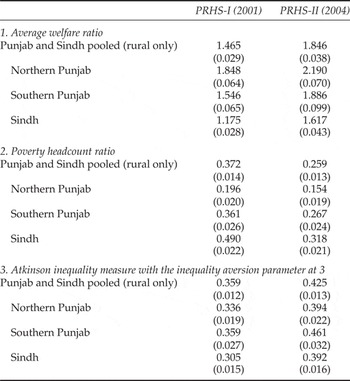
Table 1 presents average c it , poverty headcount ratios and Atkinson inequality measures based on the PRHS panel data. Since there is a socioeconomic gap and a difference in historical legacies between the northern and southern parts of Punjab, we divide Punjab into two portions.Footnote 14 The average consumption increased substantially from 2001 to 2004. The increase was slightly larger in Sindh than in northern and southern Punjab, thereby reducing the gap between the two provinces. In spite of this, the ranking of average economic wellbeing among the three regions (northern Punjab at the top, Sindh at the bottom and southern Punjab in between) remained the same in 2004. The changes between PRHS-I (2001) and PRHS-II (2004) are broadly similar to the changes observed in nationally representative, cross-section household data collected by the Federal Bureau of Statistics (Government of Pakistan, various issues). Both data sources show that between 2001 and 2004 the average consumption increased, poverty measures decreased and inequality increased. The movement of the average consumption and poverty measures (with the direction reversed) parallels that of per capita real GDP. The movement of inequality measures tends to be in the same direction as the movement of per capita real GDP, as richer households' income is more sensitive to the macroeconomic conditions than that of poorer households in Pakistan.
Average consumption, poverty and inequality measures in Pakistan

Notes: The number of observations (NOB) is 1,609. Standard errors are reported in parentheses. Statistics are weighted in order to make figures representative of individual-level summary statistics.
Source: Calculated by the author from PRHS panel data (as in the following tables).
3.2. Welfare changes at the household level and economic shocks
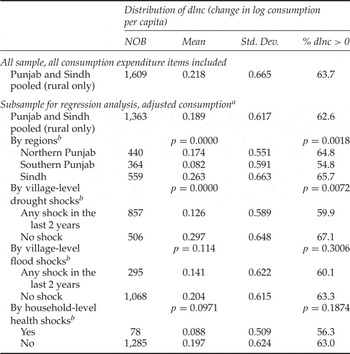
The increase in the average consumption shown in table 1 was not shared equally among all PRHS households. In order to utilize the advantage of panel data, table 2 reports the distribution of welfare changes at the household level, measured by the change in log consumption per capita (dlnc), which corresponds to the dependent variable of the cross-section regression model proposed in section 2. Among the full sample of 1,609 panel households, the average of dlnc was 0.218, indicating an increase of 24.3 per cent in real consumption over the three-year period. However, 36.3 per cent of individuals suffered from a decline in their welfare levels (i.e., dlnc was negative). Thus, the aggregate figure conceals the fact that certain households suffered from a severe decline in their welfare during the survey period.
Household-level welfare changes in Pakistan from 2001 to 2004

Notes: % dlnc > 0, Mean, and Std. Dev. (standard deviation) are weighted by the household size in PRHS-I in order to obtain individual-level summary statistics.
a The subsample used in the regression analyses includes those households whose welfare ratios and log changes were in the range of (1%, 99%) of the sample distribution and whose membership changed by less than four persons during the two surveys. dlnc is redefined as ‘Log difference of the welfare ratio between PRHS-I and PRHS-II (consumption excluding durables, house rent, and medical expenditures)’.
b For each classification, the probability value of a chi-squared test for the null hypothesis that ‘% dlnc > 0 is the same’ or ‘Mean of dlnc is the same’ is reported.
Idiosyncratic and village-level negative shocks may have been responsible for the consumption decline of certain households when the nation experienced a consumption increase on average. As an indicator of idiosyncratic shocks, we constructed a dummy variable from the PRHS panel data for households whose members experienced a severe health shock due to injury or sickness that resulted in treatment in medical institutions between PRHS-I and PRHS-II. Approximately 7 per cent of the sample households experienced such shocks. There was no statistically significant difference in the mean of the health shock variable across three regions.
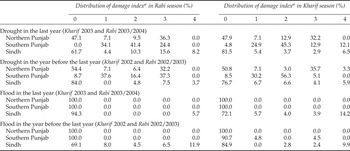
Further, with regard to village-level shocks, we compiled variables containing the information on drought and flood shocks. In PRHS-II, the information was collected from village elders using a community questionnaire. In the survey, the negative impact due to natural disasters was assessed on a five-point scale: 0 (‘No effect’: no report for crop damage in the village); 1 (‘Little effect’: yield loss up to 10 per cent in the village); 2 (‘Moderate’: 10–25 per cent loss in the village); 3 (‘Severe’: 25–50 per cent loss in the village); and 4 (‘Disaster’: over 50 per cent loss in the village). Eight cropping seasons up to the survey reference period (i.e., from Kharif 2000 to Rabi 2003/2004) were covered.
Table 3 presents the incidence of these disasters in 2002/2003 and 2003/2004. It is evident that droughts are more common than floods – they occurred in all three regions with similar frequency. On the other hand, flood damage was not reported from northern Punjab, and only infrequently from southern Punjab. It may appear that the variation in drought and flood damage reported at the village level is in effect more aggregate, with little effective variation across villages within a region. In order to investigate whether this applies to our data, we examined the spatial correlations of drought and flood variables. For example, only 17.3 per cent (21.3 per cent) of the variation of the drought (flood) damage variable was explained by variation across the three regions and the rest (82.7 per cent of the drought variation and 78.7 per cent of the flood variation) was within-region, between-village variation. The latter variation will be utilized in identifying the effects of village-level aggregate shocks on household welfare. As the sample size is small in our case, in the regression, the information in table 3 will be aggregated into one variable representing drought shocks and another variable representing flood shocks in the regression analysis (see subsection 3.3 below).
Incidence of village-level production shocks in Pakistan

Notes: NOB = 1, 609. a The index takes: 0 (‘No effect’: no report for crop damage); 1 (‘Little effect’: yield loss up to 10%); 2 (‘Moderate’: 10–25% loss); 3 (‘Severe’: 25–50% loss); and 4 (‘Disaster’: over 50% loss). Since all of them are mutually exclusive, the sum of the percentage is 100.0.
Back to table 2, we compare the distribution of dlnc for subsets of households distinguished by the village-level and household-level shocks. To sharply identify the impact of shocks on welfare changes, we now redefine the consumption by excluding durables, house rent and medical expenditures, and use a subset of sample households excluding households that experienced a drastic change in their demographic structure, outlier households in the distribution of dlnc, and observations for which the village-level shock information was missing.Footnote 15 This reduced the sample size for the cross-section regression analysis from 1,609 (table 1) to 1,363.
As expected, both the average dlnc and the percentage of individuals whose dlnc was positive are lower when the village was hit by droughts/floods or the household suffered from health shocks. It appears that idiosyncratic and village-level negative shocks were responsible for the consumption decline of certain households when the economy grew on average. The bivariate comparison, however, suggests that the statistical significance of the difference was not particularly high for floods and health shocks. Furthermore, a confounding factor is region-specific trends – both the average dlnc and the percentage of individuals whose dlnc was positive are significantly different across three regions. The empirical model of equation (2) discussed in section 2 allows us to identify the impact of natural disasters on welfare changes controlling for the confounding factor.
3.3. Empirical variables
As controls for household characteristics that determine consumption growth (vector X 1i in equations (1) and (2)), we follow the standard literature on the determinants of welfare in developing countries (for example, Glewwe, Reference Glewwe1991) and include variables such as agricultural production assets owned by the household (farmland, draft animals and farm machinery/equipment), other household assets (milk animals, sheep and goats, durable consumption goods, transportation equipment, house buildings, etc.), income sources (number of male working members engaged in permanent or casual non-farm workFootnote 16 ), credit access, distance to the marketplace, education level of the household head, and demographic composition (number of household members, female ratio among them, and dependency ratio). We identify a household as credit constrained if it either needed to borrow and applied for a loan but was rejected, or if it needed to borrow but did not apply for the loan due to the distance to credit institutions, no guarantee available, no collateral, or excessive procedures. These household characteristics are treated as fixed over time in the regression equation, as they correspond to the initial conditions.
After attempting several methods of aggregating the village-level shock variables presented in table 3, we chose the default definition of two variables for drought and flood in the following way. We aggregated shocks in four cropping seasons until Rabi 2003/2004, and then normalized them between zero and one by dividing by 16 (the max of the scores shown in table 3). The robustness of our results with respect to this definition will be investigated below. Since the PRHS-II consumption data were collected in August–October 2004, the agricultural output in 2002/2003 and 2003/2004 should have had the most direct effect on household consumption. Production shocks that occurred before these two years may have affected the PRHS-I consumption level. For this reason, we use the shocks in the last two years as village-level shocks that are exogenous to initial consumption.
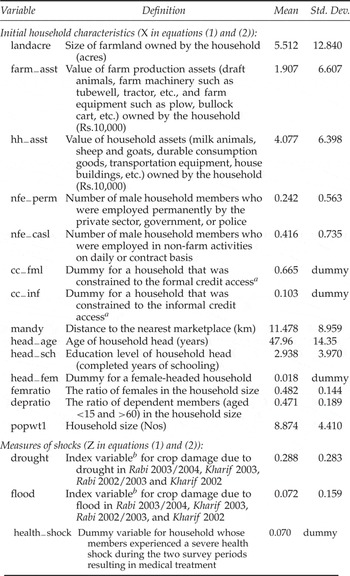
Table 4 presents the summary statistics for explanatory variables used in the regression analysis. They are weighted by the household size in order to obtain individual-level means and standard deviations. This is because the focus of the paper is on gauging individual welfare. In the regression analysis, the cross-section models of equations (1) and (2) are estimated by the weighted least squares method.
Summary statistics of explanatory variables used in the regression analysis

Notes: (1) The subsample used in the regression analyses is those households whose welfare ratios and its log changes were in the range of (1%, 99%) of the sample distribution, whose membership changed by less than four persons during the two surveys and whose village-level shock information was available. Due to this selection, the number of households in this table is at most 1,363 (1,359 for cc_fml and cc_inf, and 1,310 for head_sch), against 1,609 in table 1. (2) Means and standard deviations (Std. Dev.) are weighted by the household size in PRHS-I. (3) All of the initial household characteristics are taken from the PRHS-I data set.
a Households were regarded as constrained if they needed to borrow from the formal (informal) sector and applied for a loan but were rejected; or, if they needed to borrow from the formal (informal) sector but did not apply for the loan because the credit institutions were too far away, there was no guarantee available, no collateral, excessive procedures, etc. The corresponding period for formal loans is ‘ever until 2000/2001’ while that for informal loans is ‘during 2000/2001’.
b The sum of index variables for the four seasons in table 3 divided by 16 (minimum = 0, maximum = 1).
4. Results
4.1. Average impact of shocks and its regional heterogeneity
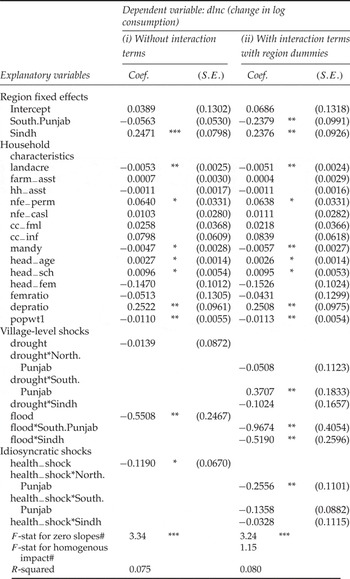
This section discusses econometric results applied to the redefined consumption described in the previous section. More concretely, the dependent variable is the first difference in log consumption per capita, where the consumption measure excludes expenditures on durables, house rent and medical treatment. In table 5, we show the estimation results of equation (1) (specification (i) in the table) and equation (2) when interaction terms are with region dummies (specification (ii)). Looking at the impact of exogenous shocks on welfare change, which is the main focus of this paper, all coefficients on the three shock variables are negative in specification (i). The absolute value of the coefficient on floods is especially large, indicating that households had to reduce consumption by 42 per cent (1 − exp(−0.5508) = 0.4235) when their village was hit by floods that destroyed over 50 per cent of crops in all four seasons in the village. This implies a substantial decline in welfare. On the other hand, the coefficient on drought shocks is statistically insignificant and that on health shocks is only marginally significant. The insignificance of drought shocks may appear surprising given the bivariate comparison shown in table 2. The inclusion of region fixed effects drives the result in table 5 – the relatively inferior growth trend in southern Punjab absorbed some of the negative impacts of droughts shown in table 2, resulting in an insignificant effect of drought shocks in table 5.
Sensitivity of consumption changes to village-level production shocks

Notes: NOB is 1,308. Estimated by weighted least squares with household size as weights. Cluster-robust standard errors are reported in parenthesis (village as the cluster), statistically significant at the 10%*, 5%** and 1%*** level. The number of clusters is 94.
a ‘F-stat for zero slopes’ indicates the F statistics for the null hypothesis that the empirical model has no explanatory power. It is distributed as F(19,93) for specification (i) and F(24,93) for specification (ii). ‘F-stat for homogenous impact’ indicates the F-statistics for the null hypothesis of specification (i) against (ii) and distributed as F(5,93).
The contrast between droughts/health shocks and floods could be understood by the insurability of shocks within a region. Theoretically, it is easy to insure health shocks within a village since they are idiosyncratic. Drought shocks are more aggregate than health shocks; however, because droughts occur frequently in rural Pakistan, villagers may have established an institution to insure against them across villages within a region. On the other hand, it is difficult to insure against floods because they occur infrequently and they disrupt across-village transportation and communication. With disrupted transportation and communication, the institutional arrangement could have become less effective. Regarding the contrast between droughts and floods, another possibility is that droughts' onset is more gradual than floods so that households are more able to cope with droughts. These are speculations, however, for which rigorous testing is left for further research.
In order to examine whether there are any regional differences in the impacts of natural disasters, specification (ii) in table 5 permits the coefficient on the three shock variables to differ across the three regions. Since no incidence of flood was reported from northern Punjab, the interaction terms that include floods are only for southern Punjab and Sindh. With regard to the effect of floods, it remains highly negative and significant on both regions. For droughts and health shocks, four out of six coefficients were statistically insignificant, one was significantly positive, and the other was significantly negative. We do not have a good explanation for the positive coefficient found for droughts in southern Punjab. Furthermore, the null hypothesis that the impact of shocks is the same in all regions (i.e., regional interactions have the same coefficient) is not rejected at the 10 per cent level. For this reason, the interaction terms with region dummies are not included in the following specifications.
Table 5 also reports coefficients on linear terms of household characteristics X 1i . These are not the main focus of the paper but are included as a control to identify the impact of shocks on welfare changes. So we comment on them only briefly. Seven variables have statistically significant coefficients in both specifications: the size of owned land (negative), the number of male household members who were employed permanently in regular non-farm jobs (positive), the distance to marketplace (negative), household head's age (positive), household head's years of schooling (positive), dependency ratio (positive), and the size of household (negative). The finding that households with larger landholding were lagging behind in consumption growth suggests that growth from 2001 to 2004 was based on non-agricultural sectors. The coefficients on non-farm permanent employment jobs, the market distance and household head's education are also consistent with this interpretation. The positive coefficient on non-farm permanent employment jobs may also indicate a life-cycle improvement in earnings associated with non-farm permanent jobs (e.g., regular promotion). The finding that households with a greater number of dependent household members experienced higher growth in consumption may reflect a life-cycle effect. The proxy variables for credit constraints have a positive sign, as expected from the theoretical model (Deaton Reference Deaton1991); however, the coefficients were statistically insignificant. These patterns are robustly found under different specifications of equation (2). Therefore, parameter estimates for b 0 are not reported in the following table in order to save space.
4.2. Heterogeneous impact among households
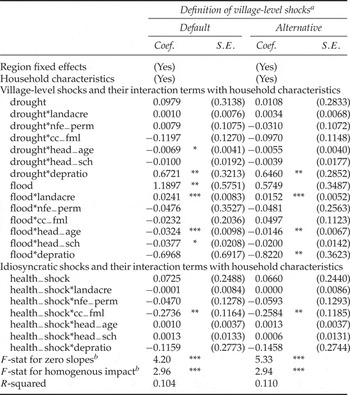
In order to further examine the heterogeneity in the marginal impact of natural disasters, household-level characteristics were interacted with shocks (table 6). From among the 14 household-level variables in X 1i , six are chosen to make interaction terms with shock variables (vector X 2i in equation (2)). Five of them (size of land holdings, number of household members employed in permanent non-agricultural jobs, age of the household head, education level of the head and dependency ratio) are those variables in X 1i in equation (1) that have robustly significant coefficients. The other (the dummy for credit constraint in the formal sector) is included because it is a direct measure of credit access. Other interaction terms, including the initial size of consumption durables, were tried but found to have insignificant coefficients. Therefore, to improve the estimation efficiency given the small size of the sample, we limit the variables in X 2i to these six variables. The interaction term using the number of household members permanently employed off the farm (nfe{_}perm) may capture the ex ante impact of labor supply diversification. Furthermore, the interaction term between drought and the landholding size may capture the ex ante impact of crop diversification. All of these interaction terms are also meant to capture ex post consumption smoothing mechanisms. In specification ‘default’, the regression results using the same definition of natural disaster shocks as in table 5 are reported, while in specification ‘alternative’, the village-level shock variables are defined differently.Footnote 17
Sensitivity of consumption changes and household characteristics

Notes: See table 5 for the estimation methodology, number of observations and list of explanatory variables not reported in this table.
a ‘Default’: same as in previous tables (see table 4 for its definition and statistics). ‘Alternative’: production shock variables corresponding to the larger of the last two years (Kharif 2002 and Rabi 2002/2003, or Kharif 2003 and Rabi 2003/2004). The mean (standard deviation) is 0.332 (0.312) for drought, 0.119 (0.258) for flood.
b ‘F-stat for zero slopes’ indicates the F-statistics for the null hypothesis that the empirical model has no explanatory power, distributed as F(37, 93). ‘F-stat for homogenous impact’ indicates the F-statistics for the null hypothesis of specification (i) in table 5 and distributed as F(18,93).
As shown in table 6, the null hypothesis that the impact of shocks is the same across different household characteristics is rejected at the 1 per cent level in both specifications. Therefore, the across-household heterogeneity in consumption response to shocks is statistically significant.
Examining individual coefficients on the interaction terms in table 6, we find the following. First, households with more dependent members were more capable of isolating their consumption from a drought-driven income decline. Second, the ill effects of flooding are mitigated if a household is more landed or the household head is younger. Third, with regard to the impact of idiosyncratic health shocks on consumption, access to formal credit helps to mitigate the ill impact.
The heterogeneity pattern is informative in terms of theoretical predictions discussed in subsection 2.2. The interaction term of landholding with flood shocks has a significantly positive coefficient while its interaction terms with droughts and health shocks have insignificant coefficients. Several explanations can be offered. Based on the mechanism of unequal access to credit markets, the significantly positive coefficient on the interaction term with floods implies that the amount of landholding has the effect of reducing household vulnerability to floods by improving their ability in intertemporal resource allocation. Since the land sales market is thin in rural Pakistan, it is likely that this ability is due to the collateral and social value of land (Hirashima, Reference Hirashima2008). Although statistically insignificant, positive coefficients on the interaction term with droughts give weak support to this interpretation. Another possibility is that landholding mitigates the transmission of flood shocks to household income. The direct route does not support this interpretation since the total income of more landed households must be affected proportionally more by floods as compared with less landed households. The indirect route may support this interpretation since landholding is likely to be associated with higher political connections to affect the control on dykes and waterworks, so that more landed households' income loss due to floods become smaller. The interpretation based on full risk sharing among heterogeneous households does not hold here, since more landed households are more able to bear risk so that we expect a negative coefficient on the interaction term of floods and landholding.
Next, the access to formal credit, by definition, improves the ability of households in intertemporal resource allocation. The significantly negative coefficient on the interaction term of credit access and health shocks supports this interpretation. Nevertheless, coefficients on the interaction terms of credit access and village-level shocks change their signs depending on specification and all are statistically insignificant. One interpretation could be that formal credit access may not be effective in coping with village-level shocks since such shocks increase the local demand for formal credit, thereby violating the assumption for the first subcase of ex post mechanisms that lending conditions in the credit market are not affected by village-level shocks. Another possibility is that the access to formal credit improves the household ability to share idiosyncratic risk with others, as argued in the second subcase among ex post mechanisms with partial risk sharing. We can deny the possibility that the formal credit access is associated with some factor that mitigates the transmission of health shocks to household income because there was no use of health insurance among the sample households.
In contrast, households headed by older household heads are subject to a larger consumption decline when hit by floods (and marginally by droughts as well), while the age of heads does not affect the impact of health shocks. From the viewpoint of household ability in using credit, this appears to be a puzzle. Our speculation is that the third subcase among the ex post mechanism in subsection 2.2 predicted from the theory of full risk sharing among heterogeneously risk-averse households may apply to the data. Households with older heads are able to bear more risk than other households; thus, it is more efficient for them to bear greater aggregate risk (in return for higher expected values of transfers from the risk-sharing network). The observed pattern is difficult to explain by the argument based on the heterogeneous impact of exogenous shocks on household transient income, since it is natural to expect that the household income of those with older household heads is less affected by droughts and floods (then the interaction term should have a positive coefficient).
Significantly positive coefficients on the interaction terms of droughts and the dependency ratio are interpreted in a way similar to the interaction terms of floods and the head's age. Households with a smaller number of working members are less able to bear risk than other households; thus, it is more efficient for others to bear greater aggregate risk. The negative and sometimes statistically significant coefficients on interaction terms of the dependency ratio with flood shocks cast a doubt on this interpretation, however. Therefore, the interpretation for the interaction terms involving the dependency ratio is left for further research.
All of the interaction terms using the number of household members permanently employed off the farm have insignificant coefficients. This suggests that the ex ante impact of labor supply diversification in reducing the ill effects of natural disasters is limited in the study region.
4.3. Sensitivity of the heterogeneous impact with respect to other specifications
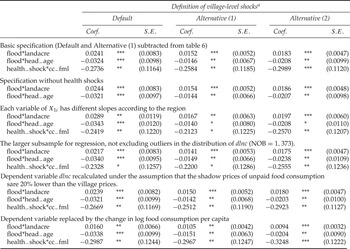
The results in tables 5 and 6 were found to be robust to various alterations.Footnote 18 We give the summary of these sensitivity checks in appendix table A1, focusing on the heterogeneous impact among households.
First, the main results reported in this paper were not affected by the particular way we aggregated the information in table 3 into two variables of village-level drought and flood shocks. Second, the specification without health shocks yielded estimates for b 1 and b 2 highly similar to those reported in table 6. In other words, our assumption of the idiosyncratic nature of the health shock variable was found to be valid.Footnote 19 Third, the extension of the regression model to allow region-specific slopes of household characteristics X 1i in equation (2) did not affect our estimates for b 1 and b 2. Fourth, to examine whether the regression results are sensitive to a particular choice of the regression subsample, we re-estimated the model using the larger subsample, without throwing away outlier observations in terms of the distribution of per capita consumption. The results were again similar to those reported in table 6. Fifth, as several households in our data set are subsistence-oriented farmers (Singh et al. Reference Singh, Squire and Strauss1986; de Janvry et al. Reference de Janvry, Fafchamps and Sadoulet1991), the way we imputed the value of unpaid food consumption (mostly the consumption of self-produced foods) may have affected our results. To examine this possibility, we re-calculated the imputed value under the assumption that the shadow prices of unpaid foods consumed by the household are 20 per cent lower than the village prices. The results shown in table 6 remain robust with this type of alteration. It is not likely, therefore, that the exact way in which we imputed the self-produced foods consumed by the household brought bias in our main results. Finally, we re-estimated the regression models by replacing the total consumption by food consumption. The regression results were again highly similar to those reported in table 6.
5. Conclusion and discussion
This paper investigated which households in rural Pakistan were vulnerable to natural disasters in terms of a decline in their consumption when their village was hit by disasters such as floods and droughts. The regression results associating observed changes in consumption to household characteristics and village-level disaster variables indicated the following results. The sensitivity of consumption changes to village-level shocks differentiated by household characteristics is different from that to idiosyncratic health shocks differentiated by similar characteristics. More specifically, it was found that more landed households were less vulnerable to flood shocks while households with greater access to formal financial institutions were less vulnerable to idiosyncratic health shocks. On the other hand, households in which the household head is elderly bore a larger burden of village-level shocks, while they were not vulnerable to idiosyncratic health shocks. It is possible that these patterns were due to the coexistence of unequal access to credit markets and risk sharing among heterogeneous households in terms of risk tolerance. We were not able to find a significant impact of ex ante labor diversification on mitigating the ill effects of natural disasters.
From anthropology literature on the rural society in Pakistan, it can be speculated that landlord-based networks of patron–client relationships are a possible mechanism that enables intra-region and inter-village risk sharing. Since such networks are strongest in rural Sindh, this interpretation appears consistent with the finding that Sindh villagers were protected against health and drought shocks but they suffered from the lowest average consumption level and their consumption dropped substantially when their villages were hit by floods. This interpretation also appears consistent with the finding that northern Punjab villagers enjoyed the highest average consumption level that was mostly self-insured. As this interpretation is more a speculation than an evidence-based result, clean identification of the actual mechanism is left for further research.
The findings of this paper have several policy implications regarding household-level resilience against village-level natural disasters in developing countries. First, the pattern of welfare declines is heterogeneous so that minute targeting is required. It may be the case that an intervention to cope with natural disasters without such concern is not effective towards some households in the affected villages. Second, the contrast found in this paper with regard to the impact of droughts and floods appears to indicate that whether or not a disaster damages physical infrastructure makes a substantial difference in terms of resiliency. Households have more difficulty in coping with floods than droughts since floods disrupt transport and communication. Third, improving intertemporal smoothing ability of households through developing assets and credit markets is key to mitigating the ill effects of floods. Investment in infrastructure such as transport and communication could contribute to higher resilience against natural disasters through both the second and third routes. The third route occurs because infrastructure investment improves the level of efficiency of risk sharing and facilitates credit transactions in wider areas.