Introduction
Background
An increasing degree of dependence on outside help with increasing severity of the dementia symptoms is typical of dementia diseases. In particular, increasing dependency in the area of activities of daily living (ADL) is a factor in early institutionalization (Luppa et al., Reference Luppa, Luck, Brahler, Konig and Riedel-Heller2008). At present, one-third (Bickel, Reference Bickel2001) to half (Hébert et al., Reference Hébert, Dubois, Wolfson, Chambers and Cohen2001; Luppa et al., Reference Luppa, Luck, Brahler, Konig and Riedel-Heller2008) of all dementia patients live in nursing homes. In the U.S.A., 90% of all dementia patients spend at least six weeks of their lives in institutional care (Smith et al., Reference Smith, Kokmen and O'Brien2000). Higher dependency is also reflected in a rise in the time required for direct care (Nordberg et al., Reference Nordberg, Strauss, Kareholt, Johansson and Wimo2005; Reference Nordberg2007). Recording the direct care time thus becomes an important component for health-economic studies, especially where reimbursement of nursing care is time-dependent, and for therapy studies where nursing expenditures can be considered an important outcome measure for the efficiency of new treatment methods (Wimo, Reference Wimo2007). There is no standardized procedure at present for recording direct care time in the nursing home. The purpose of this study is therefore to validate the “RUD-FOCA” (Resource Utilization in Dementia – Formal Care), which we developed on the basis of the “RUD lite” by Wimo and Winblad (Reference Wimo and Winblad2003).
In many studies, the formal care time in the nursing home is recorded indirectly through the costs of residence (O'Shea and O'Reilly, Reference O'Shea and O'Reilly2000). Another approach to determining care time in the nursing home includes not only person-related care, but also care-planning, charting, etc. (Arling and Williams, Reference Arling and Williams2003). This procedure is not without problems in concept, since up to 50% of the recorded times do not involve direct nursing activities (Arling et al., Reference Arling, Kane, Mueller and Lewis2007). For this reason, Nordberg et al. (Reference Nordberg2007) recommend that research should focus more on actual nursing time in the homes. In their study, the authors use the original RUD (long version of RUD lite), which was developed for recording informal care by means of interviewing the primary caregivers of dementia patients living at home (Wimo et al., Reference Wimo, Wetterholm, Mastey, Winblad, Wimo, Jönsson, Karlson and Winblad1998). It is assumed that the primary informal caregiver can report the total time spent in caring for the family member. However, it must be remembered that the time spent is underestimated by 14% if the time spent by other caregivers, in addition to the primary caregiver, is not taken into account (Neubauer et al., Reference Neubauer, Holle, Großfeld-Schmitz and Gräßel2008). Since several formal caregivers tend the same patient over 24 hours in the nursing home, we adapted the RUD lite to this specific situation. We selected a middle course between the recall method used in the RUD lite and the diary method, which is considered the gold standard of time recording (van den Berg and Spauwen, Reference van den Berg and Spauwen2006). The new instrument was called RUD-FOCA. Validation of the RUD-FOCA was made within a randomized controlled trial to evaluate a multimodal, non-medication therapy in the nursing home (ISRCTN87391496). The construct validity of the RUD-FOCA is investigated on the basis of hypotheses in the present study.
Hypotheses to evaluate construct validity
Like the RUD lite, the RUD-FOCA divides the care time into three categories: help in activities of daily living (ADL) such as hygiene, eating; help in instrumental activities of daily living (IADL) such as taking medications, telephoning, tidying up; and help in supervision, especially preventing dangerous situations and providing orientation help. The starting point of the hypotheses are test values for capabilities which, when limited, elicit a specific need for care in these three categories. In addition, we investigated the discriminate validity via correlation with the subscale on moods of the Nurses’ Observation Scale of Geriatric Patients (NOSGER). The following hypotheses were investigated:
1. The RUD-FOCA total time correlates
a. most with the parameters of everyday practical capabilities (Barthel Index as main criterion, Erlangen Test on Activities of Daily Living (E-ADL Test), NOSGER subscales on ADL and IADL, care level according to the health insurances’ classification)
b. less with parameters of cognition (Alzheimer Disease Assessment Scale, subtest Cognition (ADAS-Cog), Mini-mental-State-Examination (MMSE), NOSGER subscale memory) and on behavior (NOSGER subscales social behavior and disturbing behavior)
c. least with the NOSGER subscale on moods.
2. RUD-FOCA ADL times correlate most with ADL and IADL parameters, with ADL parameters showing a greater relationship than comparable IADL parameters. Parameters of cognition and behavior correlate less with ADL times and the smallest correlation coefficients are found with the NOSGER subscale on mood.
3. The IADL times also correlate as described in hypothesis 2, with the modification that IADL times correlate more with parameters of IADL capabilities than with comparable ADL parameters.
4. The time spent in supervision correlates more with the behavior parameters, as well as with cognitive parameters which comprise orientation capability than with the ADL and IADL parameters.
Methods
Design
The data for the validation are obtained from the randomized controlled prospective trial “MAKS aktiv!” (ISRCTN87391496) to evaluate a multimodal non-pharmacological therapy in six nursing homes in the Mittelfranken study region (Bavaria, Germany). The project is financed under the “Initiative Leuchtturm Demenz” (Lighthouse Initiative in Dementia) by the Federal German Ministry of Health. The study protocol was approved by the Ethics Commission of the University Hospital Erlangen (date of approval: 10 August 2008/ Reference Number: 3232). All 555 residents in the participating homes were screened for suitability for participation. The inclusion criteria were an MMSE-score ≤24, degenerative dementia in the doctor's assessment, test capability in principle and ability to participate in group activities, resident's consent or that of his/her legal representative, and complete performance of both test procedures E-ADL and ADAS-Cog. Exclusion criteria were blindness, deafness, being bedridden, aphasia and the highest level of care-dependence according to the classification of Health Insurance (care level 3, see “Instruments” below for further explanations). The data presented on validity refer to the initial examination of all suitable, randomly selected persons. The retest reliability was tested on all persons in the control group (care as usual) with follow-up recording (n = 49).
Instruments
Compared to the RUD lite (Wimo and Winblad, Reference Wimo and Winblad2003), the RUD-FOCA is characterized by its adaptation to the situation in a nursing home. The most important new feature is setting up a time plan which covers the time spent by all of the nursing staff (early, late and night shifts) for one week as a representative example (see Appendix 1 attached to the electronic version of this paper at http://www.journals.cambridge.org/ipg). Then the total time per 24 hours is calculated for each day for each of the three areas ADL, IADL and Supervision. The mean care time spent is calculated, using only records of those days on which care was actually required. These data serve as a model in filling out the RUD-FOCA itself, which asks about average care time per day for the areas ADL, IADL and Supervision (see Appendix 2 attached to the electronic version of this paper at http://www.journals.cambridge.org/ipg). This information is obtained in three segments. First, the nurse has the possibility of reporting whether help is needed at all in the area in question (Did the resident need help in one of the following or comparable activities?). After this question, examples are given for that area. If the answer is “yes”, the nurse is asked to enter the number of days within the last four weeks on which this help was required. “How many days during the last four weeks did you or other (formal) caregivers help the resident with this activity?” Then the average time spent per day from the RUD-FOCA time plan is asked. “On these days, how many minutes per day did you or other caregivers spend on average in helping the resident with these activities?” In answering a fourth question, the nurse can estimate the amount of time spent by family members in helping the patient. The RUD-FOCA thus covers only the direct, person-related care times.
The need for help in the ADL area is addressed in the Barthel Index (Mahoney and Barthel, Reference Mahoney and Barthel1965). The total score, formed from ten items, ranges from 0 (dependent on help in all areas) to 100 points (completely independent).
The Nurses’ Observation Scale for Geriatric Patients (NOSGER; Spiegel et al., Reference Spiegel1991), as an external assessment, records the most common characteristics of geriatric patients in six subscales. Summed values from 5 (no impairment) to 25 (maximum impairment) can be attained in each subscale.
The care level describes the extent to which the patient is eligible to receive assistance from the Long-term Care Insurance (obligatory insurance). The classification is based on the extent of need for physical care and ranges from mild (Level 1) and moderate (Level 2) up to great need for care (Level 3). For classification in Level 3, daily need for help of at least 5.0 hours is, among other things, a requirement. The time required is determined based on standardized time corridors for certain activities.
The E-ADL-Test (Graessel et al., Reference Graessel, Viegas, Stemmer, Küchly, Kornhuber and Donath2009) is a psychometric achievement test which examines the fundamental everyday practical capabilities of dementia patients under standardized conditions. Each of the five activities – pouring a beverage, spreading butter on bread, washing the hands, opening a cabinet, tying a bow – is assessed on a scale from 0 to 6 points, depending on the completeness of solving the task. Error-free solving is assigned 6 points. The higher the summed score, the greater the person's everyday practical competence. The E-ADL Test was validated in nursing homes (correlation with MMSE r = 0.72, with NOSGER r = 0.60).
The Alzheimer's Disease Assessment Scale (ADAS; Rosen et al., Reference Rosen, Mohs and Davis1984), serves to measure the degree of dementia symptoms. The summed score in the Subtest ADAS-Cog varies between 0 and 70 Points. Higher point scores represent greater cognitive deficits.
The Mini-mental State Examination (MMSE; Folstein et al., Reference Folstein, Folstein and McHugh1975) is used for dementia screening. The summed score ranges from 0 to 30 points, with higher values indicating greater performance capacity.
Data recording
The time schedule was filled out by all of the nursing shifts working in a given week, while the RUD-FOCA was filled out by the responsible ward supervisor. The NOSGER and the Barthel Index were completed by nurses who had known the dementia patients for more than four weeks. The MMSE was recorded during screening by nursing home staff. The E-ADL-Test and ADAS-Cog were recorded by external blinded testers (psychology students in the final segment of their study). All of the persons involved in data recording were thoroughly trained in the use of each instrument. The data quality was guaranteed by stringent monitoring.
Sample
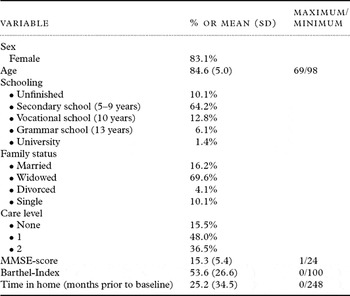
The assessment was performed with the 148 datasets of the first recording of all residents enrolled in the study (Table 1). The proportion of women in the sample was 83%, the mean age was 84.6 years. The study participants had been in the nursing home for two years and two months on average. The shortest time was two weeks, the longest nearly 21 years. The first and last recordings of all dementia patients in the control group (n = 49) were included in the calculation of retest reliability.
Sample Characteristics (n = 148)

MMSE = Mini-mental State Examination.
Statistical analyses
The assumption of normal distribution was tested with the Kolmogoroff-Smirnov Test. Owing to deviations of the RUD-FOCA values from normal distribution, the Spearman correlation coefficients were calculated. Confidence intervals of the correlation coefficients were calculated in order to identify significant differences between the correlations. Correlation coefficients whose confidence intervals do not intersect are taken to be significantly different. The correlation coefficients between the test scores of the control group (n = 49) after an interval of 6 months were calculated to estimate retest reliability.
Results
Care time
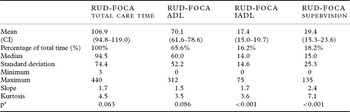
The greatest expenditure in care time is care time for ADL (65.6%); the proportion for IADL care is 16.2% and supervision is 18.2%. For total care time, the mean is 106.9 minutes and the median 93 minutes. The smallest observed care time per day is 3 minutes, the highest 440 minutes (7.3 hours). All RUD-FOCA scores (summed scores, ADL, IADL and Supervision) show a right-skewed distribution (Table 2).
Distribution parameters of the RUD-FOCA times (N = 148)

*p = Kolmogorov-Smirnov Test for normal distribution.
The time expended for ADL care increases with increasing severity of dementia (Figure 1). IADL time in contrast shows a trend to equal distribution with a sharp increase in the ADAS-Cog score of 40 (moderate dementia). At about 70 points, (highest score, severe dementia) it is again only slightly higher than ADL at 10 ADAS points (borderline dementia). The time for supervision shows a trend to an inverted U-shaped distribution with a second peak at 55 ADAS points.
Time spent in ADL, IADL and supervision measured with RUD-FOCA in dependence on ADAS-Cog summed value (range: 0–70 points, Interval width 7). The time expended for ADL care increases with increasing severity of dementia. IADL time shows a trend to equal distribution with a sharp increase in the ADAS-Cog score of 40. At about 70 points, it is again only slightly higher than ADL at 10 ADAS points. The time for supervision shows a trend as an inverted U-shaped distribution with a second peak at 55 ADAS points.

With respect to informal care, no time spent by family members was reported for 50% of the residents, and less than 10 minutes per day for 75%.
Hypothesis 1
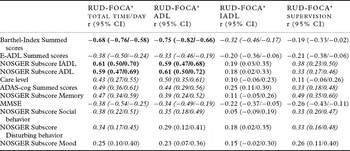
As hypothesized, the entire time of the RUD-FOCA correlates most with the test values which measure ADL and IADL impairments (Table 3). The greatest correlation coefficients (0.59 ≤ r ≤ 0.68) result for the correlations with the Barthel Index and with the ADL and IADL scales of the NOSGER. Moderate correlations 0.34 ≤ r ≤ 0.49) exist with the ADAS-Cog and E-ADL Test and the subscores of the NOSGER on memory, disturbing behavior and social behavior, as well as with the MMSE and care level. The lowest correlation (r = 0.25) is seen with the NOSGER subscore mood. The Barthel Index and NOSGER IADL show a significantly higher correlation to the overall time of the RUD-FOCA than the behavior parameters and mood, but also significantly higher than with the E-ADL Test. Here, the correlation with the overall care time was moderate (r = 0.38). The results support Hypothesis 1.
Spearman rank correlations and confidence intervals of the RUD-FOCA scores with ADL, IADL, cognition and behavior measures

*0.30 ≤ r ≤ 0.60 = italic; r > 0.60 = bold.
Hypothesis 2
The results are similar with respect to care time expended for ADL-care alone (Table 3). The Barthel Index, as a specific measure of ADL-capability, correlates significantly more with the ADL time than the cognition and behavior parameters, or with mood. The confidence interval of the correlation coefficients with the Barthel Index and NOSGER-IADL overlap by only 0.02 points. Here, too, there is only a moderate correlation coefficient (r = 0.33) for the correlation between RUD-FOCA ADL and the E-ADL Test, which is also attained by the correlation coefficients with the cognition parameters, care level and the behavior parameters of the NOSGER. The correlation coefficient with the NOSGER-ADL is also significantly higher than the corresponding scores with the MMSE and behavior parameters, and with NOSGER-mood. With the exception of the E-ADL Test, the correlations found support Hypothesis 2.
Hypothesis 3
Overall, the lowest correlations are found with the times for IADL care (Table 3). There is a moderate correlation with the Barthel Index (r = 0.32), and low correlation coefficients with ADAS, E-ADL and MMSE (0.20 ≤ r ≤ 0.25). The other correlation coefficients are even lower. The results do not support Hypothesis 3.
Hypothesis 4
The care time expended for supervision correlates moderately (0.33 ≤ r ≤ 0.49) with the NOSGER subscores memory, ADL, IADL, social behavior and disturbing behavior and the ADAS-Cog (Table 3). The degree of correlation with the Barthel Index, E-ADL Test, NOSGER-mood, care level and MMSE is lower (0.11 ≤ r ≤ 0.26). The NOSGER subscore memory shows a significantly higher correlation coefficient than the Barthel Index and care level. The correlation coefficients of behavior parameters (r = 0.33) exceed the ADL parameters, Barthel Index and E-ADL Test by up to 0.14; this difference is not significant due to the large confidence intervals and the overall rather low correlations. With the exception of the correlation coefficients for NOSGER-IADL and ADL, the other correlations support Hypothesis 4.
Reliability
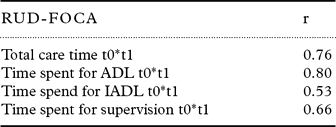
The retest-reliability was calculated from baseline and follow-up scores after 6 months in the control group (n = 49). The correlation coefficient is highest for RUD-FOCA total time and ADL-care with r = 0.76 and r = 0.80, respectively (Table 4).
Retest-Reliability (n = 49) at a time interval of 6 months

T0: Baseline.
T1: Follow-Up.
Discussion
Data for the validation of the RUD-FOCA study were recorded during the intervention study “MAKS aktiv!”. The sample consisted of 148 residents in a total of six nursing homes. This is a random sample of all the suitable and willing residents in these homes. The same exclusion criteria were applied for the MAKS aktiv! project as for the validation study of RUD FOCA. For this reason, dementia patients were excluded if they were blind, deaf, bedridden or severely dependent on care (third level of care). With respect to validity, this limitation might lead to underestimation of the validity parameters, since the variance was upward limited.
The RUD-FOCA was developed to record direct person-related care times in the nursing home. Unlike in the area of informal care, where there are various instruments for recording care time (see, for example, Clipp and Moore, Reference Clipp and Moore1995; Davis et al., Reference Davis1997), the RUD-FOCA is the first instrument validated for this application in institutional care. Other instruments, such as the RUG III (Fries et al., Reference Fries, Mehr, Schneider, Foley and Burke1993), record the time for documentation and care conferences in addition to the direct person-related care time (Arling et al., Reference Arling, Kane, Mueller and Lewis2007). This gives rise to differentiation problems in outcome studies since it cannot be assumed that the documentation times can be reduced by therapy or rehabilitation success, as is the case in direct care times. Differentiation between the various areas is also desirable in cost analyses. This is the only way to identify cost-intensive areas and work out possibilities for better resource utilization.
In adapting the RUD lite to the situation in the nursing home, the operationalization of the three times to be recorded had to be resolved in part. For example, in the RUD lite, the time that an informal caregiver spends with his/her family member in order to prevent dangerous situations is considered to be supervision time – not infrequently 24 hours per day (Wimo et al., Reference Wimo, von Strauss, Nordberg, Sassi and Johansson2002). For informal care, this operationalization of supervision is a meaningful concept, since 24-hour care is an enormous burden for the caring family member. In the nursing home, on the other hand, difficulties arise because nurses sometimes spend their time with a group of people, primarily in the area of supervision but also to a lesser extent in the areas IADL and ADL. Until now, two possibilities of operationalization have been used to record these times: (i) the time spent has been divided by the number of persons in care (see, for example, Fries et al., Reference Fries, Mehr, Schneider, Foley and Burke1993); or (ii) the entire time has been attributed to each person cared for (for example, in Nordberg et al., Reference Nordberg2007). The first causes problems if the group of persons is large, leading to an underestimate of the care time per resident. The second procedure leads to an overestimate of the total care time performed, especially since the problems arise of which nursing home resident in a group should be considered dependent on care and which not. Using this operationalization, Nordberg et al. (Reference Nordberg2007) for example found care and supervision times averaging 13 hours per day and per resident which did not enable any statement of the actual time spent with any given person.
In order to record only direct person-related care, in the RUD-FOCA only such times as are spent in direct contact with a person are recorded, not the group-related times or team meetings, etc. Direct care time, for example, includes accompanying residents back to their rooms if they wander about at night, but does not include the time spent by the night nurse in a quiet ward. It is thus possible to determine the actual need for care accruing to the individual care receiver.
The reliability was tested in the present study by means of the retest reliability after 6 months. Only persons in the control group were used in this analysis in order to prevent distortion by possible therapy effects. A much shorter time interval would be desirable for determination of reliability. The 6-month interval resulted from the study design. In light of the long time interval, the reliability parameters, especially of total time and ADL, can be considered good.
The construct validity was checked using four hypotheses. Since care time is not a hypothetical construct, validation on the criterion “real score” of actual care time would have been possible in principle. Owing to ethical considerations in the required uninterrupted recording of the events and the high economic expenditure, this form of validation, which would be desirable from a methodological point of view was, however, not the method of choice.
Three of the four hypotheses are supported by the data found in our study. Since the ADL time accounts for two-thirds of the total care time, the results of the first two hypotheses can be considered together here. As expected, both the ADL and total time correlate most with the instruments which record ADL capabilities. This result is supported by the literature. For example, Nordberg et al. (Reference Nordberg, Strauss, Kareholt, Johansson and Wimo2005) compared in their cross-sectional study care expenditure for dementia patients with that of non-dementia patients in dependence on ADL capabilities. A decrease in ADL capabilities was associated with a significant increase in the formal care required. This relationship was clearly identified in institutional care (Nordberg et al., Reference Nordberg2007) and is also confirmed in our study. The moderate correlations with the ADAS-Cog also agree with other studies. For example, Arling and Williams (Reference Arling and Williams2003) showed that cognitive limitations have an indirect influence on care times via the ADL capabilities. By contrast, the total and ADL times correlated considerably less with the E-ADL Test than expected. This could be due to differences in concept. In the E-ADL Test, partial steps in solving everyday practical tasks, like spreading butter on bread, are scored as performance. Giving assistance often, however, requires greater time expenditure than doing the task for the patient. In many cases, the caregiver will decide to perform the task because of a lack of time. Thus, the care expenditure for persons with moderate capabilities in the E-ADL Test would differ only slightly from those with low capabilities. By contrast, the Barthel Index includes basic ADL capabilities like continence and walking and asks explicitly about the degree of help dependence, and is thus closer in concept to the RUD-FOCA. The differentiated correlation profiles strongly support Hypotheses I and II. The total times and ADL times are thus a valid reflection of actual care times.
The IADL time (Hypothesis 3), by contrast, correlates only slightly with all other procedures. Unlike the ADL times, it does not increase with increasing severity of dementia. Nordberg et al. (Reference Nordberg2007) also found no relationship between the dependence on help or the presence of dementia and the time expended on IADL in institutional care. One possible explanation is in the operationalization of IADL times, which is not yet completely solved in the RUD lite. In studies of RUD lite in care at home, the problem is often reported by informal caregivers of differentiating IADL care from the customary household activities which would be necessary even without care (Wimo and Nordberg, Reference Wimo and Nordberg2007; Neubauer et al., Reference Neubauer, Holle, Menn and Gräßel2009). In a nursing home, necessary IADL activities such as cooking, laundry and cleaning are performed for all residents by the housekeeping staff, without involving the care times under examination here at all. In the RUD-FOCA, therefore, only those times count as care expenditure which exceed this “fundamental IADL care” and are directly person-related, such as administering medications, for example. Consequently, the IADL time recorded in our study of 17 minutes per day on average is considerably less than the 1.7 hours per day reported by Nordberg et al. (Reference Nordberg2007). The distribution of these IADL times shows empirically a nearly uniform correlation with the severity of dementia measured by the ADAS-Cog, but shows a sharp increase in moderate dementia. Presumable, the patients can still perform most of the IADL activities themselves at the onset of dementia. As the dementia progresses, the IADL capabilities decrease, but not to the same extent as the motivation and need to perform them. Thus, more help is required. In later stages of dementia, the patient withdraws even more and no longer has the motivation to perform the IADLs. For this reason, the time required for IADL decreases again and there are only low correlation coefficients with the severity of dementia (Wimo and Nordberg, Reference Wimo and Nordberg2007). The validity of this explanatory model, as well as the contents of IADL care in the nursing home, should be further investigated.
The supervision times (Hypothesis 4) show a tendency toward an inverted U-form relationship with the severity of dementia. This correlation was also noted by Wimo et al. (Reference Wimo, von Strauss, Nordberg, Sassi and Johansson2002). It appears plausible that, with increasing severity of dementia and thus decreasing motivation, dangerous situations become less and less frequent, so that less time has to be expended in supervision. This can be observed to some extent, although bedridden patients were excluded from our study. This is probably why the linear correlation coefficients for supervision do not reach scores above 0.5. Nonetheless, the correlation profile conforms to the hypothesis, since the Barthel Index, care level and the E-ADL Test correlate much less with the supervision time of the RUD-FOCA than the cognition and behavior parameters.
The greatest limitations of this study are the exclusion of severely care-dependent persons and the long interval to testing the retest reliability. Further research on these two points is desirable. The conceptual background with respect to the IADL times should be operationalized in a more differentiated manner and checked empirically.
Conclusion
The RUD-FOCA was found in the present study to be an easy-to-use, valid instrument for determining care expenditure in the nursing home. Three of the four hypotheses on construct validity – total time, ADL and supervision – are supported by the data. The differentiation in content of IADL should be improved by detailed operationalization.
Appendices
Two appendices are published as supplementary material attached to the electronic version of this paper, available online at http://www.journals.cambridge.org/ipg:
Appendix 1: Time Schedule for the RUD-FOCA
Appendix 2: RUD-FOCA Questionnaire
Conflict of interest
None.
Description of authors’ roles
K. Luttenberger helped in designing the study, supervised data collection, carried out the statistical analysis and wrote the paper. E. Graessel designed the study, supervised the statistical analysis and assisted in writing the paper.
Acknowledgments
We thank all nurses, residents and directors of the participating nursing homes. In addition, we thank all the parties involved in the RCT MAKS aktiv!, within which the study was conducted, especially the Diakonie Neuendettelsau. We also thank the German Ministry of Health for sponsoring MAKS aktiv!.