Introduction
Autism spectrum disorder (ASD) is a neurodevelopmental disorder characterized by early-appearing deficits in social interactions and communications and repetitive sensory-motor behaviors as well as stereotypic patterns of behaviors.Reference Posar, Resca and Visconti1 According to the report from Autism and Developmental Disabilities Monitoring Network, approximately 1 in 59 children aged 8 years has ASD, and the incidence seems to be cumulatively increasing.Reference Baio, Wiggins and Christensen2 Although it is acknowledged that ASD is a disorder with biological basis instead of a behavioral disorder framed traditionally, no curative pharmacological treatment is available. Currently, the antipsychotics risperidoneReference Kent, Kushner and Ning3 and aripiprazoleReference Owen, Sikich and Marcus4 have been approved by the Food and Drug Administration (FDA) solely for the intervention of agitation or irritability symptoms in patients with ASD, with common adverse effects such as sedation and weight gain, but not address core symptoms of ASD.Reference Fung, Mahajan and Nozzolillo5 Special education and behavioral services are primary approaches for the treatment of ASD and have shown some effectiveness.Reference Lord, Elsabbagh, Baird and Veenstra-Vanderweele 6 However, those treatments are of great personal and sociological cost. Specifically, to support an individual with ASD, the cost for a lifespan was estimated to be $2.4 million in the United States.Reference Buescher, Cidav, Knapp and Mandell7 For the family, special education services for the children and parental loss of productivity contributed to the highest costs.Reference Jarbrink8–Reference Cidav, Marcus and Mandell10 For an adult patient, the largest cost components were residential care or supportive living accommodation and individual loss of productivity.Reference Howlin, Alcock and An11–Reference Peacock, Amendah, Ouyang and Grosse13 Hence, a primary goal as well as a critical issue of much ongoing research in ASD are thus to further advance our understanding of the underlying pathogenesis of the disease as well as discovering of novel potent therapeutics.
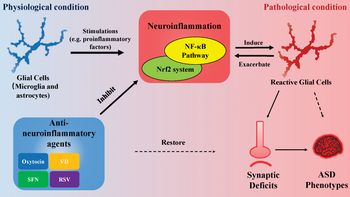
Proposed mechanism of antineuroinflammatory therapy for treatment of ASD by inhibiting glial activation and restoring synaptic function. When stimulated, glial cells (microglia and astrocytes) soon become reactive, thus cause synaptic dysfunction and lead to ASD phenotypes. Antineuroinflammatory agents (eg, oxytocin, vitamin D, sulforaphane, and resveratrol) can directly suppress neuroinflammation through the regulation of Nrf2 and NF-κB-related pathways to inhibit glial activation and restore synaptic deficits so as to potentially treat ASD.

Summary of evidence and recommendations of antineuroinflammatory therapy for autism spectrum disorder.

The precise causes of ASD remain unknown, but both genetic and environmental factors, with correlations, are believed to be involved in its complex pathogenesis.Reference Modabbernia, Velthorst and Reichenberg14 Because genetic mutations are less likely to be directly treatable, current trials are mainly focused on metabolic disorders where interventions are probably available. More importantly, metabolic biomarkers might also guide future treatment of ASD by enabling clinicians to be able to closely monitor the response of treatment in real time. Children with ASD have shown several physiological abnormalities as compared with typically developing (TD) children.Reference Liu, Talalay and Fahey15 Of note, inflammation/immune dysregulation and synaptic dysfunction (mainly aberrant pruning) have aroused wide concerns for the central role of glial cells (ie, microglia and astrocytes) in both abnormalities.Reference Petrelli, Pucci and Bezzi16 Pathways of inflammation/immune dysregulation and synaptic dysfunction seem to be unrelated and their association in the brain has been overlooked. However, activation of glial cells may fit the gap and serve as a bridge for the cross-talk. In this review, we propose the hypothesis of antineuroinflammatory therapy as a potential treatment of ASD by inhibiting glial activation and restoring synaptic pruning (Figure 1). As this review focuses on a complex field, we will first introduce the important role of glial cells in synaptic pruning, next discuss reactive glial cells and abnormal synaptic pruning in ASD, and then summarize several agents with antineuroinflammatory effects that might modulate glial-cell-dependent synaptic pruning process for ASD treatment to provide preliminary proof of the concept.
Glial Cells-Dependent Synaptic Pruning
There are a growing number of studies reporting that synaptic pruning, although considered as a neuronal maturation process, is dependent on microglia and astrocytes.Reference Neniskyte and Gross17–Reference Clarke and Barres19 Microglia are highly motile in the central nervous system (CNS) and are well positioned so as to interact with terminal boutons and dendritic spines. Microglia could remove synapses through phagocytosis by complement receptor 3 (CR3) and CX3C chemokine receptor 1 (CX3CR1)-mediated mechanisms.Reference Harrison, Jiang and Chen20, Reference Wu, Dissing-Olesen , MacVicar and Stevens21 Specifically, the microglial CR3 interacts with complement components such as C1qReference Kakegawa, Mitakidis and Miura22 and C3Reference Stevens, Allen and Vazquez23 to identify synapses with low activity. Inhibition of either C1q and C3 or CR3 restrains significantly microglial phagocytosis of synaptic material.Reference Hong, Beja-Glasser and Nfonoyim24
Astrocytes are star-shaped glial cells in the CNS, their proportion varies by region and ranges from 20% to 40% of all glia in the brain. Single astrocyte can make contact with 300–600 neuronal dendritesReference Halassa, Fellin, Takano, Dong and Haydon25; in hippocampal CA1, astrocytes are highly organized in a nonoverlapping tile-like manner so that one can make contact with in excess of 100 000 synapses.Reference Bushong, Martone, Jones and Ellisman26 There are several pathways for astrocytes-mediated synaptic elimination. First, multiple epidermal growth factor-like domains protein 10 (MEGF10) and Mer receptor tyrosine kinase (MERTK) could receive engulfment signal and mediate phagocytic pathways to eliminate synapses physically, astrocytes with genetic loss of Megf10 −/− and Mertk −/− each displayed about 50% reduction in their relative engulfment ability, while the loss of both genes decreased their relative engulfment ability by 85%.Reference Chung, Clarke and Wang27 Second, a study revealed that astrocytic phagocytosis of terminals of retinal ganglion cells is regulated by apolipoprotein E (APOE and the expression of alleles APOE2 enhances the rate of phagocytosis of synapses by astrocytes.Reference Chung, Verghese and Chakraborty28 Third, astrocytes express the transforming growth factor-β as a key modulator of C1q expression and elimination of synapses; accumulation of C1q protein represents the existence of senescent synapses and enhances the vulnerability to phagocytosis.Reference Bialas and Stevens29 Fourth, astrocytes release adenosine triphosphate (ATP), in an IP3R2-dependent manner, to activate the P2Y1 receptor and induce synaptic long-term depression (LTD) to facilitate synapse pruning.Reference Yang, Yang and Liu30
The study of glial cells provided further evidence for the association between the loss of synaptic elimination and ASD. Recently, studies have pointed out an essential role for microglia and astrocytes in synaptic pruning.Reference Neniskyte and Gross17 Also, several signaling pathways that are regulated by microglia and astrocytes are crucial for synaptic maturation.Reference Chung, Verghese and Chakraborty28, Reference Sipe, Lowery, Tremblay, Kelly, Lamantia and Majewska31 Transcriptomic study revealed the important role of glial cells in the failure to eliminate synapses. Upregulation of the immune–glial module in the cortex and downregulation of synaptic module were found in postmortem ASD brain tissue.Reference Voineagu, Wang and Johnston32 More importantly, the upregulation of the immune and glial genes may genetically drive synaptic changes.Reference Voineagu, Wang and Johnston32 Furthermore, 1 study found decreased deoxyribonucleic acid (DNA) methylation associated with immune function, such as complement components C1q, C3, and CR3, Reference Nardone, Sams and Reuveni33 all of which have been reported to be involved in glial cells-dependent synaptic pruning.Reference Stevens, Allen and Vazquez23, Reference Schafer, Lehrman and Kautzman34 In line with this, a close association of ASD with the genes related to the activation of glial cells and genes related to immune and inflammation was revealed through ribonucleic acid sequencing analysis.Reference Voineagu, Wang and Johnston32 These findings strengthened the link between ASD and loss of synaptic pruning, and suggested a bridge role of microglia and astrocytes.
These findings indicate that physiological interactions of microglia and astrocytes with their surrounding neural circuits are vital for synaptic network maturation and brain function. Thus, the loss of their functions in gardening may contribute to ASD onset and progression.
Reactive Glial Cells in ASD
Microglia account for 10% to 15% of all cells in the brain and are distributed throughout the CNS. Microglial cells are key cells, which are constantly scavenging the CNS for plaques, damaged or unnecessary neurons and superfluous synapses, and infectious agentsReference Gehrmann, Matsumoto and Kreutzberg35; thus, they are extremely sensitive to even small pathological alteration in the CNS. In pathological conditions, as resident macrophages, they first become reactive and then interact with surrounding astrocytes and other neural cells as quickly as possible to induce immune responses and maintain homeostasis.Reference Lan, Han, Li, Yang and Wang36, Reference Lenz and Nelson37 Exposure of CNS to pro-inflammatory cytokines would lead to activation of microglia and astrocytes. Furthermore, they release a number of pro-inflammatory mediators (such as tumor necrosis factor (TNF-α, glutamate, interleukin (IL)-6, IL-1β, IL-2, and IL-10)) and exacerbate the initial inflammatory condition.Reference Barbierato, Facci, Argentini, Marinelli, Skaper and Giusti38, Reference Kofler and Wiley39
Evidence linking glial cells involved in the pathological process of immune dysregulation/inflammation in the brain of ASD individuals have been previously summarized.Reference Young, Chakrabarti, Roberts, Lai, Suckling and Baron-Cohen 40 Immunohistochemistry data revealed increased reactive gliosis and glial cell proliferation in postmortem brain samples of ASD subjectsReference Vargas, Nascimbene, Krishnan, Zimmerman and Pardo41–Reference Edmonson, Ziats and Rennert44; positron emission tomography study showed reactive glial cells throughout the brain of ASD subjects.Reference Suzuki, Sugihara and Ouchi45 Also, high levels of various pro-inflammatory mediators, such as IL-6, TNF-α, and IL-1β have been identified in the postmortem brain tissuesReference Li, Chauhan and Sheikh46–Reference Estes and McAllister48 and blood samples of ASD individuals.Reference Masi, Breen and Alvares49–Reference Molloy, Morrow and Meinzen-Derr 51 In subjects with high-functioning ASD, the Th2 cytokines levels, such as IL-5 and IL-13, were also significantly higher than matched controls.Reference Suzuki, Matsuzaki and Iwata52 It is possible that anti-inflammatory pathophysiology also exists in many persons with ASD, often in the same individual where a pro-inflammatory state exists as the body attempts to restore homeostasis. Those results highlighted the abnormal immune responses in the brains of ASD individuals.
Studies have also associated maternal immune dysregulation with ASD. Findings from epidemiological data evidenced that many maternal medical conditions, which are closely related to immune dysregulation, such as infections, Reference Jiang, Xu and Shao53 preeclampsia, Reference Dachew, Mamun, Maravilla and Alati54 diabetes, Reference Xu, Jing, Bowers, Liu and Bao55 obesity, Reference Li, Ou, Liu, Zhang, Zhao and Tang56 and autoimmune disease, Reference Chen, Zhong and Jiang57 are associated with increased risk of ASD. Thus, maternal elevated inflammatory cytokines may induce placental inflammation and subsequently result in fetal inflammatory response and abnormalities in cytokines or inflammatory mediator levels in the brain, and lead to glial activation.Reference Marques, O’Connor, Roth, Susser and Bjorke-Monsen 58 Besides, the link is further supported by animal models.Reference Kim, Gonzales and Lazaro59 Maternal infection during pregnancy, a common method for inducing ASD animal models, support the causal link between systemic inflammatory processes and ASD phenotypes. Maternal immune activation (MIA) during pregnancy induces a dysregulated immune system in offspring and also leads to ASD-related phenotypes that persist well into adulthood.Reference Knuesel, Chicha and Britschgi60, Reference Estes and McAllister61 Therefore, MIA has been widely used for inducing an animal model of ASD. In particular, IL-6 has been suggested as a key factor in ASD-like abnormalities of MIA in offspring.Reference Smith, Li, Garbett, Mirnics and Patterson62–Reference Graham, Rasmussen and Rudolph64 Intriguingly, microgliaReference Magni, Ruscica, Dozio, Rizzi, Beretta and Maffei Facino65, Reference Nakanishi, Niidome, Matsuda, Akaike, Kihara and Sugimoto66 and astrocytesReference Almolda, Villacampa and Manders67, Reference Penkowa, Camats and Hadberg68 are dominant in releasing IL-6 in the brain, implying a central role of reactive glial cells in MIA-induced ASD models and leading to the speculation that reactive glia may be crucial in many ASD phenotypes with the aberrant synaptic function.
Synaptic Dysfunction in ASD
Neurons are electrically excitable cells and able to rapidly send signals to other cells through the special junction structure, synapse. Accordingly, the function of the synapse is of great significance for the neural circuits and systems. Synaptic pruning is an indispensable part of the neuronal maturation process as postnatal development of the CNS includes the excessive generation, selective elimination of synapses, and maturation of surviving neural contacts for the fact that the supernumerary synapses are supposed to be removed to form proper synaptic inputs and to establish mature synaptic architecture.Reference Schafer, Lehrman and Kautzman34, Reference Riccomagno and Kolodkin69 First, the pruning process is supported because the synaptic competition is intensified.Reference Darabid, Arbour and Robitaille70 A subset of inactive synapses, with low neurotransmission efficiency, is selectively eliminated while the remaining others are strengthened. As a result, an improved input pattern was developed. Besides, synaptic pruning helps to improve neuronal signal-to-noise ratios by providing synaptic multiplicity, which ensures weak inputs be sufficiently amplified and be effectively transmitted.Reference Zhan, Paolicelli and Sforazzini71
Given that the synaptic pruning process is crucial for forming mature synaptic contacts in CNS, it is not surprising that aberrant synaptic pruning may be involved in the cause of ASD as a neurodevelopmental disorder. Electroencephalogram and functional magnetic resonance imaging (fMRI) studies confirmed reduced long-range functional connectivity in the ASD brain with signs of loss of synaptic pruning (excess short-range connection).Reference Dinstein, Pierce and Eyler72–Reference Barttfeld, Wicker, Cukier, Navarta, Lew and Sigman74 Postmortem studies revealed that ASD patients were associated with increased dendritic spine density and decreased developmental spine pruning of pyramidal neurons (layer V).Reference Tang, Gudsnuk and Kuo75, Reference Hutsler and Zhang76 Moreover, at later age, adolescents with ASD showed increased cortical spine density compared with their TD peers, suggesting a deficit in synaptic pruning.Reference Tang, Gudsnuk and Kuo75 Apart from clinical evidence, elevated spine densities were also observed in mice carrying rare, penetrant ASD mutations that were previously reported, Reference Tang, Gudsnuk and Kuo75, Reference Piochon, Kloth and Grasselli77, Reference Young, Chakrabarti, Roberts, Lai, Suckling and Baron-Cohen 78 with deficient synaptic pruning during adolescence.Reference Tang, Gudsnuk and Kuo75 Likewise, in another mice model carrying Tsc2 +/− ASD and characterized by constitutively overactive mTOR, both ASD-like social behaviors and defects in postnatal spine pruning were observed.Reference Tang, Gudsnuk and Kuo75, Reference Kim, Cho and Shim78 A similar finding was also reported in Cx3cr1 deficient mice, Reference Zhan, Paolicelli and Sforazzini71, Reference Dichter73 which is another ASD animal model with characteristics of deficits in synaptic pruning. Besides, CX3CR1 knockout mice, with ASD-like social behavior remains into adulthood, show characters of excessive synaptic inputs in Schaffer collateral, low synaptic multiplicity, as well as increased LTD, which are features of immature synapses.Reference Zhan, Paolicelli and Sforazzini71, Reference Paolicelli, Bolasco and Pagani79 Therefore, a causal link that the loss of synaptic elimination would lead to ASD phenotypes has been highlighted.
Nrf2 and NF-κB Pathways Associated with Glial Activation
The transcription factor nuclear factor erythroid 2-related factor 2 (Nrf2) is a key protein that regulates the transcription of antioxidant proteins. Nrf2 is sequestered in the cytoplasm by binding to Kelch-like ECH associated protein 1 (Keap1).Reference Itoh, Wakabayashi and Katoh80 Under the pathological condition, Nrf2 dissociates from Keap1 and is translocated into the nucleus where it binds to antioxidant responsive element (ARE), and induces ARE-dependent genes to express antioxidant proteins.Reference Ma81
The transcription factor, nuclear factor kappa-lightchain-enhancer of activated B cells (NF-κB), is a key regulator of inflammation.Reference Shih, Wang and Yang82 NF-κB is sequestered in the cytoplasm by binding to the inhibitory kinase, an inhibitor of nuclear factor κ-B kinase subunit beta (IKK-β) protein.Reference Matsushima, Kaisho and Rennert83 When stimulated, activated NF-κB binds to specific DNA sequences in target genes, which are designated as κB elements and regulates the transcription of over mounting numbers of genes involved in inflammation, immunoregulation, and other pathophysiological conditions.Reference Gupta, Sundaram, Reuter and Aggarwal84
The relation between Nrf2 and NF-κB is yet to be determined but the identification of NF-κB binding sites in the promoter region of the Nrf2 suggests cross-talk between the 2 important modulators of inflammation.Reference Nair, Doh, Chan, Kong and Cai85 The NF-κB subunit p65 could downregulate Nrf2 activation either by cAMP-response element binding protein (CREBP) or histone deacetylase 3 (HDAC3)-related pathways.Reference Liu, Qu and Shen86 Also, p65 may decrease Nrf2 binding to its cognate DNA sequences and enhance Nrf2 ubiquitination.Reference Yu, Li and Liu87 Nuclear translocation of Keap1 was augmented by p65 and studies suggested that NF-κB signaling inhibits the Nrf2 system through the interaction of p65 and Keap1.Reference Yu, Li and Liu87 Besides, it has been shown that Keap1 is a negative regulator of NF-κB signaling via inhibiting IKK-β phosphorylation and mediating IKK-β degradation by autophagocytosis.Reference Kim, You, Lee, Ahn, Seong and Hwang88
Exposure of Nrf2-deficient mice to lipopolysaccharide, the glial activation and inflammatory response characterized by elevated levels of IL-1β, IL-6, IL-12, and TNF-α in the brain are much more pronounced.Reference Innamorato, Rojo, Garcia-Yague , Yamamoto, de Ceballos and Cuadrado89 Besides, in mice receiving LPS and LCY-2-CHO, a Nrf2 activator, the NF-κB pathway was suppressed with decreased levels of inflammatory cytokines.Reference Ho, Kang and Lee90 Those findings highlighted an interlink between the Nrf2 system and the NF-κB pathway. Therefore, the functional Nrf2-system and NF-κB pathway are key regulators for neuroinflammation and glial activation in the brain, and also therapeutic targets against brain inflammation.
Antineuroinflammatory Therapy for ASD
Although no study has provided evidence directly linking reactive glial cells and deficient synaptic function in ASD, several antineuroinflammation agents are shown to lead to improvements in behavioral performance in ASD, and they are reported to have pharmacological activities on inhibiting glial activation as well as restoring synaptic function in clinical and preclinical studies (Table 1).
Oxytocin
Oxytocin is a neuropeptide that acts on the oxytocin receptor and partially on vasopressin receptors and has been widely used during delivery and lactation period. Oxytocin plays critical roles in multiple CNS processes such as breastfeeding, social bonding, learning, and memory.Reference Lee, Macbeth, Pagani and Young91 Recent studies have highlighted the therapeutic potential of oxytocin for social behavior deficitsReference Guastella and Hickie92, Reference Wagner and Harony-Nicolas 93 and an increasing number of recent clinical trials suggest that intranasal oxytocin may improve the core social symptoms of ASD, Reference Anagnostou, Soorya and Chaplin94–Reference Kosaka, Okamoto and Munesue106 despite inconsistent results.
Recent excellent reviews have summarized molecular mechanisms of oxytocin signaling at the modulation of synaptic function.Reference Rajamani, Wagner, Grinevich and Harony-Nicolas 107, Reference Bakos, Srancikova, Havranek and Bacova108 Oxytocin receptors are presented in the presynaptic and postsynaptic membranes and it can modify synaptic plasticity and other properties to modulate neural activity in circuits.Reference van den Pol109 Glial cells are also targets of oxytocin action. Oxytocin could attenuate glial activation induced by LPS and reduce expression levels of pro-inflammatory mediators and cytokines.Reference Yuan, Liu and Bai110 In a more recent study, oxytocin improved animal behaviors and ameliorated oxidative stress and neuroinflammation and reduced number of activated microglia in autistic mice induced by valproic acid (VPA).Reference Wang, Zhao, Liu, Zheng, Li and Meng111
Vitamin D
Vitamin D (VD) is a kind of steroidal derivatives and is also a neuroactive steroid that involves in the development of the brain. Studies have reported decreased VD levels in ASD individualsReference Wang, Shan and Du112, Reference Fernell, Bejerot and Westerlund113 and findings from clinical trials suggested that VD supplementation is a promising therapy for ASD. An randomized clinical trial (RCT) of VD3 supplementation on ASD showed a significant increase of 25(OH)D in serum in the treatment group, but not in the control group, with only improvement in self-care and no significant improvement in behavior scales.Reference Kerley, Power, Gallagher and Coghlan114 However, several open-label trialsReference Bent, Ailarov, Dang, Widjaja, Lawton and Hendren115, Reference Feng, Shan and Du116 and case studiesReference Jia , Shan and Wang117, Reference Jia, Wang, Shan, Xu, Staal and Du118 provide additional evidence that VD3 supplementation could significantly improve the clinical behavioral aspects of children with ASD.
Recently, possible mechanisms for VD that helps treating ASD have been comprehensively reviewed.Reference Cannell119 The first is the antineuroinflammatory effects of VD in the brain.Reference Huang, Ho, Lai, Chiu and Wang120 VD possesses powerful antineuroinflammatory properties. Activated VD hormone (calcitriol) protects brain tissue by reducing inflammatory cytokine levels.Reference Huang, Ho, Lai, Chiu and Wang120 In other studies, it is suggested that VD could suppress oxidative stress and ameliorate the Nrf2–Keap1 pathway to attenuate inflammatory progression.Reference Nakai, Fujii and Kono121 Besides, VD also appears to have an effect on neurotransmission and synaptic plasticity.Reference Eyles, Burne and McGrath122 Developmental VD-deficient rats have altered synaptic plasticity, Reference Grecksch, Ruthrich, Hollt and Becker123 attentional processing, and learning function.Reference Latimer, Brewer and Searcy124, Reference Fernandes de Abreu, Nivet, Baril, Khrestchatisky, Roman and Feron125
Sulforaphane
Sulforaphane (SFN) is an active compound obtained from cruciferous vegetables such as broccoli, Brussels sprouts, and cabbages. SFN has various pharmacological activities and has been extensively used as antioxidant or anti-inflammatory agent.Reference Tarozzi, Angeloni, Malaguti, Morroni, Hrelia and Hrelia126 Importantly, SFN can readily cross the blood–brain barrier and quickly reach the CNS to exert its neuroprotective effects.Reference Benedict, Mountney and Hurtado127, Reference Carrasco-Pozo , Tan and Borges128 An RCT has shown that the daily administration of SFN substantially ameliorated the behavioral anomalies measured by Autism Behavior Checklist (ABC) and Social Response Scale (SRS) of the males with ASD without significant toxicity.Reference Singh, Connors and Macklin129 Furthermore, in a recent, open-label study of SFN treatment of ASD, mean scores on ASD symptoms (measured by SRS) showed significant improvements (decreases) over the study period.Reference Bent, Lawton and Warren130
The antineuroinflammatory effects of SFN, at least in part, through regulation of the Nrf2 and NF-κB-related pathways, are an important mechanism for its treatment effects on ASD.Reference Jang and Cho131–Reference Liu, Dinkova-Kostova and Talalay133 SFN could inhibit IκB phosphorylation, block NF-κB translocation to the nucleus, and interact directly with cysteine residues in the DNA-binding region of the transcription factor to disrupt the NF-κB pro-inflammatory pathway.Reference Jeong, Kim, Hu and Kong134, Reference Heiss, Herhaus, Klimo, Bartsch and Gerhauser135 SFN could attenuate reactive microglia-induced neuroinflammation in mice received LPS; critically, reduced iNOS levels and pro-inflammatory cytokines IL-6 and TNF-α levels were evidenced.Reference Innamorato, Rojo, Garcia-Yague , Yamamoto, de Ceballos and Cuadrado89 However, in Nrf2-deficient mice, SFN intervention on pro-inflammatory responses is not significant suggesting SFN might be a Nrf2-dependent anti-inflammatory agent.Reference Holloway, Gillespie and Becker136 In addition, while no evidence directly shows that SFN regulates synaptic function, there have been reports that SFN could regulate mTOR signaling and autophagy.Reference Pawlik, Wiczk, Kaczynska, Antosiewicz and Herman-Antosiewicz 137–Reference Liu, Hettinger, Zhang, Rezvani, Wang and Wang139 Dysfunction of mTOR pathway would cause autistic-like synaptic pruning deficits, Reference Tang, Gudsnuk and Kuo75 and deficient autophagy in microglial cells would induce aberrant synaptic pruning and cause ASD-like social behaviors.Reference Kim, Cho and Shim78
Resveratrol
Another interesting therapeutic is resveratrol (RSV). RSV is a polyphenolic stilbenoid, produced naturally by plants such as berries, nuts, and grapes.Reference Gambini, Ingles and Olaso140 The growing interest in the use of RSV is from its antineuroinflammatory and antioxidative effects.Reference Novelle, Wahl, Dieguez, Bernier and de Cabo141 Although no clinical trials have directly tested the treatment effects of RSV on ASD, preclinical studies have shown that RSV significantly, in a dose-dependent manner, restored all the behavioral and molecular deficits in ASD rats model induced by propanoic acid and decreased inflammatory cytokines such as TNF-α and IL-6 in the brain.Reference Bhandari and Kuhad142 In addition, prenatal RSV treatment prevented social impairments in an ASD model prenatal exposed to VPA.Reference Bambini-Junior , Zanatta and Della Flora Nunes143 Therefore, RSV might serve as an adjuvant for the treatment of ASD.
RSV is a potent antineuroinflammatory agent and the mechanisms involve Nrf2 and NF-κB-related pathways.Reference de Sa Coutinho, Pacheco, Frozza and Bernardi144, Reference Elshaer, Chen, Wang and Tang145 RSV exhibited significant antineuroinflammation effects on LPS-stimulated reactive microglia in both cell cultural and animal.Reference Yang, Xu, Qian and Xiao146 RSV could induce the expression of Nrf2 and its targeted various genes.Reference Truong, Jun and Jeong147 RSV also inhibits NF-κB activation by interfering the degradation of IκB and the consequent translocation of the p65 subunit.Reference Cianciulli, Calvello, Cavallo, Dragone, Carofiglio and Panaro148 Apart from its known effects on anti-inflammation, RSV also exerts neuroprotective effects by protecting synaptic plasticity. It was revealed that RSV could reverse the synaptic plasticity deficits induced by chronic cerebral hypoperfusion in rats.Reference Li, Wang, Wang, Rao and Chen149 Additionally, RSV could improve glutamate uptake by astrocytes and modulate the synaptic plasticity.Reference Quincozes-Santos and Gottfried150
Future Perspectives
The role of glial cells in the onset and progress of ASD has been overlooked in the past decades, previous neuropharmacological strategies were focused on improving neuronal function such as synaptic transmission for the treatment of ASD, but provided little benefit. Until recently, accumulating evidence shed light on the point of view that microglia and astrocytes are significantly involved in synaptic function (especially in synaptic pruning). It has also been suggested that the pathogenesis of ASD is closely related to neuroinflammation. The study of glial cells, as synaptic gardener and dominator in neuroinflammation, in ASD, provides an excellent opportunity to rebuild the patterns of the mechanisms of the pathogenesis of ASD for the fact that genetics or neuroscience solely focused on mutations or neurons is less likely to reveal integrated underlying pathophysiological pathways.
Here, we highlight several promising therapeutics that have shown some effects on ASD. Although the exact mechanisms for VD, SFN, and RSV treatment of ASD have not been clearly understood, their pharmacological activity on Nrf2 and NF-κB-related pathways have been evidenced and may be important mechanisms for inhibiting glial activation; besides, their effects on restoring synaptic function have been reported. Although no study has directly shown that antineuroinflammatory therapy could restore synaptic function and the causal link was speculated, further study of therapeutics with anti-inflammation and synaptic function recovery properties would help advance our understanding of the pathogenesis of ASD. Besides, under the neuroinflammation condition (ie, reactive glial cells), improving neurocircuit function solely is less likely to produce satisfactory treatment effects.
Disclosure.
Ya-Min Li, Yong-Jiang Li, and Xiaojie Zhang declare that there is no conflict of interest related to the content of this manuscript.
Acknowledgments.
The authors are supported by the National Natural Science Foundation of China (No: 81873806) and National Natural Science Foundation Hunan Province (No. 2019JJ40437).