1. Introduction
The use of polluted water in agriculture is a common practice around the world. It has recently been estimated that about 20 million hectares of land are irrigated with treated, partially treated, diluted and untreated wastewater in developing countries (Scott et al., Reference Scott, Faruqui and Raschid-Sally2004; Keraita et al., Reference Keraita, Jimenez and Drechsel2008).Footnote 1 The reasons for using wastewater vary depending on the situation and local context. Survey results from 53 cities in developing countries indicated that the main drivers of wastewater reuse in agriculture are increasing urban water demand, urban food demand, market incentives and lack of alternative water sources (Raschid-Sally and Jayakody, Reference Raschid-Sally and Jayakody2008). The use of wastewater in agriculture has both positive and negative potential impacts on crop production, public health, soil resources and ecosystems (Hussain et al., Reference Hussain, Raschid, Hanjra, Marikar and van der Hoek2002; Scott et al., Reference Scott, Faruqui and Raschid-Sally2004). It poses potential health risks because wastewater may contain microorganisms or chemical pollutants that can adversely affect the health of those working on wastewater farms, consumers of vegetables produced using wastewater and neighbouring communities, often leading to gastrointestinal disease (Shuval et al., Reference Shuval, Adin, Fattel, Rawitz and Yeutiel1986; Downs et al., Reference Downs, Cifuentes-Garcia and Suffet1999; Habbari et al., Reference Habbari, Tifnouti, Bitton and Mandil2000). However, the magnitude of these effects varies from region to region and from community to community depending on the volume and source of the wastewater and its composition and treatment before use as well as the management of the wastewater both at its source and at the level of farm usage (Drechsel et al., Reference Drechsel, Scott, Raschid-Sally, Redwood and Bahri2010).
As in most developing countries, polluted stream water has been used in crop production within and around Addis Ababa (the capital of Ethiopia) since the 1940s to produce a variety of crops for both market and home consumption. It is the main source of income for many producers and for small traders doing business in the vegetable market. Moreover, residents of the city benefit because they obtain fresh leafy vegetables at lower prices. On the other hand, it can at the same time have undesirable health effects on the farmers and consumers. Farmers are exposed to skin infections, and they consume part of their produce, especially if vegetables in local demand are grown. It is very likely that at present, farmers are more exposed to wastewater-related diseases than consumers as the type of irrigation (furrow and flooding) supports more occupational exposure than that the crops get contaminated. Moreover, farmers also consume a share of their own produce. However, from an economic policy point of view, it is the actual illness (rather than the potential hazards) caused by wastewater that should be important.
Important related policy questions such as ‘Should the practice of wastewater use for agriculture in the city and in downstream areas be discontinued?’ cannot be answered due to a lack of reliable information on actual health impacts as compared to benefits. The main objective of this paper is therefore to compare the self-reported health risks associated with the use of wastewater and freshwater in crop production, to quantify the impacts of wastewater use on health costs and consequently on income and to propose some policy recommendations.Footnote 2 Although producers, consumers and the nearby community are at risk, this study focuses on the health impact of wastewater on farm families working on wastewater-irrigated farms. We believe that the situation regarding wastewater use in agriculture in Addis Ababa is in principle similar to that in other cities in sub-Saharan African countries where wastewater is being used for irrigation; thus the results presented here can likely be generalized beyond the area studied.
2. Description of the study area and data
2.1 Description of the study area
This study was conducted in and around Addis Ababa, which is situated at the centre of Ethiopia (see figure 1 in the online appendix available at http://journals.cambridge.org/EDE). The city has mean annual rainfall of 1400 mm and temperature of 16°C (Environmental Protection Authority, 2005). The population of the city is estimated to be about five million, with a growth rate of 2.9 per cent per year. Its geographic area has grown quickly over the last decade, expanding from 11,000 hectares in 1995 to 21,000 hectares in 2000 (Addis Ababa Master Plan Project Office, 2002). Access to sanitation services in the city is low. Only 64 per cent of the solid waste generated is properly disposed; 74 per cent of the residents use pit latrines, 7 per cent flush toilets and 17 per cent use open field toilets (Central Statistical Authority, 2004). Only 5–8 per cent of the residents are connected to sewer lines. While there are two public domestic wastewater treatment plants, their capacity is limited, and they treat about 30 per cent of collected grey and black water. Because most industries have neither functional wastewater treatment nor disposal systems, the majority of domestic and industrial wastewater directly enters drains or streams that flow inside or near the city without any kind of treatment. Although the majority of contaminants are human pathogens, chemical hazards are possible; the wastewater generated from some industries is categorised as toxic or hazardous to human and animal health (Environmental Protection Authority, 2005). These small rivers and streams, as well as the limited sewer line of the city, are tributaries of the Akaki River, which is the source of irrigation water for most vegetable growers in our study area.
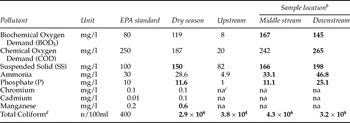
As shown in table 1, the pollution level of the river exceeds the standard values defined by the Environmental Protection Authority for discharging wastes into surface water bodies by a large margin, especially the values for biochemical oxygen demand (BOD), phosphate, suspended solids (SS), ammonia (NH3) and total coli form bacteria (Environmental Protection Authority, 2003). The metallic content of the wastewater is also higher than permitted based on Environmental Protection Authority standards. The table also indicates that pollution levels are higher in the middle and downstream areas of the river and during the dry and short rainy seasons. Furthermore, initial data on heavy metal contamination are alarming (Mekonen, Reference Mekonen2007).
Pollution level of the Little Akaki River in 1997/98a

Source: Environmental Protection Authority, 2003.
aFigures in bold show where the level of pollution is higher than the local Environmental Protection Authority, 2005 standard.
bFigures are the average for the dry and wet seasons.
cna = no data available.
dNo other data on pathogens (e.g., helminth eggs) were available.
2.2 Vegetable production
Vegetables are produced in different parts of the city using water from the Little Akaki River. In total, the survey found about 1,260 farm households producing vegetables with wastewater irrigation on about 1,240 hectares, most of them organised into farmer associations. On many sites along the upper and middle parts of the river, water is extracted upstream of the farm using a motor pump and is then transported by gravity, taking advantage of the topography of the area. Farmers use channels and furrow irrigation methods, and crop watering is performed by directly flooding the roots of the crops. This method is significantly less harmful in terms of potential health impacts for consumers. Because the water is applied to the soil, there is less contact with the leaves and thus less contamination risk for the crops than when they are sprinkled with watering cans, which is common in West Africa where the topography is less mountainous (Drechsel et al., Reference Drechsel, Graefe, Sonou and Cofie2006). The wastewater farmers mainly grow cash crops like lettuce, Swiss chard, cabbage, carrot, beet root and potatoes. About 61 per cent of all vegetables and 90 per cent of leafy vegetables in the city market come from urban farms (Kebede, personal communication, February, 2007). Due to its traditional status in the city, vegetable production is a common feature, without any legislation regarding the quality of inputs used, including irrigation water.
2.3 Data and sampling techniques
Data were obtained from surveys conducted in 2006 among a total of 415 farm households from both wastewater and freshwater farm areas.Footnote 3 Of these, 240 are wastewater farmers mainly using the Little Akaki for irrigation, and 175 are freshwater farmers using water from government-constructed dams. The two groups of farmers are located within 40 km of the centre of the city. The number of sample households from each group was determined based on a proportion principle. Wastewater farmers were sub-grouped into the Kolfe area (upstream of the river), the Lafto area (middle stream) and the Akaki–Addis and Akaki–Oromiya areas (downstream). A similar method is used to determine the number of households from each wastewater irrigation area. Accordingly, 98, 56, 46 and 40 farm households were included in the survey from the Akaki–Oromiya, Akaki–Addis, Lafto and Kolfe farm areas, respectively. Within the respective predetermined subsample, the selection of respondents was random, and an interview was carried out with the head of the household. Household- and individual-specific information was collected during our survey with the help of well-trained interviewers. In addition to diarrhoea and other skin disease or hepatitis, the medical record by the team addressed perceived illness due to intestinal parasitic infections such as hookworm and ascaris, which are typical challenges for wastewater farmers (WHO, 2006).Footnote 4
3. Empirical model
The theoretical foundation for analysing the health impact of wastewater use in crop production can be derived from the utility-maximising behaviour of the consumer and is subject to the conventional farm household production model, which was modified here via the addition of the health production functionFootnote 5 as described in detail in the online Appendix (http://journals.cambridge.org/EDE).
Wastewater use in irrigated crop production affects household income through its effect on land and labour productivity. The effect on land productivity can be positive due to the type and quantity of the nutrients of the wastewater used for irrigating crops or negative depending on its pollution level. The effect on household income can also be explained through the impact on the health status of family members working on the wastewater farm. In the latter case, wastewater might cause specific illnesses associated with wastewater. These diseases in turn reduce the labour productivity of the farmer due to absence from work and cause an individual to incur medical costs associated with treatment services. Epidemiological research that investigates causal effects requires a fundamental distinction between individuals ‘with’ and ‘without’ the risk factor. Under our approach, each individual farmer displays an outcome (illness), either with or without exposure to wastewater, which is considered the risk factor. We contrast the prevalence of illness in the individuals who make up these two groups (Jekel et al., Reference Jekel, Elmore and Katz1996).
We thus assume a counterfactual framework approach, as is commonly used to evaluate development programmes (Maddala, Reference Maddala1983; Wooldridge, Reference Wooldridge2002). In this approach, each individual farmer has an outcome (illness) either with or without exposure to wastewater. Following Maddala (Reference Maddala1983), we specify the following econometric model (illness model) to estimate health impacts:

where Y is the outcome variable and represents the farmer's illness, X is a vector of exogenous variables that are expected to affect the health of the farmer, β signifies the parameters of X, W is the treatment variable and ϵ is an error term. In equation (1) the effect of using wastewater in crop production is measured by the coefficient of the treatment parameter, α. We hypothesized that this parameter has a positive and statistically significant effect on Y, indicating that the likelihood of illness is significantly higher for farmers working on wastewater farms than those working on freshwater farms. We now turn to a discussion of the measurement and rationale for important variables within this model. This discussion also includes some of the econometric problems associated with the estimation of the model and the approaches that we chose to address these.
In this study, the outcome variable Y is farmers' self-reported illness with intestinal parasitic infections at least once within the year prior to our survey. Based on epidemiological studies on the health risk of wastewater use in agriculture, this is a binary variable that takes a value of one if the farmer reported illness due to intestinal parasitic infection within the specified period; otherwise, it is zero.Footnote 6
The indicator variable W is a dummy variable that takes the value of one if the household member works on a wastewater farm and zero if he works on a freshwater farm.Footnote 7 The pollution level of the Akaki River varies in different parts of the river. This variation implies that the severity of wastewater-related health risk may vary with the location of a farm within the wastewater area. Thus, because W is by definition a location variable it might in fact be correlated with the error term and therefore be endogenous to the model. If ignored, this factor would bias our results. This can be captured using a dummy variable for the different sites within the wastewater area. In spite of this correction, some correlation can still be expected between area-specific characteristics and the error term. Hence, a probit model with an endogenous regressor, in which W is endogenous, is estimated. The result can provide information regarding the level of illness prevalence when the model is estimated with and without controlling for the endogeneity of W.
The use of protection, i.e., special shoes and/or clothes during farming activities, can protect farmers from being exposed to parasitic helminthes found in soil and water (WHO, 2006). Thus, we expect that the incidence of illness will be lower for farmers who regularly use protective dress, especially boots, during farming than for those who do not. However, due to heterogeneity in unobserved exogenous factors, the use of protective measures can be correlated with individual behaviour (Rosenzweig and Schultz, Reference Rosenzweig and Schultz1983). For example, the awareness level of individuals regarding potential health impacts can affect the use of protective clothing during working hours on wastewater farms. Ignoring such individual behaviour when modelling illness may result in inconsistent point estimations for the variables because the use of protective dress may be correlated with the error term. Hence, equation (1) will be estimated using an instrumental probit model that takes the use of protective dress as the endogenous regressor. This will help us to examine the effects of the coefficients on illness with and without controlling for individual behaviour in terms of the use of protective measures.
Farmers' education level, their awareness of health risks to consumers and the availability of health centres near their villages are important factors affecting farmers' behaviour in using health inputs, which in turn affects the incidence of illness.Footnote 8 Diseases that are considered to be wastewater-related can also be caused by other risk factors, such as hygiene behaviour, environmental sanitation, water supply, diet and even genetic factors. To single out the impact of wastewater on a farmer's health, we need to control for these other risk factors inasmuch as they are related to behaviour.Footnote 9 Due to the absence of information on intra-family resource allocation, the amount of monthly vegetable consumption of the household is included in the illness model as a proxy for the financial status of each household.Footnote 10
Our final methodological concern is that income is an important determinant for the health production function of a farm household. However, the causality can work both ways: the health status of an individual may not only depend on but also influence his income level (Mullahy and Sindelar, Reference Mullahy and Sindelar1989). Therefore, both income and illness may be simultaneously determined, and this requires us to estimate the model using simultaneous equations. An instrumental variable (IV) estimation strategy is employed to address these econometric concerns. However, the use of IV estimation requires that the instrumental variables be good, i.e., they should be relevant and valid. Hence, the generalized method of moments (GMM) estimator is used as strategy for IV estimation (Hansen, Reference Hansen1982). Empirical evidence shows that job characteristics may affect individuals' decisions regarding whether or not to choose a certain job and, in turn, their income (Mullahy and Sindelar, Reference Mullahy and Sindelar1989). For example, in our study area, the health risk associated with working on a wastewater farm may affect the decision to work on such a farm. Therefore, the exclusion of family members not working on irrigation farms may bias the model outcome and generate inconsistent results for the parameters. To address this issue, we estimated a probit model whose aim was to investigate whether or not there are significant differences in individuals' decisions to work on irrigation farms due to differences in the quality of the irrigation water.
4. Results
4.1 Basic characteristics and prevalence of illnessFootnote 11
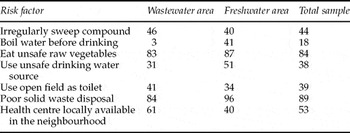
The two groups of farmers differ in their basic characteristics. An average wastewater farm household has 5.6 family members, of which 3.6 were of productive age (between 15 and 64 years of age). While 62 per cent of the wastewater irrigators are originally from other areas (ethnically Gurage and Amhara), 78 per cent of the freshwater irrigators are locally Oromo ethnic. The housing situation of wastewater households was also relatively better in terms of material and number of rooms per person. Households in the wastewater area were more urban-based, better educated, had better access to health centre and safe domestic water source and sanitation services (see table 2). However, generally, the study area is a haven for many risk factors that can cause illness.
Risk factors for illness attributed to farmers working on irrigation farms within and around Addis Ababa in 2006 (per cent of respondents)

Source: Survey results.
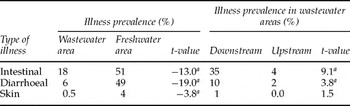
The most common illnesses reported by farmers were intestinal nematodes, diarrhea and skin disease, but these varied significantly between the wastewater and freshwater areas. The reported prevalence of intestinal illness due to hookworm or ascaris infection was significantly less in wastewater areas (18 per cent) than in freshwater areas (51 per cent) (see table 3). It was also higher for farmers working in downstream than upstream wastewater farm areas.
Prevalence of perceived illness among farmers working on irrigation farms within and around Addis Ababa in 2006

aSignificant at <1 per cent.
Source: Survey results.
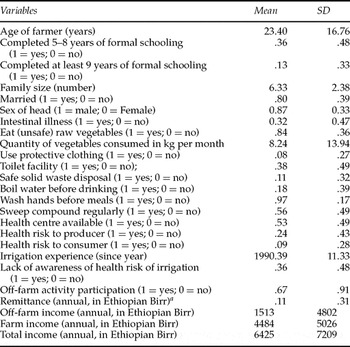
Table 4 shows the descriptive statistics for variables included in the econometric estimations and explains the mean characteristics of irrigators. In the survey, the average farmer was 23 years old, and started working on an irrigation farm in 1990 (standard deviation (SD) = 11 years of experience). The mean monthly vegetable consumption per household was 8.2 kg. At least 84 per cent of family members consumed unsafe raw vegetables, but only 8.8 per cent perceived that eating raw vegetables entailed health risks. The average total annual household income was Birr 6,425, of which about 70 per cent came from crop production and 30 per cent from off-farm activities and remittance. In 44 per cent of farm households, at least one family member had off-farm employment. While at least 36 per cent of farmers were aware of the health risks of working on irrigation farms, only 8 per cent of the farmers were protecting their bodies using protective measures while working. Major impediments to using protective dress as reported by farmers were lack of awareness, lack of affordability and the inconvenience of the available clothing technology.
Descriptive statistics of variables included in the probit regression across all groups of farmers

a1 $USD = 8.62 Ethiopian Birr.
Source: Survey results.
Furthermore, the majority of upstream wastewater irrigators believed that working on wastewater farms did not pose any particular health risks and that they therefore did not need special protective dress.
4.2 Econometric results
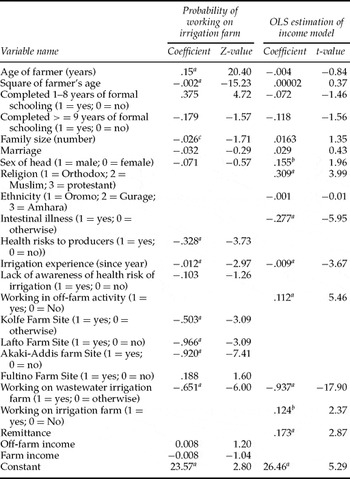
To estimate the health impacts of wastewater use in crop production, we followed the strategy employed by Mulley and Sindelar (Reference Mullahy and Sindelar1989). We estimated different econometric models under different econometric assumptions as discussed in the empirical section. Table 5 shows the results obtained using the reduced models of individuals' decision to work on irrigation farms and household income. Our focus in estimating the probit model for individuals' decision to work on irrigation farms is to investigate the correlation between this factor and job characteristics. The log pseudo likelihood and pseudo R2 of the probit model show that the model predicts the individuals' decisions to work on irrigation farms very well (column 1, table 5). As expected, individuals consider certain job characteristics when deciding to work at a given job. All of the variables for explaining job characteristics, including the awareness of health risk to producers and working in wastewater farm areas, are statistically significant at the one per cent probability level. Family members who are aware of the health risk of working in irrigation are less willing to work on irrigation farms compared to those who are less aware of the risk. Similarly, family members living in wastewater areas are less willing to work on wastewater farms compared to those living in freshwater farm areas. Wastewater site dummies (Kolfe, Lafto and Akaki–Addis) have a negative sign, showing that family members living in these areas are less likely to work on irrigation farms compared to those living downstream from wastewater irrigation farms. Perhaps this is due to the smaller farm size at these wastewater farm sites, which thus do not require increased labour input for farming.
Household members' decisions to work on irrigation farms and determinants of household income

aSignificant at <1 per cent; bsignificant at <5 per cent; csignificant at <10 per cent.
Source: Survey results.
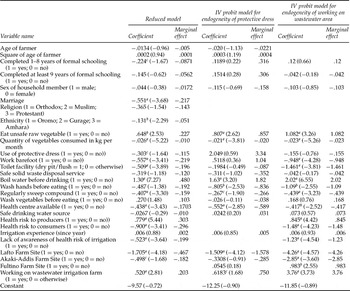
Column 2 of table 5 shows the STATA software output from the ordinary least squares (OLS) estimation of household income, a dependent variable, as explained by illness, the dummy for wastewater farm area, working on an irrigation farm and other demographic and economic variables. Our intention here is to examine the correlations among income, health status and wastewater farms without controlling for the structural relationship. As expected, off-farm work activities and remittances significantly increase household income. Irrigation also has a positive impact on household income in our study area. Similarly, living in the wastewater area significantly reduces household income as compared to living in freshwater irrigation areas. This could be due to the land and/or labour productivity effect of wastewater. Reported illness has a negative and significant (at least at one per cent significance level) effect on household income. The result of the illness reduced model is reported in column 1 of table 6. The z statistics are based on bootstrap standard errors estimated with 200 replications. The model is estimated without controlling for the endogeneity of use of protective dress and differences in unobserved farm location-specific characteristics. First, we examine the effect of the explanatory variables included in the illness reduced model using the marginal effect result of the coefficients. Later, we will relax this assumption and investigate the effect of the explanatory variables on illness. Education had a significant negative effect on reported intestinal illness: irrigators who attended primary school (had 1–8 years of formal schooling) had a significantly lower probability of illness than those who were illiterate. Similar demographic variables (marriage, religion and ethnicity) had a negative effect on illness. Only some of the epidemiologically important risk factors (toilet, health centre and compound sweeping) explaining intestinal illnesses were actually significant in explaining the probability of illness in this equation. However, source of drinking water and the mode of solid waste disposal played no significant role in explaining intestinal illness.
Determinants of the probability of illness (and z-statistics) for members of farm households working on irrigation farms (dependent variable: farmers' perceived intestinal illness)

a Significant at <1 per cent; b significant at <5 per cent; c significant at <10 per cent. Figures in parentheses are z-statistics.
Source: Survey results.
The hygienic characteristics of irrigators (eating unsafe raw vegetables and boiling water) have significant effect on illness prevalence. The sign for boiling water before drinking is inconsistent with our expectations. This result may have emerged because the water that must be boiled is initially unsafe for human consumption and the households may not boil it properly, or because there exist other infection routes. Vegetable consumption (the amount of vegetables consumed in kilograms) significantly reduced the incidence of illness, as expected. Individual behaviour and perceptions regarding the health risk of wastewater for farmers and consumers and overall awareness exhibited significant effects on the prevalence of illness: the rate was significantly increased, by 0.30, among wastewater irrigators who perceived the health risks as existing only for producers. In addition, the likelihood of being ill was 0.199 lower among farmers who were aware of the overall health risks compared to those who were not. This result shows that efforts to increase the awareness of farmers regarding the health risks of wastewater reuse can significantly reduce the illness rate.
Assuming that the use of protective dress was not correlated with other aspects of individual behaviour, using protective clothing during farm work had modest effect (statistically significant at 10 per cent) on illness. It means that illness prevalence was somewhat less likely for those who were less exposed to intestinal parasites in soil or irrigation water because they wore protective dress during farm work. Working in farm areas with bare feet did not have the expected sign, though it was statistically significant (p < 0.01).
Site dummies had negative and significant effects on illness, indicating that illness prevalence was less likely for those working on farms located in less-polluted areas (Lafto and Akaki–Addis wastewater sites) than for those working on wastewater farms (Akaki–Oromiya site), where the pollution level was higher. The z statistics for each dummy farm site show that the illness rate increased with the pollution level: the predicted probability of illness decreased by 0.47 for farmers in the Lafto area and by 0.18 for farmers in Akaki–Addis compared to farmers working on downstream wastewater farms (Akaki–Oromiya). The dummy for working in a wastewater farm had a positive and significant effect on illness prevalence. Hence, the prevalence of illness was significantly (0.20) higher for people working on wastewater farms than for those working on freshwater irrigation farms.
However, the above interpretations are made assuming that the choice between working on wastewater or freshwater farms was determined exogenously and that the reduced model is a correct specification. This may not be the case. To address this concern, we estimated two other probit models with endogenous regressors: protective dress use and working on wastewater irrigation farms (see table 6). Column 2 of table 6 shows the results of the IV estimation of a two-step probit with protective dress use as an endogenous regressor. Variables including awareness, education level, family size, gender of family head, marital status, religion and ethnicity were used as instrument variables for the use of protective dress during farm work.
The outcome of the model revealed some interesting points. First, the exogeneity of use of protective dress was rejected below the five per cent probability level with a Wald chi-square of 4.49. This means that individual behaviour was correlated with the use of protective dress during farm work. Second, the coefficient for use of protective dress was changed from the corresponding estimates, as shown in column 1 of table 6. In the reduced model, it had a negative sign and modest effect, but once we controlled for individual behaviour, it had no significant effect whatsoever. Third, the point estimate of the health effect of working on a wastewater farm changed both in magnitude and significance level compared to the estimate from the reduced model; the marginal effect was 0.75 in the IV model at the 10 per cent significance level. In the reduced model, the effect of working on a wastewater farm was 0.2 at the 1 per cent significance level. The other variables, except the dummy for working barefoot, remained the same. This implies that estimating the monetary cost of the health effect of using wastewater for irrigation without controlling for individual behaviour results in biased estimation results. We thus conclude that when estimating the health effect of working on a wastewater farm, we need to account for individual behaviour to obtain consistent estimation results.
Similarly, column 3 of table 6 shows the results of the IV estimation of a two-step probit with working on wastewater farms as the endogenous regressor. Variables including age, age squared, education, family size, marital status, religion and the ethnicity of the farmer were used as instrument variables. The outcome of this IV probit model also makes interesting points. First, the exogeneity of working in wastewater irrigation farms was rejected at a probability level of less than one per cent with a Wald Chi-square value of 13.7. Second, its sign remained positive, but the magnitudes of the coefficient and z statistic were larger than the corresponding figures in the reduced model. The other variables remained the same as those of the reduced model. This also implies that unobserved location-specific characteristics should be controlled to obtain unbiased estimates of the health effect of working on wastewater irrigation farms. It is important to note that the results of the different illness model specifications suggest that working on a wastewater farm will result in significantly increased prevalence of illness compared to working on a freshwater irrigation farm.
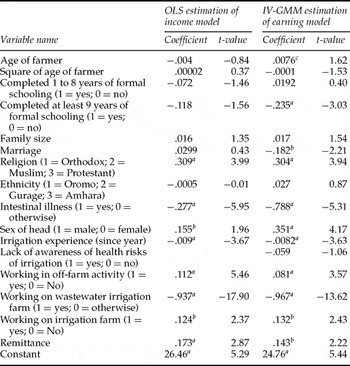
Certainly, this health impact is reflected in the income of the household, hence the monetary value of this effect should also be estimated. As discussed before, due to the (structural) relationship between income and health status, we employed the IV estimation strategy using the GMM estimator; the result is reported in table 7, column 2. The focus here is twofold: to examine the simultaneity of income and health status and the income effect of illness due to wastewater use in crop production when controlling for simultaneity and when not doing so.Footnote 12
OLS and GMM estimations of determinants of household income

aSignificant at <1 per cent; bsignificant at <5 per cent; csignificant at <10 per cent.
Source: Survey result.
As can be seen from table 7, the point estimate for the coefficient of intestinal illness in the GMM specification remains negative but has a larger magnitude (tripled) than the corresponding OLS specification. There is only a small change in the t statistics. Similarly, the point estimate for the coefficient of working on a wastewater farm has the same negative sign and shows little change in magnitude compared to the corresponding point estimate from the OLS specification. The other covariates have the same sign and significance level in both specifications. The Hasen–Newey overidentification test statistics of 252.976 and the critical value of 0.000 indicate that the GMM instrumental variable result is more informative than the OLS estimation.
4.3 Value of health damage from wastewater
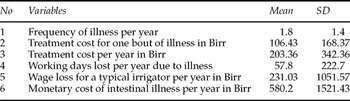
The monetary value of the health impact of wastewater use in crop production can be determined using the results from different models reported previously. It is measured by the time spent away from farm work due to illness, i.e., the opportunity cost of the farmer's time spent in bed and visiting local clinics (Grossman, Reference Grossman1972).Footnote 13 Household members who are sick with intestinal illness will incur, on average, charges of Birr 106.43 while treating one bout of illness (see table 8). Farmers reported that the mean frequency of illness is 1.8 occurrences per year. Thus, for a household member in the study area, intestinal illness treatment costs Birr 203.36 per year, on average. In addition, farmers reported that an individual who experiences illness on this level will not be able to work for an average of 57.8 days per year, which seems to be exaggerated. With a shadow wage rate of Birr 5 per day for the study area, the wage loss from absence from work due to illness will be Birr 231.03 on average.Footnote 14 The mean annual total cost of intestinal illness for an average household member who works on an irrigation farm should thus be Birr 580.20 with a standard deviation of 1521.43.
Annual monetary value of health cost from intestinal illness

Source: Survey result.
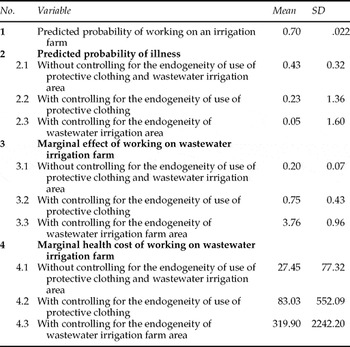
The health impact of working on a wastewater irrigation farm for a typical household member is the marginal effect on the perceived intestinal illness of the household member. Its monetary value should be estimated based on the marginal health effect of working on wastewater farms as obtained from the various models with and without controlling for the endogeneity of using protective dress and unobserved farm area characteristics. Accordingly, the result derived from the reduced model reported in table 5, column 1 predicts that the probability of working on an irrigation farm is 0.7 (see table 9, row 1). Using the illness reduced model, the predicted probability of a farmer's being ill with intestinal parasitic infection would be 0.43, and the marginal effect of illness of working on wastewater farm would be 0.2 (see table 9, rows 2.1 and 3.1). This means that for the predicted probability of working on irrigation farms, the probability of illness is 0.2 higher for family members working on wastewater farms compared to those working on freshwater irrigation farms. In monetary terms, a wastewater household member working on an irrigation farm who suffered from intestinal illness would have to spend Birr 27.45 more than a freshwater household member working in irrigation (see table 9, row 4.1). This is the marginal cost of illness due to the use of wastewater for irrigation without controlling for the use of protective dress or area-specific characteristics.
Monetary cost (in Birr) of working on a wastewater irrigation farm

Source: Survey results.
Controlling for differences in individual behaviour, the prevalence of illness would be 0.75 higher for household members working on wastewater irrigation farms than for those working on freshwater irrigation farms. This will cost farmers working on wastewater farms Birr 83.03 more than those working on freshwater farmers. Furthermore, controlling for the unobservable difference in farm location characteristics, the marginal effect of working on a wastewater farm on farmers' illnesses becomes 3.76 higher. This change entails an increase in cost of Birr 319.90 for household members working on wastewater irrigation farms compared to those working on freshwater farms. This is higher than the marginal costs estimated from the reduced illness model and from the model specification estimated by controlling for unobserved farmer behaviour. We are trying to develop a monetary estimate of the cost of perceived illness. However, we are aware that this concept can be questioned from an ethical point of view, which is why many health economists use indicators such as disability adjusted life years (DALYs) to measure the cost of illness (Drummond et al., Reference Drummond, O'Brien, Stoddart and Torrance1997). Still, we believe that deriving this monetary value using our approach can provide valuable information within the context of a discussion on how best to decrease the prevalence of illness among operators.
5. Conclusions and policy implications
This study investigated the health impact of using wastewater for crop production in farm households in central Ethiopia. From an economic policy point of view, disaggregation of the benefits and costs associated with the use of wastewater in crop production is essential, as it can provide reliable information about balancing health costs with livelihood benefits for farm households and city residents. For the majority of farm households, vegetable production using wastewater is a major source of income. An average wastewater farm household earns a net income of Birr 4448 per year, of which about 70 per cent comes from the wastewater farm. The study findings suggest that working on a wastewater irrigation farm significantly increases the prevalence of illness, which in turn reduces household income. However, estimating the monetary value of the health impact of wastewater irrigation entails econometric complications. This is due to the unobserved characteristics of farm location, the endogeneity of individual behaviour in using protective dress and the structural relationship of household income and health status. Therefore, we estimated different econometric model specifications to account for these different complications. The results from the different estimates have implications.
First, all model specifications revealed that household members who work on wastewater irrigation farms incur higher monetary costs than those working on freshwater irrigation farms. This stems from the higher probability of reported illness for wastewater irrigators due to the health risk associated with wastewater. Second, estimation of true monetary value requires that farmers' behaviour and area-specific characteristics be controlled for. Otherwise, the health effect of wastewater use for irrigation may be underestimated when such behaviours are not accounted for. Our finding shows that the monetary cost of working on wastewater irrigation farms is at least three times lower than if it is estimated without controlling for such individual behaviour. Similarly, ignoring the difference in unobservable farm area-specific characteristics may also result in underestimation of the monetary value (by at least 11-fold). The third implication comes from the complication of estimating the monetary cost of wastewater due to its effect on the health of farmers, which, in turn, affects household income. The two-way relationship between household income and health status may also result in biased estimates unless this structural relationship is controlled. The difference in the magnitude of the illness coefficient obtained from the instrumental variable (GMM estimator) and OLS model specifications revealed that in estimating the reduction in household income due to the health effects of wastewater use in crop production, it must be considered that individual behaviour and unobserved area characteristics can affect both income and health status simultaneously. Our results revealed that the effect of illness on household income is three times lower when estimated ignoring the structural relationship between income and health status.
In addition, ignoring the role of job characteristics in household members' decisions regarding labour allocation may underestimate the implied income effect of the health cost associated with wastewater. This suggestion emerges from the results of the probit estimation of individuals' decisions to work on irrigation farms, which is in line with the findings of Mullahy and Sindelar (Reference Mullahy and Sindelar1989), who concluded that ‘the effect of health (mental disorder) on earnings may be distorted when analysing earnings without reference to occupation’. In our study, it appears that household members optimize the trade-off between the job characteristics associated with wastewater irrigation farming activity and income.
Because these different econometric complications have been well addressed, some policy implications can be drawn from our study findings. Due to the increase in volume of wastes discharged from industries and residents of the city, the health effect of Akaki polluted river water increases as one works on farms located downstream of the river (and the city). This implies that it is important to design policies that prevent polluters from discharging their wastewater without treatment and pass enforceable legislation regarding the proper disposal of wastes. In designing such policies, special consideration should be given to certain industries. These industries mainly include tanning, leather and leather products, textiles and beverage production; as described in this paper, these are the major polluters of the river, and wastewater from such industries is hazardous to human health. In addition, the significant effect of individual behaviour, e.g., awareness of the health risk of working on wastewater farms, indicates that designing policies and programs that enable farmers to operate safe wastewater-irrigated farms and that increase their awareness of the health risk associated with unsafe use of wastewater will make an important contribution toward minimising the health risks and maximizing the benefits of this resource. Moreover, the statistically significant effects of the epidemiological variables, such as access to improved sanitation services and improved hygienic behaviour of farm households through education, could also contribute to reduced health risks for farming families.
A number of issues have been excluded from our study that should be considered in future research on the health impact of wastewater use in agriculture. Further studies should look at epidemiological evidence as all results presented here depend on the accuracy of perceived illness in a certain recall time, which has its natural limitations. Further studies could then also try to evaluate the risks to consumers and the nearby communities to estimate the health cost to society. Moreover, our study considered only reported intestinal illness due to worm infections. Actual infection rates and lost days may differ from what farmers reported. Illnesses such as diarrhoea, skin diseases and hepatitis, which can be caused by wastewater but also by inadequate sanitation or hygiene behaviour, were excluded from our estimate despite their prevalence in the study area, probably leading to an underestimation of actual health costs. Our final point is that the value of illness should ideally be weighed against the benefits from wastewater use in agriculture at the household level as well as at the level of society to identify the welfare contribution of wastewater as a resource.