

The advent of radical Islamist groups, the birth of ISIS, and several violent events in the last 15 years shows that ideologies and emotions are strictly associated with political violence. However, do these intangible factors have concrete roles in the process of armed mobilization and in the management of armed groups? Or are they simply epiphenomena?
Although classical studies on revolutions often acknowledged the ideological implications of those phenomena and research on armed groups performed during the Cold War was mainly focused on Marxist insurgencies, most contemporary social science literature on armed mobilization, civil wars, and terrorism neglects the role of emotions and ideologies, developing behavioral models that mostly focus on material factors. Journalists and policy makers tend to assume that emotions, ideologies, and political violence are somehow intertwined, but rigorous scholarly work on this very topic is still underdeveloped. This symposium aims to go beyond structural and material explanations of conflict and mobilization. The following contributions focus on agency and provide diverse angles on the relations between emotions, ideologies, and political violence. We argue that including emotions and ideologies in our theoretical frameworks will allow us to unpack the decision-making process that leads individuals from accepting the status quo to mobilizing and opting for political violence. It will also help us understand the behavior of armed actors once individuals have been mobilized. Moreover, we suggest that ideologies and emotions should be studied together and researchers should further theorize their possible feedback and interactions. The experience of specific emotions can facilitate certain ideologies being ingrained (see Petersen in this symposium) and, vice-versa, the presence of ideological frameworks may amplify or limit the experience of certain emotions (see Nussio in this symposium). This could possibly lead to theoretical circularity and empirical endogeneity, but the above issues are too relevant to avoid tackling these challenges.
EMOTIONS, IDEOLOGIES AND VIOLENCE: WHAT WE KNOW SO FAR
Emotion can be defined as the by-product of an event that occurred or could occur that influences a person’s individual status, especially in terms of feeling or perception. Emotions are the residues of experience (Petersen Reference Petersen2011). Ideology, instead, is “a set of political beliefs that promotes a particular way of understanding the world and shapes relations between members of a group and outsiders, and among members themselves” (Ugarriza and Craig Reference Ugarriza and Craig2013, 450). This definition is not confined to classical nineteenth century political ideologies, but rather capable of including ethno-nationalistic ideologies as well as religious ideologies. Moreover, it is crucial to recall how classical studies stressed that ideologies are action-oriented systems of ideas (Sartori Reference Sartori1969).
A wide range of positive and negative emotions and ideologies exists. Some emotions are about the past, caused by something that has already happened, while others are caused by the expectation of something that could happen in the future. The expectation of a future event can cause an emotion based on past direct or indirect experience. Furthermore, some emotions are triggered by a fact that occurred to the person who experiences the emotion, whereas others are triggered by something that happened to another person. While studying the process that leads individuals to choose different forms of armed rebellion, the effects of negative emotions, as a reaction to perceived wrongdoings, are especially important.
While studying the process that leads individuals to choose different forms of armed rebellion, the effects of negative emotions, as a reaction to perceived wrongdoings, are especially important.
Fear is probably the most studied emotion in its relation to political violence, especially in explanations of ethnic conflict. It is implicitly present in Posen’s (1993) theory based on the application of the security dilemma to situations of internal anarchy. In Kaufman’s (2001) approach, ethnic fears are necessary preconditions of ethnic conflict, even though they can be purposefully created by decisions of the elites.
Petersen (Reference Petersen2002) presents a comprehensive explanatory theory of ethnic conflict based on emotions and offers testable hypotheses linking fear, hatred, resentment, and rage to violence against specific ethnic targets in multiethnic contexts. In Petersen’s model, emotions produce changes in the saliency of desires and explain violent action to satisfy the new desires following structural changes. McDoom (Reference McDoom2012) studies ethnic conflict in the case of the 1994 Rwandan genocide and claims that fear causes group polarization, which may turn into group violence. Pearlman (Reference Pearlman2016) describes situations marked by intense fear of another group or fear of the regime in the first phase of the Syrian uprising. However, fear does not have a unidirectional effect on behavior. Fear can push individuals to fight or flight. Future research should investigate the circumstances under which fear makes people fight, rather than flight.
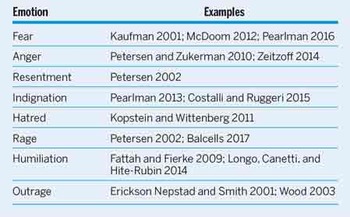
Other emotions that have been considered in studies (see table 1) on the causes of violent mobilization include rage, hatred (Petersen Reference Petersen2002; Kopstein and Wittenberg Reference Kopstein and Wittenberg2011), and moral outrage (Erickson Nepstad and Smith 2001; Wood Reference Wood2003). Costalli and Ruggeri (Reference Costalli and Ruggeri2015) focus on indignation, which emerges when an actor, B, perceives that actor/organization A has unjustly harmed an individual or group C. Consequently, B feels indignant toward A (Elster Reference Elster1998). Footnote 1 In our view, emotions triggered by events that happened to other persons (such as indignation) are especially important in explaining political mobilization because they rely on shared normative conceptions of good and evil. Emotions that involve three actors (the agent, the victim, the bystander) highlight the feeling of being part of the same community. The study of emotions and mobilization covers several emotions (see Goodwin and Jasper Reference Goodwin, Jasper, Stets and Turner2006), however emotions are rarely unpacked systemically. Hereafter we report some of the emotions usually analyzed when studying violent political mobilization.
List of Emotions Related to Violent Political Mobilization Footnote 2
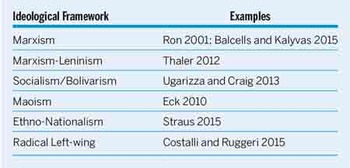
Ideologies have obviously been the central topic of a huge theoretical literature (see table 2), but only a few empirical studies have tried to assess their role in civil conflict (Sanin and Wood 2014). Ron (Reference Ron2001) shows that Sendero Luminoso’s political ideology shaped the group’s use of violence during the Peruvian civil war, while Thaler (Reference Thaler2012) argues that ideology helps explain the choice between selective and indiscriminate violence by the insurgents in Mozambique and Angola. Ugarriza and Craig (Reference Ugarriza and Craig2013) demonstrate that ideology influences the internal cohesion of armed groups in Colombia and Eck (2010) reveals that the Communist Party of Nepal-Maoist systematically indoctrinated the inhabitants of rural areas to build a common Maoist identity and stimulate recruitment. Balcells and Kalyvas (Reference Balcells and Kalyvas2015) compare domestic conflicts fought by Marxists and non–Marxist groups highlighting that, paradoxically, the highly committed Marxists tend to survive longer as rebels but have higher chances of losing the war. In a similar vein, Staniland (Reference Staniland2014), by focusing on the insurgents’ cohesion and collapse, shows how rebel groups characterized by vanguard ideologies such as Leninism tend to face important challenges when fighting against heavily armed governmental forces. Straus (Reference Straus2015), in his theory aiming to explain genocide in modern Africa, stresses that preexisting ideological frameworks affect elites’ responses to political threats: “Material conditions […] matter for how threat is experienced, but ideological frames shape how elites understand the terms and stakes of a conflict” (Straus Reference Straus2015, 11).
List of Ideologies Related to Violent Political Mobilization Footnote 3
EMOTIONS, IDEOLOGIES AND VIOLENCE: POSSIBLE MECHANISMS
We believe that both emotions and ideologies are important to understand the outbreak of civil war and violent political mobilization in general, including terrorism. In previous work (Costalli and Ruggeri Reference Costalli and Ruggeri2015), we have elaborated on this idea by offering a theoretical framework where some emotions—such as (but not limited to) indignation—emerge in individuals following a shock and act as push factors, detaching them from the social and political context in which they find themselves. Through political entrepreneurs, ideologies act as pull factors, translating private grievances into public grievances and connecting the individual to the aggregate level. Transformative ideas previously shared by a small group of strong believers can thus reach a broader audience.
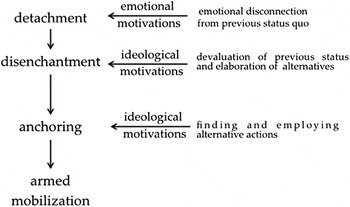
In figure 1, we show the mechanisms by which emotions and ideologies may influence a change in individual actions. Some emotional shocks make individuals available to consider alternatives to the current state of affairs, stimulating their will to change (detachment mechanism). Ideologies communicated by political entrepreneurs help to rationalize the emotional shift and elaborate alternative worldviews (disenchantment mechanism), as well as possibilities for action. The alternative ideological framework provides a new base for normative values and the conduct of action through the “anchoring” mechanism, which can be understood as a pull factor attracting individuals to a new status. The role of ideologies, however, goes beyond the framing and formation of collective grievances. Ideologies provide road maps, including different strategies to reach their goal.
Individual Decisions’ Mechanisms, Emotions and Ideologies
Thus, neither all emotions nor all ideologies are equally effective in producing violent political mobilization. Different ideologies imply different goals, strategies, and organizational forms to change the status quo. When transformative ideologies imply the use of violence, violent action will likely occur—though in different forms and with different intensity depending on the size of the mobilized group—ranging from terrorism to civil war. Ideological networks play an essential role in the process of collective armed action because the aggregation process from individual discontent to collective action develops within and thanks to such networks. Through ideological networks, political entrepreneurs translate ideas into practice, providing new worldviews as well as financial, organizational, and military resources. For ordinary people (followers of political entrepreneurs), the existence of rebel networks is essential to providing not only information and political meaning to the current situation, but also practical assistance.
Not all networks, however, are the same. Some networks are more effective than others in sustaining an armed rebellion. As we mentioned, different ideologies imply different goals, strategies, and organizational forms to change the status quo. For instance, not all ideologies imply underground networks, and those that do can create different types of networks. The importance of ideological networks further increases the need to distinguish among ideologies.
Ideological networks play an essential role in the process of collective armed action because the aggregation process from individual discontent to collective action develops within and thanks to such networks.
Thus, if emotions and ideologies play crucial roles in stimulating and organizing violent armed mobilization, it is crucial to introduce some specifications. The first basic analytical distinction is between ideologies that support the status quo and ideologies that encourage change. Clearly, this distinction is context-specific because the same ideology can support the status quo or its subversion depending on the identity of the elite in power. Then, we need to distinguish ideologies according to the relationship they have with the use of violence as a means to reach their goals. Moreover, we can distinguish between those ideologies that focus on the role of individuals as their agents and targets and the ideologies that focus on groups. In other words, in some ideologies the individual is superior to the group, while in others it is subordinated to the collectivity. The context is also important in evaluating the consequences of emotions, because the same emotions can vary in effectiveness in stimulating detachment and will for change depending on the culture of the individual or on the ethnic composition of the society. For instance, some studies argue that humiliation is a particularly powerful emotion in specific cultural contexts (Nisbett and Cohen Reference Nisbett and Cohen1996; Longo, Canetti, and Hite-Rubin Reference Longo, Canetti and Hite-Rubin2014), while resentment defined in ethnic terms (Petersen Reference Petersen2002) was simply not applicable in Italy in the 1940s (Costalli and Ruggeri Reference Costalli and Ruggeri2015).
EMOTIONS, IDEOLOGIES, AND VIOLENCE: THIS SYMPOSIUM
In this symposium, Enzo Nussio reflects on how ideology can channel emotions and, in turn, affect armed mobilization. His contribution warns about the indeterminacy of emotions as individual attributes. In fact, the same shock can cause different emotions in the same individuals and the same emotion can lead to different behavioral reactions across individuals. Thus, Nussio suggests theorizing about the “net effect” of emotions on armed mobilization. However, he suggests that ideology can provide an organizational framework even when facing “emotional heterogeneity” among individuals.
Roger Petersen responds to several critiques often addressed to research on emotions and conflict stressing that emotions always need to be considered the residue of lived experience. Studying the role of emotions, it is crucial to understand the specific circumstances under which emotions emerge. Empirical studies have found that communities who are exposed to systematic policies experience powerful collective emotions. Moreover, Petersen stresses that the link between emotions and ideologies can be complex and can change in different situations. He emphasizes that emotions can create and reinforce identities where, then, ideologies take hold.
The relationship between individual and group-level emotions is also investigated by Jacquelien van Stekelenburg, who claims that emotions are socially constructed and can be communicated to other individuals. The effectiveness of communication strictly depends on the identification of individuals with the group. Van Stekelenburg also argues that emotions can transform over time and that intergroup violence erupts only if anger and contempt transform into disgust.
Daphna Canetti explores the consequences of exposure to violence. Empirical evidence shows that prolonged exposure to political violence causes high levels of distress. Countries that are exposed to long periods of violence often develop an ethos of conflict, a specific ideology that is likely to decrease support for peaceful solutions. Hence, emotional distress caused by exposure to violence can lead to political radicalization through the lens of a conflict ideology. Thus, repeated waves of violence are likely to create barriers to peace in prolonged conflicts due to a combination of emotions and ideologies.
Francesco Moro argues that the leaders of armed groups can purposefully incorporate the emotions of their members into organizational narratives to create “foundation myths” that permeate their organizational cultures. Insurgent organizations, in other words, tend to institutionalize events that can trigger individual emotional responses to build their own legitimacy as effective representatives of grievances. Ideologies, instead, are institutionalized through processes of specification and adaptation. Different levels of adaptation and specification can help explain remarkable differences in the organizational setups and operational strategies among similar groups.
Livia Schubiger and Matthew Zelina hold that variation in ideological intrusiveness and institutionalization can help explain armed groups’ cohesion, governance, and violence. Ideological intrusiveness refers to how broadly and deeply an ideology penetrates private, political, and economic lives of civilians. Ideological institutionalization, instead, varies according to the degree to which armed groups’ institutions ideologically saturate the everyday life of combatants. Ideology also offers a system of emotional management, especially under extreme conditions. However, leaders can purposefully aim to trigger emotions to make individuals prone to assimilate specific values and ideas during indoctrination. Thus, taking emotions and ideologies seriously in the study of political violence can also illuminate the cohesion and strategies of armed collective actors.
Overall, the contributors tackle challenges and elaborate insights on studying emotions and ideologies to understand violent political mobilization. Five main issues emerge from the symposium: 1) a reflection on the analytical level where emotions and ideologies influence mobilization (individual vs. collective); 2) whether the effects of these ideational factors are context-specific (specificity vs. generalization); 3) whether political entrepreneurs can only use them instrumentally or whether emotions and ideologies shape norms (instrumental vs. normative); 4) whether they only affect organizational aspects or also action tendencies (organization vs. practices) and 5) whether a conditional relationship between ideologies and emotions affects violence (conditionality vs. additivity). Clearly this symposium is just exploring an understudied field of inquiry and we hope its pieces will trigger a necessary debate among scholars studying collective political violence.
ACKNOWLEDGMENTS
We thank the Independent Social Research Foundation (ISRF) for funding the workshop we organized in Cambridge (UK), July 2016, which has led to this symposium. We also thank Adam McCauley for research assistance and comments.



