INTRODUCTION
Basal cell carcinoma (BCC) and squamous cell carcinoma (SCC) are the most common subtypes of non-melanoma skin cancers (NMSC).Reference Lomas, Leonardi-Bee and Bath-Hextall 1 , Reference Eisemann, Waldmann and Geller 2 The incidence of NMSC is on the rise in South-East Asia and present mostly on the facial, head and neck regions because of environmental factors, genetics and hygienic conditions. BCC and SCC are best treated either by surgery or brachytherapy. Most of the cases of NMSC occurrence are on the face and neck; therefore, because of cosmetic reasons surgery is not the best option.Reference Mohs 3 Normally, surgery is best suited when adequate margins and wound closure can be achieved to resect the tumour; however, in some sensitive areas of the skin—for example, the inner canthus of the eye, lower eye lid and nose—in which surgery is difficult, a plastic surgeon may have to carry out reconstructive surgery. In such cases, radiotherapy is the best treatment option in comparison to surgery. 4 , Reference Caresana and Giardini 5 High-dose-rate (HDR) brachytherapy with an Iridium-192 (192Ir) source has been used to treat BCC and SCC patients superficially with custom-made moulds prepared and designed according to lesion shape and size. In our treatment procedure, wax moulds were prepared for each patient, irrespective of shape and size, according to superficial skin contour. All patients with a biopsy report confirming BCC or SCC and with tumour margins not greater than 2 mm–3 mm deep were accepted for treatment. As our treatment modality of brachytherapy was an 192Ir source, lesions with the risk for tumour depth being more than 4 mm were not treated superficially because of a high dose gradient. Thus, for a typical diagnosis and treatment of 3 mm lesion, the surface dose will reach ~130%. 192Ir is a radionuclide with a high specific activity, which means that a very small source can provide a very high dose rate. Its photon energy is 350 KeV, which ensures a sufficient absorbed dose at a sufficient distance from the source to treat the target homogeneously.Reference Tormo, Celada, Rodriguez, Botella and Ballesta 6 Cases with deep margins are treated either with ortho-voltage X-ray beams having energy 50–150 KV or with high-energy electron beams.Reference Wong and Wang 7
At the Institute of Radiotherapy and Nuclear Medicine (IRNUM) cancer hospital, the Nucletron®(ELEKTA,Veenendaal, The Netherlands) brachytherapy machine was installed after commissioning on 30 June 2012.The first patient was enrolled for treatment on the 1 July 2012, and the last patient was treated in June 2014. Before receiving HDR brachytherapy, patients were treated using the low-dose-rate brachytherapy technique in which live-source needles were submersed in the affected area. In this mode of treatment, the patients as well as the surrounding attendants receive unnecessary radiation exposure. In our treatment technique, the patient was laid down on a couch for treatment and a conventional source applicator prepared of wax was placed on the lesion. Flexible implant tubes were attached to the wax mould along with the source applicator using the Flexitron® (ELEKTA-Brachytherapy) remote after-loading system. The advantage of this brachytherapy system is that the patient does not receive an extra dose, nor does the radiotherapy technician get exposed to any kind of radiation. During treatment the patient is observed from outside the bunker through a video camera. There is no surgical procedure involved; only a superficial adjustment of the mould is required. This treatment is more acceptable to the patient, without any inconvenience being caused even if the treatment is prolonged.
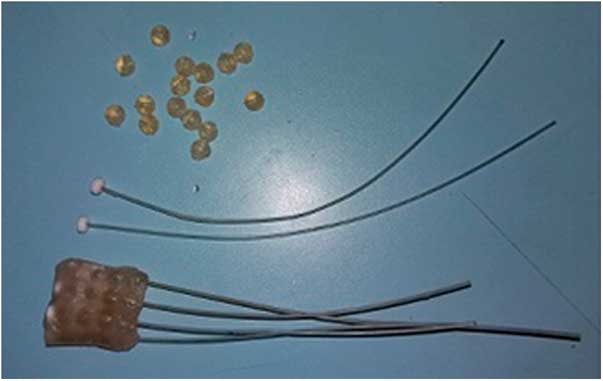
In the normal brachytherapy treatment procedure, BCC and SCC patients are mostly treated using specialised Valencia/Leipzig (Nucletron, an Elekta company; Elekta AB Stockholm, Stockholm, Sweden) surface applicators that come in various shapes and sizes. The maximum lesion site that these applicators can cover have diameters ranging between 20, 30 and 40 mm.Reference Graneo, Perez-Calytayud, Ballester and Ouhib 8 , Reference Delishaj, Laliscia and Manfredi 9 The limitation is that these applicators cannot cover sites outside their specified diameter. Patients who we treated for NMSC have lesions with dimensions of 7 cm in length and 2–3 cm in width. This specialised applicator could not cover such a large lesion in one treatment session. Thus, for its coverage, moulds were fabricated according to the patient’s lesion shape as shown in Figure 1. Planning target volume of the irradiated superficial area lesion does not have a depth >0·5 cm. Further, the dose gradient of the brachytherapy Ir192 source reduces by more than 10% per millimetre.Reference Tormo, Celada, Rodriguez, Botella and Ballesta 6 , Reference Lliso, Graneo, Perez-Caltayud, Carmoan, Pujades and Ballester 10 , Reference Lasota, Kabacinska and Makarewicz 11
Wax mould parts with one ready for patient application

MATERIALS AND METHODS
Moulds were prepared from wax mixed with acetylene in different shapes and sizes according to the lesion contour. Wax is poured on plastic beads with holes in the middle through which flexible implant plastic tubes are passed as shown in Figure 1. The size of the wax mould contour represents the size of actual lesion, called the active area of the dose. For a lesion of 7×2 cm, the mould is fabricated by pouring wax mixed with acetylene over seven beads that are passed through flexible implant tube and placed on lesion (previously covered with thin plastic sheet) while in soft form. As the mould cools down, it acquires the contour shape of the surface of the patient’s lesion area. Computerised treatment planning is performed using the Oncentra® (ELEKTA-Software Solutions) treatment planning system. Optimisation was carried out such that the superficial lesion surface receives 100% dose only in the contour of the active area by reshaping the virtual dose profile on the Oncentra® treatment planning system. In most cases, either one or two lesions per patient were treated at the same time with separate dose measurement carried out using Oncentra® treatment planning system. The length of the catheter from the remote after-loading system to the flexible implant plastic tube is 100 cm, whereas the length of the plastic tube can vary as required. The catheter attached with the flexi tube and wax mould is also included in the total length during Oncentra® treatment planning. The active length is measured only as the length from the wax mould in which the Ir192 source is attached to the wire that will deliver the dose to the lesion uniformly, according to parameters that are set in Oncentra® treatment planning software.
RESULTS
Patient’s treatment classification
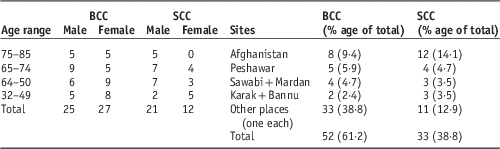
In total, 85 patients were treated both for SCC and BCC with Ir192 HDR brachytherapy. Patients were classified on the basis of age, gender and origin as summarised in Table 1. Out of 85 patients, 52 (61·18%) belong to the BCC group and 33 (38·82%) belong to the SCC group. Out of 52 BCC patients 25 were male and 27 were female, whereas in 33 SCC patients 21 were male and 12 were female. Further classification of patients shows that the maximum number were from the Afghanistan region with eight (9·4%) BCC and 12 (14·1%) SCC patients, followed by Peshawar region with five (5·9%) BCC and four (4·7%) SCC patients. Patients who were treated for NMSC are further classified on the basis of age group and are within the bandwidth of 32–85 years of age, and are not specially differentiated for treatment. In this group, most patients were within the range of 50–85 years of age.
Patients’ age, gender and place of origin

Abbreviations: BCC, basal cell carcinoma; SCC, squamous cell carcinoma.
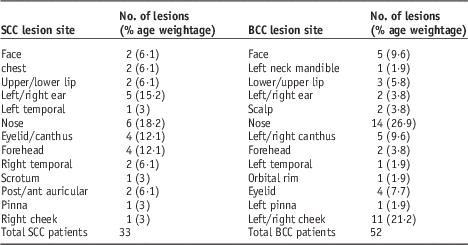
Table 2 shows the distribution of patients according to lesion sites. In this classification, 85 patients with both BCC and SCC were grouped together. In all, 52 BCC patients were treated on 13 different sites of the scalp, face and chest regions. In the facial region, the maximum number of lesions were further divided as follows: nose, 14 (26·9%); left/right cheek, 11 (21·2%); eyelid/left/right canthus combined, nine (17·3%); and face, five (9·6%). In the same group, 33 patients with SCC were treated on 13 different sites on facial region, in which major sites were as follows: nose, six (18·2%); left/right ear, five (15·2%); eyelid/canthus, four (12·1%); and forehead, four (12·1%).
Treatment sites

Abbreviations: BCC, basal cell carcinoma; SCC, squamous cell carcinoma.
DISCUSSION
IRNUM is at a geographical location near Afghanistan with the Federally Administered Tribal Area within a 30–40 km periphery. Here, NMSC are best managed by surgery or radiation therapy because they yield good results.Reference Delishaj, Laliscia and Manfredi 9 , Reference Kohler-Brock, Prager, Pohlmann and Kunze 12 , Reference Prakash and Srinivas 13 Suitable surgery is also a preferred option; however, it causes cosmetic problems like scars and is more expensive compared with radiation therapy. Patients of this area prefer radiotherapy over surgery because of the ease and cost effectiveness. Patients would not pay for expensive surgeries if there was an alternative treatment available in the form of radiotherapy. Radiotherapy gives excellent cosmetic results in NMSC lesions on sensitive anatomical sites like the face, lip and ear.Reference Alam, Nanda, Mittal, Kim and Yoo 14 Cosmetic results are recorded from each follow-up visit of a patient treated with HDR brachytherapy. These results are graded according to the National Cancer Institute, Common Terminology criteria of Adverse Events, Version 4.03. 15
Different modes of treatment are presented for comparison with our treatment method for NMSCs. Various researchers have applied different radiation dose schemes for the treatment of NMSCs. In our present study we applied 39 Gy in 13 fractions [biological effective doses (BED)50·7 Gy] for 5 days a week using custom-made wax moulds. For comparison of outcome efficacy with BED of dose regimens of different radiation schemes used by various researchers, calculation from the following equation is used:
 $${\rm BED}{\equals}{\rm nd}\left[ {1{\plus} {d \over {{\raise0.7ex\hbox{${ \alpha }$} \!\mathord{\left/ {\vphantom {{ \alpha } \beta }}\right.\kern-\nulldelimiterspace}\!\lower0.7ex\hbox{$\beta $}}}} } \right]$$
, where ‘nd’ is the total dose, ‘d’ the dose per fraction, ‘n’ the number of fractions and
 ${\alpha \over \beta }$
the property of irradiated tissue.Reference Delishaj, Laliscia and Manfredi
9
In the light of the above perspective, Durim Delishaj et al. applied two regimens of dose prescription to 57 lesions in a total of 39 patients. One group of 48 lesions was given 40 Gy in 8 fractions (BED60 Gy) and another group of nine lesions was given 50 Gy in 10 fractions (BED70 Gy) with a complete response of 96·25% and partial remission of 3·5%.Reference Delishaj, Laliscia and Manfredi 9 In superficial applicators, Kohler et al. used the Leipzig applicator and described the outcome of 520 lesions of NMSCs. They used a scheme of 30–40 Gy (BED48–56 Gy), and after 10 years of follow-up, local control was seen in 92% of cases.Reference Delishaj, Laliscia and Manfredi 9 , Reference Kohler-Brock, Prager, Pohlmann and Kunze 12 Alejandro Tormo et al. studied a group of 32 patients with 45 lesions of NMSC. In this study, lesions with 3–4 mm deep margins were treated with a prescribed dose of 42 Gy in 6 fractions at 2 fractions per week (BED70 Gy). The success rate was 98%.Reference Tormo, Celada, Rodriguez, Botella and Ballesta 6 , 15 Ajay Bhatnagar et al. treated 122 patients using HDR electron beam radiotherapy with a maximum interval of 48 hours between 2 fractions. They reported a 5-year local control rate of 98%.Reference Bhatnagar 16 Ruth Gauden et al. treated 200 patients with a prescription of 36 Gy in 12 fractions (BED47 Gy). The coverage rate ranged from 87 to 100%.Reference Gauden, Pracy, Avery, Hodgetts and Gauden 17
In the present study, we observed only one recurrence in SCC patients, whereas in BCC patients no recurrence was observed. The single recurrence reported by an SCC patient was with a complaint of a lesion near the primary site. The patient had not followed the doctor’s advice for undergoing routine check-up.
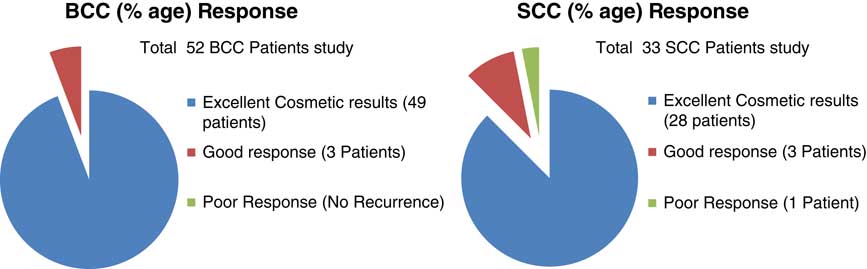
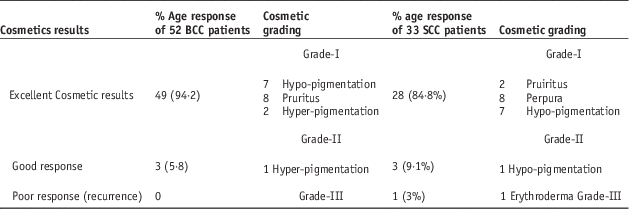
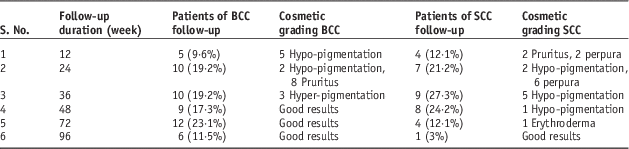
The patients were followed up on each visit to the hospital. The follow-up record is maintained for up to 2 years—that is, for a maximum of 96 weeks. As shown in Table 3, out of 52 BCC patients, 49 (94·2%) showed excellent cosmetic results. The Grade-I reactions experienced by these patients are hypo-pigmentation, pruritus and hyper-pigmentation observed in seven, eight and two patients, respectively. The remaining three (5·8%) patients showed good response with one patient experiencing Grade-II reaction related to hyper-pigmentation. No recurrence was recorded in BCC patients. In 33 SCC patients treated, 28 (84·8%) showed excellent cosmetic results. Grade-I reaction of pruiritus, perpura and hypo-pigmentation was observed in two, eight and seven patients, respectively. In all, three patients showed good response to treatment, of whom only one patient experienced a Grade-II reaction of hypo-pigmentation. Only one tumour recurrence was experienced in an SCC-treated patient near the primary site. This patient developed a Grade-III erythroderma reaction to treatment. The different reactions recorded on the routine visit of patients to the hospital are tabulated in Table 4. These specific types of reaction to treatment are observed on their scheduled follow-up visit to the doctor on a weekly basis. In the 12th week of follow-up, five BCC (9·6%) and four SCC (12·1%) patients showed the texture of the lesion site corresponding to a Grade-I reaction. On the 24th week of follow-up, ten BCC (19·2%) and seven SCC (21·2%) patients’ consultant advice was recorded. Maximum reactions were recorded in the first 36 weeks’ routine check-up, after which no reaction at any level of skin grading scale was registered. A single patient’s result was not up to the mark and is presented graphically in Figure 2. In recurrence-free cases, no patient experienced reactions of Grade-III and above. From all these results, we could confidently state that, comparatively, our dose regimen of 39 Gy in 13 fractions gives promising results. In patients treated for SCC, the result indicates 94·2% outcome efficiency, whereas for five·8% patients, the results were moderate. Outcome efficiency indicated excellent cosmetic results in 84·8% of BCC-treated patients, whereas nine·1% of patients have moderately good results. Overall results indicate 98·8% efficacy as shown in Figure 2. This result clearly signifies that our dose regimen and treatment procedure are quite good in comparison to other regimens that are discussed. In brachytherapy, the dose is more localised and targeted. In addition, organs at risk are completely spared during treatment of facial lesion sites like the eyelid, canthus and tip of the nose, etc. Elderly or weak patients are quite at ease with our treatment procedures because of the small treatment time of 10–15 minutes. Further, the treatment is well tolerated in all age groups of patients.
Total patients (BCC & SCC) response with cosmetic results outcome

Patient’s curative results on cosmetic grading

Abbreviations: BCC, basal cell carcinoma; SCC, squamous cell carcinoma.
Patients follow-up

Abbreviations: BCC, basal cell carcinoma; SCC, squamous cell carcinoma.
CONCLUSION
Superficial HDR brachytherapy is one of the safe and excellent modes of treatment for BCC and SCC on sensitive facial regions in comparison to EBRT low-energy X-rays as an extra dose to sensitive regions is avoided. HDR brachytherapy is a good alternative to a surgical procedure in NMSC patients. Good cosmetic results and patient confidence are the favourable outcomes from this procedure.
Acknowledgements
The authors acknowledge all staff members and supporting staff of the radiotherapy department of IRNUM cancer hospital, Peshawar, for permission to collect data from patients. The treatment was made possible only through the patients’ will and consent.
Financial support
No grant and funding were received for this research from any agency, either commercial or a non-profit organisation.
Conflicts of Interest
None.